India Aluminium Fenestration Market Growth Through 2032
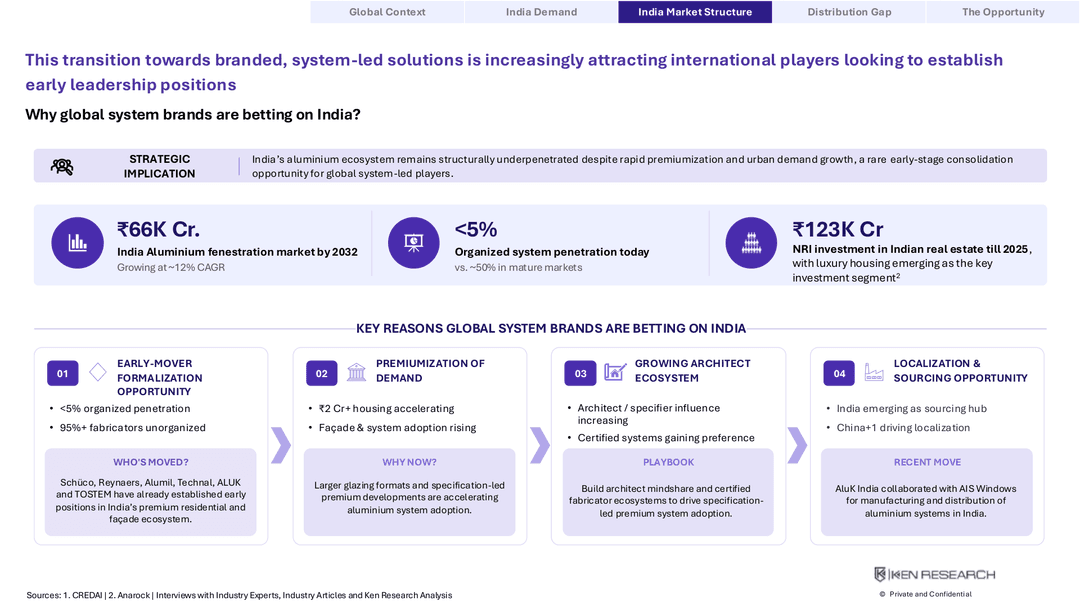
India’s Aluminium Fenestration Opportunity Is No Longer a Demand Question
A Ken Research POV on why fabricator enablement, specification influence and localized execution will determine who captures the market’s next growth wave
India’s aluminium fenestration market is entering a structural expansion cycle.
A Ken Research POV on why fabricator enablement, specification influence and localized execution will determine who captures the market’s next growth wave
India’s aluminium fenestration market is entering a structural expansion cycle.
Premium housing, Grade-A offices, organized retail and high-rise construction areincreasing demand for aluminium windows, doorsand façade systems. Aluminium is also moving beyond its earlier premium niche as developers and homeowners place greater value on slim profiles, large glazing formats, durability, thermal performance and integrated building systems.
But visible demand does not automatically translate into scalable growth for system brands.
India’s fabrication ecosystem remains fragmented, quality standards vary significantly, and the conventional dealer-led distribution model has struggled to create sufficient technical capability, specification influence or installation accountability.
The next phase of competition will therefore not be determined only by who offers the strongest aluminium profile.
It will be determined by who can orchestrate the ecosystem around it.
Ken Research’s POV examines how aluminium fenestration is shifting from a profile-driven category toward a system-led market, and why fabricator enablement could become the defining competitive advantage for brands seeking national scale. The deck’s central thesis is that long-term leadership will depend on trusted partner ecosystems, stronger specification influence and repeatable execution across local markets.
Can aluminium system brands convert India’s construction demand into a scalable and quality-assured delivery model?
The underlying demand case is becoming increasingly clear.
Aluminium is gaining relevance across premium residential, commercial and high-rise developments because it supports larger formats, slimmer profiles, greater durability and more sophisticated façade applications.
The more difficult question sits beyond product demand.
India has thousands of fabricators operating with different levels of technical capability, equipment, sales orientation and installation quality. Demand may be generated through architects, developers and homeowners, but final customer experience is frequently determined at the fabrication and installation stage.
This creates a strategic disconnect:
The brand may win the specification, but the fabricator determines whether the promise is delivered.
The market’s next leaders will therefore need to solve three problems simultaneously:
Generate demand through architects, developers and premium homeowners
Build sufficient local fabrication capacity to serve that demand
Maintain product and installation standards across a decentralized network
The opportunity is not simply to distribute more aluminium systems.
It is to create a repeatable operating model that converts a fragmented installer base into a reliable specification, fabrication and sales engine.
Demand Is Moving Toward Aluminium-Led Applications
Premiumization is changing both the material mix and the basis of competition
Commercial offices, organized malls and high-rise buildings place even greater emphasis on façade performance, design flexibility, fire and wind considerations, and compatibility with larger building systems.
The market is therefore moving from an affordability-led purchasing logic toward a performance- and specification-led logic.
This transition creates stronger opportunities for system brands because buyers are no longer evaluating only the cost of a basic window or door. They are evaluating design, engineering, fabrication quality, installation reliability and lifecycle performance.
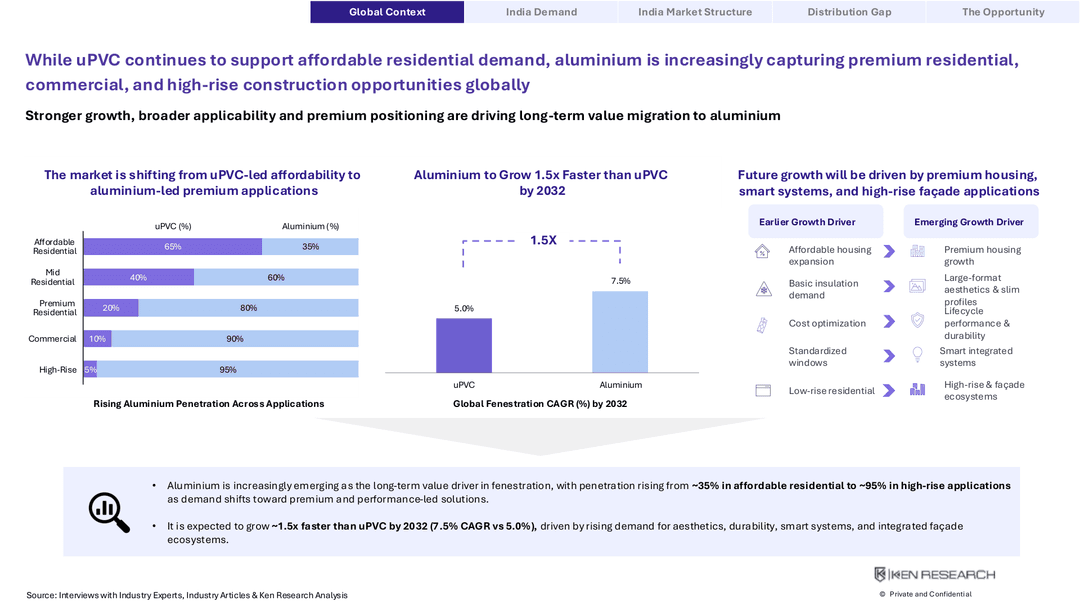
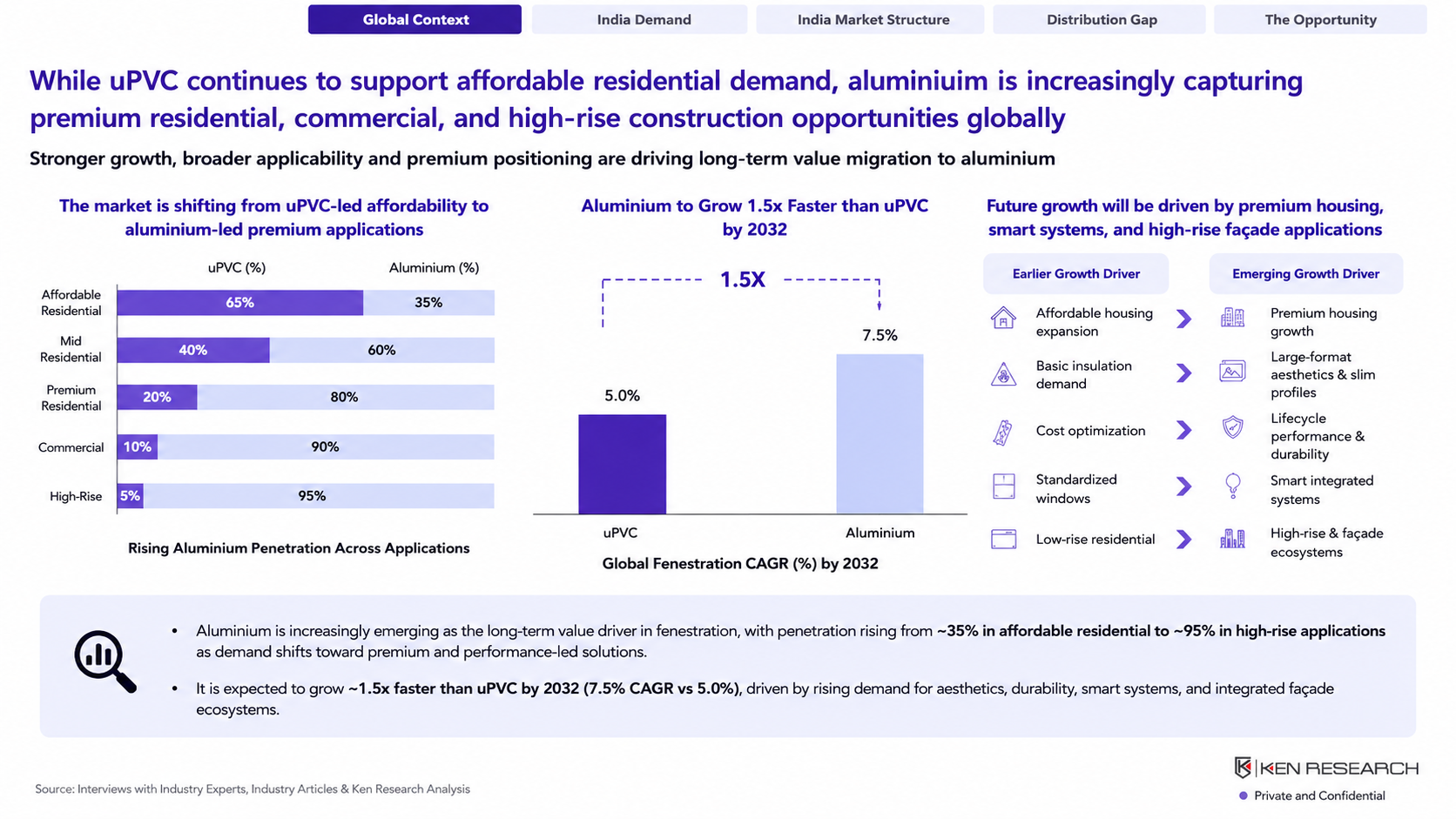
The deck estimates aluminium fenestration will grow faster than uPVC through 2032, supported by premium housing, smart systems and high-rise façade applications.
The Opportunity Is Concentrated, Not Uniform
Premium housing and commercial construction are creating identifiable demand corridors
India’s fenestration opportunity is not spread evenly across all housing units or cities.
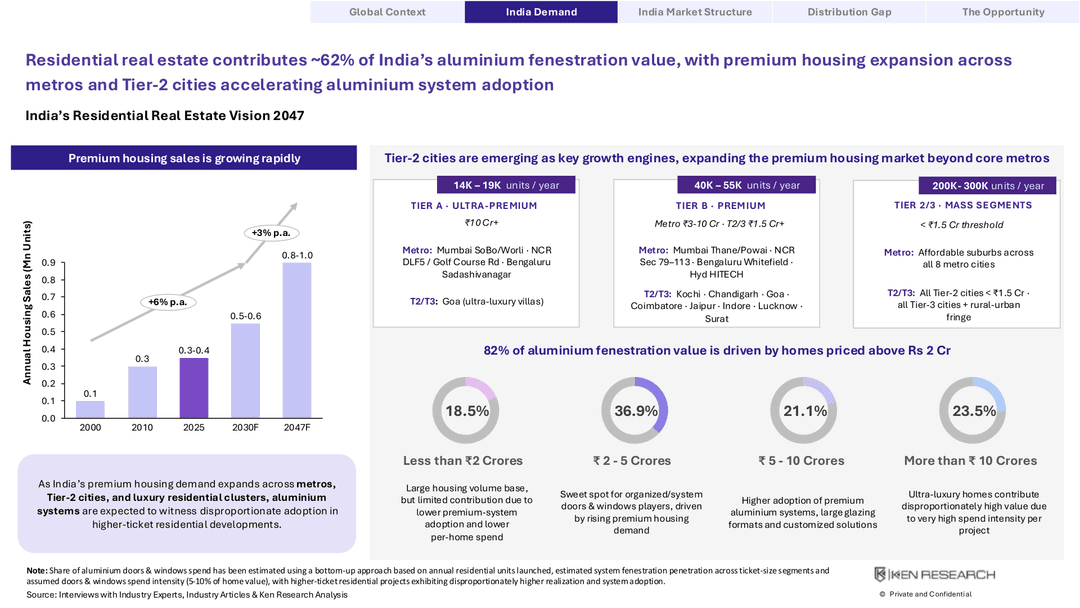
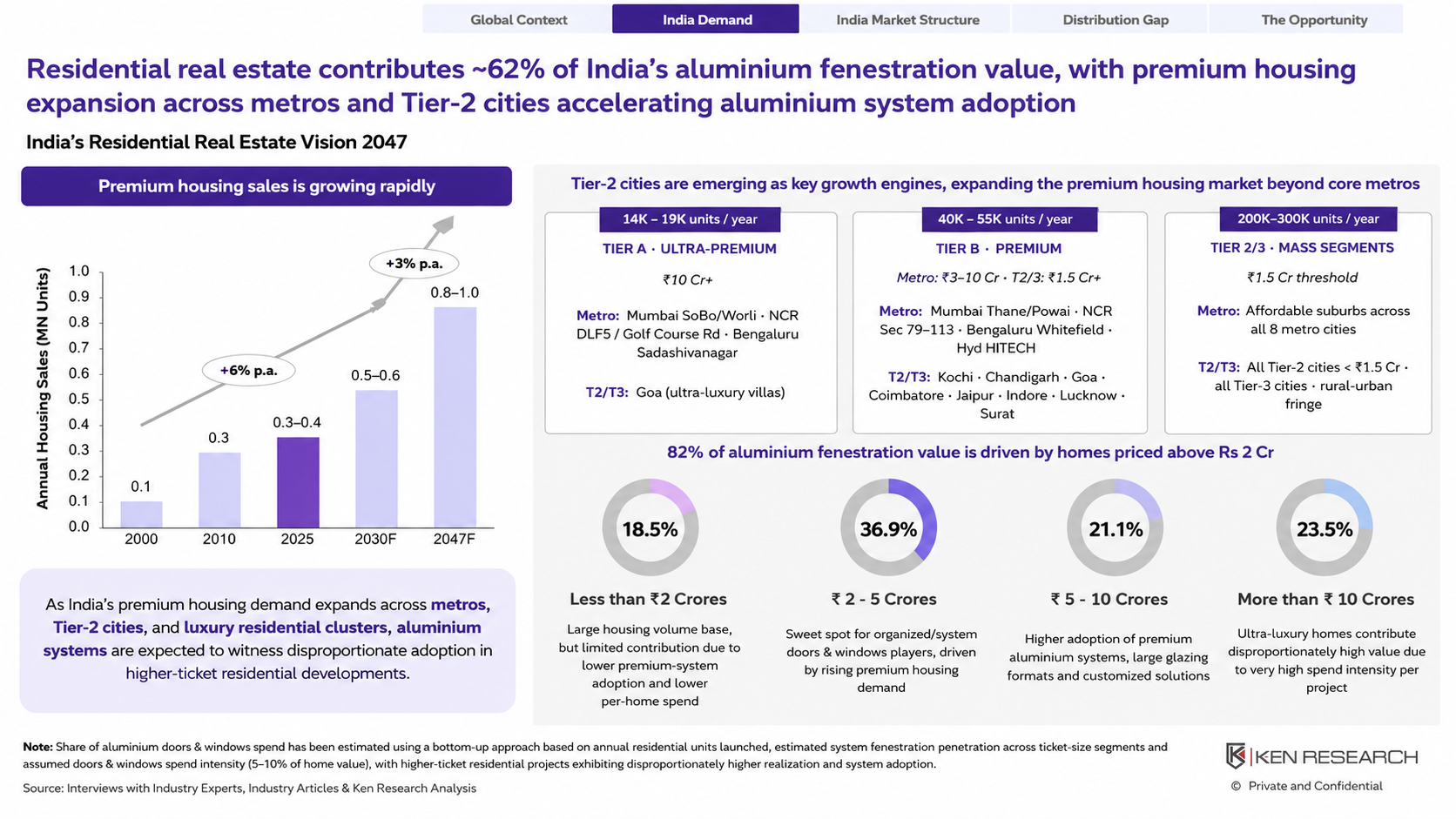
Residential value is disproportionately concentrated in higher-ticket properties, where customers spend more on larger openings, premium systems, customization and aesthetic differentiation. Homes priced above ₹2 crore represent a particularly important opportunity for organized aluminium-system players.
The premium housing opportunity is also expanding beyond the traditional metropolitan core. Tier-2 cities are creating new luxury, villa and premium-apartment clusters, broadening the number of commercially relevant markets.
Commercial demand follows a similarly concentrated pattern.
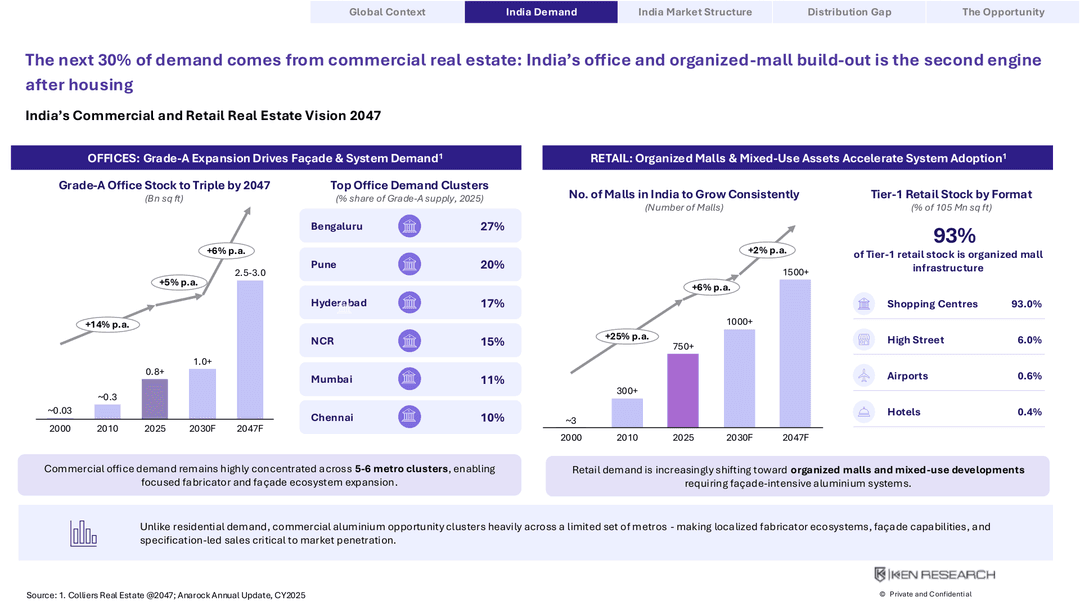
Grade-A offices and organized retail developments are clustered across a limited number of metropolitan corridors. This concentration creates an opportunity for system brands to prioritize architect relationships, fabrication capacity and project coverage in a focused set of cities rather than attempting indiscriminate national expansion.
The commercial implication is significant:
India is geographically large, but the premium aluminium opportunity can be addressed through a defined portfolio of high-value construction clusters.
Residential real estatecontributes the majority of aluminium-fenestration value, while higher-ticket homes account for a disproportionate share of system adoption and spend. Commercial offices and organized malls form the second major engine, with demand concentrated across a limited number of metro clusters.
Aluminium fenestration is projected to grow 1.5 times faster than uPVC by 2032, with penetration rising from about 35% in affordable housing to 95% in high-rise applications
Market Growth Has Outpaced the Delivery Ecosystem
India has demand density, but not yet a standardized execution network
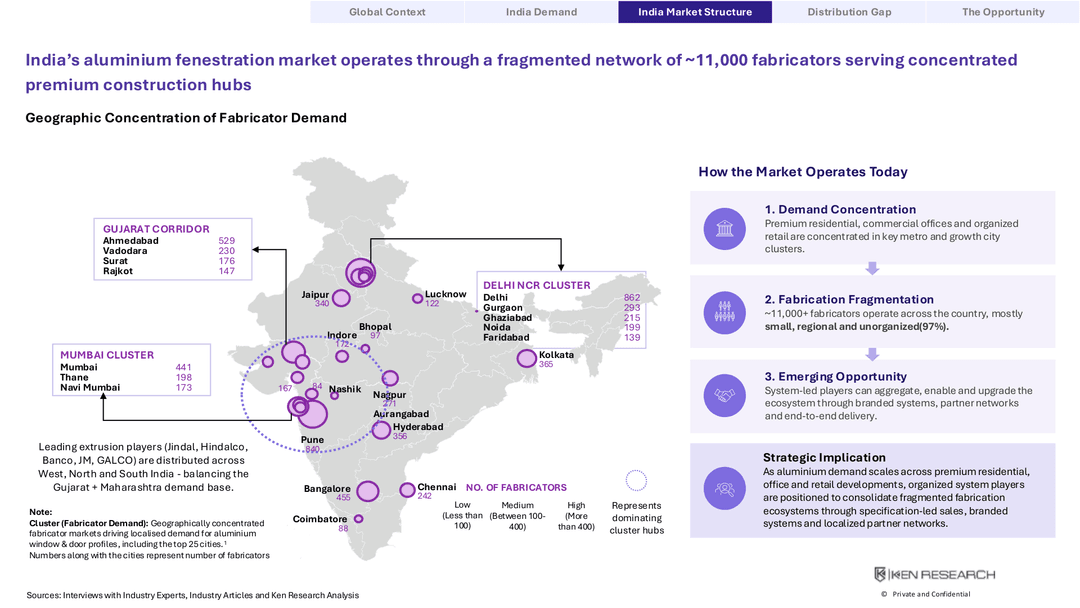
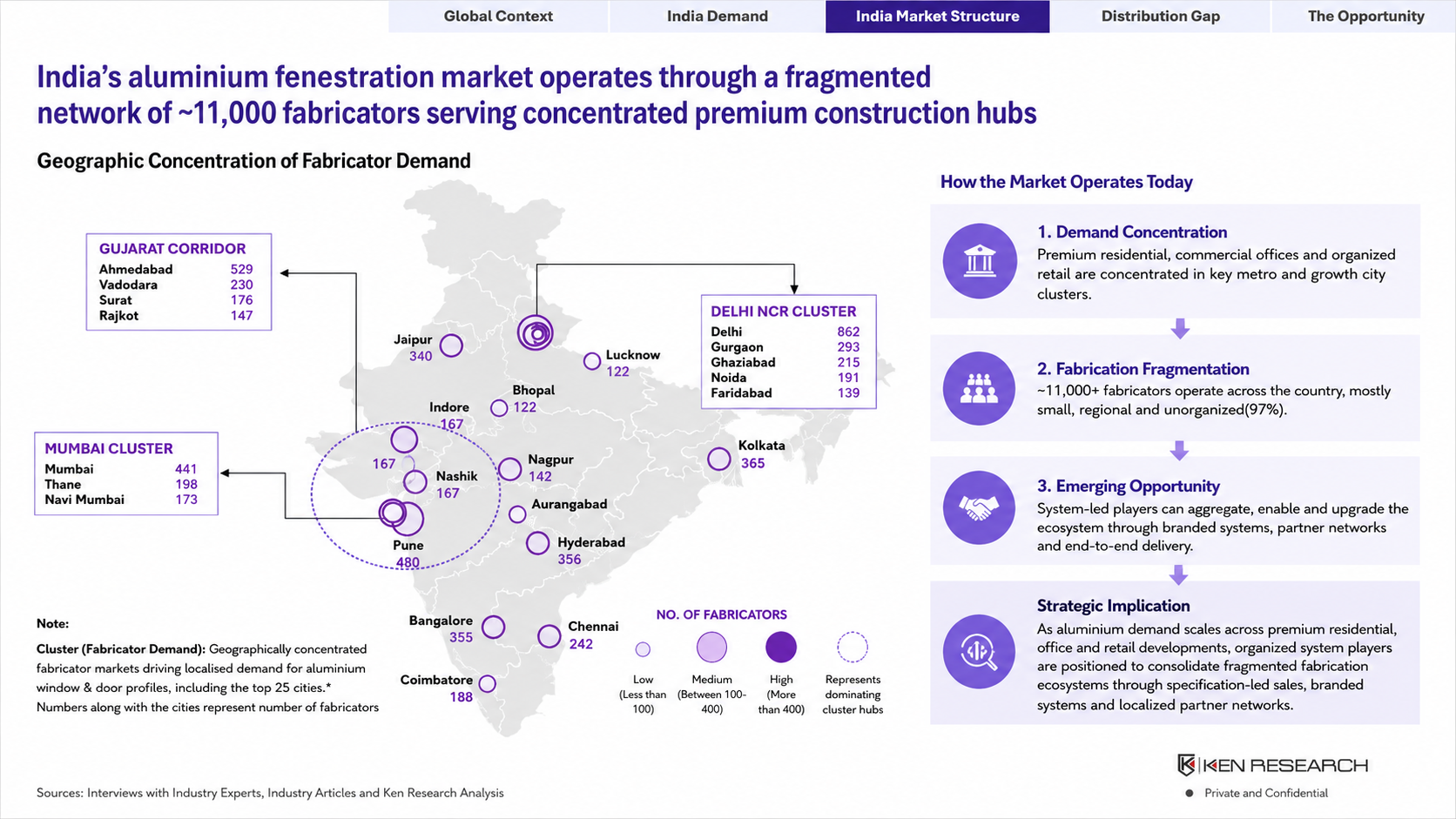
India’s aluminium-fenestration market operates through an estimated network of more than 11,000 fabricators.
This provides significant local manufacturing and installation reach, but it also creates structural complexity.
The majority of these fabricators are:
Small and regionally focused
Execution oriented rather than sales led
Uneven in equipment and technical capability
Weakly connected to architects and developers
Inconsistently trained in premium-system installation
Limited in their ability to build sub-networks
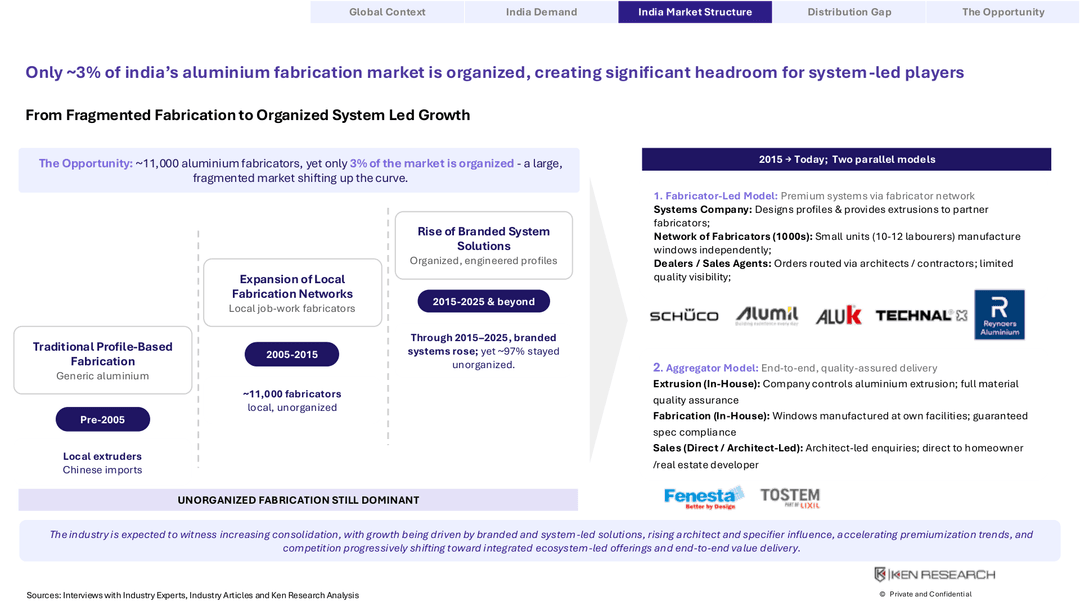
Only a small portion of the market operates within organized, branded or system-led structures.
This means the market is not constrained only by the availability of aluminium profiles. It is constrained by the ability to convert profiles into consistently manufactured and properly installed systems.
The system brand’s competitive challenge is therefore downstream.
A company may invest in product design, extrusion quality, marketing and architect relationships, but the customer experience can still fail because of:
Incorrect measurement
Poor fabrication
Inconsistent hardware integration
Installation defects
Weak project supervision
Limited post-installation accountability
India’s market is characterized by concentrated demand hubs but a fragmented fabrication base of approximately 11,000 participants, with the large majority remaining unorganized.
The Conventional Dealer Model Is Not Solving the Execution Gap
An intermediary cannot substitute for fabrication capability and accountability
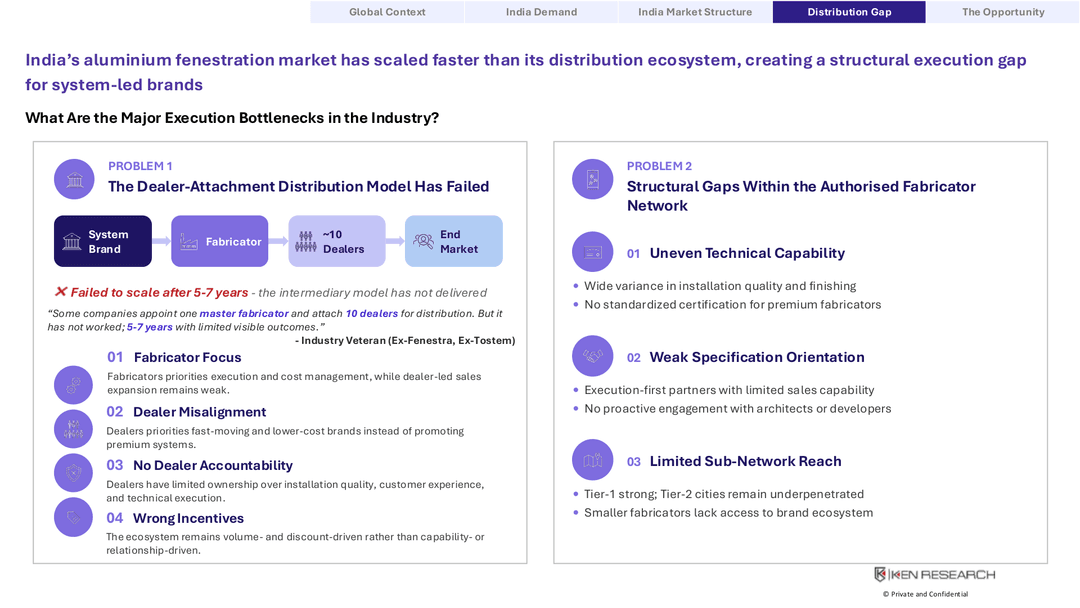
Several system brands have attempted to scale through a dealer-attached model in which an authorized fabricator is supported by a network of dealers responsible for expanding local sales.
The logic appears attractive:
The brand supplies the system
The fabricator manufactures and installs
Dealers create broader market coverage
In practice, the model often produces misaligned incentives.
Dealers tend to prioritize products that move quickly and compete well on price. They may have limited motivation to explain premium systems, influence specifications or take responsibility for installation quality.
Fabricators, meanwhile, remain focused on managing production, labour and project delivery. They are rarely equipped to supervise a distributed sales network while also maintaining fabrication standards.
The result is a gap between commercial reach and execution accountability.
The fundamental issue is not simply insufficient dealer numbers.
It is that the party influencing the sale is often separated from the party responsible for measurement, fabrication, installation and customer outcomes.
The deck identifies both dealer misalignment and uneven authorized-fabricator capability as major barriers to scale.
The Winning Model Could Be Fabricator-Led, Not Dealer-Led
System brands can build growth by turning fabricators into local specification and execution partners
Fabricators occupy a uniquely influential position in the purchasing journey.
They understand site conditions, translate designs into manufacturable systems, guide product selection, estimate project economics and ultimately install the product.
In many smaller markets, the fabricator may have more influence over the final brand selection than a distant dealer or system company.
This creates an opportunity to redesign the channel model around the fabricator.
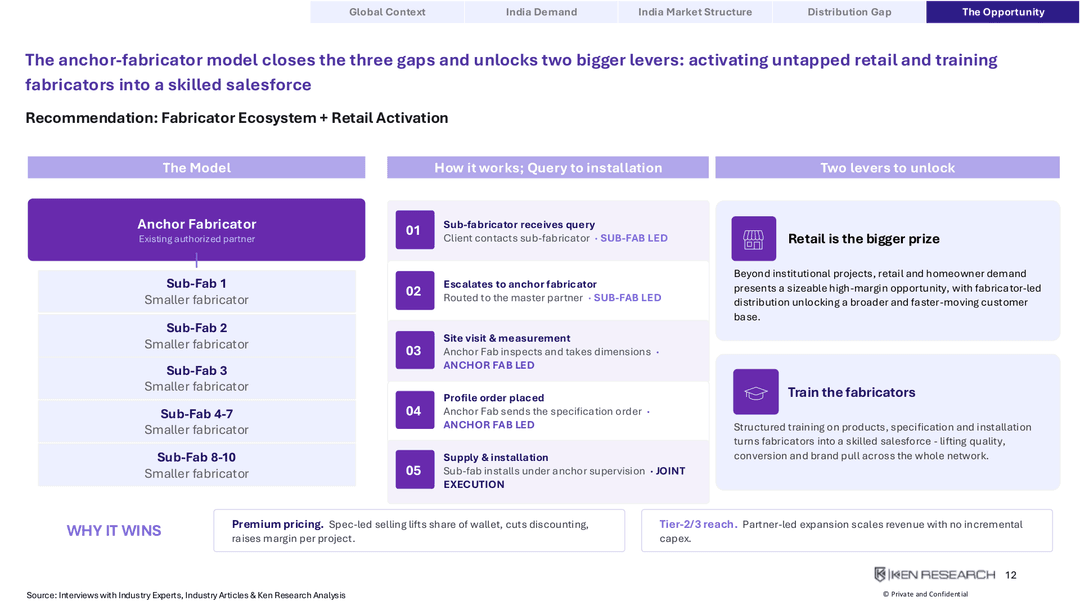
A stronger ecosystem could combine:
Anchor fabricators
Established partners with technical capability, machinery, project-management expertise and brand authorization.
Sub-fabricators
Smaller local businesses that provide customer access, local relationships and installation capacity.
Central brand enablement
Training, certification, tools, software, specification support, quality audits and architect engagement provided by the system brand.
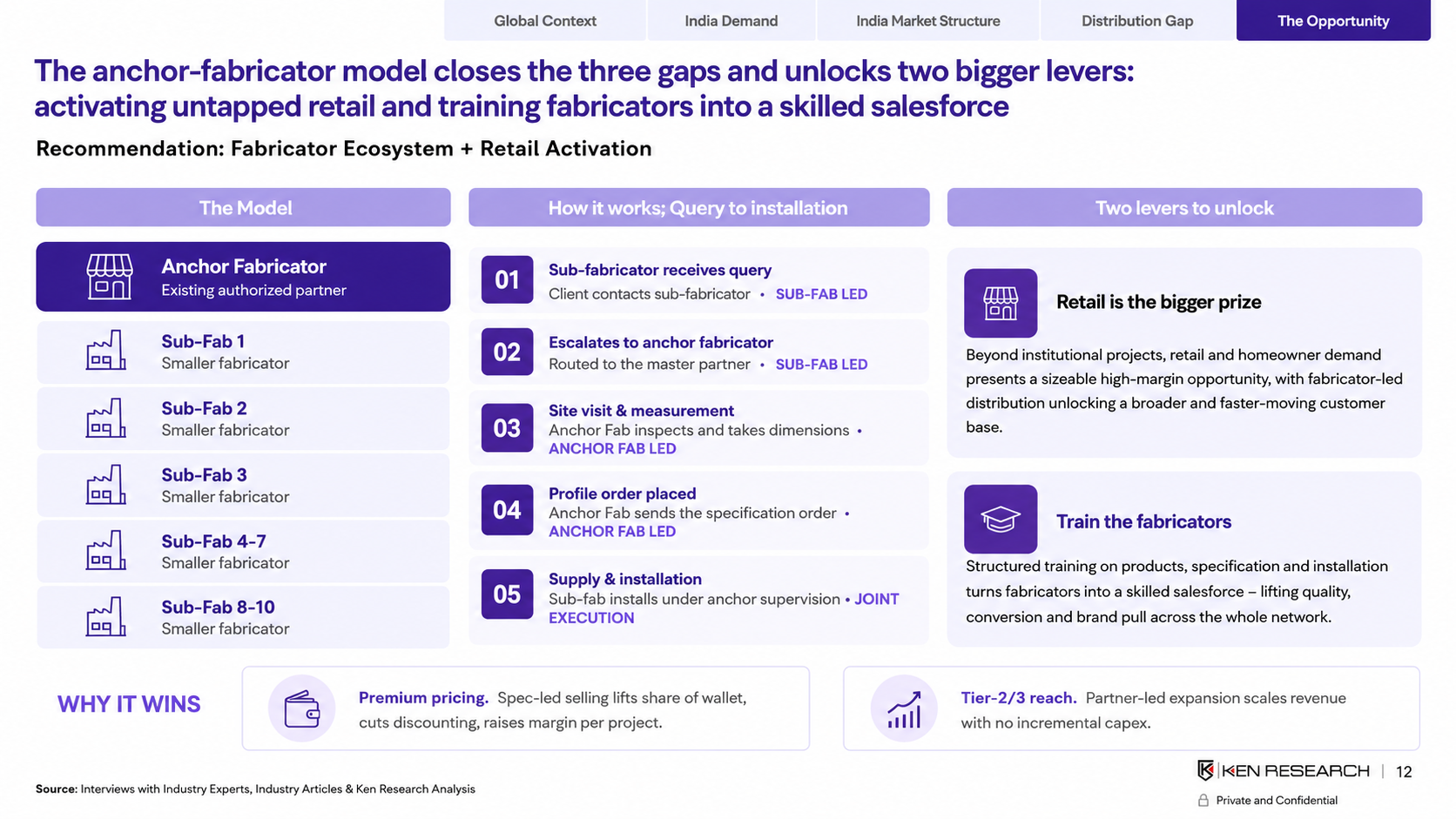
Under this model, smaller partners generate and manage local opportunities, while anchor fabricators provide measurement, engineering, profile ordering, technical supervision and quality assurance.
The structure can extend market reach without requiring every partner to make a large investment in machinery or technical teams.
It also gives the brand a clearer mechanism for controlling standards.
The deck proposes an anchor-fabricator structure in which smaller fabricators provide local reach while established partners supervise measurement, specification, supply and installation quality.
India’s aluminium fenestration market is supported by approximately 11,000 fabricators, with demand concentrated across major premium construction hubs.
Fabricator Enablement Can Become the New Distribution Advantage
The next competitive moat may be capability, not channel count
The value of a fabricator ecosystem will not come merely from appointing more partners.
It will depend on whether the brand can improve what those partners are capable of doing.
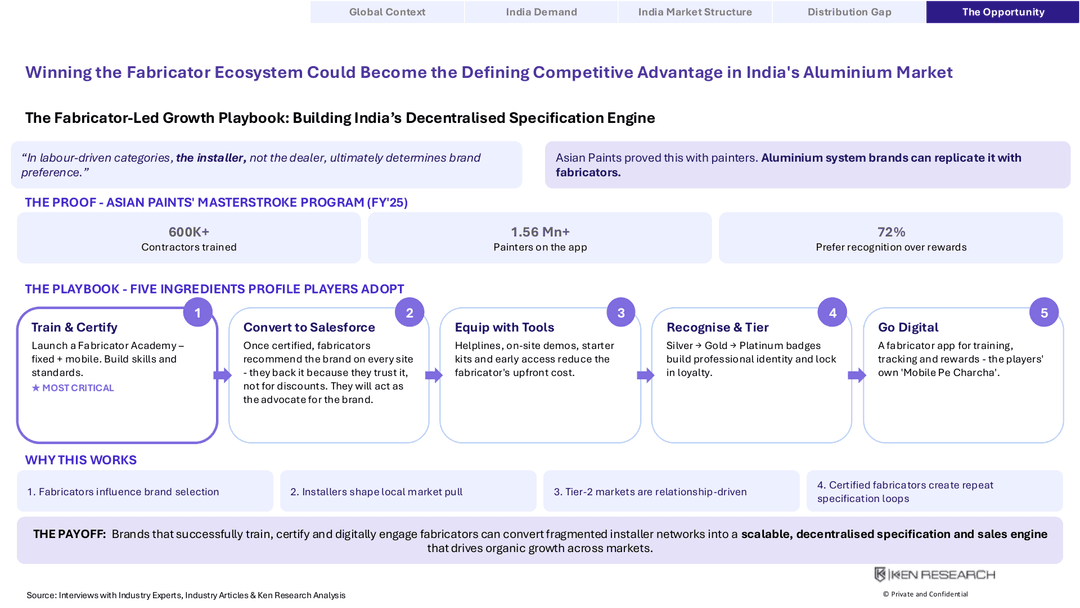
A scalable enablement model requires five connected elements.
Train and certify
Fabricators need structured education on product systems, measurement, fabrication, installation and specification requirements.
Certification should indicate proven capability, not simply commercial affiliation.
Convert fabricators into a salesforce
A technically confident fabricator can recommend the brand at the point of decision and explain why one system performs better than another.
This creates specification influence at the local-market level.
Provide tools and technical support
On-site demonstrations, helplines, starter kits, digital configurators and project support reduce barriers to adopting more sophisticated systems.
Recognize and tier the network
Capability-based tiers can create professional identity, reward progression and distinguish trained partners from generic fabricators.
Digitize partner engagement
A dedicated platform can manage training, certification, project leads, technical queries, rewards and performance visibility.
Together, these initiatives can turn a fragmented installer network into a decentralized specification engine.
The deck argues that brands capable of training, certifying and digitally engaging fabricators can create repeat specification loops and build organic market pull.
The Central Takeaway
India’s aluminium-fenestration market is not constrained by demand visibility.
It is constrained by the ability to organize and upgrade the ecosystem that converts demand into installed systems.
The long-term winners are unlikely to be determined only by:
Extrusion capacity
Product range
Dealer footprint
Imported system technology
They will be determined by the ability to combine:
Architect and developer influence
Localized demand-cluster coverage
Certified fabricator capacity
Consistent installation standards
Digital partner engagement
End-to-end accountability
India’s aluminium growth wave will be captured by the companies that build the strongest execution ecosystem around the product, not merely the strongest product portfolio.