About the Report
Base Year 2024Qatar ADHD Autism Clinics Market Overview
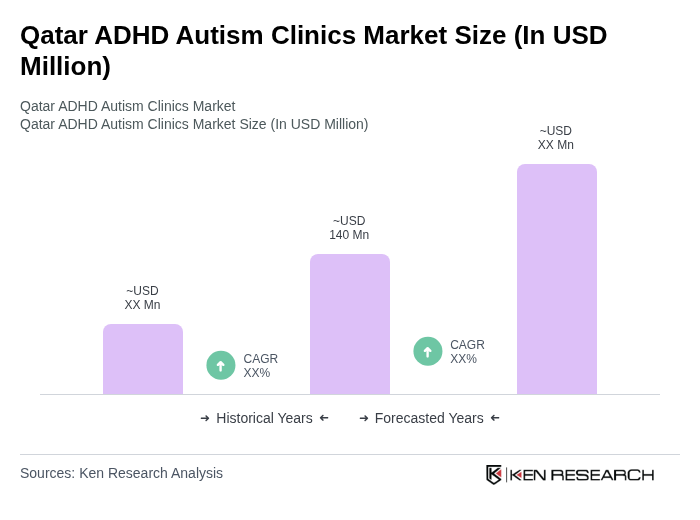
- The Qatar ADHD Autism Clinics Market is valued at USD 140 million, based on a five-year historical analysis of regional spending on ADHD and autism-related diagnostics, therapies, and outpatient services and its proportion within the broader Middle East and Africa ADHD/autism therapeutics and services market. This growth is primarily driven by increasing awareness of neurodevelopmental disorders, enhanced diagnostic capabilities, and a growing demand for specialized therapeutic services, supported by rapid expansion of Qatar’s healthcare sector. The rising prevalence and recognition of ADHD and Autism Spectrum Disorder (ASD) among children, along with improved screening programs in schools and pediatric services, has further fueled the need for comprehensive care and support services.
- Key cities such as Doha and Al Rayyan dominate the market due to their advanced healthcare infrastructure, availability of specialized clinics, and a higher concentration of healthcare professionals. The presence of leading medical institutions such as Hamad Medical Corporation, Sidra Medicine, and specialist rehabilitation and autism centers, alongside strong public investment in tertiary care, also contributes to the market's growth in these regions, making them focal points for ADHD and autism care.
- In 2023, the Qatari government implemented a national strategy aimed at improving mental health services, including those for ADHD and autism, under the National Mental Health Strategy and its subsequent updates led by the Ministry of Public Health and Hamad Medical Corporation. This initiative includes funding for training healthcare professionals, expanding multidisciplinary child and adolescent mental health services, and increasing public awareness about neurodevelopmental disorders, thereby enhancing access to necessary services and support for affected families.
Qatar ADHD Autism Clinics Market Segmentation
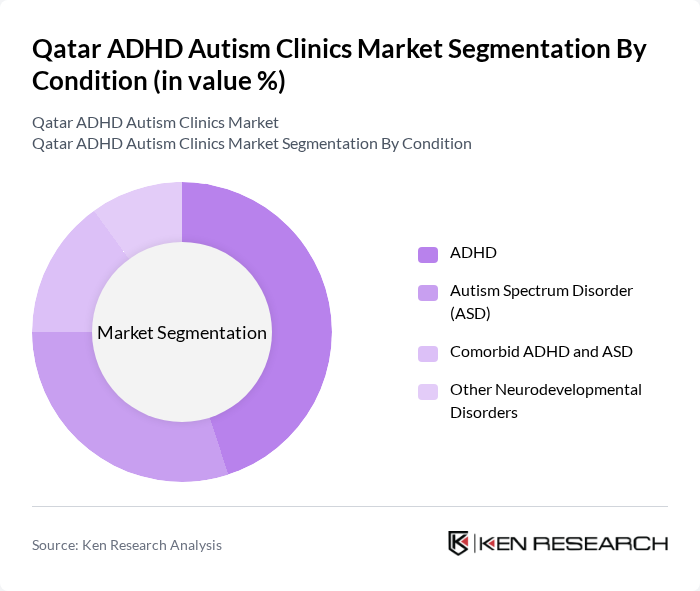
By Condition:The market is segmented into various conditions, including ADHD, Autism Spectrum Disorder (ASD), Comorbid ADHD and ASD, and Other Neurodevelopmental Disorders. Among these, ADHD is the most frequently managed condition in many outpatient mental health and pediatric settings across the Middle East and Africa region, driven by increased awareness, school-based referrals, and higher diagnosis rates. Autism Spectrum Disorder (ASD) follows closely, with a growing number of children being diagnosed and referred to specialized ASD assessment clinics and multidisciplinary services in Qatar. The rising recognition of comorbid conditions, where ADHD and ASD co-occur along with learning or speech and language disorders, has also led to a significant demand for integrated treatment approaches that combine medical, behavioral, and educational interventions.
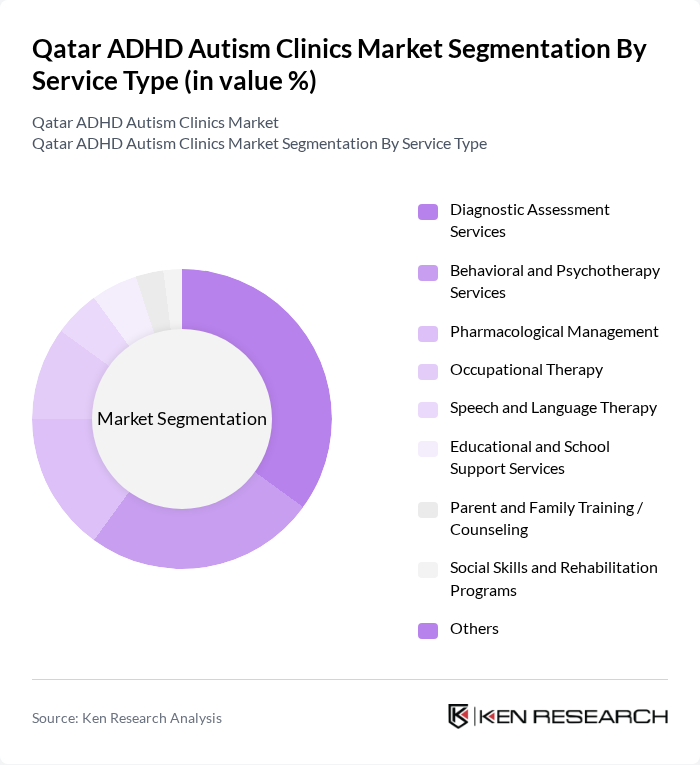
By Service Type:The service type segmentation includes Diagnostic Assessment Services, Behavioral and Psychotherapy Services, Pharmacological Management, Occupational Therapy, Speech and Language Therapy, Educational and School Support Services, Parent and Family Training/Counseling, Social Skills and Rehabilitation Programs, and Others. Diagnostic Assessment Services are leading the market due to the critical need for accurate diagnosis and early intervention, supported by the establishment of specialized ASD assessment clinics and structured multidisciplinary evaluation pathways in Qatar’s child and adolescent mental health services. Behavioral and Psychotherapy Services are the next major segment, as evidence-based behavioral interventions, psychoeducation, and family-focused therapies are essential for managing symptoms and improving quality of life. Demand is also increasing for Occupational Therapy and Speech and Language Therapy, which are integral to comprehensive management of ASD and other neurodevelopmental disorders in Qatar’s specialized centers and rehabilitation institutes.
Qatar ADHD Autism Clinics Market Competitive Landscape
The Qatar ADHD Autism Clinics Market is characterized by a dynamic mix of regional and international players. Leading participants such as Hamad Medical Corporation, Sidra Medicine, Al-Ahli Hospital, Doha Clinic Hospital, Al Wakra Hospital, Al Emadi Hospital, The Children’s Rehabilitation Center, Qatar Rehabilitation Institute, Naufar Center, Rumailah Hospital, Renad Academy (Qatar Foundation), Qatar Autism Center and Special Needs, Shafallah Center for Persons with Disabilities, Qatar Institute for Speech and Hearing, Sidra Child and Adolescent Mental Health Services (CAMHS) Clinics, Selected Private Pediatric and Neurodevelopment Clinics in Doha contribute to innovation, geographic expansion, and service delivery in this space.
Qatar ADHD Autism Clinics Market Industry Analysis
Growth Drivers
- Increasing Awareness of ADHD and Autism:The awareness of ADHD and autism in Qatar has significantly increased, with over 60% of parents now recognizing the symptoms and seeking professional help. This rise in awareness is supported by government campaigns and educational programs, which have led to a reported 30% increase in clinic visits for diagnosis and treatment. The Qatar National Health Strategy emphasizes mental health, further driving public interest and engagement in these conditions.
- Rising Demand for Specialized Healthcare Services:The demand for specialized healthcare services for ADHD and autism has surged, with a reported 25% increase in the number of clinics offering tailored services in the last two years. This growth is driven by a growing population, which reached approximately 2.8 million in the future, and an increasing number of diagnosed cases, estimated at 1 in 20 children. The healthcare sector is responding with more resources and specialized training for professionals.
- Government Initiatives and Funding:The Qatari government has allocated approximately QAR 500 million (USD 137 million) for mental health initiatives in the future, focusing on ADHD and autism. This funding supports the establishment of new clinics and the enhancement of existing facilities. Additionally, the government is promoting public-private partnerships to improve service delivery, which is expected to increase access to specialized care for families across the country.
Market Challenges
- Limited Access to Specialized Care:Access to specialized care remains a significant challenge, particularly in rural areas of Qatar. Approximately 40% of families report difficulties in reaching clinics, with many located in urban centers. This geographical disparity limits treatment options for children with ADHD and autism, exacerbating the issue of late diagnosis and intervention, which is critical for effective management of these conditions.
- Stigma Associated with Mental Health:Stigma surrounding mental health issues continues to hinder families from seeking help. A survey indicated that 35% of parents feel societal pressure and fear judgment, which prevents them from pursuing necessary treatment for their children. This stigma can lead to delayed diagnoses and inadequate support, ultimately affecting the overall well-being of children with ADHD and autism in Qatar.
Qatar ADHD Autism Clinics Market Future Outlook
The future of the Qatar ADHD and autism clinics market appears promising, driven by increasing government support and a growing emphasis on mental health. The integration of technology in treatment methods, such as telehealth services, is expected to enhance accessibility and efficiency. Additionally, the focus on early diagnosis and intervention will likely lead to improved outcomes for children, fostering a more supportive environment for families navigating these challenges.
Market Opportunities
- Expansion of Telehealth Services:The expansion of telehealth services presents a significant opportunity for ADHD and autism clinics in Qatar. With over 99% of households having internet access, telehealth can bridge the gap for families in remote areas, providing timely consultations and follow-ups, thereby improving treatment adherence and outcomes.
- Development of New Treatment Modalities:There is a growing opportunity for the development of new treatment modalities tailored to the unique needs of children with ADHD and autism. Research funding has increased by 20% in the future, encouraging innovation in therapeutic approaches, including behavioral therapies and pharmacological advancements, which can enhance the effectiveness of existing treatment protocols.
Scope of the Report
| Segment | Sub-Segments |
|---|---|
| By Condition | ADHD Autism Spectrum Disorder (ASD) Comorbid ADHD and ASD Other Neurodevelopmental Disorders |
| By Service Type | Diagnostic Assessment Services Behavioral and Psychotherapy Services Pharmacological Management Occupational Therapy Speech and Language Therapy Educational and School Support Services Parent and Family Training / Counseling Social Skills and Rehabilitation Programs Others |
| By Care Setting | Public Hospitals and Government Clinics Private Hospitals and Specialty Clinics Community and Non-Profit Centers School- and University-Based Clinics Home- and Community-Based Services Others |
| By Mode of Delivery | In-Person / On-Site Services Telehealth / Virtual Care Hybrid (In-Person + Telehealth) Digital Therapeutics and Remote Monitoring Others |
| By Age Group | Early Childhood (0–5 Years) School-Age Children (6–12 Years) Adolescents (13–17 Years) Adults (18+ Years) Geriatric Patients Others |
| By Payer Type | Government-Funded Schemes Private Health Insurance Self-Pay / Out-of-Pocket Employer-Sponsored Plans Others |
| By Geography (Within Qatar) | Doha Municipality Al Rayyan Al Wakrah Al Khor and Al Thakhira Al Daayen and Umm Salal Al Shamal and Others |
Key Target Audience
Investors and Venture Capitalist Firms
Government and Regulatory Bodies (e.g., Ministry of Public Health, Qatar National Health Authority)
Healthcare Providers and Clinics
Pharmaceutical Companies
Medical Equipment Suppliers
Insurance Companies
Non-Governmental Organizations (NGOs) focused on mental health
Health Technology Startups
Players Mentioned in the Report:
Hamad Medical Corporation
Sidra Medicine
Al-Ahli Hospital
Doha Clinic Hospital
Al Wakra Hospital
Al Emadi Hospital
The Childrens Rehabilitation Center, Qatar Rehabilitation Institute
Naufar Center
Rumailah Hospital
Renad Academy (Qatar Foundation)
Qatar Autism Center and Special Needs
Shafallah Center for Persons with Disabilities
Qatar Institute for Speech and Hearing
Sidra Child and Adolescent Mental Health Services (CAMHS) Clinics
Selected Private Pediatric and Neurodevelopment Clinics in Doha
Table of Contents
Market Assessment Phase
1. Executive Summary and Approach
2. Qatar ADHD Autism Clinics Market Overview
2.1 Key Insights and Strategic Recommendations
2.2 Qatar ADHD Autism Clinics Market Overview
2.3 Definition and Scope
2.4 Evolution of Market Ecosystem
2.5 Timeline of Key Regulatory Milestones
2.6 Value Chain & Stakeholder Mapping
2.7 Business Cycle Analysis
2.8 Policy & Incentive Landscape
3. Qatar ADHD Autism Clinics Market Analysis
3.1 Growth Drivers
3.1.1 Increasing Awareness of ADHD and Autism
3.1.2 Rising Demand for Specialized Healthcare Services
3.1.3 Government Initiatives and Funding
3.1.4 Technological Advancements in Treatment
3.2 Market Challenges
3.2.1 Limited Access to Specialized Care
3.2.2 Stigma Associated with Mental Health
3.2.3 Shortage of Trained Professionals
3.2.4 High Treatment Costs
3.3 Market Opportunities
3.3.1 Expansion of Telehealth Services
3.3.2 Development of New Treatment Modalities
3.3.3 Partnerships with Educational Institutions
3.3.4 Increased Investment in Mental Health Research
3.4 Market Trends
3.4.1 Growing Integration of Technology in Treatment
3.4.2 Shift Towards Holistic Treatment Approaches
3.4.3 Rising Popularity of Parent Support Groups
3.4.4 Focus on Early Diagnosis and Intervention
3.5 Government Regulation
3.5.1 Licensing Requirements for Clinics
3.5.2 Insurance Coverage Policies
3.5.3 Standards for Treatment Protocols
3.5.4 Data Protection Regulations for Patient Information
4. SWOT Analysis
5. Stakeholder Analysis
6. Porter's Five Forces Analysis
7. Qatar ADHD Autism Clinics Market Market Size, 2019-2024
7.1 By Value
7.2 By Volume
7.3 By Average Selling Price
8. Qatar ADHD Autism Clinics Market Segmentation
8.1 By Condition
8.1.1 ADHD
8.1.2 Autism Spectrum Disorder (ASD)
8.1.3 Comorbid ADHD and ASD
8.1.4 Other Neurodevelopmental Disorders
8.2 By Service Type
8.2.1 Diagnostic Assessment Services
8.2.2 Behavioral and Psychotherapy Services
8.2.3 Pharmacological Management
8.2.4 Occupational Therapy
8.2.5 Speech and Language Therapy
8.2.6 Educational and School Support Services
8.2.7 Parent and Family Training / Counseling
8.2.8 Social Skills and Rehabilitation Programs
8.2.9 Others
8.3 By Care Setting
8.3.1 Public Hospitals and Government Clinics
8.3.2 Private Hospitals and Specialty Clinics
8.3.3 Community and Non-Profit Centers
8.3.4 School- and University-Based Clinics
8.3.5 Home- and Community-Based Services
8.3.6 Others
8.4 By Mode of Delivery
8.4.1 In-Person / On-Site Services
8.4.2 Telehealth / Virtual Care
8.4.3 Hybrid (In-Person + Telehealth)
8.4.4 Digital Therapeutics and Remote Monitoring
8.4.5 Others
8.5 By Age Group
8.5.1 Early Childhood (0–5 Years)
8.5.2 School-Age Children (6–12 Years)
8.5.3 Adolescents (13–17 Years)
8.5.4 Adults (18+ Years)
8.5.5 Geriatric Patients
8.5.6 Others
8.6 By Payer Type
8.6.1 Government-Funded Schemes
8.6.2 Private Health Insurance
8.6.3 Self-Pay / Out-of-Pocket
8.6.4 Employer-Sponsored Plans
8.6.5 Others
8.7 By Geography (Within Qatar)
8.7.1 Doha Municipality
8.7.2 Al Rayyan
8.7.3 Al Wakrah
8.7.4 Al Khor and Al Thakhira
8.7.5 Al Daayen and Umm Salal
8.7.6 Al Shamal and Others
9. Qatar ADHD Autism Clinics Market Competitive Analysis
9.1 Market Share of Key Players
9.2 Cross Comparison of Key Players
9.2.1 Company Name
9.2.2 Group Size (Large, Medium, or Small as per industry convention)
9.2.3 Annual Patient Footfall (Number of Patients per Year)
9.2.4 Average Revenue per Patient
9.2.5 EBITDA Margin
9.2.6 Year-on-Year Revenue Growth Rate
9.2.7 Bed / Capacity Utilization Rate
9.2.8 Average Waiting Time for New Appointments
9.2.9 Treatment Outcomes (Standardized Clinical Improvement Scores)
9.2.10 Patient Retention and Referral Rate
9.2.11 Payer Mix (Government vs Private vs Self-Pay)
9.2.12 Geographic Coverage and Number of Locations
9.3 SWOT Analysis of Top Players
9.4 Pricing Analysis
9.5 Detailed Profile of Major Companies
9.5.1 Hamad Medical Corporation
9.5.2 Sidra Medicine
9.5.3 Al-Ahli Hospital
9.5.4 Doha Clinic Hospital
9.5.5 Al Wakra Hospital
9.5.6 Al Emadi Hospital
9.5.7 The Children’s Rehabilitation Center, Qatar Rehabilitation Institute
9.5.8 Naufar Center
9.5.9 Rumailah Hospital
9.5.10 Renad Academy (Qatar Foundation)
9.5.11 Qatar Autism Center and Special Needs
9.5.12 Shafallah Center for Persons with Disabilities
9.5.13 Qatar Institute for Speech and Hearing
9.5.14 Sidra Child and Adolescent Mental Health Services (CAMHS) Clinics
9.5.15 Selected Private Pediatric and Neurodevelopment Clinics in Doha
10. Qatar ADHD Autism Clinics Market End-User Analysis
10.1 Procurement Behavior of Key Ministries
10.1.1 Ministry of Public Health
10.1.2 Ministry of Education
10.1.3 Ministry of Social Development
10.1.4 Others
10.2 Corporate Spend on Infrastructure & Energy
10.2.1 Healthcare Infrastructure Investments
10.2.2 Technology Integration Costs
10.2.3 Training and Development Expenses
10.2.4 Others
10.3 Pain Point Analysis by End-User Category
10.3.1 Parents and Guardians
10.3.2 Educational Institutions
10.3.3 Healthcare Providers
10.3.4 Others
10.4 User Readiness for Adoption
10.4.1 Awareness Levels
10.4.2 Accessibility of Services
10.4.3 Financial Readiness
10.4.4 Others
10.5 Post-Deployment ROI and Use Case Expansion
10.5.1 Effectiveness of Treatment
10.5.2 Long-Term Benefits for Patients
10.5.3 Expansion of Services Offered
10.5.4 Others
11. Qatar ADHD Autism Clinics Market Future Size, 2025-2030
11.1 By Value
11.2 By Volume
11.3 By Average Selling Price
Go-To-Market Strategy Phase
1. Whitespace Analysis + Business Model Canvas
1.1 Market Gaps Identification
1.2 Business Model Development
2. Marketing and Positioning Recommendations
2.1 Branding Strategies
2.2 Product USPs
3. Distribution Plan
3.1 Urban Retail vs Rural NGO Tie-Ups
4. Channel & Pricing Gaps
4.1 Underserved Routes
4.2 Pricing Bands
5. Unmet Demand & Latent Needs
5.1 Category Gaps
5.2 Consumer Segments
6. Customer Relationship
6.1 Loyalty Programs
6.2 After-Sales Service
7. Value Proposition
7.1 Sustainability
7.2 Integrated Supply Chains
8. Key Activities
8.1 Regulatory Compliance
8.2 Branding
8.3 Distribution Setup
9. Entry Strategy Evaluation
9.1 Domestic Market Entry Strategy
9.1.1 Product Mix
9.1.2 Pricing Band
9.1.3 Packaging
9.2 Export Entry Strategy
9.2.1 Target Countries
9.2.2 Compliance Roadmap
10. Entry Mode Assessment
10.1 JV
10.2 Greenfield
10.3 M&A
10.4 Distributor Model
11. Capital and Timeline Estimation
11.1 Capital Requirements
11.2 Timelines
12. Control vs Risk Trade-Off
12.1 Ownership vs Partnerships
13. Profitability Outlook
13.1 Breakeven Analysis
13.2 Long-Term Sustainability
14. Potential Partner List
14.1 Distributors
14.2 JVs
14.3 Acquisition Targets
15. Execution Roadmap
15.1 Phased Plan for Market Entry
15.1.1 Market Setup
15.1.2 Market Entry
15.1.3 Growth Acceleration
15.1.4 Scale & Stabilize
15.2 Key Activities and Milestones
15.2.1 Milestone Planning
15.2.2 Activity Tracking
Research Methodology
Phase 1: Approach1
Desk Research
- Analysis of government health reports and statistics on ADHD and autism prevalence in Qatar
- Review of academic journals and publications focusing on ADHD and autism treatment methodologies
- Examination of existing market reports and white papers on healthcare services in Qatar
Primary Research
- Interviews with pediatricians and child psychologists specializing in ADHD and autism
- Surveys conducted with parents of children diagnosed with ADHD and autism
- Focus groups with educators and special needs coordinators in schools
Validation & Triangulation
- Cross-validation of findings through multiple expert interviews and stakeholder feedback
- Triangulation of data from healthcare providers, educational institutions, and government sources
- Sanity checks through peer reviews and expert panel discussions
Phase 2: Market Size Estimation1
Top-down Assessment
- Estimation of total healthcare expenditure in Qatar allocated to mental health services
- Analysis of demographic data to identify the target population for ADHD and autism clinics
- Incorporation of government initiatives and funding for mental health awareness and treatment
Bottom-up Modeling
- Collection of service pricing data from existing ADHD and autism clinics in Qatar
- Estimation of patient volume based on local population statistics and prevalence rates
- Calculation of revenue potential based on service offerings and average treatment costs
Forecasting & Scenario Analysis
- Multi-factor regression analysis incorporating trends in mental health awareness and healthcare access
- Scenario modeling based on potential changes in healthcare policy and funding
- Development of baseline, optimistic, and pessimistic market growth projections through 2030
Phase 3: CATI Sample Composition1
| Scope Item/Segment | Sample Size | Target Respondent Profiles |
|---|---|---|
| Pediatric ADHD Treatment Facilities | 60 | Pediatricians, Clinic Administrators |
| Autism Support Services | 60 | Special Education Teachers, Therapists |
| Parental Perspectives on Treatment | 120 | Parents of children with ADHD and autism |
| Government Health Policy Makers | 40 | Health Ministry Officials, Policy Analysts |
| Community Health Organizations | 60 | Non-profit Directors, Community Outreach Coordinators |
Frequently Asked Questions
What is the current value of the Qatar ADHD Autism Clinics Market?
The Qatar ADHD Autism Clinics Market is valued at approximately USD 140 million, reflecting a significant investment in ADHD and autism-related diagnostics, therapies, and outpatient services, driven by increased awareness and demand for specialized care.
What factors are driving the growth of the ADHD Autism Clinics Market in Qatar?
Which cities in Qatar are leading in ADHD and autism care?
What government initiatives support ADHD and autism services in Qatar?
Other Regional/Country Reports
Indonesia ADHD Autism Clinics Market
Malaysia ADHD Autism Clinics Market
KSA ADHD Autism Clinics Market
APAC ADHD Autism Clinics Market
SEA ADHD Autism Clinics Market
Vietnam ADHD Autism Clinics Market
Other Adjacent Reports
Oman Pediatric Healthcare Market
Qatar Neurodevelopmental Disorders Market
Mexico Behavioral Therapy Market
Brazil Occupational Therapy Market
Japan Speech and Language Therapy Market
Singapore Special Education Services Market
Ksa Telehealth Services Market Report Size, Share, Growth Drivers, Trends, Opportunities & Forecast 2025–2030Thailand Rehabilitation Services Market
Kuwait Child Psychiatry Market
Why Buy From Us?

What makes us stand out is that our consultants follow Robust, Refine and Result (RRR) methodology. Robust for clear definitions, approaches and sanity checking, Refine for differentiating respondents' facts and opinions, and Result for presenting data with story.

We have set a benchmark in the industry by offering our clients with syndicated and customized market research reports featuring coverage of entire market as well as meticulous research and analyst insights.

While we don't replace traditional research, we flip the method upside down. Our dual approach of Top Bottom & Bottom Top ensures quality deliverable by not just verifying company fundamentals but also looking at the sector and macroeconomic factors.

With one step in the future, our research team constantly tries to show you the bigger picture. We help with some of the tough questions you may encounter along the way: How is the industry positioned? Best marketing channel? KPI's of competitors? By aligning every element, we help maximize success.

Our report gives you instant access to the answers and sources that other companies might choose to hide. We elaborate each steps of research methodology we have used and showcase you the sample size to earn your trust.

If you need any support, we are here! We pride ourselves on universe strength, data quality, and quick, friendly, and professional service.