About the Report
Base Year 2024Qatar Botanicals Acupuncture Market Overview
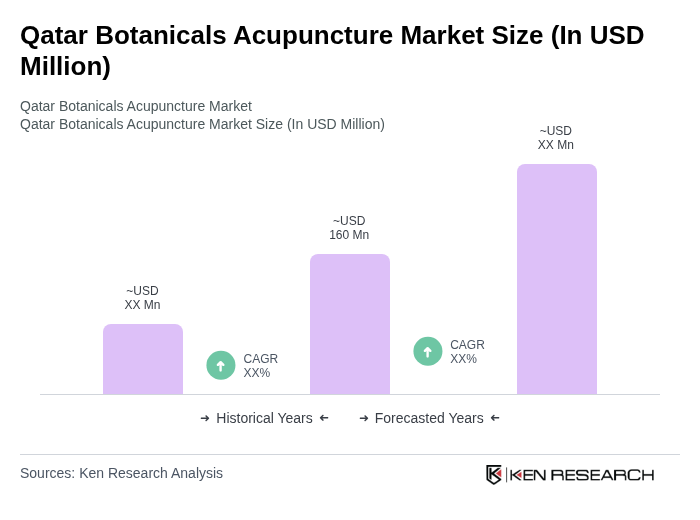
- The Qatar Botanicals Acupuncture Market is valued at USD 160 million, based on a five-year historical analysis and benchmarking against Middle East and Africa botanicals and acupuncture revenues and Qatar’s share in regional healthcare and wellness spending. This growth is primarily driven by increasing consumer interest in holistic health solutions, rising awareness of the benefits of acupuncture and herbal treatments, and a growing acceptance of alternative medicine within the healthcare system. The market is also supported by a surge in wellness tourism and broader health tourism in Qatar, with many international visitors seeking traditional and complementary therapies alongside conventional medical services.
- Key cities dominating the market include Doha, Al Rayyan, and Al Wakrah. Doha, as the capital, serves as a hub for healthcare services and wellness centers, attracting both local and expatriate populations through large public providers like Hamad Medical Corporation and private multispecialty centers offering integrative and complementary medicine services. Al Rayyan and Al Wakrah benefit from their proximity to Doha and ongoing urban development, with growing investments in hospitals, polyclinics, wellness, and rehabilitation facilities, making them significant catchment areas for acupuncture and botanical-based therapies.
- In 2023, the Qatari government strengthened the regulatory framework to promote the integration of traditional and complementary medicine into the national healthcare system through instruments such as the Regulation of the Practice of Human Medicine and Dental Medicine Law No. 2 of 2004 and subsequent Ministry of Public Health licensing rules for complementary and alternative medicine professionals, which set licensing requirements for practitioners, define scopes of practice, and mandate facility approvals. In parallel, the Ministry of Public Health applies pharmaceutical law and product registration standards for herbal and botanical products, including requirements on product quality, labeling, and safety documentation to ensure efficacy and consumer protection in botanical therapies.
Qatar Botanicals Acupuncture Market Segmentation
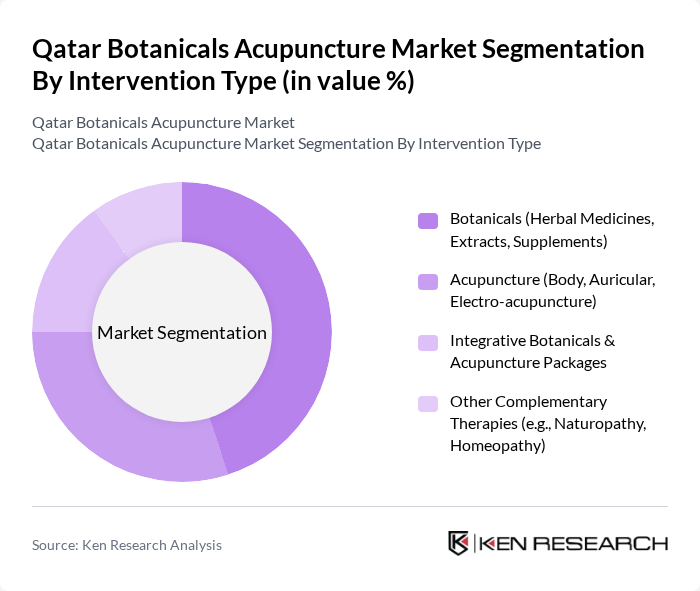
By Intervention Type:The market is segmented into various intervention types, including Botanicals (Herbal Medicines, Extracts, Supplements), Acupuncture (Body, Auricular, Electro-acupuncture), Integrative Botanicals & Acupuncture Packages, and Other Complementary Therapies (e.g., Naturopathy, Homeopathy). Among these, the Botanicals segment is currently leading the market due to the increasing consumer preference for natural remedies, the growing trend of self-care and preventive supplementation, and the wide availability of herbal products through pharmacies, wellness centers, and e-commerce channels. The demand for herbal supplements and extracts is particularly high, driven by rising health consciousness, lifestyle-related conditions, and the desire for preventive healthcare solutions that complement conventional treatment.
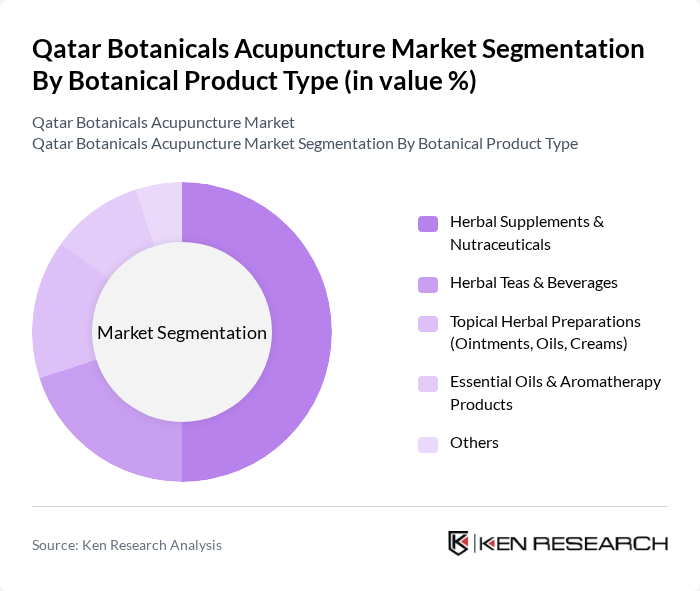
By Botanical Product Type:The market is further segmented into Herbal Supplements & Nutraceuticals, Herbal Teas & Beverages, Topical Herbal Preparations (Ointments, Oils, Creams), Essential Oils & Aromatherapy Products, and Others. The Herbal Supplements & Nutraceuticals segment is the most dominant, driven by a growing trend towards preventive health and wellness and the increasing use of vitamins, minerals, botanicals, and functional blends tailored to immunity, stress management, and metabolic health. Consumers are increasingly seeking natural alternatives and adjuncts to pharmaceuticals, leading to a surge in demand for these products, which are perceived as supportive, convenient, and aligned with holistic lifestyle choices.
Qatar Botanicals Acupuncture Market Competitive Landscape
The Qatar Botanicals Acupuncture Market is characterized by a dynamic mix of regional and international players. Leading participants such as Hamad Medical Corporation – Integrative & Complementary Medicine Services, Sidra Medicine – Integrative Medicine & Wellness Programs, Qatar Wellness Centre, Balance Wellness Centre, Doha, Royal Ayurveda & Acupuncture Center, Doha, Asian Medical Center – Acupuncture & TCM Services, Naseem Medical Centre – Complementary & Alternative Medicine, Doha Clinic Hospital – Integrative & Pain Management Clinics, Aster Medical Centre Qatar – Acupuncture & Wellness Services, Elite Medical Center – Pain & Rehabilitation with Acupuncture, Al Ahmadani Medical Center – Traditional & Herbal Medicine Services, VLCC Qatar – Wellness & Slimming with Herbal Therapies, Asian Integrated Medical Centre (AIMC), Qatar, Allevia Medical Center – Pain, Rehab & Acupuncture, Other Emerging Acupuncture & Botanical Therapy Clinics in Qatar contribute to innovation, geographic expansion, and service delivery in this space.
Qatar Botanicals Acupuncture Market Industry Analysis
Growth Drivers
- Increasing Awareness of Alternative Medicine:The awareness of alternative medicine in Qatar has surged, with a reported 60% of the population expressing interest in non-conventional therapies. This shift is supported by the World Health Organization's report, which indicates that 30% of Qatari citizens have utilized alternative treatments. The growing acceptance of acupuncture as a viable option for pain management and wellness is driving demand, particularly among younger demographics seeking holistic health solutions.
- Rising Demand for Natural Healing Solutions:The demand for natural healing solutions in Qatar is evident, with a 25% increase in inquiries for acupuncture services over the past year. The Ministry of Public Health reported that 40% of patients prefer natural remedies over pharmaceuticals, reflecting a cultural shift towards wellness. This trend is further fueled by the increasing prevalence of chronic conditions, prompting individuals to seek alternative therapies that align with their health philosophies and lifestyle choices.
- Government Support for Traditional Practices:The Qatari government has actively promoted traditional medicine, allocating approximately QAR 12 million to support training and certification programs for practitioners. This initiative aims to integrate traditional practices into the national healthcare system, enhancing accessibility and credibility. The government's endorsement is crucial in legitimizing acupuncture, encouraging more practitioners to enter the market and increasing public trust in these services.
Market Challenges
- Limited Awareness Among General Population:Despite the growing interest in alternative medicine, a significant portion of the Qatari population remains unaware of acupuncture's benefits. A survey revealed that only 35% of respondents could accurately describe acupuncture. This lack of awareness poses a challenge for practitioners, as they must invest in educational campaigns to inform potential clients about the efficacy and safety of acupuncture treatments.
- Regulatory Hurdles for Practitioners:Practitioners in Qatar face stringent regulatory requirements, including mandatory licensing and adherence to specific health standards. Only 50% of acupuncture practitioners have obtained the necessary certifications, limiting the availability of services. These regulatory hurdles can deter new entrants into the market, stifling growth and innovation within the acupuncture sector, and potentially leading to a shortage of qualified professionals.
Qatar Botanicals Acupuncture Market Future Outlook
The future of the Qatar Botanicals Acupuncture Market appears promising, driven by increasing consumer interest in holistic health and wellness. As the government continues to support traditional practices, more wellness centers are likely to emerge, integrating acupuncture into their offerings. Additionally, advancements in technology will facilitate online consultations, making acupuncture more accessible. The trend towards personalized treatment plans will also gain traction, as practitioners tailor their services to meet individual health needs, enhancing patient satisfaction and outcomes.
Market Opportunities
- Expansion of Wellness Centers:The establishment of new wellness centers in Qatar presents a significant opportunity for acupuncture practitioners. With an estimated 20 new centers projected to open in future, these facilities can offer integrated services that include acupuncture, attracting a broader clientele seeking comprehensive health solutions.
- Integration with Conventional Healthcare:There is a growing opportunity for acupuncture to be integrated into conventional healthcare settings. As hospitals and clinics increasingly recognize the benefits of complementary therapies, partnerships can be formed, allowing acupuncture to be offered alongside traditional treatments, thereby enhancing patient care and expanding market reach.
Scope of the Report
| Segment | Sub-Segments |
|---|---|
| By Intervention Type | Botanicals (Herbal Medicines, Extracts, Supplements) Acupuncture (Body, Auricular, Electro-acupuncture) Integrative Botanicals & Acupuncture Packages Other Complementary Therapies (e.g., Naturopathy, Homeopathy) |
| By Botanical Product Type | Herbal Supplements & Nutraceuticals Herbal Teas & Beverages Topical Herbal Preparations (Ointments, Oils, Creams) Essential Oils & Aromatherapy Products Others |
| By Application Area | Pain & Musculoskeletal Disorders Stress, Anxiety & Sleep Disorders Metabolic & Digestive Disorders Respiratory & Immunity Support Women’s Health & Fertility Beauty, Skin & Wellness Others |
| By End-User | Hospitals & Medical Centers Dedicated Acupuncture & TCM Clinics Wellness & Spa Centers Pharmacies & Retail Health Stores Online & Telehealth Platforms Others |
| By Distribution Channel | Direct Clinical Services (In-person) Hospital & Clinic Pharmacies Retail Pharmacies & Drug Stores E-commerce & Online Pharmacies Corporate & Institutional Wellness Programs Others |
| By Payer Type | Out-of-pocket (Self-pay) Private Insurance Reimbursement Government / Semi-government Schemes Corporate-sponsored Plans Others |
| By Geographic Cluster | Doha Al Rayyan Al Wakrah Al Khor & Al Thakhira Umm Salal, Al Daayen & Others |
Key Target Audience
Investors and Venture Capitalist Firms
Government and Regulatory Bodies (e.g., Ministry of Public Health, Qatar National Health Authority)
Manufacturers and Producers of Acupuncture Equipment
Distributors and Retailers of Herbal Products
Health and Wellness Clinics
Insurance Companies and Health Insurers
Industry Associations (e.g., Qatar Chamber of Commerce)
Pharmaceutical Companies with Herbal Product Lines
Players Mentioned in the Report:
Hamad Medical Corporation Integrative & Complementary Medicine Services
Sidra Medicine Integrative Medicine & Wellness Programs
Qatar Wellness Centre
Balance Wellness Centre, Doha
Royal Ayurveda & Acupuncture Center, Doha
Asian Medical Center Acupuncture & TCM Services
Naseem Medical Centre Complementary & Alternative Medicine
Doha Clinic Hospital Integrative & Pain Management Clinics
Aster Medical Centre Qatar Acupuncture & Wellness Services
Elite Medical Center Pain & Rehabilitation with Acupuncture
Al Ahmadani Medical Center Traditional & Herbal Medicine Services
VLCC Qatar Wellness & Slimming with Herbal Therapies
Asian Integrated Medical Centre (AIMC), Qatar
Allevia Medical Center Pain, Rehab & Acupuncture
Other Emerging Acupuncture & Botanical Therapy Clinics in Qatar
Table of Contents
Market Assessment Phase
1. Executive Summary and Approach
2. Qatar Botanicals Acupuncture Market Overview
2.1 Key Insights and Strategic Recommendations
2.2 Qatar Botanicals Acupuncture Market Overview
2.3 Definition and Scope
2.4 Evolution of Market Ecosystem
2.5 Timeline of Key Regulatory Milestones
2.6 Value Chain & Stakeholder Mapping
2.7 Business Cycle Analysis
2.8 Policy & Incentive Landscape
3. Qatar Botanicals Acupuncture Market Analysis
3.1 Growth Drivers
3.1.1 Increasing Awareness of Alternative Medicine
3.1.2 Rising Demand for Natural Healing Solutions
3.1.3 Government Support for Traditional Practices
3.1.4 Growth in Wellness Tourism
3.2 Market Challenges
3.2.1 Limited Awareness Among General Population
3.2.2 Regulatory Hurdles for Practitioners
3.2.3 Competition from Conventional Medicine
3.2.4 Cultural Resistance to Alternative Therapies
3.3 Market Opportunities
3.3.1 Expansion of Wellness Centers
3.3.2 Integration with Conventional Healthcare
3.3.3 Development of Training Programs for Practitioners
3.3.4 Increasing Online Consultation Services
3.4 Market Trends
3.4.1 Growth of Mobile Acupuncture Services
3.4.2 Rising Popularity of Holistic Health Approaches
3.4.3 Increased Use of Technology in Treatment
3.4.4 Focus on Personalized Treatment Plans
3.5 Government Regulation
3.5.1 Licensing Requirements for Practitioners
3.5.2 Standards for Acupuncture Practices
3.5.3 Health Insurance Coverage for Acupuncture
3.5.4 Promotion of Traditional Medicine Policies
4. SWOT Analysis
5. Stakeholder Analysis
6. Porter's Five Forces Analysis
7. Qatar Botanicals Acupuncture Market Market Size, 2019-2024
7.1 By Value
7.2 By Volume
7.3 By Average Selling Price
8. Qatar Botanicals Acupuncture Market Segmentation
8.1 By Intervention Type
8.1.1 Botanicals (Herbal Medicines, Extracts, Supplements)
8.1.2 Acupuncture (Body, Auricular, Electro-acupuncture)
8.1.3 Integrative Botanicals & Acupuncture Packages
8.1.4 Other Complementary Therapies (e.g., Naturopathy, Homeopathy)
8.2 By Botanical Product Type
8.2.1 Herbal Supplements & Nutraceuticals
8.2.2 Herbal Teas & Beverages
8.2.3 Topical Herbal Preparations (Ointments, Oils, Creams)
8.2.4 Essential Oils & Aromatherapy Products
8.2.5 Others
8.3 By Application Area
8.3.1 Pain & Musculoskeletal Disorders
8.3.2 Stress, Anxiety & Sleep Disorders
8.3.3 Metabolic & Digestive Disorders
8.3.4 Respiratory & Immunity Support
8.3.5 Women’s Health & Fertility
8.3.6 Beauty, Skin & Wellness
8.3.7 Others
8.4 By End-User
8.4.1 Hospitals & Medical Centers
8.4.2 Dedicated Acupuncture & TCM Clinics
8.4.3 Wellness & Spa Centers
8.4.4 Pharmacies & Retail Health Stores
8.4.5 Online & Telehealth Platforms
8.4.6 Others
8.5 By Distribution Channel
8.5.1 Direct Clinical Services (In-person)
8.5.2 Hospital & Clinic Pharmacies
8.5.3 Retail Pharmacies & Drug Stores
8.5.4 E-commerce & Online Pharmacies
8.5.5 Corporate & Institutional Wellness Programs
8.5.6 Others
8.6 By Payer Type
8.6.1 Out-of-pocket (Self-pay)
8.6.2 Private Insurance Reimbursement
8.6.3 Government / Semi-government Schemes
8.6.4 Corporate-sponsored Plans
8.6.5 Others
8.7 By Geographic Cluster
8.7.1 Doha
8.7.2 Al Rayyan
8.7.3 Al Wakrah
8.7.4 Al Khor & Al Thakhira
8.7.5 Umm Salal, Al Daayen & Others
9. Qatar Botanicals Acupuncture Market Competitive Analysis
9.1 Market Share of Key Players
9.2 Cross Comparison of Key Players
9.2.1 Company Name
9.2.2 Group Size (Large, Medium, or Small as per industry convention)
9.2.3 Annual Revenue (QAR / USD)
9.2.4 3-year Revenue CAGR (%)
9.2.5 EBITDA Margin (%)
9.2.6 Revenue per Treatment Session (QAR)
9.2.7 Average Ticket Size per Patient (QAR)
9.2.8 Patient Footfall per Month
9.2.9 Patient Retention / Repeat-visit Rate (%)
9.2.10 Occupancy / Capacity Utilization Rate (%)
9.2.11 Market Share in Qatar (%)
9.2.12 Branch / Outlet Count (Qatar & GCC)
9.2.13 Digital Engagement Index (App/Website Users, Followers)
9.2.14 Average Treatment Outcome / Satisfaction Score
9.3 SWOT Analysis of Top Players
9.4 Pricing Analysis
9.5 Detailed Profile of Major Companies
9.5.1 Hamad Medical Corporation – Integrative & Complementary Medicine Services
9.5.2 Sidra Medicine – Integrative Medicine & Wellness Programs
9.5.3 Qatar Wellness Centre
9.5.4 Balance Wellness Centre, Doha
9.5.5 Royal Ayurveda & Acupuncture Center, Doha
9.5.6 Asian Medical Center – Acupuncture & TCM Services
9.5.7 Naseem Medical Centre – Complementary & Alternative Medicine
9.5.8 Doha Clinic Hospital – Integrative & Pain Management Clinics
9.5.9 Aster Medical Centre Qatar – Acupuncture & Wellness Services
9.5.10 Elite Medical Center – Pain & Rehabilitation with Acupuncture
9.5.11 Al Ahmadani Medical Center – Traditional & Herbal Medicine Services
9.5.12 VLCC Qatar – Wellness & Slimming with Herbal Therapies
9.5.13 Asian Integrated Medical Centre (AIMC), Qatar
9.5.14 Allevia Medical Center – Pain, Rehab & Acupuncture
9.5.15 Other Emerging Acupuncture & Botanical Therapy Clinics in Qatar
10. Qatar Botanicals Acupuncture Market End-User Analysis
10.1 Procurement Behavior of Key Ministries
10.1.1 Ministry of Health
10.1.2 Ministry of Education
10.1.3 Ministry of Sports and Youth
10.1.4 Ministry of Culture and Sports
10.2 Corporate Spend on Infrastructure & Energy
10.2.1 Corporate Wellness Programs
10.2.2 Employee Health Initiatives
10.2.3 Partnerships with Wellness Centers
10.3 Pain Point Analysis by End-User Category
10.3.1 Individual Patients
10.3.2 Corporate Clients
10.3.3 Healthcare Providers
10.4 User Readiness for Adoption
10.4.1 Awareness Levels
10.4.2 Accessibility of Services
10.4.3 Cultural Acceptance
10.5 Post-Deployment ROI and Use Case Expansion
10.5.1 Patient Recovery Rates
10.5.2 Cost Savings for Healthcare Providers
10.5.3 Expansion of Service Offerings
11. Qatar Botanicals Acupuncture Market Future Size, 2025-2030
11.1 By Value
11.2 By Volume
11.3 By Average Selling Price
Go-To-Market Strategy Phase
1. Whitespace Analysis + Business Model Canvas
1.1 Market Gaps Identification
1.2 Business Model Development
2. Marketing and Positioning Recommendations
2.1 Branding Strategies
2.2 Product USPs
3. Distribution Plan
3.1 Urban Retail vs Rural NGO Tie-ups
4. Channel & Pricing Gaps
4.1 Underserved Routes
4.2 Pricing Bands
5. Unmet Demand & Latent Needs
5.1 Category Gaps
5.2 Consumer Segments
6. Customer Relationship
6.1 Loyalty Programs
6.2 After-sales Service
7. Value Proposition
7.1 Sustainability
7.2 Integrated Supply Chains
8. Key Activities
8.1 Regulatory Compliance
8.2 Branding
8.3 Distribution Setup
9. Entry Strategy Evaluation
9.1 Domestic Market Entry Strategy
9.1.1 Product Mix
9.1.2 Pricing Band
9.1.3 Packaging
9.2 Export Entry Strategy
9.2.1 Target Countries
9.2.2 Compliance Roadmap
10. Entry Mode Assessment
10.1 JV
10.2 Greenfield
10.3 M&A
10.4 Distributor Model
11. Capital and Timeline Estimation
11.1 Capital Requirements
11.2 Timelines
12. Control vs Risk Trade-Off
12.1 Ownership vs Partnerships
13. Profitability Outlook
13.1 Breakeven Analysis
13.2 Long-term Sustainability
14. Potential Partner List
14.1 Distributors
14.2 JVs
14.3 Acquisition Targets
15. Execution Roadmap
15.1 Phased Plan for Market Entry
15.1.1 Market Setup
15.1.2 Market Entry
15.1.3 Growth Acceleration
15.1.4 Scale & Stabilize
15.2 Key Activities and Milestones
15.2.1 Activity Planning
15.2.2 Milestone Tracking
Research Methodology
Phase 1: Approach1
Desk Research
- Analysis of market reports from local health authorities and acupuncture associations in Qatar
- Review of academic journals and publications on acupuncture practices and botanical usage
- Examination of demographic and health statistics from Qatar's Ministry of Public Health
Primary Research
- Interviews with licensed acupuncturists and herbalists operating in Qatar
- Surveys conducted with patients receiving acupuncture treatments to gauge satisfaction and preferences
- Focus groups with wellness center owners to understand market trends and consumer behavior
Validation & Triangulation
- Cross-validation of findings through multiple expert interviews and patient surveys
- Triangulation of data from academic research, industry reports, and primary interviews
- Sanity checks through feedback from a panel of healthcare professionals specializing in alternative medicine
Phase 2: Market Size Estimation1
Top-down Assessment
- Estimation of total healthcare expenditure in Qatar and its allocation to alternative therapies
- Analysis of the growth rate of the wellness industry and its impact on acupuncture services
- Incorporation of government health initiatives promoting alternative medicine practices
Bottom-up Modeling
- Collection of data on the number of acupuncture clinics and their average patient volume
- Estimation of revenue per treatment session based on pricing strategies of local practitioners
- Calculation of total market size by multiplying patient volume by average treatment costs
Forecasting & Scenario Analysis
- Multi-factor regression analysis considering factors such as population growth and increasing health awareness
- Scenario planning based on potential regulatory changes and shifts in consumer preferences
- Development of baseline, optimistic, and pessimistic market projections through 2030
Phase 3: CATI Sample Composition1
| Scope Item/Segment | Sample Size | Target Respondent Profiles |
|---|---|---|
| Acupuncture Clinic Owners | 60 | Clinic Owners, Practitioners |
| Patients Receiving Acupuncture | 120 | Current Patients, Former Patients |
| Herbal Product Suppliers | 50 | Suppliers, Distributors |
| Wellness Center Managers | 40 | Managers, Marketing Directors |
| Healthcare Professionals in Alternative Medicine | 70 | Doctors, Therapists, Researchers |
Frequently Asked Questions
What is the current value of the Qatar Botanicals Acupuncture Market?
The Qatar Botanicals Acupuncture Market is valued at approximately USD 160 million, reflecting a significant growth trend driven by increasing consumer interest in holistic health solutions and the rising acceptance of alternative medicine within the healthcare system.
What factors are driving the growth of the Qatar Botanicals Acupuncture Market?
Which cities are the main hubs for acupuncture services in Qatar?
How has the Qatari government supported the acupuncture market?
Other Regional/Country Reports
Indonesia Botanicals Acupuncture Market
Malaysia Botanicals Acupuncture Market
KSA Botanicals Acupuncture Market
APAC Botanicals Acupuncture Market
SEA Botanicals Acupuncture Market
Vietnam Botanicals Acupuncture Market
Other Adjacent Reports
South Korea Alternative Medicine Market
Saudi Arabia Herbal Supplements Market Outlook to 2030GCC Nutraceuticals MarketJapan Aromatherapy Market Size Share Growth Drivers Trends Opportunities & Forecast 2025–2030Global wellness tourism market Size, Share, Growth Drivers, Trends, Opportunities & Forecast 2025–2030Kuwait Integrative Medicine Market
Egypt Traditional Chinese Medicine Market
UAE Ayurveda MarketIndia Homeopathy Market (2023-2029)Brazil Pain Management Market
Why Buy From Us?

What makes us stand out is that our consultants follow Robust, Refine and Result (RRR) methodology. Robust for clear definitions, approaches and sanity checking, Refine for differentiating respondents' facts and opinions, and Result for presenting data with story.

We have set a benchmark in the industry by offering our clients with syndicated and customized market research reports featuring coverage of entire market as well as meticulous research and analyst insights.

While we don't replace traditional research, we flip the method upside down. Our dual approach of Top Bottom & Bottom Top ensures quality deliverable by not just verifying company fundamentals but also looking at the sector and macroeconomic factors.

With one step in the future, our research team constantly tries to show you the bigger picture. We help with some of the tough questions you may encounter along the way: How is the industry positioned? Best marketing channel? KPI's of competitors? By aligning every element, we help maximize success.

Our report gives you instant access to the answers and sources that other companies might choose to hide. We elaborate each steps of research methodology we have used and showcase you the sample size to earn your trust.

If you need any support, we are here! We pride ourselves on universe strength, data quality, and quick, friendly, and professional service.