About the Report
Base Year 2024Listen to the audio summary
Qatar Champagne Market Overview
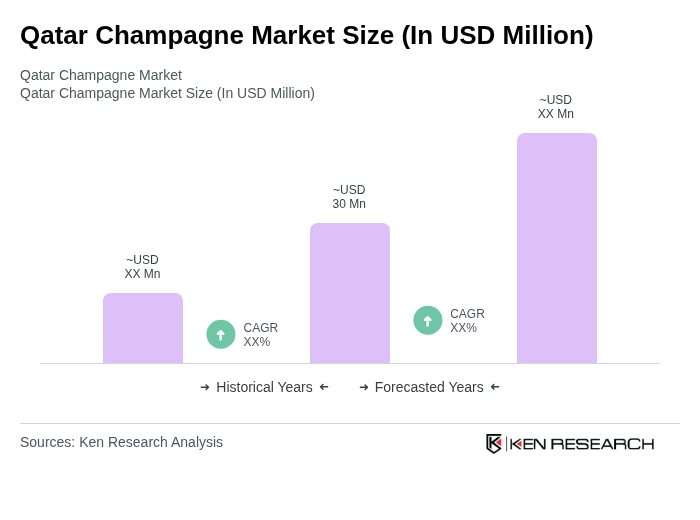
- The Qatar Champagne Market is valued at USD 30 million, based on a five-year historical analysis and proportional allocation from the GCC champagne market size. This growth is primarily driven by increasing disposable incomes, a rising trend in luxury consumption, the influence of international events, and a growing number of social gatherings where champagne is preferred. The market has seen a steady increase in demand, particularly among affluent consumers, expatriates, and through luxury hospitality venues .
- Key cities dominating the market include Doha, Al Rayyan, and Lusail. Doha, as the capital, serves as a cultural and economic hub, attracting high-end restaurants and luxury hotels that cater to a clientele seeking premium champagne. Al Rayyan and Lusail also contribute significantly due to their rapid urban development and increasing number of upscale events .
- The “Alcoholic Beverage Control Law, Law No. 3 of 1972” issued by the State of Qatar, governs the import, sale, and consumption of alcoholic beverages, including champagne. The law mandates that only licensed retailers may sell alcohol, restricts sales to designated outlets, and enforces strict age verification and consumption controls. The Qatar Distribution Company (QDC) is the sole licensed importer and retailer, and all establishments must comply with licensing and quality standards .
Qatar Champagne Market Segmentation
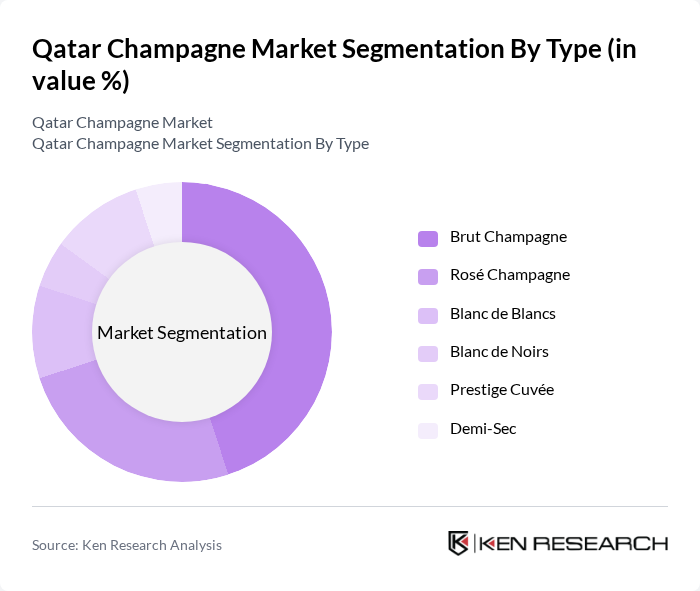
By Type:The market is segmented into various types of champagne, including Brut Champagne, Rosé Champagne, Blanc de Blancs, Blanc de Noirs, Prestige Cuvée, and Demi-Sec. Among these, Brut Champagne is the most popular due to its dry taste and versatility, making it suitable for various occasions. Rosé Champagne has also gained traction, particularly among younger consumers who prefer its unique flavor profile. The demand for Prestige Cuvée is rising as consumers seek premium experiences .
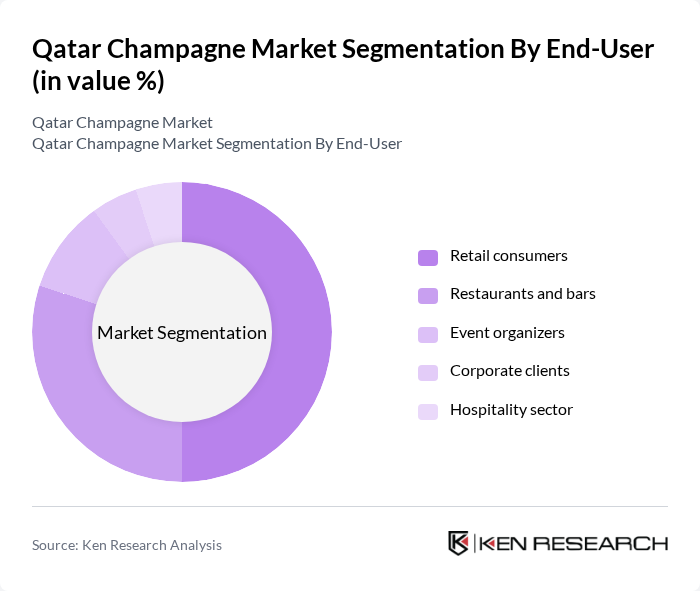
By End-User:The end-user segmentation includes retail consumers, restaurants and bars, event organizers, corporate clients, and the hospitality sector. Retail consumers dominate the market as they increasingly purchase champagne for personal consumption and gifting. Restaurants and bars also play a significant role, particularly high-end establishments that offer champagne as part of their beverage menu. The hospitality sector is growing, driven by luxury hotels and resorts catering to affluent tourists .
Qatar Champagne Market Competitive Landscape
The Qatar Champagne Market is characterized by a dynamic mix of regional and international players. Leading participants such as Moët & Chandon (LVMH Group), Veuve Clicquot (Champagne Veuve Clicquot Ponsardin), Dom Pérignon (Moët & Chandon subsidiary), Laurent-Perrier, Taittinger, Perrier-Jouët (Pernod Ricard), Bollinger, Krug (LVMH Group), Louis Roederer, Piper-Heidsieck (Pernod Ricard) contribute to innovation, geographic expansion, and service delivery in this space.
Qatar Champagne Market Industry Analysis
Growth Drivers
- Increasing Disposable Income:Qatar's GDP per capita is projected to reach approximately $83,000 in future, reflecting a significant increase in disposable income. This economic growth enables consumers to spend more on luxury items, including champagne. The rise in personal wealth is expected to drive the demand for premium champagne brands, as affluent consumers seek high-quality products for celebrations and social gatherings, thereby boosting market growth.
- Rising Demand for Luxury Products:The luxury goods market in Qatar is anticipated to grow by 10% annually, with champagne being a key segment. As the population becomes more affluent, there is a notable shift towards luxury consumption, including high-end beverages. This trend is supported by the increasing number of high-net-worth individuals, which reached 4,000 in future, further driving the demand for premium champagne brands in the region.
- Growth in Tourism and Hospitality Sectors:Qatar's tourism sector is expected to welcome over 4 million visitors in future, significantly boosting the hospitality industry. The influx of tourists, particularly for events like the FIFA World Cup, has led to an increase in demand for champagne in hotels and restaurants. This growth in the hospitality sector creates a favorable environment for champagne sales, as establishments seek to cater to the luxury preferences of international visitors.
Market Challenges
- High Import Duties and Taxes:Qatar imposes substantial import duties on alcoholic beverages, with rates reaching up to 100%. This high taxation significantly increases the retail price of champagne, making it less accessible to consumers. As a result, the market faces challenges in maintaining competitive pricing against other alcoholic beverages, which may deter potential buyers and limit overall market growth.
- Regulatory Restrictions on Alcohol Sales:The sale of alcohol in Qatar is heavily regulated, with strict licensing requirements for retailers. Only licensed establishments can sell champagne, which limits market access. Additionally, advertising restrictions hinder brand visibility and consumer awareness. These regulatory challenges create barriers for new entrants and existing players, impacting the overall growth potential of the champagne market in Qatar.
Qatar Champagne Market Future Outlook
The future of the Qatar champagne market appears promising, driven by increasing disposable incomes and a growing luxury consumer base. As tourism continues to rise, particularly with major events scheduled, the demand for champagne is expected to grow. Additionally, the trend towards premium and organic products is likely to shape consumer preferences. Companies that adapt to these trends and navigate regulatory challenges effectively will find significant opportunities for growth in this evolving market landscape.
Market Opportunities
- Expansion of Luxury Hotels and Restaurants:The ongoing development of luxury hotels and fine dining establishments in Qatar presents a significant opportunity for champagne brands. With over 20 new luxury hotels expected to open in future, these venues will likely feature champagne prominently on their menus, catering to affluent tourists and locals seeking premium experiences.
- Increasing Online Sales Channels:The rise of e-commerce in Qatar, with online retail sales projected to reach $2 billion in future, offers a new avenue for champagne distribution. Brands that establish a strong online presence can tap into the growing consumer preference for convenient shopping, thereby expanding their market reach and enhancing sales opportunities.
Scope of the Report
| Segment | Sub-Segments |
|---|---|
| By Type | Brut Champagne Rosé Champagne Blanc de Blancs Blanc de Noirs Prestige Cuvée Demi-Sec |
| By End-User | Retail consumers Restaurants and bars Event organizers Corporate clients Hospitality sector |
| By Occasion | Weddings Corporate events Celebrations and parties Seasonal festivities Premium dining experiences |
| By Distribution Channel | Online retail Supermarkets and hypermarkets Specialty liquor stores Duty-free shops (airports) Hotels and restaurants |
| By Price Range | Luxury (Premium Cuvée) Premium (Mid-to-High Range) Mid-range Budget-friendly |
| By Packaging Type | Glass bottles (750ml standard) Magnum bottles (1.5L) Half bottles (375ml) Specialty packaging |
| By Region | Doha Al Rayyan Al Wakrah Lusail |
Key Target Audience
Investors and Venture Capitalist Firms
Government and Regulatory Bodies (e.g., Ministry of Commerce and Industry, Qatar Tourism Authority)
Champagne Importers and Distributors
Luxury Hotels and Restaurants
Event Planners and Organizers
Retail Chains and Supermarkets
Hospitality Industry Stakeholders
Marketing and Advertising Agencies
Players Mentioned in the Report:
Moet & Chandon (LVMH Group)
Veuve Clicquot (Champagne Veuve Clicquot Ponsardin)
Dom Perignon (Moet & Chandon subsidiary)
Laurent-Perrier
Taittinger
Perrier-Jouet (Pernod Ricard)
Bollinger
Krug (LVMH Group)
Louis Roederer
Piper-Heidsieck (Pernod Ricard)
Table of Contents
Market Assessment Phase
1. Executive Summary and Approach
2. Qatar Champagne Market Overview
2.1 Key Insights and Strategic Recommendations
2.2 Qatar Champagne Market Overview
2.3 Definition and Scope
2.4 Evolution of Market Ecosystem
2.5 Timeline of Key Regulatory Milestones
2.6 Value Chain & Stakeholder Mapping
2.7 Business Cycle Analysis
2.8 Policy & Incentive Landscape
3. Qatar Champagne Market Analysis
3.1 Growth Drivers
3.1.1 Increasing disposable income
3.1.2 Rising demand for luxury products
3.1.3 Growth in tourism and hospitality sectors
3.1.4 Cultural acceptance of champagne consumption
3.2 Market Challenges
3.2.1 High import duties and taxes
3.2.2 Limited local production
3.2.3 Regulatory restrictions on alcohol sales
3.2.4 Competition from other alcoholic beverages
3.3 Market Opportunities
3.3.1 Expansion of luxury hotels and restaurants
3.3.2 Increasing online sales channels
3.3.3 Growing interest in champagne tasting events
3.3.4 Potential for local champagne production
3.4 Market Trends
3.4.1 Shift towards organic and premium champagne
3.4.2 Rise of champagne cocktails in bars
3.4.3 Increased marketing efforts targeting millennials
3.4.4 Focus on sustainability in production
3.5 Government Regulation
3.5.1 Licensing requirements for retailers
3.5.2 Restrictions on advertising alcoholic beverages
3.5.3 Regulations on importation of alcohol
3.5.4 Compliance with health and safety standards
4. SWOT Analysis
5. Stakeholder Analysis
6. Porter's Five Forces Analysis
7. Qatar Champagne Market Market Size, 2019-2024
7.1 By Value
7.2 By Volume
7.3 By Average Selling Price
8. Qatar Champagne Market Segmentation
8.1 By Type
8.1.1 Brut Champagne
8.1.2 Rosé Champagne
8.1.3 Blanc de Blancs
8.1.4 Blanc de Noirs
8.1.5 Prestige Cuvée
8.1.6 Demi-Sec
8.2 By End-User
8.2.1 Retail consumers
8.2.2 Restaurants and bars
8.2.3 Event organizers
8.2.4 Corporate clients
8.2.5 Hospitality sector
8.3 By Occasion
8.3.1 Weddings
8.3.2 Corporate events
8.3.3 Celebrations and parties
8.3.4 Seasonal festivities
8.3.5 Premium dining experiences
8.4 By Distribution Channel
8.4.1 Online retail
8.4.2 Supermarkets and hypermarkets
8.4.3 Specialty liquor stores
8.4.4 Duty-free shops (airports)
8.4.5 Hotels and restaurants
8.5 By Price Range
8.5.1 Luxury (Premium Cuvée)
8.5.2 Premium (Mid-to-High Range)
8.5.3 Mid-range
8.5.4 Budget-friendly
8.6 By Packaging Type
8.6.1 Glass bottles (750ml standard)
8.6.2 Magnum bottles (1.5L)
8.6.3 Half bottles (375ml)
8.6.4 Specialty packaging
8.7 By Region
8.7.1 Doha
8.7.2 Al Rayyan
8.7.3 Al Wakrah
8.7.4 Lusail
9. Qatar Champagne Market Competitive Analysis
9.1 Market Share of Key Players
9.2 Cross Comparison of Key Players
9.2.1 Company Name
9.2.2 Market Share (%)
9.2.3 Revenue Growth Rate (YoY %)
9.2.4 Distribution Network Reach (Number of outlets)
9.2.5 Product Portfolio Diversity (Number of SKUs)
9.2.6 Average Selling Price (AED per bottle)
9.2.7 Brand Recognition Score (1-10)
9.2.8 Online Sales Penetration (%)
9.2.9 Sustainability Certifications
9.2.10 Customer Satisfaction Rating (1-5 stars)
9.3 SWOT Analysis of Top Players
9.4 Pricing Analysis
9.5 Detailed Profile of Major Companies
9.5.1 Moët & Chandon (LVMH Group)
9.5.2 Veuve Clicquot (Champagne Veuve Clicquot Ponsardin)
9.5.3 Dom Pérignon (Moët & Chandon subsidiary)
9.5.4 Laurent-Perrier
9.5.5 Taittinger
9.5.6 Perrier-Jouët (Pernod Ricard)
9.5.7 Bollinger
9.5.8 Krug (LVMH Group)
9.5.9 Louis Roederer
9.5.10 Piper-Heidsieck (Pernod Ricard)
10. Qatar Champagne Market End-User Analysis
10.1 Procurement Behavior of Key Sectors
10.1.1 Hospitality and hotel sector
10.1.2 Food and beverage establishments
10.1.3 Event management companies
10.1.4 Corporate entities
10.2 Corporate Spend on Premium Beverages
10.2.1 Hospitality sector investments
10.2.2 Event management expenditures
10.2.3 Marketing and promotional budgets
10.2.4 Employee engagement programs
10.3 Pain Point Analysis by End-User Category
10.3.1 High costs of importation and customs duties
10.3.2 Limited availability of premium brands
10.3.3 Regulatory hurdles and licensing requirements
10.3.4 Supply chain delays and inventory management
10.4 User Readiness for Adoption
10.4.1 Awareness of champagne varieties and quality tiers
10.4.2 Acceptance of champagne in social and business settings
10.4.3 Willingness to pay premium prices for authentic brands
10.4.4 Interest in sustainable and organic champagne options
10.5 Post-Deployment ROI and Use Case Expansion
10.5.1 Increased sales through premium events and celebrations
10.5.2 Brand loyalty development and repeat purchases
10.5.3 Market share growth in luxury segment
10.5.4 Enhanced customer experience and premium positioning
11. Qatar Champagne Market Future Size, 2025-2030
11.1 By Value
11.2 By Volume
11.3 By Average Selling Price
Go-To-Market Strategy Phase
1. Whitespace Analysis + Business Model Canvas
1.1 Market gaps identification
1.2 Value proposition development
1.3 Revenue model exploration
1.4 Customer segmentation analysis
1.5 Competitive landscape overview
1.6 Key partnerships identification
1.7 Operational framework design
2. Marketing and Positioning Recommendations
2.1 Branding strategies
2.2 Product USPs
2.3 Target audience definition
2.4 Marketing channels selection
2.5 Campaign planning
3. Distribution Plan
3.1 Urban retail vs rural NGO tie-ups
3.2 Distribution channel optimization
3.3 Logistics and supply chain management
3.4 Partnership with local distributors
4. Channel & Pricing Gaps
4.1 Underserved routes
4.2 Pricing bands
4.3 Competitor pricing analysis
4.4 Value-based pricing strategies
5. Unmet Demand & Latent Needs
5.1 Category gaps
5.2 Consumer segments
5.3 Product development opportunities
5.4 Market entry strategies
6. Customer Relationship
6.1 Loyalty programs
6.2 After-sales service
6.3 Customer feedback mechanisms
6.4 Engagement strategies
7. Value Proposition
7.1 Sustainability
7.2 Integrated supply chains
7.3 Unique selling points
7.4 Customer-centric approach
8. Key Activities
8.1 Regulatory compliance
8.2 Branding
8.3 Distribution setup
8.4 Marketing execution
9. Entry Strategy Evaluation
9.1 Domestic Market Entry Strategy
9.1.1 Product mix
9.1.2 Pricing band
9.1.3 Packaging
9.2 Export Entry Strategy
9.2.1 Target countries
9.2.2 Compliance roadmap
10. Entry Mode Assessment
10.1 JV
10.2 Greenfield
10.3 M&A
10.4 Distributor Model
11. Capital and Timeline Estimation
11.1 Capital requirements
11.2 Timelines
12. Control vs Risk Trade-Off
12.1 Ownership vs Partnerships
13. Profitability Outlook
13.1 Breakeven analysis
13.2 Long-term sustainability
14. Potential Partner List
14.1 Distributors
14.2 JVs
14.3 Acquisition targets
15. Execution Roadmap
Research Methodology
Phase 1: Approach1
Desk Research
- Analysis of market reports from local and international beverage associations
- Review of import/export data from Qatar's Ministry of Economy and Commerce
- Examination of consumer behavior studies published by regional market research firms
Primary Research
- Interviews with sommeliers and wine experts in Qatar's hospitality sector
- Surveys conducted with retail managers in high-end liquor stores
- Focus groups with consumers to understand preferences and purchasing behavior
Validation & Triangulation
- Cross-validation of findings with sales data from major distributors
- Triangulation of consumer insights with industry expert opinions
- Sanity checks through feedback from local wine importers and distributors
Phase 2: Market Size Estimation1
Top-down Assessment
- Estimation of total market size based on national alcohol consumption statistics
- Segmentation of the champagne market by price tier and consumer demographics
- Incorporation of tourism data to assess impact on champagne sales
Bottom-up Modeling
- Volume estimates based on sales data from leading champagne retailers
- Analysis of average price points across different champagne brands
- Calculation of market share based on distributor sales reports
Forecasting & Scenario Analysis
- Multi-factor regression analysis incorporating economic indicators and consumer trends
- Scenario modeling based on potential changes in import regulations and tariffs
- Baseline, optimistic, and pessimistic forecasts through 2030
Phase 3: CATI Sample Composition1
| Scope Item/Segment | Sample Size | Target Respondent Profiles |
|---|---|---|
| High-End Retail Champagne Sales | 100 | Store Managers, Sales Executives |
| Hospitality Sector Champagne Consumption | 80 | Restaurant Owners, Bar Managers |
| Consumer Preferences in Champagne | 120 | Wine Enthusiasts, Casual Consumers |
| Champagne Importer Insights | 60 | Import Managers, Distribution Executives |
| Event and Celebration Champagne Usage | 70 | Event Planners, Corporate Buyers |
Frequently Asked Questions
What is the current value of the Qatar Champagne Market?
The Qatar Champagne Market is valued at approximately USD 30 million, reflecting a steady increase in demand driven by rising disposable incomes and luxury consumption trends among affluent consumers and expatriates.
Which cities are the main contributors to the Qatar Champagne Market?
What are the main types of champagne available in Qatar?
Who are the primary consumers of champagne in Qatar?
Other Regional/Country Reports
Indonesia Champagne Market
Malaysia Champagne Market
KSA Champagne Market
APAC Champagne Market
SEA Champagne Market
Vietnam Champagne Market
Other Adjacent Reports
Egypt Sparkling Wine Market
Belgium Luxury Beverages Market
UAE Alcoholic Beverages MarketBelgium Premium Spirits Market
United States Wine MarketThailand Hospitality Services Market
Indonesia Tourism Industry Market
Germany Event Planning Market
Malaysia Retail Alcohol Market
Egypt Import Beverages Market
Why Buy From Us?

What makes us stand out is that our consultants follow Robust, Refine and Result (RRR) methodology. Robust for clear definitions, approaches and sanity checking, Refine for differentiating respondents' facts and opinions, and Result for presenting data with story.

We have set a benchmark in the industry by offering our clients with syndicated and customized market research reports featuring coverage of entire market as well as meticulous research and analyst insights.

While we don't replace traditional research, we flip the method upside down. Our dual approach of Top Bottom & Bottom Top ensures quality deliverable by not just verifying company fundamentals but also looking at the sector and macroeconomic factors.

With one step in the future, our research team constantly tries to show you the bigger picture. We help with some of the tough questions you may encounter along the way: How is the industry positioned? Best marketing channel? KPI's of competitors? By aligning every element, we help maximize success.

Our report gives you instant access to the answers and sources that other companies might choose to hide. We elaborate each steps of research methodology we have used and showcase you the sample size to earn your trust.

If you need any support, we are here! We pride ourselves on universe strength, data quality, and quick, friendly, and professional service.