About the Report
Base Year 2024Qatar Fire Protection System Market Overview
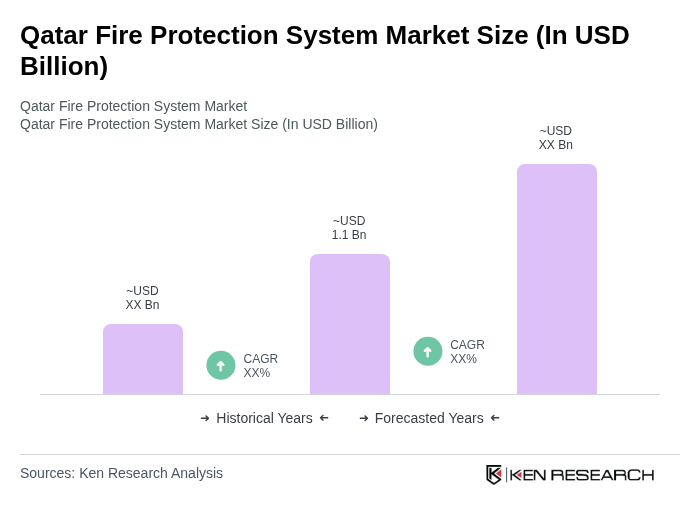
- The Qatar Fire Protection System market is valued at USD 1.1 billion, based on a five-year historical analysis and benchmarking against the Middle East fire protection system market size of about USD 4.4 billion, where Qatar is one of the key contributors within the GCC block alongside Saudi Arabia and the UAE. This growth is primarily driven by increasing investments in infrastructure, mega-projects aligned with Qatar National Vision 2030, and ongoing expansion in commercial, industrial, and residential construction that require code-compliant fire and life safety solutions. The market has seen a surge in demand for advanced fire protection technologies, including smart, networked fire detection, integrated fire and life safety platforms, and IoT-enabled monitoring, as organizations prioritize safety, business continuity, and regulatory compliance in high-value assets such as airports, stadiums, hospitals, data centers, and high-rise developments.
- Key cities dominating the market include Doha, Al Rayyan, and Al Wakrah. Doha, as the capital and largest city, is a hub for commercial, hospitality, and residential developments, leading to a higher demand for fire protection systems, particularly in mixed-use towers, hotels, malls, and transportation infrastructure. Al Rayyan and Al Wakrah also contribute significantly due to their growing industrial and logistics zones, proximity to major energy and port facilities, and rapid urbanization, which necessitate robust fire detection, suppression, and emergency evacuation systems across industrial plants, warehousing, and community developments.
- Fire and life safety in Qatar are governed by a structured framework of building and civil defence requirements, including the Qatar Civil Defence Department (QCDD) Fire Safety Requirements and the Qatar Construction Specifications (QCS), which reference international standards such as NFPA codes for fire protection and life safety. The QCDD Fire Safety Requirements, issued by the Ministry of Interior through the General Directorate of Civil Defence, mandate that all new buildings and major renovations incorporate approved fire detection, alarm, suppression, emergency lighting, and means-of-egress provisions, and require design approvals, product listing, and system commissioning sign-off before occupancy. These binding requirements significantly impact the market by increasing compliance-driven demand for certified systems, periodic inspection and maintenance, and upgrades to align existing assets with current safety standards.
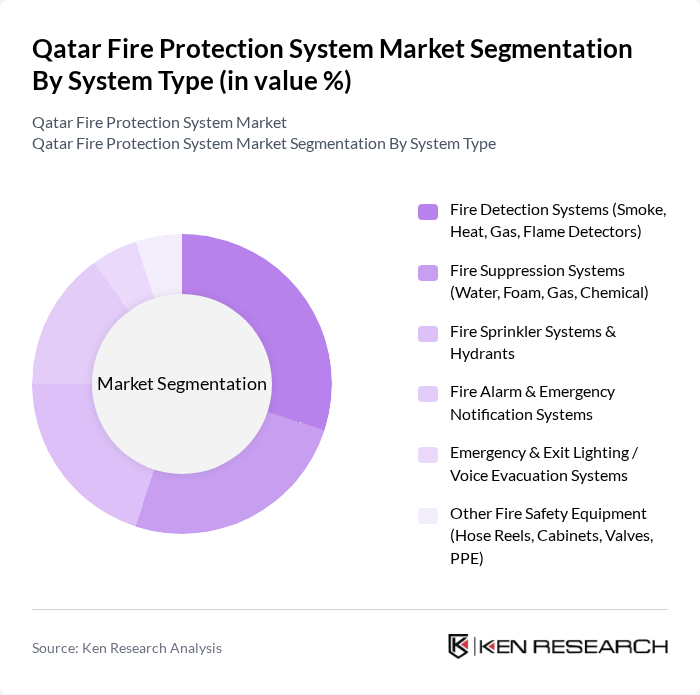
Qatar Fire Protection System Market Segmentation
By System Type:The fire protection system market can be segmented into various system types, each catering to specific safety needs. The primary subsegments include fire detection systems, fire suppression systems, fire sprinkler systems, fire alarm systems, emergency lighting, and other fire safety equipment, broadly in line with global product categorization for fire protection systems. Among these, fire detection systems are gaining traction due to their critical role in early fire detection and prevention, driven by increasing safety regulations, integration with building management systems, and adoption of addressable, networked, and smart detectors that support remote monitoring and analytics.
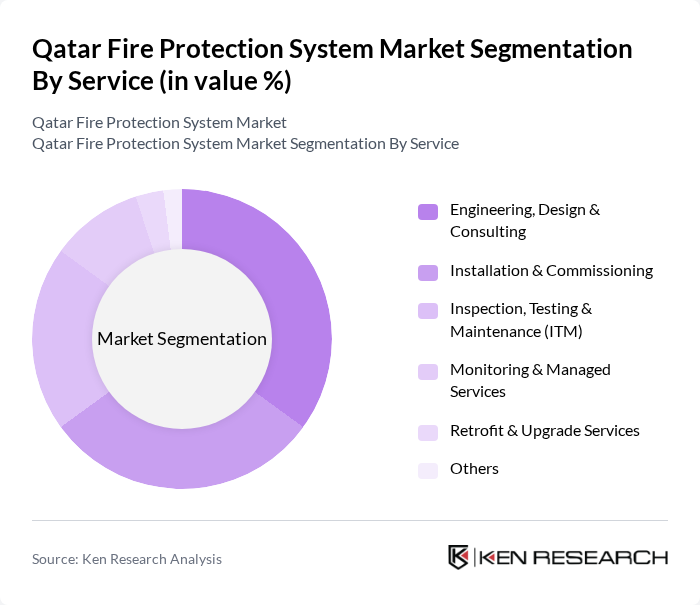
By Service:The market can also be segmented based on the services offered, which include engineering, installation, inspection, monitoring, retrofit services, and others. The engineering and design services are particularly significant as they ensure that fire protection systems are tailored to meet specific building requirements, integrate with other building systems, and comply with local QCDD and QCS regulations, thus driving demand in the market.
Qatar Fire Protection System Market Competitive Landscape
The Qatar Fire Protection System market is characterized by a dynamic mix of regional and international players. Leading participants such as Alpha Fire Services W.L.L., Apex Fire Engineering & Trading Est., Qatar Fire Protection Company, Gulf Fire & Safety, Naffco Qatar Factory W.L.L., Chubb Fire & Security Qatar, Honeywell International Inc. (Fire & Life Safety), Tyco Fire & Security (Johnson Controls), Siemens Qatar W.L.L. (Fire Safety Division), Phoenix International W.L.L., Dafoos Fire & Security, Unisafe Fire Protection Specialists LLC (Qatar Operations), Qatar Industrial Equipment / Safety Product Distributors, Regional OEMs and System Integrators Active in Qatar, Emerging Local Players and Niche Technology Providers contribute to innovation, geographic expansion, and service delivery in this space.
Qatar Fire Protection System Market Industry Analysis
Growth Drivers
- Increasing Industrialization:Qatar's industrial sector is projected to contribute approximately $40 billion to the GDP in future, driven by investments in oil, gas, and manufacturing. This industrial growth necessitates advanced fire protection systems to mitigate risks associated with high-value assets and hazardous materials. The expansion of industrial zones, such as the Qatar Free Zones Authority, further emphasizes the need for robust fire safety measures, creating a significant demand for fire protection systems across various sectors.
- Stringent Safety Regulations:The Qatari government has implemented rigorous fire safety regulations, mandating compliance with international standards. The Ministry of Interior reported that over 1,500 inspections were conducted in future to ensure adherence to fire safety codes. These regulations are expected to tighten further, compelling businesses to invest in advanced fire protection systems to avoid penalties and ensure operational continuity, thus driving market growth significantly.
- Rising Awareness of Fire Safety:Public awareness campaigns and training programs have increased the understanding of fire safety among businesses and the general populace. In future, over 600 fire safety workshops were conducted, reaching approximately 12,000 participants. This heightened awareness is leading to increased demand for fire protection systems, as organizations recognize the importance of safeguarding lives and property, thereby contributing to market expansion in Qatar.
Market Challenges
- High Initial Investment Costs:The upfront costs associated with installing advanced fire protection systems can be prohibitive, often exceeding $150,000 for large facilities. Many businesses, particularly small and medium enterprises, struggle to allocate sufficient budgets for these investments. This financial barrier can delay the adoption of necessary fire safety measures, hindering overall market growth in the region.
- Lack of Skilled Workforce:The fire protection industry in Qatar faces a significant skills gap, with an estimated shortage of 3,000 trained professionals in future. This deficiency hampers the effective installation and maintenance of fire safety systems. Companies often resort to hiring expatriates, which can increase operational costs and complicate compliance with local labor regulations, posing a challenge to market development.
Qatar Fire Protection System Market Future Outlook
The future of the Qatar fire protection system market appears promising, driven by ongoing industrialization and government initiatives aimed at enhancing safety standards. As the country prepares for major events like the FIFA World Cup in future, investments in infrastructure and safety systems are expected to surge. Additionally, the integration of smart technologies and IoT solutions will likely transform fire safety management, making systems more efficient and responsive to real-time threats, thus fostering market growth.
Market Opportunities
- Expansion in Emerging Sectors:The growth of sectors such as hospitality and healthcare presents significant opportunities for fire protection systems. With Qatar's tourism sector projected to reach $15 billion in future, the demand for advanced fire safety solutions in hotels and hospitals is expected to rise, creating a lucrative market for providers.
- Integration of Smart Technologies:The adoption of smart technologies in fire safety systems is gaining traction, with an estimated market value of $2 billion in future. This trend includes the use of IoT devices for real-time monitoring and alerts, enhancing safety measures and operational efficiency, thus opening new avenues for innovation and growth in the fire protection sector.
Scope of the Report
| Segment | Sub-Segments |
|---|---|
| By System Type | Fire Detection Systems (Smoke, Heat, Gas, Flame Detectors) Fire Suppression Systems (Water, Foam, Gas, Chemical) Fire Sprinkler Systems & Hydrants Fire Alarm & Emergency Notification Systems Emergency & Exit Lighting / Voice Evacuation Systems Other Fire Safety Equipment (Hose Reels, Cabinets, Valves, PPE) |
| By Service | Engineering, Design & Consulting Installation & Commissioning Inspection, Testing & Maintenance (ITM) Monitoring & Managed Services Retrofit & Upgrade Services Others |
| By Application | Building Construction (Residential, Commercial, Institutional) Oil & Gas and Petrochemicals Industrial & Manufacturing Facilities Transportation & Logistics (Airports, Ports, Rail, Ta??mac?l?k) Utilities & Critical Infrastructure Others |
| By Technology | Conventional (Non-addressable) Systems Addressable / Intelligent Systems Wireless & IoT-Enabled Systems Integrated Fire & Building Management Systems Others |
| By End-User Vertical | Residential Commercial (Offices, Retail, Hospitality, Healthcare, Education) Industrial Oil & Gas and Energy Government & Public Infrastructure Others |
| By Region | Doha Al Rayyan Al Khor & Al Thakhira Al Wakrah Umm Salal Others |
Key Target Audience
Investors and Venture Capitalist Firms
Government and Regulatory Bodies (e.g., Qatar Civil Defence, Ministry of Interior)
Manufacturers and Producers
Distributors and Retailers
Construction and Engineering Firms
Fire Safety Equipment Suppliers
Insurance Companies
Real Estate Developers
Players Mentioned in the Report:
Alpha Fire Services W.L.L.
Apex Fire Engineering & Trading Est.
Qatar Fire Protection Company
Gulf Fire & Safety
Naffco Qatar Factory W.L.L.
Chubb Fire & Security Qatar
Honeywell International Inc. (Fire & Life Safety)
Tyco Fire & Security (Johnson Controls)
Siemens Qatar W.L.L. (Fire Safety Division)
Phoenix International W.L.L.
Dafoos Fire & Security
Unisafe Fire Protection Specialists LLC (Qatar Operations)
Qatar Industrial Equipment / Safety Product Distributors
Regional OEMs and System Integrators Active in Qatar
Emerging Local Players and Niche Technology Providers
Table of Contents
Market Assessment Phase
1. Executive Summary and Approach
2. Qatar Fire Protection System Market Overview
2.1 Key Insights and Strategic Recommendations
2.2 Qatar Fire Protection System Market Overview
2.3 Definition and Scope
2.4 Evolution of Market Ecosystem
2.5 Timeline of Key Regulatory Milestones
2.6 Value Chain & Stakeholder Mapping
2.7 Business Cycle Analysis
2.8 Policy & Incentive Landscape
3. Qatar Fire Protection System Market Analysis
3.1 Growth Drivers
3.1.1 Increasing Industrialization
3.1.2 Stringent Safety Regulations
3.1.3 Rising Awareness of Fire Safety
3.1.4 Technological Advancements in Fire Protection
3.2 Market Challenges
3.2.1 High Initial Investment Costs
3.2.2 Lack of Skilled Workforce
3.2.3 Regulatory Compliance Issues
3.2.4 Competition from Low-Cost Alternatives
3.3 Market Opportunities
3.3.1 Expansion in Emerging Sectors
3.3.2 Integration of Smart Technologies
3.3.3 Government Initiatives for Infrastructure Development
3.3.4 Growing Demand for Eco-Friendly Solutions
3.4 Market Trends
3.4.1 Adoption of IoT in Fire Safety Systems
3.4.2 Shift Towards Integrated Fire Safety Solutions
3.4.3 Increasing Focus on Fire Risk Assessment
3.4.4 Rise in Fire Safety Training Programs
3.5 Government Regulation
3.5.1 Fire Safety Codes and Standards
3.5.2 Building Regulations Compliance
3.5.3 Environmental Protection Regulations
3.5.4 Licensing and Certification Requirements
4. SWOT Analysis
5. Stakeholder Analysis
6. Porter's Five Forces Analysis
7. Qatar Fire Protection System Market Market Size, 2019-2024
7.1 By Value
7.2 By Volume
7.3 By Average Selling Price
8. Qatar Fire Protection System Market Segmentation
8.1 By System Type
8.1.1 Fire Detection Systems (Smoke, Heat, Gas, Flame Detectors)
8.1.2 Fire Suppression Systems (Water, Foam, Gas, Chemical)
8.1.3 Fire Sprinkler Systems & Hydrants
8.1.4 Fire Alarm & Emergency Notification Systems
8.1.5 Emergency & Exit Lighting / Voice Evacuation Systems
8.1.6 Other Fire Safety Equipment (Hose Reels, Cabinets, Valves, PPE)
8.2 By Service
8.2.1 Engineering, Design & Consulting
8.2.2 Installation & Commissioning
8.2.3 Inspection, Testing & Maintenance (ITM)
8.2.4 Monitoring & Managed Services
8.2.5 Retrofit & Upgrade Services
8.2.6 Others
8.3 By Application
8.3.1 Building Construction (Residential, Commercial, Institutional)
8.3.2 Oil & Gas and Petrochemicals
8.3.3 Industrial & Manufacturing Facilities
8.3.4 Transportation & Logistics (Airports, Ports, Rail, Ta??mac?l?k)
8.3.5 Utilities & Critical Infrastructure
8.3.6 Others
8.4 By Technology
8.4.1 Conventional (Non-addressable) Systems
8.4.2 Addressable / Intelligent Systems
8.4.3 Wireless & IoT-Enabled Systems
8.4.4 Integrated Fire & Building Management Systems
8.4.5 Others
8.5 By End-User Vertical
8.5.1 Residential
8.5.2 Commercial (Offices, Retail, Hospitality, Healthcare, Education)
8.5.3 Industrial
8.5.4 Oil & Gas and Energy
8.5.5 Government & Public Infrastructure
8.5.6 Others
8.6 By Region
8.6.1 Doha
8.6.2 Al Rayyan
8.6.3 Al Khor & Al Thakhira
8.6.4 Al Wakrah
8.6.5 Umm Salal
8.6.6 Others
9. Qatar Fire Protection System Market Competitive Analysis
9.1 Market Share of Key Players
9.2 Cross Comparison of Key Players
9.2.1 Company Name
9.2.2 Group Size (Large, Medium, or Small as per industry convention)
9.2.3 Qatar Fire Protection System Revenue (QAR / USD)
9.2.4 3-Year Revenue CAGR in Qatar Fire Protection Segment
9.2.5 EBITDA Margin (%) for Qatar Operations
9.2.6 Market Share in Qatar Fire Protection System Market (%)
9.2.7 Installed Base / Number of Active Projects in Qatar
9.2.8 Order Book / Backlog Value (QAR / USD)
9.2.9 Average Contract Value (ACV)
9.2.10 Win Rate in Competitive Tenders (%)
9.2.11 Recurring Revenue Share (Service & Maintenance % of Total)
9.2.12 Customer Retention Rate (%)
9.2.13 Days Sales Outstanding (DSO)
9.2.14 R&D / Technology Investment as % of Revenue
9.2.15 Pricing Positioning (Premium / Mid / Value)
9.3 SWOT Analysis of Top Players
9.4 Pricing Analysis
9.5 Detailed Profile of Major Companies
9.5.1 Alpha Fire Services W.L.L.
9.5.2 Apex Fire Engineering & Trading Est.
9.5.3 Qatar Fire Protection Company
9.5.4 Gulf Fire & Safety
9.5.5 Naffco Qatar Factory W.L.L.
9.5.6 Chubb Fire & Security Qatar
9.5.7 Honeywell International Inc. (Fire & Life Safety)
9.5.8 Tyco Fire & Security (Johnson Controls)
9.5.9 Siemens Qatar W.L.L. (Fire Safety Division)
9.5.10 Phoenix International W.L.L.
9.5.11 Dafoos Fire & Security
9.5.12 Unisafe Fire Protection Specialists LLC (Qatar Operations)
9.5.13 Qatar Industrial Equipment / Safety Product Distributors
9.5.14 Regional OEMs and System Integrators Active in Qatar
9.5.15 Emerging Local Players and Niche Technology Providers
10. Qatar Fire Protection System Market End-User Analysis
10.1 Procurement Behavior of Key Ministries
10.1.1 Ministry of Interior
10.1.2 Ministry of Municipality and Environment
10.1.3 Ministry of Education and Higher Education
10.1.4 Others
10.2 Corporate Spend on Infrastructure & Energy
10.2.1 Investment Trends
10.2.2 Budget Allocations
10.2.3 Project Prioritization
10.2.4 Others
10.3 Pain Point Analysis by End-User Category
10.3.1 Residential Sector
10.3.2 Commercial Sector
10.3.3 Industrial Sector
10.3.4 Government Sector
10.4 User Readiness for Adoption
10.4.1 Awareness Levels
10.4.2 Training Needs
10.4.3 Technology Acceptance
10.4.4 Others
10.5 Post-Deployment ROI and Use Case Expansion
10.5.1 Performance Metrics
10.5.2 Case Studies
10.5.3 User Feedback
10.5.4 Others
11. Qatar Fire Protection System Market Future Size, 2025-2030
11.1 By Value
11.2 By Volume
11.3 By Average Selling Price
Go-To-Market Strategy Phase
1. Whitespace Analysis + Business Model Canvas
1.1 Market Gaps Identification
1.2 Value Proposition Development
1.3 Revenue Streams
1.4 Key Partnerships
1.5 Cost Structure
1.6 Customer Segments
1.7 Channels
2. Marketing and Positioning Recommendations
2.1 Branding Strategies
2.2 Product USPs
3. Distribution Plan
3.1 Urban Retail vs Rural NGO Tie-ups
4. Channel & Pricing Gaps
4.1 Underserved Routes
4.2 Pricing Bands
5. Unmet Demand & Latent Needs
5.1 Category Gaps
5.2 Consumer Segments
6. Customer Relationship
6.1 Loyalty Programs
6.2 After-sales Service
7. Value Proposition
7.1 Sustainability
7.2 Integrated Supply Chains
8. Key Activities
8.1 Regulatory Compliance
8.2 Branding
8.3 Distribution Setup
9. Entry Strategy Evaluation
9.1 Domestic Market Entry Strategy
9.1.1 Product Mix
9.1.2 Pricing Band
9.1.3 Packaging
9.2 Export Entry Strategy
9.2.1 Target Countries
9.2.2 Compliance Roadmap
10. Entry Mode Assessment
10.1 JV
10.2 Greenfield
10.3 M&A
10.4 Distributor Model
11. Capital and Timeline Estimation
11.1 Capital Requirements
11.2 Timelines
12. Control vs Risk Trade-Off
12.1 Ownership vs Partnerships
13. Profitability Outlook
13.1 Breakeven Analysis
13.2 Long-term Sustainability
14. Potential Partner List
14.1 Distributors
14.2 JVs
14.3 Acquisition Targets
15. Execution Roadmap
15.1 Phased Plan for Market Entry
15.1.1 Market Setup
15.1.2 Market Entry
15.1.3 Growth Acceleration
15.1.4 Scale & Stabilize
15.2 Key Activities and Milestones
15.2.1 Milestone Planning
15.2.2 Activity Tracking
Research Methodology
Phase 1: Approach1
Desk Research
- Analysis of industry reports from local fire safety associations and regulatory bodies
- Review of market trends and forecasts from government publications and trade journals
- Examination of fire protection system standards and compliance documents from Qatar Civil Defence
Primary Research
- Interviews with fire safety engineers and consultants in Qatar
- Surveys with facility managers and safety officers across various sectors
- Field visits to construction sites and industrial facilities to assess fire protection implementations
Validation & Triangulation
- Cross-validation of data through multiple sources including industry experts and market reports
- Triangulation of findings from primary interviews and secondary data sources
- Sanity checks conducted through expert panel discussions and feedback sessions
Phase 2: Market Size Estimation1
Top-down Assessment
- Estimation of market size based on national infrastructure spending and fire safety regulations
- Segmentation of the market by end-user industries such as construction, oil & gas, and hospitality
- Incorporation of government initiatives promoting fire safety and compliance standards
Bottom-up Modeling
- Collection of sales data from leading fire protection system manufacturers and distributors
- Estimation of installation and maintenance costs based on service pricing models
- Volume x cost analysis for various fire protection products and services
Forecasting & Scenario Analysis
- Multi-factor regression analysis considering economic growth, urbanization, and safety regulations
- Scenario modeling based on potential changes in fire safety legislation and market demand
- Development of baseline, optimistic, and pessimistic forecasts through 2030
Phase 3: CATI Sample Composition1
| Scope Item/Segment | Sample Size | Target Respondent Profiles |
|---|---|---|
| Commercial Building Fire Safety | 110 | Facility Managers, Safety Compliance Officers |
| Industrial Fire Protection Systems | 90 | Operations Managers, Fire Safety Engineers |
| Residential Fire Safety Solutions | 75 | Homeowners, Property Managers |
| Fire Safety Equipment Suppliers | 55 | Sales Managers, Product Development Heads |
| Government Fire Safety Regulations | 45 | Regulatory Officials, Policy Makers |
Frequently Asked Questions
What is the current value of the Qatar Fire Protection System market?
The Qatar Fire Protection System market is valued at approximately USD 1.1 billion, making it a significant contributor to the Middle East fire protection system market, which is around USD 4.4 billion.
What factors are driving the growth of the fire protection system market in Qatar?
Which cities in Qatar are leading in fire protection system demand?
What are the main types of fire protection systems available in Qatar?
Other Regional/Country Reports
Other Adjacent Reports
Germany Building Automation Market
South Korea Security System Market
Indonesia IoT Technology Market Outlook to 2030UAE Smart Building MarketGermany Industrial Safety Equipment Market
Belgium Emergency Management System Market
Germany Facility Management Service Market
Qatar Construction Technology Market
South Korea Data Center Infrastructure Market
Indonesia Healthcare Infrastructure Market
Why Buy From Us?

What makes us stand out is that our consultants follow Robust, Refine and Result (RRR) methodology. Robust for clear definitions, approaches and sanity checking, Refine for differentiating respondents' facts and opinions, and Result for presenting data with story.

We have set a benchmark in the industry by offering our clients with syndicated and customized market research reports featuring coverage of entire market as well as meticulous research and analyst insights.

While we don't replace traditional research, we flip the method upside down. Our dual approach of Top Bottom & Bottom Top ensures quality deliverable by not just verifying company fundamentals but also looking at the sector and macroeconomic factors.

With one step in the future, our research team constantly tries to show you the bigger picture. We help with some of the tough questions you may encounter along the way: How is the industry positioned? Best marketing channel? KPI's of competitors? By aligning every element, we help maximize success.

Our report gives you instant access to the answers and sources that other companies might choose to hide. We elaborate each steps of research methodology we have used and showcase you the sample size to earn your trust.

If you need any support, we are here! We pride ourselves on universe strength, data quality, and quick, friendly, and professional service.