About the Report
Base Year 2024Qatar Uranium Enrichment Market Overview
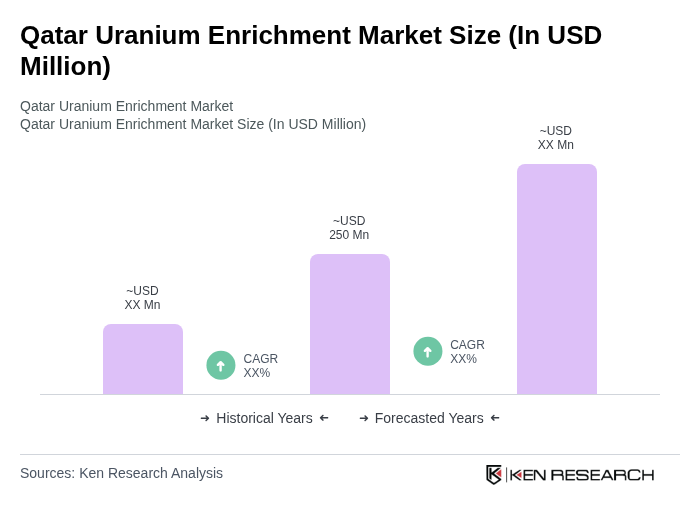
- The Qatar Uranium Enrichment Market is valued at USD 250 million, based on a five-year historical analysis. This growth is primarily driven by the increasing demand for nuclear energy as a sustainable power source, coupled with Qatar's strategic initiatives to diversify its energy portfolio, alongside global trends in technological innovations in enrichment methods and investments in nuclear fuel cycle infrastructure. The government's focus on developing nuclear capabilities to meet future energy needs has significantly contributed to the market's expansion.
- Key players in this market include Qatar Nuclear Energy Company, Qatar Petroleum, and international firms such as Orano and Rosatom. Qatar's strategic location, coupled with its substantial investments in nuclear technology and infrastructure, positions it as a dominant player in the uranium enrichment sector, attracting both regional and global partnerships.
- The Law No. 12 of 2019 on the Regulation of the Peaceful Uses of Nuclear Energy, issued by the State of Qatar, establishes a comprehensive regulatory framework ensuring the safe and secure development of nuclear energy. This framework mandates licensing requirements for nuclear facilities, adherence to international safety standards including radiation protection thresholds, and mandatory environmental impact assessments for all nuclear activities.
Qatar Uranium Enrichment Market Segmentation
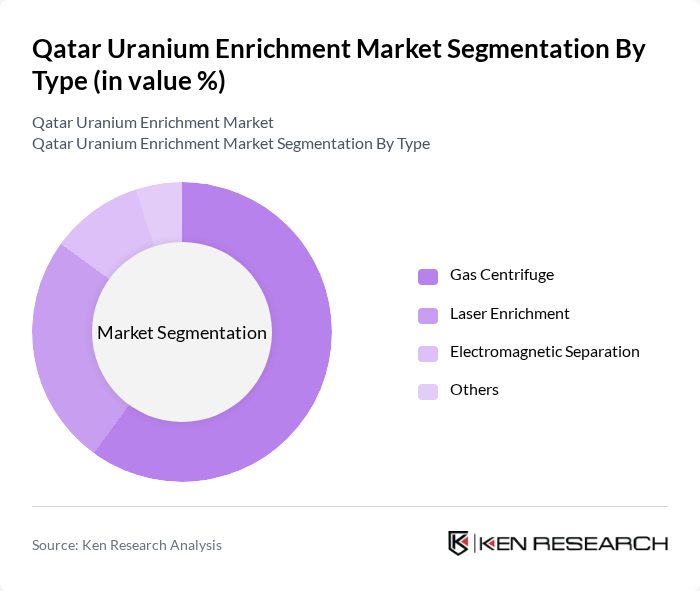
By Type:The market is segmented into four types: Gas Centrifuge, Laser Enrichment, Electromagnetic Separation, and Others. Among these, Gas Centrifuge technology is the most widely adopted due to its efficiency and cost-effectiveness in uranium enrichment processes. The increasing focus on advanced technologies and the need for higher enrichment levels in nuclear fuel production are driving the demand for this segment. Laser Enrichment is also gaining traction, particularly for its potential to reduce operational costs and enhance precision in enrichment.
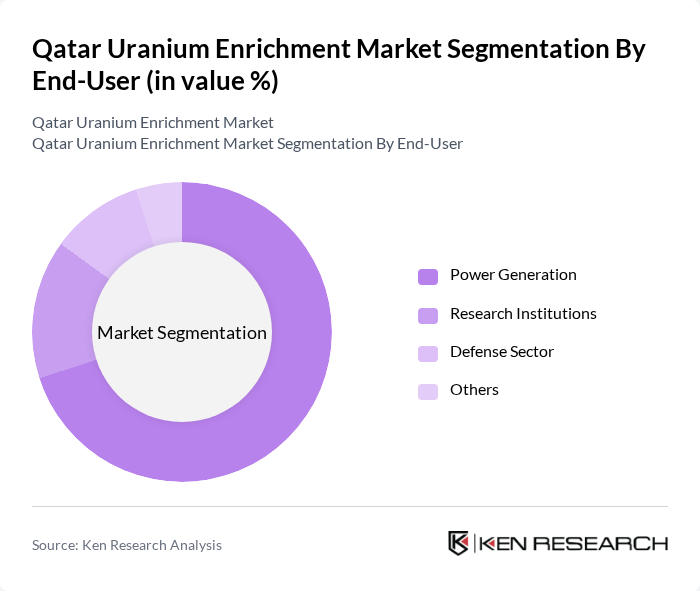
By End-User:The end-user segmentation includes Power Generation, Research Institutions, Defense Sector, and Others. The Power Generation sector dominates the market, driven by the increasing reliance on nuclear energy for electricity generation. As countries seek to reduce carbon emissions and enhance energy security, the demand for enriched uranium in power plants is expected to grow. Research Institutions also represent a significant segment, focusing on advancements in nuclear technology and applications.
Qatar Uranium Enrichment Market Competitive Landscape
The Qatar Uranium Enrichment Market is characterized by a dynamic mix of regional and international players. Leading participants such as Qatar General Electricity & Water Corporation (Kahramaa), Qatar Nuclear Energy Company, Qatar Petroleum, Qatar University, Qatar Science & Technology Park, Qatar Investment Authority, International Atomic Energy Agency (IAEA), Orano, Rosatom State Atomic Energy Corporation, Westinghouse Electric Company, GE Hitachi Nuclear Energy, Babcock & Wilcox, Fluor Corporation, Bechtel Corporation, Mitsubishi Heavy Industries contribute to innovation, geographic expansion, and service delivery in this space.
Qatar Uranium Enrichment Market Industry Analysis
Growth Drivers
- Increasing Energy Demand:Qatar's energy consumption is projected to reach 66 terawatt-hours (TWh) in future, driven by population growth and industrial expansion. The country's commitment to diversifying its energy sources, particularly through nuclear power, is evident as it aims to generate 20% of its electricity from nuclear energy in future. This increasing demand for energy creates a robust market for uranium enrichment, essential for fueling nuclear reactors and meeting future energy needs.
- Government Investment in Nuclear Technology:The Qatari government has allocated approximately $12 billion for the development of nuclear technology in future. This investment is part of a broader strategy to enhance energy security and reduce reliance on fossil fuels. The establishment of a national nuclear regulatory authority and partnerships with international nuclear organizations further solidify Qatar's commitment to advancing its uranium enrichment capabilities, positioning the country as a regional leader in nuclear energy.
- Strategic Partnerships with Global Players:Qatar has entered into strategic partnerships with leading global nuclear technology firms, including a $6 billion agreement with a French company for nuclear reactor technology. These collaborations not only enhance Qatar's technical expertise but also facilitate knowledge transfer and innovation in uranium enrichment processes. Such partnerships are crucial for developing a sustainable nuclear energy sector, ensuring that Qatar can effectively meet its future energy demands.
Market Challenges
- Regulatory Compliance Issues:Navigating the complex regulatory landscape poses significant challenges for Qatar's uranium enrichment market. Compliance with international standards set by the International Atomic Energy Agency (IAEA) requires substantial investment in safety and security measures. Qatar must align its regulations with IAEA guidelines in future, which may involve extensive modifications to existing frameworks, potentially delaying project timelines and increasing operational costs.
- Public Perception and Environmental Concerns:Public opposition to nuclear energy remains a significant hurdle for the uranium enrichment sector in Qatar. Concerns about safety, waste management, and environmental impact are prevalent among the population. A survey indicated that 62% of Qataris expressed apprehension regarding nuclear energy. Addressing these concerns through transparent communication and community engagement is essential for gaining public support and ensuring the successful implementation of nuclear projects.
Qatar Uranium Enrichment Market Future Outlook
The future of Qatar's uranium enrichment market appears promising, driven by increasing energy demands and government initiatives to diversify energy sources. As the country invests in nuclear technology and forms strategic partnerships, advancements in enrichment processes are expected to emerge. Additionally, addressing regulatory compliance and public concerns will be crucial for fostering a supportive environment. Overall, Qatar is poised to become a significant player in the nuclear energy sector, contributing to regional energy security and sustainability.
Market Opportunities
- Expansion of Nuclear Power Plants:Qatar's plan to construct multiple nuclear power plants in future presents a significant opportunity for uranium enrichment. With an estimated capacity of 4,500 megawatts, these plants will require substantial uranium supplies, creating a robust demand for enriched uranium. This expansion aligns with Qatar's energy diversification goals and positions the country as a key player in the regional nuclear landscape.
- Development of Advanced Enrichment Technologies:Investing in advanced enrichment technologies, such as laser enrichment and gas diffusion, can enhance efficiency and reduce costs. Qatar's focus on innovation in this area could lead to breakthroughs that improve the sustainability of uranium enrichment processes. By adopting cutting-edge technologies, Qatar can strengthen its competitive edge in the global uranium market and attract international partnerships.
Scope of the Report
| Segment | Sub-Segments |
|---|---|
| By Type | Gas Centrifuge Laser Enrichment Electromagnetic Separation Others |
| By End-User | Power Generation Research Institutions Defense Sector Others |
| By Application | Fuel Production Medical Isotope Production Industrial Applications Others |
| By Technology | Gas Diffusion Chemical Exchange Others |
| By Investment Source | Government Funding Private Investments International Aid Others |
| By Policy Support | Subsidies for Nuclear Projects Tax Incentives for Research Regulatory Support for New Technologies Others |
| By Market Maturity | Emerging Market Established Market Others |
Key Target Audience
Investors and Venture Capitalist Firms
Government and Regulatory Bodies (e.g., Qatar Nuclear Regulatory Authority)
Uranium Mining Companies
Energy Sector Stakeholders
International Atomic Energy Agency (IAEA)
Environmental Protection Agencies
Energy Policy Makers
Infrastructure Development Firms
Players Mentioned in the Report:
Qatar General Electricity & Water Corporation (Kahramaa)
Qatar Nuclear Energy Company
Qatar Petroleum
Qatar University
Qatar Science & Technology Park
Qatar Investment Authority
International Atomic Energy Agency (IAEA)
Areva SA
Rosatom State Atomic Energy Corporation
Westinghouse Electric Company
GE Hitachi Nuclear Energy
Babcock & Wilcox
Fluor Corporation
Bechtel Corporation
Mitsubishi Heavy Industries
Table of Contents
Market Assessment Phase
1. Executive Summary and Approach
2. Qatar Uranium Enrichment Market Overview
2.1 Key Insights and Strategic Recommendations
2.2 Qatar Uranium Enrichment Market Overview
2.3 Definition and Scope
2.4 Evolution of Market Ecosystem
2.5 Timeline of Key Regulatory Milestones
2.6 Value Chain & Stakeholder Mapping
2.7 Business Cycle Analysis
2.8 Policy & Incentive Landscape
3. Qatar Uranium Enrichment Market Analysis
3.1 Growth Drivers
3.1.1 Increasing Energy Demand
3.1.2 Government Investment in Nuclear Technology
3.1.3 Strategic Partnerships with Global Players
3.1.4 Technological Advancements in Enrichment Processes
3.2 Market Challenges
3.2.1 Regulatory Compliance Issues
3.2.2 High Initial Capital Investment
3.2.3 Public Perception and Environmental Concerns
3.2.4 Geopolitical Risks
3.3 Market Opportunities
3.3.1 Expansion of Nuclear Power Plants
3.3.2 Development of Advanced Enrichment Technologies
3.3.3 International Collaboration and Trade
3.3.4 Growing Demand for Clean Energy Solutions
3.4 Market Trends
3.4.1 Shift Towards Sustainable Energy Sources
3.4.2 Increased Focus on Energy Security
3.4.3 Innovations in Nuclear Fuel Recycling
3.4.4 Rising Interest in Small Modular Reactors (SMRs)
3.5 Government Regulation
3.5.1 Nuclear Regulatory Authority Guidelines
3.5.2 Environmental Protection Regulations
3.5.3 International Atomic Energy Agency (IAEA) Standards
3.5.4 National Energy Policy Framework
4. SWOT Analysis
5. Stakeholder Analysis
6. Porter's Five Forces Analysis
7. Qatar Uranium Enrichment Market Market Size, 2019-2024
7.1 By Value
7.2 By Volume
7.3 By Average Selling Price
8. Qatar Uranium Enrichment Market Segmentation
8.1 By Type
8.1.1 Gas Centrifuge
8.1.2 Laser Enrichment
8.1.3 Electromagnetic Separation
8.1.4 Others
8.2 By End-User
8.2.1 Power Generation
8.2.2 Research Institutions
8.2.3 Defense Sector
8.2.4 Others
8.3 By Application
8.3.1 Fuel Production
8.3.2 Medical Isotope Production
8.3.3 Industrial Applications
8.3.4 Others
8.4 By Technology
8.4.1 Gas Diffusion
8.4.2 Chemical Exchange
8.4.3 Others
8.5 By Investment Source
8.5.1 Government Funding
8.5.2 Private Investments
8.5.3 International Aid
8.5.4 Others
8.6 By Policy Support
8.6.1 Subsidies for Nuclear Projects
8.6.2 Tax Incentives for Research
8.6.3 Regulatory Support for New Technologies
8.6.4 Others
8.7 By Market Maturity
8.7.1 Emerging Market
8.7.2 Established Market
8.7.3 Others
9. Qatar Uranium Enrichment Market Competitive Analysis
9.1 Market Share of Key Players
9.2 Cross Comparison of Key Players
9.2.1 Company Name
9.2.2 Group Size (Large, Medium, or Small as per industry convention)
9.2.3 Revenue Growth Rate
9.2.4 Market Penetration Rate
9.2.5 Customer Retention Rate
9.2.6 Pricing Strategy
9.2.7 Operational Efficiency
9.2.8 Innovation Rate
9.2.9 Supply Chain Efficiency
9.2.10 Market Responsiveness
9.3 SWOT Analysis of Top Players
9.4 Pricing Analysis
9.5 Detailed Profile of Major Companies
9.5.1 Qatar General Electricity & Water Corporation (Kahramaa)
9.5.2 Qatar Nuclear Energy Company
9.5.3 Qatar Petroleum
9.5.4 Qatar University
9.5.5 Qatar Science & Technology Park
9.5.6 Qatar Investment Authority
9.5.7 International Atomic Energy Agency (IAEA)
9.5.8 Areva SA
9.5.9 Rosatom State Atomic Energy Corporation
9.5.10 Westinghouse Electric Company
9.5.11 GE Hitachi Nuclear Energy
9.5.12 Babcock & Wilcox
9.5.13 Fluor Corporation
9.5.14 Bechtel Corporation
9.5.15 Mitsubishi Heavy Industries
10. Qatar Uranium Enrichment Market End-User Analysis
10.1 Procurement Behavior of Key Ministries
10.1.1 Ministry of Energy and Industry
10.1.2 Ministry of Defense
10.1.3 Ministry of Education and Higher Education
10.1.4 Others
10.2 Corporate Spend on Infrastructure & Energy
10.2.1 Energy Sector Investments
10.2.2 Infrastructure Development Budgets
10.2.3 Research and Development Funding
10.2.4 Others
10.3 Pain Point Analysis by End-User Category
10.3.1 Power Generation Sector
10.3.2 Research Institutions
10.3.3 Defense Sector
10.3.4 Others
10.4 User Readiness for Adoption
10.4.1 Awareness of Nuclear Technology
10.4.2 Training and Skill Development
10.4.3 Infrastructure Readiness
10.4.4 Others
10.5 Post-Deployment ROI and Use Case Expansion
10.5.1 Performance Metrics
10.5.2 Scalability of Solutions
10.5.3 Long-term Sustainability
10.5.4 Others
11. Qatar Uranium Enrichment Market Future Size, 2025-2030
11.1 By Value
11.2 By Volume
11.3 By Average Selling Price
Go-To-Market Strategy Phase
1. Whitespace Analysis + Business Model Canvas
1.1 Market Gaps Identification
1.2 Business Model Development
2. Marketing and Positioning Recommendations
2.1 Branding Strategies
2.2 Product USPs
3. Distribution Plan
3.1 Urban Retail Strategies
3.2 Rural NGO Tie-ups
4. Channel & Pricing Gaps
4.1 Underserved Routes
4.2 Pricing Bands
5. Unmet Demand & Latent Needs
5.1 Category Gaps
5.2 Consumer Segments
6. Customer Relationship
6.1 Loyalty Programs
6.2 After-sales Service
7. Value Proposition
7.1 Sustainability Initiatives
7.2 Integrated Supply Chains
8. Key Activities
8.1 Regulatory Compliance
8.2 Branding Efforts
8.3 Distribution Setup
9. Entry Strategy Evaluation
9.1 Domestic Market Entry Strategy
9.1.1 Product Mix
9.1.2 Pricing Band
9.1.3 Packaging
9.2 Export Entry Strategy
9.2.1 Target Countries
9.2.2 Compliance Roadmap
10. Entry Mode Assessment
10.1 Joint Ventures
10.2 Greenfield Investments
10.3 Mergers & Acquisitions
10.4 Distributor Model
11. Capital and Timeline Estimation
11.1 Capital Requirements
11.2 Timelines
12. Control vs Risk Trade-Off
12.1 Ownership vs Partnerships
13. Profitability Outlook
13.1 Breakeven Analysis
13.2 Long-term Sustainability
14. Potential Partner List
14.1 Distributors
14.2 Joint Ventures
14.3 Acquisition Targets
15. Execution Roadmap
15.1 Phased Plan for Market Entry
15.1.1 Market Setup
15.1.2 Market Entry
15.1.3 Growth Acceleration
15.1.4 Scale & Stabilize
15.2 Key Activities and Milestones
15.2.1 Milestone Planning
15.2.2 Activity Tracking
Research Methodology
Phase 1: Approach1
Desk Research
- Analysis of government publications and reports on nuclear energy policies in Qatar
- Review of international uranium market trends and pricing data from industry reports
- Examination of academic journals and white papers on uranium enrichment technologies
Primary Research
- Interviews with key stakeholders in the Qatari energy sector, including government officials
- Surveys with executives from uranium enrichment facilities and related industries
- Field interviews with experts in nuclear energy and regulatory compliance
Validation & Triangulation
- Cross-validation of findings through multiple data sources, including trade publications and market reports
- Triangulation of insights from primary interviews with secondary data trends
- Sanity checks conducted through expert panel discussions and feedback sessions
Phase 2: Market Size Estimation1
Top-down Assessment
- Estimation of the total addressable market for uranium enrichment based on national energy consumption forecasts
- Segmentation of the market by end-user applications, including power generation and research
- Incorporation of regional geopolitical factors influencing uranium demand and supply
Bottom-up Modeling
- Collection of operational data from existing uranium enrichment facilities in the region
- Cost analysis based on technology adoption and operational efficiencies
- Volume estimates derived from projected energy needs and enrichment capacity
Forecasting & Scenario Analysis
- Multi-variable forecasting models incorporating global uranium prices and local demand shifts
- Scenario analysis based on potential regulatory changes and international trade agreements
- Development of baseline, optimistic, and pessimistic market projections through 2035
Phase 3: CATI Sample Composition1
| Scope Item/Segment | Sample Size | Target Respondent Profiles |
|---|---|---|
| Government Energy Policy Makers | 45 | Energy Ministers, Regulatory Officials |
| Uranium Enrichment Facility Operators | 40 | Plant Managers, Technical Directors |
| Nuclear Energy Researchers | 35 | Academic Researchers, Industry Analysts |
| Energy Sector Investors | 20 | Investment Analysts, Venture Capitalists |
| Environmental Compliance Officers | 15 | Compliance Managers, Environmental Consultants |
Frequently Asked Questions
What is the current value of the Qatar Uranium Enrichment Market?
The Qatar Uranium Enrichment Market is valued at approximately USD 250 million, reflecting a significant growth trend driven by increasing demand for nuclear energy and strategic government initiatives to diversify the energy portfolio.
What are the main drivers of growth in the Qatar Uranium Enrichment Market?
Who are the key players in the Qatar Uranium Enrichment Market?
What regulatory framework governs the uranium enrichment sector in Qatar?
Other Regional/Country Reports
Other Adjacent Reports
Belgium Nuclear Energy Market
Vietnam Uranium Mining Market
Singapore Nuclear Fuel Market
South Africa Nuclear Reactor Market
Oman Radiation Protection Market
Bahrain Nuclear Waste Management Market
Qatar Energy Infrastructure Market
North America Renewable Energy Market Outlook to 2030: Size, Share, Growth and TrendsThailand Defense Technology Market
Singapore Scientific Research Market
Why Buy From Us?

What makes us stand out is that our consultants follow Robust, Refine and Result (RRR) methodology. Robust for clear definitions, approaches and sanity checking, Refine for differentiating respondents' facts and opinions, and Result for presenting data with story.

We have set a benchmark in the industry by offering our clients with syndicated and customized market research reports featuring coverage of entire market as well as meticulous research and analyst insights.

While we don't replace traditional research, we flip the method upside down. Our dual approach of Top Bottom & Bottom Top ensures quality deliverable by not just verifying company fundamentals but also looking at the sector and macroeconomic factors.

With one step in the future, our research team constantly tries to show you the bigger picture. We help with some of the tough questions you may encounter along the way: How is the industry positioned? Best marketing channel? KPI's of competitors? By aligning every element, we help maximize success.

Our report gives you instant access to the answers and sources that other companies might choose to hide. We elaborate each steps of research methodology we have used and showcase you the sample size to earn your trust.

If you need any support, we are here! We pride ourselves on universe strength, data quality, and quick, friendly, and professional service.