About the Report
Base Year 2024Saudi Arabia Biodegradable Tableware Market Overview
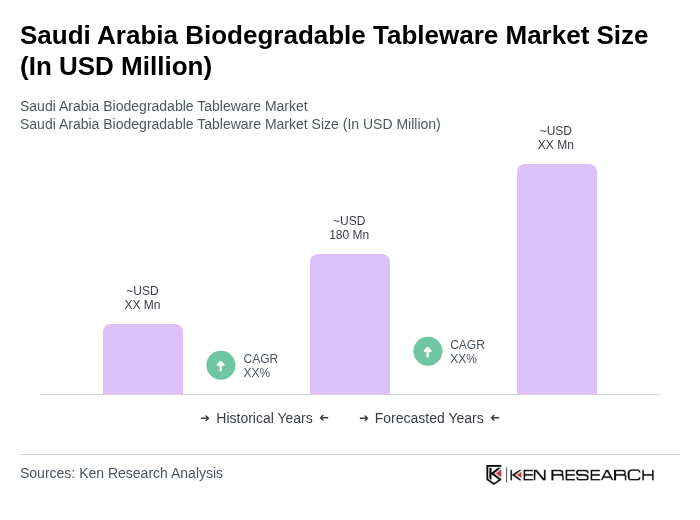
- The Saudi Arabia Biodegradable Tableware Market is valued at USD 180 million, based on a five-year historical analysis. This growth is primarily driven by increasing environmental awareness, government initiatives promoting sustainability, and a shift in consumer preferences towards eco-friendly products. The rising demand for biodegradable alternatives in food service and retail sectors has significantly contributed to the market's expansion.
- Key cities such as Riyadh, Jeddah, and Dammam dominate the market due to their high population density and robust food service industries. These urban centers are witnessing a surge in restaurants, cafes, and catering services that prefer biodegradable tableware to align with sustainability goals and meet consumer demand for environmentally friendly options.
- The “Technical Regulation for Biodegradable Plastic Products” (SASO 2879:2016), issued by the Saudi Standards, Metrology and Quality Organization (SASO), mandates that plastic products, including tableware and food packaging, must be oxo-biodegradable and certified accordingly. This regulation requires compliance with specific biodegradability standards and labeling, directly impacting the adoption of biodegradable tableware across food service establishments.
Saudi Arabia Biodegradable Tableware Market Segmentation
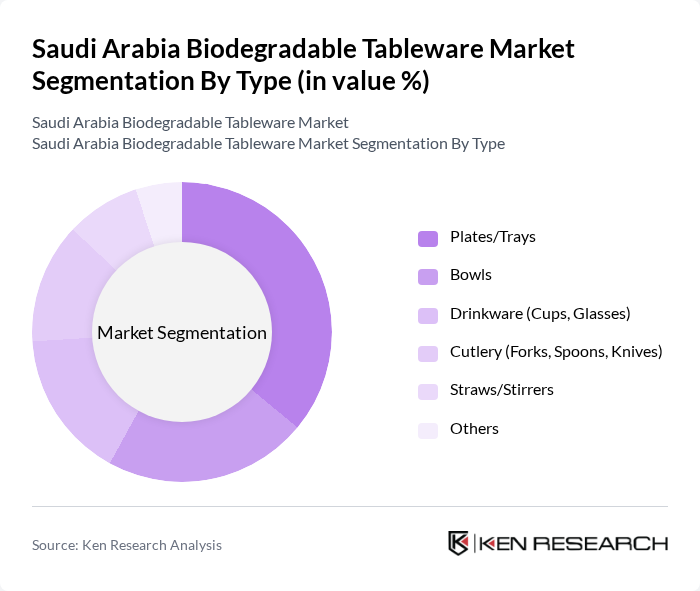
By Type:The biodegradable tableware market can be segmented into various types, including Plates/Trays, Bowls, Drinkware (Cups, Glasses), Cutlery (Forks, Spoons, Knives), Straws/Stirrers, and Others. Among these, Plates/Trays are the most dominant sub-segment, driven by their extensive use in restaurants and catering services. The growing trend of takeaway and delivery services has further fueled the demand for these products, as they are essential for serving food conveniently and sustainably.
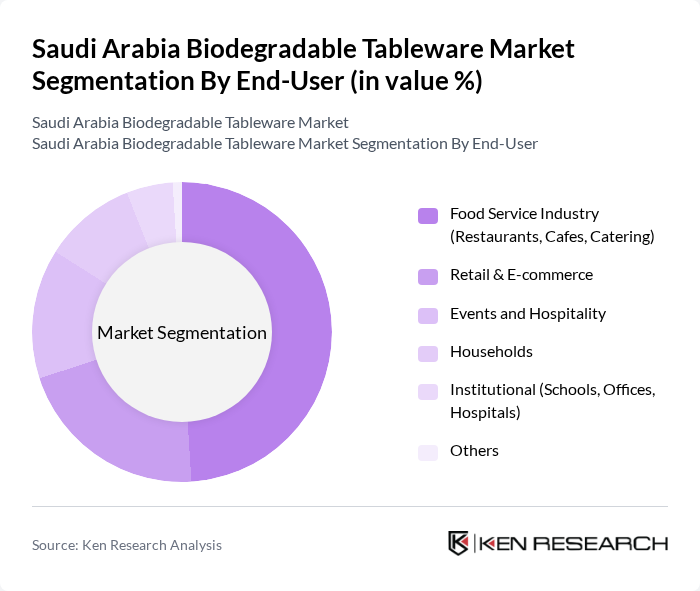
By End-User:The market can also be segmented by end-user categories, including Food Service Industry (Restaurants, Cafes, Catering), Retail & E-commerce, Events and Hospitality, Households, Institutional (Schools, Offices, Hospitals), and Others. The Food Service Industry is the leading segment, as restaurants and catering services increasingly adopt biodegradable tableware to meet consumer preferences for sustainable dining options. This trend is further supported by government regulations promoting eco-friendly practices.
Saudi Arabia Biodegradable Tableware Market Competitive Landscape
The Saudi Arabia Biodegradable Tableware Market is characterized by a dynamic mix of regional and international players. Leading participants such as BioPak, Huhtamäki Oyj, Genpak LLC, Bionatic GmbH & Co. KG, Pactiv Evergreen Inc., Reynolds Consumer Products Inc., Dart Container Corporation, PAPSTAR GmbH, Biotrem, NatureWorks LLC, Eco-Products, Inc., Green Paper Products LLC, World Centric, Apollo Global Management Inc. (via portfolio companies), Earthware Saudi Arabia contribute to innovation, geographic expansion, and service delivery in this space.
Saudi Arabia Biodegradable Tableware Market Industry Analysis
Growth Drivers
- Increasing Environmental Awareness:The growing concern over plastic pollution has led to a significant rise in environmental awareness among consumers in Saudi Arabia. According to a survey by the Saudi Ministry of Environment, 68% of respondents expressed a preference for eco-friendly products. This shift is driving demand for biodegradable tableware, as consumers seek sustainable alternatives to traditional plastic options, which are increasingly viewed as harmful to the environment.
- Government Initiatives for Sustainability:The Saudi government has implemented various initiatives aimed at promoting sustainability, including the Vision 2030 plan, which emphasizes reducing waste and promoting green products. The government allocated SAR 1.5 billion (approximately USD 400 million) to support sustainable manufacturing practices. These initiatives are expected to bolster the biodegradable tableware market by encouraging manufacturers to adopt eco-friendly production methods and technologies.
- Rising Demand from Food Service Industry:The food service industry in Saudi Arabia is experiencing rapid growth, with the market projected to reach SAR 100 billion (approximately USD 26.6 billion). This expansion is driving demand for biodegradable tableware, as restaurants and cafes increasingly seek sustainable options to meet consumer preferences. The trend is further supported by a report indicating that 75% of food service operators are actively seeking eco-friendly packaging solutions.
Market Challenges
- High Production Costs:One of the significant challenges facing the biodegradable tableware market in Saudi Arabia is the high production costs associated with eco-friendly materials. For instance, the cost of raw materials for biodegradable products can be up to 30% higher than conventional plastics. This price disparity can deter manufacturers from transitioning to sustainable options, limiting market growth and accessibility for consumers seeking affordable alternatives.
- Limited Consumer Awareness:Despite increasing environmental awareness, there remains a significant gap in consumer knowledge regarding biodegradable products. A study revealed that only 45% of consumers in Saudi Arabia are familiar with the benefits of biodegradable tableware. This lack of awareness can hinder market growth, as consumers may be reluctant to choose these products over traditional options due to misconceptions about their performance and environmental impact.
Saudi Arabia Biodegradable Tableware Market Future Outlook
The future of the biodegradable tableware market in Saudi Arabia appears promising, driven by increasing environmental consciousness and supportive government policies. As consumer preferences shift towards sustainable products, manufacturers are likely to innovate and expand their offerings. Additionally, the rise of e-commerce platforms will facilitate greater access to biodegradable options, enhancing market penetration. The ongoing collaboration between businesses and the food service sector will further solidify the market's growth trajectory, positioning it favorably in future.
Market Opportunities
- Expansion in E-commerce Platforms:The growth of e-commerce in Saudi Arabia presents a significant opportunity for biodegradable tableware. With online retail sales projected to reach SAR 30 billion (approximately USD 8 billion), businesses can leverage digital platforms to reach environmentally conscious consumers, enhancing product visibility and accessibility.
- Collaborations with Restaurants and Cafes:Partnering with restaurants and cafes can create substantial opportunities for biodegradable tableware manufacturers. As the food service industry increasingly prioritizes sustainability, collaborations can lead to bulk orders and brand loyalty, driving sales and market penetration while promoting eco-friendly practices within the sector.
Scope of the Report
| Segment | Sub-Segments |
|---|---|
| By Type | Plates/Trays Bowls Drinkware (Cups, Glasses) Cutlery (Forks, Spoons, Knives) Straws/Stirrers Others |
| By End-User | Food Service Industry (Restaurants, Cafes, Catering) Retail & E-commerce Events and Hospitality Households Institutional (Schools, Offices, Hospitals) Others |
| By Material | Bagasse (Sugarcane Fiber) PLA/Bioplastics Bamboo Palm Leaf Paper/Cardboard Wood Others |
| By Distribution Channel | Online Retail Supermarkets/Hypermarkets Specialty Stores Direct Sales (B2B) Others |
| By Region | Central Region Eastern Region Western Region Southern Region |
| By Application | Food Packaging Takeaway & Delivery Services In-Store Dining Events and Festivals Others |
| By Price Range | Economy Mid-Range Premium Others |
Key Target Audience
Investors and Venture Capitalist Firms
Government and Regulatory Bodies (e.g., Saudi Food and Drug Authority, Ministry of Environment, Water and Agriculture)
Manufacturers and Producers
Distributors and Retailers
Hospitality and Food Service Providers
Environmental NGOs and Advocacy Groups
Packaging and Material Suppliers
Waste Management and Recycling Companies
Players Mentioned in the Report:
BioPak
Huhtamaki Oyj
Genpak LLC
Bionatic GmbH & Co. KG
Pactiv Evergreen Inc.
Reynolds Consumer Products Inc.
Dart Container Corporation
PAPSTAR GmbH
Biotrem
NatureWorks LLC
Eco-Products, Inc.
Green Paper Products LLC
World Centric
Apollo Global Management Inc. (via portfolio companies)
Earthware Saudi Arabia
Table of Contents
Market Assessment Phase
1. Executive Summary and Approach
2. Saudi Arabia Biodegradable Tableware Market Overview
2.1 Key Insights and Strategic Recommendations
2.2 Saudi Arabia Biodegradable Tableware Market Overview
2.3 Definition and Scope
2.4 Evolution of Market Ecosystem
2.5 Timeline of Key Regulatory Milestones
2.6 Value Chain & Stakeholder Mapping
2.7 Business Cycle Analysis
2.8 Policy & Incentive Landscape
3. Saudi Arabia Biodegradable Tableware Market Analysis
3.1 Growth Drivers
3.1.1 Increasing Environmental Awareness
3.1.2 Government Initiatives for Sustainability
3.1.3 Rising Demand from Food Service Industry
3.1.4 Shift Towards Eco-Friendly Products
3.2 Market Challenges
3.2.1 High Production Costs
3.2.2 Limited Consumer Awareness
3.2.3 Competition from Conventional Tableware
3.2.4 Regulatory Compliance Issues
3.3 Market Opportunities
3.3.1 Expansion in E-commerce Platforms
3.3.2 Collaborations with Restaurants and Cafes
3.3.3 Development of Innovative Products
3.3.4 Export Potential to Neighboring Markets
3.4 Market Trends
3.4.1 Growth of Online Retailing
3.4.2 Increasing Use of Biodegradable Materials
3.4.3 Customization and Personalization in Products
3.4.4 Adoption of Circular Economy Practices
3.5 Government Regulation
3.5.1 Ban on Single-Use Plastics
3.5.2 Incentives for Sustainable Manufacturing
3.5.3 Standards for Biodegradable Products
3.5.4 Environmental Impact Assessments
4. SWOT Analysis
5. Stakeholder Analysis
6. Porter's Five Forces Analysis
7. Saudi Arabia Biodegradable Tableware Market Market Size, 2019-2024
7.1 By Value
7.2 By Volume
7.3 By Average Selling Price
8. Saudi Arabia Biodegradable Tableware Market Segmentation
8.1 By Type
8.1.1 Plates/Trays
8.1.2 Bowls
8.1.3 Drinkware (Cups, Glasses)
8.1.4 Cutlery (Forks, Spoons, Knives)
8.1.5 Straws/Stirrers
8.1.6 Others
8.2 By End-User
8.2.1 Food Service Industry (Restaurants, Cafes, Catering)
8.2.2 Retail & E-commerce
8.2.3 Events and Hospitality
8.2.4 Households
8.2.5 Institutional (Schools, Offices, Hospitals)
8.2.6 Others
8.3 By Material
8.3.1 Bagasse (Sugarcane Fiber)
8.3.2 PLA/Bioplastics
8.3.3 Bamboo
8.3.4 Palm Leaf
8.3.5 Paper/Cardboard
8.3.6 Wood
8.3.7 Others
8.4 By Distribution Channel
8.4.1 Online Retail
8.4.2 Supermarkets/Hypermarkets
8.4.3 Specialty Stores
8.4.4 Direct Sales (B2B)
8.4.5 Others
8.5 By Region
8.5.1 Central Region
8.5.2 Eastern Region
8.5.3 Western Region
8.5.4 Southern Region
8.6 By Application
8.6.1 Food Packaging
8.6.2 Takeaway & Delivery Services
8.6.3 In-Store Dining
8.6.4 Events and Festivals
8.6.5 Others
8.7 By Price Range
8.7.1 Economy
8.7.2 Mid-Range
8.7.3 Premium
8.7.4 Others
9. Saudi Arabia Biodegradable Tableware Market Competitive Analysis
9.1 Market Share of Key Players
9.2 Cross Comparison of Key Players
9.2.1 Company Name
9.2.2 Group Size (Large, Medium, or Small as per industry convention)
9.2.3 Revenue Growth Rate (YoY %)
9.2.4 Market Penetration Rate (Share of Saudi Arabia Tableware Market %)
9.2.5 Customer Retention Rate (%)
9.2.6 Product Diversification Index (Number of SKUs/Segments)
9.2.7 Pricing Strategy (Economy, Mid-Range, Premium)
9.2.8 Distribution Efficiency (Number of Channels/Regions Served)
9.2.9 Brand Recognition Score (Survey/Market Study)
9.2.10 Sustainability Index (Certifications, % Compostable/Biodegradable)
9.3 SWOT Analysis of Top Players
9.4 Pricing Analysis
9.5 Detailed Profile of Major Companies
9.5.1 BioPak
9.5.2 Huhtamäki Oyj
9.5.3 Genpak LLC
9.5.4 Bionatic GmbH & Co. KG
9.5.5 Pactiv Evergreen Inc.
9.5.6 Reynolds Consumer Products Inc.
9.5.7 Dart Container Corporation
9.5.8 PAPSTAR GmbH
9.5.9 Biotrem
9.5.10 NatureWorks LLC
9.5.11 Eco-Products, Inc.
9.5.12 Green Paper Products LLC
9.5.13 World Centric
9.5.14 Apollo Global Management Inc. (via portfolio companies)
9.5.15 Earthware Saudi Arabia
10. Saudi Arabia Biodegradable Tableware Market End-User Analysis
10.1 Procurement Behavior of Key Ministries
10.1.1 Ministry of Environment
10.1.2 Ministry of Commerce
10.1.3 Ministry of Municipal and Rural Affairs
10.1.4 Ministry of Health
10.2 Corporate Spend on Infrastructure & Energy
10.2.1 Corporate Sustainability Initiatives
10.2.2 Investment in Green Technologies
10.2.3 Budget Allocation for Eco-Friendly Products
10.2.4 Partnerships with Sustainable Suppliers
10.3 Pain Point Analysis by End-User Category
10.3.1 Cost Constraints
10.3.2 Quality Concerns
10.3.3 Availability of Products
10.3.4 Compliance with Regulations
10.4 User Readiness for Adoption
10.4.1 Awareness Levels
10.4.2 Willingness to Pay
10.4.3 Training and Support Needs
10.4.4 Feedback Mechanisms
10.5 Post-Deployment ROI and Use Case Expansion
10.5.1 Measurement of Environmental Impact
10.5.2 Cost Savings Analysis
10.5.3 Customer Satisfaction Metrics
10.5.4 Opportunities for Product Line Expansion
11. Saudi Arabia Biodegradable Tableware Market Future Size, 2025-2030
11.1 By Value
11.2 By Volume
11.3 By Average Selling Price
Go-To-Market Strategy Phase
1. Whitespace Analysis + Business Model Canvas
1.1 Market Gaps Identification
1.2 Business Model Framework
2. Marketing and Positioning Recommendations
2.1 Branding Strategies
2.2 Product USPs
3. Distribution Plan
3.1 Urban Retail Strategies
3.2 Rural NGO Tie-ups
4. Channel & Pricing Gaps
4.1 Underserved Routes
4.2 Pricing Bands
5. Unmet Demand & Latent Needs
5.1 Category Gaps
5.2 Consumer Segments
6. Customer Relationship
6.1 Loyalty Programs
6.2 After-sales Service
7. Value Proposition
7.1 Sustainability
7.2 Integrated Supply Chains
8. Key Activities
8.1 Regulatory Compliance
8.2 Branding
8.3 Distribution Setup
9. Entry Strategy Evaluation
9.1 Domestic Market Entry Strategy
9.1.1 Product Mix
9.1.2 Pricing Band
9.1.3 Packaging
9.2 Export Entry Strategy
9.2.1 Target Countries
9.2.2 Compliance Roadmap
10. Entry Mode Assessment
10.1 Joint Ventures
10.2 Greenfield Investments
10.3 Mergers & Acquisitions
10.4 Distributor Model
11. Capital and Timeline Estimation
11.1 Capital Requirements
11.2 Timelines
12. Control vs Risk Trade-Off
12.1 Ownership vs Partnerships
13. Profitability Outlook
13.1 Breakeven Analysis
13.2 Long-term Sustainability
14. Potential Partner List
14.1 Distributors
14.2 Joint Ventures
14.3 Acquisition Targets
15. Execution Roadmap
15.1 Phased Plan for Market Entry
15.1.1 Market Setup
15.1.2 Market Entry
15.1.3 Growth Acceleration
15.1.4 Scale & Stabilize
15.2 Key Activities and Milestones
15.2.1 Activity Planning
15.2.2 Milestone Tracking
Research Methodology
Phase 1: Approach1
Desk Research
- Analysis of market reports from industry associations and government publications
- Review of academic journals and articles focusing on biodegradable materials and their applications
- Examination of trade statistics and import/export data related to biodegradable tableware
Primary Research
- Interviews with manufacturers of biodegradable tableware to understand production capabilities
- Surveys with retailers to gauge consumer preferences and purchasing behavior
- Focus groups with end-users to assess awareness and acceptance of biodegradable products
Validation & Triangulation
- Cross-validation of findings through multiple data sources including trade publications and expert opinions
- Triangulation of market size estimates using both qualitative and quantitative data
- Sanity checks through feedback from industry experts and stakeholders
Phase 2: Market Size Estimation1
Top-down Assessment
- Estimation of total market size based on national consumption patterns of disposable tableware
- Segmentation of the market by product type, including plates, cups, and cutlery
- Incorporation of growth rates from sustainability initiatives and government regulations
Bottom-up Modeling
- Collection of sales data from key manufacturers and distributors in the biodegradable tableware sector
- Estimation of average selling prices across different product categories
- Calculation of market size based on production volumes and pricing strategies
Forecasting & Scenario Analysis
- Development of forecasts based on historical growth trends and market drivers
- Scenario analysis considering potential regulatory changes and shifts in consumer behavior
- Creation of multiple growth scenarios (baseline, optimistic, and pessimistic) through 2030
Phase 3: CATI Sample Composition1
| Scope Item/Segment | Sample Size | Target Respondent Profiles |
|---|---|---|
| Manufacturers of Biodegradable Tableware | 60 | Production Managers, R&D Heads |
| Retailers of Disposable Products | 50 | Store Managers, Category Buyers |
| End-Users in Food Service Industry | 45 | Restaurant Owners, Catering Managers |
| Environmental NGOs and Advocacy Groups | 40 | Sustainability Advocates, Policy Makers |
| Consumers in Urban Areas | 100 | General Public, Eco-conscious Shoppers |
Frequently Asked Questions
What is the current value of the Saudi Arabia Biodegradable Tableware Market?
The Saudi Arabia Biodegradable Tableware Market is valued at approximately USD 180 million, reflecting a significant growth trend driven by increasing environmental awareness and consumer demand for sustainable products.
What factors are driving the growth of the biodegradable tableware market in Saudi Arabia?
Which cities in Saudi Arabia are leading in the biodegradable tableware market?
What regulations impact the biodegradable tableware market in Saudi Arabia?
Other Regional/Country Reports
Indonesia Biodegradable Tableware Market
Malaysia Biodegradable Tableware Market
KSA Biodegradable Tableware Market
APAC Biodegradable Tableware Market
SEA Biodegradable Tableware Market
Vietnam Biodegradable Tableware Market
Other Adjacent Reports
Singapore Sustainable Food Packaging Market
UAE Eco-Friendly Disposables Market
Malaysia Compostable Products Market
Bahrain Bioplastics Market Report Size Share Growth Drivers Trends Opportunities & Forecast 2025–2030UAE Food Service Packaging MarketUAE Disposable Cutlery Market
Philippines Green Tableware Market
UAE Renewable Materials Market
Indonesia Environmental Packaging Market
Why Buy From Us?

What makes us stand out is that our consultants follow Robust, Refine and Result (RRR) methodology. Robust for clear definitions, approaches and sanity checking, Refine for differentiating respondents' facts and opinions, and Result for presenting data with story.

We have set a benchmark in the industry by offering our clients with syndicated and customized market research reports featuring coverage of entire market as well as meticulous research and analyst insights.

While we don't replace traditional research, we flip the method upside down. Our dual approach of Top Bottom & Bottom Top ensures quality deliverable by not just verifying company fundamentals but also looking at the sector and macroeconomic factors.

With one step in the future, our research team constantly tries to show you the bigger picture. We help with some of the tough questions you may encounter along the way: How is the industry positioned? Best marketing channel? KPI's of competitors? By aligning every element, we help maximize success.

Our report gives you instant access to the answers and sources that other companies might choose to hide. We elaborate each steps of research methodology we have used and showcase you the sample size to earn your trust.

If you need any support, we are here! We pride ourselves on universe strength, data quality, and quick, friendly, and professional service.