About the Report
Base Year 2024Saudi Arabia Fresh Fish Market Overview
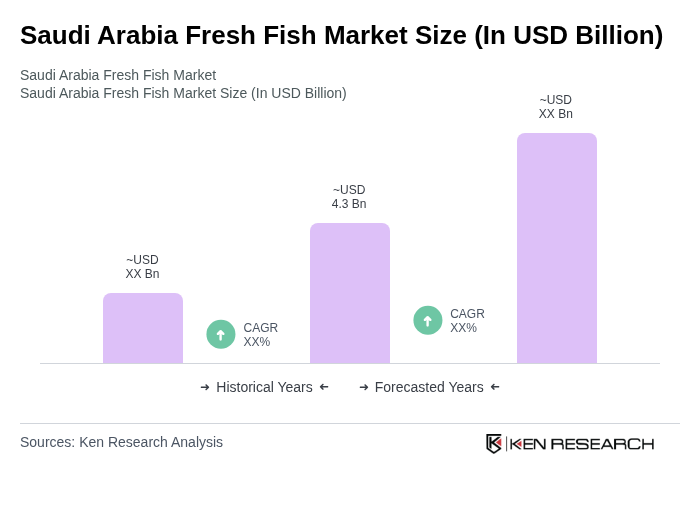
- The Saudi Arabia Fresh Fish Market is valued at USD 4.3 billion, based on a five-year historical analysis. This growth is primarily driven by increasing consumer demand for fresh seafood, heightened health consciousness, and the rising popularity of fish as a protein source. The market has seen a significant uptick in both domestic consumption and exports, reflecting a broader trend towards sustainable and healthy eating habits. Key growth drivers include government initiatives to boost local seafood production, expansion of aquaculture, and technological advancements in fish farming and distribution .
- Key cities such as Jeddah, Riyadh, and Dammam dominate the market due to their strategic coastal locations and robust infrastructure. Jeddah, being a major port city, facilitates the import and export of seafood, while Riyadh serves as a central hub for distribution. Dammam's proximity to the Arabian Gulf enhances its access to fresh fish, making these cities pivotal in the fresh fish supply chain .
- In 2023, the Saudi government implemented regulations to promote sustainable fishing practices, including the introduction of quotas and licensing for fishing vessels. This initiative aims to protect marine biodiversity and ensure the long-term viability of fish stocks, aligning with the country's Vision 2030 goals for environmental sustainability and economic diversification. The operational framework is governed by the “Executive Regulations for Fisheries Resources,” issued by the Ministry of Environment, Water and Agriculture in 2023, which mandates vessel licensing, catch quotas, and compliance with sustainable fishing standards .
Saudi Arabia Fresh Fish Market Segmentation
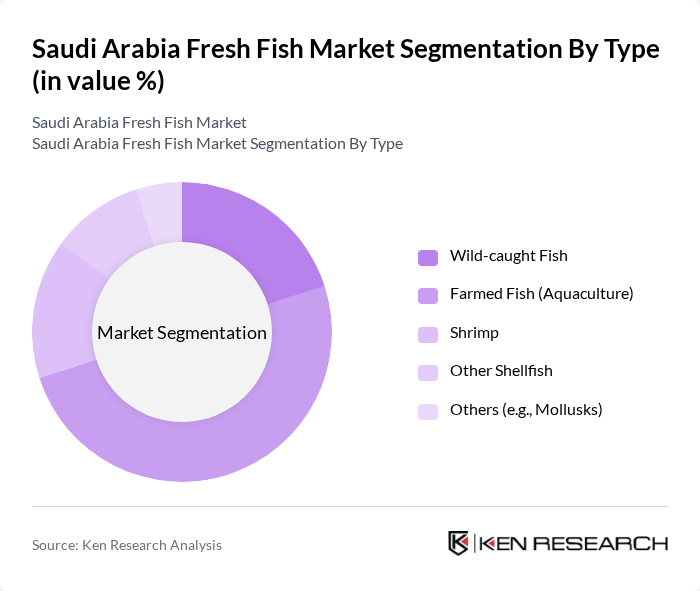
By Type:The market is segmented into various types, including Wild-caught Fish, Farmed Fish (Aquaculture), Shrimp, Other Shellfish, and Others (e.g., Mollusks). Among these, Farmed Fish (Aquaculture) is the leading sub-segment due to the increasing demand for sustainable seafood and the ability to control production quality. The trend towards aquaculture is driven by consumer preferences for fresh, locally sourced fish, as well as government support for aquaculture initiatives. Recent advancements in recirculating aquaculture systems and automated feeding are further boosting production efficiency and sustainability .
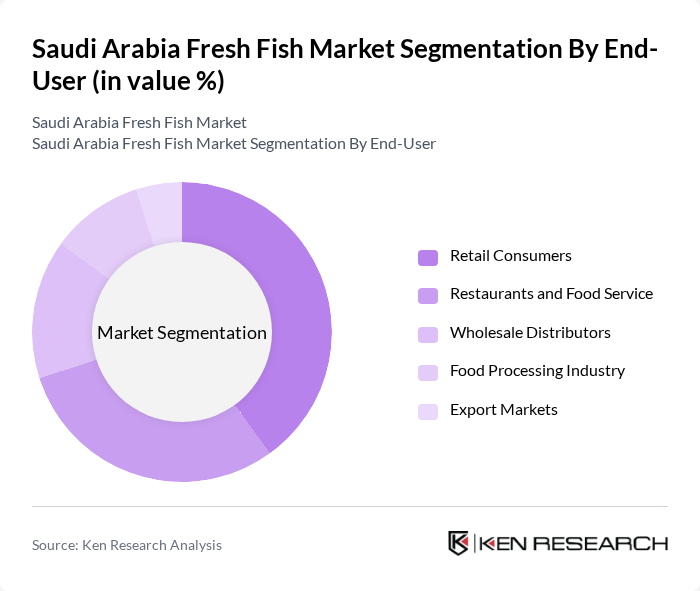
By End-User:The end-user segmentation includes Retail Consumers, Restaurants and Food Service, Wholesale Distributors, Food Processing Industry, and Export Markets. The Retail Consumers segment is currently the dominant sub-segment, driven by the increasing trend of home cooking and the growing awareness of the health benefits of fish consumption. This shift in consumer behavior has led to a rise in demand for fresh fish in supermarkets and local markets. The expansion of retail channels and the growing middle class further support this trend .
Saudi Arabia Fresh Fish Market Competitive Landscape
The Saudi Arabia Fresh Fish Market is characterized by a dynamic mix of regional and international players. Leading participants such as National Aquaculture Group (NAQUA), Saudi Fisheries Company (SFC), Almunajem Foods, Arab Fisheries Co., International Seafood Company (IZAFCO LLC), Tabuk Fisheries Company, Shell Fisheries Company W.L.L., Jazan Energy and Development Company (JAZADCO), Al Ameen Fisheries, Al Dabbagh Group, Al Watania Fisheries, Al Qarah Fish Company, Red Sea Fish Company, Al Badr Fisheries, Al Safi Danone (Seafood Division) contribute to innovation, geographic expansion, and service delivery in this space.
Saudi Arabia Fresh Fish Market Industry Analysis
Growth Drivers
- Increasing Consumer Demand for Fresh Seafood:The demand for fresh seafood in Saudi Arabia has surged, with consumption reaching approximately 1.3 million tons in future. This growth is driven by a population of over 33.4 million, where seafood is increasingly viewed as a healthy dietary choice. The World Bank projects that the country's GDP will grow by 3.3% in future, further boosting disposable incomes and consumer spending on fresh fish products.
- Government Initiatives to Boost Local Fisheries:The Saudi government has invested over SAR 1 billion (approximately USD 267 million) in initiatives aimed at enhancing local fisheries. These initiatives include subsidies for fishing equipment and training programs for local fishermen. The Ministry of Environment, Water, and Agriculture aims to increase local fish production by 35% in future, which will significantly contribute to the fresh fish market's growth.
- Rising Health Consciousness Among Consumers:Health awareness in Saudi Arabia is on the rise, with a reported 65% of consumers prioritizing healthy eating habits. The consumption of fish, rich in omega-3 fatty acids, is increasingly promoted by health organizations. The Saudi Food and Drug Authority has also launched campaigns to encourage seafood consumption, which is expected to drive the fresh fish market's growth, with an estimated increase in demand of 20% in future.
Market Challenges
- Overfishing and Sustainability Concerns:Overfishing poses a significant threat to the sustainability of fish stocks in Saudi waters. Reports indicate that 65% of fish species are overexploited, leading to a decline in local fish populations. This situation raises concerns among consumers and environmentalists, potentially impacting market growth as sustainability becomes a priority for both consumers and regulatory bodies.
- Regulatory Compliance and Enforcement Issues:The regulatory landscape for the fishing industry in Saudi Arabia is complex, with numerous compliance requirements. In future, only 45% of local fisheries met the necessary health and safety standards. This lack of compliance not only affects market credibility but also poses challenges for businesses seeking to expand, as they must navigate stringent regulations and potential penalties for non-compliance.
Saudi Arabia Fresh Fish Market Future Outlook
The future of the Saudi Arabia fresh fish market appears promising, driven by increasing consumer awareness and government support for local fisheries. As the population continues to grow, the demand for fresh seafood is expected to rise, particularly among health-conscious consumers. Additionally, advancements in aquaculture and sustainable fishing practices will likely enhance supply capabilities, ensuring that the market can meet the evolving preferences of consumers while addressing sustainability concerns.
Market Opportunities
- Growth in Aquaculture Practices:The aquaculture sector in Saudi Arabia is projected to expand significantly, with production expected to reach 700,000 tons in future. This growth presents an opportunity for local businesses to meet rising demand while ensuring sustainability, as aquaculture can alleviate pressure on wild fish stocks and provide a consistent supply of fresh fish.
- Development of Value-Added Fish Products:There is a growing trend towards value-added fish products, such as ready-to-cook and marinated fish. The market for these products is expected to grow by 25% annually, driven by busy lifestyles and the increasing popularity of convenience foods. This presents a lucrative opportunity for manufacturers to innovate and cater to changing consumer preferences.
Scope of the Report
| Segment | Sub-Segments |
|---|---|
| By Type | Wild-caught Fish Farmed Fish (Aquaculture) Shrimp Other Shellfish Others (e.g., Mollusks) |
| By End-User | Retail Consumers Restaurants and Food Service Wholesale Distributors Food Processing Industry Export Markets |
| By Distribution Channel | Supermarkets and Hypermarkets Fish Markets Online Retail Direct Sales Institutional Sales Others |
| By Region | Western Region Northern & Central Region Eastern Region Southern Region |
| By Product Form | Fresh / Chilled Frozen Canned Processed (e.g., fillets, value-added) Others |
| By Quality Grade | Premium Quality Standard Quality Economy Quality Others |
| By Packaging Type | Vacuum Sealed Modified Atmosphere Packaging Bulk Packaging Others |
Key Target Audience
Investors and Venture Capitalist Firms
Government and Regulatory Bodies (e.g., Saudi Food and Drug Authority, Ministry of Environment, Water and Agriculture)
Manufacturers and Producers
Distributors and Retailers
Seafood Exporters
Logistics and Supply Chain Companies
Industry Associations (e.g., Saudi Fisheries Association)
Financial Institutions
Players Mentioned in the Report:
National Aquaculture Group (NAQUA)
Saudi Fisheries Company (SFC)
Almunajem Foods
Arab Fisheries Co.
International Seafood Company (IZAFCO LLC)
Tabuk Fisheries Company
Shell Fisheries Company W.L.L.
Jazan Energy and Development Company (JAZADCO)
Al Ameen Fisheries
Al Dabbagh Group
Al Watania Fisheries
Al Qarah Fish Company
Red Sea Fish Company
Al Badr Fisheries
Al Safi Danone (Seafood Division)
Table of Contents
Market Assessment Phase
1. Executive Summary and Approach
2. Saudi Arabia Fresh Fish Market Overview
2.1 Key Insights and Strategic Recommendations
2.2 Saudi Arabia Fresh Fish Market Overview
2.3 Definition and Scope
2.4 Evolution of Market Ecosystem
2.5 Timeline of Key Regulatory Milestones
2.6 Value Chain & Stakeholder Mapping
2.7 Business Cycle Analysis
2.8 Policy & Incentive Landscape
3. Saudi Arabia Fresh Fish Market Analysis
3.1 Growth Drivers
3.1.1 Increasing consumer demand for fresh seafood
3.1.2 Government initiatives to boost local fisheries
3.1.3 Rising health consciousness among consumers
3.1.4 Expansion of distribution channels
3.2 Market Challenges
3.2.1 Overfishing and sustainability concerns
3.2.2 Regulatory compliance and enforcement issues
3.2.3 Competition from imported seafood
3.2.4 Supply chain disruptions
3.3 Market Opportunities
3.3.1 Growth in aquaculture practices
3.3.2 Development of value-added fish products
3.3.3 Export potential to neighboring countries
3.3.4 Technological advancements in fishing and processing
3.4 Market Trends
3.4.1 Shift towards organic and sustainably sourced fish
3.4.2 Increasing online sales of fresh fish
3.4.3 Rising popularity of seafood restaurants
3.4.4 Enhanced focus on traceability and food safety
3.5 Government Regulation
3.5.1 Fishing quotas and licensing requirements
3.5.2 Health and safety standards for seafood
3.5.3 Environmental protection regulations
3.5.4 Import/export regulations for seafood products
4. SWOT Analysis
5. Stakeholder Analysis
6. Porter's Five Forces Analysis
7. Saudi Arabia Fresh Fish Market Market Size, 2019-2024
7.1 By Value
7.2 By Volume
7.3 By Average Selling Price
8. Saudi Arabia Fresh Fish Market Segmentation
8.1 By Type
8.1.1 Wild-caught Fish
8.1.2 Farmed Fish (Aquaculture)
8.1.3 Shrimp
8.1.4 Other Shellfish
8.1.5 Others (e.g., Mollusks)
8.2 By End-User
8.2.1 Retail Consumers
8.2.2 Restaurants and Food Service
8.2.3 Wholesale Distributors
8.2.4 Food Processing Industry
8.2.5 Export Markets
8.3 By Distribution Channel
8.3.1 Supermarkets and Hypermarkets
8.3.2 Fish Markets
8.3.3 Online Retail
8.3.4 Direct Sales
8.3.5 Institutional Sales
8.3.6 Others
8.4 By Region
8.4.1 Western Region
8.4.2 Northern & Central Region
8.4.3 Eastern Region
8.4.4 Southern Region
8.5 By Product Form
8.5.1 Fresh / Chilled
8.5.2 Frozen
8.5.3 Canned
8.5.4 Processed (e.g., fillets, value-added)
8.5.5 Others
8.6 By Quality Grade
8.6.1 Premium Quality
8.6.2 Standard Quality
8.6.3 Economy Quality
8.6.4 Others
8.7 By Packaging Type
8.7.1 Vacuum Sealed
8.7.2 Modified Atmosphere Packaging
8.7.3 Bulk Packaging
8.7.4 Others
9. Saudi Arabia Fresh Fish Market Competitive Analysis
9.1 Market Share of Key Players
9.2 Cross Comparison of Key Players
9.2.1 Company Name
9.2.2 Group Size (Large, Medium, or Small as per industry convention)
9.2.3 Annual Revenue (SAR/USD)
9.2.4 Revenue Growth Rate (%)
9.2.5 Market Share (%)
9.2.6 Production Capacity (tons/year)
9.2.7 Product Portfolio Breadth (Number of SKUs/species)
9.2.8 Distribution Network Coverage (Number of outlets/regions served)
9.2.9 Export Ratio (% of revenue from exports)
9.2.10 Supply Chain Efficiency (Lead time, cold chain reliability)
9.2.11 Sustainability Certifications (e.g., ASC, BAP)
9.2.12 Customer Segments Served (Retail, HORECA, Processing, Export)
9.3 SWOT Analysis of Top Players
9.4 Pricing Analysis
9.5 Detailed Profile of Major Companies
9.5.1 National Aquaculture Group (NAQUA)
9.5.2 Saudi Fisheries Company (SFC)
9.5.3 Almunajem Foods
9.5.4 Arab Fisheries Co.
9.5.5 International Seafood Company (IZAFCO LLC)
9.5.6 Tabuk Fisheries Company
9.5.7 Shell Fisheries Company W.L.L.
9.5.8 Jazan Energy and Development Company (JAZADCO)
9.5.9 Al Ameen Fisheries
9.5.10 Al Dabbagh Group
9.5.11 Al Watania Fisheries
9.5.12 Al Qarah Fish Company
9.5.13 Red Sea Fish Company
9.5.14 Al Badr Fisheries
9.5.15 Al Safi Danone (Seafood Division)
10. Saudi Arabia Fresh Fish Market End-User Analysis
10.1 Procurement Behavior of Key Ministries
10.1.1 Ministry of Environment, Water and Agriculture
10.1.2 Ministry of Commerce
10.1.3 Ministry of Health
10.1.4 Ministry of Municipal and Rural Affairs
10.2 Corporate Spend on Infrastructure & Energy
10.2.1 Investment in Cold Storage Facilities
10.2.2 Expenditure on Transportation Logistics
10.2.3 Budget for Quality Control Measures
10.2.4 Funding for Research and Development
10.3 Pain Point Analysis by End-User Category
10.3.1 Supply Chain Inefficiencies
10.3.2 Quality Assurance Challenges
10.3.3 Price Volatility
10.3.4 Regulatory Compliance Issues
10.4 User Readiness for Adoption
10.4.1 Awareness of Sustainable Practices
10.4.2 Willingness to Pay for Quality
10.4.3 Adoption of Technology in Procurement
10.4.4 Training and Skill Development Needs
10.5 Post-Deployment ROI and Use Case Expansion
10.5.1 Measurement of Cost Savings
10.5.2 Evaluation of Customer Satisfaction
10.5.3 Analysis of Market Share Growth
10.5.4 Identification of New Market Segments
11. Saudi Arabia Fresh Fish Market Future Size, 2025-2030
11.1 By Value
11.2 By Volume
11.3 By Average Selling Price
Go-To-Market Strategy Phase
1. Whitespace Analysis + Business Model Canvas
1.1 Market Gaps Identification
1.2 Value Proposition Development
1.3 Revenue Streams Analysis
1.4 Cost Structure Evaluation
1.5 Key Partnerships Exploration
1.6 Customer Segmentation
1.7 Channels of Distribution
2. Marketing and Positioning Recommendations
2.1 Branding Strategies
2.2 Product USPs
3. Distribution Plan
3.1 Urban Retail vs Rural NGO Tie-ups
4. Channel & Pricing Gaps
4.1 Underserved Routes
4.2 Pricing Bands
5. Unmet Demand & Latent Needs
5.1 Category Gaps
5.2 Consumer Segments
6. Customer Relationship
6.1 Loyalty Programs
6.2 After-sales Service
7. Value Proposition
7.1 Sustainability
7.2 Integrated Supply Chains
8. Key Activities
8.1 Regulatory Compliance
8.2 Branding
8.3 Distribution Setup
9. Entry Strategy Evaluation
9.1 Domestic Market Entry Strategy
9.1.1 Product Mix
9.1.2 Pricing Band
9.1.3 Packaging
9.2 Export Entry Strategy
9.2.1 Target Countries
9.2.2 Compliance Roadmap
10. Entry Mode Assessment
10.1 JV
10.2 Greenfield
10.3 M&A
10.4 Distributor Model
11. Capital and Timeline Estimation
11.1 Capital Requirements
11.2 Timelines
12. Control vs Risk Trade-Off
12.1 Ownership vs Partnerships
13. Profitability Outlook
13.1 Breakeven Analysis
13.2 Long-term Sustainability
14. Potential Partner List
14.1 Distributors
14.2 JVs
14.3 Acquisition Targets
15. Execution Roadmap
15.1 Phased Plan for Market Entry
15.1.1 Market Setup
15.1.2 Market Entry
15.1.3 Growth Acceleration
15.1.4 Scale & Stabilize
15.2 Key Activities and Milestones
15.2.1 Activity Planning
15.2.2 Milestone Tracking
Research Methodology
Phase 1: Approach1
Desk Research
- Analysis of trade statistics from the Saudi Arabian Ministry of Environment, Water and Agriculture
- Review of market reports from local seafood associations and industry publications
- Examination of consumer behavior studies and seafood consumption trends in Saudi Arabia
Primary Research
- Interviews with key stakeholders in the fresh fish supply chain, including fishermen and distributors
- Surveys conducted with seafood retailers and market managers across major cities
- Focus group discussions with consumers to understand preferences and purchasing behavior
Validation & Triangulation
- Cross-validation of findings through multiple data sources, including government reports and industry insights
- Triangulation of qualitative insights from interviews with quantitative data from surveys
- Sanity checks through expert panel reviews involving industry veterans and market analysts
Phase 2: Market Size Estimation1
Top-down Assessment
- Estimation of total market size based on national fish consumption statistics and population demographics
- Segmentation of the market by fish type, including local and imported varieties
- Incorporation of seasonal trends and regional consumption patterns across Saudi Arabia
Bottom-up Modeling
- Collection of sales data from major fish markets and retail outlets
- Estimation of average selling prices for various fish species and product forms
- Volume estimates based on supply chain data from distributors and wholesalers
Forecasting & Scenario Analysis
- Multi-factor regression analysis incorporating economic indicators and population growth rates
- Scenario modeling based on potential regulatory changes affecting fishing practices and imports
- Baseline, optimistic, and pessimistic forecasts for market growth through 2030
Phase 3: CATI Sample Composition1
| Scope Item/Segment | Sample Size | Target Respondent Profiles |
|---|---|---|
| Retail Fish Market Insights | 120 | Market Managers, Retail Buyers |
| Consumer Preferences in Fresh Fish | 150 | Household Consumers, Seafood Enthusiasts |
| Distribution Channel Analysis | 100 | Distributors, Supply Chain Managers |
| Fishermen and Catch Data | 80 | Local Fishermen, Cooperative Leaders |
| Regulatory Impact Assessment | 50 | Policy Makers, Environmental Analysts |
Frequently Asked Questions
What is the current value of the Saudi Arabia Fresh Fish Market?
The Saudi Arabia Fresh Fish Market is valued at approximately USD 4.3 billion, reflecting significant growth driven by increasing consumer demand for fresh seafood, health consciousness, and government initiatives to enhance local seafood production.
What are the main drivers of growth in the Saudi Arabia Fresh Fish Market?
Which cities are the main hubs for the fresh fish market in Saudi Arabia?
What regulations has the Saudi government implemented for sustainable fishing?
Other Regional/Country Reports
Indonesia Fresh Fish Market
Malaysia Fresh Fish Market
KSA Fresh Fish Market
APAC Fresh Fish Market
SEA Fresh Fish Market
Vietnam Fresh Fish Market
Other Adjacent Reports
Malaysia Seafood Processing Market
Bahrain Frozen Seafood Market
Malaysia Canned Seafood Market
Singapore Fish Feed Market
Indonesia Fisheries Equipment Market
Singapore Seafood Export Market
Egypt Sustainable Fishing Market
New Zealand Marine Biotechnology Market Report Size, Share, Growth Drivers, Trends, Opportunities & Forecast 2025–2030Oman Seafood Logistics Market
Why Buy From Us?

What makes us stand out is that our consultants follow Robust, Refine and Result (RRR) methodology. Robust for clear definitions, approaches and sanity checking, Refine for differentiating respondents' facts and opinions, and Result for presenting data with story.

We have set a benchmark in the industry by offering our clients with syndicated and customized market research reports featuring coverage of entire market as well as meticulous research and analyst insights.

While we don't replace traditional research, we flip the method upside down. Our dual approach of Top Bottom & Bottom Top ensures quality deliverable by not just verifying company fundamentals but also looking at the sector and macroeconomic factors.

With one step in the future, our research team constantly tries to show you the bigger picture. We help with some of the tough questions you may encounter along the way: How is the industry positioned? Best marketing channel? KPI's of competitors? By aligning every element, we help maximize success.

Our report gives you instant access to the answers and sources that other companies might choose to hide. We elaborate each steps of research methodology we have used and showcase you the sample size to earn your trust.

If you need any support, we are here! We pride ourselves on universe strength, data quality, and quick, friendly, and professional service.