About the Report
Base Year 2025Saudi Arabia Package Cooling Market Overview
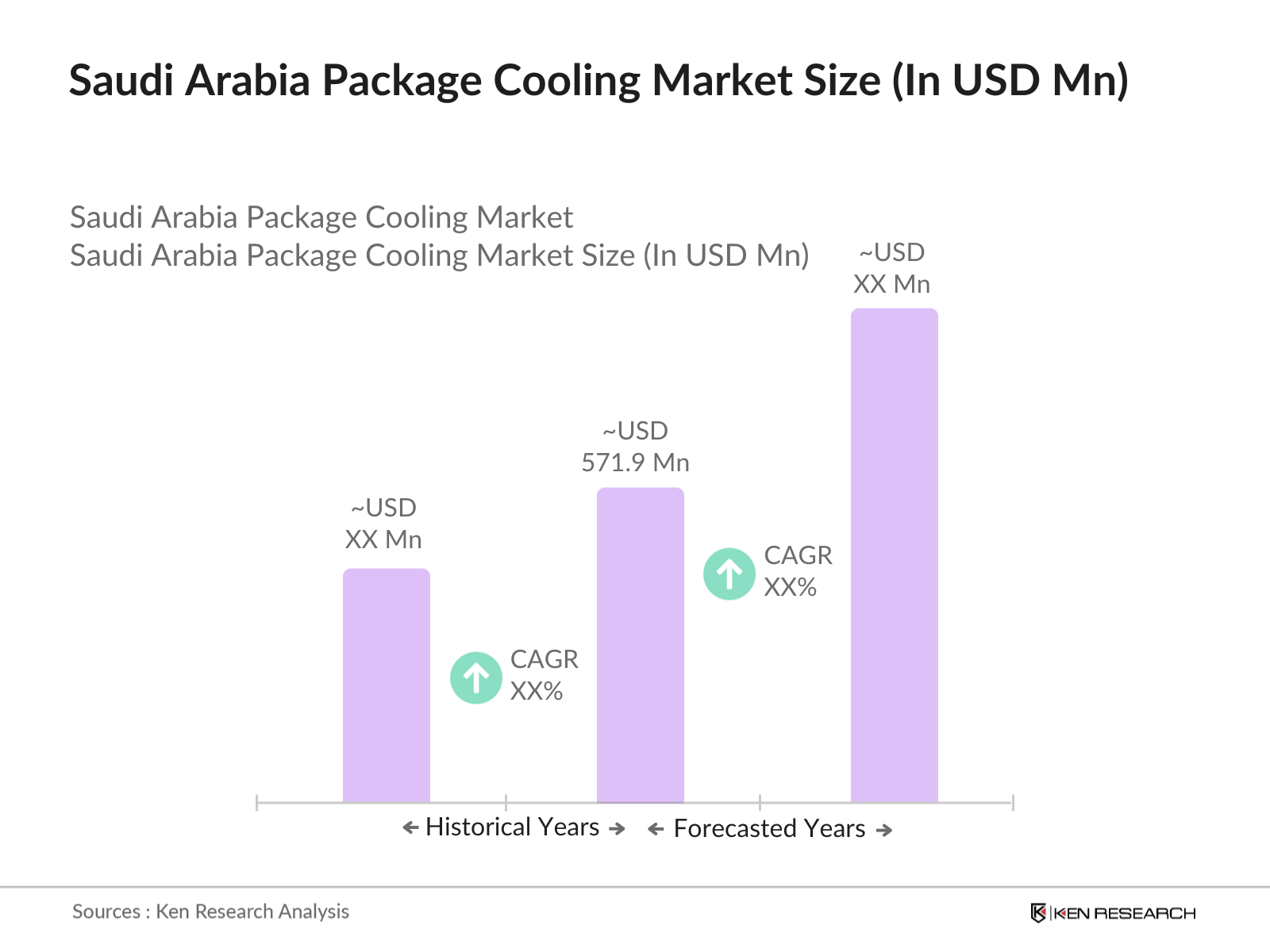
- The Saudi Arabia Package Cooling Market operates within a broader Saudi cooling-tower market benchmark of approximately USD 571.9 million, based on a five-year historical analysis. Package cooling systems comprise factory-assembled open-circuit, closed-circuit, hybrid and dry heat-rejection equipment used across HVAC, industrial processes, data centers and utilities. Demand is supported by 324 TWh of national electricity consumption, substantial process-industry activity and continuous replacement of cooling equipment operating under demanding high-temperature conditions.
- The Eastern Region, Riyadh and the Western Region form the principal demand clusters. The Eastern Region benefits from refining, petrochemicals, utilities and manufacturing, while Riyadh supports commercial buildings, data centers and major infrastructure projects. Western Saudi Arabia generates demand from hospitality, mixed-use development and industrial facilities around Jeddah. The country contains approximately 12,589 industrial establishments, creating a diversified installed base for package cooling towers, fluid coolers, retrofit equipment and lifecycle maintenance services.
- The Saudi Mechanical Code SBC 501 includes dedicated requirements under Section 908 for cooling towers, evaporative condensers and fluid coolers, while the Saudi Energy Conservation Code SBC 601 governs energy performance for non-residential HVAC installations. Imported equipment may also pass through applicable SASO and Saber conformity procedures. These requirements increase the importance of documented thermal performance, safe installation, energy-efficient motors, compliant materials, technical submittals and proper commissioning for package cooling systems supplied to Saudi projects.
Saudi Arabia Package Cooling Market Segmentation
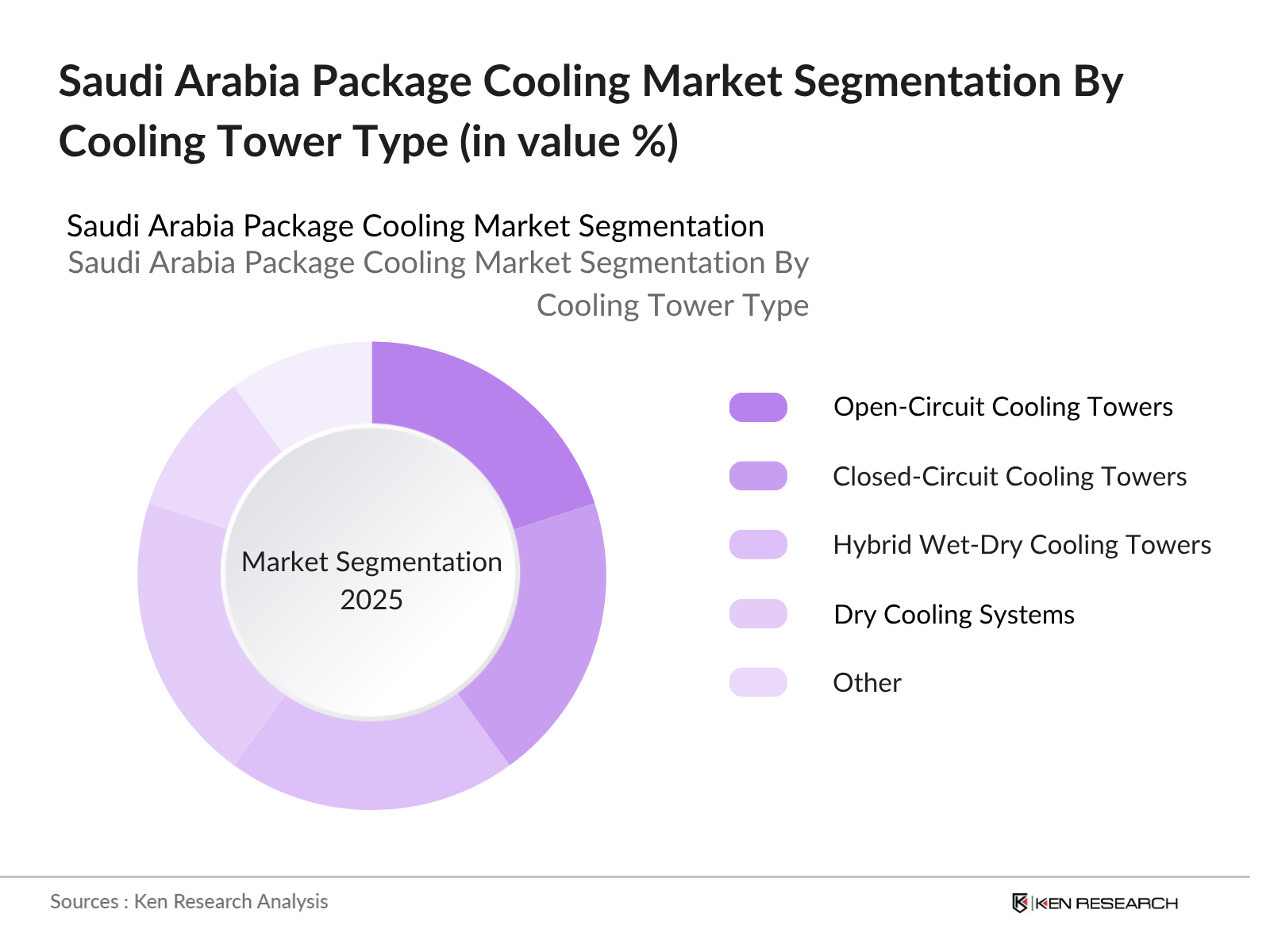
By Cooling Tower Type:Open-circuit cooling towers represent the largest segment because they provide high heat-rejection efficiency and competitive installed cost for industrial processing, HVAC and utility applications. Their established maintenance practices and ability to handle large circulating-water flows support extensive usage across Saudi Arabia. Closed-circuit towers are gaining demand where process-water isolation, cleaner circuits and lower contamination risk are required. Hybrid wet-dry systems are increasingly specified where customers need to reduce water exposure while retaining evaporative performance during extreme summer conditions. Dry cooling systems serve water-constrained applications and projects where plume, water treatment or make-up water availability presents an operating concern. The product mix is gradually shifting toward more sophisticated closed-circuit and hybrid solutions as data centers, high-value industrial operations and sustainability-focused projects place greater emphasis on water efficiency, controls, reliability and total lifecycle cost.
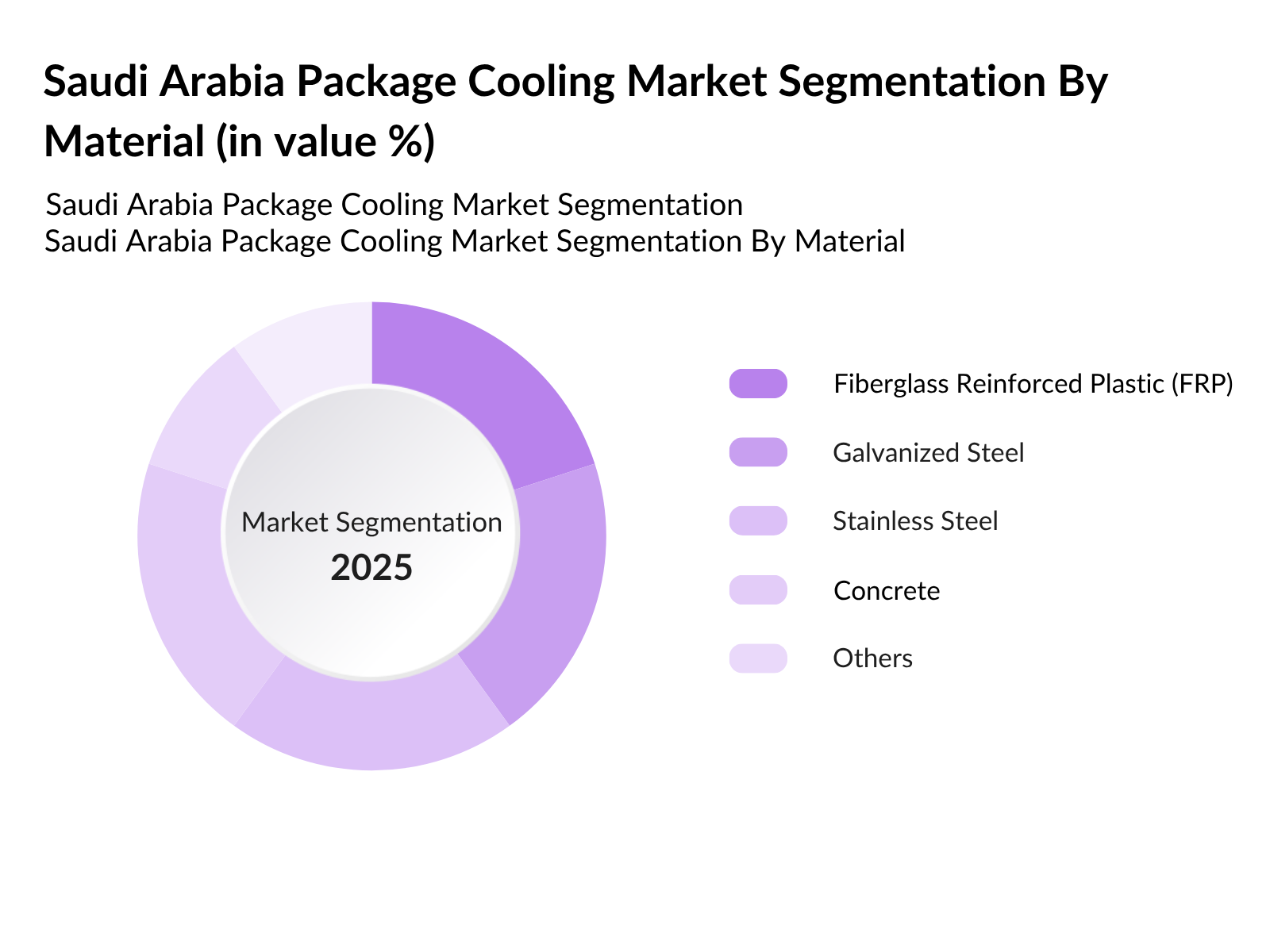
By Material:Fiberglass Reinforced Plastic is the leading material for package cooling systems because its corrosion resistance, comparatively low structural weight and suitability for factory fabrication align well with Saudi Arabia's operating environment. FRP is especially attractive where towers handle treated, reclaimed or mineral-rich water and where reduced corrosion maintenance is important. Galvanized steel remains widely used because it offers structural strength, established fabrication capability and competitive initial pricing. Stainless steel addresses demanding hygiene, corrosion and long-life applications but carries a higher material cost. Concrete is more relevant for larger or specialized installations and is less dominant in standardized package systems. HDPE provides corrosion resistance and is increasingly considered for selected compact installations. Material selection depends on circulating-water chemistry, cooling load, expected asset life, ambient conditions, project specification, CAPEX constraints and end-user maintenance philosophy.
Saudi Arabia Package Cooling Market Competitive Landscape
The Saudi Arabia Package Cooling Market combines global cooling-tower OEMs, international thermal-management companies, Saudi HVAC groups, specialist distributors and local fabrication and service providers. Leading suppliers such as SPX Cooling Technologies, Baltimore Aircoil Company, EVAPCO, Paharpur Cooling Towers and Thermax compete through thermal performance, package-tower breadth, installed project references, consultant approvals, material selection, local spare-parts availability, field-service capability and lifecycle pricing.
Saudi Arabia Package Cooling Market Industry Analysis
Growth Drivers
- Rising Electricity and Cooling Loads:Saudi electricity consumption has reached approximately 324 TWh while national peak load stands near 74.8 GW, creating a substantial heat-rejection requirement across power, commercial, industrial and infrastructure assets. Package cooling towers benefit because standardized modular systems can be installed faster than large field-built alternatives for appropriate capacities. Rising operating loads also expand demand for replacement cells, fan upgrades, fills, controls and water-management equipment required to maintain thermal performance during extended periods of extreme summer operation.
- Expansion of Industrial and Process Cooling Demand:Saudi Arabia has approximately 12,589 industrial establishments, providing a diversified addressable base for package cooling systems across petrochemicals, food processing, chemicals, metals, pharmaceuticals and advanced manufacturing. These facilities require heat rejection for compressors, process equipment, chillers and production lines. Factory-assembled cooling towers allow repeatable engineering and shorter installation periods, while modular capacity expansion enables industrial operators to add cooling incrementally as plants expand without committing immediately to larger site-erected cooling infrastructure.
- Data Center and Mission-Critical Infrastructure Development:Saudi data center operating capacity has reached approximately 440 MW, creating a growing customer segment with stringent uptime, redundancy and water-management requirements. Closed-circuit fluid coolers, hybrid wet-dry systems and modular package towers are particularly relevant because they can isolate process loops and support controllable heat rejection. High-density digital infrastructure increases demand not only for equipment but also for sensors, variable-speed fans, performance monitoring, maintenance and redundant cooling capacity needed to protect continuously operating computing assets.
Market Challenges
- Water Scarcity and Extreme Ambient Conditions:Saudi cooling equipment must operate through summer conditions that can exceed 45°C, while evaporative towers require continuous make-up water to replace evaporation, drift and blowdown. This creates a technical trade-off between thermal efficiency, electricity consumption and water demand. Closed-circuit, dry and hybrid technologies reduce water exposure but generally increase equipment complexity and initial investment. Suppliers must therefore demonstrate lifecycle economics rather than competing only on purchase price, particularly for data centers, industrial assets and sustainability-sensitive developments.
- Imported Components and Project Qualification:The Saudi cooling-tower ecosystem includes approximately 138 suppliers and service participants, but many critical fans, drives, fills, controls, coils and proprietary components continue to depend on international supply chains. A market handling around 1,500 equivalent tower cells annually requires dependable inventory and field service to prevent shutdown delays. Consultant approvals, EPC vendor registration, thermal-performance documentation and reference requirements further lengthen sales cycles, creating an advantage for suppliers with local engineering teams and stocked critical spare parts.
Saudi Arabia Package Cooling Market Future Outlook
The Saudi Arabia Package Cooling Market is likely to shift toward higher-engineering-content products as industrial customers, data centers and commercial developments prioritize water efficiency, reliability and lifecycle operating cost. Open-circuit towers will remain important because of their thermal and capital-cost advantages, but closed-circuit, hybrid and dry configurations should capture more technically demanding applications. Replacement and retrofit activity will provide a recurring revenue base alongside new projects. Competitive advantage will increasingly depend on local spare parts, consultant approvals, fast installation, proven high-ambient performance, digital controls and Saudi-based service capability rather than equipment pricing alone.
Market Opportunities
- Data Center and Hybrid Cooling Solutions:Data center operating capacity of roughly 440 MW creates a sizeable opportunity for closed-circuit, hybrid and water-optimized package cooling systems. Suppliers can differentiate through redundant configurations, low-water modes, variable-speed controls and performance monitoring. High-uptime customers also support recurring service contracts, critical-spare inventories and predictive-maintenance offerings beyond the initial equipment sale.
- Replacement and Local Aftermarket Services:A national cooling-tower base represented by roughly 1,500 equivalent annual cells creates recurring opportunity in fill replacement, fan and gearbox upgrades, drift eliminators, structural rehabilitation and thermal testing. Suppliers with Saudi inventory, technicians and retrofit engineering can reduce shutdown duration while building recurring revenue that is less dependent on new construction cycles.
Scope of the Report
| Segment | Sub-Segments |
|---|---|
| By Cooling Tower Type | Open-Circuit Cooling Towers Closed-Circuit Cooling Towers Hybrid Wet-Dry Cooling Towers Dry Cooling Systems |
| By Air-Water Flow Configuration | Counterflow Cooling Towers Crossflow Cooling Towers Forced-Draft Cooling Towers Induced-Draft Cooling Towers Others |
| By Application | HVAC Heat Rejection Industrial Process Cooling Data Center Thermal Management Refrigeration & Cold Storage Power & Utility Cooling District Cooling Others |
| By End User | Data Centers Commercial Buildings Hotels & Resorts Oil, Gas & Petrochemicals Manufacturing & Process Industries Power & Utilities Food & Beverage Processing Healthcare Facilities District Cooling Operators Others |
| By Circulating Water Capacity | Below 100 m³/h 100-500 m³/h 501-1,000 m³/h 1,001-2,500 m³/h Above 2,500 m³/h |
| By Material | Fiberglass Reinforced Plastic (FRP) Galvanized Steel Stainless Steel Concrete High-Density Polyethylene (HDPE) Others |
| By Demand Type | New Installation Demand Replacement Demand Capacity Expansion Retrofit & Modernization Others |
| By Region | Eastern Region Central Region Western Region Southern Region Northern Region |
Key Target Audience
Cooling Tower and Heat-Rejection Equipment Manufacturers
HVAC Equipment Importers, Distributors and Service Providers
MEP Contractors and EPC Companies
Data Center Owners and Operators
Oil, Gas, Petrochemical and Industrial Plant Operators
Hotels, Resorts, Commercial Building Owners and Asset Managers
Government and Regulatory Bodies including Saudi Building Code National Committee and SASO
Investors, Industrial Funds and Infrastructure Investment Companies
Major Players Mentioned
SPX Cooling Technologies
Baltimore Aircoil Company
EVAPCO, Inc.
Paharpur Cooling Towers Ltd.
Thermax Limited
Delta Cooling Towers, Inc.
GEA Group AG
Kelvion Holding GmbH
KTI-Plersch Kältetechnik GmbH
Al Salem Johnson Controls
Table of Contents
Market Assessment Phase
1. Executive Summary and Approach
2. Saudi Arabia Package Cooling Market Overview
2.1 Key Insights and Strategic Recommendations
2.2 Saudi Arabia Package Cooling Market Overview
2.3 Definition and Scope
2.4 Evolution of Market Ecosystem
2.5 Timeline of Key Regulatory Milestones
2.6 Value Chain & Stakeholder Mapping
2.7 Business Cycle Analysis
2.8 Policy & Incentive Landscape
3. Saudi Arabia Package Cooling Market Analysis
3.1 Growth Drivers
3.1.1 Expansion of Industrial, Petrochemical and Process Cooling Demand
3.1.2 Rising Electricity Load and High-Temperature Cooling Requirements
3.1.3 Expansion of Data Centers and Mission-Critical Digital Infrastructure
3.1.4 Replacement and Retrofit Demand from Existing Cooling Installations
3.2 Market Challenges
3.2.1 Water Scarcity and High Make-Up Water Requirements
3.2.2 Import Dependence for Specialized Components and Controls
3.2.3 Extreme Ambient Conditions and Cooling Performance Requirements
3.2.4 Long Consultant, EPC and End-User Qualification Cycles
3.3 Market Opportunities
3.3.1 Hybrid Wet-Dry and Water-Efficient Cooling Systems
3.3.2 Data Center Cooling and High-Uptime Applications
3.3.3 Replacement, Retrofit and Lifecycle Maintenance Services
3.3.4 Local Assembly, FRP Fabrication and Spare Parts Localization
3.4 Market Trends
3.4.1 Shift Toward Factory-Assembled Modular Cooling Towers
3.4.2 Increasing Adoption of FRP and Corrosion-Resistant Materials
3.4.3 Integration of Variable-Speed Drives, Sensors and Digital Controls
3.4.4 Growing Preference for Closed-Circuit and Hybrid Cooling Systems
3.5 Government Regulation
3.5.1 Saudi Mechanical Code SBC 501 Requirements for Cooling Towers, Evaporative Condensers and Fluid Coolers
3.5.2 Saudi Energy Conservation Code SBC 601 Requirements for Non-Residential HVAC Systems
3.5.3 SASO Energy Efficiency and Applicable Product Standards
3.5.4 Saber Product Registration, Conformity and Shipment Certification Requirements
4. SWOT Analysis
5. Stakeholder Analysis
6. Porter's Five Forces Analysis
7. Saudi Arabia Package Cooling Market Size, 2019-2024
7.1 By Value
7.2 By Volume
7.3 By Average Selling Price
8. Saudi Arabia Package Cooling Market Segmentation
8.1 By Cooling Tower Type
8.1.1 Open-Circuit Cooling Towers
8.1.2 Closed-Circuit Cooling Towers
8.1.3 Hybrid Wet-Dry Cooling Towers
8.1.4 Dry Cooling Systems
8.2 By Air-Water Flow Configuration
8.2.1 Counterflow Cooling Towers
8.2.2 Crossflow Cooling Towers
8.2.3 Forced-Draft Cooling Towers
8.2.4 Induced-Draft Cooling Towers
8.2.5 Others
8.3 By Application
8.3.1 HVAC Heat Rejection
8.3.2 Industrial Process Cooling
8.3.3 Data Center Thermal Management
8.3.4 Refrigeration & Cold Storage
8.3.5 Power & Utility Cooling
8.3.6 District Cooling
8.3.7 Others
8.4 By End User
8.4.1 Data Centers
8.4.2 Commercial Buildings
8.4.3 Hotels & Resorts
8.4.4 Oil, Gas & Petrochemicals
8.4.5 Manufacturing & Process Industries
8.4.6 Power & Utilities
8.4.7 Food & Beverage Processing
8.4.8 Healthcare Facilities
8.4.9 District Cooling Operators
8.4.10 Others
8.5 By Circulating Water Capacity
8.5.1 Below 100 m³/h
8.5.2 100-500 m³/h
8.5.3 501-1,000 m³/h
8.5.4 1,001-2,500 m³/h
8.5.5 Above 2,500 m³/h
8.6 By Material
8.6.1 Fiberglass Reinforced Plastic (FRP)
8.6.2 Galvanized Steel
8.6.3 Stainless Steel
8.6.4 Concrete
8.6.5 High-Density Polyethylene (HDPE)
8.6.6 Others
8.7 By Demand Type
8.7.1 New Installation Demand
8.7.2 Replacement Demand
8.7.3 Capacity Expansion
8.7.4 Retrofit & Modernization
8.7.5 Others
8.8 By Region
8.8.1 Eastern Region
8.8.2 Central Region
8.8.3 Western Region
8.8.4 Southern Region
8.8.5 Northern Region
9. Saudi Arabia Package Cooling Market Competitive Analysis
9.1 Market Share of Key Players (Micro, Small, Medium, Large Enterprises)
9.2 Cross Comparison of Key Players
9.2.1 Company Name
9.2.2 Group Size (Large, Medium, or Small as per industry convention)
9.2.3 Annual Package Cooling Units Sold
9.2.4 Installed Cooling Capacity
9.2.5 Package Cooling Product Portfolio Breadth
9.2.6 Saudi Arabia Project Reference Base
9.2.7 Replacement & Retrofit Capability
9.2.8 Local Spare Parts & Service Coverage
9.2.9 EPC & Consultant Approval Coverage
9.2.10 Pricing Strategy
9.3 SWOT Analysis of Top Players
9.4 Pricing Analysis by Cooling Capacity, Tower Type and Material
9.5 Detailed Profile of Major Companies
9.5.1 SPX Cooling Technologies
9.5.2 Baltimore Aircoil Company
9.5.3 EVAPCO, Inc.
9.5.4 Paharpur Cooling Towers Ltd.
9.5.5 Thermax Limited
9.5.6 Delta Cooling Towers, Inc.
9.5.7 GEA Group AG
9.5.8 Kelvion Holding GmbH
9.5.9 KTI-Plersch Kältetechnik GmbH
9.5.10 Al Salem Johnson Controls
9.5.11 Trane Technologies plc
9.5.12 Carrier Global Corporation
9.5.13 Daikin Industries, Ltd.
9.5.14 Al Zamil Air Conditioning & Refrigeration Co.
9.5.15 Saudi Cooling Towers Factory Co.
10. Saudi Arabia Package Cooling Market End-User Analysis
10.1 Procurement Behavior of Key Ministries and Government-Linked Entities
10.1.1 Prequalification and Technical Compliance Requirements
10.1.2 Lifecycle Cost and Energy-Efficiency Evaluation
10.1.3 Local Content and Saudi Service Capability Requirements
10.1.4 EPC and Consultant Approved Vendor List Requirements
10.2 Corporate Spend on Cooling Infrastructure & Energy
10.2.1 Oil, Gas & Petrochemical Cooling Infrastructure
10.2.2 Data Center Thermal Infrastructure
10.2.3 Commercial Real Estate & Hospitality Cooling
10.2.4 Industrial Process Cooling and Plant Expansion
10.3 Pain Point Analysis by End-User Category
10.3.1 High Water Consumption
10.3.2 Corrosion and Water Quality Management
10.3.3 High Summer Ambient Temperature Performance
10.3.4 Long Spare-Part and Component Lead Times
10.3.5 Noise, Plume and Footprint Constraints
10.4 User Readiness for Adoption
10.4.1 Readiness for Hybrid Wet-Dry Cooling
10.4.2 Adoption of Variable-Speed Drives and Smart Controls
10.4.3 Acceptance of FRP and HDPE Packaged Towers
10.4.4 Readiness for Predictive Maintenance Solutions
10.5 Post-Deployment ROI and Use Case Expansion
10.5.1 Water Consumption Reduction
10.5.2 Fan Energy and Pumping Cost Optimization
10.5.3 Reduction in Unplanned Downtime
10.5.4 Expansion from Equipment Sale to Annual Maintenance Contracts
11. Saudi Arabia Package Cooling Market Future Size, 2025-2030
11.1 By Value
11.2 By Volume
11.3 By Average Selling Price
Go-To-Market Strategy Phase
1. Whitespace Analysis + Business Model Canvas
1.1 Factory-Assembled FRP Package Cooling Towers
1.2 Hybrid Wet-Dry Cooling Systems
1.3 Data Center Closed-Circuit Cooling Solutions
1.4 Replacement, Retrofit and Aftermarket Services
2. Marketing and Positioning Recommendations (Branding Strategies, Product USPs)
2.1 Position Around High-Ambient Thermal Performance
2.2 Promote Water Efficiency and Lifecycle Cost Advantages
2.3 Position Fast Installation and Modular Scalability as Core Product USPs
2.4 Build Consultant and EPC Specification Influence
3. Distribution Plan (Direct Sales, EPC and Service Network)
3.1 Direct Sales to Strategic Industrial Accounts
3.2 EPC and MEP Contractor Partnerships
3.3 Authorized Distributor and Spare Parts Network
3.4 Riyadh, Eastern Province and Western Region Service Coverage
4. Channel & Pricing Gaps (Underserved Routes, Pricing Bands)
4.1 Mid-Capacity Package Cooling System Gap
4.2 Local Spare Parts Availability Gap
4.3 Hybrid Cooling Price-Premium Gap
4.4 Secondary Industrial City Service Coverage Gap
5. Unmet Demand & Latent Needs (Category Gaps, Customer Segments)
5.1 Water-Efficient Cooling for Data Centers
5.2 Corrosion-Resistant Cooling Systems for Coastal Installations
5.3 Low-Noise Cooling Towers for Commercial Developments
5.4 Fast Replacement Solutions for Aging Installed Towers
6. Customer Relationship (Lifecycle Programs, After-Sales Service)
7.1 Annual Maintenance Contracts
7.2 Critical Spare Parts Agreements
7.3 Performance Testing and Thermal Audits
7.4 Remote Monitoring and Preventive Maintenance
7. Value Proposition (Efficiency, Reliability and Local Service)
8.1 Lower Lifecycle Water Consumption
8.2 High Thermal Performance under Saudi Ambient Conditions
8.3 Shorter Installation and Commissioning Period
8.4 Local Parts and Engineering Support
8. Key Activities (Regulatory Compliance, Branding, Distribution Setup)
9.1 Saudi Building Code and SASO Compliance
9.2 Consultant and EPC Prequalification
9.3 Local Warehouse and Spare Parts Setup
9.4 Technical Sales and Service Team Development
9. Entry Strategy Evaluation
9.1 Domestic Market Entry Strategy (Product Mix, Pricing Band, Packaging)
10.1.1 Prioritize 100-1,000 m³/h Package Cooling Systems
10.1.2 Launch FRP Open-Circuit and Closed-Circuit Product Lines
10.1.3 Establish Value, Standard and High-Efficiency Product Tiers
10.1.4 Develop Saudi-Ready Technical Documentation and Submittal Packages
9.2 Export Entry Strategy (GCC Markets, Compliance Roadmap)
10.2.1 Use Saudi Arabia as GCC Distribution and Service Hub
10.2.2 Prioritize UAE, Qatar, Kuwait, Oman and Bahrain
10.2.3 Align Technical Certifications with GCC Consultant Expectations
10.2.4 Develop Regional EPC and Distributor Partnerships
10. Entry Mode Assessment (JV, Greenfield, M&A, Distributor Model)
11.1 Technical Distributor Model
11.2 Joint Venture with Local HVAC or Cooling Equipment Company
11.3 Local Assembly and Greenfield Facility
11.4 Direct OEM Sales with Local Service Partner
11. Capital and Timeline Estimation (Capital Requirements, Timelines)
12.1 Product Certification and Market-Entry Investment
12.2 Warehouse, Spare Parts and Service Infrastructure
12.3 Local Assembly and Fabrication Investment
12.4 Sales, Engineering and Working-Capital Requirements
12. Control vs Risk Trade-Off (Ownership vs Partnerships)
13.1 Direct Technical Control versus Local Market Access
13.2 Imported Systems versus Local Assembly
13.3 Inventory Availability versus Working-Capital Exposure
13.4 Premium Technical Positioning versus Price Competitiveness
13. Profitability Outlook (Breakeven Analysis, Long-Term Sustainability)
14.1 Equipment Gross Margin by Cooling Tower Type
14.2 Installation and Commissioning Revenue
14.3 Replacement Parts and AMC Revenue
14.4 Local Assembly and Procurement Margin Improvement
14. Potential Partner List (Distributors, JVs, Acquisition Targets)
15.1 Al Salem Johnson Controls - HVAC and Service Partnership Assessment
15.2 Zamil Air Conditioners - Manufacturing and Distribution Partnership Assessment
15.3 Alfanar - Industrial and Infrastructure Channel Assessment
15.4 Saudi MEP and EPC Contractors - Project Specification Partnership Assessment
15. Execution Roadmap
15.1 Phased Plan for Market Entry (Market Setup → Market Entry → Growth Acceleration → Scale & Stabilize)
16.1.1 Market Setup: Certification, Product Adaptation and Partner Shortlisting
16.1.2 Market Entry: EPC Engagement, First Reference Projects and Spare Parts Setup
16.1.3 Growth Acceleration: Data Center and Industrial Account Expansion
16.1.4 Scale & Stabilize: Local Assembly, GCC Expansion and Service Revenue Growth
15.2 Key Activities and Milestones
16.2.1 Complete Saudi Technical and Regulatory Compliance
16.2.2 Obtain Consultant and EPC Vendor Approvals
16.2.3 Establish Riyadh and Eastern Province Sales Coverage
16.2.4 Commission Initial Reference Installations
16.2.5 Launch Replacement Parts and AMC Offering
16.2.6 Evaluate Local FRP and Structural Component Assembly
Research Methodology
Phase 1: Approach1
Desk Research
- Review of Saudi cooling-tower, dry-cooling, HVAC, industrial and data-center demand indicators
- Assessment of Saudi Mechanical Code, Energy Conservation Code, SASO and applicable Saber conformity requirements
- Analysis of cooling-tower OEM portfolios, EPC activity, material specifications, cooling capacities and replacement requirements
Primary Research
- Interviews with cooling-tower OEM sales directors, distributors and thermal-equipment specialists
- Discussions with MEP consultants, EPC procurement managers and mechanical-design engineers
- Interviews with facility managers, data-center operators, industrial maintenance heads and hotel or commercial-building asset managers
Validation & Triangulation
- Cross-validation of unit demand using supplier sales, installed cooling capacity and project-level procurement activity
- Triangulation of replacement demand through installed-base age, service records and end-user maintenance interviews
- Sanity checks across tower type, material, circulating-water capacity, application and end-user demand
Phase 2: Market Size Estimation1
Top-down Assessment
- Assessment of the wider Saudi cooling-tower and industrial heat-rejection equipment market
- Isolation of factory-assembled and modular package cooling systems from broader site-erected demand
- Allocation across new installation, replacement, retrofit and capacity-expansion requirements
Bottom-up Modeling
- Supplier-level annual unit sales and average project-value benchmarking
- Cooling capacity assessment by m³/h across package cooling tower size classes
- End-user demand aggregation across industrial, commercial, hospitality, data-center and utility customers
Forecasting & Scenario Analysis
- Assessment of industrial project pipelines, data-center capacity, commercial construction and replacement cycles
- Scenarios based on water constraints, hybrid-system adoption, localization and equipment pricing
- Base, optimistic and conservative scenarios through the market outlook period
Phase 3: CATI Sample Composition1
| Scope Item/Segment | Sample Size | Target Respondent Profiles |
|---|---|---|
| Cooling Tower OEMs & Distributors | 90 | Sales Directors, Country Managers, Product Managers, Service Heads |
| MEP Consultants & EPC Contractors | 80 | Mechanical Consultants, Design Managers, Procurement Heads, Project Managers |
| Industrial & Petrochemical End Users | 70 | Plant Managers, Maintenance Managers, Utilities Heads, Mechanical Engineers |
| Data Centers & Commercial Buildings | 55 | Facility Managers, Data Center Engineers, Asset Managers, HVAC Managers |
| Hotels, Resorts & District Cooling Operators | 45 | Engineering Directors, Facility Heads, Procurement Managers, Operations Managers |
Frequently Asked Questions
What is the Saudi Arabia Package Cooling Market?
The Saudi Arabia Package Cooling Market covers factory-assembled and modular heat-rejection systems including open-circuit, closed-circuit, hybrid wet-dry and dry cooling equipment. These systems serve HVAC, industrial processes, data centers, refrigeration, power infrastructure, district cooling, hotels and other commercial or institutional applications.
What is the size of the Saudi Arabia Package Cooling Market?
What is driving demand for package cooling systems in Saudi Arabia?
Why Buy From Us?

What makes us stand out is that our consultants follow Robust, Refine and Result (RRR) methodology. Robust for clear definitions, approaches and sanity checking, Refine for differentiating respondents' facts and opinions, and Result for presenting data with story.

We have set a benchmark in the industry by offering our clients with syndicated and customized market research reports featuring coverage of entire market as well as meticulous research and analyst insights.

While we don't replace traditional research, we flip the method upside down. Our dual approach of Top Bottom & Bottom Top ensures quality deliverable by not just verifying company fundamentals but also looking at the sector and macroeconomic factors.

With one step in the future, our research team constantly tries to show you the bigger picture. We help with some of the tough questions you may encounter along the way: How is the industry positioned? Best marketing channel? KPI's of competitors? By aligning every element, we help maximize success.

Our report gives you instant access to the answers and sources that other companies might choose to hide. We elaborate each steps of research methodology we have used and showcase you the sample size to earn your trust.

If you need any support, we are here! We pride ourselves on universe strength, data quality, and quick, friendly, and professional service.