About the Report
Base Year 2024South Africa AI-Driven Financial Brokerage Platforms Market Overview
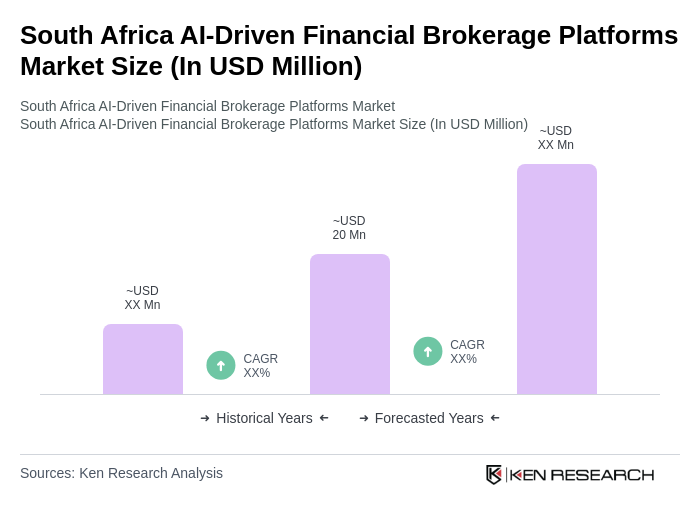
- The South Africa AI-Driven Financial Brokerage Platforms Market is valued at approximately USD 20 million, based on a five-year historical analysis. This growth is primarily driven by the increasing adoption of artificial intelligence in financial services, the rise of retail trading, and the demand for personalized investment solutions. The integration of AI in trading platforms has significantly enhanced decision-making processes, leading to improved trading outcomes for users. Key industry trends include the use of AI for fraud detection, risk management, and customer service automation, which are transforming the financial services landscape in South Africa .
- Key cities dominating this market include Johannesburg, Cape Town, and Durban. Johannesburg, as the financial hub of South Africa, hosts numerous financial institutions and tech startups, fostering innovation in AI-driven brokerage services. Cape Town is recognized for its vibrant tech ecosystem, attracting fintech companies, while Durban’s expanding economy supports the growth of financial services, making these cities pivotal in the market landscape .
- The Financial Sector Regulation Act, 2017 (FSRA), issued by the Parliament of South Africa, governs the financial services sector, including AI-driven brokerage platforms. The Act establishes the Twin Peaks regulatory model, requiring all financial service providers to comply with standards for market conduct and prudential regulation. The FSRA mandates licensing, risk management, and consumer protection measures, ensuring operational integrity and fair competition in the financial system .
South Africa AI-Driven Financial Brokerage Platforms Market Segmentation
By Type:The market is segmented into various types of platforms that cater to different trading needs. The subsegments include Algorithmic Trading Platforms, Robo-Advisory Platforms, Social Trading Platforms, Risk Management Platforms, Market Forecasting Platforms, Hybrid Platforms, Mobile Trading Apps, and Others. Each of these platforms serves unique functionalities, appealing to diverse investor preferences. Algorithmic Trading Platforms leverage advanced AI algorithms for high-frequency trading and market analysis, while Robo-Advisory Platforms provide automated investment management. Social Trading Platforms enable users to follow and replicate strategies of experienced traders. Risk Management and Market Forecasting Platforms utilize AI for predictive analytics and portfolio optimization. Hybrid Platforms combine multiple functionalities, and Mobile Trading Apps offer accessibility and convenience for retail investors .
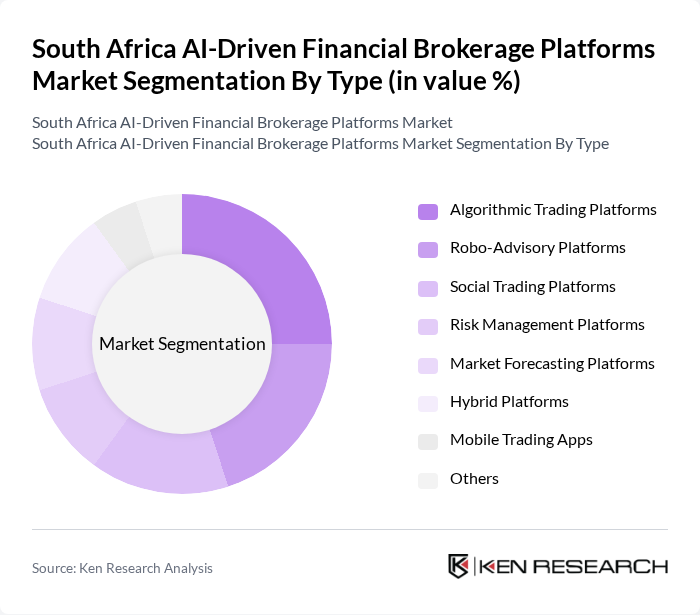
The Algorithmic Trading Platforms segment is currently leading the market due to their ability to execute trades at high speeds and with minimal human intervention. These platforms utilize complex algorithms to analyze market data and make trading decisions, which appeals to both institutional and retail investors seeking efficiency and precision. The increasing sophistication of AI algorithms and the trend toward automated trading are driving demand for these platforms, making them a preferred choice among traders .
By End-User:The market is segmented based on the end-users of the platforms, which include Individual Investors, Institutional Investors, Financial Advisors, and Corporates. Each segment has distinct needs and preferences, influencing the types of platforms they utilize. Individual Investors are increasingly adopting mobile trading apps and user-friendly platforms, while Institutional Investors focus on advanced algorithmic and risk management solutions. Financial Advisors leverage robo-advisory and forecasting platforms, and Corporates utilize hybrid and risk management platforms for portfolio optimization .
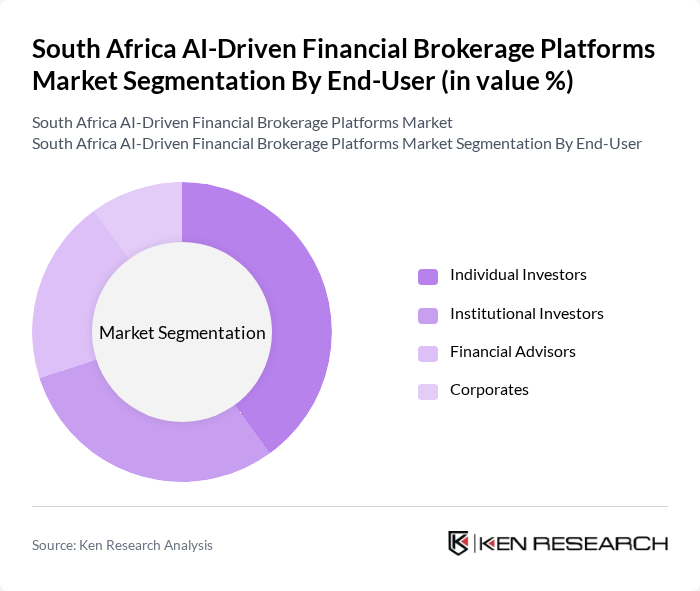
The Individual Investors segment dominates the market, driven by the increasing number of retail traders entering the financial markets. The proliferation of mobile trading apps and intuitive platforms has made investing more accessible to the general public. Additionally, the growing interest in personal finance and investment education has empowered individual investors to engage actively in trading, further solidifying their position as the largest user group in the market .
South Africa AI-Driven Financial Brokerage Platforms Market Competitive Landscape
The South Africa AI-Driven Financial Brokerage Platforms Market is characterized by a dynamic mix of regional and international players. Leading participants such as Standard Bank Group, Absa Group Limited, Investec Bank Limited, Capitec Bank Holdings Limited, Nedbank Group Limited, FNB (First National Bank), Sasfin Holdings Limited, PSG Konsult Limited, Sygnia Limited, 4Sight Holdings Limited, EasyEquities (Purple Group Limited), Wealth Migrate, Satrix, CM Trading, Sharenet, IG Markets South Africa Limited, Rand Swiss, Tickmill South Africa (Pty) Ltd contribute to innovation, geographic expansion, and service delivery in this space.
South Africa AI-Driven Financial Brokerage Platforms Market Industry Analysis
Growth Drivers
- Increasing Demand for Automated Trading Solutions:The South African financial market is witnessing a surge in demand for automated trading solutions, driven by a 15% increase in retail trading volumes in future. This trend is supported by the growing number of retail investors, which reached approximately 1.2 million in future, as reported by the Johannesburg Stock Exchange. The convenience and efficiency of automated systems are appealing to both novice and experienced traders, further propelling market growth.
- Rise in Mobile Trading Applications:The proliferation of mobile trading applications is transforming the South African brokerage landscape. In future, mobile trading accounted for 60% of all trading activities, reflecting a 20% increase from the previous period. This shift is largely attributed to the 80% smartphone penetration rate in South Africa, enabling users to trade anytime and anywhere. The accessibility of these platforms is attracting a younger demographic, which is crucial for the market's expansion.
- Enhanced Data Analytics Capabilities:The integration of advanced data analytics in trading platforms is a significant growth driver. In future, 70% of brokerage firms in South Africa reported investing in AI-driven analytics tools to improve trading strategies. This investment is supported by a 25% increase in data processing capabilities, allowing firms to analyze vast datasets for better decision-making. Enhanced analytics not only optimize trading performance but also attract tech-savvy investors seeking data-driven insights.
Market Challenges
- Regulatory Compliance Complexities:Navigating the regulatory landscape poses a significant challenge for AI-driven financial brokerage platforms in South Africa. The Financial Sector Conduct Authority (FSCA) has implemented stringent regulations, requiring compliance from all trading platforms. In future, over 30% of firms reported difficulties in meeting these regulatory requirements, leading to increased operational costs and potential penalties. This complexity can deter new entrants and stifle innovation in the market.
- Data Security Concerns:Data security remains a critical challenge for financial brokerage platforms. In future, cyberattacks on financial institutions in South Africa increased by 40%, raising concerns among users regarding the safety of their personal and financial information. As platforms adopt AI technologies, the risk of data breaches escalates, prompting firms to invest heavily in cybersecurity measures. This necessity can divert resources from other areas, impacting overall growth potential.
South Africa AI-Driven Financial Brokerage Platforms Market Future Outlook
The future of AI-driven financial brokerage platforms in South Africa appears promising, with technological advancements and evolving consumer preferences shaping the landscape. The increasing adoption of machine learning algorithms is expected to enhance trading efficiency, while the rise of social trading platforms will foster community engagement among investors. Additionally, the shift towards sustainable investing will likely drive demand for platforms that offer ESG-focused investment options, aligning with global trends and local market needs.
Market Opportunities
- Expansion into Underserved Demographics:There is a significant opportunity for brokerage platforms to expand into underserved demographics, particularly among the youth and rural populations. With over 30% of South Africans aged 18-34 showing interest in investing, platforms that tailor their services to these groups can capture a growing market segment, enhancing financial inclusion and driving overall market growth.
- Integration of AI for Personalized Services:The integration of AI technologies to offer personalized trading experiences presents a lucrative opportunity. By leveraging AI to analyze user behavior and preferences, platforms can provide tailored investment recommendations. This approach can enhance user satisfaction and retention, as evidenced by a 20% increase in user engagement reported by firms that have adopted personalized services in future.
Scope of the Report
| Segment | Sub-Segments |
|---|---|
| By Type | Algorithmic Trading Platforms Robo-Advisory Platforms Social Trading Platforms Risk Management Platforms Market Forecasting Platforms Hybrid Platforms Mobile Trading Apps Others |
| By End-User | Individual Investors Institutional Investors Financial Advisors Corporates |
| By Investment Type | Equities Forex Commodities Cryptocurrencies ETFs Others |
| By Distribution Channel | Direct Online Sales Third-Party Brokers Mobile Applications Affiliate Marketing |
| By Customer Segment | Retail Investors High Net-Worth Individuals Small and Medium Enterprises |
| By Geographic Region | Gauteng Western Cape KwaZulu-Natal Eastern Cape Others |
| By Regulatory Compliance Level | Fully Compliant Platforms Partially Compliant Platforms Non-Compliant Platforms |
Key Target Audience
Investors and Venture Capitalist Firms
Government and Regulatory Bodies (e.g., Financial Sector Conduct Authority, South African Reserve Bank)
Financial Institutions
Insurance Companies
Wealth Management Firms
Fintech Startups
Technology Providers
Industry Associations
Players Mentioned in the Report:
Standard Bank Group
Absa Group Limited
Investec Bank Limited
Capitec Bank Holdings Limited
Nedbank Group Limited
FNB (First National Bank)
Sasfin Holdings Limited
PSG Konsult Limited
Sygnia Limited
4Sight Holdings Limited
EasyEquities (Purple Group Limited)
Wealth Migrate
Satrix
CM Trading
Sharenet
IG Markets South Africa Limited
Rand Swiss
Tickmill South Africa (Pty) Ltd
Table of Contents
Market Assessment Phase
1. Executive Summary and Approach
2. South Africa AI-Driven Financial Brokerage Platforms Market Overview
2.1 Key Insights and Strategic Recommendations
2.2 South Africa AI-Driven Financial Brokerage Platforms Market Overview
2.3 Definition and Scope
2.4 Evolution of Market Ecosystem
2.5 Timeline of Key Regulatory Milestones
2.6 Value Chain & Stakeholder Mapping
2.7 Business Cycle Analysis
2.8 Policy & Incentive Landscape
3. South Africa AI-Driven Financial Brokerage Platforms Market Analysis
3.1 Growth Drivers
3.1.1 Increasing demand for automated trading solutions
3.1.2 Rise in mobile trading applications
3.1.3 Enhanced data analytics capabilities
3.1.4 Growing interest in algorithmic trading
3.2 Market Challenges
3.2.1 Regulatory compliance complexities
3.2.2 High competition among platforms
3.2.3 Data security concerns
3.2.4 Limited financial literacy among users
3.3 Market Opportunities
3.3.1 Expansion into underserved demographics
3.3.2 Integration of AI for personalized services
3.3.3 Partnerships with fintech startups
3.3.4 Development of educational resources for users
3.4 Market Trends
3.4.1 Increasing use of machine learning in trading
3.4.2 Growth of social trading platforms
3.4.3 Shift towards sustainable investing
3.4.4 Adoption of blockchain technology
3.5 Government Regulation
3.5.1 Financial Sector Conduct Authority (FSCA) guidelines
3.5.2 Anti-Money Laundering (AML) regulations
3.5.3 Data Protection Act compliance
3.5.4 Taxation policies on trading profits
4. SWOT Analysis
5. Stakeholder Analysis
6. Porter's Five Forces Analysis
7. South Africa AI-Driven Financial Brokerage Platforms Market Market Size, 2019-2024
7.1 By Value
7.2 By Volume
7.3 By Average Selling Price
8. South Africa AI-Driven Financial Brokerage Platforms Market Segmentation
8.1 By Type
8.1.1 Algorithmic Trading Platforms
8.1.2 Robo-Advisory Platforms
8.1.3 Social Trading Platforms
8.1.4 Risk Management Platforms
8.1.5 Market Forecasting Platforms
8.1.6 Hybrid Platforms
8.1.7 Mobile Trading Apps
8.1.8 Others
8.2 By End-User
8.2.1 Individual Investors
8.2.2 Institutional Investors
8.2.3 Financial Advisors
8.2.4 Corporates
8.3 By Investment Type
8.3.1 Equities
8.3.2 Forex
8.3.3 Commodities
8.3.4 Cryptocurrencies
8.3.5 ETFs
8.3.6 Others
8.4 By Distribution Channel
8.4.1 Direct Online Sales
8.4.2 Third-Party Brokers
8.4.3 Mobile Applications
8.4.4 Affiliate Marketing
8.5 By Customer Segment
8.5.1 Retail Investors
8.5.2 High Net-Worth Individuals
8.5.3 Small and Medium Enterprises
8.6 By Geographic Region
8.6.1 Gauteng
8.6.2 Western Cape
8.6.3 KwaZulu-Natal
8.6.4 Eastern Cape
8.6.5 Others
8.7 By Regulatory Compliance Level
8.7.1 Fully Compliant Platforms
8.7.2 Partially Compliant Platforms
8.7.3 Non-Compliant Platforms
9. South Africa AI-Driven Financial Brokerage Platforms Market Competitive Analysis
9.1 Market Share of Key Players
9.2 Cross Comparison of Key Players
9.2.1 Company Name
9.2.2 Group Size (Large, Medium, or Small as per industry convention)
9.2.3 Customer Acquisition Cost (CAC)
9.2.4 Average Revenue Per User (ARPU)
9.2.5 Customer Retention Rate
9.2.6 Pricing Strategy (Commission, Subscription, Spread, etc.)
9.2.7 Trading Volume Growth Rate
9.2.8 Market Penetration Rate
9.2.9 User Engagement Metrics (e.g., daily active users, session duration)
9.2.10 Return on Investment (ROI)
9.2.11 Assets Under Management (AUM)
9.2.12 Platform Uptime/Availability
9.2.13 Regulatory Compliance Status
9.3 SWOT Analysis of Top Players
9.4 Pricing Analysis
9.5 Detailed Profile of Major Companies
9.5.1 Standard Bank Group
9.5.2 Absa Group Limited
9.5.3 Investec Bank Limited
9.5.4 Capitec Bank Holdings Limited
9.5.5 Nedbank Group Limited
9.5.6 FNB (First National Bank)
9.5.7 Sasfin Holdings Limited
9.5.8 PSG Konsult Limited
9.5.9 Sygnia Limited
9.5.10 4Sight Holdings Limited
9.5.11 EasyEquities (Purple Group Limited)
9.5.12 Wealth Migrate
9.5.13 Satrix
9.5.14 CM Trading
9.5.15 Sharenet
9.5.16 IG Markets South Africa Limited
9.5.17 Rand Swiss
9.5.18 Tickmill South Africa (Pty) Ltd
10. South Africa AI-Driven Financial Brokerage Platforms Market End-User Analysis
10.1 Procurement Behavior of Key Ministries
10.1.1 Budget Allocation for Financial Services
10.1.2 Decision-Making Processes
10.1.3 Preferred Platforms and Services
10.2 Corporate Spend on Infrastructure & Energy
10.2.1 Investment in Financial Technology
10.2.2 Spending on Compliance and Security
10.2.3 Budget for Training and Development
10.3 Pain Point Analysis by End-User Category
10.3.1 Lack of User-Friendly Interfaces
10.3.2 High Fees and Commissions
10.3.3 Limited Access to Information
10.4 User Readiness for Adoption
10.4.1 Awareness of AI-Driven Solutions
10.4.2 Technical Skills Assessment
10.4.3 Trust in Digital Platforms
10.5 Post-Deployment ROI and Use Case Expansion
10.5.1 Measurement of Financial Performance
10.5.2 User Feedback and Improvement
10.5.3 Expansion into New Services
11. South Africa AI-Driven Financial Brokerage Platforms Market Future Size, 2025-2030
11.1 By Value
11.2 By Volume
11.3 By Average Selling Price
Go-To-Market Strategy Phase
1. Whitespace Analysis + Business Model Canvas
1.1 Market Gaps Identification
1.2 Business Model Framework
2. Marketing and Positioning Recommendations
2.1 Branding Strategies
2.2 Product USPs
3. Distribution Plan
3.1 Urban Retail vs Rural NGO Tie-Ups
4. Channel & Pricing Gaps
4.1 Underserved Routes
4.2 Pricing Bands
5. Unmet Demand & Latent Needs
5.1 Category Gaps
5.2 Consumer Segments
6. Customer Relationship
6.1 Loyalty Programs
6.2 After-Sales Service
7. Value Proposition
7.1 Sustainability
7.2 Integrated Supply Chains
8. Key Activities
8.1 Regulatory Compliance
8.2 Branding
8.3 Distribution Setup
9. Entry Strategy Evaluation
9.1 Domestic Market Entry Strategy
9.1.1 Product Mix
9.1.2 Pricing Band
9.1.3 Packaging
9.2 Export Entry Strategy
9.2.1 Target Countries
9.2.2 Compliance Roadmap
10. Entry Mode Assessment
10.1 Joint Ventures
10.2 Greenfield Investments
10.3 Mergers & Acquisitions
10.4 Distributor Model
11. Capital and Timeline Estimation
11.1 Capital Requirements
11.2 Timelines
12. Control vs Risk Trade-Off
12.1 Ownership vs Partnerships
13. Profitability Outlook
13.1 Breakeven Analysis
13.2 Long-Term Sustainability
14. Potential Partner List
14.1 Distributors
14.2 Joint Ventures
14.3 Acquisition Targets
15. Execution Roadmap
15.1 Phased Plan for Market Entry
15.1.1 Market Setup
15.1.2 Market Entry
15.1.3 Growth Acceleration
15.1.4 Scale & Stabilize
15.2 Key Activities and Milestones
15.2.1 Activity Planning
15.2.2 Milestone Tracking
Research Methodology
Phase 1: Approach1
Desk Research
- Analysis of financial technology reports from South African regulatory bodies
- Review of market studies and white papers published by industry associations
- Examination of financial brokerage platform user statistics and trends from reputable financial news outlets
Primary Research
- Interviews with executives from leading AI-driven financial brokerage platforms
- Surveys targeting financial analysts and investment advisors in South Africa
- Focus groups with end-users to gather insights on platform usability and features
Validation & Triangulation
- Cross-validation of findings through multiple data sources including user feedback and expert opinions
- Triangulation of market data with financial performance metrics from brokerage firms
- Sanity checks conducted through expert panel reviews comprising industry veterans
Phase 2: Market Size Estimation1
Top-down Assessment
- Estimation of market size based on overall financial services revenue in South Africa
- Segmentation of the market by user demographics and platform types
- Incorporation of growth rates from related sectors such as fintech and digital banking
Bottom-up Modeling
- Collection of user adoption rates from various AI-driven brokerage platforms
- Operational cost analysis based on service offerings and pricing models
- Volume and transaction value calculations based on user engagement metrics
Forecasting & Scenario Analysis
- Multi-variable forecasting using economic indicators and technology adoption rates
- Scenario analysis based on regulatory changes and market entry of new players
- Development of baseline, optimistic, and pessimistic growth projections through 2030
Phase 3: CATI Sample Composition1
| Scope Item/Segment | Sample Size | Target Respondent Profiles |
|---|---|---|
| Retail Investor Engagement | 120 | Individual Investors, Financial Advisors |
| Institutional Brokerage Services | 90 | Institutional Investors, Fund Managers |
| AI Technology Adoption | 60 | CTOs, Product Managers in Fintech |
| User Experience Feedback | 50 | End-users, UX/UI Designers |
| Market Trends and Insights | 70 | Market Analysts, Economic Researchers |
Frequently Asked Questions
What is the current market value of AI-driven financial brokerage platforms in South Africa?
The South Africa AI-Driven Financial Brokerage Platforms Market is valued at approximately USD 20 million, reflecting significant growth driven by the increasing adoption of artificial intelligence in financial services and the rise of retail trading.
Which cities are key players in the South African AI-driven financial brokerage market?
What regulatory framework governs AI-driven financial brokerage platforms in South Africa?
What are the main types of AI-driven financial brokerage platforms available in South Africa?
Other Regional/Country Reports
Indonesia AI-Driven Financial Brokerage Platforms Market
Malaysia AI-Driven Financial Brokerage Platforms Market
KSA AI-Driven Financial Brokerage Platforms Market
APAC AI-Driven Financial Brokerage Platforms Market
SEA AI-Driven Financial Brokerage Platforms Market
Vietnam AI-Driven Financial Brokerage Platforms Market
Other Adjacent Reports
South Korea Robo-Advisory Services Market
Brazil Algorithmic Trading Software Market
Bahrain Financial Data Analytics Market
Oman Cybersecurity in Finance Market
Malaysia Mobile Trading Apps Market
Philippines Blockchain Finance MarketMexico Insurtech Platforms Market
Oman Payment Processing Market
Saudi Arabia wealth management software market size, share, growth drivers, trends, opportunities & forecast 2025–2030Why Buy From Us?

What makes us stand out is that our consultants follow Robust, Refine and Result (RRR) methodology. Robust for clear definitions, approaches and sanity checking, Refine for differentiating respondents' facts and opinions, and Result for presenting data with story.

We have set a benchmark in the industry by offering our clients with syndicated and customized market research reports featuring coverage of entire market as well as meticulous research and analyst insights.

While we don't replace traditional research, we flip the method upside down. Our dual approach of Top Bottom & Bottom Top ensures quality deliverable by not just verifying company fundamentals but also looking at the sector and macroeconomic factors.

With one step in the future, our research team constantly tries to show you the bigger picture. We help with some of the tough questions you may encounter along the way: How is the industry positioned? Best marketing channel? KPI's of competitors? By aligning every element, we help maximize success.

Our report gives you instant access to the answers and sources that other companies might choose to hide. We elaborate each steps of research methodology we have used and showcase you the sample size to earn your trust.

If you need any support, we are here! We pride ourselves on universe strength, data quality, and quick, friendly, and professional service.