About the Report
Base Year 2024South Africa Professional Skincare Market Overview
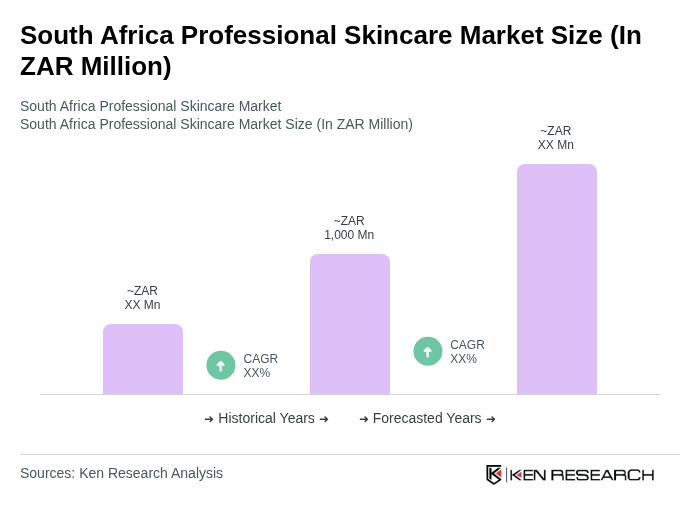
- The South Africa Professional Skincare Market is valued at ZAR 1,000 million, based on a five-year historical analysis, aligning with the strong growth seen in the broader South African skincare and beauty sector, which has benefited from rising disposable incomes in middle- and upper-income segments and the expansion of premium skincare offerings.This growth is primarily driven by increasing consumer awareness of skincare, the rise of beauty and aesthetic treatments, and the growing influence of social media and beauty influencers on skincare routines and standards.The market has seen a surge in demand for professional skincare products and services, particularly in urban areas where consumers are more inclined to invest in personal care and in-clinic treatments.
- Key cities such as Johannesburg, Cape Town, and Durban dominate the South African professional skincare market due to their high population density, higher household incomes, and concentration of beauty salons, spas, aesthetic clinics, and dermatology practices.These urban centers are also home to a diverse demographic that is increasingly seeking advanced skincare solutions such as chemical peels, microneedling, laser-based procedures, and medically backed cosmeceutical brands, contributing to the overall growth of the market.
- Skincare products and professional cosmetic treatments in South Africa are regulated under the Medicines and Related Substances Act 101 of 1965 and the associated regulations, including the General Regulations published by the Department of Health, which require that cosmetics and certain skincare products placed on the market comply with safety, labeling, ingredient, and quality requirements, and that products with pharmacological or therapeutic claims may be classified and controlled as medicines.In addition, the draft South African National Standard SANS 1812 on cosmetics and the self-regulatory code of practice of Cosmetics South Africa provide further guidance on safety assessment, ingredient restrictions, and product information for skincare products and professional formulations.
South Africa Professional Skincare Market Segmentation
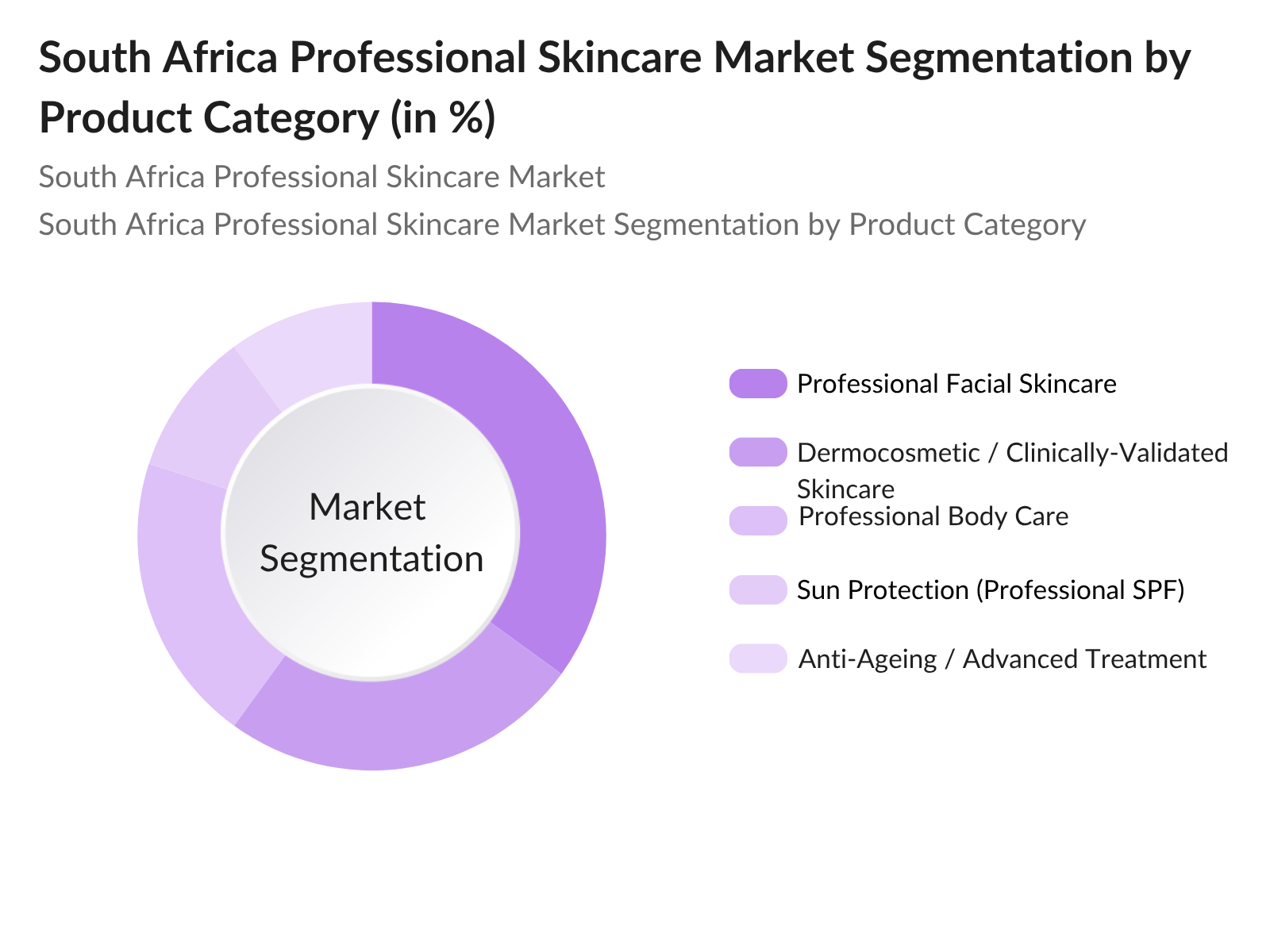
By Product Category:The product category segmentation includes Professional Facial Skincare, Dermocosmetic / Clinically-Validated Skincare, Professional Body Care, Sun Protection, and Anti-Ageing / Advanced Treatment. Professional Facial Skincare forms a core category as salons, spas, dermatology clinics, and aesthetic centers continue to use facial care products for cleansing, hydration, brightening, acne care, and skin maintenance treatments. Dermocosmetic and clinically validated skincare is gaining strong relevance as consumers increasingly prefer products backed by dermatological testing, active ingredients, and professional recommendations. Professional Body Care supports demand across spa, wellness, and body treatment services. Sun Protection remains important due to rising awareness of preventive skincare, while Anti-Ageing and Advanced Treatment products address premium demand for targeted, results-oriented solutions.
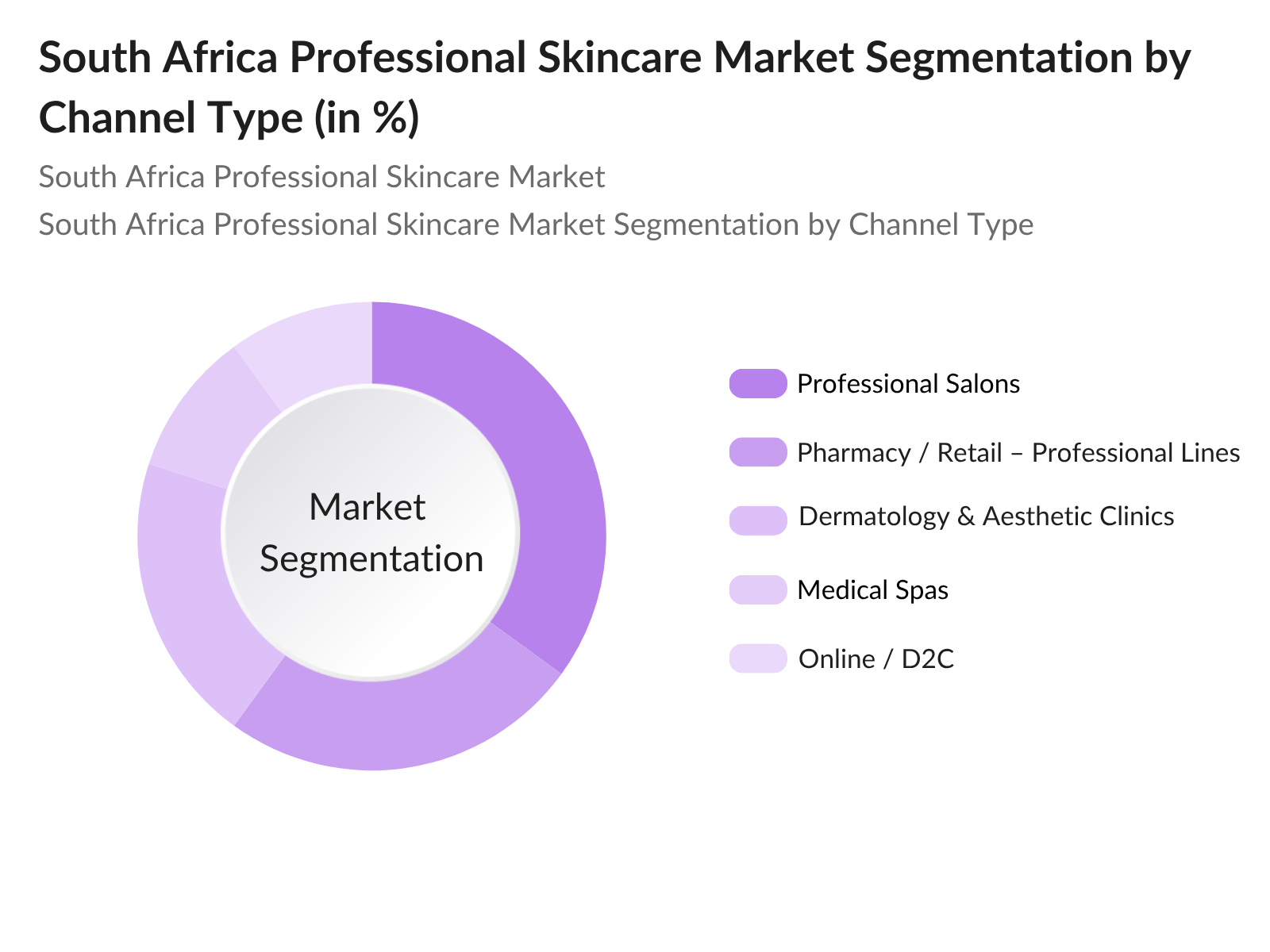
By Channel Type:The channel type segmentation includes Professional Salons, Pharmacy / Retail – Professional Lines, Dermatology & Aesthetic Clinics, Medical Spas, and Online / D2C. Professional Salons hold the leading position, driven by strong consumer dependence on therapist-led consultations, facial treatments, product recommendations, and repeat skincare purchases. Pharmacy / Retail – Professional Lines currently occupies the next major position, supported by access to clinically positioned skincare brands and trusted retail advisory. Dermatology & Aesthetic Clinics rank after pharmacy-led channels but are expected to strengthen their position as demand rises for prescription-backed, procedure-linked, and clinically validated skincare. Medical Spas remain a specialized channel focused on premium treatments, while Online / D2C is gaining relevance as brands expand digital consultations, direct selling, and convenience-led professional skincare access.
South Africa Professional Skincare Market Competitive Landscape
The South Africa Professional Skincare Market is characterized by a dynamic mix of regional and international players. Leading participants such as Environ Skincare, Nimue Skin Technology, SkinCeuticals (L'Oréal Group), Lamelle Research Laboratories, and Dermalogica contribute to innovation, geographic expansion, and service delivery in this space.
South Africa Professional Skincare Market Industry Analysis
Growth Drivers
- Rising Disposable Income and Growing SA Middle Class:The South African professional skincare market is being driven by rising disposable income and the expansion of the middle-class consumer base. As consumers gain higher spending capacity, they are increasingly shifting from basic skincare to premium dermatology-backed and clinic-recommended products. This is strengthening demand for targeted skincare solutions across anti-aging, hydration, pigmentation, acne care, and overall skin health.
- Increased Dermatologist and Aesthetic Clinic Penetration:Growing access to dermatologists, aesthetic clinics, and professional skincare centers is accelerating adoption of clinical-grade skincare products in South Africa. Consumers are increasingly seeking expert-led treatments and prescription-supported regimens for concerns such as pigmentation, acne, sensitivity, and aging. This shift is improving trust in professional skincare brands and expanding product usage beyond routine beauty care into corrective and preventive skincare.
- Growing Melanin-Skin Awareness and Demand for Targeted Formulations:Rising awareness around melanin-rich skin concerns is creating strong demand for formulations designed for South African skin types and diverse phototypes. Consumers are looking for products that address hyperpigmentation, uneven tone, sun damage, acne marks, and sensitivity without irritation. This is encouraging brands to develop targeted, inclusive, and dermatologist-tested skincare solutions suited to local consumer needs.
Market Challenges
- Increasing Cost of Imported Actives and Finished Products:The South African professional skincare market remains exposed to rising import costs, as many brands depend on international suppliers for active ingredients, specialized formulations, and finished products. This increases procurement pressure, affects product pricing, and reduces margin flexibility for distributors and clinics. Higher landed costs can also limit affordability, especially for premium skincare ranges positioned toward professional treatment-led consumers.
- High Unemployment and Regulatory Time-to-Market Barriers:High unemployment continues to restrict the addressable consumer base for premium cosmetic and professional skincare products, as discretionary spending remains limited among price-sensitive consumers. At the same time, an increasingly complex regulatory environment adds compliance requirements for product approvals, labeling, safety documentation, and market entry. These factors can delay launches, increase operating costs, and constrain faster category expansion.
South Africa Professional Skincare Market Future Outlook
The South African professional skincare market is poised for dynamic growth, driven by evolving consumer preferences and technological advancements. As the demand for personalized skincare solutions increases, brands are likely to invest in innovative product development and marketing strategies. Additionally, the rise of e-commerce platforms will facilitate broader access to skincare products, enhancing consumer convenience. With a focus on sustainability and ethical practices, the market is expected to adapt to changing consumer values, positioning itself for long-term success in a competitive landscape.
Market Opportunities
- Growth in Melanin-Rich Skin Type Solutions:South Africa presents a strong opportunity for professional skincare brands focused on melanin-rich skin needs, as the market has limited clinically validated local solutions. Brands offering targeted products for hyperpigmentation, uneven tone, sensitivity, and post-treatment care can address a clear unmet demand.
- White Space in Certified Professional Brands:The market offers opportunities for COSMOS-certified professional skincare brands, with limited competition in certified clean formulations. Companies can strengthen differentiation by targeting independent clinics and aestheticians directly, offering trusted, sustainability-aligned products supported by professional recommendations and treatment-led distribution.
Scope of the Report
| Segment | Sub-Segments |
|---|---|
| By Product Category | Professional Facial Skincare Dermocosmetic / Clinically-Validated Skincare Professional Body Care Sun Protection (Professional SPF) Anti-Ageing / Advanced Treatment |
| By Channel Type | Professional Salons Pharmacy / Retail - Professional Lines Dermatology & Aesthetic Clinics Medical Spas Online / D2C |
| By Price Tier | Mid-Range (USD 8–20 per unit) Premium (USD 20–50 per unit) Accessible / Entry Professional (< USD 8 per unit) Ultra-Premium (> USD 50 per unit) |
| By Geography | Eastern Cape & Other Provinces Gauteng (Johannesburg / Pretoria) KwaZulu-Natal (Durban) Western Cape (Cape Town) Northern Cape & Free State |
Key Target Audience
Investors and Venture Capitalist Firms
Government and Regulatory Bodies (e.g., South African Health Products Regulatory Authority)
Manufacturers and Producers
Distributors and Retailers
Beauty Salons and Spas
Dermatologists and Skincare Professionals
Industry Associations (e.g., Cosmetic, Toiletry and Fragrance Association of South Africa)
Financial Institutions
Players Mentioned in the Report:
Environ Skin Care
Nimue Skin Technology
SkinCeuticals (L'Oréal Group)
Lamelle Research Laboratories
Dermalogica (Unilever)
pHformula
DermaFix Cosmeceutical
NeoStrata
Obagi Medical
Heliocare
Table of Contents
Market Assessment Phase
1. Executive Summary and Approach
2. South Africa Professional Skincare Market Overview
2.1 Key Insights and Strategic Recommendations
2.2 South Africa Professional Skincare Market Overview
2.3 Definition and Scope
2.4 Evolution of Market Ecosystem
2.5 Timeline of Key Regulatory Milestones
2.6 Value Chain & Stakeholder Mapping
2.7 Business Cycle Analysis
2.8 Policy & Incentive Landscape
3. South Africa Professional Skincare Market Analysis
3.1 Growth Drivers
3.1.1 Increasing demand for organic and natural skincare products
3.1.2 Rising awareness of skincare among consumers
3.1.3 Growth of the beauty and wellness industry
3.1.4 Expansion of distribution channels
3.2 Market Challenges
3.2.1 High competition among local and international brands
3.2.2 Economic fluctuations affecting consumer spending
3.2.3 Regulatory compliance and product safety standards
3.2.4 Limited access to advanced skincare technologies
3.3 Market Opportunities
3.3.1 Growth in e-commerce and online sales
3.3.2 Increasing investment in skincare research and development
3.3.3 Rising disposable incomes among consumers
3.3.4 Expansion into emerging markets within South Africa
3.4 Market Trends
3.4.1 Shift towards personalized skincare solutions
3.4.2 Increasing popularity of skincare treatments in salons and spas
3.4.3 Adoption of sustainable and eco-friendly packaging
3.4.4 Growth of influencer marketing in the skincare sector
3.5 Government Regulation
3.5.1 Compliance with the South African Health Products Regulatory Authority (SAHPRA)
3.5.2 Regulations on labeling and advertising of skincare products
3.5.3 Standards for product safety and efficacy
3.5.4 Import regulations for skincare ingredients
4. SWOT Analysis
5. Stakeholder Analysis
6. Porter's Five Forces Analysis
7. South Africa Professional Skincare Market Size, 2019-2024
7.1 By Value
7.2 By Volume
7.3 By Average Selling Price
8. South Africa Professional Skincare Market Segmentation
8.1 By Product Category
8.1.1 Professional Facial Skincare
8.1.2 Dermocosmetic / Clinically-Validated Skincare
8.1.3 Professional Body Care
8.1.4 Sun Protection (Professional SPF)
8.1.5 Anti-Ageing / Advanced Treatment
8.2 By Channel Type
8.2.1 Professional Salons
8.2.2 Pharmacy / Retail - Professional Lines
8.2.3 Dermatology & Aesthetic Clinics
8.2.4 Medical Spas
8.2.5 Online / D2C
8.3 By Price Tier
8.3.1 Mid-Range (USD 8–20 per unit)
8.3.2 Premium (USD 20–50 per unit)
8.3.3 Accessible / Entry Professional (< USD 8 per unit)
8.3.4 Ultra-Premium (> USD 50 per unit)
8.4 By Geography
8.4.1 Eastern Cape & Other Provinces
8.4.2 Gauteng (Johannesburg / Pretoria)
8.4.3 KwaZulu-Natal (Durban)
8.4.4 Western Cape (Cape Town)
8.4.5 Northern Cape & Free State
9. South Africa Professional Skincare Market Competitive Analysis
9.1 Market Share of Key Players
9.2 Cross Comparison of Key Players
9.2.1 Company Name
9.2.2 Group Size (Large, Medium, or Small as per industry convention)
9.2.3 South Africa Professional Skincare Revenue (ZAR, latest FY)
9.2.4 3-year Revenue CAGR in South Africa Professional Skincare
9.2.5 Professional Channel Coverage (no. of salons/spas/clinics served)
9.2.6 Share of Professional Portfolio in Total South Africa Skincare Revenue (%)
9.2.7 Average Selling Price per Professional Treatment / Kit
9.2.8 New Product Launches in Past 24 Months (count)
9.2.9 R&D or Training Spend as % of Professional Skincare Revenue
9.2.10 Geographic Footprint (no. of provinces / key cities covered)
9.2.11 Digital Engagement Metrics (social reach, practitioner portal traffic)
9.2.12 Customer Retention / Repeat Purchase Rate in Professional Accounts (%)
9.3 SWOT Analysis of Top Players
9.4 Pricing Analysis
9.5 Detailed Profile of Major Companies
9.5.1 Environ Skin Care
9.5.2 Nimue Skin Technology
9.5.3 SkinCeuticals (L'Oréal Group)
9.5.4 Lamelle Research Laboratories
9.5.5 Dermalogica (Unilever)
9.5.6 pHformula
9.5.7 DermaFix Cosmeceutical
9.5.8 NeoStrata
9.5.9 Obagi Medical
9.5.10 Heliocare
10. South Africa Professional Skincare Market End-User Analysis
10.1 Procurement Behavior of Key Ministries
10.1.1 Budget Allocation for Skincare Products
10.1.2 Decision-Making Process
10.1.3 Preferred Suppliers
10.1.4 Compliance Requirements
10.2 Corporate Spend on Infrastructure & Energy
10.2.1 Investment in Skincare Facilities
10.2.2 Spending on Employee Wellness Programs
10.2.3 Budget for Skincare Product Procurement
10.3 Pain Point Analysis by End-User Category
10.3.1 Challenges Faced by Salons
10.3.2 Issues in Product Availability
10.3.3 Customer Expectations
10.3.4 Regulatory Compliance Challenges
10.4 User Readiness for Adoption
10.4.1 Awareness of New Products
10.4.2 Willingness to Try New Brands
10.4.3 Feedback Mechanisms
10.5 Post-Deployment ROI and Use Case Expansion
10.5.1 Measurement of Customer Satisfaction
10.5.2 Analysis of Repeat Purchases
10.5.3 Expansion into New Markets
10.5.4 Long-term Customer Engagement Strategies
11. South Africa Professional Skincare Market Future Size, 2025-2030
11.1 By Value
11.2 By Volume
11.3 By Average Selling Price
Go-To-Market Strategy Phase
1. Whitespace Analysis + Business Model Canvas
1.1 Market Gaps Identification
1.2 Business Model Development
2. Marketing and Positioning Recommendations
2.1 Branding Strategies
2.2 Product USPs
3. Distribution Plan
3.1 Urban Retail vs Rural NGO Tie-ups
4. Channel & Pricing Gaps
4.1 Underserved Routes
4.2 Pricing Bands
5. Unmet Demand & Latent Needs
5.1 Category Gaps
5.2 Consumer Segments
6. Customer Relationship
6.1 Loyalty Programs
6.2 After-sales Service
7. Value Proposition
7.1 Sustainability
7.2 Integrated Supply Chains
8. Key Activities
8.1 Regulatory Compliance
8.2 Branding
8.3 Distribution Setup
9. Entry Strategy Evaluation
9.1 Domestic Market Entry Strategy
9.1.1 Product Mix
9.1.2 Pricing Band
9.1.3 Packaging
9.2 Export Entry Strategy
9.2.1 Target Countries
9.2.2 Compliance Roadmap
10. Entry Mode Assessment
10.1 JV
10.2 Greenfield
10.3 M&A
10.4 Distributor Model
11. Capital and Timeline Estimation
11.1 Capital Requirements
11.2 Timelines
12. Control vs Risk Trade-Off
12.1 Ownership vs Partnerships
13. Profitability Outlook
13.1 Breakeven Analysis
13.2 Long-term Sustainability
14. Potential Partner List
14.1 Distributors
14.2 JVs
14.3 Acquisition Targets
15. Execution Roadmap
15.1 Phased Plan for Market Entry
15.1.1 Market Setup
15.1.2 Market Entry
15.1.3 Growth Acceleration
15.1.4 Scale & Stabilize
15.2 Key Activities and Milestones
15.2.1 Milestone Tracking
15.2.2 Activity Scheduling
Research Methodology
Phase 1: Approach1
Desk Research
- Analysis of industry reports from South African skincare associations and market research firms
- Review of government publications on health and beauty regulations affecting skincare products
- Examination of consumer behavior studies and demographic data from Statistics South Africa
Primary Research
- Interviews with dermatologists and skincare professionals to understand market trends and consumer preferences
- Surveys conducted with retail managers in beauty stores to gather insights on product performance and customer feedback
- Focus groups with consumers to explore attitudes towards professional skincare products and brands
Validation & Triangulation
- Cross-validation of findings through comparison with international skincare market trends
- Triangulation of data from consumer surveys, expert interviews, and sales data from retailers
- Sanity checks through expert panel reviews involving industry veterans and market analysts
Phase 2: Market Size Estimation1
Top-down Assessment
- Estimation of total market size based on national beauty and personal care expenditure statistics
- Segmentation of the market by product categories such as anti-aging, moisturizers, and treatments
- Incorporation of growth rates from historical data and projected trends in consumer spending
Bottom-up Modeling
- Collection of sales data from leading skincare brands and local manufacturers
- Estimation of average price points and volume sold across different product segments
- Analysis of distribution channels including online sales, salons, and retail outlets
Forecasting & Scenario Analysis
- Multi-factor regression analysis incorporating economic indicators, consumer income levels, and skincare trends
- Scenario modeling based on potential regulatory changes and shifts in consumer preferences towards natural products
- Development of baseline, optimistic, and pessimistic forecasts through 2030
Phase 3: CATI Sample Composition1
| Scope Item/Segment | Sample Size | Target Respondent Profiles |
|---|---|---|
| Professional Skincare Clinics | 80 | Clinic Owners, Skincare Therapists |
| Retail Beauty Outlets | 70 | Store Managers, Beauty Advisors |
| Online Skincare Retailers | 60 | E-commerce Managers, Digital Marketing Specialists |
| Consumer Focus Groups | 50 | Skincare Enthusiasts, General Consumers |
| Dermatology Clinics | 40 | Dermatologists, Aesthetic Practitioners |
Frequently Asked Questions
What is the current value of the South Africa Professional Skincare Market?
The South Africa Professional Skincare Market is valued at approximately ZAR 1,000 million, reflecting significant growth driven by rising disposable incomes and increased consumer awareness of skincare products and treatments.
What factors are driving growth in the South African skincare market?
Which cities are the main hubs for professional skincare in South Africa?
What types of professional skincare products are available in South Africa?
Other Regional/Country Reports
Indonesia Professional Skincare Market
Malaysia Professional Skincare Market
KSA Professional Skincare Market
APAC Professional Skincare Market
SEA Professional Skincare Market
Other Adjacent Reports
South Africa Natural Skincare Products Market
South Africa Organic Cosmetics Market
Singapore Beauty and Wellness Services Market
Global Skincare Devices Market Size Share Growth Drivers Trends Opportunities & Forecast 2025–2030Philippines Ecommerce Beauty Platforms Market
Japan Luxury Skincare MarketSouth Africa Professional Haircare Market
Philippines anti aging products market report size, share, growth drivers, trends, opportunities & forecast 2025–2030Saudi Arabia cosmeceutical market size, share, growth drivers, trends, opportunities & forecast 2025–2030Germany Personal Care Appliances Market
Why Buy From Us?

What makes us stand out is that our consultants follow Robust, Refine and Result (RRR) methodology. Robust for clear definitions, approaches and sanity checking, Refine for differentiating respondents' facts and opinions, and Result for presenting data with story.

We have set a benchmark in the industry by offering our clients with syndicated and customized market research reports featuring coverage of entire market as well as meticulous research and analyst insights.

While we don't replace traditional research, we flip the method upside down. Our dual approach of Top Bottom & Bottom Top ensures quality deliverable by not just verifying company fundamentals but also looking at the sector and macroeconomic factors.

With one step in the future, our research team constantly tries to show you the bigger picture. We help with some of the tough questions you may encounter along the way: How is the industry positioned? Best marketing channel? KPI's of competitors? By aligning every element, we help maximize success.

Our report gives you instant access to the answers and sources that other companies might choose to hide. We elaborate each steps of research methodology we have used and showcase you the sample size to earn your trust.

If you need any support, we are here! We pride ourselves on universe strength, data quality, and quick, friendly, and professional service.