About the Report
Base Year 2024Listen to the audio summary
Global Skincare Devices Market Overview
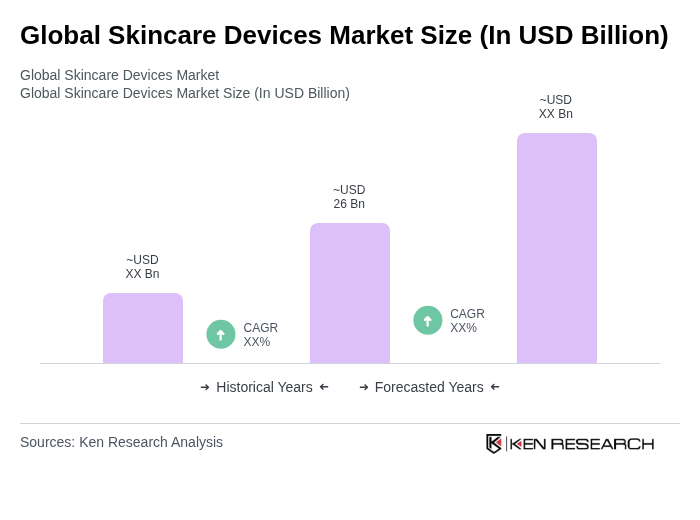
- The Global Skincare Devices Market is valued at USD 26 billion, based on recent analysis. Market expansion is being driven by a growing focus on skincare and aesthetics amplified through social media alongside rising disposable incomes in emerging regions, which make premium and multifunctional anti-aging and light-therapy devices more accessible. Innovation in at-home, eco-friendly, rechargeable formats further fuels consumer adoption and market momentum across demographics.
- Key players in this market include L’Oréal, Philips, NuFACE, FOREO, and Panasonic, which are at the forefront of smart device development. Leadership in the market stems notably from North America and Asia-Pacific, where high consumer awareness and strong life-sciences infrastructure support innovation and uptake. North American consumers benefit from advanced regulatory pathways, deep R&D investment, and familiarity with smart, app-connected tools. Meanwhile, Asia-Pacific, propelled by urbanization and beauty consciousness, commands rapid growth and market expansion in both clinical and home use segments.
- In 2024, the European Union’s Regulation (EU) 2017/745 governs medical-grade skincare devices, mandating clinical investigation and stringent market approval pathways to ensure safety and efficacy. This regulation elevates quality standards and influences product development and marketing strategies across manufacturers operating in the EU market.
Global Skincare Devices Market Segmentation
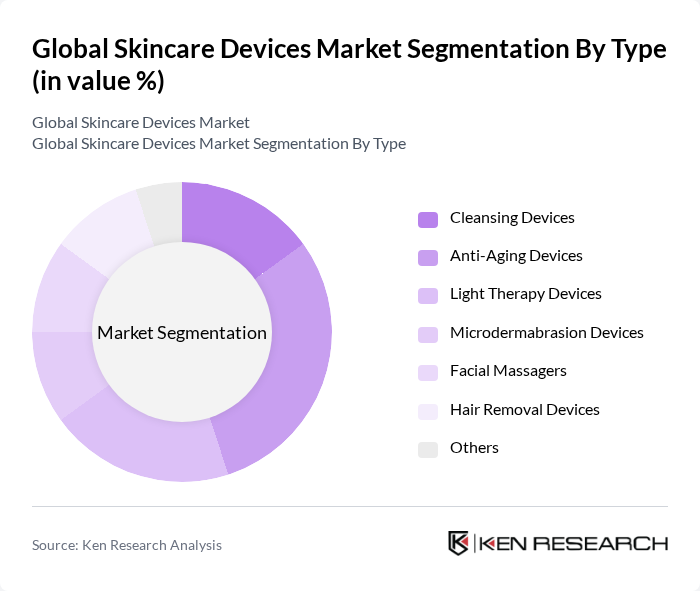
By Type:The skincare devices market is segmented into various types, including cleansing devices, anti-aging devices, moisturizing devices, exfoliating devices, light therapy devices, microdermabrasion devices, and others. Among these, anti-aging devices are currently dominating the market due to the increasing consumer demand for effective solutions to combat aging signs. The rise in awareness regarding skin health and the influence of social media on beauty standards have further propelled the growth of this segment. Consumers are increasingly investing in advanced technologies that promise visible results, making anti-aging devices a preferred choice.
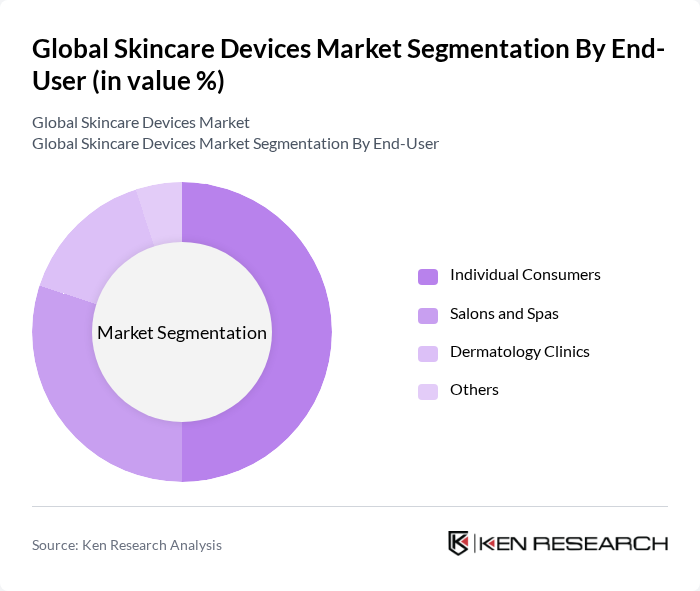
By End-User:The end-user segmentation includes individual consumers, salons and spas, dermatology clinics, and others. Individual consumers represent the largest segment, driven by the increasing trend of at-home skincare routines and the desire for professional-quality results without visiting clinics. The rise of e-commerce platforms has made these devices more accessible to consumers, further boosting their popularity. Salons and spas are also significant users, as they incorporate advanced skincare devices into their services to enhance customer experience and satisfaction.
Global Skincare Devices Market Competitive Landscape
The Global Skincare Devices Market is characterized by a dynamic mix of regional and international players. Leading participants such as L'Oréal, Procter & Gamble, Philips, NuFace, Foreo, ReFa, Panasonic, Galvanic Spa, Tria Beauty, Neutrogena, Olay, Skin Inc., Dr. Dennis Gross Skincare, ZO Skin Health, Clarisonic contribute to innovation, geographic expansion, and service delivery in this space.
Global Skincare Devices Market Industry Analysis
Growth Drivers
- Market Valuation in 2024:The global skincare devices market is valued at **USD 9.83 billion** in 2024, indicating a robust demand for skincare solutions. This valuation reflects a growing consumer base that prioritizes skincare, driven by increased awareness of skin health and beauty. The market's expansion is supported by rising disposable incomes and a shift towards self-care, particularly in urban areas where skincare routines are becoming more prevalent. This trend is expected to continue as consumers invest in their skincare regimens.
- At-Home Device Adoption:Approximately **61%** of urban U.S. consumers are utilizing home-use skincare devices, showcasing a significant shift towards at-home treatments. This trend is fueled by the convenience and effectiveness of these devices, allowing consumers to achieve professional results without visiting clinics. The increasing preference for non-invasive treatments and the desire for personalized skincare solutions are driving this adoption, making at-home devices a key growth driver in the skincare market.
- Diagnostic and Smart Features Uptake:The integration of AI-based tools has improved diagnostic accuracy by **38%**, enhancing consumer trust in skincare devices. These advancements allow for more personalized skincare regimens, as devices can analyze skin conditions and recommend tailored treatments. The growing interest in technology-driven solutions is encouraging consumers to invest in smart skincare devices, which are becoming essential for effective skincare management and routine personalization.
Market Challenges
- Regulatory Complexities:A significant **41%** of skincare devices face regulatory challenges, which can hinder market entry and product availability. These complexities arise from stringent compliance requirements that manufacturers must navigate to ensure safety and efficacy. The lengthy approval processes can delay product launches, impacting companies' ability to capitalize on emerging trends and consumer demands, particularly in regions with strict regulatory frameworks.
- High Cost Barriers:Approximately **38%** of skincare devices are priced at levels that limit consumer access, particularly in emerging markets. The high costs associated with advanced technologies deter many potential buyers, restricting market growth. This challenge is exacerbated by the economic disparities in different regions, where consumers may prioritize essential goods over premium skincare devices, leading to a slower adoption rate in price-sensitive markets.
Global Skincare Devices Market Future Outlook
The future of the skincare devices market is poised for significant transformation, driven by technological advancements and evolving consumer preferences. Emerging smart technologies, such as L'Oréal’s Cell BioPrint device, are set to revolutionize personalized skincare by providing rapid analysis of skin conditions. Additionally, the integration of AI-powered diagnostics is expected to enhance user experience, with a projected **46%** growth in AI-enabled tools, making skincare more accessible and tailored to individual needs.
Market Opportunities
- Rapidly Expanding At-Home Electric Devices:The market for at-home electric skincare devices is projected to grow from **USD 38.6 billion** in 2024 to **USD 125.1 billion** in future. This substantial growth indicates a large unaddressed market potential, driven by consumer demand for convenience and effective skincare solutions that can be used in the comfort of their homes.
- Portable LED & Microcurrent Devices:With **63%** of users preferring at-home treatments, the demand for portable skincare devices is on the rise. The convenience and time-saving benefits of these devices are key motivators for consumers, presenting a lucrative opportunity for manufacturers to innovate and expand their product lines to meet this growing preference.
Scope of the Report
| Segment | Sub-Segments |
|---|---|
| By Type | Cleansing Devices Anti-Aging Devices Moisturizing Devices Exfoliating Devices Light Therapy Devices Microdermabrasion Devices Others |
| By End-User | Individual Consumers Salons and Spas Dermatology Clinics Others |
| By Distribution Channel | Online Retail Offline Retail Direct Sales Others |
| By Region | North America Europe Asia-Pacific Latin America Middle East & Africa |
| By Price Range | Premium Devices Mid-Range Devices Budget Devices Others |
| By Brand Positioning | Luxury Brands Mass Market Brands Niche Brands Others |
| By Technology | Ultrasonic Technology Radiofrequency Technology LED Technology Others |
Key Target Audience
Investors and Venture Capitalist Firms
Government and Regulatory Bodies (e.g., Food and Drug Administration, European Medicines Agency)
Manufacturers and Producers
Distributors and Retailers
Healthcare Providers and Dermatologists
Beauty and Wellness Industry Stakeholders
Market Analysts and Industry Experts
Financial Institutions
Players Mentioned in the Report:
L'Oreal
Procter & Gamble
Philips
NuFace
Foreo
ReFa
Panasonic
Galvanic Spa
Tria Beauty
Neutrogena
Olay
Skin Inc.
Dr. Dennis Gross Skincare
ZO Skin Health
Clarisonic
Table of Contents
Market Assessment Phase
1. Executive Summary and Approach
2. Global Skincare Devices Market Overview
2.1 Key Insights and Strategic Recommendations
2.2 Global Skincare Devices Market Overview
2.3 Definition and Scope
2.4 Evolution of Market Ecosystem
2.5 Timeline of Key Regulatory Milestones
2.6 Value Chain & Stakeholder Mapping
2.7 Business Cycle Analysis
2.8 Policy & Incentive Landscape
3. Global Skincare Devices Market Analysis
3.1 Growth Drivers
3.1.1 Increasing consumer awareness about skincare
3.1.2 Rising demand for anti-aging products
3.1.3 Technological advancements in skincare devices
3.1.4 Growth of e-commerce platforms for skincare products
3.2 Market Challenges
3.2.1 High cost of advanced skincare devices
3.2.2 Regulatory hurdles in product approvals
3.2.3 Intense competition among key players
3.2.4 Consumer skepticism towards new technologies
3.3 Market Opportunities
3.3.1 Expansion into emerging markets
3.3.2 Development of personalized skincare solutions
3.3.3 Collaborations with dermatologists and skincare professionals
3.3.4 Integration of AI and IoT in skincare devices
3.4 Market Trends
3.4.1 Increasing popularity of at-home skincare devices
3.4.2 Shift towards sustainable and eco-friendly products
3.4.3 Growth in subscription-based skincare services
3.4.4 Rise of social media influencers in skincare marketing
3.5 Government Regulation
3.5.1 Compliance with FDA regulations for skincare devices
3.5.2 Guidelines for safety and efficacy testing
3.5.3 Labeling requirements for skincare products
3.5.4 Regulations on advertising and marketing claims
4. SWOT Analysis
5. Stakeholder Analysis
6. Porter's Five Forces Analysis
7. Global Skincare Devices Market Market Size, 2019-2024
7.1 By Value
7.2 By Volume
7.3 By Average Selling Price
8. Global Skincare Devices Market Segmentation
8.1 By Type
8.1.1 Cleansing Devices
8.1.2 Anti-Aging Devices
8.1.3 Moisturizing Devices
8.1.4 Exfoliating Devices
8.1.5 Light Therapy Devices
8.1.6 Microdermabrasion Devices
8.1.7 Others
8.2 By End-User
8.2.1 Individual Consumers
8.2.2 Salons and Spas
8.2.3 Dermatology Clinics
8.2.4 Others
8.3 By Distribution Channel
8.3.1 Online Retail
8.3.2 Offline Retail
8.3.3 Direct Sales
8.3.4 Others
8.4 By Region
8.4.1 North America
8.4.2 Europe
8.4.3 Asia-Pacific
8.4.4 Latin America
8.4.5 Middle East & Africa
8.5 By Price Range
8.5.1 Premium Devices
8.5.2 Mid-Range Devices
8.5.3 Budget Devices
8.5.4 Others
8.6 By Brand Positioning
8.6.1 Luxury Brands
8.6.2 Mass Market Brands
8.6.3 Niche Brands
8.6.4 Others
8.7 By Technology
8.7.1 Ultrasonic Technology
8.7.2 Radiofrequency Technology
8.7.3 LED Technology
8.7.4 Others
9. Global Skincare Devices Market Competitive Analysis
9.1 Market Share of Key Players
9.2 Cross Comparison of Key Players
9.2.1 Company Name
9.2.2 Group Size (Large, Medium, or Small as per industry convention)
9.2.3 Revenue Growth Rate
9.2.4 Market Penetration Rate
9.2.5 Customer Retention Rate
9.2.6 Product Innovation Rate
9.2.7 Distribution Efficiency
9.2.8 Pricing Strategy
9.2.9 Brand Equity
9.2.10 Customer Satisfaction Score
9.3 SWOT Analysis of Top Players
9.4 Pricing Analysis
9.5 Detailed Profile of Major Companies
9.5.1 L'Oréal
9.5.2 Procter & Gamble
9.5.3 Philips
9.5.4 NuFace
9.5.5 Foreo
9.5.6 ReFa
9.5.7 Panasonic
9.5.8 Galvanic Spa
9.5.9 Tria Beauty
9.5.10 Neutrogena
9.5.11 Olay
9.5.12 Skin Inc.
9.5.13 Dr. Dennis Gross Skincare
9.5.14 ZO Skin Health
9.5.15 Clarisonic
10. Global Skincare Devices Market End-User Analysis
10.1 Procurement Behavior of Key Ministries
10.1.1 Government procurement policies
10.1.2 Budget allocation for skincare devices
10.1.3 Evaluation criteria for procurement
10.1.4 Supplier selection process
10.2 Corporate Spend on Infrastructure & Energy
10.2.1 Investment in skincare technology
10.2.2 Budget trends in corporate skincare
10.2.3 Impact of corporate wellness programs
10.2.4 Future spending forecasts
10.3 Pain Point Analysis by End-User Category
10.3.1 Individual consumer concerns
10.3.2 Salon and spa operational challenges
10.3.3 Dermatology clinic needs
10.3.4 Others
10.4 User Readiness for Adoption
10.4.1 Awareness of skincare devices
10.4.2 Willingness to invest in skincare technology
10.4.3 Training and support requirements
10.4.4 Others
10.5 Post-Deployment ROI and Use Case Expansion
10.5.1 Measurement of ROI
10.5.2 Case studies of successful implementations
10.5.3 Expansion into new use cases
10.5.4 Others
11. Global Skincare Devices Market Future Size, 2025-2030
11.1 By Value
11.2 By Volume
11.3 By Average Selling Price
Go-To-Market Strategy Phase
1. Whitespace Analysis + Business Model Canvas
1.1 Market gaps and opportunities
1.2 Business model components
2. Marketing and Positioning Recommendations
2.1 Branding strategies
2.2 Product USPs
3. Distribution Plan
3.1 Urban retail vs rural NGO tie-ups
4. Channel & Pricing Gaps
4.1 Underserved routes
4.2 Pricing bands
5. Unmet Demand & Latent Needs
5.1 Category gaps
5.2 Consumer segments
6. Customer Relationship
6.1 Loyalty programs
6.2 After-sales service
7. Value Proposition
7.1 Sustainability
7.2 Integrated supply chains
8. Key Activities
8.1 Regulatory compliance
8.2 Branding
8.3 Distribution setup
9. Entry Strategy Evaluation
9.1 Domestic Market Entry Strategy
9.1.1 Product mix
9.1.2 Pricing band
9.1.3 Packaging
9.2 Export Entry Strategy
9.2.1 Target countries
9.2.2 Compliance roadmap
10. Entry Mode Assessment
10.1 JV
10.2 Greenfield
10.3 M&A
10.4 Distributor Model
11. Capital and Timeline Estimation
11.1 Capital requirements
11.2 Timelines
12. Control vs Risk Trade-Off
12.1 Ownership vs Partnerships
13. Profitability Outlook
13.1 Breakeven analysis
13.2 Long-term sustainability
14. Potential Partner List
14.1 Distributors
14.2 JVs
14.3 Acquisition targets
15. Execution Roadmap
15.1 Phased Plan for Market Entry
15.1.1 Market Setup
15.1.2 Market Entry
15.1.3 Growth Acceleration
15.1.4 Scale & Stabilize
15.2 Key Activities and Milestones
15.2.1 Milestone tracking
15.2.2 Activity scheduling
Research Methodology
Phase 1: Approach1
Desk Research
- Market reports from industry associations such as the International Spa Association
- Analysis of consumer behavior trends from published surveys and studies
- Review of regulatory frameworks impacting skincare devices from health authorities
Primary Research
- Interviews with dermatologists and skincare professionals to gather insights on device efficacy
- Surveys targeting consumers who use skincare devices to understand preferences and usage patterns
- Focus groups with beauty industry experts to discuss emerging trends and innovations
Validation & Triangulation
- Cross-validation of findings through multiple data sources including sales data and consumer feedback
- Triangulation of insights from primary interviews with secondary research findings
- Sanity checks conducted through expert panel reviews to ensure data reliability
Phase 2: Market Size Estimation1
Top-down Assessment
- Estimation of market size based on global skincare market growth rates and device penetration
- Segmentation analysis by device type, including facial cleansing brushes, LED masks, and microdermabrasion tools
- Incorporation of demographic data to assess potential market expansion in emerging regions
Bottom-up Modeling
- Collection of sales data from leading skincare device manufacturers to establish baseline figures
- Estimation of average selling prices across different device categories
- Volume projections based on consumer adoption rates and market trends
Forecasting & Scenario Analysis
- Multi-factor regression analysis incorporating factors such as technological advancements and consumer spending
- Scenario modeling based on potential market disruptions, including economic downturns and health crises
- Development of baseline, optimistic, and pessimistic forecasts through 2030
Phase 3: CATI Sample Composition1
| Scope Item/Segment | Sample Size | Target Respondent Profiles |
|---|---|---|
| Consumer Skincare Device Usage | 150 | Skincare Device Users, Beauty Enthusiasts |
| Professional Insights on Skincare Devices | 100 | Dermatologists, Aesthetic Practitioners |
| Retail Market Trends in Skincare Devices | 80 | Retail Managers, Beauty Product Buyers |
| Technological Innovations in Skincare | 70 | Product Developers, R&D Managers |
| Consumer Preferences and Trends | 120 | General Consumers, Skincare Influencers |
Frequently Asked Questions
What is the current value of the Global Skincare Devices Market?
The Global Skincare Devices Market is valued at approximately USD 26 billion, driven by increasing consumer focus on skincare and aesthetics, particularly influenced by social media and rising disposable incomes in emerging regions.
What are the main types of skincare devices available in the market?
Who are the key players in the Global Skincare Devices Market?
What factors are driving the growth of the skincare devices market?
Other Regional/Country Reports
Indonesia Skincare Devices Market
Malaysia Skincare Devices Market
KSA Skincare Devices Market
APAC Skincare Devices Market
SEA Skincare Devices Market
Vietnam Skincare Devices Market
Other Adjacent Reports
Japan Beauty Devices Market
Middle East aesthetic devices market report size, share, growth drivers, trends, opportunities & forecast 2025–2030Mexico Dermatology Equipment Market
South Korea Personal Care Appliances Market
Singapore Anti-Aging Technology Market
South Africa Light Therapy Devices Market
Bahrain Cosmetic Equipment Market
Vietnam Wellness Devices Market
Brazil Facial Treatment Devices Market
Thailand Home Beauty Tools Market
Why Buy From Us?

What makes us stand out is that our consultants follow Robust, Refine and Result (RRR) methodology. Robust for clear definitions, approaches and sanity checking, Refine for differentiating respondents' facts and opinions, and Result for presenting data with story.

We have set a benchmark in the industry by offering our clients with syndicated and customized market research reports featuring coverage of entire market as well as meticulous research and analyst insights.

While we don't replace traditional research, we flip the method upside down. Our dual approach of Top Bottom & Bottom Top ensures quality deliverable by not just verifying company fundamentals but also looking at the sector and macroeconomic factors.

With one step in the future, our research team constantly tries to show you the bigger picture. We help with some of the tough questions you may encounter along the way: How is the industry positioned? Best marketing channel? KPI's of competitors? By aligning every element, we help maximize success.

Our report gives you instant access to the answers and sources that other companies might choose to hide. We elaborate each steps of research methodology we have used and showcase you the sample size to earn your trust.

If you need any support, we are here! We pride ourselves on universe strength, data quality, and quick, friendly, and professional service.