About the Report
Base Year 2024South Korea Digital Content & OTT Platforms Market Overview
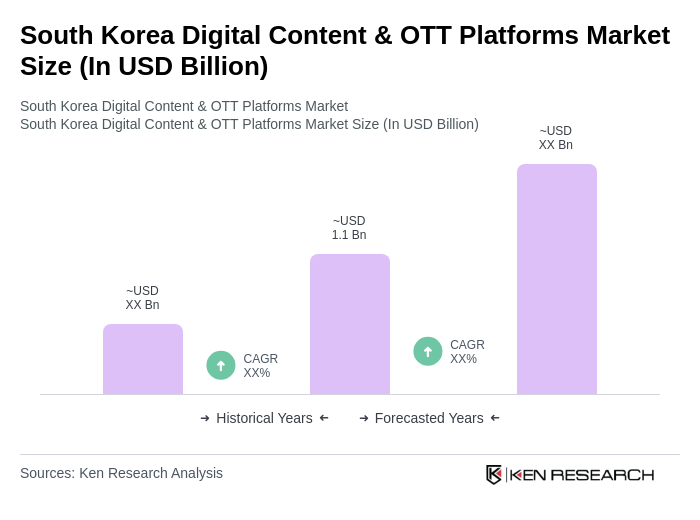
- The South Korea Digital Content & OTT Platforms Market is valued at USD 1.1 billion, based on a five-year historical analysis. This growth is primarily driven by the increasing penetration of high-speed internet, the proliferation of smartphones, and a growing consumer preference for on-demand content. The rise of K-content, including dramas, music, and webtoons, has also significantly contributed to the market's expansion, attracting both domestic and international audiences. Recent trends highlight the rapid adoption of short-form video, the global popularity of Korean pop culture, and the expansion of local OTT platforms, which are intensifying competition and innovation in the sector .
- Seoul is the dominant city in this market, serving as a hub for major digital content companies and OTT platforms. The city's advanced technological infrastructure, coupled with a high concentration of tech-savvy consumers, fosters innovation and competition. Other notable regions include Busan and Incheon, which are also emerging as key players due to their growing entertainment industries and investments in digital content .
- The South Korean government has implemented regulations to promote the digital content industry, including the "Content Industry Promotion Act" (Content Industry Promotion Act, Ministry of Culture, Sports and Tourism, 2014). This act aims to support the growth of local content creators and enhance the competitiveness of the digital content sector. It includes provisions for funding, tax incentives, and support for international collaborations, thereby fostering a vibrant ecosystem for digital content production and distribution. The Korea Creative Content Agency (KOCCA) further supports the industry with dedicated funding and policy initiatives .
South Korea Digital Content & OTT Platforms Market Segmentation
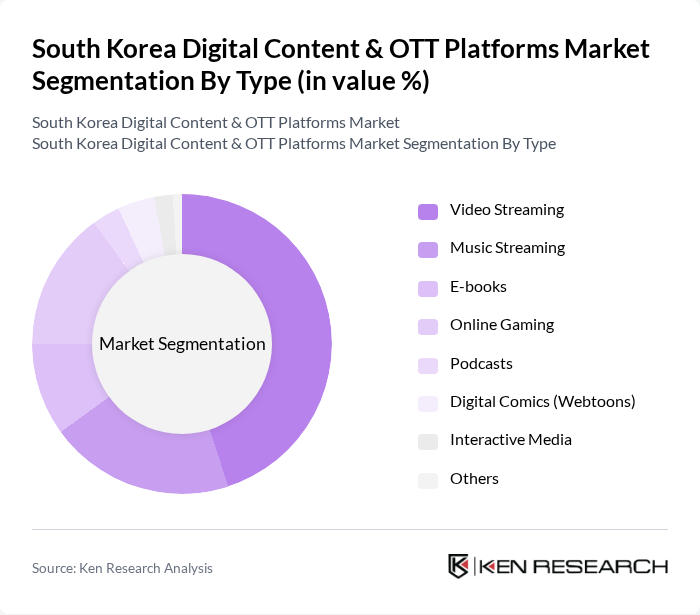
By Type:The market is segmented into various types of digital content, including video streaming, music streaming, e-books, online gaming, podcasts, digital comics (webtoons), interactive media, and others. Among these, video streaming has emerged as the leading segment, driven by the popularity of platforms like Netflix and local services such as Wavve and Tving. The increasing demand for diverse content, the convenience of on-demand viewing, and the rise of original Korean productions have significantly boosted this segment's growth .
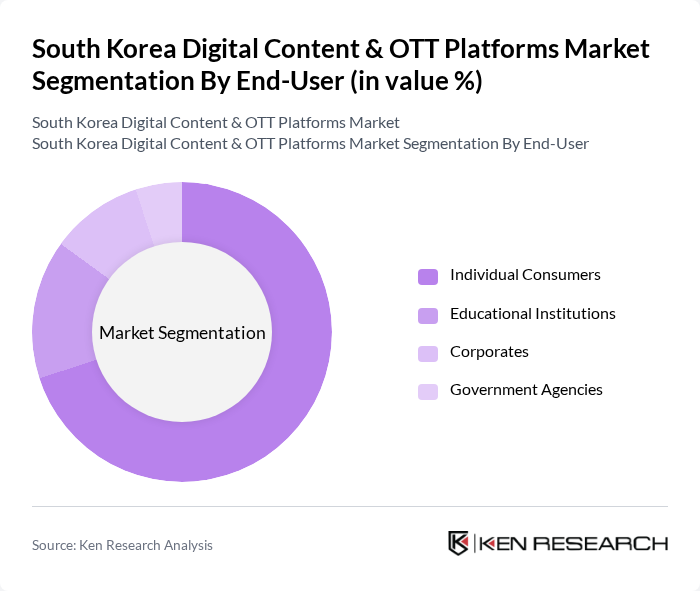
By End-User:The end-user segmentation includes individual consumers, educational institutions, corporates, and government agencies. Individual consumers dominate the market, driven by the increasing consumption of digital content for entertainment and education. The rise of mobile devices and the availability of affordable subscription plans have made it easier for consumers to access a wide range of content, further propelling this segment's growth. Educational institutions and corporates are also increasing their adoption of digital content for e-learning and training purposes .
South Korea Digital Content & OTT Platforms Market Competitive Landscape
The South Korea Digital Content & OTT Platforms Market is characterized by a dynamic mix of regional and international players. Leading participants such as Netflix, Inc., Naver Corporation, Kakao Entertainment Corp., Coupang Play (Coupang, Inc.), Tving Co., Ltd. (CJ ENM), Watcha, Inc., Disney+ (The Walt Disney Company), Amazon Prime Video (Amazon.com, Inc.), YouTube (Google LLC), Spotify Technology S.A., Kakao Corp. (Daum Kakao), iQIYI, Inc., Rakuten Viki, Inc., Wavve (Content Wavve Corp.), Seezn (KT Corporation) contribute to innovation, geographic expansion, and service delivery in this space.
South Korea Digital Content & OTT Platforms Market Industry Analysis
Growth Drivers
- Increasing Internet Penetration:As of future, South Korea boasts an internet penetration rate of approximately 98%, with over 50 million users actively engaging online. This high connectivity fosters a robust environment for digital content consumption, driving demand for OTT platforms. The World Bank reports that the country's digital economy is projected to contribute around $200 billion to GDP, highlighting the critical role of internet access in expanding the digital content market.
- Rising Demand for Mobile Content:In future, mobile data traffic in South Korea is expected to reach 5.5 exabytes per month, reflecting a significant increase in mobile content consumption. The rapid adoption of smartphones, with over 90% of the population owning one, has led to a surge in demand for mobile-optimized content. This trend is supported by the increasing number of mobile subscriptions, which is projected to exceed 70 million, further driving the growth of OTT platforms.
- Expansion of 5G Networks:By future, South Korea aims to have 90% of its population covered by 5G networks, facilitating faster and more reliable streaming services. The rollout of 5G is expected to enhance user experiences, allowing for high-definition content delivery and interactive features. According to the Ministry of Science and ICT, the 5G sector is projected to generate approximately $30 billion in economic value, significantly benefiting digital content providers and OTT platforms.
Market Challenges
- Intense Competition:The South Korean digital content market is characterized by fierce competition, with over 30 OTT platforms vying for consumer attention. Major players like Netflix and local services such as Wavve and Tving are investing heavily in original content, leading to increased content acquisition costs. This competitive landscape pressures smaller platforms, which may struggle to differentiate themselves and maintain profitability amidst rising operational expenses.
- Content Piracy:Content piracy remains a significant challenge in South Korea, with estimates suggesting that over 20% of digital content is consumed illegally. This not only undermines revenue for legitimate platforms but also complicates content licensing and distribution. The government has implemented stricter regulations, yet enforcement remains a challenge, impacting the overall growth potential of the digital content market and discouraging investment in original productions.
South Korea Digital Content & OTT Platforms Market Future Outlook
The South Korean digital content and OTT platforms market is poised for continued growth, driven by technological advancements and evolving consumer preferences. The increasing integration of artificial intelligence in content delivery will enhance personalization, while the demand for localized content will cater to diverse audiences. As platforms explore innovative monetization strategies, including subscription models and partnerships, the market is expected to adapt dynamically to changing consumer behaviors and technological trends, ensuring sustained engagement and revenue growth.
Market Opportunities
- Growth in Subscription-Based Models:The shift towards subscription-based models presents a lucrative opportunity, with projections indicating that subscription revenues could reach $1.5 billion by future. This model allows platforms to build a loyal customer base while ensuring steady revenue streams, particularly as consumers increasingly prefer ad-free experiences and exclusive content offerings.
- Expansion into International Markets:South Korean OTT platforms are increasingly looking to expand internationally, particularly in Southeast Asia, where demand for Korean content is surging. By future, exports of Korean digital content are expected to exceed $1 billion, driven by the global popularity of K-dramas and music. This expansion not only diversifies revenue sources but also enhances brand recognition on a global scale.
Scope of the Report
| Segment | Sub-Segments |
|---|---|
| By Type | Video Streaming Music Streaming E-books Online Gaming Podcasts Digital Comics (Webtoons) Interactive Media Others |
| By End-User | Individual Consumers Educational Institutions Corporates Government Agencies |
| By Content Format | Live Streaming On-Demand Content Interactive Content |
| By Subscription Model | Ad-Supported Subscription-Based Pay-Per-View |
| By Distribution Channel | Direct-to-Consumer Third-Party Platforms Social Media |
| By Device Type | Mobile Devices Smart TVs Laptops and Desktops Tablets |
| By Pricing Strategy | Freemium Tiered Pricing Bundled Offers |
Key Target Audience
Investors and Venture Capitalist Firms
Government and Regulatory Bodies (e.g., Ministry of Science and ICT, Korea Communications Commission)
Content Creators and Producers
Telecommunications Companies
Advertising Agencies
Streaming Service Providers
Media and Entertainment Industry Associations
Financial Institutions
Players Mentioned in the Report:
Netflix, Inc.
Naver Corporation
Kakao Entertainment Corp.
Coupang Play (Coupang, Inc.)
Tving Co., Ltd. (CJ ENM)
Watcha, Inc.
Disney+ (The Walt Disney Company)
Amazon Prime Video (Amazon.com, Inc.)
YouTube (Google LLC)
Spotify Technology S.A.
Kakao Corp. (Daum Kakao)
iQIYI, Inc.
Rakuten Viki, Inc.
Wavve (Content Wavve Corp.)
Seezn (KT Corporation)
Table of Contents
Market Assessment Phase
1. Executive Summary and Approach
2. South Korea Digital Content & OTT Platforms Market Overview
2.1 Key Insights and Strategic Recommendations
2.2 South Korea Digital Content & OTT Platforms Market Overview
2.3 Definition and Scope
2.4 Evolution of Market Ecosystem
2.5 Timeline of Key Regulatory Milestones
2.6 Value Chain & Stakeholder Mapping
2.7 Business Cycle Analysis
2.8 Policy & Incentive Landscape
3. South Korea Digital Content & OTT Platforms Market Analysis
3.1 Growth Drivers
3.1.1 Increasing Internet Penetration
3.1.2 Rising Demand for Mobile Content
3.1.3 Growth of E-commerce and Digital Payments
3.1.4 Expansion of 5G Networks
3.2 Market Challenges
3.2.1 Intense Competition
3.2.2 Regulatory Compliance Issues
3.2.3 Content Piracy
3.2.4 Consumer Privacy Concerns
3.3 Market Opportunities
3.3.1 Growth in Subscription-Based Models
3.3.2 Expansion into International Markets
3.3.3 Development of Original Content
3.3.4 Partnerships with Telecom Providers
3.4 Market Trends
3.4.1 Shift Towards Interactive Content
3.4.2 Increased Use of AI in Content Delivery
3.4.3 Rise of User-Generated Content
3.4.4 Focus on Localized Content
3.5 Government Regulation
3.5.1 Content Rating Systems
3.5.2 Data Protection Laws
3.5.3 Tax Incentives for Content Production
3.5.4 Broadcasting Regulations
4. SWOT Analysis
5. Stakeholder Analysis
6. Porter's Five Forces Analysis
7. South Korea Digital Content & OTT Platforms Market Market Size, 2019-2024
7.1 By Value
7.2 By Volume
7.3 By Average Selling Price
8. South Korea Digital Content & OTT Platforms Market Segmentation
8.1 By Type
8.1.1 Video Streaming
8.1.2 Music Streaming
8.1.3 E-books
8.1.4 Online Gaming
8.1.5 Podcasts
8.1.6 Digital Comics (Webtoons)
8.1.7 Interactive Media
8.1.8 Others
8.2 By End-User
8.2.1 Individual Consumers
8.2.2 Educational Institutions
8.2.3 Corporates
8.2.4 Government Agencies
8.3 By Content Format
8.3.1 Live Streaming
8.3.2 On-Demand Content
8.3.3 Interactive Content
8.4 By Subscription Model
8.4.1 Ad-Supported
8.4.2 Subscription-Based
8.4.3 Pay-Per-View
8.5 By Distribution Channel
8.5.1 Direct-to-Consumer
8.5.2 Third-Party Platforms
8.5.3 Social Media
8.6 By Device Type
8.6.1 Mobile Devices
8.6.2 Smart TVs
8.6.3 Laptops and Desktops
8.6.4 Tablets
8.7 By Pricing Strategy
8.7.1 Freemium
8.7.2 Tiered Pricing
8.7.3 Bundled Offers
9. South Korea Digital Content & OTT Platforms Market Competitive Analysis
9.1 Market Share of Key Players
9.2 Cross Comparison of Key Players
9.2.1 Company Name
9.2.2 Group Size (Large, Medium, or Small as per industry convention)
9.2.3 Revenue Growth Rate (YoY %)
9.2.4 Customer Acquisition Cost (CAC)
9.2.5 Average Revenue Per User (ARPU)
9.2.6 Monthly Active Users (MAU)
9.2.7 Churn Rate (%)
9.2.8 Content Library Size (Titles/Hours)
9.2.9 User Engagement (Avg. Daily/Monthly Time Spent)
9.2.10 Pricing Strategy (Ad-supported, Subscription, Hybrid, etc.)
9.2.11 Market Penetration Rate (%)
9.2.12 Local vs. International Content Ratio
9.3 SWOT Analysis of Top Players
9.4 Pricing Analysis
9.5 Detailed Profile of Major Companies
9.5.1 Netflix, Inc.
9.5.2 Naver Corporation
9.5.3 Kakao Entertainment Corp.
9.5.4 Coupang Play (Coupang, Inc.)
9.5.5 Tving Co., Ltd. (CJ ENM)
9.5.6 Watcha, Inc.
9.5.7 Disney+ (The Walt Disney Company)
9.5.8 Amazon Prime Video (Amazon.com, Inc.)
9.5.9 YouTube (Google LLC)
9.5.10 Spotify Technology S.A.
9.5.11 Kakao Corp. (Daum Kakao)
9.5.12 iQIYI, Inc.
9.5.13 Rakuten Viki, Inc.
9.5.14 Wavve (Content Wavve Corp.)
9.5.15 Seezn (KT Corporation)
10. South Korea Digital Content & OTT Platforms Market End-User Analysis
10.1 Procurement Behavior of Key Ministries
10.1.1 Ministry of Culture, Sports and Tourism
10.1.2 Ministry of Science and ICT
10.1.3 Ministry of Education
10.2 Corporate Spend on Infrastructure & Energy
10.2.1 Investment in Digital Infrastructure
10.2.2 Spending on Content Development
10.2.3 Budget Allocation for Marketing
10.3 Pain Point Analysis by End-User Category
10.3.1 Content Accessibility Issues
10.3.2 High Subscription Costs
10.3.3 Quality of Content
10.4 User Readiness for Adoption
10.4.1 Awareness of Digital Platforms
10.4.2 Technical Proficiency
10.4.3 Willingness to Pay
10.5 Post-Deployment ROI and Use Case Expansion
10.5.1 Measurement of User Engagement
10.5.2 Analysis of Revenue Growth
10.5.3 Expansion into New Content Areas
11. South Korea Digital Content & OTT Platforms Market Future Size, 2025-2030
11.1 By Value
11.2 By Volume
11.3 By Average Selling Price
Go-To-Market Strategy Phase
1. Whitespace Analysis + Business Model Canvas
1.1 Market Gaps Identification
1.2 Business Model Framework
2. Marketing and Positioning Recommendations
2.1 Branding Strategies
2.2 Product USPs
3. Distribution Plan
3.1 Urban Retail vs Rural NGO Tie-ups
4. Channel & Pricing Gaps
4.1 Underserved Routes
4.2 Pricing Bands
5. Unmet Demand & Latent Needs
5.1 Category Gaps
5.2 Consumer Segments
6. Customer Relationship
6.1 Loyalty Programs
6.2 After-sales Service
7. Value Proposition
7.1 Sustainability
7.2 Integrated Supply Chains
8. Key Activities
8.1 Regulatory Compliance
8.2 Branding
8.3 Distribution Setup
9. Entry Strategy Evaluation
9.1 Domestic Market Entry Strategy
9.1.1 Product Mix
9.1.2 Pricing Band
9.1.3 Packaging
9.2 Export Entry Strategy
9.2.1 Target Countries
9.2.2 Compliance Roadmap
10. Entry Mode Assessment
10.1 JV
10.2 Greenfield
10.3 M&A
10.4 Distributor Model
11. Capital and Timeline Estimation
11.1 Capital Requirements
11.2 Timelines
12. Control vs Risk Trade-Off
12.1 Ownership vs Partnerships
13. Profitability Outlook
13.1 Breakeven Analysis
13.2 Long-term Sustainability
14. Potential Partner List
14.1 Distributors
14.2 JVs
14.3 Acquisition Targets
15. Execution Roadmap
15.1 Phased Plan for Market Entry
15.1.1 Market Setup
15.1.2 Market Entry
15.1.3 Growth Acceleration
15.1.4 Scale & Stabilize
15.2 Key Activities and Milestones
15.2.1 Activity Timeline
15.2.2 Milestone Tracking
Research Methodology
Phase 1: Approach1
Desk Research
- Analysis of industry reports from South Korean digital content associations and OTT platforms
- Review of government publications and regulatory frameworks impacting digital content distribution
- Examination of market trends and consumer behavior studies published by research institutions
Primary Research
- In-depth interviews with executives from leading OTT platforms and content creators
- Surveys targeting consumers to understand viewing habits and preferences
- Focus groups with industry experts to discuss emerging trends and challenges
Validation & Triangulation
- Cross-validation of findings through multiple data sources, including market reports and expert opinions
- Triangulation of consumer insights with industry forecasts and financial performance data
- Sanity checks conducted through expert panel reviews to ensure data reliability
Phase 2: Market Size Estimation1
Top-down Assessment
- Estimation of total market size based on national digital content revenue statistics
- Segmentation of the market by content type (e.g., video, music, gaming) and distribution channel
- Incorporation of growth rates from historical data and projected trends in digital consumption
Bottom-up Modeling
- Collection of revenue data from key players in the OTT space to establish baseline figures
- Analysis of subscription and advertising revenue models across different platforms
- Volume and pricing analysis based on user engagement metrics and content consumption rates
Forecasting & Scenario Analysis
- Development of forecasting models using historical growth rates and market drivers
- Scenario analysis based on potential regulatory changes and technological advancements
- Creation of multiple projections (baseline, optimistic, and pessimistic) through 2030
Phase 3: CATI Sample Composition1
| Scope Item/Segment | Sample Size | Target Respondent Profiles |
|---|---|---|
| OTT Platform User Experience | 100 | Regular Users, Content Consumers |
| Content Creation Insights | 60 | Producers, Content Directors |
| Advertising Effectiveness in Digital Media | 50 | Marketing Managers, Brand Strategists |
| Regulatory Impact on Content Distribution | 40 | Legal Advisors, Compliance Officers |
| Consumer Preferences in Digital Content | 90 | General Audience, Focus Group Participants |
Frequently Asked Questions
What is the current value of the South Korea Digital Content & OTT Platforms Market?
The South Korea Digital Content & OTT Platforms Market is valued at approximately USD 1.1 billion, driven by high-speed internet penetration, smartphone usage, and a growing preference for on-demand content, particularly K-content like dramas and webtoons.
What factors are driving the growth of the South Korean OTT market?
Which cities are the main hubs for digital content in South Korea?
What types of digital content are popular in South Korea?
Other Regional/Country Reports
Indonesia Digital Content & OTT Platforms Market
Malaysia Digital Content & OTT Platforms Market
KSA Digital Content & OTT Platforms Market
APAC Digital Content & OTT Platforms Market
SEA Digital Content & OTT Platforms Market
Vietnam Digital Content & OTT Platforms Market
Other Adjacent Reports
Mexico Content Creation Tools Market
South Africa Online Gaming Market
Qatar E-Learning Platforms Market
Bahrain Music Streaming Market Report Size Share Growth Drivers Trends Opportunities & Forecast 2025–2030Germany Webtoon Publishing Market
Bahrain Social Media Platforms Market
Thailand Cloud Computing Services Market
Thailand Cybersecurity Solutions Market
KSA 5G Network Infrastructure Market
Why Buy From Us?

What makes us stand out is that our consultants follow Robust, Refine and Result (RRR) methodology. Robust for clear definitions, approaches and sanity checking, Refine for differentiating respondents' facts and opinions, and Result for presenting data with story.

We have set a benchmark in the industry by offering our clients with syndicated and customized market research reports featuring coverage of entire market as well as meticulous research and analyst insights.

While we don't replace traditional research, we flip the method upside down. Our dual approach of Top Bottom & Bottom Top ensures quality deliverable by not just verifying company fundamentals but also looking at the sector and macroeconomic factors.

With one step in the future, our research team constantly tries to show you the bigger picture. We help with some of the tough questions you may encounter along the way: How is the industry positioned? Best marketing channel? KPI's of competitors? By aligning every element, we help maximize success.

Our report gives you instant access to the answers and sources that other companies might choose to hide. We elaborate each steps of research methodology we have used and showcase you the sample size to earn your trust.

If you need any support, we are here! We pride ourselves on universe strength, data quality, and quick, friendly, and professional service.