About the Report
Base Year 2024Switzerland Healthcare Medical Tourism Market Overview
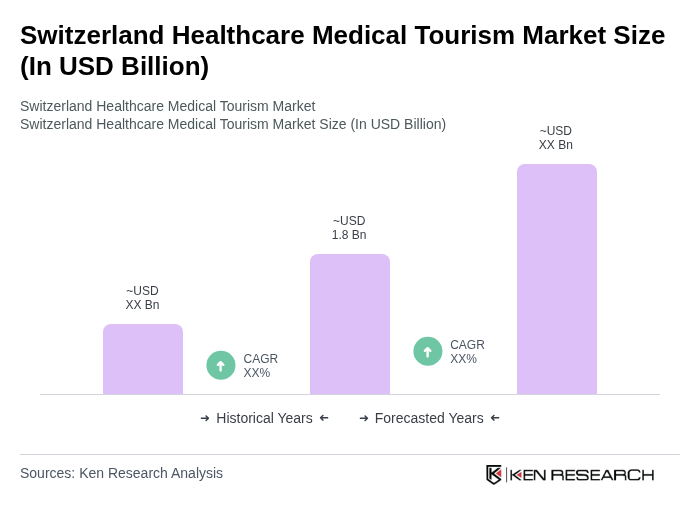
- The Switzerland Healthcare Medical Tourism Market is valued at USD 1.8 billion, based on a five-year historical analysis. This growth is primarily driven by the country's reputation for high-quality healthcare services, advanced medical technology, and a strong emphasis on patient safety and satisfaction. The influx of international patients seeking specialized treatments, such as cardiovascular, orthopedic, oncology, fertility, and aesthetic procedures, along with high-end wellness and regenerative medicine programs, has significantly contributed to the market's expansion.
- Key cities dominating the market include Zurich, Geneva, Basel, Bern, and Lausanne. These cities are renowned for their world-class hospitals, specialized clinics, and wellness centers, attracting patients from Europe, the Middle East, Russia, China, and other Asian markets. The presence of highly skilled medical professionals, strong university hospital networks, and cutting-edge healthcare facilities with advanced imaging, robotic surgery, and minimally invasive technologies further enhances their appeal as medical tourism destinations.
- Switzerland’s medical tourism ecosystem functions under the broader Swiss health insurance and hospital planning framework, including the Federal Health Insurance Act (Bundesgesetz über die Krankenversicherung, KVG/LAMal) issued by the Swiss Federal Assembly in 1994, which governs mandatory health insurance, benefit coverage, provider reimbursement, and quality obligations for hospitals treating both resident and foreign patients. In parallel, cantonal hospital planning and licensing regulations define which hospitals are included on cantonal lists and set requirements for infrastructure, quality management, and transparency, which also apply when these hospitals admit international self-paying patients. At the promotion level, Switzerland Tourism’s dedicated health and medical tourism initiatives coordinate with accredited clinics and hospitals to standardize information, marketing, and service pathways for international patients.
Switzerland Healthcare Medical Tourism Market Segmentation
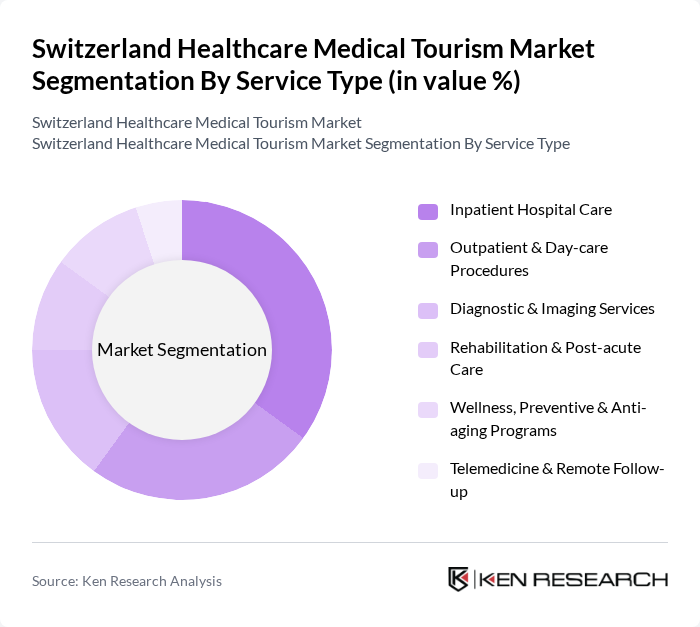
By Service Type:The service type segmentation includes various healthcare services offered to international patients. The subsegments are Inpatient Hospital Care, Outpatient & Day-care Procedures, Diagnostic & Imaging Services, Rehabilitation & Post-acute Care, Wellness, Preventive & Anti-aging Programs, and Telemedicine & Remote Follow-up. Among these, Inpatient Hospital Care is the leading subsegment, driven by the demand for complex surgeries and treatments that require hospitalization, including cardiovascular, oncology, neurosurgery, and orthopedic procedures. Patients often prefer Swiss hospitals for their advanced medical technologies, strong clinical outcome records, and high success rates in complex and multidisciplinary care.
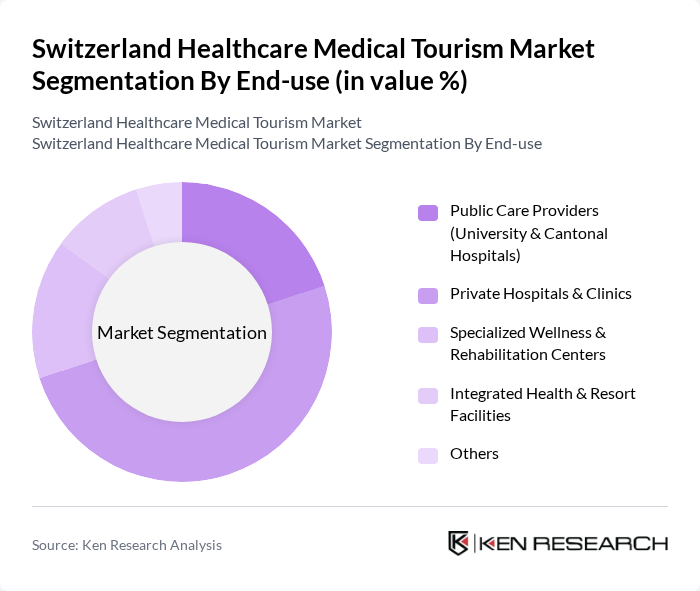
By End-use:The end-use segmentation categorizes the healthcare services based on the type of facilities providing care. This includes Public Care Providers (University & Cantonal Hospitals), Private Hospitals & Clinics, Specialized Wellness & Rehabilitation Centers, Integrated Health & Resort Facilities, and Others. Public Care Providers (University & Cantonal Hospitals) account for a major share of international patient revenues in Switzerland, supported by strong government backing, inclusion on cantonal hospital lists, and comprehensive tertiary and quaternary care capabilities. Private Hospitals & Clinics play a critical complementary role for self-paying foreign patients, offering personalized care pathways, high privacy standards, extensive concierge services, and shorter waiting times, which are particularly appealing to affluent international patients seeking immediate or highly customized treatment.
Switzerland Healthcare Medical Tourism Market Competitive Landscape
The Switzerland Healthcare Medical Tourism Market is characterized by a dynamic mix of regional and international players. Leading participants such as Hirslanden Private Hospital Group, Swiss Medical Network, University Hospital Zurich (USZ), Geneva University Hospitals (HUG), Inselspital, Bern University Hospital, Lausanne University Hospital (CHUV), Schulthess Klinik, Klinik Im Park, Klinik St. Anna, Rehaklinik Zihlschlacht, Clinique Générale-Beaulieu, Switzerland Tourism – Medical Tourism Program, MediTravel Switzerland, Swiss Health Tourism Facilitators (Representative Players), Selected Luxury Wellness & Anti-aging Clinics (Representative Players) contribute to innovation, geographic expansion, and service delivery in this space.
Switzerland Healthcare Medical Tourism Market Industry Analysis
Growth Drivers
- High-Quality Healthcare Services:Switzerland is renowned for its exceptional healthcare services, with over 90% of hospitals accredited by the Swiss Federal Office of Public Health. The country boasts a physician-to-population ratio of 4.4 per 1,000 people, significantly higher than the OECD average of 3.8. This high standard of care attracts approximately 70,000 medical tourists annually, seeking specialized treatments, particularly in cardiology and orthopedics, contributing to the sector's robust growth.
- Advanced Medical Technology:Switzerland invests heavily in healthcare innovation, with healthcare expenditure reaching CHF 90 billion, representing 12.5% of GDP. The country is home to leading medical technology firms, such as Roche and Novartis, which drive advancements in treatments and diagnostics. This technological edge enhances the appeal of Swiss healthcare, drawing international patients seeking cutting-edge procedures, particularly in oncology and regenerative medicine, thus bolstering the medical tourism market.
- Strong Reputation for Patient Safety:Switzerland's healthcare system is characterized by stringent patient safety regulations, with a reported 97% satisfaction rate among patients. The country has one of the lowest hospital-acquired infection rates in Europe, at 5.2%. This commitment to safety and quality care fosters trust among international patients, making Switzerland a preferred destination for complex surgeries and treatments, further propelling the growth of medical tourism in the region.
Market Challenges
- High Costs of Medical Procedures:The cost of medical procedures in Switzerland is among the highest globally, with average surgical costs exceeding CHF 25,000. This financial barrier limits access for many potential medical tourists, particularly from emerging markets. Despite the high-quality services offered, the price sensitivity of patients can deter them from choosing Switzerland as their medical tourism destination, posing a significant challenge to market growth.
- Regulatory Complexities:Navigating the regulatory landscape in Switzerland can be challenging for international patients. The country has strict licensing requirements for healthcare providers, with an average processing time of five months for approvals. Additionally, varying regulations across cantons can create confusion for medical tourists. These complexities may discourage potential patients from pursuing treatment in Switzerland, impacting the overall attractiveness of the medical tourism sector.
Switzerland Healthcare Medical Tourism Market Future Outlook
The future of Switzerland's healthcare medical tourism market appears promising, driven by increasing global demand for high-quality healthcare services. As digital health solutions gain traction, more patients are likely to seek Swiss expertise remotely. Furthermore, the integration of personalized medicine into treatment plans is expected to enhance patient experiences. With ongoing investments in healthcare infrastructure and technology, Switzerland is well-positioned to maintain its status as a leading destination for medical tourism, attracting a diverse range of international patients.
Market Opportunities
- Growing Demand for Cosmetic Surgery:The global cosmetic surgery market is projected to reach USD 70 billion, with Switzerland emerging as a key player. The country's reputation for high-quality aesthetic procedures, combined with its luxurious environment, positions it favorably to attract patients seeking cosmetic enhancements, thus creating significant growth opportunities in this niche market.
- Expansion of Telemedicine Services:The rise of telemedicine, accelerated by the COVID-19 pandemic, presents a unique opportunity for Swiss healthcare providers. With an estimated 40% increase in telehealth consultations, Swiss hospitals can leverage this trend to offer pre- and post-operative consultations to international patients, enhancing accessibility and convenience, thereby boosting medical tourism.
Scope of the Report
| Segment | Sub-Segments |
|---|---|
| By Service Type | Inpatient Hospital Care Outpatient & Day-care Procedures Diagnostic & Imaging Services Rehabilitation & Post-acute Care Wellness, Preventive & Anti-aging Programs Telemedicine & Remote Follow-up |
| By End-use | Public Care Providers (University & Cantonal Hospitals) Private Hospitals & Clinics Specialized Wellness & Rehabilitation Centers Integrated Health & Resort Facilities Others |
| By Treatment Specialty | Cardiology & Cardiovascular Surgery Orthopedics & Spine Surgery Oncology & Advanced Diagnostics Aesthetic & Reconstructive Surgery Fertility, Gynecology & Maternity Care Neurology & Neurosurgery Others |
| By Patient Origin | Intra-European Patients Middle East & GCC Patients CIS & Eastern Europe Patients Asia-Pacific Patients Others |
| By Payer Type | Self-pay / Out-of-pocket International Private Insurance Government & Embassy-sponsored Patients Corporate & Third-party Payers Others |
| By Length of Stay | Short-term (Up to 7 Days) Medium-term (8–21 Days) Long-term (More than 21 Days) |
| By Region within Switzerland | Zurich Geneva Basel Bern Lausanne & Vaud Others |
Key Target Audience
Investors and Venture Capitalist Firms
Government and Regulatory Bodies (e.g., Federal Office of Public Health, Swiss Medical Association)
Healthcare Providers and Hospitals
Insurance Companies
Medical Tourism Facilitators
Travel Agencies Specializing in Medical Tourism
Pharmaceutical Companies
Health Technology Companies
Players Mentioned in the Report:
Hirslanden Private Hospital Group
Swiss Medical Network
University Hospital Zurich (USZ)
Geneva University Hospitals (HUG)
Inselspital, Bern University Hospital
Lausanne University Hospital (CHUV)
Schulthess Klinik
Klinik Im Park
Klinik St. Anna
Rehaklinik Zihlschlacht
Clinique Generale-Beaulieu
Switzerland Tourism Medical Tourism Program
MediTravel Switzerland
Swiss Health Tourism Facilitators (Representative Players)
Selected Luxury Wellness & Anti-aging Clinics (Representative Players)
Table of Contents
Market Assessment Phase
1. Executive Summary and Approach
2. Switzerland Healthcare Medical Tourism Market Overview
2.1 Key Insights and Strategic Recommendations
2.2 Switzerland Healthcare Medical Tourism Market Overview
2.3 Definition and Scope
2.4 Evolution of Market Ecosystem
2.5 Timeline of Key Regulatory Milestones
2.6 Value Chain & Stakeholder Mapping
2.7 Business Cycle Analysis
2.8 Policy & Incentive Landscape
3. Switzerland Healthcare Medical Tourism Market Analysis
3.1 Growth Drivers
3.1.1 High-quality healthcare services
3.1.2 Advanced medical technology
3.1.3 Strong reputation for patient safety
3.1.4 Attractive tourism infrastructure
3.2 Market Challenges
3.2.1 High costs of medical procedures
3.2.2 Regulatory complexities
3.2.3 Limited insurance coverage for medical tourism
3.2.4 Competition from other countries
3.3 Market Opportunities
3.3.1 Growing demand for cosmetic surgery
3.3.2 Expansion of telemedicine services
3.3.3 Partnerships with international health insurers
3.3.4 Development of wellness tourism
3.4 Market Trends
3.4.1 Increasing use of digital health solutions
3.4.2 Rise in personalized medicine
3.4.3 Focus on holistic health approaches
3.4.4 Growth in health and wellness retreats
3.5 Government Regulation
3.5.1 Licensing requirements for healthcare providers
3.5.2 Patient rights and safety regulations
3.5.3 Cross-border healthcare regulations
3.5.4 Data protection laws affecting patient information
4. SWOT Analysis
5. Stakeholder Analysis
6. Porter's Five Forces Analysis
7. Switzerland Healthcare Medical Tourism Market Size, 2019-2024
7.1 By Value
7.2 By Volume
7.3 By Average Selling Price
8. Switzerland Healthcare Medical Tourism Market Segmentation
8.1 By Service Type
8.1.1 Inpatient Hospital Care
8.1.2 Outpatient & Day-care Procedures
8.1.3 Diagnostic & Imaging Services
8.1.4 Rehabilitation & Post-acute Care
8.1.5 Wellness, Preventive & Anti-aging Programs
8.1.6 Telemedicine & Remote Follow-up
8.2 By End-use
8.2.1 Public Care Providers (University & Cantonal Hospitals)
8.2.2 Private Hospitals & Clinics
8.2.3 Specialized Wellness & Rehabilitation Centers
8.2.4 Integrated Health & Resort Facilities
8.2.5 Others
8.3 By Treatment Specialty
8.3.1 Cardiology & Cardiovascular Surgery
8.3.2 Orthopedics & Spine Surgery
8.3.3 Oncology & Advanced Diagnostics
8.3.4 Aesthetic & Reconstructive Surgery
8.3.5 Fertility, Gynecology & Maternity Care
8.3.6 Neurology & Neurosurgery
8.3.7 Others
8.4 By Patient Origin
8.4.1 Intra-European Patients
8.4.2 Middle East & GCC Patients
8.4.3 CIS & Eastern Europe Patients
8.4.4 Asia-Pacific Patients
8.4.5 Others
8.5 By Payer Type
8.5.1 Self-pay / Out-of-pocket
8.5.2 International Private Insurance
8.5.3 Government & Embassy-sponsored Patients
8.5.4 Corporate & Third-party Payers
8.5.5 Others
8.6 By Length of Stay
8.6.1 Short-term (Up to 7 Days)
8.6.2 Medium-term (8–21 Days)
8.6.3 Long-term (More than 21 Days)
8.7 By Region within Switzerland
8.7.1 Zurich
8.7.2 Geneva
8.7.3 Basel
8.7.4 Bern
8.7.5 Lausanne & Vaud
8.7.6 Others
9. Switzerland Healthcare Medical Tourism Market Competitive Analysis
9.1 Market Share of Key Players
9.2 Cross Comparison of Key Players
9.2.1 Company Name
9.2.2 Ownership / End-use Category (Public vs Private)
9.2.3 International Patient Volume per Year
9.2.4 Share of Revenue from Medical Tourists (%)
9.2.5 Average Revenue per International Patient (ARPP)
9.2.6 Case-mix Complexity Index
9.2.7 Treatment Outcome / Success Rate
9.2.8 Average Length of Stay for International Patients
9.2.9 Bed Occupancy Rate
9.2.10 EBITDA Margin
9.2.11 International Referral & Partner Network Size
9.2.12 Digital Engagement Metrics (Website Traffic, Lead Conversion Rate)
9.3 SWOT Analysis of Top Players
9.4 Pricing Analysis
9.5 Detailed Profile of Major Companies
9.5.1 Hirslanden Private Hospital Group
9.5.2 Swiss Medical Network
9.5.3 University Hospital Zurich (USZ)
9.5.4 Geneva University Hospitals (HUG)
9.5.5 Inselspital, Bern University Hospital
9.5.6 Lausanne University Hospital (CHUV)
9.5.7 Schulthess Klinik
9.5.8 Klinik Im Park
9.5.9 Klinik St. Anna
9.5.10 Rehaklinik Zihlschlacht
9.5.11 Clinique Générale-Beaulieu
9.5.12 Switzerland Tourism – Medical Tourism Program
9.5.13 MediTravel Switzerland
9.5.14 Swiss Health Tourism Facilitators (Representative Players)
9.5.15 Selected Luxury Wellness & Anti-aging Clinics (Representative Players)
10. Switzerland Healthcare Medical Tourism Market End-User Analysis
10.1 Procurement Behavior of Key Ministries
10.1.1 Budget Allocation for Health Services
10.1.2 Decision-Making Processes
10.1.3 Evaluation Criteria for Providers
10.1.4 Contracting Practices
10.2 Corporate Spend on Infrastructure & Energy
10.2.1 Investment in Healthcare Facilities
10.2.2 Spending on Medical Equipment
10.2.3 Budget for Employee Health Programs
10.2.4 Others
10.3 Pain Point Analysis by End-User Category
10.3.1 Access to Quality Care
10.3.2 Affordability of Treatments
10.3.3 Availability of Information
10.3.4 Others
10.4 User Readiness for Adoption
10.4.1 Awareness of Medical Tourism Options
10.4.2 Perceived Risks and Benefits
10.4.3 Readiness to Travel for Treatment
10.4.4 Others
10.5 Post-Deployment ROI and Use Case Expansion
10.5.1 Measurement of Treatment Outcomes
10.5.2 Patient Follow-up Practices
10.5.3 Expansion into New Treatment Areas
10.5.4 Others
11. Switzerland Healthcare Medical Tourism Market Future Size, 2025-2030
11.1 By Value
11.2 By Volume
11.3 By Average Selling Price
Go-To-Market Strategy Phase
1. Whitespace Analysis + Business Model Canvas
1.1 Market Gaps Identification
1.2 Business Model Development
2. Marketing and Positioning Recommendations
2.1 Branding Strategies
2.2 Product USPs
3. Distribution Plan
3.1 Urban Retail vs Rural NGO Tie-ups
4. Channel & Pricing Gaps
4.1 Underserved Routes
4.2 Pricing Bands
5. Unmet Demand & Latent Needs
5.1 Category Gaps
5.2 Consumer Segments
6. Customer Relationship
6.1 Loyalty Programs
6.2 After-sales Service
7. Value Proposition
7.1 Sustainability
7.2 Integrated Supply Chains
8. Key Activities
8.1 Regulatory Compliance
8.2 Branding
8.3 Distribution Setup
9. Entry Strategy Evaluation
9.1 Domestic Market Entry Strategy
9.1.1 Product Mix
9.1.2 Pricing Band
9.1.3 Packaging
9.2 Export Entry Strategy
9.2.1 Target Countries
9.2.2 Compliance Roadmap
10. Entry Mode Assessment
10.1 JV
10.2 Greenfield
10.3 M&A
10.4 Distributor Model
11. Capital and Timeline Estimation
11.1 Capital Requirements
11.2 Timelines
12. Control vs Risk Trade-Off
12.1 Ownership vs Partnerships
13. Profitability Outlook
13.1 Breakeven Analysis
13.2 Long-term Sustainability
14. Potential Partner List
14.1 Distributors
14.2 JVs
14.3 Acquisition Targets
15. Execution Roadmap
15.1 Phased Plan for Market Entry
15.1.1 Market Setup
15.1.2 Market Entry
15.1.3 Growth Acceleration
15.1.4 Scale & Stabilize
15.2 Key Activities and Milestones
15.2.1 Milestone Planning
15.2.2 Activity Tracking
Research Methodology
Phase 1: Approach1
Desk Research
- Analysis of healthcare tourism reports from Swiss government and health authorities
- Review of academic journals and publications on medical tourism trends in Switzerland
- Examination of online databases and industry reports focusing on patient demographics and treatment types
Primary Research
- Interviews with healthcare providers and hospital administrators in Switzerland
- Surveys conducted with international patients who have utilized Swiss medical services
- Focus groups with medical tourism facilitators and travel agencies specializing in healthcare
Validation & Triangulation
- Cross-validation of findings through multiple data sources including government statistics and industry reports
- Triangulation of patient feedback and healthcare provider insights to ensure data reliability
- Sanity checks through expert panel reviews comprising healthcare economists and medical tourism experts
Phase 2: Market Size Estimation1
Top-down Assessment
- Estimation of total healthcare expenditure in Switzerland as a baseline for medical tourism
- Segmentation of market size by treatment type, including elective surgeries and wellness services
- Incorporation of trends in international patient inflow and healthcare service demand
Bottom-up Modeling
- Collection of data on patient volumes from leading Swiss hospitals and clinics
- Operational cost analysis based on treatment pricing and service offerings
- Calculation of revenue generated from international patients using treatment volume and average cost per procedure
Forecasting & Scenario Analysis
- Multi-factor regression analysis incorporating economic indicators and healthcare accessibility trends
- Scenario modeling based on potential changes in healthcare regulations and international travel policies
- Development of baseline, optimistic, and pessimistic forecasts through 2030
Phase 3: CATI Sample Composition1
| Scope Item/Segment | Sample Size | Target Respondent Profiles |
|---|---|---|
| Elective Surgery Patients | 150 | International Patients, Medical Tourism Coordinators |
| Wellness and Spa Services | 100 | Health and Wellness Tourists, Spa Managers |
| Rehabilitation Services | 80 | Patients Seeking Rehabilitation, Healthcare Providers |
| Cosmetic Surgery Clients | 120 | Cosmetic Surgery Patients, Clinic Administrators |
| Dental Tourism | 90 | Dental Patients, Dental Clinic Managers |
Frequently Asked Questions
What is the current value of the Switzerland Healthcare Medical Tourism Market?
The Switzerland Healthcare Medical Tourism Market is valued at approximately USD 1.8 billion, reflecting a robust growth driven by the country's high-quality healthcare services, advanced medical technology, and a focus on patient safety and satisfaction.
Which cities in Switzerland are popular for medical tourism?
What types of medical services are most sought after by international patients in Switzerland?
How does Switzerland ensure high-quality healthcare services for medical tourists?
Other Regional/Country Reports
Other Adjacent Reports
Thailand Cosmetic Surgery Market
South Korea Telemedicine Services Market
Bahrain Oncology Treatment Market
UAE Orthopedic Treatment Market
South Korea Cardiovascular Treatment Market
Philippines Fertility Treatment Market
UAE Healthcare Technology Market
Oman Medical Device Market Size Share Growth Drivers Trends Opportunities & Forecast 2025–2030Why Buy From Us?

What makes us stand out is that our consultants follow Robust, Refine and Result (RRR) methodology. Robust for clear definitions, approaches and sanity checking, Refine for differentiating respondents' facts and opinions, and Result for presenting data with story.

We have set a benchmark in the industry by offering our clients with syndicated and customized market research reports featuring coverage of entire market as well as meticulous research and analyst insights.

While we don't replace traditional research, we flip the method upside down. Our dual approach of Top Bottom & Bottom Top ensures quality deliverable by not just verifying company fundamentals but also looking at the sector and macroeconomic factors.

With one step in the future, our research team constantly tries to show you the bigger picture. We help with some of the tough questions you may encounter along the way: How is the industry positioned? Best marketing channel? KPI's of competitors? By aligning every element, we help maximize success.

Our report gives you instant access to the answers and sources that other companies might choose to hide. We elaborate each steps of research methodology we have used and showcase you the sample size to earn your trust.

If you need any support, we are here! We pride ourselves on universe strength, data quality, and quick, friendly, and professional service.