About the Report
Base Year 2024Turkey Aerospace and Defense Manufacturing Market Overview
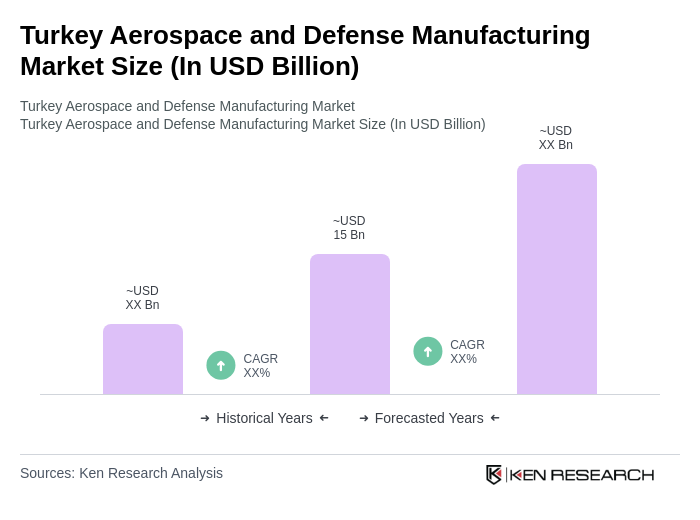
- The Turkey Aerospace and Defense Manufacturing Market is valued at USD 15 billion, based on a five-year historical analysis. This growth is primarily driven by increased government spending on defense, rapid technological advancements, and a rising demand for indigenous military capabilities. The market has seen significant investments in research and development, leading to innovations in aerospace technologies and defense systems, particularly in unmanned systems and advanced propulsion technologies .
- Key production and innovation hubs in this market include Istanbul, Ankara, and Eski?ehir, which dominate due to their strategic locations, robust industrial infrastructure, and proximity to major defense contractors. Istanbul serves as a commercial and industrial hub, Ankara is the political and administrative center facilitating government contracts, and Eski?ehir is recognized for its aerospace engineering and manufacturing capabilities, contributing significantly to sector growth .
- The National Defense Industry Strategy, implemented by the Presidency of Defense Industries (SSB) in 2023, aims to increase local production and reduce dependency on foreign suppliers. The strategy includes a binding commitment of USD 1 billion for the development of advanced defense technologies and mandates public-private partnerships to enhance innovation and competitiveness. This is governed by the “Presidential Decree on the Organization and Duties of the Presidency of Defense Industries” (Decree No. 1, issued by the Presidency of the Republic of Turkey, 2018, as amended), which sets operational standards, compliance requirements, and R&D funding thresholds for all defense industry stakeholders .
Turkey Aerospace and Defense Manufacturing Market Segmentation
By Industry:The industry segmentation includes Manufacturing, Design, and Engineering (MDE) and Maintenance, Repair, and Overhaul (MRO). The Manufacturing, Design, and Engineering segment is crucial as it encompasses the development of new technologies and systems, while the MRO segment ensures the longevity and operational readiness of existing assets.
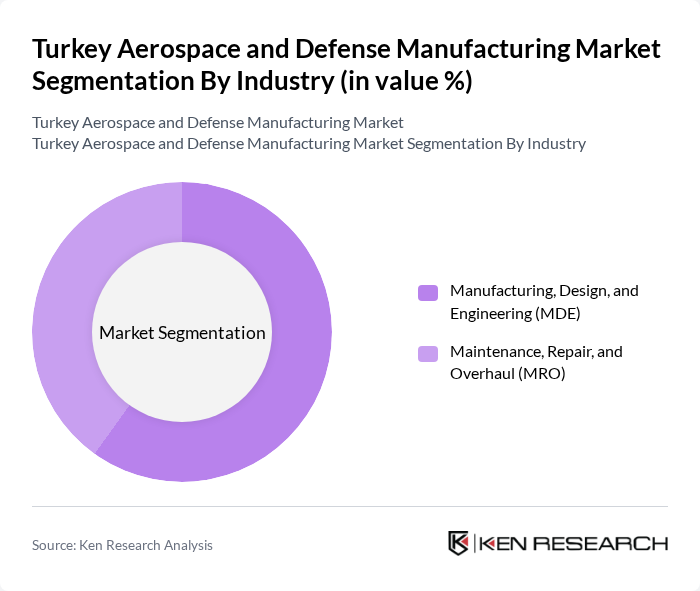
The Manufacturing, Design, and Engineering (MDE) segment is currently dominating the market due to the increasing focus on developing indigenous capabilities and advanced technologies. This segment is characterized by significant investments in R&D, leading to innovations in aerospace systems and defense technologies. The demand for new aircraft, drones, and defense systems has surged, driven by both domestic needs and export opportunities. The MRO segment, while essential for maintaining operational readiness, does not match the growth pace of MDE, which is fueled by technological advancements and government initiatives .
By Type:The type segmentation includes Aerospace (Aviation & Space) and Defense. The Aerospace segment focuses on the development of aircraft and space technologies, while the Defense segment encompasses military systems and equipment.
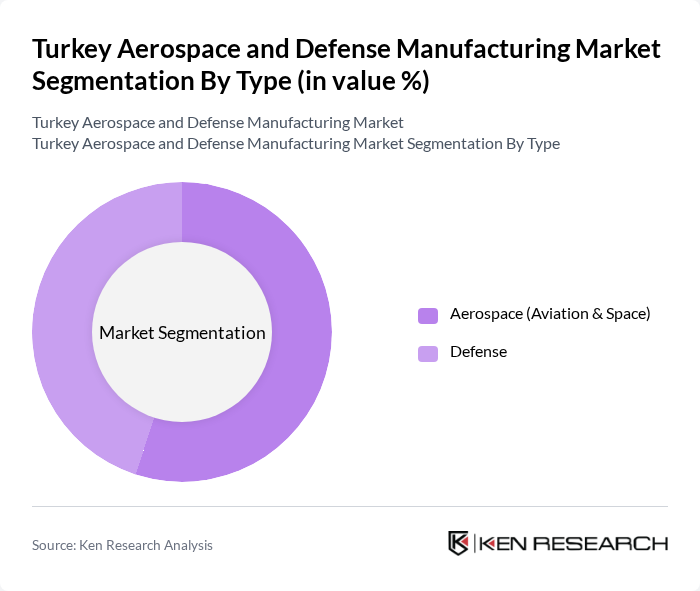
The Aerospace (Aviation & Space) segment is leading the market, driven by the increasing demand for commercial and military aircraft, as well as advancements in space technologies. The Turkish government has prioritized the development of its aerospace capabilities, resulting in significant investments in new aircraft programs and satellite technologies. The Defense segment remains vital, focusing on military equipment and systems, but it is the Aerospace segment that is currently experiencing higher growth due to the global demand for advanced aviation solutions and the push for indigenous production .
Turkey Aerospace and Defense Manufacturing Market Competitive Landscape
The Turkey Aerospace and Defense Manufacturing Market is characterized by a dynamic mix of regional and international players. Leading participants such as Turkish Aerospace Industries, Inc. (TUSA?), ASELSAN Elektronik Sanayi ve Ticaret A.?., ROKETSAN Roket Sanayii ve Ticaret A.?., HAVELSAN Hava Elektronik Sanayi ve Ticaret A.?., STM Savunma Teknolojileri Mühendislik ve Ticaret A.?., BMC Otomotiv Sanayi ve Ticaret A.?., FNSS Savunma Sistemleri A.?., Otokar Otomotiv ve Savunma Sanayi A.?., Makine ve Kimya Endüstrisi A.?. (MKE), Baykar Teknoloji (Baykar Makina Sanayi ve Ticaret A.?.), TEI-TUSA? Motor Sanayii A.?., AYESA? Ayd?n Yaz?l?m ve Elektronik Sanayi A.?., Alp Havac?l?k Sanayi ve Ticaret A.?., Kale Arge / Kale Aero (Kale Grubu), Turkish Technic (Turkish Airlines Technic A.?.) contribute to innovation, geographic expansion, and service delivery in this space.
Turkey Aerospace and Defense Manufacturing Market Industry Analysis
Growth Drivers
- Increased Defense Spending:Turkey's defense budget reached approximately $19.5 billion, reflecting a moderate increase from the previous year. This rise is driven by regional security concerns and the need for modernization of military capabilities. The government aims to allocate 2.5% of its GDP to defense, which is projected to enhance domestic production and stimulate the aerospace and defense sector significantly. This increased funding supports various projects, including advanced fighter jets and naval systems.
- Technological Advancements:The Turkish aerospace and defense sector is witnessing substantial investments in R&D, with over $1.6 billion allocated. This investment is focused on developing indigenous technologies, such as advanced avionics and missile systems. Collaborations with universities and research institutions are fostering innovation, leading to the creation of cutting-edge products. The emphasis on technology not only enhances military capabilities but also positions Turkey as a competitive player in the global defense market.
- Strategic Geopolitical Positioning:Turkey's unique geographical location at the crossroads of Europe and Asia enhances its strategic importance in defense. The country serves as a critical partner for NATO, contributing to regional stability. In future, Turkey is expected to increase its defense exports to approximately $2.1 billion, capitalizing on its strategic alliances and partnerships. This positioning allows Turkey to leverage its defense capabilities, attracting foreign investments and fostering international collaborations in aerospace and defense manufacturing.
Market Challenges
- Supply Chain Disruptions:The aerospace and defense sector in Turkey faces significant supply chain challenges, exacerbated by global disruptions. In future, the industry is projected to experience delays in component deliveries, impacting production timelines. The reliance on foreign suppliers for critical materials, such as titanium and advanced composites, poses risks. These disruptions can lead to increased costs and hinder the timely execution of defense contracts, affecting overall market competitiveness.
- Regulatory Compliance Issues:Navigating the complex regulatory landscape is a significant challenge for Turkey's aerospace and defense manufacturers. In future, compliance with stringent export control regulations and local content requirements is expected to increase operational costs by approximately 15%. Companies must invest in legal expertise and compliance systems to meet these regulations, which can divert resources from innovation and production, ultimately affecting market growth and competitiveness.
Turkey Aerospace and Defense Manufacturing Market Future Outlook
The future of Turkey's aerospace and defense manufacturing market appears promising, driven by increased defense spending and a focus on technological innovation. As the government continues to prioritize domestic production, the sector is likely to see enhanced capabilities in UAVs and advanced weaponry. Additionally, partnerships with NATO and other international entities will foster collaboration, leading to shared technological advancements. The emphasis on cybersecurity and sustainable practices will further shape the industry's trajectory, ensuring Turkey remains competitive in the global defense landscape.
Market Opportunities
- Export Potential:Turkey's defense exports are projected to reach approximately $2.1 billion, driven by increased demand for military equipment in the Middle East and Africa. This growth presents significant opportunities for local manufacturers to expand their market reach and establish strategic partnerships with foreign governments, enhancing their global presence and competitiveness.
- Investment in R&D:With over $1.6 billion earmarked for R&D, there is a substantial opportunity for innovation in aerospace technologies. This investment can lead to breakthroughs in areas such as drone technology and advanced materials, positioning Turkey as a leader in the defense sector and attracting further investments from international firms seeking collaboration.
Scope of the Report
| Segment | Sub-Segments |
|---|---|
| By Industry | Manufacturing, Design, and Engineering (MDE) Maintenance, Repair, and Overhaul (MRO) |
| By Type | Aerospace (Aviation & Space) Defense |
| By Platform | Fixed-Wing Aircraft Rotary-Wing Aircraft Unmanned Aerial Vehicles (UAVs) Land Systems Naval Systems Missiles and Precision Munitions Space Platforms and Launchers |
| By End-User | Turkish Armed Forces (Military) Security Agencies Civil & Commercial Aerospace Export Customers |
| By Component | Avionics Propulsion Systems Structural Components Defense Electronics & C4ISR Software Solutions |
| By Sales Channel | Direct Sales Distributors Online Sales |
| By Investment Source | Government Funding Private Investments Foreign Direct Investment |
| By Policy Support | Subsidies Tax Incentives Grants for R&D |
Key Target Audience
Investors and Venture Capitalist Firms
Government and Regulatory Bodies (e.g., Turkish Ministry of National Defense)
Manufacturers and Producers
Defense Procurement Agencies (e.g., Turkish Defense Industry Agency)
Military and Defense Contractors
Technology Providers
Industry Associations (e.g., Turkish Aerospace Industries Association)
Financial Institutions
Players Mentioned in the Report:
Turkish Aerospace Industries, Inc. (TUSAS)
ASELSAN Elektronik Sanayi ve Ticaret A.S.
ROKETSAN Roket Sanayii ve Ticaret A.S.
HAVELSAN Hava Elektronik Sanayi ve Ticaret A.S.
STM Savunma Teknolojileri Muhendislik ve Ticaret A.S.
BMC Otomotiv Sanayi ve Ticaret A.S.
FNSS Savunma Sistemleri A.S.
Otokar Otomotiv ve Savunma Sanayi A.S.
Makine ve Kimya Endustrisi A.S. (MKE)
Baykar Teknoloji (Baykar Makina Sanayi ve Ticaret A.S.)
TEI-TUSAS Motor Sanayii A.S.
AYESAS Aydn Yazlm ve Elektronik Sanayi A.S.
Alp Havaclk Sanayi ve Ticaret A.S.
Kale Arge / Kale Aero (Kale Grubu)
Turkish Technic (Turkish Airlines Technic A.S.)
Table of Contents
Market Assessment Phase
1. Executive Summary and Approach
2. Turkey Aerospace and Defense Manufacturing Market Overview
2.1 Key Insights and Strategic Recommendations
2.2 Turkey Aerospace and Defense Manufacturing Market Overview
2.3 Definition and Scope
2.4 Evolution of Market Ecosystem
2.5 Timeline of Key Regulatory Milestones
2.6 Value Chain & Stakeholder Mapping
2.7 Business Cycle Analysis
2.8 Policy & Incentive Landscape
3. Turkey Aerospace and Defense Manufacturing Market Analysis
3.1 Growth Drivers
3.1.1 Increased Defense Spending
3.1.2 Technological Advancements
3.1.3 Strategic Geopolitical Positioning
3.1.4 Domestic Production Initiatives
3.2 Market Challenges
3.2.1 Supply Chain Disruptions
3.2.2 Regulatory Compliance Issues
3.2.3 Competition from Global Players
3.2.4 Skilled Labor Shortages
3.3 Market Opportunities
3.3.1 Export Potential
3.3.2 Collaboration with NATO
3.3.3 Investment in R&D
3.3.4 Emerging Technologies
3.4 Market Trends
3.4.1 Increased Focus on Cybersecurity
3.4.2 Growth of UAVs and Drones
3.4.3 Shift Towards Sustainable Practices
3.4.4 Integration of AI in Defense Systems
3.5 Government Regulation
3.5.1 Defense Procurement Law
3.5.2 Export Control Regulations
3.5.3 Local Content Requirements
3.5.4 Environmental Compliance Standards
4. SWOT Analysis
5. Stakeholder Analysis
6. Porter's Five Forces Analysis
7. Turkey Aerospace and Defense Manufacturing Market Market Size, 2019-2024
7.1 By Value
7.2 By Volume
7.3 By Average Selling Price
8. Turkey Aerospace and Defense Manufacturing Market Segmentation
8.1 By Industry
8.1.1 Manufacturing, Design, and Engineering (MDE)
8.1.2 Maintenance, Repair, and Overhaul (MRO)
8.2 By Type
8.2.1 Aerospace (Aviation & Space)
8.2.2 Defense
8.3 By Platform
8.3.1 Fixed-Wing Aircraft
8.3.2 Rotary-Wing Aircraft
8.3.3 Unmanned Aerial Vehicles (UAVs)
8.3.4 Land Systems
8.3.5 Naval Systems
8.3.6 Missiles and Precision Munitions
8.3.7 Space Platforms and Launchers
8.4 By End-User
8.4.1 Turkish Armed Forces (Military)
8.4.2 Security Agencies
8.4.3 Civil & Commercial Aerospace
8.4.4 Export Customers
8.5 By Component
8.5.1 Avionics
8.5.2 Propulsion Systems
8.5.3 Structural Components
8.5.4 Defense Electronics & C4ISR
8.5.5 Software Solutions
8.6 By Sales Channel
8.6.1 Direct Sales
8.6.2 Distributors
8.6.3 Online Sales
8.7 By Investment Source
8.7.1 Government Funding
8.7.2 Private Investments
8.7.3 Foreign Direct Investment
8.8 By Policy Support
8.8.1 Subsidies
8.8.2 Tax Incentives
8.8.3 Grants for R&D
9. Turkey Aerospace and Defense Manufacturing Market Competitive Analysis
9.1 Market Share of Key Players
9.2 KPIs for Cross Comparison of Key Players
9.2.1 Company Name
9.2.2 Group Size (Large, Medium, or Small as per industry convention)
9.2.3 Revenue (USD, latest fiscal year)
9.2.4 Revenue Growth Rate (CAGR, 3-5 years)
9.2.5 Market Share (%)
9.2.6 Export Ratio (% of revenue from exports)
9.2.7 R&D Intensity (% of revenue spent on R&D)
9.2.8 Product Portfolio Breadth (number of product categories/platforms)
9.2.9 Major Programs/Contracts (number/value of key contracts)
9.2.10 Operational Efficiency (e.g., revenue per employee)
9.2.11 Innovation Output (number of patents or new products launched)
9.2.12 Supply Chain Localization (% local content)
9.3 SWOT Analysis of Top Players
9.4 Pricing Analysis
9.5 Detailed Profile of Major Companies
9.5.1 Turkish Aerospace Industries, Inc. (TUSA?)
9.5.2 ASELSAN Elektronik Sanayi ve Ticaret A.?.
9.5.3 ROKETSAN Roket Sanayii ve Ticaret A.?.
9.5.4 HAVELSAN Hava Elektronik Sanayi ve Ticaret A.?.
9.5.5 STM Savunma Teknolojileri Mühendislik ve Ticaret A.?.
9.5.6 BMC Otomotiv Sanayi ve Ticaret A.?.
9.5.7 FNSS Savunma Sistemleri A.?.
9.5.8 Otokar Otomotiv ve Savunma Sanayi A.?.
9.5.9 Makine ve Kimya Endüstrisi A.?. (MKE)
9.5.10 Baykar Teknoloji (Baykar Makina Sanayi ve Ticaret A.?.)
9.5.11 TEI-TUSA? Motor Sanayii A.?.
9.5.12 AYESA? Ayd?n Yaz?l?m ve Elektronik Sanayi A.?.
9.5.13 Alp Havac?l?k Sanayi ve Ticaret A.?.
9.5.14 Kale Arge / Kale Aero (Kale Grubu)
9.5.15 Turkish Technic (Turkish Airlines Technic A.?.)
10. Turkey Aerospace and Defense Manufacturing Market End-User Analysis
10.1 Procurement Behavior of Key Ministries
10.1.1 Ministry of National Defense
10.1.2 Ministry of Interior
10.1.3 Ministry of Transport and Infrastructure
10.2 Corporate Spend on Infrastructure & Energy
10.2.1 Defense Infrastructure Projects
10.2.2 Energy Security Initiatives
10.3 Pain Point Analysis by End-User Category
10.3.1 Budget Constraints
10.3.2 Technology Gaps
10.3.3 Compliance Challenges
10.4 User Readiness for Adoption
10.4.1 Training and Skill Development Needs
10.4.2 Infrastructure Readiness
10.5 Post-Deployment ROI and Use Case Expansion
10.5.1 Performance Metrics
10.5.2 Long-term Maintenance Costs
11. Turkey Aerospace and Defense Manufacturing Market Future Size, 2025-2030
11.1 By Value
11.2 By Volume
11.3 By Average Selling Price
Go-To-Market Strategy Phase
1. Whitespace Analysis + Business Model Canvas
1.1 Market Gaps Identification
1.2 Business Model Framework
2. Marketing and Positioning Recommendations
2.1 Branding Strategies
2.2 Product USPs
3. Distribution Plan
3.1 Urban Retail Strategies
3.2 Rural NGO Tie-ups
4. Channel & Pricing Gaps
4.1 Underserved Routes
4.2 Pricing Bands
5. Unmet Demand & Latent Needs
5.1 Category Gaps
5.2 Consumer Segments
6. Customer Relationship
6.1 Loyalty Programs
6.2 After-sales Service
7. Value Proposition
7.1 Sustainability Initiatives
7.2 Integrated Supply Chains
8. Key Activities
8.1 Regulatory Compliance
8.2 Branding Efforts
8.3 Distribution Setup
9. Entry Strategy Evaluation
9.1 Domestic Market Entry Strategy
9.1.1 Product Mix
9.1.2 Pricing Band
9.1.3 Packaging Strategies
9.2 Export Entry Strategy
9.2.1 Target Countries
9.2.2 Compliance Roadmap
10. Entry Mode Assessment
10.1 Joint Ventures
10.2 Greenfield Investments
10.3 Mergers & Acquisitions
10.4 Distributor Model
11. Capital and Timeline Estimation
11.1 Capital Requirements
11.2 Timelines
12. Control vs Risk Trade-Off
12.1 Ownership vs Partnerships
13. Profitability Outlook
13.1 Breakeven Analysis
13.2 Long-term Sustainability
14. Potential Partner List
14.1 Distributors
14.2 Joint Ventures
14.3 Acquisition Targets
15. Execution Roadmap
15.1 Phased Plan for Market Entry
15.1.1 Market Setup
15.1.2 Market Entry
15.1.3 Growth Acceleration
15.1.4 Scale & Stabilize
15.2 Key Activities and Milestones
15.2.1 Milestone Planning
15.2.2 Activity Tracking
Research Methodology
Phase 1: Approach1
Desk Research
- Analysis of government publications and reports on the Turkish aerospace and defense sector
- Review of industry white papers and market analysis reports from reputable organizations
- Examination of trade statistics and export-import data from Turkish Statistical Institute
Primary Research
- Interviews with executives from leading aerospace and defense manufacturers in Turkey
- Surveys targeting procurement and supply chain managers within the defense sector
- Field interviews with engineers and R&D personnel involved in aerospace projects
Validation & Triangulation
- Cross-validation of findings through multiple data sources including government and industry reports
- Triangulation of insights from primary interviews with secondary data trends
- Sanity checks conducted through expert panel reviews comprising industry veterans
Phase 2: Market Size Estimation1
Top-down Assessment
- Estimation of total market size based on national defense budgets and aerospace spending
- Segmentation of the market by product categories such as military aircraft, drones, and defense electronics
- Incorporation of growth forecasts based on geopolitical factors and defense policies
Bottom-up Modeling
- Collection of firm-level data from key players in the aerospace and defense manufacturing sector
- Operational cost analysis based on production capabilities and technological investments
- Volume and pricing analysis to establish a comprehensive market value estimation
Forecasting & Scenario Analysis
- Multi-variable regression analysis incorporating factors such as defense spending trends and technological advancements
- Scenario modeling based on potential changes in government policies and international relations
- Development of baseline, optimistic, and pessimistic forecasts through 2030
Phase 3: CATI Sample Composition1
| Scope Item/Segment | Sample Size | Target Respondent Profiles |
|---|---|---|
| Military Aircraft Manufacturing | 45 | Production Managers, Quality Assurance Leads |
| Defense Electronics Development | 40 | R&D Engineers, Product Managers |
| Drones and UAV Production | 40 | Technical Directors, Operations Supervisors |
| Aerospace Component Suppliers | 40 | Supply Chain Managers, Procurement Specialists |
| Government Defense Procurement | 45 | Policy Makers, Defense Analysts |
Frequently Asked Questions
What is the current value of the Turkey Aerospace and Defense Manufacturing Market?
The Turkey Aerospace and Defense Manufacturing Market is valued at approximately USD 15 billion, reflecting significant growth driven by increased government spending, technological advancements, and a rising demand for indigenous military capabilities.
What are the key production hubs in Turkey's aerospace and defense sector?
What is the National Defense Industry Strategy in Turkey?
How much is Turkey's defense budget and what drives its increase?
Other Regional/Country Reports
Indonesia Aerospace and Defense Manufacturing Market
Malaysia Aerospace and Defense Manufacturing Market
KSA Aerospace and Defense Manufacturing Market
APAC Aerospace and Defense Manufacturing Market
SEA Aerospace and Defense Manufacturing Market
Vietnam Aerospace and Defense Manufacturing Market
Other Adjacent Reports
Japan Aviation Components Market
Qatar Defense Electronics Market
South Korea Unmanned Aerial Vehicles Market
Singapore Missile Systems Market
Malaysia Aircraft Maintenance Market
KSA space technology market report size, share, growth drivers, trends, opportunities & forecast 2025–2030UAE Military Vehicles Market
Mexico Avionics Systems Market
Qatar Cybersecurity Defense Market
India Advanced Materials Market Outlook to 2030Why Buy From Us?

What makes us stand out is that our consultants follow Robust, Refine and Result (RRR) methodology. Robust for clear definitions, approaches and sanity checking, Refine for differentiating respondents' facts and opinions, and Result for presenting data with story.

We have set a benchmark in the industry by offering our clients with syndicated and customized market research reports featuring coverage of entire market as well as meticulous research and analyst insights.

While we don't replace traditional research, we flip the method upside down. Our dual approach of Top Bottom & Bottom Top ensures quality deliverable by not just verifying company fundamentals but also looking at the sector and macroeconomic factors.

With one step in the future, our research team constantly tries to show you the bigger picture. We help with some of the tough questions you may encounter along the way: How is the industry positioned? Best marketing channel? KPI's of competitors? By aligning every element, we help maximize success.

Our report gives you instant access to the answers and sources that other companies might choose to hide. We elaborate each steps of research methodology we have used and showcase you the sample size to earn your trust.

If you need any support, we are here! We pride ourselves on universe strength, data quality, and quick, friendly, and professional service.