About the Report
Base Year 2024UAE Autonomous Tractors Market Overview
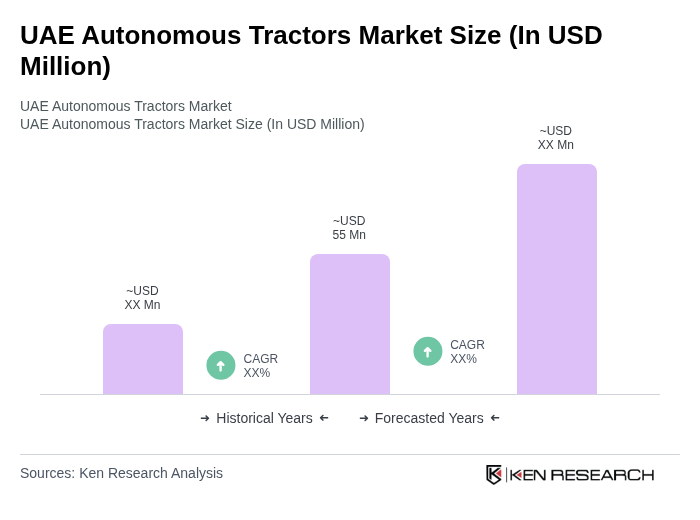
- The UAE Autonomous Tractors Market is valued at USD 55 million, based on a five-year historical analysis. This growth is primarily driven by advancements in agricultural technology, increasing demand for efficient farming solutions, and government initiatives promoting automation in agriculture. The market is witnessing a shift towards sustainable farming practices, with a notable emphasis on precision agriculture, AI-driven automation, and resource optimization, all of which further fuel the adoption of autonomous tractors.
- Key cities dominating the market include Dubai and Abu Dhabi, where the concentration of large-scale agricultural operations and investment in smart farming technologies is high. The UAE's strategic location and robust infrastructure also facilitate the growth of the autonomous tractors market, making it a hub for agricultural innovation in the region.
- The Ministerial Resolution No. 471 of 2023 issued by the UAE Ministry of Climate Change and Environment mandates the integration of smart technologies in agricultural practices. This regulation aims to enhance productivity and sustainability in the sector, requiring farmers to adopt advanced machinery, including autonomous tractors, to comply with new agricultural standards. The regulation covers operational requirements for technology integration, compliance thresholds for farm size, and licensing standards for autonomous equipment.
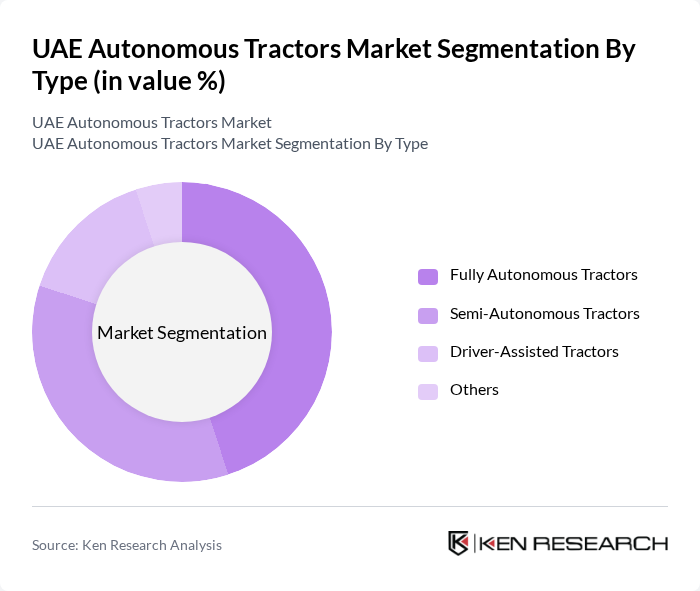
UAE Autonomous Tractors Market Segmentation
By Type:The market is segmented into Fully Autonomous Tractors, Semi-Autonomous Tractors, Driver-Assisted Tractors, and Others. Fully Autonomous Tractors are gaining traction due to their ability to operate without human intervention, making them ideal for large-scale farming operations. Semi-Autonomous Tractors are also popular as they provide a balance between automation and manual control, appealing to farmers who prefer some level of human oversight. Driver-Assisted Tractors are utilized for specific tasks, enhancing efficiency while still requiring operator input. The "Others" category includes niche products that cater to specialized agricultural needs.
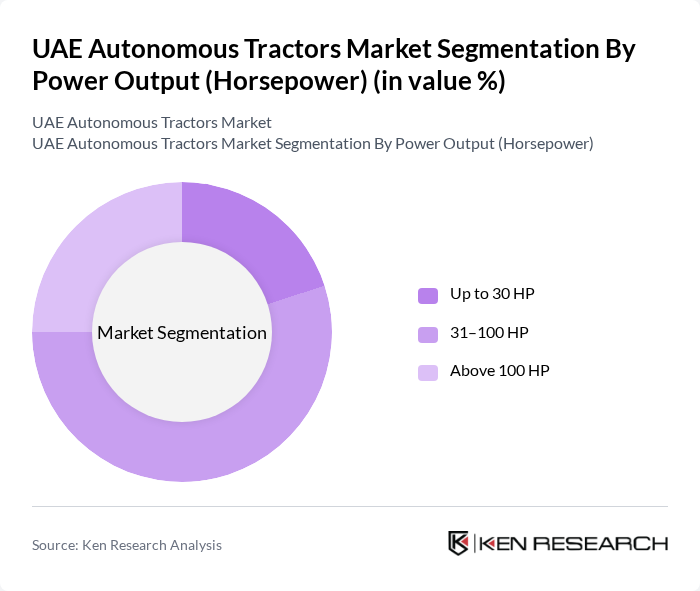
By Power Output (Horsepower):The market is categorized into Up to 30 HP, 31–100 HP, and Above 100 HP. Tractors in the 31–100 HP range dominate the market due to their versatility and suitability for various farming tasks. They are favored by medium to large-scale farms that require a balance of power and efficiency. Tractors with power output above 100 HP are also gaining popularity for heavy-duty applications, while those under 30 HP cater to small farms and specialized tasks.
UAE Autonomous Tractors Market Competitive Landscape
The UAE Autonomous Tractors Market is characterized by a dynamic mix of regional and international players. Leading participants such as John Deere, CNH Industrial (Case IH & New Holland Agriculture), AGCO Corporation (Fendt, Massey Ferguson), Kubota Corporation, Yanmar Co., Ltd., Trimble Inc., Topcon Positioning Systems, Raven Industries (a CNH Industrial company), Autonomous Solutions, Inc. (ASI), Monarch Tractor, Blue River Technology (a John Deere company), AgXeed, Bear Flag Robotics (a John Deere company), Hexagon Agriculture, DJI Agriculture contribute to innovation, geographic expansion, and service delivery in this space.
UAE Autonomous Tractors Market Industry Analysis
Growth Drivers
- Increasing Demand for Precision Agriculture:The UAE's agricultural sector is increasingly adopting precision farming techniques, driven by a 15% rise in crop yields attributed to technology integration. The government aims to enhance food security, targeting a 30% increase in local food production in future. This demand for precision agriculture is further supported by the UAE's investment of AED 1 billion in agricultural technology, fostering the adoption of autonomous tractors to optimize resource use and improve productivity.
- Government Initiatives Promoting Automation:The UAE government has launched several initiatives to promote automation in agriculture, including the "National Food Security Strategy 2051." This strategy allocates AED 1.5 billion for agricultural innovation, aiming to increase the efficiency of farming practices. Additionally, the UAE's Ministry of Climate Change and Environment has introduced subsidies for smart farming technologies, which are expected to boost the adoption of autonomous tractors by 20% in future, enhancing overall agricultural productivity.
- Rising Labor Costs and Shortage of Skilled Labor:Labor costs in the UAE agricultural sector have surged by 10% annually, exacerbated by a shortage of skilled labor due to migration trends. This situation has prompted farmers to seek automation solutions, with autonomous tractors offering a viable alternative. The UAE's agricultural workforce is projected to decline by 5% in future, further increasing the urgency for automated solutions that can maintain productivity levels while reducing reliance on human labor.
Market Challenges
- High Initial Investment Costs:The adoption of autonomous tractors requires significant upfront investment, with costs ranging from AED 300,000 to AED 1 million per unit. This financial barrier limits access for small to medium-sized farms, which constitute approximately 70% of the UAE's agricultural sector. As a result, many farmers are hesitant to invest in these technologies, despite their long-term benefits, leading to slower market penetration and adoption rates.
- Limited Awareness and Understanding of Technology:A significant challenge in the UAE is the limited awareness and understanding of autonomous tractor technology among farmers. Approximately 60% of farmers lack knowledge about the benefits and functionalities of these systems. This gap in understanding hinders adoption rates, as many farmers remain skeptical about transitioning from traditional farming methods to automated solutions, despite the potential for increased efficiency and productivity.
UAE Autonomous Tractors Market Future Outlook
The future of the UAE autonomous tractors market appears promising, driven by technological advancements and increasing government support. As farmers become more aware of the benefits of automation, adoption rates are expected to rise significantly. The integration of IoT and data analytics into farming practices will further enhance operational efficiency. Additionally, the shift towards sustainable farming practices will encourage the development of eco-friendly autonomous solutions, positioning the UAE as a leader in agricultural innovation in the region.
Market Opportunities
- Expansion into New Agricultural Sectors:There is a significant opportunity for autonomous tractors to penetrate new agricultural sectors, such as horticulture and aquaculture. With the UAE's agricultural diversification strategy, which aims to increase the contribution of non-traditional crops by 25% in future, autonomous tractors can play a crucial role in enhancing productivity and efficiency in these emerging sectors.
- Partnerships with Technology Providers:Collaborating with technology providers presents a lucrative opportunity for local farmers and manufacturers. By forming partnerships, stakeholders can develop customized solutions tailored to the unique challenges of the UAE's agricultural landscape. This collaboration can lead to innovative products that enhance the functionality of autonomous tractors, ultimately driving market growth and improving agricultural outcomes.
Scope of the Report
| Segment | Sub-Segments |
|---|---|
| By Type | Fully Autonomous Tractors Semi-Autonomous Tractors Driver-Assisted Tractors Others |
| By Power Output (Horsepower) | Up to 30 HP –100 HP Above 100 HP |
| By End-User/Farm Size | Large Scale Farms (>500 ha) Medium Farms (100–500 ha) Small Farms (<100 ha) |
| By Application | Tillage Harvesting Planting & Seeding Crop Monitoring Soil Preparation Others |
| By Technology | GPS Guidance Systems Sensor-Based Systems Remote Control/Telematics Machine Learning & AI Algorithms Others |
| By Region | Abu Dhabi Dubai Sharjah Others |
| By Distribution Channel | Direct Sales Distributors and Dealers Online Sales Others |
Key Target Audience
Investors and Venture Capitalist Firms
Government and Regulatory Bodies (e.g., Ministry of Climate Change and Environment, Ministry of Agriculture and Fisheries)
Agricultural Cooperatives and Associations
Farm Equipment Manufacturers
Logistics and Supply Chain Companies
Technology Providers and Software Developers
Infrastructure Development Agencies
Financial Institutions and Banks
Players Mentioned in the Report:
John Deere
CNH Industrial (Case IH & New Holland Agriculture)
AGCO Corporation (Fendt, Massey Ferguson)
Kubota Corporation
Yanmar Co., Ltd.
Trimble Inc.
Topcon Positioning Systems
Raven Industries (a CNH Industrial company)
Autonomous Solutions, Inc. (ASI)
Monarch Tractor
Blue River Technology (a John Deere company)
AgXeed
Bear Flag Robotics (a John Deere company)
Hexagon Agriculture
DJI Agriculture
Table of Contents
Market Assessment Phase
1. Executive Summary and Approach
2. UAE Autonomous Tractors Market Overview
2.1 Key Insights and Strategic Recommendations
2.2 UAE Autonomous Tractors Market Overview
2.3 Definition and Scope
2.4 Evolution of Market Ecosystem
2.5 Timeline of Key Regulatory Milestones
2.6 Value Chain & Stakeholder Mapping
2.7 Business Cycle Analysis
2.8 Policy & Incentive Landscape
3. UAE Autonomous Tractors Market Analysis
3.1 Growth Drivers
3.1.1 Increasing demand for precision agriculture
3.1.2 Government initiatives promoting automation in agriculture
3.1.3 Rising labor costs and shortage of skilled labor
3.1.4 Technological advancements in autonomous systems
3.2 Market Challenges
3.2.1 High initial investment costs
3.2.2 Limited awareness and understanding of technology
3.2.3 Regulatory hurdles and compliance issues
3.2.4 Integration with existing farming practices
3.3 Market Opportunities
3.3.1 Expansion into new agricultural sectors
3.3.2 Partnerships with technology providers
3.3.3 Development of customized solutions for local farmers
3.3.4 Export potential to neighboring regions
3.4 Market Trends
3.4.1 Increasing adoption of IoT in agriculture
3.4.2 Growth of data analytics for farm management
3.4.3 Shift towards sustainable farming practices
3.4.4 Rise of agritech startups in the UAE
3.5 Government Regulation
3.5.1 Standards for autonomous vehicle safety
3.5.2 Incentives for adopting smart farming technologies
3.5.3 Environmental regulations impacting agricultural practices
3.5.4 Licensing requirements for autonomous machinery
4. SWOT Analysis
5. Stakeholder Analysis
6. Porter's Five Forces Analysis
7. UAE Autonomous Tractors Market Market Size, 2019-2024
7.1 By Value
7.2 By Volume
7.3 By Average Selling Price
8. UAE Autonomous Tractors Market Segmentation
8.1 By Type
8.1.1 Fully Autonomous Tractors
8.1.2 Semi-Autonomous Tractors
8.1.3 Driver-Assisted Tractors
8.1.4 Others
8.2 By Power Output (Horsepower)
8.2.1 Up to 30 HP
8.2.2 31–100 HP
8.2.3 Above 100 HP
8.3 By End-User/Farm Size
8.3.1 Large Scale Farms (>500 ha)
8.3.2 Medium Farms (100–500 ha)
8.3.3 Small Farms (<100 ha)
8.4 By Application
8.4.1 Tillage
8.4.2 Harvesting
8.4.3 Planting & Seeding
8.4.4 Crop Monitoring
8.4.5 Soil Preparation
8.4.6 Others
8.5 By Technology
8.5.1 GPS Guidance Systems
8.5.2 Sensor-Based Systems
8.5.3 Remote Control/Telematics
8.5.4 Machine Learning & AI Algorithms
8.5.5 Others
8.6 By Region
8.6.1 Abu Dhabi
8.6.2 Dubai
8.6.3 Sharjah
8.6.4 Others
8.7 By Distribution Channel
8.7.1 Direct Sales
8.7.2 Distributors and Dealers
8.7.3 Online Sales
8.7.4 Others
9. UAE Autonomous Tractors Market Competitive Analysis
9.1 Market Share of Key Players
9.2 Cross Comparison of Key Players
9.2.1 Company Name
9.2.2 Group Size (Large, Medium, or Small as per industry convention)
9.2.3 Revenue Growth Rate (UAE/MEA-specific, 3-year CAGR)
9.2.4 Market Penetration Rate (Units deployed or % of UAE market share)
9.2.5 Installed Base (Number of autonomous tractors in operation in UAE)
9.2.6 Product Portfolio Breadth (Number of autonomous models offered)
9.2.7 Technology Differentiation (Level of autonomy, AI/ML integration, sensor suite)
9.2.8 After-Sales Service Network (Coverage in UAE, response time)
9.2.9 Strategic Partnerships (Local collaborations, JV, pilot projects)
9.2.10 Customer Satisfaction Score (UAE/MEA end-user ratings)
9.3 SWOT Analysis of Top Players
9.4 Pricing Analysis
9.5 Detailed Profile of Major Companies
9.5.1 John Deere
9.5.2 CNH Industrial (Case IH & New Holland Agriculture)
9.5.3 AGCO Corporation (Fendt, Massey Ferguson)
9.5.4 Kubota Corporation
9.5.5 Yanmar Co., Ltd.
9.5.6 Trimble Inc.
9.5.7 Topcon Positioning Systems
9.5.8 Raven Industries (a CNH Industrial company)
9.5.9 Autonomous Solutions, Inc. (ASI)
9.5.10 Monarch Tractor
9.5.11 Blue River Technology (a John Deere company)
9.5.12 AgXeed
9.5.13 Bear Flag Robotics (a John Deere company)
9.5.14 Hexagon Agriculture
9.5.15 DJI Agriculture
10. UAE Autonomous Tractors Market End-User Analysis
10.1 Procurement Behavior of Key Ministries
10.1.1 Ministry of Climate Change and Environment
10.1.2 Ministry of Agriculture and Fisheries
10.1.3 Ministry of Economy
10.1.4 Others
10.2 Corporate Spend on Infrastructure & Energy
10.2.1 Investment in Smart Farming Technologies
10.2.2 Budget Allocation for Agricultural Innovation
10.2.3 Funding for Research and Development
10.2.4 Others
10.3 Pain Point Analysis by End-User Category
10.3.1 Large Scale Farmers
10.3.2 Smallholder Farmers
10.3.3 Agricultural Cooperatives
10.3.4 Others
10.4 User Readiness for Adoption
10.4.1 Awareness of Autonomous Technologies
10.4.2 Training and Support Needs
10.4.3 Financial Readiness
10.4.4 Others
10.5 Post-Deployment ROI and Use Case Expansion
10.5.1 Efficiency Gains
10.5.2 Cost Savings
10.5.3 Scalability of Solutions
10.5.4 Others
11. UAE Autonomous Tractors Market Future Size, 2025-2030
11.1 By Value
11.2 By Volume
11.3 By Average Selling Price
Go-To-Market Strategy Phase
1. Whitespace Analysis + Business Model Canvas
1.1 Market Gaps Identification
1.2 Business Model Development
2. Marketing and Positioning Recommendations
2.1 Branding Strategies
2.2 Product USPs
3. Distribution Plan
3.1 Urban Retail vs Rural NGO Tie-ups
4. Channel & Pricing Gaps
4.1 Underserved Routes
4.2 Pricing Bands
5. Unmet Demand & Latent Needs
5.1 Category Gaps
5.2 Consumer Segments
6. Customer Relationship
6.1 Loyalty Programs
6.2 After-sales Service
7. Value Proposition
7.1 Sustainability
7.2 Integrated Supply Chains
8. Key Activities
8.1 Regulatory Compliance
8.2 Branding
8.3 Distribution Setup
9. Entry Strategy Evaluation
9.1 Domestic Market Entry Strategy
9.1.1 Product Mix
9.1.2 Pricing Band
9.1.3 Packaging
9.2 Export Entry Strategy
9.2.1 Target Countries
9.2.2 Compliance Roadmap
10. Entry Mode Assessment
10.1 JV
10.2 Greenfield
10.3 M&A
10.4 Distributor Model
11. Capital and Timeline Estimation
11.1 Capital Requirements
11.2 Timelines
12. Control vs Risk Trade-Off
12.1 Ownership vs Partnerships
13. Profitability Outlook
13.1 Breakeven Analysis
13.2 Long-term Sustainability
14. Potential Partner List
14.1 Distributors
14.2 JVs
14.3 Acquisition Targets
15. Execution Roadmap
15.1 Phased Plan for Market Entry
15.1.1 Market Setup
15.1.2 Market Entry
15.1.3 Growth Acceleration
15.1.4 Scale & Stabilize
15.2 Key Activities and Milestones
15.2.1 Milestone Planning
15.2.2 Activity Tracking
Research Methodology
Phase 1: Approach1
Desk Research
- Analysis of industry reports from agricultural technology associations in the UAE
- Review of government publications on agricultural policies and automation initiatives
- Examination of market trends and forecasts from reputable market research firms
Primary Research
- Interviews with agricultural equipment manufacturers and distributors in the UAE
- Surveys with farmers and agricultural cooperatives utilizing autonomous technology
- Focus groups with agricultural technology experts and consultants
Validation & Triangulation
- Cross-validation of findings through multiple data sources including trade publications
- Triangulation of insights from primary interviews and secondary data analysis
- Sanity checks conducted through expert panel discussions and feedback sessions
Phase 2: Market Size Estimation1
Top-down Assessment
- Estimation of market size based on national agricultural output and mechanization rates
- Segmentation by crop types and autonomous tractor applications
- Incorporation of government incentives for agricultural automation
Bottom-up Modeling
- Collection of sales data from leading autonomous tractor manufacturers in the UAE
- Operational cost analysis based on pricing models of autonomous farming solutions
- Volume estimates derived from adoption rates among different farm sizes
Forecasting & Scenario Analysis
- Multi-variable regression analysis considering factors like labor costs and technology adoption rates
- Scenario modeling based on potential regulatory changes and market disruptions
- Development of baseline, optimistic, and pessimistic forecasts through 2030
Phase 3: CATI Sample Composition1
| Scope Item/Segment | Sample Size | Target Respondent Profiles |
|---|---|---|
| Commercial Farming Operations | 100 | Farm Owners, Agricultural Managers |
| Government Agricultural Agencies | 50 | Policy Makers, Agricultural Advisors |
| Agri-Tech Startups | 60 | Founders, Product Development Leads |
| Research Institutions | 40 | Agricultural Researchers, Technology Analysts |
| Distribution and Retail Channels | 45 | Supply Chain Managers, Sales Directors |
Frequently Asked Questions
What is the current value of the UAE Autonomous Tractors Market?
The UAE Autonomous Tractors Market is valued at approximately USD 55 million, reflecting a five-year historical analysis driven by advancements in agricultural technology and increasing demand for efficient farming solutions.
What factors are driving the growth of autonomous tractors in the UAE?
Which cities in the UAE are leading in the autonomous tractors market?
What types of autonomous tractors are available in the UAE market?
Other Regional/Country Reports
Indonesia Autonomous Tractors Market
Malaysia Autonomous Tractors Market
KSA Autonomous Tractors Market
APAC Autonomous Tractors Market
SEA Autonomous Tractors Market
Vietnam Autonomous Tractors Market
Other Adjacent Reports
Kuwait Agricultural Robotics Market
South Africa Crop Monitoring Technology Market
UAE Soil Sensors Market
South Korea Sustainable Farming Solutions Market
APAC middle east livestock monitoring market report Size, Share, Growth Drivers, Trends, Opportunities & Forecast 2025–2030Why Buy From Us?

What makes us stand out is that our consultants follow Robust, Refine and Result (RRR) methodology. Robust for clear definitions, approaches and sanity checking, Refine for differentiating respondents' facts and opinions, and Result for presenting data with story.

We have set a benchmark in the industry by offering our clients with syndicated and customized market research reports featuring coverage of entire market as well as meticulous research and analyst insights.

While we don't replace traditional research, we flip the method upside down. Our dual approach of Top Bottom & Bottom Top ensures quality deliverable by not just verifying company fundamentals but also looking at the sector and macroeconomic factors.

With one step in the future, our research team constantly tries to show you the bigger picture. We help with some of the tough questions you may encounter along the way: How is the industry positioned? Best marketing channel? KPI's of competitors? By aligning every element, we help maximize success.

Our report gives you instant access to the answers and sources that other companies might choose to hide. We elaborate each steps of research methodology we have used and showcase you the sample size to earn your trust.

If you need any support, we are here! We pride ourselves on universe strength, data quality, and quick, friendly, and professional service.