About the Report
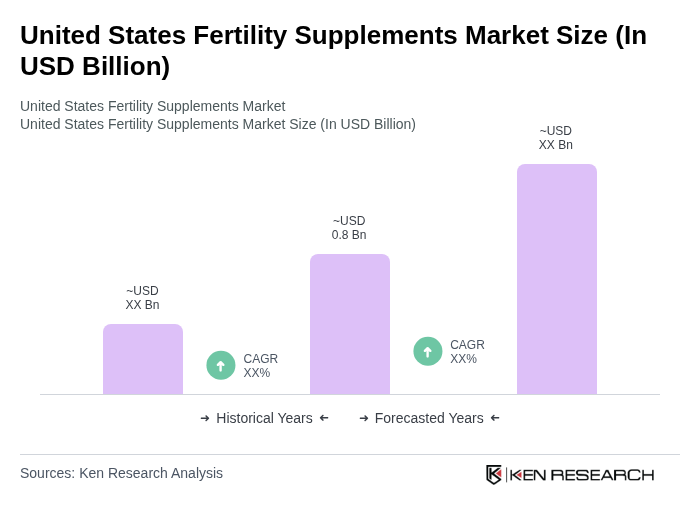
Base Year 2024United States Fertility Supplements Market Overview
- The United States Fertility Supplements Market is valued at USD 0.8 billion, based on a five-year historical analysis and the share of North America and the U.S. in the global fertility supplements industry. This growth is primarily driven by increasing awareness of reproductive health, rising infertility rates among both men and women, and a growing trend towards natural and holistic health solutions. Consumers are increasingly seeking supplements that support fertility, such as products containing folate, vitamin D, CoQ10, myo-inositol, and omega-3 fatty acids, leading to a surge in product offerings, personalization, and clinically oriented formulations in this sector.
- Key demand hubs in this market include large and higher-income states such as California, New York, and Texas, which together account for a substantial share of fertility clinic volumes in the country and have strong penetration of specialty OB/GYN, IVF centers, and wellness chains. These states also host a higher concentration of reproductive endocrinologists, integrative medicine practices, and retail and online wellness outlets, contributing to elevated demand for fertility supplements and related reproductive health products.
- Dietary fertility supplements in the United States are primarily regulated under the Federal Food, Drug, and Cosmetic Act as amended by the Dietary Supplement Health and Education Act (DSHEA) of 1994, administered by the U.S. Food and Drug Administration (FDA). Under this framework, manufacturers must ensure product safety, comply with Current Good Manufacturing Practice (CGMP) regulations in 21 CFR Part 111, and, for any new dietary ingredient, submit a premarket notification to FDA at least 75 days before marketing with evidence that the ingredient is reasonably expected to be safe.
United States Fertility Supplements Market Segmentation
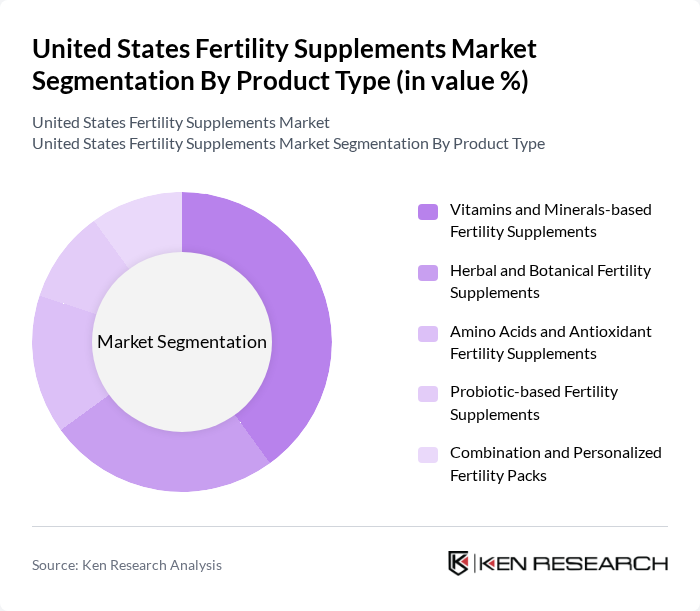
By Product Type:The product type segmentation includes various categories such as Vitamins and Minerals-based Fertility Supplements, Herbal and Botanical Fertility Supplements, Amino Acids and Antioxidant Fertility Supplements, Probiotic-based Fertility Supplements, and Combination and Personalized Fertility Packs. Among these, Vitamins and Minerals-based Fertility Supplements are leading the market, in line with global trends where vitamin-based products are the largest revenue-generating fertility supplement category, due to their essential role in reproductive health (e.g., folate, vitamin D, B-complex, zinc) and their widespread acceptance among consumers and healthcare professionals. The increasing focus on nutritional support for fertility, evidence-based formulations (such as myo-inositol and CoQ10 blends), and physician-recommended prenatal and preconception vitamins is driving demand in this segment.
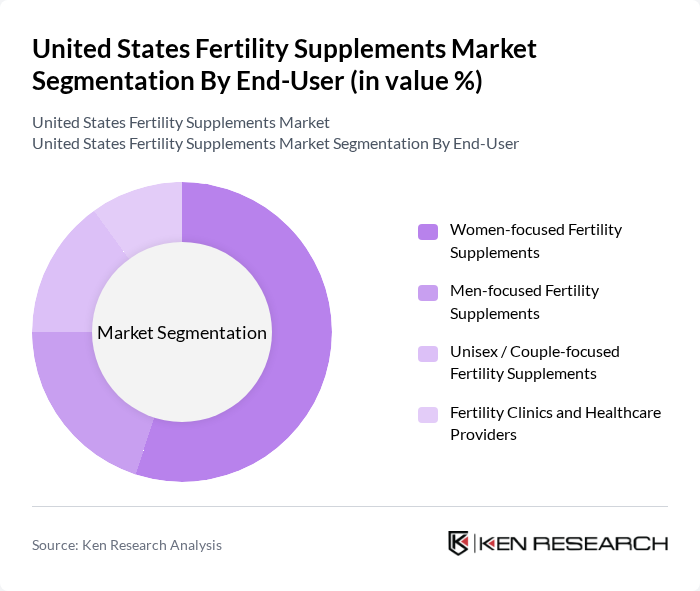
By End-User:The end-user segmentation encompasses Women-focused Fertility Supplements, Men-focused Fertility Supplements, Unisex / Couple-focused Fertility Supplements, and Fertility Clinics and Healthcare Providers. Women-focused Fertility Supplements dominate this segment, aligned with research indicating that women represent the largest share of global fertility supplement consumption and revenue. This is driven by the increasing number of women seeking fertility solutions, delayed childbearing, greater awareness of reproductive health issues such as PCOS and age-related infertility, and the strong positioning of prenatal and preconception products in retail and online channels. This trend is further supported by targeted marketing strategies aimed at women and by recommendations from OB/GYN and fertility specialists, making this sub-segment a key player in the market.
United States Fertility Supplements Market Competitive Landscape
The United States Fertility Supplements Market is characterized by a dynamic mix of regional and international players. Leading participants such as Fairhaven Health, Eu Natural, Coast Science, Natalist (an Everly Health company), Pink Stork, Bird&Be, Theralogix (TheraNatal), Conception Men & Women (BeyHealth), Conceive Plus (SASMAR), OvaBoost (Fairhaven Health), Premama Wellness, Needed PBC, Ritual, Garden of Life, New Chapter contribute to innovation, geographic expansion, and service delivery in this space.
United States Fertility Supplements Market Industry Analysis
Growth Drivers
- Increasing Awareness of Fertility Health:The United States has seen a significant rise in awareness regarding fertility health, with over 60% of adults actively seeking information on reproductive health. This trend is supported by a recent report from the American Society for Reproductive Medicine, which noted a 25% increase in fertility-related consultations. As more individuals prioritize reproductive health, the demand for fertility supplements is expected to grow, driving market expansion.
- Growing Demand for Natural and Organic Supplements:The market for natural and organic supplements is projected to reach $24 billion in future, reflecting a 15% annual growth rate. Consumers are increasingly opting for products perceived as safer and healthier, with 70% of supplement users preferring organic options. This shift towards natural ingredients is propelling the fertility supplements market, as brands adapt their offerings to meet consumer preferences for clean-label products.
- Advancements in Supplement Formulations:Innovations in supplement formulations have led to the development of more effective products, with a 30% increase in the introduction of new fertility supplements in the past year alone. Research from the National Institutes of Health indicates that advanced formulations, including personalized blends, enhance efficacy and consumer satisfaction. This trend is crucial for attracting new customers and retaining existing ones, thereby boosting market growth.
Market Challenges
- Regulatory Hurdles:The fertility supplements market faces significant regulatory challenges, with the FDA enforcing strict guidelines on dietary supplements. In future, over 40% of fertility supplement brands reported difficulties in compliance with labeling and health claim regulations. These hurdles can delay product launches and increase operational costs, hindering market growth and innovation in the sector.
- Consumer Skepticism Regarding Efficacy:Despite the growing market, consumer skepticism remains a significant barrier, with 55% of potential buyers expressing doubts about the effectiveness of fertility supplements. This skepticism is often fueled by a lack of robust clinical evidence supporting product claims. Brands must invest in transparent marketing and scientific validation to build trust and overcome this challenge, which can impede sales growth.
United States Fertility Supplements Market Future Outlook
The future of the United States fertility supplements market appears promising, driven by increasing consumer awareness and a shift towards natural products. As more individuals prioritize reproductive health, the demand for innovative and effective supplements is expected to rise. Additionally, the integration of technology in product development and marketing strategies will likely enhance consumer engagement, leading to sustained growth. Companies that adapt to these trends will be well-positioned to capitalize on emerging opportunities in the market.
Market Opportunities
- Expansion into E-commerce Platforms:The e-commerce sector is projected to account for 30% of total supplement sales in future, driven by increased online shopping. Brands can leverage this trend by enhancing their online presence and offering direct-to-consumer sales, which can significantly boost revenue and market reach.
- Development of Personalized Supplements:The demand for personalized health solutions is on the rise, with 50% of consumers expressing interest in customized fertility supplements. Companies that invest in personalized formulations based on individual health profiles can tap into this lucrative market segment, enhancing customer satisfaction and loyalty.
Scope of the Report
| Segment | Sub-Segments |
|---|---|
| By Product Type | Vitamins and Minerals-based Fertility Supplements Herbal and Botanical Fertility Supplements Amino Acids and Antioxidant Fertility Supplements Probiotic-based Fertility Supplements Combination and Personalized Fertility Packs |
| By End-User | Women-focused Fertility Supplements Men-focused Fertility Supplements Unisex / Couple-focused Fertility Supplements Fertility Clinics and Healthcare Providers |
| By Distribution Channel | Online Retail and Direct-to-Consumer Platforms Hospital and Fertility Clinic Pharmacies Retail Pharmacies and Drugstores Supermarkets/Hypermarkets Specialty and Health & Wellness Stores |
| By Dosage Form | Capsules Tablets Gummies and Chewables Powders and Sachets Liquids and Softgels |
| By Age Group | –25 Years –35 Years –45 Years Years and Above |
| By Gender | Female Male Unisex |
| By Price Range | Economy Fertility Supplements Mid-range Fertility Supplements Premium Fertility Supplements |
Key Target Audience
Investors and Venture Capitalist Firms
Government and Regulatory Bodies (e.g., Food and Drug Administration, Centers for Disease Control and Prevention)
Manufacturers and Producers
Distributors and Retailers
Pharmaceutical Companies
Health and Wellness Organizations
Insurance Providers
Market Analysts and Industry Experts
Players Mentioned in the Report:
Fairhaven Health
Eu Natural
Coast Science
Natalist (an Everly Health company)
Pink Stork
Bird&Be
Theralogix (TheraNatal)
Conception Men & Women (BeyHealth)
Conceive Plus (SASMAR)
OvaBoost (Fairhaven Health)
Premama Wellness
Needed PBC
Ritual
Garden of Life
New Chapter
Table of Contents
Market Assessment Phase
1. Executive Summary and Approach
2. United States Fertility Supplements Market Overview
2.1 Key Insights and Strategic Recommendations
2.2 United States Fertility Supplements Market Overview
2.3 Definition and Scope
2.4 Evolution of Market Ecosystem
2.5 Timeline of Key Regulatory Milestones
2.6 Value Chain & Stakeholder Mapping
2.7 Business Cycle Analysis
2.8 Policy & Incentive Landscape
3. United States Fertility Supplements Market Analysis
3.1 Growth Drivers
3.1.1 Increasing awareness of fertility health
3.1.3 Growing demand for natural and organic supplements
3.1.4 Advancements in supplement formulations
3.2 Market Challenges
3.2.1 Regulatory hurdles
3.2.2 High competition among brands
3.2.3 Consumer skepticism regarding efficacy
3.2.4 Limited insurance coverage for supplements
3.3 Market Opportunities
3.3.1 Expansion into e-commerce platforms
3.3.2 Development of personalized supplements
3.3.3 Collaborations with healthcare providers
3.3.4 Increasing focus on male fertility supplements
3.4 Market Trends
3.4.1 Rise in holistic health approaches
3.4.2 Growth of subscription-based models
3.4.3 Increased use of social media for marketing
3.4.4 Focus on sustainability in packaging
3.5 Government Regulation
3.5.1 FDA guidelines on dietary supplements
3.5.2 Labeling requirements for fertility supplements
3.5.3 Advertising regulations for health claims
3.5.4 Compliance with Good Manufacturing Practices (GMP)
4. SWOT Analysis
5. Stakeholder Analysis
6. Porter's Five Forces Analysis
7. United States Fertility Supplements Market Market Size, 2019-2024
7.1 By Value
7.2 By Volume
7.3 By Average Selling Price
8. United States Fertility Supplements Market Segmentation
8.1 By Product Type
8.1.1 Vitamins and Minerals-based Fertility Supplements
8.1.2 Herbal and Botanical Fertility Supplements
8.1.3 Amino Acids and Antioxidant Fertility Supplements
8.1.4 Probiotic-based Fertility Supplements
8.1.5 Combination and Personalized Fertility Packs
8.2 By End-User
8.2.1 Women-focused Fertility Supplements
8.2.2 Men-focused Fertility Supplements
8.2.3 Unisex / Couple-focused Fertility Supplements
8.2.4 Fertility Clinics and Healthcare Providers
8.3 By Distribution Channel
8.3.1 Online Retail and Direct-to-Consumer Platforms
8.3.2 Hospital and Fertility Clinic Pharmacies
8.3.3 Retail Pharmacies and Drugstores
8.3.4 Supermarkets/Hypermarkets
8.3.5 Specialty and Health & Wellness Stores
8.4 By Dosage Form
8.4.1 Capsules
8.4.2 Tablets
8.4.3 Gummies and Chewables
8.4.4 Powders and Sachets
8.4.5 Liquids and Softgels
8.5 By Age Group
8.5.1 18–25 Years
8.5.2 26–35 Years
8.5.3 36–45 Years
8.5.4 46 Years and Above
8.6 By Gender
8.6.1 Female
8.6.2 Male
8.6.3 Unisex
8.7 By Price Range
8.7.1 Economy Fertility Supplements
8.7.2 Mid-range Fertility Supplements
8.7.3 Premium Fertility Supplements
9. United States Fertility Supplements Market Competitive Analysis
9.1 Market Share of Key Players
9.2 Cross Comparison of Key Players
9.2.1 Company Name
9.2.2 U.S. Fertility Supplement Revenue
9.2.3 U.S. Revenue Growth Rate (3–5 Year CAGR)
9.2.4 U.S. Market Share in Fertility Supplements
9.2.5 Share of Sales from Online / D2C Channels
9.2.6 Average Selling Price Positioning (Economy / Mid-range / Premium)
9.2.7 Portfolio Breadth (Male, Female, and Unisex SKUs)
9.2.8 R&D and Clinical Evidence Intensity (No. of Clinically Supported SKUs / Studies)
9.2.9 Distribution Footprint (No. of U.S. Retail and Clinic Touchpoints)
9.2.10 Brand Awareness and User Rating Score (U.S. Digital & Retail Platforms)
9.3 SWOT Analysis of Top Players
9.4 Pricing Analysis
9.5 Detailed Profile of Major Companies
9.5.1 Fairhaven Health
9.5.2 Eu Natural
9.5.3 Coast Science
9.5.4 Natalist (an Everly Health company)
9.5.5 Pink Stork
9.5.6 Bird&Be
9.5.7 Theralogix (TheraNatal)
9.5.8 Conception Men & Women (BeyHealth)
9.5.9 Conceive Plus (SASMAR)
9.5.10 OvaBoost (Fairhaven Health)
9.5.11 Premama Wellness
9.5.12 Needed PBC
9.5.13 Ritual
9.5.14 Garden of Life
9.5.15 New Chapter
10. United States Fertility Supplements Market End-User Analysis
10.1 Procurement Behavior of Key Ministries
10.1.1 Government health initiatives
10.1.2 Funding for fertility programs
10.1.3 Partnerships with supplement providers
10.1.4 Awareness campaigns
10.2 Corporate Spend on Infrastructure & Energy
10.2.1 Investment in fertility health programs
10.2.2 Budget allocation for employee wellness
10.2.3 Collaborations with health organizations
10.2.4 Research funding
10.3 Pain Point Analysis by End-User Category
10.3.1 Accessibility of supplements
10.3.2 Affordability concerns
10.3.3 Information gaps on efficacy
10.3.4 Quality assurance issues
10.4 User Readiness for Adoption
10.4.1 Awareness of fertility supplements
10.4.2 Willingness to invest in health
10.4.3 Trust in brands
10.4.4 Availability of information
10.5 Post-Deployment ROI and Use Case Expansion
10.5.1 Measurement of health outcomes
10.5.2 Long-term user engagement
10.5.3 Expansion into new demographics
10.5.4 Feedback loops for product improvement
11. United States Fertility Supplements Market Future Size, 2025-2030
11.1 By Value
11.2 By Volume
11.3 By Average Selling Price
Go-To-Market Strategy Phase
1. Whitespace Analysis + Business Model Canvas
1.1 Market gaps identification
1.2 Value proposition development
1.3 Revenue model exploration
1.4 Customer segment analysis
1.5 Competitive landscape overview
1.6 Key partnerships identification
1.7 Cost structure analysis
2. Marketing and Positioning Recommendations
2.1 Branding strategies
2.2 Product USPs
2.3 Target audience segmentation
2.4 Communication strategies
2.5 Digital marketing tactics
2.6 Influencer partnerships
2.7 Customer engagement initiatives
3. Distribution Plan
3.1 Urban retail strategies
3.2 Rural NGO tie-ups
3.3 E-commerce platform integration
3.4 Direct-to-consumer models
3.5 Wholesale distribution channels
3.6 International distribution considerations
3.7 Logistics and supply chain management
4. Channel & Pricing Gaps
4.1 Underserved routes
4.2 Pricing bands analysis
4.3 Competitor pricing strategies
4.4 Consumer price sensitivity
4.5 Value-based pricing models
4.6 Discount and promotion strategies
4.7 Price positioning against competitors
5. Unmet Demand & Latent Needs
5.1 Category gaps identification
5.2 Consumer segments analysis
5.3 Product innovation opportunities
5.4 Market entry barriers
5.5 Customer feedback incorporation
5.6 Trends in consumer preferences
5.7 Future demand forecasting
6. Customer Relationship
6.1 Loyalty programs
6.2 After-sales service
6.3 Customer feedback mechanisms
6.4 Community building initiatives
6.5 Customer education programs
6.6 Engagement through social media
6.7 Personalization of customer interactions
7. Value Proposition
7.1 Sustainability initiatives
7.2 Integrated supply chains
7.3 Unique selling propositions
7.4 Customer-centric product development
7.5 Brand trust and credibility
7.6 Competitive differentiation
7.7 Long-term value creation
8. Key Activities
8.1 Regulatory compliance
8.2 Branding efforts
8.3 Distribution setup
8.4 Marketing campaigns
8.5 Product development
8.6 Customer service enhancement
8.7 Performance monitoring
9. Entry Strategy Evaluation
9.1 Domestic Market Entry Strategy
9.1.1 Product mix considerations
9.1.2 Pricing band analysis
9.1.3 Packaging strategies
9.2 Export Entry Strategy
9.2.1 Target countries identification
9.2.2 Compliance roadmap development
10. Entry Mode Assessment
10.1 Joint Ventures
10.2 Greenfield investments
10.3 Mergers & Acquisitions
10.4 Distributor Model
10.5 Risk assessment
10.6 Strategic fit evaluation
10.7 Long-term partnership considerations
11. Capital and Timeline Estimation
11.1 Capital requirements
11.2 Timelines for market entry
11.3 Budget allocation strategies
11.4 Financial forecasting
11.5 Funding sources identification
11.6 Cost management strategies
11.7 Investment return expectations
12. Control vs Risk Trade-Off
12.1 Ownership considerations
12.2 Partnership dynamics
12.3 Risk mitigation strategies
12.4 Control mechanisms
12.5 Long-term sustainability planning
12.6 Exit strategies
12.7 Stakeholder alignment
13. Profitability Outlook
13.1 Breakeven analysis
13.2 Long-term sustainability
13.3 Profit margin expectations
13.4 Revenue growth projections
13.5 Cost structure optimization
13.6 Financial health indicators
13.7 Investment attractiveness
14. Potential Partner List
14.1 Distributors
14.2 Joint Ventures
14.3 Acquisition targets
14.4 Strategic alliances
14.5 Collaborative opportunities
14.6 Partnership evaluation criteria
14.7 Long-term relationship management
15. Execution Roadmap
15.1 Phased Plan for Market Entry
15.1.1 Market Setup
15.1.2 Market Entry
15.1.3 Growth Acceleration
15.1.4 Scale & Stabilize
15.2 Key Activities and Milestones
15.2.1 Timeline for execution
15.2.2 Milestone tracking
15.2.3 Performance evaluation
Research Methodology
Phase 1: Approach1
Desk Research
- Analysis of market reports from industry associations and health organizations
- Review of academic journals and publications on fertility and dietary supplements
- Examination of consumer behavior studies related to fertility supplements
Primary Research
- Interviews with healthcare professionals specializing in reproductive health
- Surveys targeting consumers who have purchased fertility supplements
- Focus groups with couples experiencing fertility challenges
Validation & Triangulation
- Cross-validation of findings with sales data from major retailers
- Triangulation of consumer insights with expert opinions from fertility clinics
- Sanity checks through feedback from industry stakeholders and market analysts
Phase 2: Market Size Estimation1
Top-down Assessment
- Estimation of total market size based on national health expenditure data
- Segmentation by product type, including vitamins, minerals, and herbal supplements
- Incorporation of demographic trends affecting fertility rates and supplement usage
Bottom-up Modeling
- Collection of sales data from leading fertility supplement manufacturers
- Estimation of average retail prices across different product categories
- Volume estimates based on consumer purchasing patterns and trends
Forecasting & Scenario Analysis
- Multi-variable regression analysis incorporating economic indicators and health trends
- Scenario modeling based on potential changes in healthcare policies and consumer awareness
- Development of baseline, optimistic, and pessimistic market growth projections through 2030
Phase 3: CATI Sample Composition1
| Scope Item/Segment | Sample Size | Target Respondent Profiles |
|---|---|---|
| Healthcare Professionals | 60 | Gynecologists, Fertility Specialists |
| Consumers of Fertility Supplements | 120 | Women aged 25-40, Couples trying to conceive |
| Retailers of Health Supplements | 50 | Pharmacy Managers, Health Store Owners |
| Fertility Clinics | 40 | Clinic Administrators, Reproductive Health Counselors |
| Nutritionists and Dietitians | 50 | Registered Dietitians, Nutrition Consultants |
Frequently Asked Questions
What is the current value of the United States Fertility Supplements Market?
The United States Fertility Supplements Market is valued at approximately USD 0.8 billion, reflecting a significant growth trend driven by increasing awareness of reproductive health and rising infertility rates among both men and women.
What factors are driving the growth of the fertility supplements market in the U.S.?
Which states are the largest markets for fertility supplements in the U.S.?
What types of products are included in the fertility supplements market?
Other Regional/Country Reports
Indonesia Fertility Supplements Market
Malaysia Fertility Supplements Market
KSA Fertility Supplements Market
Other Adjacent Reports
Bahrain Prenatal Vitamins Market
Thailand Infertility Treatment Market
South Korea Reproductive Health Services Market
Malaysia Nutraceuticals Market
UAE Womens Health Supplements Market
Indonesia Mens Fertility Products Market
Germany Herbal Remedies Market
Vietnam Antioxidant Supplements Market
Mexico Probiotic Supplements Market
Philippines Personalized Nutrition Market
Why Buy From Us?

What makes us stand out is that our consultants follow Robust, Refine and Result (RRR) methodology. Robust for clear definitions, approaches and sanity checking, Refine for differentiating respondents' facts and opinions, and Result for presenting data with story.

We have set a benchmark in the industry by offering our clients with syndicated and customized market research reports featuring coverage of entire market as well as meticulous research and analyst insights.

While we don't replace traditional research, we flip the method upside down. Our dual approach of Top Bottom & Bottom Top ensures quality deliverable by not just verifying company fundamentals but also looking at the sector and macroeconomic factors.

With one step in the future, our research team constantly tries to show you the bigger picture. We help with some of the tough questions you may encounter along the way: How is the industry positioned? Best marketing channel? KPI's of competitors? By aligning every element, we help maximize success.

Our report gives you instant access to the answers and sources that other companies might choose to hide. We elaborate each steps of research methodology we have used and showcase you the sample size to earn your trust.

If you need any support, we are here! We pride ourselves on universe strength, data quality, and quick, friendly, and professional service.