About the Report
Base Year 2024US Centrifugal Pump Market Overview
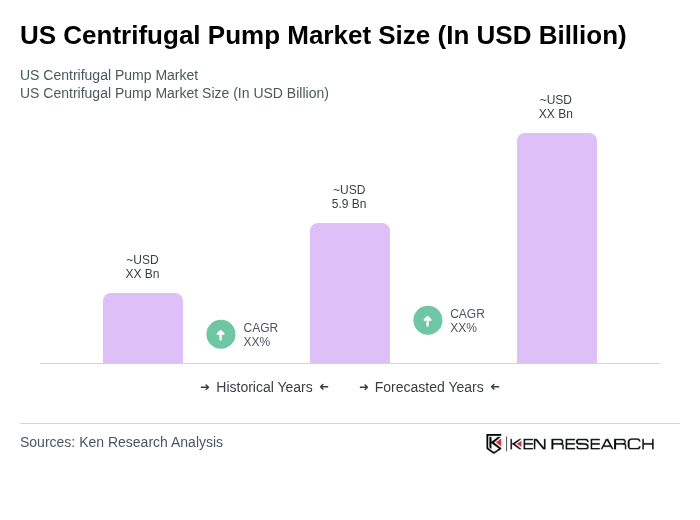
- The US Centrifugal Pump Market is valued at USD 5.9 billion, based on a five-year historical analysis. Growth is primarily driven by the increasing demand for efficient water management systems, expansion in the oil and gas sector, and the adoption of smart pumping technologies. Enhanced focus on sustainability, environmental compliance, and energy-efficient solutions, along with advancements in pump technology, are significant contributors to market growth.
- Key regions dominating the market include Texas, California, and New York. Texas leads due to its robust oil and gas industry, while California’s emphasis on sustainable water management and New York’s extensive infrastructure projects further enhance their market presence. These regions benefit from significant investments in industrial and municipal applications, with California standing out for its innovation and stringent environmental regulations.
- In 2020, the US Department of Energy issued the Energy Conservation Standards for Pumps under 10 CFR Part 431, which mandates that certain classes of centrifugal pumps distributed in commerce must meet minimum energy efficiency standards. These standards require manufacturers to comply with specified Pump Energy Index (PEI) thresholds, driving the adoption of advanced, energy-efficient pump technologies across industrial and municipal sectors.
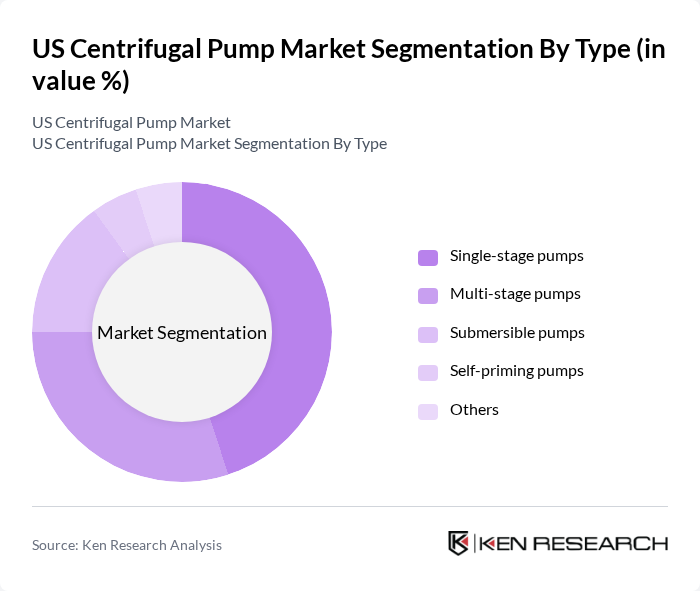
US Centrifugal Pump Market Segmentation
By Type:The centrifugal pump market can be segmented into various types, including single-stage pumps, multi-stage pumps, submersible pumps, self-priming pumps, and others. Among these, single-stage pumps dominate the market due to their simplicity, cost-effectiveness, and widespread application in water supply, irrigation, and industrial processes. Multi-stage pumps are gaining traction for high-pressure applications, while submersible pumps are preferred for their efficiency in handling liquids from deep sources.
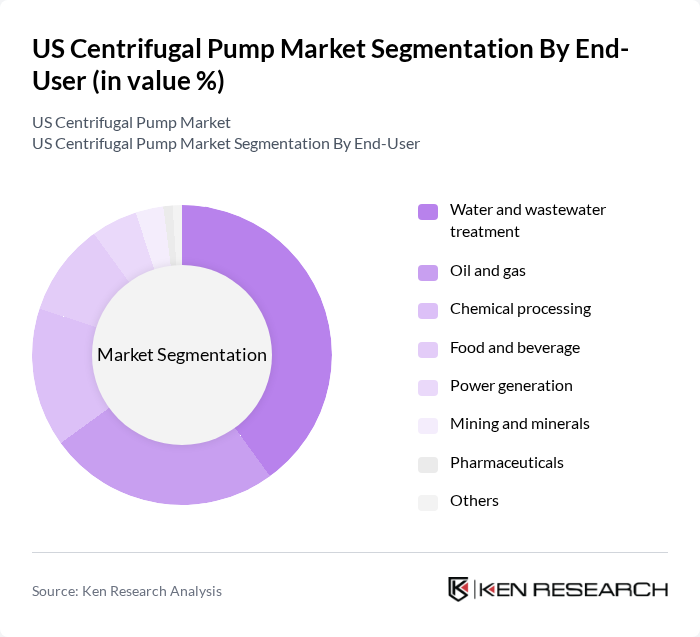
By End-User:The centrifugal pump market is segmented by end-user industries, including water and wastewater treatment, oil and gas, chemical processing, food and beverage, power generation, mining and minerals, pharmaceuticals, and others. The water and wastewater treatment segment holds the largest share, driven by increasing urbanization, infrastructure investment, and the need for efficient water management systems. The oil and gas sector also plays a crucial role, particularly in regions with significant extraction activities and ongoing investments in pipeline and refinery infrastructure.
US Centrifugal Pump Market Competitive Landscape
The US Centrifugal Pump Market is characterized by a dynamic mix of regional and international players. Leading participants such as Flowserve Corporation, Xylem Inc., Grundfos Holding A/S, KSB SE & Co. KGaA, Sulzer Ltd., Pentair plc, ITT Inc., Ebara Corporation, Gorman-Rupp Company, Weir Group PLC, ARO Fluid Management, National Oilwell Varco, Inc., SPX Flow, Inc., Crane Co., HOMA Pumpenfabrik GmbH, IDEX Corporation, Ruhrpumpen GmbH, Wilo SE, Franklin Electric Co., Inc., and Colfax Corporation contribute to innovation, geographic expansion, and service delivery in this space.
US Centrifugal Pump Market Industry Analysis
Growth Drivers
- Increasing Demand for Water and Wastewater Management:The US faces a significant challenge in managing its water resources, with the Environmental Protection Agency (EPA) estimating that over2 trillion gallons of untreated wastewater are discharged annually. This has led to a projected investment ofUSD 271 billion in water infrastructure in future, driving demand for centrifugal pumps. As municipalities upgrade systems to meet regulatory standards, the need for efficient pumping solutions will continue to rise, supporting market growth.
- Expansion of Industrial Sectors:The US industrial sector is projected to grow by approximatelyUSD 1.2 trillion in future, driven by manufacturing and energy production. This expansion necessitates reliable pumping solutions for various applications, including chemical processing and oil refining. As industries increasingly adopt automation and advanced technologies, the demand for high-performance centrifugal pumps will surge, further propelling market growth and innovation in pump design and efficiency.
- Technological Advancements in Pump Efficiency:The centrifugal pump market is witnessing rapid technological advancements, with innovations such as variable frequency drives (VFDs) enhancing energy efficiency. According to the US Department of Energy, implementing VFDs canreduce energy consumption by up to 50 percent. As industries prioritize energy savings and operational efficiency, the adoption of these advanced pumping technologies will drive market growth, aligning with sustainability goals and regulatory requirements.
Market Challenges
- High Initial Costs of Advanced Pumps:The initial investment for advanced centrifugal pumps can be substantial, often exceedingUSD 10,000 for high-efficiency models. This financial barrier can deter small and medium-sized enterprises from upgrading their systems, limiting market penetration. Additionally, the long payback period associated with energy-efficient pumps can further complicate purchasing decisions, hindering overall market growth in the short term.
- Regulatory Compliance and Environmental Concerns:The centrifugal pump industry faces stringent regulatory compliance requirements, particularly regarding emissions and energy efficiency. The EPA's Clean Water Act mandates strict standards for wastewater management, which can impose additional costs on manufacturers. Non-compliance can lead to significant fines, estimated atUSD 37,500 per day, creating a challenging environment for companies striving to meet these regulations while maintaining profitability.
US Centrifugal Pump Market Future Outlook
The US centrifugal pump market is poised for significant transformation, driven by the increasing emphasis on sustainability and energy efficiency. As industries adopt smart technologies and IoT integration, operational efficiencies will improve, leading to reduced energy consumption. Furthermore, the ongoing expansion of infrastructure projects will create a robust demand for advanced pumping solutions. Companies that innovate and adapt to these trends will likely capture substantial market share, positioning themselves favorably in a competitive landscape.
Market Opportunities
- Growth in Renewable Energy Applications:The renewable energy sector is expected to invest overUSD 500 billion in future, creating opportunities for centrifugal pumps in solar and wind energy applications. These pumps are essential for cooling systems and fluid management, positioning manufacturers to capitalize on this growing market segment and enhance their product offerings.
- Development of Eco-Friendly Pump Solutions:With increasing environmental awareness, the demand for eco-friendly pump solutions is rising. Companies focusing on developing biodegradable materials and energy-efficient designs can tap into this market, potentially increasing their customer base. The global push for sustainability will drive innovation, creating a competitive advantage for early adopters of green technologies.
Scope of the Report
| Segment | Sub-Segments |
|---|---|
| By Type | Single-stage pumps Multi-stage pumps Submersible pumps Self-priming pumps Others |
| By End-User | Water and wastewater treatment Oil and gas Chemical processing Food and beverage Power generation Mining and minerals Pharmaceuticals Others |
| By Application | Industrial processes HVAC systems Fire protection systems Irrigation systems Municipal water supply Others |
| By Material | Cast iron Stainless steel Plastic Bronze Others |
| By Drive Type | Electric-driven pumps Engine-driven pumps Solar-powered pumps Others |
| By Size | Small pumps Medium pumps Large pumps Others |
| By Region | Northeast Midwest South West |
Key Target Audience
Investors and Venture Capitalist Firms
Government and Regulatory Bodies (e.g., Environmental Protection Agency, Department of Energy)
Manufacturers and Producers
Distributors and Retailers
Industrial Equipment Suppliers
Energy and Utility Companies
Construction and Infrastructure Firms
Financial Institutions
Players Mentioned in the Report:
Flowserve Corporation
Xylem Inc.
Grundfos Holding A/S
KSB SE & Co. KGaA
Sulzer Ltd.
Pentair plc
ITT Inc.
Ebara Corporation
Gorman-Rupp Company
Weir Group PLC
ARO Fluid Management
National Oilwell Varco, Inc.
SPX Flow, Inc.
Crane Co.
HOMA Pumpenfabrik GmbH
IDEX Corporation
Ruhrpumpen GmbH
Wilo SE
Franklin Electric Co., Inc.
Colfax Corporation
Table of Contents
Market Assessment Phase
1. Executive Summary and Approach
2. US Centrifugal Pump Market Overview
2.1 Key Insights and Strategic Recommendations
2.2 US Centrifugal Pump Market Overview
2.3 Definition and Scope
2.4 Evolution of Market Ecosystem
2.5 Timeline of Key Regulatory Milestones
2.6 Value Chain & Stakeholder Mapping
2.7 Business Cycle Analysis
2.8 Policy & Incentive Landscape
3. US Centrifugal Pump Market Analysis
3.1 Growth Drivers
3.1.1 Increasing demand for water and wastewater management
3.1.2 Expansion of industrial sectors
3.1.3 Technological advancements in pump efficiency
3.1.4 Rising investments in infrastructure development
3.2 Market Challenges
3.2.1 High initial costs of advanced pumps
3.2.2 Competition from alternative pumping technologies
3.2.3 Regulatory compliance and environmental concerns
3.2.4 Supply chain disruptions
3.3 Market Opportunities
3.3.1 Growth in renewable energy applications
3.3.2 Increasing adoption of smart pump technologies
3.3.3 Expansion into emerging markets
3.3.4 Development of eco-friendly pump solutions
3.4 Market Trends
3.4.1 Shift towards energy-efficient pumps
3.4.2 Integration of IoT in pump systems
3.4.3 Customization and modular designs
3.4.4 Focus on sustainability and reduced carbon footprint
3.5 Government Regulation
3.5.1 Energy efficiency standards
3.5.2 Environmental protection regulations
3.5.3 Water quality regulations
3.5.4 Safety standards for industrial pumps
4. SWOT Analysis
5. Stakeholder Analysis
6. Porter's Five Forces Analysis
7. US Centrifugal Pump Market Market Size, 2019-2024
7.1 By Value
7.2 By Volume
7.3 By Average Selling Price
8. US Centrifugal Pump Market Segmentation
8.1 By Type
8.1.1 Single-stage pumps
8.1.2 Multi-stage pumps
8.1.3 Submersible pumps
8.1.4 Self-priming pumps
8.1.5 Others
8.2 By End-User
8.2.1 Water and wastewater treatment
8.2.2 Oil and gas
8.2.3 Chemical processing
8.2.4 Food and beverage
8.2.5 Power generation
8.2.6 Mining and minerals
8.2.7 Pharmaceuticals
8.2.8 Others
8.3 By Application
8.3.1 Industrial processes
8.3.2 HVAC systems
8.3.3 Fire protection systems
8.3.4 Irrigation systems
8.3.5 Municipal water supply
8.3.6 Others
8.4 By Material
8.4.1 Cast iron
8.4.2 Stainless steel
8.4.3 Plastic
8.4.4 Bronze
8.4.5 Others
8.5 By Drive Type
8.5.1 Electric-driven pumps
8.5.2 Engine-driven pumps
8.5.3 Solar-powered pumps
8.5.4 Others
8.6 By Size
8.6.1 Small pumps
8.6.2 Medium pumps
8.6.3 Large pumps
8.6.4 Others
8.7 By Region
8.7.1 Northeast
8.7.2 Midwest
8.7.3 South
8.7.4 West
9. US Centrifugal Pump Market Competitive Analysis
9.1 Market Share of Key Players
9.2 Cross Comparison of Key Players
9.2.1 Company Name
9.2.2 Revenue (USD millions)
9.2.3 Market Share (%)
9.2.4 Revenue Growth Rate (YoY)
9.2.5 Product Portfolio Breadth
9.2.6 R&D Investment (USD millions)
9.2.7 Operational Efficiency (EBITDA margin %)
9.2.8 Customer Retention Rate (%)
9.2.9 Distribution Network Coverage
9.2.10 Brand Recognition (Industry Index)
9.3 SWOT Analysis of Top Players
9.4 Pricing Analysis
9.5 Detailed Profile of Major Companies
9.5.1 Flowserve Corporation
9.5.2 Xylem Inc.
9.5.3 Grundfos Holding A/S
9.5.4 KSB SE & Co. KGaA
9.5.5 Sulzer Ltd.
9.5.6 Pentair plc
9.5.7 ITT Inc.
9.5.8 Ebara Corporation
9.5.9 Gorman-Rupp Company
9.5.10 Weir Group PLC
9.5.11 ARO Fluid Management
9.5.12 National Oilwell Varco, Inc.
9.5.13 SPX Flow, Inc.
9.5.14 Crane Co.
9.5.15 HOMA Pumpenfabrik GmbH
9.5.16 IDEX Corporation
9.5.17 Ruhrpumpen GmbH
9.5.18 Wilo SE
9.5.19 Franklin Electric Co., Inc.
9.5.20 Colfax Corporation
10. US Centrifugal Pump Market End-User Analysis
10.1 Procurement Behavior of Key Ministries
10.1.1 Government procurement processes
10.1.2 Budget allocation trends
10.1.3 Supplier selection criteria
10.1.4 Contract management practices
10.2 Corporate Spend on Infrastructure & Energy
10.2.1 Investment trends in infrastructure
10.2.2 Energy efficiency initiatives
10.2.3 Budgeting for pump systems
10.2.4 Corporate sustainability goals
10.3 Pain Point Analysis by End-User Category
10.3.1 Reliability issues
10.3.2 Maintenance costs
10.3.3 Energy consumption concerns
10.3.4 Regulatory compliance challenges
10.4 User Readiness for Adoption
10.4.1 Awareness of new technologies
10.4.2 Training and support needs
10.4.3 Financial readiness
10.4.4 Infrastructure compatibility
10.5 Post-Deployment ROI and Use Case Expansion
10.5.1 Measurement of ROI
10.5.2 Case studies of successful implementations
10.5.3 Opportunities for scaling
10.5.4 Feedback mechanisms for improvement
11. US Centrifugal Pump Market Future Size, 2025-2030
11.1 By Value
11.2 By Volume
11.3 By Average Selling Price
Go-To-Market Strategy Phase
1. Whitespace Analysis + Business Model Canvas
1.1 Market gaps identification
1.2 Value proposition development
1.3 Revenue model exploration
1.4 Customer segmentation analysis
1.5 Competitive landscape overview
1.6 Key partnerships identification
1.7 Operational model design
2. Marketing and Positioning Recommendations
2.1 Branding strategies
2.2 Product USPs
2.3 Target audience definition
2.4 Marketing channels selection
2.5 Messaging and communication strategy
2.6 Performance metrics establishment
2.7 Budget allocation for marketing
3. Distribution Plan
3.1 Urban retail strategies
3.2 Rural NGO tie-ups
3.3 Online distribution channels
3.4 Direct sales approach
3.5 Partnership with distributors
3.6 Logistics and supply chain management
3.7 Inventory management practices
4. Channel & Pricing Gaps
4.1 Underserved routes
4.2 Pricing bands analysis
4.3 Competitor pricing strategies
4.4 Customer willingness to pay
4.5 Value-based pricing models
4.6 Discounting strategies
4.7 Price elasticity considerations
5. Unmet Demand & Latent Needs
5.1 Category gaps identification
5.2 Consumer segments analysis
5.3 Emerging trends exploration
5.4 Customer feedback collection
5.5 Innovation opportunities
5.6 Market entry barriers
5.7 Future demand forecasting
6. Customer Relationship
6.1 Loyalty programs design
6.2 After-sales service strategies
6.3 Customer engagement initiatives
6.4 Feedback and improvement loops
6.5 Relationship management tools
6.6 Customer satisfaction measurement
6.7 Retention strategies
7. Value Proposition
7.1 Sustainability initiatives
7.2 Integrated supply chains
7.3 Cost-saving measures
7.4 Quality assurance practices
7.5 Customer-centric innovations
7.6 Competitive advantages
7.7 Long-term value creation
8. Key Activities
8.1 Regulatory compliance measures
8.2 Branding initiatives
8.3 Distribution setup processes
8.4 Training and development programs
8.5 Performance monitoring systems
8.6 Risk management strategies
8.7 Stakeholder engagement activities
9. Entry Strategy Evaluation
9.1 Domestic Market Entry Strategy
9.1.1 Product mix considerations
9.1.2 Pricing band analysis
9.1.3 Packaging strategies
9.2 Export Entry Strategy
9.2.1 Target countries identification
9.2.2 Compliance roadmap development
10. Entry Mode Assessment
10.1 Joint Ventures
10.2 Greenfield investments
10.3 Mergers & Acquisitions
10.4 Distributor Model
11. Capital and Timeline Estimation
11.1 Capital requirements analysis
11.2 Timelines for market entry
12. Control vs Risk Trade-Off
12.1 Ownership considerations
12.2 Partnerships evaluation
13. Profitability Outlook
13.1 Breakeven analysis
13.2 Long-term sustainability strategies
14. Potential Partner List
14.1 Distributors identification
14.2 Joint Ventures opportunities
14.3 Acquisition targets
15. Execution Roadmap
15.1 Phased Plan for Market Entry
15.1.1 Market Setup
15.1.2 Market Entry
15.1.3 Growth Acceleration
15.1.4 Scale & Stabilize
15.2 Key Activities and Milestones
15.2.1 Milestone tracking
15.2.2 Activity scheduling
15.2.3 Resource allocation
Research Methodology
Phase 1: Approach1
Desk Research
- Industry reports from the American Society of Mechanical Engineers (ASME)
- Market analysis from the U.S. Department of Energy on energy-efficient pumps
- Published articles and white papers from leading pump manufacturers and associations
Primary Research
- Interviews with engineers and project managers in the oil and gas sector
- Surveys with facility managers in water treatment plants
- Field interviews with maintenance supervisors in manufacturing facilities
Validation & Triangulation
- Cross-validation using historical sales data from industry reports
- Triangulation of findings from primary interviews and secondary data sources
- Sanity checks through expert panel discussions with industry veterans
Phase 2: Market Size Estimation1
Top-down Assessment
- Analysis of total market size based on national pump sales data
- Segmentation by application areas such as industrial, municipal, and agricultural
- Incorporation of growth trends in end-user industries driving pump demand
Bottom-up Modeling
- Volume estimates based on production capacities of leading manufacturers
- Cost analysis derived from average selling prices across different pump types
- Estimation of market share based on sales volume and revenue data
Forecasting & Scenario Analysis
- Multi-variable regression analysis incorporating economic indicators and industry growth rates
- Scenario modeling based on potential regulatory changes affecting pump efficiency standards
- Baseline, optimistic, and pessimistic forecasts through 2030 based on market dynamics
Phase 3: CATI Sample Composition1
| Scope Item/Segment | Sample Size | Target Respondent Profiles |
|---|---|---|
| Industrial Pump Applications | 100 | Plant Managers, Process Engineers |
| Agricultural Irrigation Systems | 60 | Agronomists, Farm Equipment Managers |
| Municipal Water Supply | 50 | Water Resource Managers, City Planners |
| Oil & Gas Sector | 40 | Field Engineers, Operations Supervisors |
| HVAC Systems | 40 | Building Engineers, Facility Managers |
Frequently Asked Questions
What is the current value of the US Centrifugal Pump Market?
The US Centrifugal Pump Market is valued at approximately USD 5.9 billion, driven by the demand for efficient water management systems, advancements in pump technology, and the expansion of the oil and gas sector.
What are the key growth drivers for the US Centrifugal Pump Market?
Which regions dominate the US Centrifugal Pump Market?
What types of centrifugal pumps are available in the market?
Other Regional/Country Reports
Indonesia Centrifugal Pump Market Report Size, Share, Growth Drivers, Trends, Opportunities & Forecast 2025–2030
Malaysia Centrifugal Pump Market Report Size, Share, Growth Drivers, Trends, Opportunities & Forecast 2025–2030
KSA Centrifugal Pump Market Report Size, Share, Growth Drivers, Trends, Opportunities & Forecast 2025–2030
APAC Centrifugal Pump Market Report Size, Share, Growth Drivers, Trends, Opportunities & Forecast 2025–2030
SEA Centrifugal Pump Market Report Size, Share, Growth Drivers, Trends, Opportunities & Forecast 2025–2030
Vietnam Centrifugal Pump Market Report Size, Share, Growth Drivers, Trends, Opportunities & Forecast 2025–2030
Other Adjacent Reports
Singapore Water and Wastewater Treatment Market
Belgium Oil and Gas Equipment Market
South Korea Chemical Processing Equipment Market
Kuwait Power Generation Equipment Market
Global Mining Equipment MarketUAE Pharmaceutical Equipment MarketSingapore Food and Beverage Processing Market
Qatar Industrial Valve Market
UAE Fluid Handling System Market
UAE Pump Monitoring Technology Market
Why Buy From Us?

What makes us stand out is that our consultants follow Robust, Refine and Result (RRR) methodology. Robust for clear definitions, approaches and sanity checking, Refine for differentiating respondents' facts and opinions, and Result for presenting data with story.

We have set a benchmark in the industry by offering our clients with syndicated and customized market research reports featuring coverage of entire market as well as meticulous research and analyst insights.

While we don't replace traditional research, we flip the method upside down. Our dual approach of Top Bottom & Bottom Top ensures quality deliverable by not just verifying company fundamentals but also looking at the sector and macroeconomic factors.

With one step in the future, our research team constantly tries to show you the bigger picture. We help with some of the tough questions you may encounter along the way: How is the industry positioned? Best marketing channel? KPI's of competitors? By aligning every element, we help maximize success.

Our report gives you instant access to the answers and sources that other companies might choose to hide. We elaborate each steps of research methodology we have used and showcase you the sample size to earn your trust.

If you need any support, we are here! We pride ourselves on universe strength, data quality, and quick, friendly, and professional service.