About the Report
Base Year 2024US Furnace Filters Market Overview
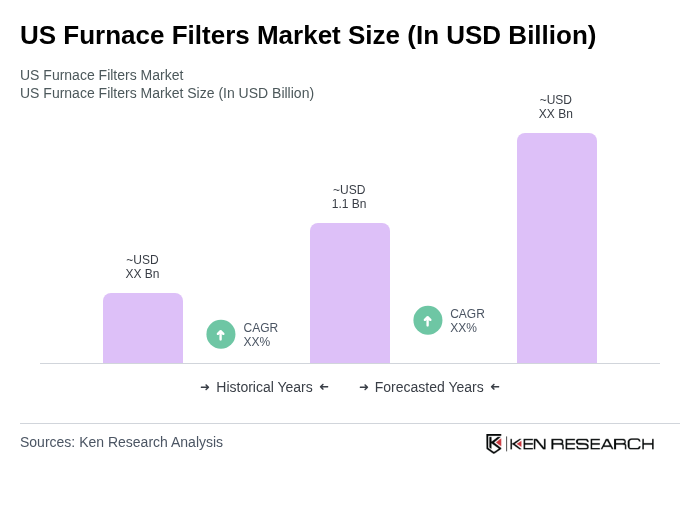
- The US Furnace Filters Market is valued at USD 1.1 billion, based on a five-year historical analysis. This growth is primarily driven by increasing awareness of indoor air quality, rising health concerns such as allergies and asthma, and the growing demand for energy-efficient HVAC systems. The market has seen a significant uptick in the adoption of high-efficiency and higher-MERV filters, which are essential for maintaining optimal air quality in residential and commercial spaces and for capturing finer particulates, allergens, and airborne microorganisms.
- Key demand hubs in this market include major metropolitan areas such as New York, Los Angeles, and Chicago, which account for substantial consumption due to their large building stock, dense populations, and high penetration of HVAC systems. Additionally, states with extreme or highly variable weather conditions, such as Texas and Florida in the South, contribute significantly to the market, as residents and businesses require reliable heating and cooling solutions with regular filter replacement to maintain comfort and system efficiency throughout the year.
- Regulatory and standards frameworks are also shaping the US furnace filters market, with requirements linked to HVAC system performance and indoor air quality. For example, ASHRAE Standard 62.1: Ventilation for Acceptable Indoor Air Quality, issued by ASHRAE and referenced in many state and local building codes, specifies ventilation and filtration performance levels, including minimum filter efficiency requirements (commonly MERV 8 or higher) for many commercial applications. In addition, U.S. Environmental Protection Agency (EPA) programs and guidance on indoor air quality and energy-efficient HVAC systems encourage the use of higher-efficiency filters, supporting increased adoption of MERV-rated furnace filters that meet these performance expectations.
US Furnace Filters Market Segmentation
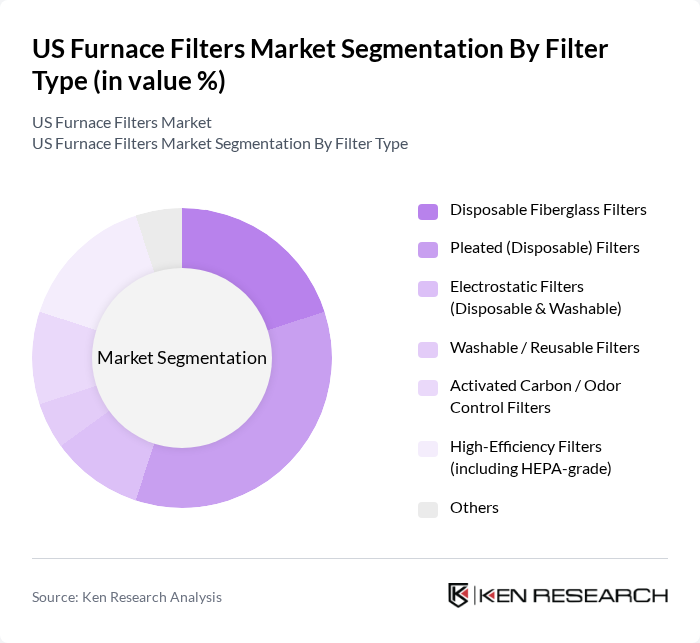
By Filter Type:The market is segmented into various filter types, including Disposable Fiberglass Filters, Pleated (Disposable) Filters, Electrostatic Filters (Disposable & Washable), Washable / Reusable Filters, Activated Carbon / Odor Control Filters, High-Efficiency Filters (including HEPA-grade), and Others. This segmentation is consistent with leading industry reports that group furnace filters by media construction and performance level. Among these, Pleated Filters are gaining traction due to their superior surface area, improved particulate capture, and longer service life compared to traditional fiberglass filters, which aligns with the shift toward higher-efficiency MERV-rated products in the US market. The increasing consumer preference for energy-efficient and high-performance filters, including higher-MERV pleated and electrostatic designs that can maintain airflow while capturing fine particles, is driving the growth of this segment.
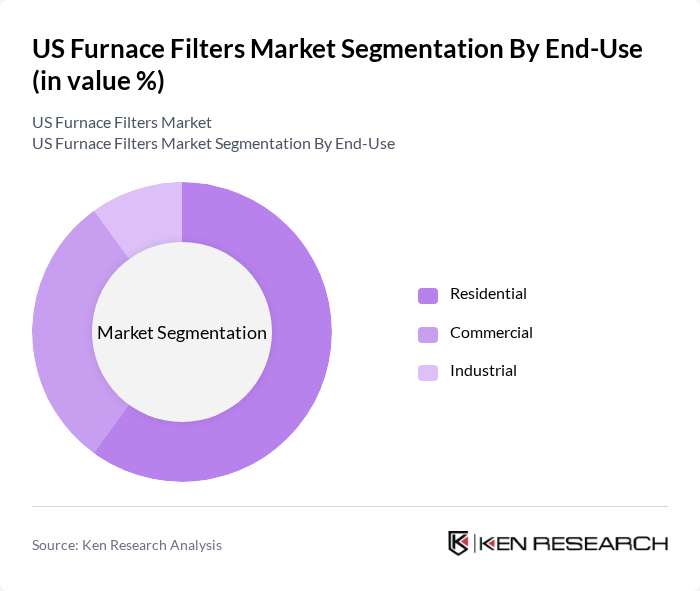
By End-Use:The market is categorized into Residential, Commercial, and Industrial segments. The Residential segment is the largest, driven by the high installed base of forced-air HVAC systems in US homes and the growing awareness of indoor air quality, especially following heightened concern over airborne viruses, allergens, and wildfire smoke in recent years. Consumers are increasingly investing in high-quality, higher-MERV filters to ensure a healthier living environment, supported by expanded availability through retail and e-commerce channels. The Commercial segment is also significant, as businesses prioritize air quality to enhance employee productivity, support return-to-office strategies, and align with indoor air quality and ventilation standards referenced in building codes and occupational health guidance. The Industrial segment, while smaller in share, relies on robust filtration for process protection, equipment performance, and worker safety in facilities that integrate furnace or central HVAC systems with other industrial air handling and filtration solutions.
US Furnace Filters Market Competitive Landscape
The US Furnace Filters Market is characterized by a dynamic mix of regional and international players. Leading participants such as 3M Company, Honeywell International Inc., Filtrete (3M Brand), Nordic Pure, Inc., Aprilaire (Research Products Corporation), Lennox International Inc., Trion (Johnson Controls International plc), Flanders Corporation (Part of AAF Flanders), AAF International (AAF Flanders), Camfil AB, MervFilters LLC, FilterBuy, Inc., Accumulair / Filters-NOW, LLC, K&N Engineering, Inc., Air Filters, Inc. contribute to innovation, geographic expansion, and service delivery in this space, with several of these brands identified among the key competitors in the US furnace filters market.
US Furnace Filters Market Industry Analysis
Growth Drivers
- Increasing Demand for Indoor Air Quality:The US indoor air quality market is projected to reach $12.1 billion, driven by heightened consumer awareness of air pollution's health effects. According to the EPA, indoor air can be 2-5 times more polluted than outdoor air. This growing concern is prompting consumers to invest in high-efficiency furnace filters, which can capture up to 99.97% of airborne particles, thus significantly improving indoor air quality and driving market growth.
- Rising Awareness of Health Impacts:A report from the World Health Organization indicates that air pollution is responsible for approximately 7 million premature deaths annually. This alarming statistic has led to increased consumer demand for effective air filtration solutions. As individuals become more health-conscious, the preference for high-performance filters, such as HEPA and MERV-rated options, is expected to rise, further propelling the furnace filters market in the US.
- Technological Advancements in Filter Materials:The US furnace filters market is benefiting from innovations in filter technology, with new materials enhancing filtration efficiency. For instance, electrostatic filters can capture particles as small as 0.3 microns, outperforming traditional fiberglass filters. The market for advanced filter materials is projected to grow by 8.5% annually, driven by consumer demand for better air quality solutions and the increasing adoption of smart home technologies that integrate advanced filtration systems.
Market Challenges
- High Competition and Price Sensitivity:The US furnace filters market is characterized by intense competition, with numerous players vying for market share. This competitive landscape has led to price wars, making it challenging for manufacturers to maintain profit margins. According to IBISWorld, the average profit margin in the industry is around 5.5%, which constrains investment in innovation and marketing, ultimately affecting long-term growth prospects.
- Supply Chain Disruptions:The COVID-19 pandemic has highlighted vulnerabilities in supply chains, particularly for raw materials used in filter production. A survey by the National Association of Manufacturers revealed that 75% of manufacturers experienced supply chain disruptions, leading to increased lead times and costs. These challenges can hinder the timely availability of furnace filters, impacting sales and customer satisfaction in the US market.
US Furnace Filters Market Future Outlook
The US furnace filters market is poised for significant growth, driven by increasing consumer awareness of indoor air quality and health impacts. As smart home technologies continue to evolve, the integration of advanced filtration systems will become more prevalent. Additionally, the demand for eco-friendly filter options is expected to rise, aligning with sustainability trends. Manufacturers that adapt to these changes and invest in innovative solutions will likely capture a larger share of the market in the future.
Market Opportunities
- Growth in Smart Home Technologies:The smart home market is projected to reach $200 billion, creating opportunities for furnace filter manufacturers to develop IoT-enabled products. These smart filters can provide real-time air quality monitoring and filter replacement alerts, enhancing user experience and driving sales in the US market.
- Development of Eco-friendly Filter Options:With increasing consumer preference for sustainable products, the market for eco-friendly furnace filters is expanding. According to a report, 65% of consumers are willing to pay more for environmentally friendly products. This trend presents a significant opportunity for manufacturers to innovate and capture a growing segment of environmentally conscious consumers in the US.
Scope of the Report
| Segment | Sub-Segments |
|---|---|
| By Filter Type | Disposable Fiberglass Filters Pleated (Disposable) Filters Electrostatic Filters (Disposable & Washable) Washable / Reusable Filters Activated Carbon / Odor Control Filters High-Efficiency Filters (including HEPA-grade) Others |
| By End-Use | Residential Commercial Industrial |
| By Furnace / System Type | Gas Furnace Oil Furnace Electric / Heat Pump & Hybrid Systems Others |
| By MERV Rating | MERV 1–4 MERV 5–8 MERV 9–11 MERV 12–13 MERV 14–16 MERV 17 and Above |
| By Filter Thickness | inch Filters inch Filters –5-inch Filters Others |
| By Distribution Channel | Retail Stores (Home Centers, Hardware, Big Box) Wholesale / Distributor Channels Online / E-commerce Direct-to-Consumer & OEM Channels |
| By Region | Northeast Midwest South West |
Key Target Audience
Investors and Venture Capitalist Firms
Government and Regulatory Bodies (e.g., Environmental Protection Agency, Department of Energy)
Manufacturers and Producers
Distributors and Retailers
HVAC System Installers and Service Providers
Industry Associations (e.g., American Society of Heating, Refrigerating and Air-Conditioning Engineers)
Building Contractors and Developers
Financial Institutions
Players Mentioned in the Report:
3M Company
Honeywell International Inc.
Filtrete (3M Brand)
Nordic Pure, Inc.
Aprilaire (Research Products Corporation)
Lennox International Inc.
Trion (Johnson Controls International plc)
Flanders Corporation (Part of AAF Flanders)
AAF International (AAF Flanders)
Camfil AB
MervFilters LLC
FilterBuy, Inc.
Accumulair / Filters-NOW, LLC
K&N Engineering, Inc.
Air Filters, Inc.
Table of Contents
Market Assessment Phase
1. Executive Summary and Approach
2. US Furnace Filters Market Overview
2.1 Key Insights and Strategic Recommendations
2.2 US Furnace Filters Market Overview
2.3 Definition and Scope
2.4 Evolution of Market Ecosystem
2.5 Timeline of Key Regulatory Milestones
2.6 Value Chain & Stakeholder Mapping
2.7 Business Cycle Analysis
2.8 Policy & Incentive Landscape
3. US Furnace Filters Market Analysis
3.1 Growth Drivers
3.1.1 Increasing Demand for Indoor Air Quality
3.1.2 Rising Awareness of Health Impacts
3.1.3 Technological Advancements in Filter Materials
3.1.4 Government Regulations Promoting Energy Efficiency
3.2 Market Challenges
3.2.1 High Competition and Price Sensitivity
3.2.2 Supply Chain Disruptions
3.2.3 Limited Consumer Awareness of Product Options
3.2.4 Fluctuating Raw Material Prices
3.3 Market Opportunities
3.3.1 Growth in Smart Home Technologies
3.3.2 Expansion of E-commerce Platforms
3.3.3 Increasing Renovation and Construction Activities
3.3.4 Development of Eco-friendly Filter Options
3.4 Market Trends
3.4.1 Shift Towards HEPA and MERV Rated Filters
3.4.2 Integration of IoT in Air Filtration Systems
3.4.3 Customization and Personalization of Products
3.4.4 Focus on Sustainability and Recyclable Materials
3.5 Government Regulation
3.5.1 Energy Star Certification Requirements
3.5.2 EPA Standards for Indoor Air Quality
3.5.3 State-Level Energy Efficiency Programs
3.5.4 Regulations on Manufacturing Emissions
4. SWOT Analysis
5. Stakeholder Analysis
6. Porter's Five Forces Analysis
7. US Furnace Filters Market Market Size, 2019-2024
7.1 By Value
7.2 By Volume
7.3 By Average Selling Price
8. US Furnace Filters Market Segmentation
8.1 By Filter Type
8.1.1 Disposable Fiberglass Filters
8.1.2 Pleated (Disposable) Filters
8.1.3 Electrostatic Filters (Disposable & Washable)
8.1.4 Washable / Reusable Filters
8.1.5 Activated Carbon / Odor Control Filters
8.1.6 High-Efficiency Filters (including HEPA-grade)
8.1.7 Others
8.2 By End-Use
8.2.1 Residential
8.2.2 Commercial
8.2.3 Industrial
8.3 By Furnace / System Type
8.3.1 Gas Furnace
8.3.2 Oil Furnace
8.3.3 Electric / Heat Pump & Hybrid Systems
8.3.4 Others
8.4 By MERV Rating
8.4.1 MERV 1–4
8.4.2 MERV 5–8
8.4.3 MERV 9–11
8.4.4 MERV 12–13
8.4.5 MERV 14–16
8.4.6 MERV 17 and Above
8.5 By Filter Thickness
8.5.1 1-inch Filters
8.5.2 2-inch Filters
8.5.3 4–5-inch Filters
8.5.4 Others
8.6 By Distribution Channel
8.6.1 Retail Stores (Home Centers, Hardware, Big Box)
8.6.2 Wholesale / Distributor Channels
8.6.3 Online / E-commerce
8.6.4 Direct-to-Consumer & OEM Channels
8.7 By Region
8.7.1 Northeast
8.7.2 Midwest
8.7.3 South
8.7.4 West
9. US Furnace Filters Market Competitive Analysis
9.1 Market Share of Key Players
9.2 Cross Comparison of Key Players
9.2.1 Company Name
9.2.2 Revenue (US$ million) – Latest Fiscal Year
9.2.3 3–5 Year Revenue CAGR (%) – Furnace Filters / IAQ Segment
9.2.4 US Furnace Filters Market Share (%)
9.2.5 EBITDA Margin (%) – Filtration Business
9.2.6 R&D Spend as % of Revenue
9.2.7 Average Realized Price per Filter (US$)
9.2.8 Volume Sold (Million Units per Year)
9.2.9 Distribution Reach (No. of Retail & Distributor Outlets)
9.2.10 Share of Online Sales (%)
9.2.11 Customer Retention / Repeat Purchase Rate (%)
9.2.12 New Product Launches in Last 3 Years (Count)
9.3 SWOT Analysis of Top Players
9.4 Pricing Analysis
9.5 Detailed Profile of Major Companies
9.5.1 3M Company
9.5.2 Honeywell International Inc.
9.5.3 Filtrete (3M Brand)
9.5.4 Nordic Pure, Inc.
9.5.5 Aprilaire (Research Products Corporation)
9.5.6 Lennox International Inc.
9.5.7 Trion (Johnson Controls International plc)
9.5.8 Flanders Corporation (Part of AAF Flanders)
9.5.9 AAF International (AAF Flanders)
9.5.10 Camfil AB
9.5.11 MervFilters LLC
9.5.12 FilterBuy, Inc.
9.5.13 Accumulair / Filters-NOW, LLC
9.5.14 K&N Engineering, Inc.
9.5.15 Air Filters, Inc.
10. US Furnace Filters Market End-User Analysis
10.1 Procurement Behavior of Key Ministries
10.1.1 Budget Allocation Trends
10.1.2 Preferred Procurement Channels
10.1.3 Evaluation Criteria for Suppliers
10.1.4 Frequency of Procurement
10.2 Corporate Spend on Infrastructure & Energy
10.2.1 Investment Trends in Air Quality Solutions
10.2.2 Budgeting for Maintenance and Upgrades
10.2.3 Impact of Energy Efficiency Initiatives
10.2.4 Corporate Sustainability Goals
10.3 Pain Point Analysis by End-User Category
10.3.1 Common Issues Faced by Residential Users
10.3.2 Challenges in Commercial Applications
10.3.3 Industrial User Requirements
10.3.4 Government Sector Needs
10.4 User Readiness for Adoption
10.4.1 Awareness of Filter Options
10.4.2 Willingness to Invest in Quality
10.4.3 Adoption of Smart Technologies
10.4.4 Feedback Mechanisms
10.5 Post-Deployment ROI and Use Case Expansion
10.5.1 Measurement of Air Quality Improvements
10.5.2 Cost Savings Analysis
10.5.3 User Satisfaction Metrics
10.5.4 Opportunities for Upselling
11. US Furnace Filters Market Future Size, 2025-2030
11.1 By Value
11.2 By Volume
11.3 By Average Selling Price
Go-To-Market Strategy Phase
1. Whitespace Analysis + Business Model Canvas
1.1 Market Gaps Identification
1.2 Business Model Framework
2. Marketing and Positioning Recommendations
2.1 Branding Strategies
2.2 Product USPs
3. Distribution Plan
3.1 Urban Retail Strategies
3.2 Rural NGO Tie-ups
4. Channel & Pricing Gaps
4.1 Underserved Routes
4.2 Pricing Bands Analysis
5. Unmet Demand & Latent Needs
5.1 Category Gaps
5.2 Consumer Segments
6. Customer Relationship
6.1 Loyalty Programs
6.2 After-sales Service
7. Value Proposition
7.1 Sustainability Initiatives
7.2 Integrated Supply Chains
8. Key Activities
8.1 Regulatory Compliance
8.2 Branding Efforts
8.3 Distribution Setup
9. Entry Strategy Evaluation
9.1 Domestic Market Entry Strategy
9.1.1 Product Mix Considerations
9.1.2 Pricing Band Strategy
9.1.3 Packaging Solutions
9.2 Export Entry Strategy
9.2.1 Target Countries Analysis
9.2.2 Compliance Roadmap
10. Entry Mode Assessment
10.1 Joint Ventures
10.2 Greenfield Investments
10.3 Mergers & Acquisitions
10.4 Distributor Model
11. Capital and Timeline Estimation
11.1 Capital Requirements
11.2 Timelines for Implementation
12. Control vs Risk Trade-Off
12.1 Ownership Considerations
12.2 Partnerships Evaluation
13. Profitability Outlook
13.1 Breakeven Analysis
13.2 Long-term Sustainability Strategies
14. Potential Partner List
14.1 Distributors
14.2 Joint Ventures
14.3 Acquisition Targets
15. Execution Roadmap
15.1 Phased Plan for Market Entry
15.1.1 Market Setup
15.1.2 Market Entry
15.1.3 Growth Acceleration
15.1.4 Scale & Stabilize
15.2 Key Activities and Milestones
15.2.1 Milestone Planning
15.2.2 Activity Tracking
Research Methodology
Phase 1: Approach1
Desk Research
- Analysis of industry reports from HVAC associations and market research firms
- Review of government publications on air quality standards and regulations
- Examination of trade publications and articles focusing on furnace filter technologies
Primary Research
- Interviews with HVAC system manufacturers and furnace filter producers
- Surveys conducted with HVAC contractors and service technicians
- Focus groups with end-users to understand preferences and buying behavior
Validation & Triangulation
- Cross-validation of findings through multiple data sources including sales data and market trends
- Triangulation of insights from primary interviews with secondary research findings
- Sanity checks through expert panel reviews comprising industry veterans
Phase 2: Market Size Estimation1
Top-down Assessment
- Estimation of total market size based on national HVAC system installations
- Segmentation by residential, commercial, and industrial furnace filter applications
- Incorporation of growth rates from historical data and projected trends
Bottom-up Modeling
- Volume estimates derived from sales data of leading furnace filter manufacturers
- Cost analysis based on average pricing of various filter types
- Calculation of market size using unit sales multiplied by average selling prices
Forecasting & Scenario Analysis
- Multi-variable regression analysis incorporating factors like energy efficiency trends and regulatory changes
- Scenario modeling based on economic conditions and consumer behavior shifts
- Development of baseline, optimistic, and pessimistic forecasts through 2030
Phase 3: CATI Sample Composition1
| Scope Item/Segment | Sample Size | Target Respondent Profiles |
|---|---|---|
| Residential Furnace Filter Market | 120 | Homeowners, HVAC Technicians |
| Commercial HVAC Systems | 100 | Facility Managers, Building Engineers |
| Industrial Air Filtration | 80 | Plant Managers, Environmental Compliance Officers |
| Retail Distribution Channels | 70 | Retail Buyers, Supply Chain Managers |
| Online Sales of Furnace Filters | 90 | E-commerce Managers, Digital Marketing Specialists |
Frequently Asked Questions
What is the current value of the US Furnace Filters Market?
The US Furnace Filters Market is valued at approximately USD 1.1 billion, reflecting a significant growth trend driven by increasing awareness of indoor air quality and the demand for energy-efficient HVAC systems.
What factors are driving the growth of the US Furnace Filters Market?
Which regions in the US have the highest demand for furnace filters?
What types of furnace filters are available in the market?
Other Regional/Country Reports
Indonesia Furnace Filters Market
Malaysia Furnace Filters Market
KSA Furnace Filters Market
APAC Furnace Filters Market
SEA Furnace Filters Market
Vietnam Furnace Filters Market
Other Adjacent Reports
Bahrain Air Purification Market
KSA Indoor Air Quality Market
Bahrain Ventilation Systems Market
Brazil Filtration Media Market
Vietnam HEPA Filters Market
KSA Electrostatic Filters Market
Thailand Smart Home Devices Market
Malaysia Energy Efficiency Solutions Market
Vietnam Building Automation Market
Why Buy From Us?

What makes us stand out is that our consultants follow Robust, Refine and Result (RRR) methodology. Robust for clear definitions, approaches and sanity checking, Refine for differentiating respondents' facts and opinions, and Result for presenting data with story.

We have set a benchmark in the industry by offering our clients with syndicated and customized market research reports featuring coverage of entire market as well as meticulous research and analyst insights.

While we don't replace traditional research, we flip the method upside down. Our dual approach of Top Bottom & Bottom Top ensures quality deliverable by not just verifying company fundamentals but also looking at the sector and macroeconomic factors.

With one step in the future, our research team constantly tries to show you the bigger picture. We help with some of the tough questions you may encounter along the way: How is the industry positioned? Best marketing channel? KPI's of competitors? By aligning every element, we help maximize success.

Our report gives you instant access to the answers and sources that other companies might choose to hide. We elaborate each steps of research methodology we have used and showcase you the sample size to earn your trust.

If you need any support, we are here! We pride ourselves on universe strength, data quality, and quick, friendly, and professional service.