About the Report
Base Year 2024US Induction Cookware Market Overview
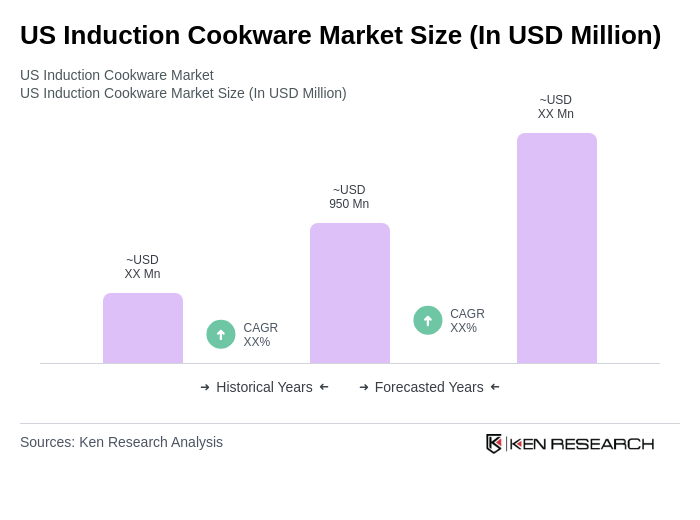
- The US Induction Cookware Market is valued at USD 950 million, based on a five-year historical analysis. This growth is primarily driven by the increasing adoption of induction cooking technology, which is favored for its energy efficiency and safety features. The rising trend of home cooking, coupled with a growing awareness of health and wellness, has further propelled the demand for induction cookware among consumers .
- Key demand centers in this market include major metropolitan areas such as New York, Los Angeles, and Chicago, which dominate due to their large populations and high disposable incomes. These cities also have a strong culinary culture and a growing trend towards modern cooking appliances, making them significant hubs for the induction cookware market .
- The Energy Star Program Requirements for Residential Cooktops, issued by the US Environmental Protection Agency in 2023, set mandatory energy efficiency standards for induction cooktops and compatible cookware. This regulation requires manufacturers to comply with specific energy consumption thresholds, driving product innovation and supporting the market’s alignment with national sustainability objectives .
US Induction Cookware Market Segmentation
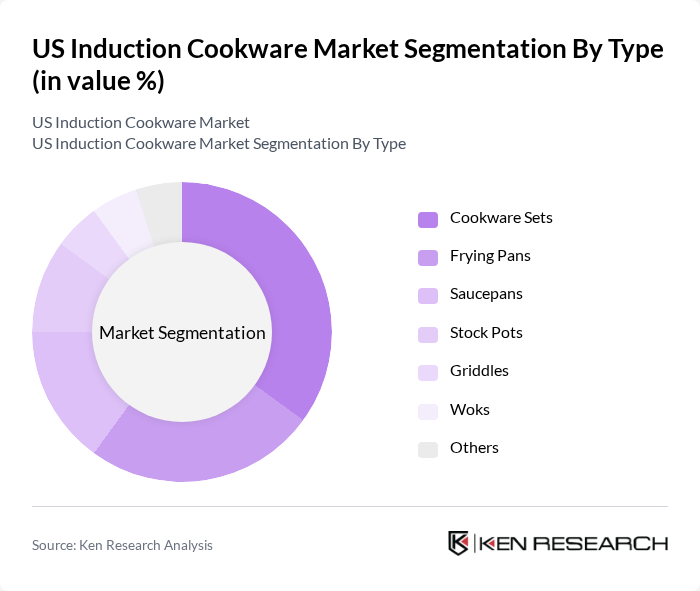
By Type:The market is segmented into various types of cookware, including cookware sets, frying pans, saucepans, stock pots, griddles, woks, and others. Among these, cookware sets and frying pans are particularly popular due to their versatility and convenience for everyday cooking. The trend towards multi-functional kitchenware has led to increased consumer preference for these subsegments, driving their market share significantly .
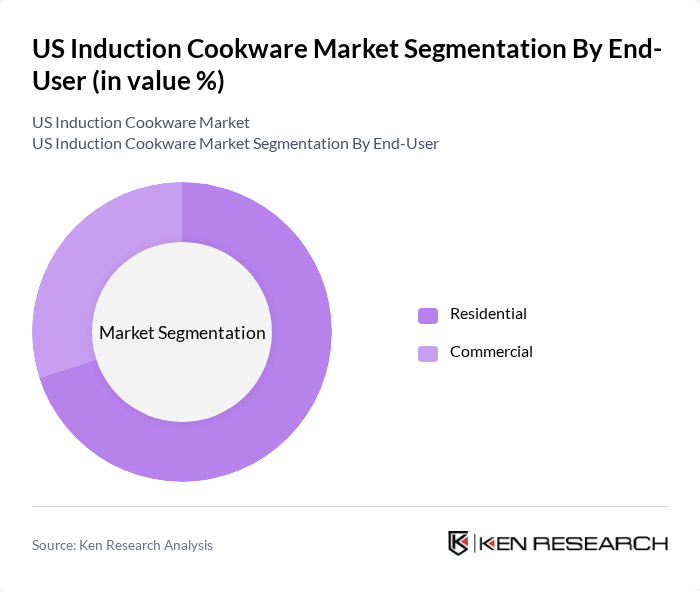
By End-User:The market is divided into residential and commercial segments. The residential segment dominates the market, driven by the increasing trend of home cooking and the growing number of households investing in modern kitchen appliances. Consumers are increasingly seeking high-quality cookware that enhances their cooking experience, leading to a surge in demand for induction cookware in residential settings .
US Induction Cookware Market Competitive Landscape
The US Induction Cookware Market is characterized by a dynamic mix of regional and international players. Leading participants such as T-fal, Cuisinart, All-Clad, Calphalon, Duxtop, Anolon, GreenPan, Scanpan, Tramontina, Lodge, Cooks Standard, Rachael Ray, Farberware, Le Creuset, KitchenAid, Mauviel contribute to innovation, geographic expansion, and service delivery in this space.
US Induction Cookware Market Industry Analysis
Growth Drivers
- Increasing Consumer Preference for Energy-Efficient Cooking Solutions:The US energy consumption for residential cooking is projected to reach approximately 1,200 trillion BTUs annually. Induction cookware, which uses about 85-90% of its energy for cooking, is gaining traction as consumers seek to reduce energy bills. The average household could save around $50 to $125 annually by switching to induction cooking, driving demand for energy-efficient cookware options.
- Rising Demand for Smart Kitchen Appliances:The smart kitchen appliance market in the US is expected to grow to over $10 billion, with induction cookware being a key segment. Consumers are increasingly interested in integrated technology, such as app-controlled cooking features. This trend is supported by the fact that approximately 60% of new kitchen appliance purchases included smart technology, indicating a shift towards tech-savvy cooking solutions.
- Growth in Home Cooking Trends:The number of home cooks in the US has surged, with approximately 70% of adults cooking at home more frequently than in previous years. This trend is supported by a 15% increase in home cooking-related online searches. As more consumers invest in quality cookware, the demand for induction cookware is expected to rise, particularly among health-conscious individuals seeking efficient cooking methods.
Market Challenges
- High Initial Cost of Induction Cookware:The average price of induction cookware sets ranges from $100 to $500, which can deter budget-conscious consumers. With the average American household income projected at around $75,000, many consumers may prioritize lower-cost alternatives. This price barrier limits market penetration, especially among first-time buyers who may not see the long-term savings potential.
- Limited Consumer Awareness about Induction Cooking:Despite the benefits, only about 25-30% of US consumers are familiar with induction cooking technology. This lack of awareness is a significant barrier to market growth, as many potential buyers remain unaware of the efficiency and safety benefits. Educational initiatives and marketing campaigns are essential to increase consumer knowledge and drive adoption rates in the coming years.
US Induction Cookware Market Future Outlook
The US induction cookware market is poised for significant growth as consumer preferences shift towards energy-efficient and smart cooking solutions. With the increasing popularity of home cooking and a growing emphasis on health-conscious meal preparation, manufacturers are likely to innovate and expand their product lines. Additionally, as e-commerce continues to thrive, online sales channels will play a crucial role in reaching a broader audience, enhancing market accessibility and consumer engagement.
Market Opportunities
- Innovations in Induction Cookware Design:There is a growing opportunity for manufacturers to develop innovative designs that enhance usability and aesthetics. For instance, incorporating lightweight materials and ergonomic handles can attract more consumers. As the market evolves, unique designs can differentiate products, potentially increasing market share and consumer loyalty.
- Potential for Product Bundling with Induction Cooktops:Bundling induction cookware with cooktops presents a lucrative opportunity. As more households transition to induction cooking, offering bundled products can simplify the purchasing process. This strategy can enhance customer satisfaction and drive sales, particularly among first-time buyers looking for comprehensive solutions to their cooking needs.
Scope of the Report
| Segment | Sub-Segments |
|---|---|
| By Type | Cookware Sets Frying Pans Saucepans Stock Pots Griddles Woks Others |
| By End-User | Residential Commercial |
| By Material | Stainless Steel Cast Iron Aluminum Non-Stick Coated Copper Carbon Steel Others |
| By Price Range | Budget Mid-Range Premium |
| By Distribution Channel | Online Retail Supermarkets/Hypermarkets Specialty Stores Direct Sales Others |
| By Brand | National Brands Private Labels Boutique Brands |
| By Usage Frequency | Daily Use Weekly Use Occasional Use Others |
Key Target Audience
Investors and Venture Capitalist Firms
Government and Regulatory Bodies (e.g., U.S. Consumer Product Safety Commission, U.S. Department of Energy)
Manufacturers and Producers
Distributors and Retailers
Home Appliance Retail Chains
Industry Associations (e.g., Association of Home Appliance Manufacturers)
Financial Institutions
Importers and Exporters
Players Mentioned in the Report:
T-fal
Cuisinart
All-Clad
Calphalon
Duxtop
Anolon
GreenPan
Scanpan
Tramontina
Lodge
Cooks Standard
Rachael Ray
Farberware
Le Creuset
KitchenAid
Mauviel
Table of Contents
Market Assessment Phase
1. Executive Summary and Approach
2. US Induction Cookware Market Overview
2.1 Key Insights and Strategic Recommendations
2.2 US Induction Cookware Market Overview
2.3 Definition and Scope
2.4 Evolution of Market Ecosystem
2.5 Timeline of Key Regulatory Milestones
2.6 Value Chain & Stakeholder Mapping
2.7 Business Cycle Analysis
2.8 Policy & Incentive Landscape
3. US Induction Cookware Market Analysis
3.1 Growth Drivers
3.1.1 Increasing Consumer Preference for Energy-Efficient Cooking Solutions
3.1.2 Rising Demand for Smart Kitchen Appliances
3.1.3 Growth in Home Cooking Trends
3.1.4 Expansion of E-commerce Platforms for Cookware Sales
3.2 Market Challenges
3.2.1 High Initial Cost of Induction Cookware
3.2.2 Limited Consumer Awareness about Induction Cooking
3.2.3 Compatibility Issues with Non-Induction Cookware
3.2.4 Supply Chain Disruptions Affecting Availability
3.3 Market Opportunities
3.3.1 Innovations in Induction Cookware Design
3.3.2 Growing Interest in Sustainable Cooking Solutions
3.3.3 Potential for Product Bundling with Induction Cooktops
3.3.4 Expansion into Emerging Markets within the US
3.4 Market Trends
3.4.1 Increasing Adoption of Smart Technology in Cookware
3.4.2 Rising Popularity of Non-Stick Induction Cookware
3.4.3 Shift Towards Health-Conscious Cooking Options
3.4.4 Growth of Online Reviews and Influencer Marketing
3.5 Government Regulation
3.5.1 Energy Efficiency Standards for Cookware
3.5.2 Safety Regulations for Induction Cookware Materials
3.5.3 Labeling Requirements for Induction Compatibility
3.5.4 Environmental Regulations on Manufacturing Processes
4. SWOT Analysis
5. Stakeholder Analysis
6. Porter's Five Forces Analysis
7. US Induction Cookware Market Market Size, 2019-2024
7.1 By Value
7.2 By Volume
7.3 By Average Selling Price
8. US Induction Cookware Market Segmentation
8.1 By Type
8.1.1 Cookware Sets
8.1.2 Frying Pans
8.1.3 Saucepans
8.1.4 Stock Pots
8.1.5 Griddles
8.1.6 Woks
8.1.7 Others
8.2 By End-User
8.2.1 Residential
8.2.2 Commercial
8.3 By Material
8.3.1 Stainless Steel
8.3.2 Cast Iron
8.3.3 Aluminum
8.3.4 Non-Stick Coated
8.3.5 Copper
8.3.6 Carbon Steel
8.3.7 Others
8.4 By Price Range
8.4.1 Budget
8.4.2 Mid-Range
8.4.3 Premium
8.5 By Distribution Channel
8.5.1 Online Retail
8.5.2 Supermarkets/Hypermarkets
8.5.3 Specialty Stores
8.5.4 Direct Sales
8.5.5 Others
8.6 By Brand
8.6.1 National Brands
8.6.2 Private Labels
8.6.3 Boutique Brands
8.7 By Usage Frequency
8.7.1 Daily Use
8.7.2 Weekly Use
8.7.3 Occasional Use
8.7.4 Others
9. US Induction Cookware Market Competitive Analysis
9.1 Market Share of Key Players
9.2 KPIs for Cross Comparison of Key Players
9.2.1 Company Name
9.2.2 Group Size (Large, Medium, or Small as per industry convention)
9.2.3 US Revenue Growth Rate (YoY %)
9.2.4 US Market Share (%)
9.2.5 Distribution Channel Coverage (Online, Retail, Specialty)
9.2.6 Product Portfolio Breadth (Number of Induction-Compatible SKUs)
9.2.7 Innovation Index (Patents, New Product Launches)
9.2.8 Average Selling Price (ASP)
9.2.9 Brand Recognition Score (US Consumer Surveys)
9.2.10 Customer Satisfaction Index (US Market)
9.3 SWOT Analysis of Top Players
9.4 Pricing Analysis
9.5 Detailed Profile of Major Companies
9.5.1 T-fal
9.5.2 Cuisinart
9.5.3 All-Clad
9.5.4 Calphalon
9.5.5 Duxtop
9.5.6 Anolon
9.5.7 GreenPan
9.5.8 Scanpan
9.5.9 Tramontina
9.5.10 Lodge
9.5.11 Cooks Standard
9.5.12 Rachael Ray
9.5.13 Farberware
9.5.14 Le Creuset
9.5.15 KitchenAid
9.5.16 Mauviel
10. US Induction Cookware Market End-User Analysis
10.1 Procurement Behavior of Key Ministries
10.1.1 Budget Allocation for Kitchen Equipment
10.1.2 Preference for Energy-Efficient Solutions
10.1.3 Compliance with Safety Standards
10.1.4 Supplier Selection Criteria
10.2 Corporate Spend on Infrastructure & Energy
10.2.1 Investment in Modern Kitchen Facilities
10.2.2 Focus on Sustainable Practices
10.2.3 Budgeting for Employee Wellness Programs
10.3 Pain Point Analysis by End-User Category
10.3.1 Cost Constraints
10.3.2 Quality and Durability Concerns
10.3.3 Availability of Compatible Cookware
10.4 User Readiness for Adoption
10.4.1 Awareness of Induction Cooking Benefits
10.4.2 Training and Support Needs
10.4.3 Willingness to Invest in New Technology
10.5 Post-Deployment ROI and Use Case Expansion
10.5.1 Measurement of Energy Savings
10.5.2 User Feedback and Improvement Areas
10.5.3 Potential for Upselling Additional Products
11. US Induction Cookware Market Future Size, 2025-2030
11.1 By Value
11.2 By Volume
11.3 By Average Selling Price
Go-To-Market Strategy Phase
1. Whitespace Analysis + Business Model Canvas
1.1 Market Gaps Identification
1.2 Value Proposition Development
1.3 Revenue Streams Analysis
1.4 Customer Segmentation
1.5 Key Partnerships
1.6 Cost Structure
1.7 Channels of Distribution
2. Marketing and Positioning Recommendations
2.1 Branding Strategies
2.2 Product USPs
3. Distribution Plan
3.1 Urban Retail vs Rural NGO Tie-ups
4. Channel & Pricing Gaps
4.1 Underserved Routes
4.2 Pricing Bands
5. Unmet Demand & Latent Needs
5.1 Category Gaps
5.2 Consumer Segments
6. Customer Relationship
6.1 Loyalty Programs
6.2 After-sales Service
7. Value Proposition
7.1 Sustainability
7.2 Integrated Supply Chains
8. Key Activities
8.1 Regulatory Compliance
8.2 Branding
8.3 Distribution Setup
9. Entry Strategy Evaluation
9.1 Domestic Market Entry Strategy
9.1.1 Product Mix
9.1.2 Pricing Band
9.1.3 Packaging
9.2 Export Entry Strategy
9.2.1 Target Countries
9.2.2 Compliance Roadmap
10. Entry Mode Assessment
10.1 JV
10.2 Greenfield
10.3 M&A
10.4 Distributor Model
11. Capital and Timeline Estimation
11.1 Capital Requirements
11.2 Timelines
12. Control vs Risk Trade-Off
12.1 Ownership vs Partnerships
13. Profitability Outlook
13.1 Breakeven Analysis
13.2 Long-term Sustainability
14. Potential Partner List
14.1 Distributors
14.2 JVs
14.3 Acquisition Targets
15. Execution Roadmap
15.1 Phased Plan for Market Entry
15.1.1 Market Setup
15.1.2 Market Entry
15.1.3 Growth Acceleration
15.1.4 Scale & Stabilize
15.2 Key Activities and Milestones
15.2.1 Activity Planning
15.2.2 Milestone Tracking
Research Methodology
Phase 1: Approach1
Desk Research
- Market reports from industry associations such as the American Cookware Association
- Government publications on consumer trends and cookware regulations
- Academic journals and articles focusing on the health and safety aspects of induction cookware
Primary Research
- Interviews with product managers at leading cookware manufacturers
- Surveys targeting consumers to understand preferences and purchasing behavior
- Focus groups with culinary experts and chefs to gather insights on cookware performance
Validation & Triangulation
- Cross-validation of findings with sales data from major retail chains
- Triangulation of consumer feedback with expert opinions from culinary schools
- Sanity checks through reviews and ratings on e-commerce platforms
Phase 2: Market Size Estimation1
Top-down Assessment
- Analysis of overall kitchenware market size and growth trends
- Segmentation of the induction cookware market by material type and price range
- Incorporation of demographic data to assess target consumer segments
Bottom-up Modeling
- Estimation of sales volume based on unit sales from major retailers
- Cost analysis of production and distribution for various cookware types
- Volume x average selling price calculations to derive market value
Forecasting & Scenario Analysis
- Multi-variable regression analysis incorporating economic indicators and consumer spending
- Scenario planning based on potential shifts in consumer preferences towards eco-friendly products
- Baseline, optimistic, and pessimistic forecasts through 2030 based on market dynamics
Phase 3: CATI Sample Composition1
| Scope Item/Segment | Sample Size | Target Respondent Profiles |
|---|---|---|
| Consumer Preferences for Induction Cookware | 100 | Home Cooks, Culinary Enthusiasts |
| Retail Insights on Cookware Sales | 60 | Store Managers, Category Buyers |
| Manufacturers' Perspectives on Market Trends | 40 | Product Development Managers, Marketing Directors |
| Chefs' Feedback on Cookware Performance | 40 | Professional Chefs, Culinary Instructors |
| Consumer Awareness of Induction Technology | 80 | General Consumers, Tech-Savvy Homeowners |
Frequently Asked Questions
What is the current value of the US Induction Cookware Market?
The US Induction Cookware Market is valued at approximately USD 950 million, reflecting a significant growth trend driven by the increasing adoption of energy-efficient induction cooking technology and a rising interest in home cooking.
What are the main factors driving the growth of the US Induction Cookware Market?
Which cities are the primary demand centers for induction cookware in the US?
What types of cookware are most popular in the induction cookware market?
Other Regional/Country Reports
Indonesia Induction Cookware Market
Malaysia Induction Cookware Market
APAC Induction Cookware Market
SEA Induction Cookware Market
Vietnam Induction Cookware Market
Why Buy From Us?

What makes us stand out is that our consultants follow Robust, Refine and Result (RRR) methodology. Robust for clear definitions, approaches and sanity checking, Refine for differentiating respondents' facts and opinions, and Result for presenting data with story.

We have set a benchmark in the industry by offering our clients with syndicated and customized market research reports featuring coverage of entire market as well as meticulous research and analyst insights.

While we don't replace traditional research, we flip the method upside down. Our dual approach of Top Bottom & Bottom Top ensures quality deliverable by not just verifying company fundamentals but also looking at the sector and macroeconomic factors.

With one step in the future, our research team constantly tries to show you the bigger picture. We help with some of the tough questions you may encounter along the way: How is the industry positioned? Best marketing channel? KPI's of competitors? By aligning every element, we help maximize success.

Our report gives you instant access to the answers and sources that other companies might choose to hide. We elaborate each steps of research methodology we have used and showcase you the sample size to earn your trust.

If you need any support, we are here! We pride ourselves on universe strength, data quality, and quick, friendly, and professional service.