About the Report
Base Year 2024Saudi Arabia Induction Cookware Market Overview
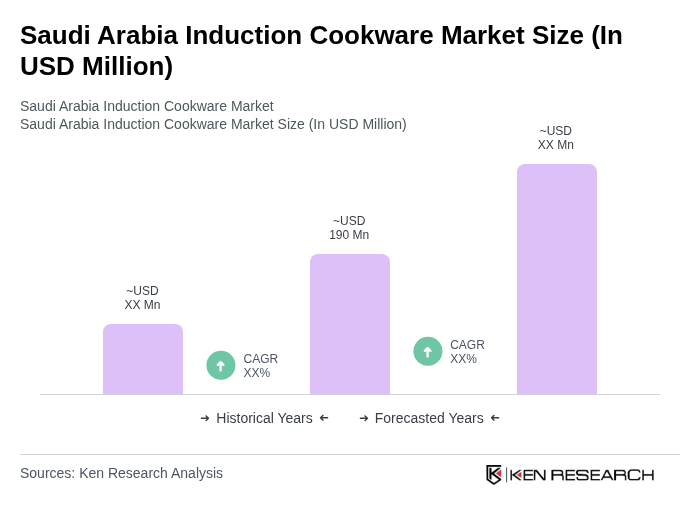
- The Saudi Arabia Induction Cookware Market is valued at USD 190 million, based on a five?year analysis of the kingdom’s broader kitchenware and cookware spending and the share of induction?compatible products within this category. Market growth is driven by rapid urbanization, increasing fuel and electricity costs, and a rising preference for energy?efficient and safe cooking solutions, which make induction cookware an appealing alternative to traditional options. The trend toward modular kitchens, higher disposable incomes, and the expanding working population further support rising demand for convenient, modern kitchenware, especially induction?ready stainless steel and non?stick lines promoted by leading brands.
- Key players in this market include Tefal, IKEA, Al-Dar Kitchenware, and Home Centre, whose innovation and wide?reaching offline and online distribution help shape the market dynamics in Saudi Arabia. Urban hubs such as Riyadh and Jeddah dominate the market due to higher urban incomes, modern lifestyles, and the expansion of the hospitality and foodservice sector, which boosts demand for high?quality, induction?compatible cookware across hotels, restaurants, and catering services.
- A relevant government initiative involves updated technical regulations under SASO 2862:2023, the Saudi Standard, Metrology and Quality Organization (SASO) Technical Regulation for Kitchenware, which mandates detailed safety, material composition, labeling, and traceability requirements for food?contact articles and cookware placed on the Saudi market, including induction?compatible products. The regulation specifies conformity assessment procedures, Arabic labeling and traceability obligations, and compliance with limits for hazardous substances and migration into food, thereby raising product quality benchmarks and influencing both domestic manufacturing and imports.
Saudi Arabia Induction Cookware Market Segmentation
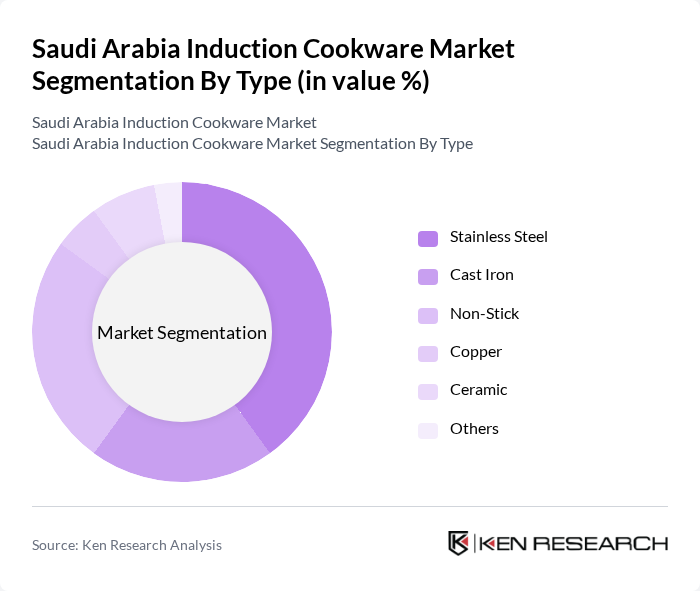
By Type:The induction cookware market is segmented into various types, including stainless steel, cast iron, non-stick, copper, ceramic, and others. Stainless steel cookware is widely used due to its durability, resistance to corrosion, and good compatibility with induction cooktops when made with ferromagnetic bases, and stainless steel is also cited among the leading materials in Saudi kitchenware demand. Non?stick cookware is gaining traction as consumers seek convenience, easy cleaning, and lower?oil cooking, in line with broader market trends toward non?stick and multifunctional cookware. Demand for cast iron and ceramic cookware is also growing as health?conscious consumers look for durable, long?lasting materials and options marketed as free from certain chemical coatings, mirroring global preferences for premium and healthier?perceived cookware materials.
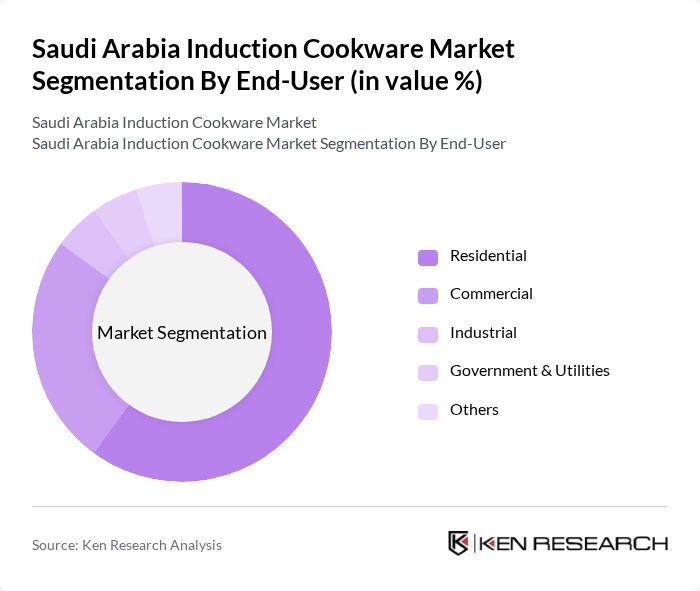
By End-User:The market is segmented by end-user into residential, commercial, industrial, government & utilities, and others. The residential segment dominates the market as more households invest in modern kitchenware and adopt induction and energy?efficient cooking solutions, supported by rising disposable income, urban apartment living, and growing interest in home cooking and meal prep. The commercial segment is also significant, driven by the expanding number of hotels, restaurants, cafés, and catering services under Saudi Arabia’s tourism and hospitality push, which prefer durable, fast?heating, and easy?to?clean induction?compatible cookware to improve kitchen throughput and energy management. The industrial and institutional segments remain smaller but are gradually adopting modern cooking technologies and standardized food?service equipment for staff canteens, large?scale kitchens, and government facilities.
Saudi Arabia Induction Cookware Market Competitive Landscape
The Saudi Arabia Induction Cookware Market is characterized by a dynamic mix of regional and international players. Leading participants such as Tefal, Philips, Cuisinart, Prestige, Zojirushi, Fagor, Black+Decker, Kenwood, Hamilton Beach, Breville, Cook's Essentials, Cuisipro, All-Clad, Scanpan, and Rachael Ray contribute to innovation, geographic expansion, and service delivery in this space.
Saudi Arabia Induction Cookware Market Industry Analysis
Growth Drivers
- Non-oil GDP Growth & Economic Diversification:In future, Saudi Arabia's non-oil GDP is projected to grow by 4.5 percent, contributing to an overall real GDP growth of 2.0 percent. This growth is driven by sectors such as retail and hospitality, which are essential for increasing consumer demand. As urbanization progresses, the rising disposable income supports the purchase of durable goods, including induction cookware, reflecting a shift towards modern cooking solutions.
- Digital Economy Expansion:The digital economy in Saudi Arabia reached SAR 495 billion (approximately USD 132 billion) in future, with the ICT market exceeding USD 48 billion. Investments in AI and data centers totaled SAR 55 billion, enhancing digital infrastructure. This robust digital landscape facilitates e-commerce and online marketing, making advanced induction cookware more accessible to consumers, thus driving market growth.
- Rising Disposable Incomes and Urban Income Disparities:The average monthly disposable income in Riyadh households is approximately 26,000 SAR (around USD 6,933), significantly higher than in rural areas like Najran. This disparity indicates that urban consumers have greater purchasing power, which is likely to increase demand for premium kitchen appliances, including induction cookware, as they seek energy-efficient and modern cooking solutions.
Market Challenges
- Regional Income Disparities and Under-served Areas:The stark contrast in disposable income levels, with Riyadh households earning 26,000 SAR monthly compared to much lower figures in rural regions, poses a challenge. This income disparity limits the penetration of premium induction cookware in less affluent areas, as consumers may prioritize essential goods over higher-end kitchen appliances, affecting overall market growth.
- Debt Reliance for Megaproject Funding:In early future, the Saudi government issued USD 12 billion in bonds, reflecting a reliance on debt to finance megaprojects. With Public Investment Fund (PIF) cash reserves dropping to USD 15 billion, this fiscal pressure may restrict discretionary consumer spending. Consequently, it could delay the adoption of energy-efficient appliances like induction cookware, impacting market dynamics negatively.
Saudi Arabia Induction Cookware Market Future Outlook
The future of the Saudi Arabia induction cookware market appears promising, driven by the expanding digital infrastructure and increasing consumer awareness of energy-efficient appliances. As urbanization continues and disposable incomes rise, the demand for modern kitchen solutions is expected to grow. Additionally, the integration of smart technology into cookware aligns with consumer preferences for convenience and sustainability, further enhancing market potential in the coming years.
Market Opportunities
- Premium Urban Markets (Riyadh, Jeddah):Targeting affluent urban consumers in cities like Riyadh, where households average 26,000 SAR monthly in disposable income, presents a significant opportunity. Focusing on premium induction cookware can yield high margins, catering to the growing demand for quality kitchen appliances among wealthier demographics.
- Smart Appliance Integration:With the digital economy valued at SAR 495 billion and extensive fiber-optic coverage, there is a substantial opportunity to develop connected induction cookware. Integrating smart technology into these appliances can enhance user experience and align with the growing trend of smart home ecosystems, appealing to tech-savvy consumers.
Scope of the Report
| Segment | Sub-Segments |
|---|---|
| By Type | Stainless Steel Cast Iron Non-Stick Copper Ceramic Others |
| By End-User | Residential Commercial Industrial Government & Utilities Others |
| By Material | Aluminum Stainless Steel Glass Others |
| By Brand | Local Brands International Brands Premium Brands Budget Brands |
| By Distribution Channel | Online Retail Offline Retail Direct Sales Others |
| By Price Range | Low Price Mid Price High Price Others |
| By Application | Home Cooking Professional Cooking Catering Services Others |
Key Target Audience
Investors and Venture Capitalist Firms
Government and Regulatory Bodies (e.g., Saudi Standards, Metrology and Quality Organization)
Manufacturers and Producers
Distributors and Retailers
Importers and Exporters
Home Appliance Retail Chains
Industry Associations (e.g., Saudi Arabian General Investment Authority)
Financial Institutions
Players Mentioned in the Report:
Tefal
Philips
Cuisinart
Prestige
Zojirushi
Fagor
Black+Decker
Kenwood
Hamilton Beach
Breville
Cook's Essentials
Cuisipro
All-Clad
Scanpan
Rachael Ray
Table of Contents
Market Assessment Phase
1. Executive Summary and Approach
2. Saudi Arabia Induction Cookware Market Overview
2.1 Key Insights and Strategic Recommendations
2.2 Saudi Arabia Induction Cookware Market Overview
2.3 Definition and Scope
2.4 Evolution of Market Ecosystem
2.5 Timeline of Key Regulatory Milestones
2.6 Value Chain & Stakeholder Mapping
2.7 Business Cycle Analysis
2.8 Policy & Incentive Landscape
3. Saudi Arabia Induction Cookware Market Analysis
3.1 Growth Drivers
3.1.1 Increasing consumer preference for energy-efficient cooking solutions
3.1.2 Rising disposable income and urbanization
3.1.3 Growing awareness of health and safety standards
3.1.4 Expansion of the retail sector and e-commerce platforms
3.2 Market Challenges
3.2.1 High initial cost of induction cookware
3.2.2 Limited consumer awareness about induction cooking
3.2.3 Competition from traditional cooking methods
3.2.4 Supply chain disruptions affecting availability
3.3 Market Opportunities
3.3.1 Introduction of innovative and smart cookware
3.3.2 Expansion into untapped rural markets
3.3.3 Collaborations with local chefs and influencers
3.3.4 Government initiatives promoting energy-efficient appliances
3.4 Market Trends
3.4.1 Increasing demand for eco-friendly materials
3.4.2 Rise in online shopping for kitchen appliances
3.4.3 Customization and personalization of cookware
3.4.4 Integration of smart technology in cookware
3.5 Government Regulation
3.5.1 Standards for energy efficiency in cookware
3.5.2 Import regulations for induction cookware
3.5.3 Safety certifications required for cookware
3.5.4 Incentives for manufacturers adopting sustainable practices
4. SWOT Analysis
5. Stakeholder Analysis
6. Porter's Five Forces Analysis
7. Saudi Arabia Induction Cookware Market Market Size, 2019-2024
7.1 By Value
7.2 By Volume
7.3 By Average Selling Price
8. Saudi Arabia Induction Cookware Market Segmentation
8.1 By Type
8.1.1 Stainless Steel
8.1.2 Cast Iron
8.1.3 Non-Stick
8.1.4 Copper
8.1.5 Ceramic
8.1.6 Others
8.2 By End-User
8.2.1 Residential
8.2.2 Commercial
8.2.3 Industrial
8.2.4 Government & Utilities
8.2.5 Others
8.3 By Material
8.3.1 Aluminum
8.3.2 Stainless Steel
8.3.3 Glass
8.3.4 Others
8.4 By Brand
8.4.1 Local Brands
8.4.2 International Brands
8.4.3 Premium Brands
8.4.4 Budget Brands
8.5 By Distribution Channel
8.5.1 Online Retail
8.5.2 Offline Retail
8.5.3 Direct Sales
8.5.4 Others
8.6 By Price Range
8.6.1 Low Price
8.6.2 Mid Price
8.6.3 High Price
8.6.4 Others
8.7 By Application
8.7.1 Home Cooking
8.7.2 Professional Cooking
8.7.3 Catering Services
8.7.4 Others
9. Saudi Arabia Induction Cookware Market Competitive Analysis
9.1 Market Share of Key Players
9.2 Cross Comparison of Key Players
9.2.1 Company Name
9.2.2 Group Size (Large, Medium, or Small as per industry convention)
9.2.3 Revenue Growth Rate
9.2.4 Market Penetration Rate
9.2.5 Customer Retention Rate
9.2.6 Pricing Strategy
9.2.7 Product Innovation Rate
9.2.8 Distribution Efficiency
9.2.9 Brand Recognition Score
9.2.10 Customer Satisfaction Index
9.3 SWOT Analysis of Top Players
9.4 Pricing Analysis
9.5 Detailed Profile of Major Companies
9.5.1 Tefal
9.5.2 Philips
9.5.3 Cuisinart
9.5.4 Prestige
9.5.5 Zojirushi
9.5.6 Fagor
9.5.7 Black+Decker
9.5.8 Kenwood
9.5.9 Hamilton Beach
9.5.10 Breville
9.5.11 Cook's Essentials
9.5.12 Cuisipro
9.5.13 All-Clad
9.5.14 Scanpan
9.5.15 Rachael Ray
10. Saudi Arabia Induction Cookware Market End-User Analysis
10.1 Procurement Behavior of Key Ministries
10.1.1 Budget Allocation for Kitchen Equipment
10.1.2 Preference for Local vs. International Brands
10.1.3 Evaluation Criteria for Procurement
10.1.4 Frequency of Procurement Cycles
10.2 Corporate Spend on Infrastructure & Energy
10.2.1 Investment in Energy-Efficient Appliances
10.2.2 Budget for Kitchen Renovations
10.2.3 Spending on Employee Welfare Programs
10.2.4 Trends in Corporate Gifting of Cookware
10.3 Pain Point Analysis by End-User Category
10.3.1 Quality Concerns
10.3.2 Availability of Spare Parts
10.3.3 Customer Service Issues
10.3.4 Price Sensitivity
10.4 User Readiness for Adoption
10.4.1 Awareness of Induction Cooking Benefits
10.4.2 Training Needs for Users
10.4.3 Availability of Compatible Cookware
10.4.4 User Feedback Mechanisms
10.5 Post-Deployment ROI and Use Case Expansion
10.5.1 Measurement of Energy Savings
10.5.2 User Satisfaction Surveys
10.5.3 Opportunities for Upselling
10.5.4 Case Studies of Successful Implementations
11. Saudi Arabia Induction Cookware Market Future Size, 2025-2030
11.1 By Value
11.2 By Volume
11.3 By Average Selling Price
Go-To-Market Strategy Phase
1. Whitespace Analysis + Business Model Canvas
1.1 Market Gaps Identification
1.2 Value Proposition Development
1.3 Revenue Streams Analysis
1.4 Cost Structure Evaluation
1.5 Key Partnerships Exploration
1.6 Customer Segments Definition
1.7 Channels Strategy
2. Marketing and Positioning Recommendations
2.1 Branding Strategies
2.2 Product USPs
3. Distribution Plan
3.1 Urban Retail vs Rural NGO Tie-ups
4. Channel & Pricing Gaps
4.1 Underserved Routes
4.2 Pricing Bands
5. Unmet Demand & Latent Needs
5.1 Category Gaps
5.2 Consumer Segments
6. Customer Relationship
6.1 Loyalty Programs
6.2 After-sales Service
7. Value Proposition
7.1 Sustainability
7.2 Integrated Supply Chains
8. Key Activities
8.1 Regulatory Compliance
8.2 Branding
8.3 Distribution Setup
9. Entry Strategy Evaluation
9.1 Domestic Market Entry Strategy
9.1.1 Product Mix
9.1.2 Pricing Band
9.1.3 Packaging
9.2 Export Entry Strategy
9.2.1 Target Countries
9.2.2 Compliance Roadmap
10. Entry Mode Assessment
10.1 JV
10.2 Greenfield
10.3 M&A
10.4 Distributor Model
11. Capital and Timeline Estimation
11.1 Capital Requirements
11.2 Timelines
12. Control vs Risk Trade-Off
12.1 Ownership vs Partnerships
13. Profitability Outlook
13.1 Breakeven Analysis
13.2 Long-term Sustainability
14. Potential Partner List
14.1 Distributors
14.2 JVs
14.3 Acquisition Targets
15. Execution Roadmap
15.1 Phased Plan for Market Entry
15.1.1 Market Setup
15.1.2 Market Entry
15.1.3 Growth Acceleration
15.1.4 Scale & Stabilize
15.2 Key Activities and Milestones
15.2.1 Milestone Planning
15.2.2 Activity Tracking
Research Methodology
Phase 1: Approach1
Desk Research
- Analysis of market reports from industry associations and government publications on cookware trends in Saudi Arabia
- Review of import/export data and trade statistics related to induction cookware
- Examination of consumer behavior studies and market surveys focusing on kitchen appliances in the region
Primary Research
- Interviews with key stakeholders including manufacturers, distributors, and retailers of induction cookware
- Surveys targeting consumers to understand preferences, purchasing behavior, and brand perception
- Focus group discussions with culinary experts and home chefs to gather insights on product features and usability
Validation & Triangulation
- Cross-validation of findings through comparison with historical sales data and market growth rates
- Triangulation of insights from primary interviews with secondary data sources to ensure consistency
- Sanity checks conducted through expert panel reviews to validate assumptions and projections
Phase 2: Market Size Estimation1
Top-down Assessment
- Estimation of the total market size based on national kitchen appliance sales and growth trends
- Segmentation of the market by product type, including various materials and features of induction cookware
- Incorporation of demographic data to assess potential market penetration among different consumer segments
Bottom-up Modeling
- Collection of sales data from major retailers and e-commerce platforms to establish baseline figures
- Estimation of average selling prices and volume sold across different distribution channels
- Analysis of consumer spending patterns on kitchen appliances to derive potential market size
Forecasting & Scenario Analysis
- Development of forecasting models based on historical growth rates and market trends
- Scenario analysis considering factors such as economic conditions, consumer preferences, and technological advancements
- Creation of multiple projections (baseline, optimistic, and pessimistic) to account for market volatility
Phase 3: CATI Sample Composition1
| Scope Item/Segment | Sample Size | Target Respondent Profiles |
|---|---|---|
| Retail Market Insights | 150 | Store Managers, Category Buyers |
| Consumer Preferences Survey | 120 | Homeowners, Cooking Enthusiasts |
| Distribution Channel Analysis | 100 | Wholesalers, Distributors |
| Product Feature Evaluation | 80 | Culinary Experts, Product Designers |
| Market Trend Assessment | 120 | Market Analysts, Industry Experts |
Frequently Asked Questions
What is the current value of the Saudi Arabia Induction Cookware Market?
The Saudi Arabia Induction Cookware Market is valued at approximately USD 190 million, reflecting a growing trend towards energy-efficient cooking solutions and modern kitchenware among consumers in the region.
What factors are driving the growth of the induction cookware market in Saudi Arabia?
Which types of induction cookware are most popular in Saudi Arabia?
Who are the major players in the Saudi Arabia Induction Cookware Market?
Other Regional/Country Reports
Indonesia Induction Cookware Market
Malaysia Induction Cookware Market
KSA Induction Cookware Market
APAC Induction Cookware Market
SEA Induction Cookware Market
Other Adjacent Reports
Singapore Kitchen Appliance Market
Middle East home appliance market size, share, growth drivers, trends, opportunities & forecast 2025–2030Qatar Smart Home Technology MarketBahrain Energy-Efficient Appliance Market
Saudi Arabia Cookware Market Report Size Share Growth Drivers Trends Opportunities & Forecast 2025–2030KSA Tableware MarketIndonesia Hospitality Equipment Market
Mexico Foodservice Equipment Market
Oman Retail Kitchenware Market
India E-commerce MarketWhy Buy From Us?

What makes us stand out is that our consultants follow Robust, Refine and Result (RRR) methodology. Robust for clear definitions, approaches and sanity checking, Refine for differentiating respondents' facts and opinions, and Result for presenting data with story.

We have set a benchmark in the industry by offering our clients with syndicated and customized market research reports featuring coverage of entire market as well as meticulous research and analyst insights.

While we don't replace traditional research, we flip the method upside down. Our dual approach of Top Bottom & Bottom Top ensures quality deliverable by not just verifying company fundamentals but also looking at the sector and macroeconomic factors.

With one step in the future, our research team constantly tries to show you the bigger picture. We help with some of the tough questions you may encounter along the way: How is the industry positioned? Best marketing channel? KPI's of competitors? By aligning every element, we help maximize success.

Our report gives you instant access to the answers and sources that other companies might choose to hide. We elaborate each steps of research methodology we have used and showcase you the sample size to earn your trust.

If you need any support, we are here! We pride ourselves on universe strength, data quality, and quick, friendly, and professional service.