About the Report
Base Year 2024US Smoke Detector Market Overview
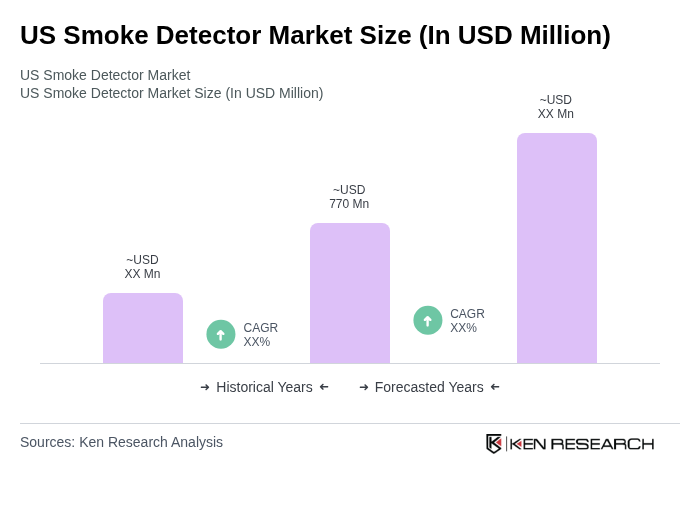
- The US Smoke Detector Market is valued at USD 770 million, driven by increasing safety regulations, rising awareness of fire safety, and ongoing technological advancements in smoke detection systems. The market continues to see robust demand across both residential and commercial applications, with innovations such as smart smoke detectors and IoT-enabled devices gaining traction among consumers. Growth is further supported by integration with smart home platforms and the adoption of AI-driven detection technologies, which enhance accuracy and reduce false alarms .
- Key cities dominating the market include New York, Los Angeles, and Chicago, primarily due to their high population density and stringent building codes that mandate smoke detector installations. These urban centers also have a higher concentration of commercial establishments, which further drives the demand for advanced smoke detection solutions .
- The National Fire Alarm and Signaling Code (NFPA 72), issued by the National Fire Protection Association and adopted in various forms by state and local authorities, mandates the installation of smoke detectors in all new residential buildings and major renovations. The code outlines requirements for placement, interconnection, and maintenance of smoke alarms, significantly impacting market demand and enhancing fire safety standards across the United States .
US Smoke Detector Market Segmentation
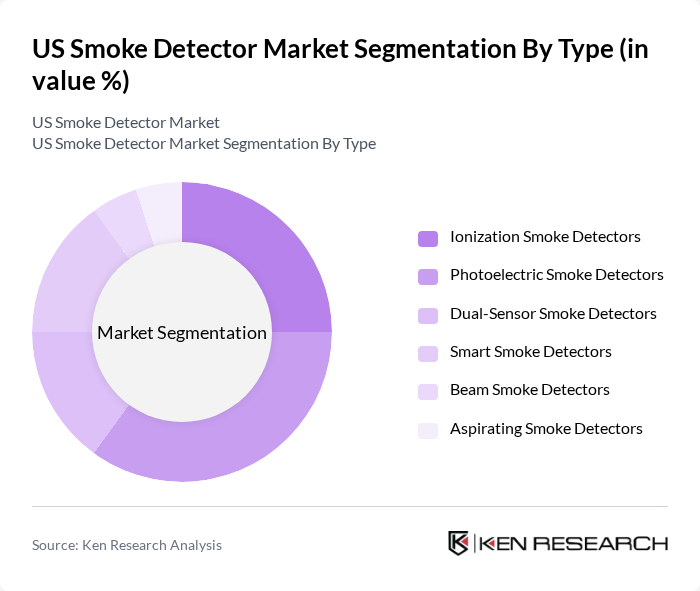
By Type:The market is segmented into Ionization Smoke Detectors, Photoelectric Smoke Detectors, Dual-Sensor Smoke Detectors, Smart Smoke Detectors, Beam Smoke Detectors, and Aspirating Smoke Detectors. Among these, Photoelectric Smoke Detectors hold the largest share due to their superior performance in detecting smoldering fires, which are prevalent in residential environments. The adoption of Smart Smoke Detectors is accelerating, driven by consumer demand for connectivity, integration with home automation systems, and real-time alerts via mobile applications. These trends are reinforced by the increasing availability of AI-powered and IoT-enabled smoke detection solutions .
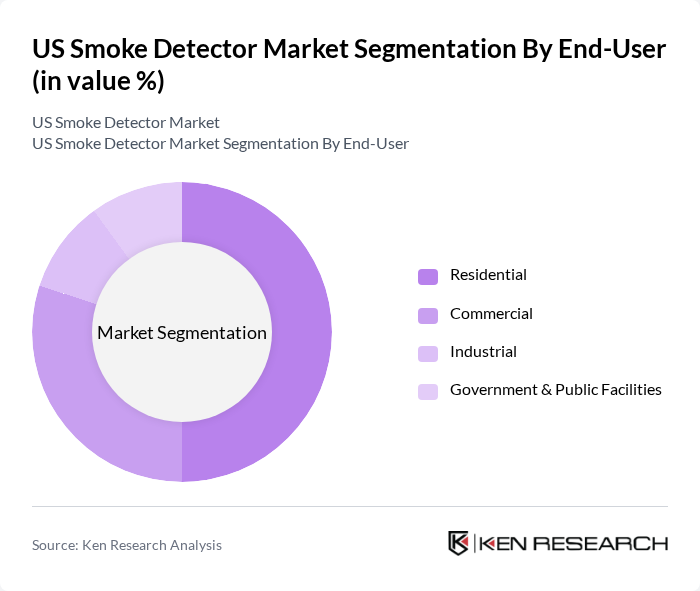
By End-User:The smoke detector market is segmented by end-user into Residential, Commercial, Industrial, and Government & Public Facilities. The Residential segment leads the market, driven by heightened fire safety awareness among homeowners and the proliferation of smart home technologies. The Commercial segment is also significant, propelled by regulatory compliance requirements and the need for advanced safety systems in office buildings, retail, and hospitality. Industrial facilities are increasingly adopting sophisticated smoke detection solutions to protect assets and ensure worker safety, while Government & Public Facilities maintain steady demand due to mandatory safety standards .
US Smoke Detector Market Competitive Landscape
The US Smoke Detector Market is characterized by a dynamic mix of regional and international players. Leading participants such as Kidde (Carrier Global Corporation), First Alert (Resideo Technologies Inc.), Nest Labs (Google LLC), Honeywell International Inc., BRK Brands, Inc. (Resideo Technologies Inc.), Siemens AG, Johnson Controls International plc, Bosch Security Systems (Robert Bosch GmbH), System Sensor (Honeywell International Inc.), FireAngel Safety Technology Group plc, X-Sense, Amcrest Technologies, Hochiki America Corporation, Mircom Group of Companies, Apollo Fire Detectors Ltd. (Halma plc) contribute to innovation, geographic expansion, and service delivery in this space.
US Smoke Detector Market Industry Analysis
Growth Drivers
- Increasing Awareness of Fire Safety:The US has seen a significant rise in fire safety awareness, with over 3,000 fire-related fatalities reported annually, according to the National Fire Protection Association (NFPA). This alarming statistic has prompted both consumers and businesses to prioritize fire safety measures, including smoke detectors. In future, the US fire department responded to approximately 1.4 million fires, further emphasizing the need for effective smoke detection systems in residential and commercial properties.
- Technological Advancements in Smoke Detection:The smoke detector market is benefiting from rapid technological advancements, with the introduction of smart smoke detectors projected to reach 15 million units sold in future. These devices offer features such as smartphone connectivity and real-time alerts, enhancing user safety. The integration of artificial intelligence in smoke detection technology is also expected to improve response times and accuracy, making these devices more appealing to consumers and driving market growth.
- Stringent Government Regulations:Government regulations play a crucial role in the smoke detector market, with the NFPA mandating smoke detector installation in all residential properties. In future, approximately 90% of homes in the US are expected to comply with these regulations, leading to increased demand for smoke detectors. Additionally, state-specific laws are enforcing stricter compliance, further driving the market as homeowners seek to meet legal requirements and enhance safety measures.
Market Challenges
- High Installation Costs:The initial installation costs for smoke detectors can be a significant barrier for many consumers. In future, the average cost of installing a smoke detector system in a residential property is estimated to be around $300 to $500, depending on the complexity of the system. This financial burden can deter homeowners from upgrading their safety measures, particularly in lower-income households, limiting market growth potential.
- Lack of Consumer Awareness:Despite the importance of smoke detectors, a considerable portion of the population remains unaware of their benefits. In future, surveys indicate that nearly 40% of homeowners do not have a smoke detector installed, primarily due to a lack of understanding of fire risks. This gap in consumer knowledge poses a challenge for market penetration, as manufacturers must invest in educational campaigns to raise awareness and drive sales.
US Smoke Detector Market Future Outlook
The US smoke detector market is poised for significant growth as technological innovations and heightened safety awareness converge. With the increasing integration of smart technology and IoT capabilities, consumers are expected to favor advanced smoke detection systems. Additionally, government initiatives aimed at enhancing fire safety standards will likely drive further adoption. As the market evolves, manufacturers will need to focus on affordability and consumer education to overcome existing challenges and capitalize on emerging opportunities.
Market Opportunities
- Expansion into Emerging Markets:The potential for market expansion into emerging regions is significant, with an estimated 25% of households in these areas lacking basic fire safety measures. By targeting these markets, companies can tap into a growing consumer base eager for affordable smoke detection solutions, thereby increasing overall market penetration and revenue.
- Development of IoT-Enabled Smoke Detectors:The rise of smart home technology presents a lucrative opportunity for manufacturers to develop IoT-enabled smoke detectors. Projections indicate that smart home device sales will exceed 100 million units in future, integrating smoke detectors into this ecosystem can enhance user experience and safety, driving demand and fostering brand loyalty.
Scope of the Report
| Segment | Sub-Segments |
|---|---|
| By Type | Ionization Smoke Detectors Photoelectric Smoke Detectors Dual-Sensor Smoke Detectors Smart Smoke Detectors Beam Smoke Detectors Aspirating Smoke Detectors |
| By End-User | Residential Commercial Industrial Government & Public Facilities |
| By Installation Type | Hardwired Smoke Detectors Battery-Operated Smoke Detectors Wireless Smoke Detectors Combination Units |
| By Distribution Channel | Online Retail Offline Retail Direct Sales |
| By Region | Northeast Midwest South West |
| By Technology | Conventional Smoke Detectors Smart Smoke Detectors Wireless Smoke Detectors Dual-Sensor Smoke Detectors Photoelectric Smoke Detectors Ionization Smoke Detectors Beam Smoke Detectors Aspirating Smoke Detectors |
| By Application | Home Safety Commercial Safety Industrial Safety Public Facility Safety |
Key Target Audience
Investors and Venture Capitalist Firms
Government and Regulatory Bodies (e.g., U.S. Consumer Product Safety Commission, National Fire Protection Association)
Manufacturers and Producers
Distributors and Retailers
Fire Safety Equipment Suppliers
Insurance Companies
Building and Construction Firms
Fire Departments and Emergency Services
Players Mentioned in the Report:
Kidde (Carrier Global Corporation)
First Alert (Resideo Technologies Inc.)
Nest Labs (Google LLC)
Honeywell International Inc.
BRK Brands, Inc. (Resideo Technologies Inc.)
Siemens AG
Johnson Controls International plc
Bosch Security Systems (Robert Bosch GmbH)
System Sensor (Honeywell International Inc.)
FireAngel Safety Technology Group plc
X-Sense
Amcrest Technologies
Hochiki America Corporation
Mircom Group of Companies
Apollo Fire Detectors Ltd. (Halma plc)
Table of Contents
Market Assessment Phase
1. Executive Summary and Approach
2. US Smoke Detector Market Overview
2.1 Key Insights and Strategic Recommendations
2.2 US Smoke Detector Market Overview
2.3 Definition and Scope
2.4 Evolution of Market Ecosystem
2.5 Timeline of Key Regulatory Milestones
2.6 Value Chain & Stakeholder Mapping
2.7 Business Cycle Analysis
2.8 Policy & Incentive Landscape
3. US Smoke Detector Market Analysis
3.1 Growth Drivers
3.1.1 Increasing awareness of fire safety
3.1.2 Technological advancements in smoke detection
3.1.3 Stringent government regulations
3.1.4 Rising demand for smart home devices
3.2 Market Challenges
3.2.1 High installation costs
3.2.2 Lack of consumer awareness
3.2.3 Competition from alternative safety devices
3.2.4 Regulatory compliance complexities
3.3 Market Opportunities
3.3.1 Expansion into emerging markets
3.3.2 Development of IoT-enabled smoke detectors
3.3.3 Partnerships with home automation companies
3.3.4 Government incentives for safety upgrades
3.4 Market Trends
3.4.1 Shift towards wireless smoke detectors
3.4.2 Integration with home security systems
3.4.3 Increased focus on sustainability
3.4.4 Growth in DIY installation options
3.5 Government Regulation
3.5.1 National Fire Protection Association (NFPA) standards
3.5.2 Underwriters Laboratories (UL) certification requirements
3.5.3 State-specific smoke detector laws
3.5.4 Building code requirements for residential properties
4. SWOT Analysis
5. Stakeholder Analysis
6. Porter's Five Forces Analysis
7. US Smoke Detector Market Market Size, 2019-2024
7.1 By Value
7.2 By Volume
7.3 By Average Selling Price
8. US Smoke Detector Market Segmentation
8.1 By Type
8.1.1 Ionization Smoke Detectors
8.1.2 Photoelectric Smoke Detectors
8.1.3 Dual-Sensor Smoke Detectors
8.1.4 Smart Smoke Detectors
8.1.5 Beam Smoke Detectors
8.1.6 Aspirating Smoke Detectors
8.2 By End-User
8.2.1 Residential
8.2.2 Commercial
8.2.3 Industrial
8.2.4 Government & Public Facilities
8.3 By Installation Type
8.3.1 Hardwired Smoke Detectors
8.3.2 Battery-Operated Smoke Detectors
8.3.3 Wireless Smoke Detectors
8.3.4 Combination Units
8.4 By Distribution Channel
8.4.1 Online Retail
8.4.2 Offline Retail
8.4.3 Direct Sales
8.5 By Region
8.5.1 Northeast
8.5.2 Midwest
8.5.3 South
8.5.4 West
8.6 By Technology
8.6.1 Conventional Smoke Detectors
8.6.2 Smart Smoke Detectors
8.6.3 Wireless Smoke Detectors
8.6.4 Dual-Sensor Smoke Detectors
8.6.5 Photoelectric Smoke Detectors
8.6.6 Ionization Smoke Detectors
8.6.7 Beam Smoke Detectors
8.6.8 Aspirating Smoke Detectors
8.7 By Application
8.7.1 Home Safety
8.7.2 Commercial Safety
8.7.3 Industrial Safety
8.7.4 Public Facility Safety
9. US Smoke Detector Market Competitive Analysis
9.1 Market Share of Key Players
9.2 Cross Comparison of Key Players
9.2.1 Company Name
9.2.2 Group Size (Large, Medium, or Small as per industry convention)
9.2.3 US Revenue Growth Rate
9.2.4 US Market Share
9.2.5 Product Portfolio Breadth
9.2.6 R&D Investment Ratio
9.2.7 Smart Detector Penetration Rate
9.2.8 Distribution Channel Coverage
9.2.9 Regulatory Compliance Score (NFPA/UL)
9.2.10 Customer Satisfaction Index
9.3 SWOT Analysis of Top Players
9.4 Pricing Analysis
9.5 Detailed Profile of Major Companies
9.5.1 Kidde (Carrier Global Corporation)
9.5.2 First Alert (Resideo Technologies Inc.)
9.5.3 Nest Labs (Google LLC)
9.5.4 Honeywell International Inc.
9.5.5 BRK Brands, Inc. (Resideo Technologies Inc.)
9.5.6 Siemens AG
9.5.7 Johnson Controls International plc
9.5.8 Bosch Security Systems (Robert Bosch GmbH)
9.5.9 System Sensor (Honeywell International Inc.)
9.5.10 FireAngel Safety Technology Group plc
9.5.11 X-Sense
9.5.12 Amcrest Technologies
9.5.13 Hochiki America Corporation
9.5.14 Mircom Group of Companies
9.5.15 Apollo Fire Detectors Ltd. (Halma plc)
10. US Smoke Detector Market End-User Analysis
10.1 Procurement Behavior of Key Ministries
10.1.1 Government procurement policies
10.1.2 Budget allocation for safety equipment
10.1.3 Evaluation criteria for smoke detectors
10.1.4 Supplier selection process
10.2 Corporate Spend on Infrastructure & Energy
10.2.1 Investment in safety upgrades
10.2.2 Budget trends for smoke detection systems
10.2.3 Corporate responsibility initiatives
10.2.4 Energy efficiency considerations
10.3 Pain Point Analysis by End-User Category
10.3.1 Residential user concerns
10.3.2 Commercial user challenges
10.3.3 Industrial user requirements
10.3.4 Government user expectations
10.4 User Readiness for Adoption
10.4.1 Awareness of smoke detector benefits
10.4.2 Willingness to invest in safety
10.4.3 Adoption of smart technologies
10.4.4 Training and education needs
10.5 Post-Deployment ROI and Use Case Expansion
10.5.1 Cost savings from fire prevention
10.5.2 User satisfaction and feedback
10.5.3 Opportunities for system upgrades
10.5.4 Expansion into new applications
11. US Smoke Detector Market Future Size, 2025-2030
11.1 By Value
11.2 By Volume
11.3 By Average Selling Price
Go-To-Market Strategy Phase
1. Whitespace Analysis + Business Model Canvas
1.1 Market gaps identification
1.2 Business model development
2. Marketing and Positioning Recommendations
2.1 Branding strategies
2.2 Product USPs
3. Distribution Plan
3.1 Urban retail vs rural NGO tie-ups
4. Channel & Pricing Gaps
4.1 Underserved routes
4.2 Pricing bands
5. Unmet Demand & Latent Needs
5.1 Category gaps
5.2 Consumer segments
6. Customer Relationship
6.1 Loyalty programs
6.2 After-sales service
7. Value Proposition
7.1 Sustainability
7.2 Integrated supply chains
8. Key Activities
8.1 Regulatory compliance
8.2 Branding
8.3 Distribution setup
9. Entry Strategy Evaluation
9.1 Domestic Market Entry Strategy
9.1.1 Product mix
9.1.2 Pricing band
9.1.3 Packaging
9.2 Export Entry Strategy
9.2.1 Target countries
9.2.2 Compliance roadmap
10. Entry Mode Assessment
10.1 JV
10.2 Greenfield
10.3 M&A
10.4 Distributor Model
11. Capital and Timeline Estimation
11.1 Capital requirements
11.2 Timelines
12. Control vs Risk Trade-Off
12.1 Ownership vs Partnerships
13. Profitability Outlook
13.1 Breakeven analysis
13.2 Long-term sustainability
14. Potential Partner List
14.1 Distributors
14.2 JVs
14.3 Acquisition targets
15. Execution Roadmap
15.1 Phased Plan for Market Entry
15.1.1 Market Setup
15.1.2 Market Entry
15.1.3 Growth Acceleration
15.1.4 Scale & Stabilize
15.2 Key Activities and Milestones
15.2.1 Activity timelines
15.2.2 Milestone tracking
Research Methodology
Phase 1: Approach1
Desk Research
- Analysis of industry reports from the National Fire Protection Association (NFPA) and other relevant organizations
- Review of market data from government publications and safety regulations related to smoke detectors
- Examination of consumer behavior studies and trends in home safety products
Primary Research
- Interviews with product managers at leading smoke detector manufacturers
- Surveys with home improvement retailers and distributors
- Focus groups with homeowners to understand purchasing decisions and preferences
Validation & Triangulation
- Cross-validation of findings through multiple data sources, including sales data and consumer feedback
- Triangulation of market insights from industry experts and academic research
- Sanity checks through expert panel reviews to ensure data accuracy and relevance
Phase 2: Market Size Estimation1
Top-down Assessment
- Estimation of total market size based on national fire safety regulations and compliance requirements
- Segmentation of the market by product type (ionization, photoelectric, combination) and application (residential, commercial)
- Incorporation of growth trends in smart home technology and its impact on smoke detector sales
Bottom-up Modeling
- Collection of sales data from major retailers and e-commerce platforms
- Estimation of average selling prices and volume sold across different smoke detector categories
- Analysis of installation rates and replacement cycles in residential and commercial sectors
Forecasting & Scenario Analysis
- Multi-factor regression analysis incorporating factors such as housing market trends and fire safety awareness campaigns
- Scenario modeling based on potential regulatory changes and technological advancements in smoke detection
- Development of baseline, optimistic, and pessimistic forecasts through 2030
Phase 3: CATI Sample Composition1
| Scope Item/Segment | Sample Size | Target Respondent Profiles |
|---|---|---|
| Residential Smoke Detector Purchases | 100 | Homeowners, Property Managers |
| Commercial Fire Safety Compliance | 80 | Facility Managers, Safety Officers |
| Retail Market Insights | 60 | Store Managers, Merchandising Directors |
| Smart Smoke Detector Adoption | 50 | Tech-Savvy Homeowners, Smart Home Installers |
| Consumer Awareness and Preferences | 70 | General Consumers, Safety Advocates |
Frequently Asked Questions
What is the current value of the US Smoke Detector Market?
The US Smoke Detector Market is valued at approximately USD 770 million, driven by increasing safety regulations, heightened fire safety awareness, and technological advancements in smoke detection systems, including smart and IoT-enabled devices.
What are the main types of smoke detectors available in the market?
Which cities are leading in the US Smoke Detector Market?
What regulations impact the installation of smoke detectors in the US?
Other Regional/Country Reports
Indonesia Smoke Detector Market
Malaysia Smoke Detector Market
KSA Smoke Detector Market
APAC Smoke Detector Market
SEA Smoke Detector Market
Vietnam Smoke Detector Market
Other Adjacent Reports
Bahrain Fire Alarm Systems Market
Japan Carbon Monoxide Detectors Market
KSA Smart Home Devices Market
Belgium Home Security Systems Market
Vietnam Fire Suppression Equipment Market
Japan Building Automation Market
Middle East iot sensors market report size, share, growth drivers, trends, opportunities & forecast 2025–2030Kuwait Safety and Emergency Equipment Market
South Africa Residential Fire Safety Market
Vietnam Commercial Fire Protection Market
Why Buy From Us?

What makes us stand out is that our consultants follow Robust, Refine and Result (RRR) methodology. Robust for clear definitions, approaches and sanity checking, Refine for differentiating respondents' facts and opinions, and Result for presenting data with story.

We have set a benchmark in the industry by offering our clients with syndicated and customized market research reports featuring coverage of entire market as well as meticulous research and analyst insights.

While we don't replace traditional research, we flip the method upside down. Our dual approach of Top Bottom & Bottom Top ensures quality deliverable by not just verifying company fundamentals but also looking at the sector and macroeconomic factors.

With one step in the future, our research team constantly tries to show you the bigger picture. We help with some of the tough questions you may encounter along the way: How is the industry positioned? Best marketing channel? KPI's of competitors? By aligning every element, we help maximize success.

Our report gives you instant access to the answers and sources that other companies might choose to hide. We elaborate each steps of research methodology we have used and showcase you the sample size to earn your trust.

If you need any support, we are here! We pride ourselves on universe strength, data quality, and quick, friendly, and professional service.