About the Report
Base Year 2024USA Drone-Based Agriculture Logistics Market Overview
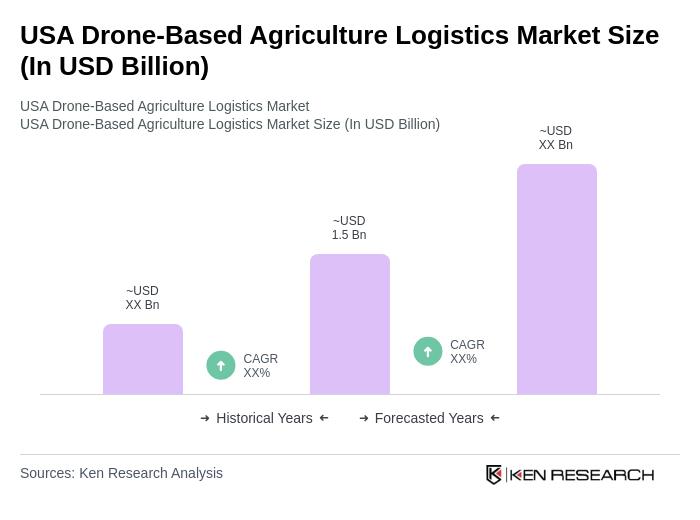
- The USA Drone-Based Agriculture Logistics Market is valued at USD 1.5 billion, based on a five-year historical analysis. This growth is primarily driven by advancements in drone technology, increasing adoption of precision agriculture, and the need for efficient logistics solutions in the agricultural sector. The integration of drones in agriculture has enhanced productivity and reduced operational costs, making them an essential tool for modern farming.
- Key players in this market include California, Texas, and Florida, which dominate due to their large agricultural outputs and favorable regulatory environments. These states have embraced drone technology to optimize crop management and logistics, leading to increased efficiency and yield. The presence of major agricultural companies and research institutions in these regions further supports the growth of the drone-based logistics market.
- In 2023, the Federal Aviation Administration (FAA) implemented new regulations allowing for the commercial use of drones in agriculture without the need for a pilot's license. This regulation aims to streamline the approval process for drone operations in farming, encouraging more farmers to adopt drone technology for tasks such as crop monitoring and pesticide application.
USA Drone-Based Agriculture Logistics Market Segmentation
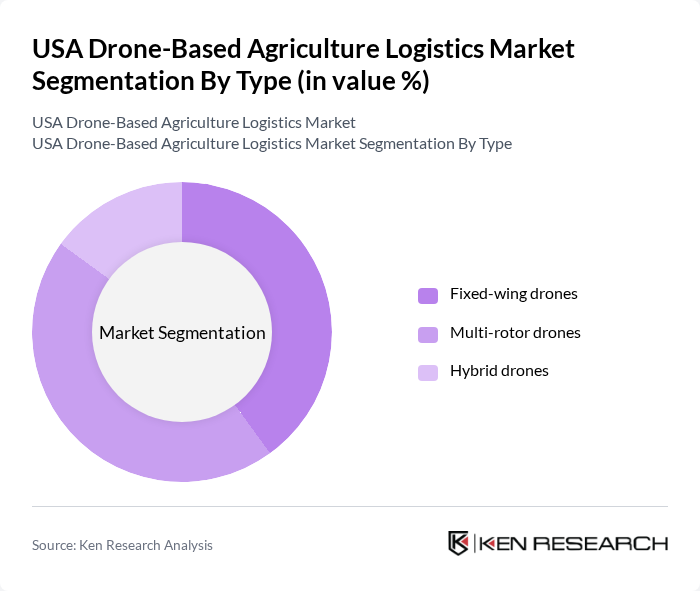
By Type:The market is segmented into three main types of drones: Fixed-wing drones, Multi-rotor drones, and Hybrid drones. Fixed-wing drones are known for their long flight times and ability to cover large areas, making them suitable for extensive agricultural monitoring. Multi-rotor drones are favored for their maneuverability and ease of use, particularly in smaller fields. Hybrid drones combine the advantages of both types, offering versatility in various agricultural applications.
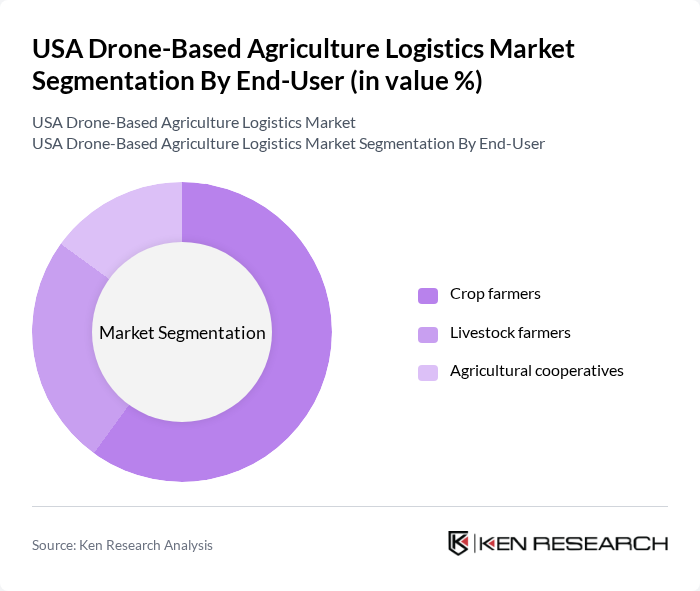
By End-User:The end-user segmentation includes Crop farmers, Livestock farmers, and Agricultural cooperatives. Crop farmers are the largest segment, utilizing drones for crop monitoring, spraying, and data collection to enhance yield. Livestock farmers are increasingly adopting drones for monitoring animal health and managing grazing patterns. Agricultural cooperatives leverage drone technology for collective benefits, optimizing resource use and improving logistics across multiple farms.
USA Drone-Based Agriculture Logistics Market Competitive Landscape
The USA Drone-Based Agriculture Logistics Market is characterized by a dynamic mix of regional and international players. Leading participants such as DJI Technology Inc., PrecisionHawk Inc., AeroVironment Inc., AgEagle Aerial Systems Inc., Parrot Drones S.A., senseFly S.A., Delair Tech S.A.S., Skydio Inc., DroneDeploy Inc., Zipline International Inc., Airinov, Raptor Maps Inc., Trimble Inc., Syngenta AG, Bayer AG contribute to innovation, geographic expansion, and service delivery in this space.
USA Drone-Based Agriculture Logistics Market Industry Analysis
Growth Drivers
- Increasing Demand for Efficient Logistics Solutions:The USA agriculture sector is projected to reach $1.3 trillion in future, driving the need for efficient logistics solutions. With over 2 million farms in the U.S., the demand for streamlined operations is critical. Drones can reduce delivery times by up to 50%, significantly enhancing supply chain efficiency. This efficiency is vital as the agricultural sector faces increasing pressure to meet the food demands of a growing population, expected to reach 335 million in future.
- Advancements in Drone Technology:The drone technology market is anticipated to grow to $48 billion in future, with significant advancements in payload capacity and flight time. Innovations such as improved battery life and enhanced sensors are enabling drones to perform complex agricultural tasks, including crop monitoring and pesticide application. These advancements are crucial as they allow farmers to utilize drones for a wider range of applications, ultimately leading to increased productivity and reduced operational costs.
- Rising Labor Costs in Agriculture:Labor costs in the U.S. agricultural sector have risen by approximately 22% over the past five years, prompting farmers to seek automation solutions. With the average hourly wage for farmworkers reaching $16.50 in future, the financial burden on farmers is significant. Drones offer a cost-effective alternative, allowing for tasks such as planting and monitoring to be performed with minimal human intervention, thereby reducing labor costs and increasing operational efficiency.
Market Challenges
- Regulatory Hurdles and Compliance Issues:The Federal Aviation Administration (FAA) has stringent regulations governing drone operations, which can hinder market growth. As of future, compliance with these regulations requires significant investment in training and technology. Farmers must navigate complex legal frameworks, which can delay the adoption of drone technology. This regulatory environment poses a challenge for farmers looking to integrate drones into their logistics operations effectively.
- High Initial Investment Costs:The initial investment for drone technology can be prohibitive, with costs ranging from $6,000 to $55,000 depending on the drone's capabilities. Many small to medium-sized farms struggle to justify these expenses, especially when margins are tight. This financial barrier limits the widespread adoption of drone technology in agriculture, as farmers weigh the costs against potential benefits, often leading to slower market penetration.
USA Drone-Based Agriculture Logistics Market Future Outlook
The future of the USA drone-based agriculture logistics market appears promising, driven by technological advancements and increasing adoption rates among farmers. As drone technology continues to evolve, we can expect enhanced capabilities, including improved data analytics and autonomous operations. Additionally, the growing emphasis on sustainable farming practices will likely encourage further integration of drones into agricultural logistics, enabling farmers to optimize resource use and reduce environmental impact while meeting the demands of a changing market landscape.
Market Opportunities
- Expansion into Precision Agriculture:The precision agriculture market is projected to reach $15 billion in future, presenting significant opportunities for drone integration. Drones can provide real-time data on crop health, enabling farmers to make informed decisions. This data-driven approach can enhance yield and reduce waste, making it an attractive option for farmers looking to improve efficiency and sustainability.
- Development of Drone Delivery Services:The demand for drone delivery services in agriculture is expected to grow, with logistics companies investing in this technology. By future, the drone delivery market could reach $35 billion, offering farmers a new avenue for distributing products efficiently. This service can significantly reduce transportation costs and delivery times, enhancing overall supply chain effectiveness in the agricultural sector.
Scope of the Report
| Segment | Sub-Segments |
|---|---|
| By Type | Fixed-wing drones Multi-rotor drones Hybrid drones |
| By End-User | Crop farmers Livestock farmers Agricultural cooperatives |
| By Application | Crop monitoring Soil analysis Pest control Crop spraying |
| By Distribution Mode | Direct sales Online sales Distributors |
| By Payload Capacity | Light payload drones Medium payload drones Heavy payload drones |
| By Pricing Strategy | Premium pricing Competitive pricing Value-based pricing |
| By Others | Custom-built drones Rental services Maintenance services |
Key Target Audience
Investors and Venture Capitalist Firms
Government and Regulatory Bodies (e.g., Federal Aviation Administration, U.S. Department of Agriculture)
Agricultural Producers and Farmers
Drone Manufacturers and Suppliers
Agricultural Technology Companies
Logistics and Supply Chain Management Firms
Insurance Companies Specializing in Agricultural Risks
Environmental and Sustainability Organizations
Players Mentioned in the Report:
DJI Technology Inc.
PrecisionHawk Inc.
AeroVironment Inc.
AgEagle Aerial Systems Inc.
Parrot Drones S.A.
senseFly S.A.
Delair Tech S.A.S.
Skydio Inc.
DroneDeploy Inc.
Zipline International Inc.
Airinov
Raptor Maps Inc.
Trimble Inc.
Syngenta AG
Bayer AG
Table of Contents
Market Assessment Phase
1. Executive Summary and Approach
2. USA Drone-Based Agriculture Logistics Market Overview
2.1 Key Insights and Strategic Recommendations
2.2 USA Drone-Based Agriculture Logistics Market Overview
2.3 Definition and Scope
2.4 Evolution of Market Ecosystem
2.5 Timeline of Key Regulatory Milestones
2.6 Value Chain & Stakeholder Mapping
2.7 Business Cycle Analysis
2.8 Policy & Incentive Landscape
3. USA Drone-Based Agriculture Logistics Market Analysis
3.1 Growth Drivers
3.1.1 Increasing demand for efficient logistics solutions
3.1.2 Advancements in drone technology
3.1.3 Rising labor costs in agriculture
3.1.4 Government support and funding for agricultural innovation
3.2 Market Challenges
3.2.1 Regulatory hurdles and compliance issues
3.2.2 High initial investment costs
3.2.3 Limited awareness and adoption among farmers
3.2.4 Technical limitations of current drone technology
3.3 Market Opportunities
3.3.1 Expansion into precision agriculture
3.3.2 Development of drone delivery services
3.3.3 Partnerships with agricultural technology firms
3.3.4 Increasing focus on sustainability in farming
3.4 Market Trends
3.4.1 Integration of AI and machine learning in drone operations
3.4.2 Growth of data analytics in agriculture
3.4.3 Rise of autonomous drone systems
3.4.4 Increasing consumer demand for organic produce
3.5 Government Regulation
3.5.1 FAA regulations on drone operations
3.5.2 State-specific agricultural drone laws
3.5.3 Environmental regulations affecting drone usage
3.5.4 Subsidies for agricultural technology adoption
4. SWOT Analysis
5. Stakeholder Analysis
6. Porter's Five Forces Analysis
7. USA Drone-Based Agriculture Logistics Market Market Size, 2019-2024
7.1 By Value
7.2 By Volume
7.3 By Average Selling Price
8. USA Drone-Based Agriculture Logistics Market Segmentation
8.1 By Type
8.1.1 Fixed-wing drones
8.1.2 Multi-rotor drones
8.1.3 Hybrid drones
8.2 By End-User
8.2.1 Crop farmers
8.2.2 Livestock farmers
8.2.3 Agricultural cooperatives
8.3 By Application
8.3.1 Crop monitoring
8.3.2 Soil analysis
8.3.3 Pest control
8.3.4 Crop spraying
8.4 By Distribution Mode
8.4.1 Direct sales
8.4.2 Online sales
8.4.3 Distributors
8.5 By Payload Capacity
8.5.1 Light payload drones
8.5.2 Medium payload drones
8.5.3 Heavy payload drones
8.6 By Pricing Strategy
8.6.1 Premium pricing
8.6.2 Competitive pricing
8.6.3 Value-based pricing
8.7 Others
8.7.1 Custom-built drones
8.7.2 Rental services
8.7.3 Maintenance services
9. USA Drone-Based Agriculture Logistics Market Competitive Analysis
9.1 Market Share of Key Players
9.2 Cross Comparison of Key Players
9.2.1 Company Name
9.2.2 Group Size (Large, Medium, or Small as per industry convention)
9.2.3 Revenue Growth Rate
9.2.4 Market Penetration Rate
9.2.5 Customer Retention Rate
9.2.6 Average Order Value
9.2.7 Pricing Strategy
9.2.8 Operational Efficiency
9.2.9 Product Innovation Rate
9.2.10 Customer Satisfaction Score
9.3 SWOT Analysis of Top Players
9.4 Pricing Analysis
9.5 Detailed Profile of Major Companies
9.5.1 DJI Technology Inc.
9.5.2 PrecisionHawk Inc.
9.5.3 AeroVironment Inc.
9.5.4 AgEagle Aerial Systems Inc.
9.5.5 Parrot Drones S.A.
9.5.6 senseFly S.A.
9.5.7 Delair Tech S.A.S.
9.5.8 Skydio Inc.
9.5.9 DroneDeploy Inc.
9.5.10 Zipline International Inc.
9.5.11 Airinov
9.5.12 Raptor Maps Inc.
9.5.13 Trimble Inc.
9.5.14 Syngenta AG
9.5.15 Bayer AG
10. USA Drone-Based Agriculture Logistics Market End-User Analysis
10.1 Procurement Behavior of Key Ministries
10.1.1 Federal agricultural programs
10.1.2 State-level agricultural initiatives
10.1.3 Research grants for agricultural technology
10.2 Corporate Spend on Infrastructure & Energy
10.2.1 Investment in drone infrastructure
10.2.2 Funding for agricultural research
10.2.3 Expenditure on technology upgrades
10.3 Pain Point Analysis by End-User Category
10.3.1 Cost of technology adoption
10.3.2 Training and skill gaps
10.3.3 Integration with existing systems
10.4 User Readiness for Adoption
10.4.1 Awareness of drone benefits
10.4.2 Availability of training programs
10.4.3 Financial readiness for investment
10.5 Post-Deployment ROI and Use Case Expansion
10.5.1 Measurement of operational efficiency
10.5.2 Expansion into new agricultural practices
10.5.3 Long-term cost savings analysis
11. USA Drone-Based Agriculture Logistics Market Future Size, 2025-2030
11.1 By Value
11.2 By Volume
11.3 By Average Selling Price
Go-To-Market Strategy Phase
1. Whitespace Analysis + Business Model Canvas
1.1 Market gaps identification
1.2 Value proposition development
1.3 Revenue model exploration
1.4 Customer segment analysis
1.5 Key partnerships identification
1.6 Cost structure evaluation
1.7 Competitive advantage assessment
2. Marketing and Positioning Recommendations
2.1 Branding strategies
2.2 Product USPs
2.3 Target audience segmentation
2.4 Communication strategies
2.5 Digital marketing tactics
3. Distribution Plan
3.1 Urban retail strategies
3.2 Rural NGO tie-ups
3.3 E-commerce platforms
3.4 Direct sales channels
4. Channel & Pricing Gaps
4.1 Underserved routes
4.2 Pricing bands analysis
4.3 Competitor pricing comparison
5. Unmet Demand & Latent Needs
5.1 Category gaps identification
5.2 Consumer segments analysis
5.3 Emerging trends exploration
6. Customer Relationship
6.1 Loyalty programs
6.2 After-sales service
6.3 Customer feedback mechanisms
7. Value Proposition
7.1 Sustainability initiatives
7.2 Integrated supply chains
7.3 Cost-benefit analysis
8. Key Activities
8.1 Regulatory compliance
8.2 Branding efforts
8.3 Distribution setup
9. Entry Strategy Evaluation
9.1 Domestic Market Entry Strategy
9.1.1 Product mix considerations
9.1.2 Pricing band strategy
9.1.3 Packaging options
9.2 Export Entry Strategy
9.2.1 Target countries analysis
9.2.2 Compliance roadmap development
10. Entry Mode Assessment
10.1 Joint Ventures
10.2 Greenfield investments
10.3 Mergers & Acquisitions
10.4 Distributor Model
11. Capital and Timeline Estimation
11.1 Capital requirements
11.2 Timelines for market entry
12. Control vs Risk Trade-Off
12.1 Ownership considerations
12.2 Partnerships evaluation
13. Profitability Outlook
13.1 Breakeven analysis
13.2 Long-term sustainability strategies
14. Potential Partner List
14.1 Distributors
14.2 Joint Ventures
14.3 Acquisition targets
15. Execution Roadmap
15.1 Phased Plan for Market Entry
15.1.1 Market Setup
15.1.2 Market Entry
15.1.3 Growth Acceleration
15.1.4 Scale & Stabilize
15.2 Key Activities and Milestones
15.2.1 Activity timelines
15.2.2 Milestone tracking
Research Methodology
Phase 1: Approach1
Desk Research
- Analysis of industry reports from agricultural drone manufacturers and logistics providers
- Review of government publications on agricultural technology adoption and drone regulations
- Examination of academic journals focusing on drone applications in agriculture and logistics
Primary Research
- Interviews with agricultural logistics managers and drone service providers
- Surveys targeting farmers and agribusinesses utilizing drone technology
- Field visits to farms employing drone logistics for crop monitoring and delivery
Validation & Triangulation
- Cross-validation of findings through multiple data sources including market reports and expert opinions
- Triangulation of data from primary interviews and secondary research insights
- Sanity checks conducted through expert panel discussions with industry veterans
Phase 2: Market Size Estimation1
Top-down Assessment
- Estimation of total addressable market based on agricultural output and logistics spending
- Segmentation by crop type and logistics service offerings (e.g., delivery, monitoring)
- Incorporation of trends in precision agriculture and drone adoption rates
Bottom-up Modeling
- Data collection on drone usage rates from leading agricultural firms and cooperatives
- Cost analysis of drone operations including maintenance, labor, and technology investments
- Volume and frequency of drone deliveries calculated from operational benchmarks
Forecasting & Scenario Analysis
- Multi-variable regression analysis incorporating factors like crop yield forecasts and technology advancements
- Scenario modeling based on regulatory changes and market entry of new drone technologies
- Development of baseline, optimistic, and pessimistic market growth projections through 2030
Phase 3: CATI Sample Composition1
| Scope Item/Segment | Sample Size | Target Respondent Profiles |
|---|---|---|
| Drone Logistics in Crop Delivery | 100 | Agricultural Logistics Managers, Drone Operators |
| Precision Agriculture Technology Adoption | 80 | Farm Owners, Agronomists |
| Drone Usage for Crop Monitoring | 70 | Field Technicians, Crop Scientists |
| Regulatory Compliance in Drone Operations | 60 | Compliance Officers, Policy Makers |
| Market Trends in Agricultural Drones | 90 | Industry Analysts, Market Researchers |
Frequently Asked Questions
What is the current value of the USA Drone-Based Agriculture Logistics Market?
The USA Drone-Based Agriculture Logistics Market is valued at approximately USD 1.5 billion, driven by advancements in drone technology and the increasing adoption of precision agriculture practices aimed at enhancing productivity and reducing operational costs in the agricultural sector.
Which states are leading in the USA Drone-Based Agriculture Logistics Market?
What recent regulatory changes have impacted drone use in agriculture?
What types of drones are used in agriculture logistics?
Other Regional/Country Reports
Indonesia Drone-Based Agriculture Logistics Market
Malaysia Drone-Based Agriculture Logistics Market
KSA Drone-Based Agriculture Logistics Market
APAC Drone-Based Agriculture Logistics Market
SEA Drone-Based Agriculture Logistics Market
Vietnam Drone-Based Agriculture Logistics Market
Other Adjacent Reports
South Africa Agricultural Drone Technology Market
Kuwait Farm Management Software Market Size, Share, Growth Drivers, Trends, Opportunities & Forecast 2025–2030Philippines Crop Monitoring Systems Market
APAC middle east livestock monitoring market report Size, Share, Growth Drivers, Trends, Opportunities & Forecast 2025–2030Egypt Agricultural Robotics Market
MEA Supply Chain Analytics Market Outlook to 2030: Size, Share, Growth and TrendsIndonesia Remote Sensing Market
Indonesia Drone Delivery Services Market
Qatar Sustainable Farming Technology Market
Why Buy From Us?

What makes us stand out is that our consultants follow Robust, Refine and Result (RRR) methodology. Robust for clear definitions, approaches and sanity checking, Refine for differentiating respondents' facts and opinions, and Result for presenting data with story.

We have set a benchmark in the industry by offering our clients with syndicated and customized market research reports featuring coverage of entire market as well as meticulous research and analyst insights.

While we don't replace traditional research, we flip the method upside down. Our dual approach of Top Bottom & Bottom Top ensures quality deliverable by not just verifying company fundamentals but also looking at the sector and macroeconomic factors.

With one step in the future, our research team constantly tries to show you the bigger picture. We help with some of the tough questions you may encounter along the way: How is the industry positioned? Best marketing channel? KPI's of competitors? By aligning every element, we help maximize success.

Our report gives you instant access to the answers and sources that other companies might choose to hide. We elaborate each steps of research methodology we have used and showcase you the sample size to earn your trust.

If you need any support, we are here! We pride ourselves on universe strength, data quality, and quick, friendly, and professional service.