About the Report
Base Year 2024Vietnam Direct Garment Printing Market Overview
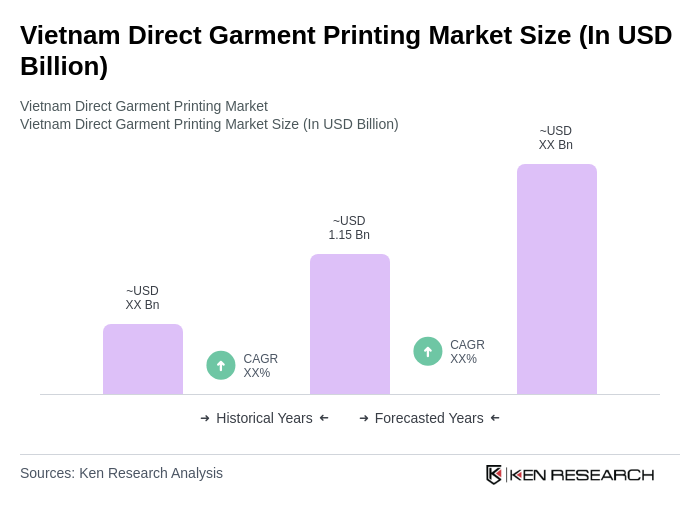
- The Vietnam Direct Garment Printing Market is valued at USD 1.15 billion, based on a five-year historical analysis. This growth is primarily driven by the increasing demand for customized apparel, advancements in printing technology, and the rise of e-commerce platforms that facilitate direct-to-consumer sales. The market has seen significant expansion fueled by Industry 4.0 technologies and digital manufacturing solutions that enable faster production cycles and customized designs. The penetration rate of intelligent printing equipment has increased substantially, with the coverage rate of industrial Internet platforms among printing and dyeing enterprises exceeding 40 percent. Consumer preferences for personalized products continue to fuel sector expansion, supported by the growing adoption of print-on-demand services.
- Key cities dominating the market include Ho Chi Minh City and Hanoi, which serve as major hubs for garment manufacturing and distribution. Ho Chi Minh City concentrates 75 percent of high-end digital printing production capacity, while the areas around Hanoi are dominated by traditional textile printing clusters. The concentration of textile and garment factories in these urban areas, coupled with a robust supply chain and skilled labor force, contributes to their dominance. Additionally, the presence of numerous fashion brands and startups in these cities enhances their market position, with Binh Duong Province attracting substantial foreign investment in intelligent printing solutions.
- The 2025 Vietnam Textile Industry Development Strategy identifies digital printing as a priority support area, with four additional demonstration bases for technical training centers established in Da Nang and Can Tho in 2025. This strategy mandates the adoption of eco-friendly inks and sustainable production methods, with the market share of water-based inks and bio-based materials growing to 27 percent. The initiative encompasses requirements for reduced water usage, zero wastage practices, and enhanced design freedom while targeting improved environmental performance across the textile printing sector.
Vietnam Direct Garment Printing Market Segmentation
By Printing Technology:The market can be segmented into various printing technologies, including Direct-to-Garment (DTG) Printing, Direct-to-Film (DTF) Printing, Sublimation Printing, Screen Printing (Digital Hybrid), Heat Transfer Printing, and Others (e.g., UV Printing, Hybrid Methods). Each of these technologies caters to different consumer needs and preferences, with DTF technology demonstrating rapid adoption due to its compatibility with diverse fabrics and lower maintenance requirements. The penetration of hybrid production lines combining 3D printing and traditional screen printing has exceeded 20 percent in specialized applications, while nano-coating technology for sports fabric printing continues accelerating its commercialization.
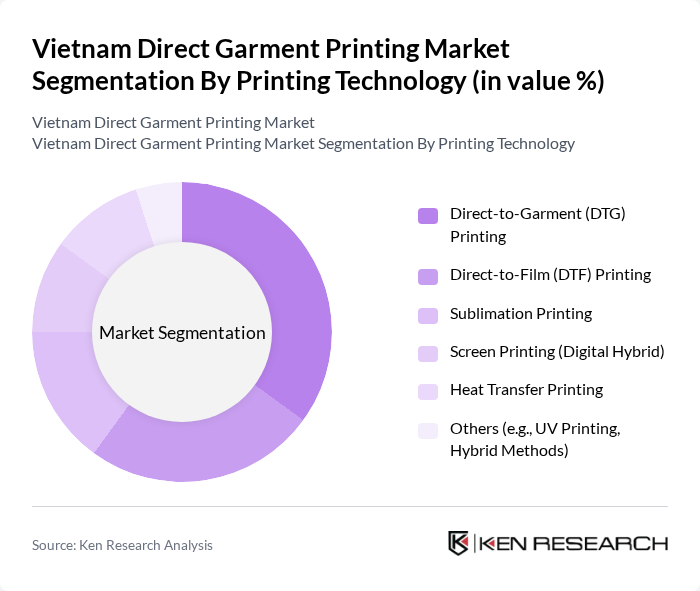
The Direct-to-Garment (DTG) Printing segment is currently dominating the market due to its ability to produce high-quality prints with intricate designs and vibrant colors. This technology delivers highly qualitative, custom prints on limited small batches that satisfy stringent demands for unique and personalized fashion. DTG printing is particularly favored by small to medium-sized businesses and independent designers who require flexibility and quick turnaround times for custom orders. The growing trend of personalized fashion and the rise of print-on-demand services have further solidified DTG's position, though DTF technology is gaining momentum as a competitive alternative, pressuring DTG vendors to innovate continuously.
By End-User Industry:The market can also be segmented based on end-user industries, including Fashion & Apparel Brands, Sportswear & Activewear, Promotional & Corporate Merchandise, Uniforms & Workwear, and Others (e.g., Startups, Designers). Each segment has unique requirements and preferences that influence the choice of printing technology and design. The sportswear and activewear segment benefits particularly from advances in pre-treat chemistry and disperse ink formulations that bond effectively with polyester fibers, supporting bright colors and durability. Vietnam's tropical climate drives strong market demand for functional printed fabrics with properties such as water resistance, quick-drying, sun protection, and breathability, with consumers favoring bright and vivid printed patterns.
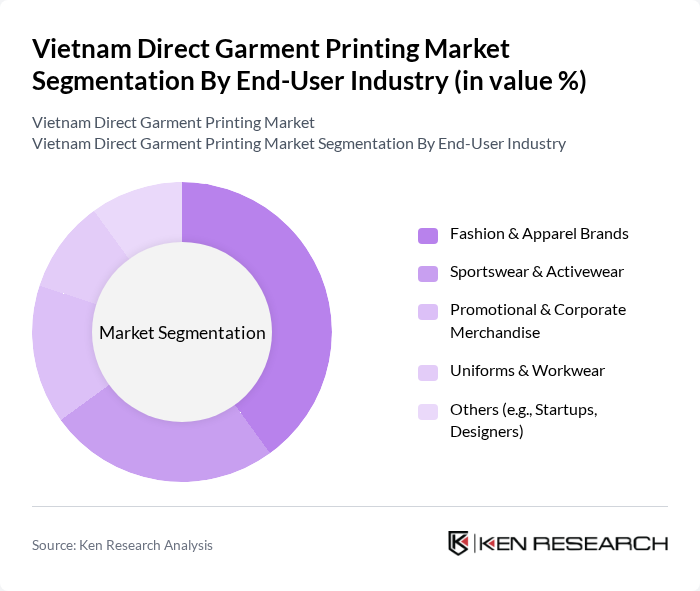
The Fashion & Apparel Brands segment is the largest contributor to the market, driven by the increasing demand for trendy and customized clothing. This segment benefits from the growing consumer inclination towards unique fashion statements and the ability to quickly adapt to changing trends. The emergence of ODM (Original Design Manufacturer) enterprises focusing on customized printing services has shortened order response speed by 30 percent compared with traditional models. Additionally, the rise of e-commerce platforms has enabled fashion brands to reach a broader audience, with platform-based channels projected to experience robust growth driven by direct-to-consumer business models. The expanding e-commerce landscape continues facilitating market growth through enhanced accessibility and customization capabilities.
Vietnam Direct Garment Printing Market Competitive Landscape
The Vietnam Direct Garment Printing Market is characterized by a dynamic mix of regional and international players. Leading participants such as Vinatex (Vietnam National Textile and Garment Group), Garment 10 Corporation JSC (May 10), TNG Investment and Trading JSC, Thanh Cong Textile Garment Investment Trading JSC, Viet Tien Garment Joint Stock Corporation, An Phuoc Garment Embroidery Shoes Company, Saigon 3 Garment Joint Stock Company, Binh Minh Garment Joint Stock Company, Phuoc An Textile Garment Joint Stock Company, Dong Nai Garment Corporation (Donagamex), Huu Nghi Garment Joint Stock Company, Nam Dinh Textile Garment Joint Stock Corporation (Natexco), Binh Duong Garment Joint Stock Company, Hai Phong Textile Garment Joint Stock Company, Quang Ninh Garment Joint Stock Company contribute to innovation, geographic expansion, and service delivery in this space.
Vietnam Direct Garment Printing Market Industry Analysis
Growth Drivers
- Increasing Demand for Customization:The Vietnamese direct garment printing market is experiencing a surge in demand for customized apparel, driven by consumer preferences for unique designs. In future, the customization segment is projected to account for approximately 30 million units, reflecting a 15% increase from the previous year. This trend is supported by the rise of social media platforms, where personalized fashion is increasingly showcased, leading to a growing consumer base willing to pay a premium for tailored products.
- Growth of E-commerce Platforms:The expansion of e-commerce in Vietnam is significantly boosting the direct garment printing market. In future, e-commerce sales are expected to reach $16 billion, up from $13 billion in the previous year, indicating a 23% growth. This growth is facilitating easier access to customized printing services, allowing consumers to order personalized garments online, thus driving demand for direct printing solutions among businesses and individual consumers alike.
- Technological Advancements in Printing:Technological innovations in printing processes are enhancing the efficiency and quality of direct garment printing. In future, investments in advanced printing technologies are projected to exceed $50 million, enabling faster production times and improved print quality. These advancements are attracting more businesses to adopt direct printing methods, as they can now offer high-resolution designs and vibrant colors, meeting the evolving expectations of consumers in Vietnam's competitive market.
Market Challenges
- High Competition from Traditional Printing:The direct garment printing market in Vietnam faces significant competition from traditional printing methods, which still dominate a large portion of the market. In future, traditional printing is expected to account for 65% of the overall garment printing market. This competition poses challenges for direct printing businesses, as they must differentiate their offerings and demonstrate the added value of direct printing to attract customers away from established traditional methods.
- Fluctuating Raw Material Prices:The direct garment printing industry is also challenged by the volatility of raw material prices, particularly inks and fabrics. In future, the cost of printing inks is projected to rise by 10% due to supply chain disruptions and increased demand. This fluctuation can impact profit margins for direct printing companies, making it essential for them to implement effective cost management strategies to maintain competitiveness in the market.
Vietnam Direct Garment Printing Market Future Outlook
The future of the Vietnam direct garment printing market appears promising, driven by increasing consumer demand for personalized products and the ongoing digital transformation of the retail sector. As e-commerce continues to grow, businesses are likely to invest in advanced printing technologies to enhance production capabilities. Additionally, the trend towards sustainability will encourage the adoption of eco-friendly printing solutions, positioning companies to meet both consumer preferences and regulatory requirements in the coming years.
Market Opportunities
- Expansion into Rural Markets:There is a significant opportunity for direct garment printing companies to expand into rural markets, where demand for customized apparel is rising. With a population of over 30 million in rural areas, targeting this segment could lead to an estimated increase in sales by $5 million in future, as more consumers seek personalized clothing options.
- Adoption of Eco-friendly Printing Solutions:The growing consumer awareness regarding environmental issues presents an opportunity for direct garment printing businesses to adopt eco-friendly practices. By future, the market for sustainable printing solutions is expected to grow by $3 million, as consumers increasingly prefer brands that prioritize sustainability, thus enhancing brand loyalty and market share.
Scope of the Report
| Segment | Sub-Segments |
|---|---|
| By Printing Technology | Direct-to-Garment (DTG) Printing Direct-to-Film (DTF) Printing Sublimation Printing Screen Printing (Digital Hybrid) Heat Transfer Printing Others (e.g., UV Printing, Hybrid Methods) |
| By End-User Industry | Fashion & Apparel Brands Sportswear & Activewear Promotional & Corporate Merchandise Uniforms & Workwear Others (e.g., Startups, Designers) |
| By Application | Custom T-Shirts & Apparel Home Textiles (Bedding, Curtains) Accessories (Bags, Caps, Shoes) Fashion Merchandise Others (e.g., Art Prints, Prototypes) |
| By Distribution Channel | Online Print-on-Demand Platforms Offline Retailers & Print Shops Direct B2B Sales Export/Trade Channels Others |
| By Price Range | Budget Segment Mid-Range Segment Premium Segment Others |
| By Material Type | Cotton Polyester Blends (Poly-cotton, Tri-blends) Others (e.g., Silk, Rayon) |
| By Region | Northern Vietnam (Hanoi, Bac Ninh, etc.) Southern Vietnam (Ho Chi Minh City, Binh Duong, etc.) Central Vietnam (Da Nang, Hue, etc.) Others |
Key Target Audience
Investors and Venture Capitalist Firms
Government and Regulatory Bodies (e.g., Ministry of Industry and Trade, General Department of Customs)
Manufacturers and Producers
Distributors and Retailers
Textile and Apparel Export Associations
Technology Providers
Logistics and Supply Chain Companies
Financial Institutions
Players Mentioned in the Report:
Vinatex (Vietnam National Textile and Garment Group)
Garment 10 Corporation JSC (May 10)
TNG Investment and Trading JSC
Thanh Cong Textile Garment Investment Trading JSC
Viet Tien Garment Joint Stock Corporation
An Phuoc Garment Embroidery Shoes Company
Saigon 3 Garment Joint Stock Company
Binh Minh Garment Joint Stock Company
Phuoc An Textile Garment Joint Stock Company
Dong Nai Garment Corporation (Donagamex)
Huu Nghi Garment Joint Stock Company
Nam Dinh Textile Garment Joint Stock Corporation (Natexco)
Binh Duong Garment Joint Stock Company
Hai Phong Textile Garment Joint Stock Company
Quang Ninh Garment Joint Stock Company
Table of Contents
Market Assessment Phase
1. Executive Summary and Approach
2. Vietnam Direct Garment Printing Market Overview
2.1 Key Insights and Strategic Recommendations
2.2 Vietnam Direct Garment Printing Market Overview
2.3 Definition and Scope
2.4 Evolution of Market Ecosystem
2.5 Timeline of Key Regulatory Milestones
2.6 Value Chain & Stakeholder Mapping
2.7 Business Cycle Analysis
2.8 Policy & Incentive Landscape
3. Vietnam Direct Garment Printing Market Analysis
3.1 Growth Drivers
3.1.1 Increasing Demand for Customization
3.1.2 Growth of E-commerce Platforms
3.1.3 Rising Disposable Income
3.1.4 Technological Advancements in Printing
3.2 Market Challenges
3.2.1 High Competition from Traditional Printing
3.2.2 Fluctuating Raw Material Prices
3.2.3 Regulatory Compliance Issues
3.2.4 Limited Awareness of Direct Printing Benefits
3.3 Market Opportunities
3.3.1 Expansion into Rural Markets
3.3.2 Collaborations with Fashion Brands
3.3.3 Adoption of Eco-friendly Printing Solutions
3.3.4 Growth in Promotional Merchandise Sector
3.4 Market Trends
3.4.1 Shift Towards Sustainable Practices
3.4.2 Increasing Use of Digital Printing Technologies
3.4.3 Customization and Personalization Trends
3.4.4 Integration of AI in Design Processes
3.5 Government Regulation
3.5.1 Environmental Protection Standards
3.5.2 Import Tariffs on Printing Equipment
3.5.3 Labor Laws Affecting Production
3.5.4 Quality Control Regulations
4. SWOT Analysis
5. Stakeholder Analysis
6. Porter's Five Forces Analysis
7. Vietnam Direct Garment Printing Market Market Size, 2019-2024
7.1 By Value
7.2 By Volume
7.3 By Average Selling Price
8. Vietnam Direct Garment Printing Market Segmentation
8.1 By Printing Technology
8.1.1 Direct-to-Garment (DTG) Printing
8.1.2 Direct-to-Film (DTF) Printing
8.1.3 Sublimation Printing
8.1.4 Screen Printing (Digital Hybrid)
8.1.5 Heat Transfer Printing
8.1.6 Others (e.g., UV Printing, Hybrid Methods)
8.2 By End-User Industry
8.2.1 Fashion & Apparel Brands
8.2.2 Sportswear & Activewear
8.2.3 Promotional & Corporate Merchandise
8.2.4 Uniforms & Workwear
8.2.5 Others (e.g., Startups, Designers)
8.3 By Application
8.3.1 Custom T-Shirts & Apparel
8.3.2 Home Textiles (Bedding, Curtains)
8.3.3 Accessories (Bags, Caps, Shoes)
8.3.4 Fashion Merchandise
8.3.5 Others (e.g., Art Prints, Prototypes)
8.4 By Distribution Channel
8.4.1 Online Print-on-Demand Platforms
8.4.2 Offline Retailers & Print Shops
8.4.3 Direct B2B Sales
8.4.4 Export/Trade Channels
8.4.5 Others
8.5 By Price Range
8.5.1 Budget Segment
8.5.2 Mid-Range Segment
8.5.3 Premium Segment
8.5.4 Others
8.6 By Material Type
8.6.1 Cotton
8.6.2 Polyester
8.6.3 Blends (Poly-cotton, Tri-blends)
8.6.4 Others (e.g., Silk, Rayon)
8.7 By Region
8.7.1 Northern Vietnam (Hanoi, Bac Ninh, etc.)
8.7.2 Southern Vietnam (Ho Chi Minh City, Binh Duong, etc.)
8.7.3 Central Vietnam (Da Nang, Hue, etc.)
8.7.4 Others
9. Vietnam Direct Garment Printing Market Competitive Analysis
9.1 Market Share of Key Players
9.2 KPIs for Cross Comparison of Key Players
9.2.1 Company Name
9.2.2 Company Size (Large, Medium, Small)
9.2.3 Annual Revenue (USD, VND)
9.2.4 Revenue Growth Rate (%)
9.2.5 Market Share (%)
9.2.6 Production Capacity (Units per Year)
9.2.7 Utilization Rate (%)
9.2.8 Number of Digital Printers Installed
9.2.9 Geographic Reach (Domestic/Export Markets)
9.2.10 Customer Segments Served
9.2.11 R&D Investment (% of Revenue)
9.2.12 Product Portfolio Breadth (No. of SKUs/Services)
9.2.13 Sustainability Initiatives (e.g., % Eco-friendly Inks)
9.2.14 Lead Time (Average Days per Order)
9.2.15 Customer Satisfaction Score (NPS or Equivalent)
9.3 SWOT Analysis of Top Players
9.4 Pricing Analysis
9.5 List of Major Companies
9.5.1 Vinatex (Vietnam National Textile and Garment Group)
9.5.2 Garment 10 Corporation JSC (May 10)
9.5.3 TNG Investment and Trading JSC
9.5.4 Thanh Cong Textile Garment Investment Trading JSC
9.5.5 Viet Tien Garment Joint Stock Corporation
9.5.6 An Phuoc Garment Embroidery Shoes Company
9.5.7 Saigon 3 Garment Joint Stock Company
9.5.8 Binh Minh Garment Joint Stock Company
9.5.9 Phuoc An Textile Garment Joint Stock Company
9.5.10 Dong Nai Garment Corporation (Donagamex)
9.5.11 Huu Nghi Garment Joint Stock Company
9.5.12 Nam Dinh Textile Garment Joint Stock Corporation (Natexco)
9.5.13 Binh Duong Garment Joint Stock Company
9.5.14 Hai Phong Textile Garment Joint Stock Company
9.5.15 Quang Ninh Garment Joint Stock Company
10. Vietnam Direct Garment Printing Market End-User Analysis
10.1 Procurement Behavior of Key Ministries
10.1.1 Government Procurement Policies
10.1.2 Budget Allocation Trends
10.1.3 Supplier Selection Criteria
10.1.4 Contract Management Practices
10.2 Corporate Spend on Infrastructure & Energy
10.2.1 Investment in Printing Technology
10.2.2 Budget for Custom Apparel
10.2.3 Expenditure on Marketing Materials
10.3 Pain Point Analysis by End-User Category
10.3.1 Quality Control Issues
10.3.2 Supply Chain Disruptions
10.3.3 Cost Management Challenges
10.4 User Readiness for Adoption
10.4.1 Awareness of Direct Printing Benefits
10.4.2 Training and Skill Development Needs
10.4.3 Technology Adoption Barriers
10.5 Post-Deployment ROI and Use Case Expansion
10.5.1 Measurement of ROI
10.5.2 Case Studies of Successful Implementations
10.5.3 Future Use Case Opportunities
11. Vietnam Direct Garment Printing Market Future Size, 2025-2030
11.1 By Value
11.2 By Volume
11.3 By Average Selling Price
Go-To-Market Strategy Phase
1. Whitespace Analysis + Business Model Canvas
1.1 Market Gaps Identification
1.2 Value Proposition Development
1.3 Revenue Streams Analysis
1.4 Cost Structure Evaluation
1.5 Key Partnerships Exploration
1.6 Customer Segments Definition
1.7 Channels Strategy
2. Marketing and Positioning Recommendations
2.1 Branding Strategies
2.2 Product USPs
2.3 Target Audience Identification
2.4 Communication Strategy
2.5 Digital Marketing Tactics
3. Distribution Plan
3.1 Urban Retail Strategy
3.2 Rural NGO Tie-ups
3.3 E-commerce Integration
3.4 Logistics and Supply Chain Management
4. Channel & Pricing Gaps
4.1 Underserved Routes
4.2 Pricing Bands Analysis
4.3 Competitor Pricing Comparison
5. Unmet Demand & Latent Needs
5.1 Category Gaps Identification
5.2 Consumer Segments Analysis
5.3 Product Development Opportunities
6. Customer Relationship
6.1 Loyalty Programs
6.2 After-sales Service
6.3 Customer Feedback Mechanisms
7. Value Proposition
7.1 Sustainability Initiatives
7.2 Integrated Supply Chains
7.3 Competitive Advantages
8. Key Activities
8.1 Regulatory Compliance
8.2 Branding Efforts
8.3 Distribution Setup
9. Entry Strategy Evaluation
9.1 Domestic Market Entry Strategy
9.1.1 Product Mix Considerations
9.1.2 Pricing Band Strategy
9.1.3 Packaging Solutions
9.2 Export Entry Strategy
9.2.1 Target Countries Identification
9.2.2 Compliance Roadmap Development
10. Entry Mode Assessment
10.1 Joint Ventures
10.2 Greenfield Investments
10.3 Mergers & Acquisitions
10.4 Distributor Model Evaluation
11. Capital and Timeline Estimation
11.1 Capital Requirements
11.2 Timelines for Implementation
12. Control vs Risk Trade-Off
12.1 Ownership vs Partnerships
13. Profitability Outlook
13.1 Breakeven Analysis
13.2 Long-term Sustainability Strategies
14. Potential Partner List
14.1 Distributors
14.2 Joint Ventures
14.3 Acquisition Targets
15. Execution Roadmap
15.1 Phased Plan for Market Entry
15.1.1 Market Setup
15.1.2 Market Entry
15.1.3 Growth Acceleration
15.1.4 Scale & Stabilize
15.2 Key Activities and Milestones
15.2.1 Milestone Planning
15.2.2 Activity Tracking
Research Methodology
Phase 1: Approach1
Desk Research
- Analysis of industry reports from Vietnamese textile and garment associations
- Review of government publications on trade statistics and export data
- Examination of market trends through academic journals and white papers on direct garment printing
Primary Research
- Interviews with key stakeholders in the garment printing industry, including manufacturers and suppliers
- Surveys conducted with end-users such as fashion brands and retailers utilizing direct garment printing
- Field visits to printing facilities to gather insights on operational practices and technology adoption
Validation & Triangulation
- Cross-validation of findings through multiple data sources, including trade publications and expert opinions
- Triangulation of market data with insights from industry conferences and seminars
- Sanity checks through feedback from a panel of industry experts and analysts
Phase 2: Market Size Estimation1
Top-down Assessment
- Estimation of market size based on national garment production and printing capacity
- Segmentation of the market by application areas such as fashion, promotional items, and home textiles
- Incorporation of growth rates from related sectors, including e-commerce and retail
Bottom-up Modeling
- Collection of data on production volumes from leading direct garment printing companies
- Analysis of pricing models and cost structures within the direct printing segment
- Estimation of market size based on unit sales and average selling prices
Forecasting & Scenario Analysis
- Development of forecasts using historical growth trends and market drivers
- Scenario analysis based on potential regulatory changes and technological advancements
- Creation of multiple growth scenarios (baseline, optimistic, and pessimistic) through 2030
Phase 3: CATI Sample Composition1
| Scope Item/Segment | Sample Size | Target Respondent Profiles |
|---|---|---|
| Fashion Brands Utilizing Direct Printing | 60 | Brand Managers, Product Designers |
| Garment Printing Service Providers | 50 | Operations Managers, Technical Directors |
| Retailers with In-House Printing | 40 | Retail Managers, Supply Chain Coordinators |
| Textile Manufacturers Adopting Direct Printing | 45 | Production Managers, Quality Control Officers |
| Industry Experts and Consultants | 30 | Market Analysts, Business Development Executives |
Frequently Asked Questions
What is the current value of the Vietnam Direct Garment Printing Market?
The Vietnam Direct Garment Printing Market is valued at approximately USD 1.15 billion, reflecting significant growth driven by increasing demand for customized apparel and advancements in printing technology.
What are the key factors driving growth in the Vietnam Direct Garment Printing Market?
Which cities are the main hubs for the Vietnam Direct Garment Printing Market?
What printing technologies are used in the Vietnam Direct Garment Printing Market?
Other Regional/Country Reports
Indonesia Direct Garment Printing Market
Malaysia Direct Garment Printing Market
KSA Direct Garment Printing Market
APAC Direct Garment Printing Market
SEA Direct Garment Printing Market
Thailand Direct Garment Printing Market
Other Adjacent Reports
UAE Garment Manufacturing Market
Bahrain Apparel E-Commerce Market
Singapore Screen Printing Market
Brazil Sublimation Printing Market
Bahrain Fashion Design Software Market
South Korea Textile Ink Market
Brazil Custom Apparel Market
Brazil Sportswear Printing Market
Vietnam Promotional Merchandise Market
Why Buy From Us?

What makes us stand out is that our consultants follow Robust, Refine and Result (RRR) methodology. Robust for clear definitions, approaches and sanity checking, Refine for differentiating respondents' facts and opinions, and Result for presenting data with story.

We have set a benchmark in the industry by offering our clients with syndicated and customized market research reports featuring coverage of entire market as well as meticulous research and analyst insights.

While we don't replace traditional research, we flip the method upside down. Our dual approach of Top Bottom & Bottom Top ensures quality deliverable by not just verifying company fundamentals but also looking at the sector and macroeconomic factors.

With one step in the future, our research team constantly tries to show you the bigger picture. We help with some of the tough questions you may encounter along the way: How is the industry positioned? Best marketing channel? KPI's of competitors? By aligning every element, we help maximize success.

Our report gives you instant access to the answers and sources that other companies might choose to hide. We elaborate each steps of research methodology we have used and showcase you the sample size to earn your trust.

If you need any support, we are here! We pride ourselves on universe strength, data quality, and quick, friendly, and professional service.