About the Report
Base Year 2024Africa Telecom Towers And Allied Market Overview
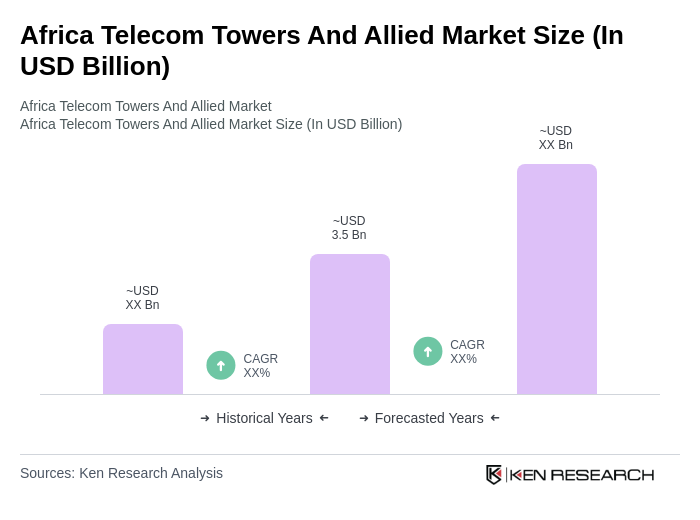
- The Africa Telecom Towers and Allied Market is valued at USD 3.5 billion, based on a five-year historical analysis. This growth is primarily driven by the increasing demand for mobile connectivity, the expansion of 4G and targeted 5G rollouts, and the rising number of mobile subscribers across the continent, supported by towerco strategies focused on co-locations and selective build-to-suit . The market is also supported by significant investments in infrastructure development and the need for enhanced data services .
- Countries such as Nigeria, South Africa, and Kenya dominate the Africa Telecom Towers market due to their large populations, urbanization rates, and the presence of major telecommunications companies. Nigeria continues to see consistent organic growth and new public–private commitments for thousands of additional towers; Kenya maintains steady rollouts led by Safaricom and Airtel; South Africa remains a large, mature market with complex power and rollout dynamics . These nations have established themselves as key players in the telecommunications sector, attracting foreign investments and fostering competitive environments that drive the growth of telecom infrastructure .
- In 2023, several national regulators advanced measures to streamline or accelerate tower deployments; however, there is no single continent-wide “African government” regulation with a standardized permitting process across all countries. Recent industry reporting highlights policy-driven initiatives and public–private programs in key markets (e.g., Nigeria) to enable faster site acquisition and rollouts toward underserved areas, but processes remain country-specific rather than uniform across Africa .
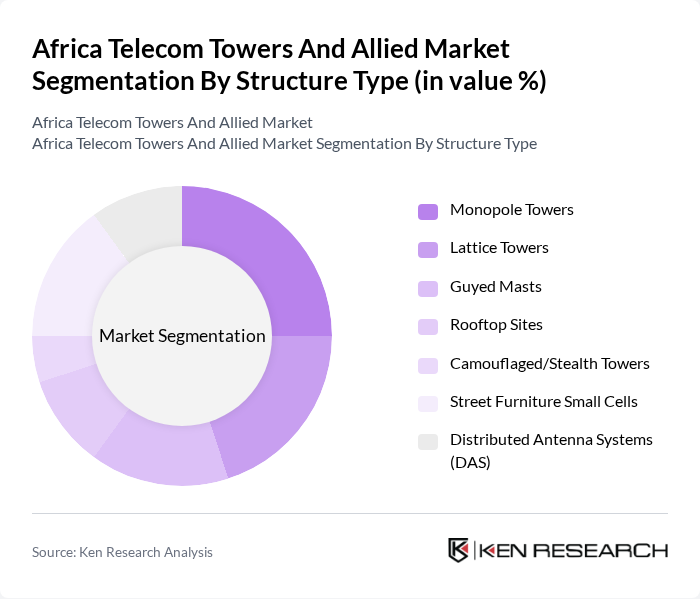
Africa Telecom Towers And Allied Market Segmentation
By Structure Type:The structure type segmentation includes various forms of telecom towers that cater to different operational needs and geographical conditions. The subsegments include Monopole Towers, Lattice Towers, Guyed Masts, Rooftop Sites, Camouflaged/Stealth Towers, Street Furniture Small Cells, and Distributed Antenna Systems (DAS). Each type serves specific purposes, with some being more suitable for urban environments while others are designed for rural or remote areas. In Africa, macro sites (lattice and monopoles) remain the backbone due to coverage needs and power-backup requirements, while small cells and DAS are more selectively deployed in dense urban zones and venues .
By Ownership/Business Model:This segmentation focuses on the ownership structure of telecom towers, which can significantly influence operational strategies and market dynamics. The subsegments include Independent TowerCo Owned, MNO Captive (Operator-Owned), Joint Ventures/InfraCo SPVs, and Sale-and-Leaseback Portfolios. Each model presents unique advantages, such as flexibility in operations or capital efficiency. Across Africa, independent towercos continue prioritizing co-locations and selective build-to-suit, while operators pursue sale-and-leaseback or carve-outs to optimize capital and network quality .

Africa Telecom Towers And Allied Market Competitive Landscape
The Africa Telecom Towers and Allied Market is characterized by a dynamic mix of regional and international players. Leading participants such as IHS Towers (IHS Holding Limited), Helios Towers plc, American Tower Corporation (ATC Africa), Eaton Towers (now part of American Tower), MTN Group Ltd. (Tower assets and partnerships), Vodacom Group Ltd. (including Vantage Towers Africa partnerships), Airtel Africa plc, Safaricom PLC, Telkom SA SOC Ltd. (including Swiftnet), Liquid Intelligent Technologies, ZESCO Limited (Zambia) — power supply to tower sites, Eskom Holdings SOC Ltd. — power utility interfacing with tower networks, Huawei Technologies Co., Ltd., ZTE Corporation, Ericsson AB contribute to innovation, geographic expansion, and service delivery in this space. Ongoing themes include tenancy ratio improvement, selective build-to-suit, and market-specific initiatives such as Nigeria’s large PPP for new towers and lease reallocations among leading towercos .
Africa Telecom Towers And Allied Market Industry Analysis
Growth Drivers
- Increasing Mobile Penetration:As of future, mobile penetration in Africa is projected to reach approximately 50%, with over 1.2 billion mobile subscriptions reported. This surge is driven by affordable smartphones and competitive pricing strategies from telecom operators. The World Bank indicates that mobile technology is crucial for economic growth, contributing to a 1% increase in GDP in countries with high mobile penetration. This trend significantly boosts the demand for telecom towers to support the growing user base.
- Demand for High-Speed Internet:The demand for high-speed internet in Africa is expected to rise sharply, with an estimated 100 million new broadband subscriptions anticipated in future. According to the International Telecommunication Union (ITU), this demand is fueled by increased online activities, including e-commerce and remote work. The growing reliance on digital services necessitates the expansion of telecom infrastructure, particularly towers capable of supporting high-speed connectivity, thus driving market growth.
- Expansion of 4G and 5G Networks:By future, it is estimated that 4G and 5G networks will cover over 30% of the African population, with investments exceeding $5 billion in network infrastructure. The African Telecommunications Union reports that the rollout of these advanced networks is essential for enhancing mobile broadband access. This expansion not only improves service quality but also increases the demand for telecom towers, as operators seek to enhance their coverage and capacity.
Market Challenges
- Regulatory Hurdles:The telecom sector in Africa faces significant regulatory challenges, with over 20% of operators citing complex licensing processes as a major barrier. According to the African Development Bank, inconsistent regulations across countries hinder the establishment of telecom towers. These hurdles can delay project timelines and increase costs, ultimately affecting the overall growth of the telecom infrastructure market in the region.
- High Operational Costs:Operational costs for telecom tower maintenance and deployment in Africa can reach up to $1 million per site annually. Factors such as fuel prices, labor costs, and equipment expenses contribute to these high costs. The World Bank highlights that these financial burdens can deter investment in new infrastructure, limiting the expansion of telecom services and the overall market growth in the region.
Africa Telecom Towers And Allied Market Future Outlook
The future of the Africa telecom towers market appears promising, driven by technological advancements and increasing connectivity demands. As urbanization accelerates, the need for robust telecom infrastructure will intensify, particularly in underserved areas. Additionally, the integration of renewable energy solutions and smart tower technologies is expected to enhance operational efficiency. These trends will likely attract investments, fostering a more competitive landscape and enabling operators to meet the growing consumer expectations for high-quality services.
Market Opportunities
- Growth in IoT Applications:The rise of IoT applications in Africa is projected to create a demand for over 500 million connected devices in future. This growth necessitates a robust telecom infrastructure, particularly in rural areas, where connectivity is limited. Telecom towers will play a crucial role in supporting IoT networks, providing significant opportunities for operators to expand their services and reach new markets.
- Partnerships with Local Governments:Collaborations between telecom operators and local governments are expected to increase, with over 30% of new projects anticipated to involve public-private partnerships in future. These partnerships can facilitate infrastructure development, reduce costs, and enhance service delivery. By leveraging government support, telecom companies can accelerate tower deployment and improve connectivity in underserved regions.
Scope of the Report
| Segment | Sub-Segments |
|---|---|
| By Structure Type | Monopole Towers Lattice Towers Guyed Masts Rooftop Sites Camouflaged/Stealth Towers Street Furniture Small Cells Distributed Antenna Systems (DAS) |
| By Ownership/Business Model | Independent TowerCo Owned MNO Captive (Operator-Owned) Joint Ventures/InfraCo SPVs Sale-and-Leaseback Portfolios |
| By Tenancy & Commercials | Single-Tenant Sites Multi-Tenant Sites (2–3 Tenants) High-Density Sites (4+ Tenants) Colocation and Site Sharing Agreements |
| By Power Solution | Grid-Connected Diesel Generator-Based Hybrid (Solar/DG/Battery) Renewable/Energy-as-a-Service (TowerCos/ESCo) |
| By Application | Mobile Access (2G/3G/4G/5G) Microwave Backhaul Fixed Wireless Access (FWA) Broadcasting and Public Safety |
| By Geography | Nigeria South Africa Egypt Kenya Tanzania Ghana Ethiopia Rest of Africa |
Key Target Audience
Investors and Venture Capitalist Firms
Government and Regulatory Bodies (e.g., National Communications Authority, Communications Regulatory Authority)
Telecom Infrastructure Providers
Mobile Network Operators
Real Estate Investment Trusts (REITs) focused on telecom assets
Telecom Equipment Manufacturers
Local and Regional Telecom Associations
Private Equity Firms specializing in telecommunications
Players Mentioned in the Report:
IHS Towers (IHS Holding Limited)
Helios Towers plc
American Tower Corporation (ATC Africa)
Eaton Towers (now part of American Tower)
MTN Group Ltd. (Tower assets and partnerships)
Vodacom Group Ltd. (including Vantage Towers Africa partnerships)
Airtel Africa plc
Safaricom PLC
Telkom SA SOC Ltd. (including Swiftnet)
Liquid Intelligent Technologies
ZESCO Limited (Zambia) power supply to tower sites
Eskom Holdings SOC Ltd. power utility interfacing with tower networks
Huawei Technologies Co., Ltd.
ZTE Corporation
Ericsson AB
Table of Contents
Market Assessment Phase
1. Executive Summary and Approach
2. Africa Telecom Towers And Allied Market Overview
2.1 Key Insights and Strategic Recommendations
2.2 Africa Telecom Towers And Allied Market Overview
2.3 Definition and Scope
2.4 Evolution of Market Ecosystem
2.5 Timeline of Key Regulatory Milestones
2.6 Value Chain & Stakeholder Mapping
2.7 Business Cycle Analysis
2.8 Policy & Incentive Landscape
3. Africa Telecom Towers And Allied Market Analysis
3.1 Growth Drivers
3.1.1 Increasing Mobile Penetration
3.1.2 Demand for High-Speed Internet
3.1.3 Expansion of 4G and 5G Networks
3.1.4 Urbanization and Infrastructure Development
3.2 Market Challenges
3.2.1 Regulatory Hurdles
3.2.2 High Operational Costs
3.2.3 Limited Access to Financing
3.2.4 Competition from Alternative Technologies
3.3 Market Opportunities
3.3.1 Growth in IoT Applications
3.3.2 Partnerships with Local Governments
3.3.3 Expansion into Rural Areas
3.3.4 Technological Advancements in Tower Design
3.4 Market Trends
3.4.1 Shift Towards Renewable Energy Solutions
3.4.2 Increasing Use of Shared Infrastructure
3.4.3 Focus on Sustainability and Environmental Impact
3.4.4 Adoption of Smart Tower Technologies
3.5 Government Regulation
3.5.1 Licensing Requirements for Tower Operators
3.5.2 Spectrum Allocation Policies
3.5.3 Environmental Compliance Regulations
3.5.4 Tax Incentives for Infrastructure Development
4. SWOT Analysis
5. Stakeholder Analysis
6. Porter's Five Forces Analysis
7. Africa Telecom Towers And Allied Market Market Size, 2019-2024
7.1 By Value
7.2 By Volume
7.3 By Average Selling Price
8. Africa Telecom Towers And Allied Market Segmentation
8.1 By Structure Type
8.1.1 Monopole Towers
8.1.2 Lattice Towers
8.1.3 Guyed Masts
8.1.4 Rooftop Sites
8.1.5 Camouflaged/Stealth Towers
8.1.6 Street Furniture Small Cells
8.1.7 Distributed Antenna Systems (DAS)
8.2 By Ownership/Business Model
8.2.1 Independent TowerCo Owned
8.2.2 MNO Captive (Operator-Owned)
8.2.3 Joint Ventures/InfraCo SPVs
8.2.4 Sale-and-Leaseback Portfolios
8.3 By Tenancy & Commercials
8.3.1 Single-Tenant Sites
8.3.2 Multi-Tenant Sites (2–3 Tenants)
8.3.3 High-Density Sites (4+ Tenants)
8.3.4 Colocation and Site Sharing Agreements
8.4 By Power Solution
8.4.1 Grid-Connected
8.4.2 Diesel Generator-Based
8.4.3 Hybrid (Solar/DG/Battery)
8.4.4 Renewable/Energy-as-a-Service (TowerCos/ESCo)
8.5 By Application
8.5.1 Mobile Access (2G/3G/4G/5G)
8.5.2 Microwave Backhaul
8.5.3 Fixed Wireless Access (FWA)
8.5.4 Broadcasting and Public Safety
8.6 By Geography
8.6.1 Nigeria
8.6.2 South Africa
8.6.3 Egypt
8.6.4 Kenya
8.6.5 Tanzania
8.6.6 Ghana
8.6.7 Ethiopia
8.6.8 Rest of Africa
9. Africa Telecom Towers And Allied Market Competitive Analysis
9.1 Market Share of Key Players
9.2 KPIs for Cross Comparison of Key Players
9.2.1 Total Towers/Sites in Africa
9.2.2 Tenancy Ratio (Tenants per Tower)
9.2.3 Lease-Up Rate (New Tenants per Quarter)
9.2.4 Anchor vs. Colocation Mix
9.2.5 Average Revenue per Tower (ARPT)
9.2.6 EBITDA Margin and EBITDA per Tower
9.2.7 Power Uptime (% Availability) and Runtime on DG
9.2.8 Energy Cost per Site (USD/site/month)
9.2.9 Build-to-Suit (BTS) Pipeline and New Sites Commissioned
9.2.10 Portfolio Utilization (Occupied Rack/Load %) and Fiber/Backhaul Readiness
9.3 SWOT Analysis of Top Players
9.4 Pricing Analysis
9.5 Detailed Profile of Major Companies
9.5.1 IHS Towers (IHS Holding Limited)
9.5.2 Helios Towers plc
9.5.3 American Tower Corporation (ATC Africa)
9.5.4 Eaton Towers (now part of American Tower)
9.5.5 MTN Group Ltd. (Tower assets and partnerships)
9.5.6 Vodacom Group Ltd. (including Vantage Towers Africa partnerships)
9.5.7 Airtel Africa plc
9.5.8 Safaricom PLC
9.5.9 Telkom SA SOC Ltd. (including Swiftnet)
9.5.10 Liquid Intelligent Technologies
9.5.11 ZESCO Limited (Zambia) — power supply to tower sites
9.5.12 Eskom Holdings SOC Ltd. — power utility interfacing with tower networks
9.5.13 Huawei Technologies Co., Ltd.
9.5.14 ZTE Corporation
9.5.15 Ericsson AB
10. Africa Telecom Towers And Allied Market End-User Analysis
10.1 Procurement Behavior of Key Ministries
10.1.1 Ministry of Communications
10.1.2 Ministry of Information Technology
10.1.3 Ministry of Finance
10.2 Corporate Spend on Infrastructure & Energy
10.2.1 Telecom Infrastructure Investments
10.2.2 Energy Solutions for Towers
10.2.3 Maintenance and Upgrades
10.3 Pain Point Analysis by End-User Category
10.3.1 Network Reliability Issues
10.3.2 High Operational Costs
10.3.3 Regulatory Compliance Challenges
10.4 User Readiness for Adoption
10.4.1 Awareness of New Technologies
10.4.2 Training and Support Needs
10.4.3 Financial Readiness
10.5 Post-Deployment ROI and Use Case Expansion
10.5.1 Performance Metrics Tracking
10.5.2 Expansion into New Markets
10.5.3 Customer Feedback Integration
11. Africa Telecom Towers And Allied Market Future Size, 2025-2030
11.1 By Value
11.2 By Volume
11.3 By Average Selling Price
Go-To-Market Strategy Phase
1. Whitespace Analysis + Business Model Canvas
1.1 Market Gaps Identification
1.2 Value Proposition Development
1.3 Revenue Streams Analysis
1.4 Cost Structure Evaluation
1.5 Key Partnerships Exploration
1.6 Customer Segmentation
1.7 Channels of Distribution
2. Marketing and Positioning Recommendations
2.1 Branding Strategies
2.2 Product USPs
2.3 Target Market Identification
2.4 Communication Strategies
2.5 Digital Marketing Approaches
3. Distribution Plan
3.1 Urban Retail Strategies
3.2 Rural NGO Tie-Ups
3.3 Logistics and Supply Chain Management
3.4 Distribution Partnerships
4. Channel & Pricing Gaps
4.1 Underserved Routes
4.2 Pricing Bands Analysis
4.3 Competitor Pricing Strategies
4.4 Customer Willingness to Pay
5. Unmet Demand & Latent Needs
5.1 Category Gaps Identification
5.2 Consumer Segments Analysis
5.3 Emerging Trends and Needs
5.4 Future Demand Projections
6. Customer Relationship
6.1 Loyalty Programs
6.2 After-Sales Service
6.3 Customer Feedback Mechanisms
6.4 Engagement Strategies
7. Value Proposition
7.1 Sustainability Initiatives
7.2 Integrated Supply Chains
7.3 Competitive Advantages
7.4 Customer-Centric Innovations
8. Key Activities
8.1 Regulatory Compliance
8.2 Branding Initiatives
8.3 Distribution Setup
8.4 Operational Efficiency Improvements
9. Entry Strategy Evaluation
9.1 Domestic Market Entry Strategy
9.1.1 Product Mix Considerations
9.1.2 Pricing Band Strategies
9.1.3 Packaging Innovations
9.2 Export Entry Strategy
9.2.1 Target Countries Identification
9.2.2 Compliance Roadmap Development
10. Entry Mode Assessment
10.1 Joint Ventures
10.2 Greenfield Investments
10.3 Mergers & Acquisitions
10.4 Distributor Model Evaluation
11. Capital and Timeline Estimation
11.1 Capital Requirements
11.2 Timelines for Implementation
12. Control vs Risk Trade-Off
12.1 Ownership vs Partnerships
12.2 Risk Management Strategies
13. Profitability Outlook
13.1 Breakeven Analysis
13.2 Long-Term Sustainability Strategies
14. Potential Partner List
14.1 Distributors
14.2 Joint Ventures
14.3 Acquisition Targets
15. Execution Roadmap
15.1 Phased Plan for Market Entry
15.1.1 Market Setup
15.1.2 Market Entry
15.1.3 Growth Acceleration
15.1.4 Scale & Stabilize
15.2 Key Activities and Milestones
15.2.1 Milestone Planning
15.2.2 Activity Tracking
Research Methodology
Phase 1: Approach1
Desk Research
- Analysis of industry reports from telecommunications regulatory authorities in Africa
- Review of market studies published by telecom associations and research firms
- Examination of financial reports and press releases from major telecom tower operators
Primary Research
- Interviews with executives from telecom tower companies and infrastructure providers
- Surveys with network planners and engineers in telecom operators
- Field interviews with local government officials regarding telecom regulations
Validation & Triangulation
- Cross-validation of data through multiple industry sources and expert opinions
- Triangulation of findings from desk research and primary interviews
- Sanity checks through feedback from a panel of telecom industry experts
Phase 2: Market Size Estimation1
Top-down Assessment
- Estimation of total telecom infrastructure spending across African nations
- Segmentation of market size by tower type (macro, micro, and small cells)
- Incorporation of growth rates from mobile subscriber data and internet penetration trends
Bottom-up Modeling
- Collection of data on the number of towers and average revenue per tower
- Operational cost analysis based on maintenance and leasing agreements
- Volume x revenue basis for estimating market potential in emerging regions
Forecasting & Scenario Analysis
- Multi-factor regression analysis incorporating mobile data traffic growth and 5G rollout
- Scenario modeling based on regulatory changes and investment trends in telecom
- Baseline, optimistic, and pessimistic forecasts through 2030
Phase 3: CATI Sample Composition1
| Scope Item/Segment | Sample Size | Target Respondent Profiles |
|---|---|---|
| Telecom Tower Infrastructure Providers | 90 | CEOs, Operations Managers |
| Mobile Network Operators | 80 | Network Engineers, Strategic Planners |
| Regulatory Bodies | 50 | Policy Makers, Regulatory Affairs Managers |
| Investment Firms in Telecom | 60 | Investment Analysts, Portfolio Managers |
| Local Government Officials | 40 | City Planners, Telecommunications Advisors |
Frequently Asked Questions
What is the current value of the Africa Telecom Towers and Allied Market?
The Africa Telecom Towers and Allied Market is valued at approximately USD 3.5 billion, driven by the increasing demand for mobile connectivity, the expansion of 4G and 5G networks, and a growing number of mobile subscribers across the continent.
Which countries dominate the Africa Telecom Towers market?
What are the main drivers of growth in the Africa Telecom Towers market?
What challenges does the Africa Telecom Towers market face?
Other Regional/Country Reports
Indonesia Telecom Towers And Allied Markets Market
Malaysia Telecom Towers And Allied Markets Market
KSA Telecom Towers And Allied Markets Market
APAC Telecom Towers And Allied Markets Market
SEA Telecom Towers And Allied Markets Market
Vietnam Telecom Towers And Allied Markets Market
Why Buy From Us?

What makes us stand out is that our consultants follow Robust, Refine and Result (RRR) methodology. Robust for clear definitions, approaches and sanity checking, Refine for differentiating respondents' facts and opinions, and Result for presenting data with story.

We have set a benchmark in the industry by offering our clients with syndicated and customized market research reports featuring coverage of entire market as well as meticulous research and analyst insights.

While we don't replace traditional research, we flip the method upside down. Our dual approach of Top Bottom & Bottom Top ensures quality deliverable by not just verifying company fundamentals but also looking at the sector and macroeconomic factors.

With one step in the future, our research team constantly tries to show you the bigger picture. We help with some of the tough questions you may encounter along the way: How is the industry positioned? Best marketing channel? KPI's of competitors? By aligning every element, we help maximize success.

Our report gives you instant access to the answers and sources that other companies might choose to hide. We elaborate each steps of research methodology we have used and showcase you the sample size to earn your trust.

If you need any support, we are here! We pride ourselves on universe strength, data quality, and quick, friendly, and professional service.