
APAC Business Jet Market Outlook to 2030
Region:Asia
Author(s):Shubham Kashyap
Product Code:KROD2672
November 2024
85
About the Report
APAC Business Jet Market Overview
- The APAC Business Jet market is currently valued at USD 1.55 billion, based on a five-year historical analysis. This market is primarily driven by the growing demand for private travel among high-net-worth individuals (HNWIs) and businesses seeking operational flexibility and efficiency. The increasing emphasis on point-to-point travel, reducing travel time for business executives, is further fueling the market growth in the region. The need for enhanced connectivity between remote locations, combined with rising investments in advanced business jet models featuring improved comfort and fuel efficiency, has made the APAC region a key area of interest for business jet manufacturers.
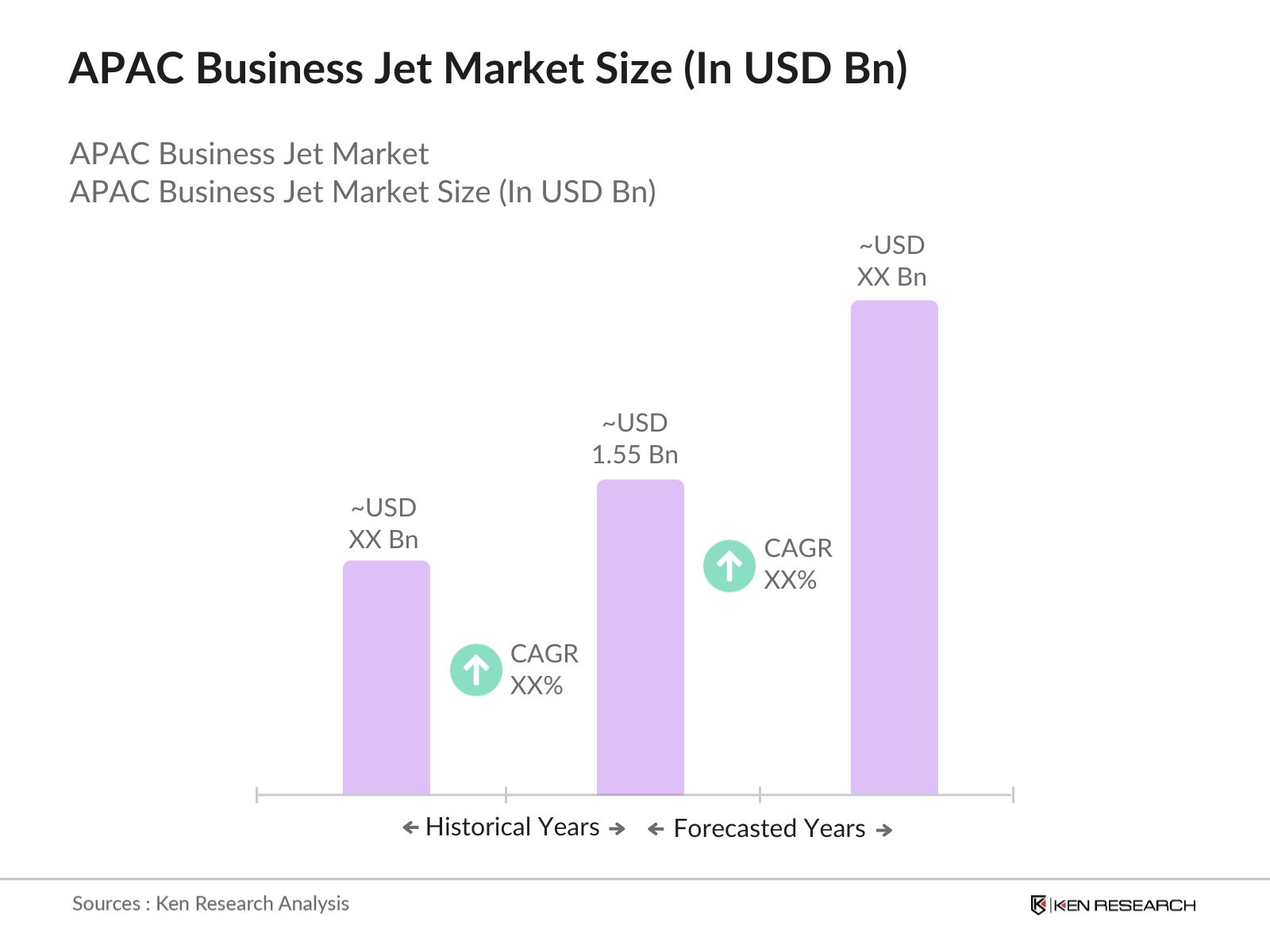
- Market dominance is largely concentrated in key countries such as China, Japan, and India due to their robust economic growth and expanding high-income population. These countries offer significant opportunities for private aviation services, supported by growing corporate sectors and increased infrastructure investment in private airstrips and jet-friendly airports. Additionally, the Southeast Asian markets, including Indonesia, Malaysia, and Singapore, are witnessing a surge in demand as regional economies grow and more multinational corporations establish headquarters there.
- The Civil Aviation Authorities in various APAC countries have also played a pivotal role in regulating business jet operations to ensure safety, efficiency, and environmental compliance. Indias 2023 National Civil Aviation Policy includes tax benefits for private aviation operators, such as a 5% reduction in import duties on business jets and related aviation equipment. Indonesia is investing USD 2 billion in expanding business aviation infrastructure. This investment is part of a broader initiative to improve airport facilities and services to accommodate the growing demand for air travel within the country, which is essential given its geographical nature as an archipelago.
APAC Business Jet Market Segmentation
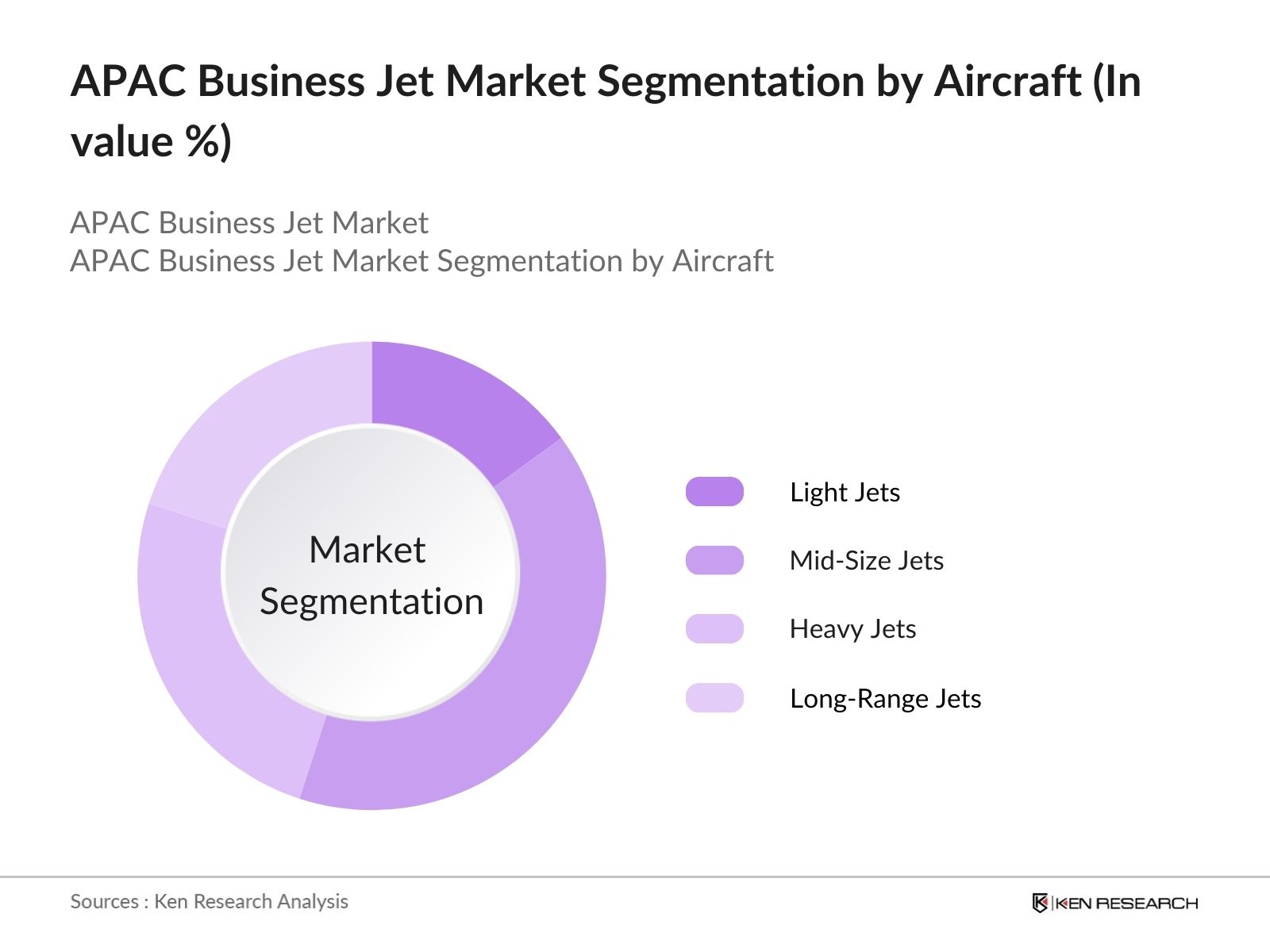
- By Aircraft Type: The market is segmented by aircraft type into light jets, mid-size jets, heavy jets, and long-range jets. Among these, the demand for mid-size jets dominates the market, especially in countries like China, Japan, and India, where businesses require jets that balance operational efficiency with range. Mid-size jets, such as Bombardiers Challenger series and Gulfstream G280, offer a cost-effective solution for domestic and intra-regional travel, driving their popularity in the market.
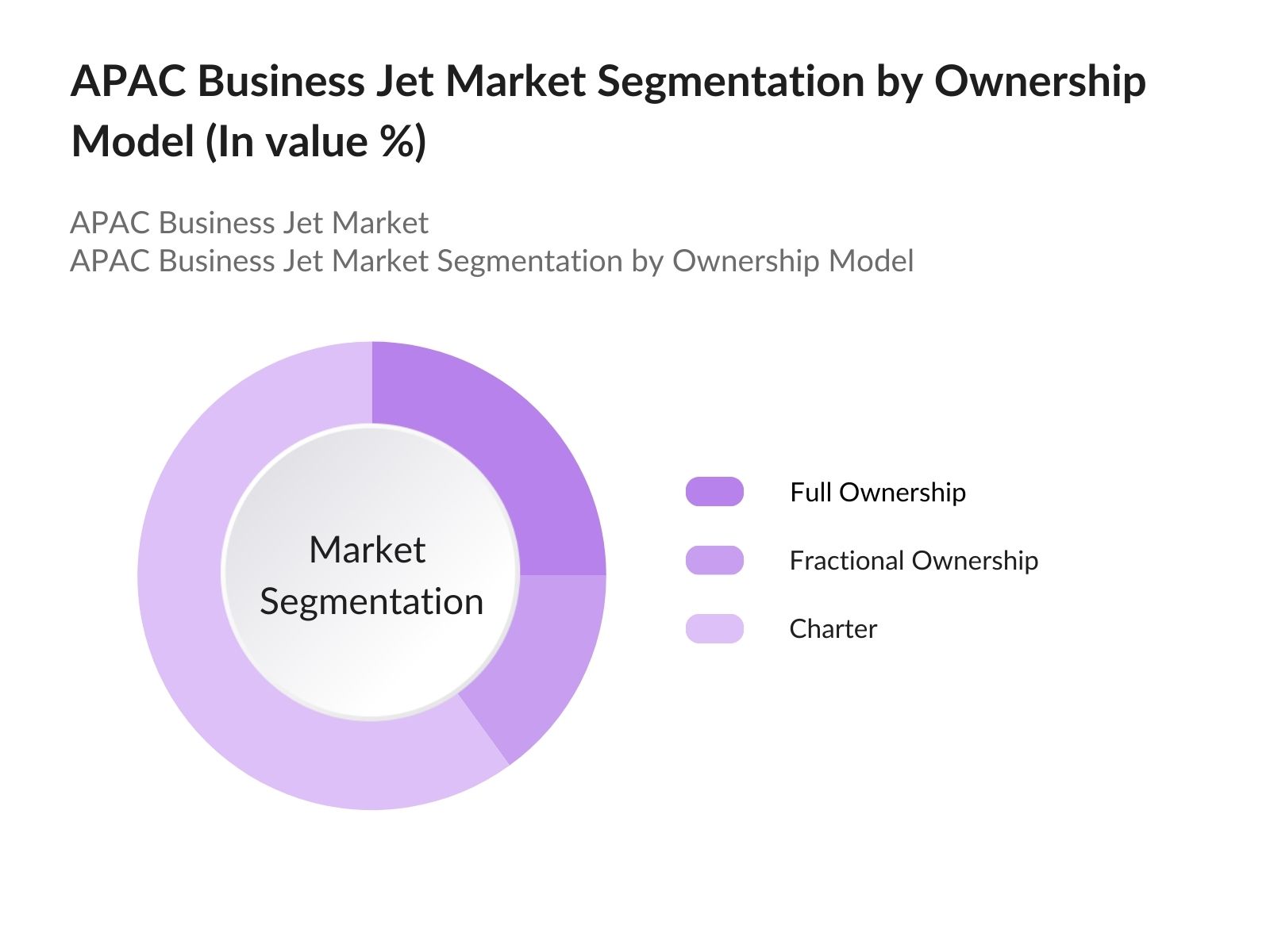
- By Ownership Model: The market is segmented by ownership model into fractional ownership, charter, and full ownership. Charter services dominate the market share, with high demand from corporations that prefer on-demand travel without the long-term financial commitment of full ownership. Fractional ownership is gaining traction, particularly in Southeast Asia, as it offers a balance between flexibility and reduced costs.
APAC Business Jet Market Competitive Landscape
The APAC Business Jet market is highly competitive, with several global and regional players striving for market share through innovation, strategic partnerships, and investments in cutting-edge technology. Leading companies such as Bombardier, Gulfstream Aerospace, and Dassault Aviation dominate the market with their range of business jets tailored for different segments of the market.
|
Company Name |
Establishment Year |
Headquarters |
Fleet Size |
Revenue (2023) |
Key Models |
R&D Investment |
Client Segments |
Key Regions |
Partnerships |
|
Bombardier |
1942 |
Montreal, Canada |
|||||||
|
Gulfstream Aerospace |
1958 |
Savannah, USA |
|||||||
|
Dassault Aviation |
1929 |
Paris, France |
|||||||
|
VistaJet |
2004 |
Valletta, Malta |
|||||||
|
ExecuJet Aviation Group |
1991 |
Zurich, Switzerland |
APAC Business Jet Industry Analysis
Growth Drivers
- Increase in High-Net-Worth Individuals (HNWIs): The APAC region has seen significant growth in the number of high-net-worth individuals (HNWIs), with over 7.4 million individuals having assets exceeding $1 million in 2023, according to government data. This wealth growth directly impacts business jet demand, as ultra-high-net-worth individuals (UHNWIs) increasingly invest in private aviation. China alone added 200,000 HNWIs in 2023, making it a key market for business jets. Government sources like the Asia Pacific Wealth Report show that UHNWIs have been increasing their travel spending, including private jet purchases and fractional ownership models.
- Expansion of Corporate Travel: In 2023, multinational corporations (MNCs) expanded their operations across Asia-Pacific, driving an increase in corporate executive travel. The region experienced a surge in business aviation due to cross-border operations, with companies in Singapore, Hong Kong, and Japan reporting a 15% increase in private jet charters for executives in 2023, according to the International Air Transport Association (IATA). Additionally, South Korea saw a rise in business jet usage for intra-Asian corporate travel, encouraged by more relaxed travel restrictions and government incentives for corporate mobility.
- Government Support and Infrastructure Development: Government initiatives in the APAC region have created favourable conditions for business aviation growth. For instance, Japan's Ministry of Land, Infrastructure, Transport, and Tourism introduced policies in 2023 that ease regulations for private jet operations and expanded Fukuoka Airport to accommodate private jets. Additionally, India announced a USD 10 billion investment in airport infrastructure, with 21 new private aviation terminals under construction as of 2024, bolstering the business jet market. This regulatory and infrastructural support has made private jet travel more accessible across the region.
Market Challenges
- High Ownership and Maintenance Costs: Business jets come with significant acquisition and maintenance costs, with the average price of a new long-range jet exceeding USD 50 million. Operational expenditures such as fuel, maintenance, and crew salaries add substantial recurring costs annually per aircraft. This makes ownership a challenge for smaller companies and individuals in the APAC region. Many corporate entities opt for fractional ownership or charter services to avoid the high financial burden associated with full ownership, limiting broader adoption of business jets among mid-sized firms.
- Stringent Regulations and Air Traffic Constraints: Regulatory hurdles remain a significant challenge in the APAC business jet market. Countries like China and Indonesia impose strict airspace control, with business jets requiring specific permits that can delay operations. Airspace congestion, particularly in key hubs such as Tokyo and Hong Kong, further complicates operations, making efficient planning for business jet travel difficult. These regulatory complexities and air traffic limitations reduce operational flexibility and limit the growth potential of the business jet market in the region.
APAC Business Jet Market Future Outlook
The APAC Business Jet market is poised for significant growth over the next five years, driven by expanding corporate travel, increasing HNWI population, and rising investments in aviation infrastructure. As the region's economies continue to develop, the demand for business jets as a symbol of status, convenience, and efficiency is expected to rise, particularly in emerging markets such as Southeast Asia and India. Moreover, the ongoing advancements in business jet technology, such as improved fuel efficiency and comfort, will make these aircraft more attractive to both corporate and individual buyers.
Future Market Opportunities
- Rising Investment in Business Aviation Infrastructure: Governments in APAC are heavily investing in business aviation infrastructure to meet growing demand. For example, India has allocated substantial amount toward the construction of private aviation terminals, with 10 new facilities set to open by the end of 2024. Similarly, Australia has committed USD 3 billion to expanding private aviation services at key airports such as Melbourne. These investments are creating opportunities for private jet operators to expand their services, particularly in under-served regions. This surge in infrastructure development is expected to increase the accessibility and efficiency of business jet travel.
- Expansion into Emerging Markets: Emerging markets such as Vietnam, the Philippines, and Indonesia are showing increasing demand for business jets. In 2023, Vietnam saw a noteworthy rise in corporate jet charters, spurred by the expansion of foreign direct investment (FDI) from MNCs. Indonesia also reported a remarkable increase in private jet usage among domestic corporations. The rise of these markets presents significant opportunities for business jet manufacturers and service providers, as companies in these countries expand their operations. Additionally, local governments are easing regulations and providing incentives to attract more business jet services.
Scope of the Report
|
By Aircraft Type |
Light Jets Mid-Size Jets Heavy Jets Long-Range Jets |
|
By Ownership Model |
Full Ownership Fractional Ownership Charter |
|
By End-User |
Corporate Individuals Government |
|
By Range |
Short-Range Jets Mid-Range Jets Long-Range Jets |
|
By Country |
China Japan India Singapore Indonesia Rest of APAC |
Products
Key Target Audience
Aircraft Manufacturers
Charter and Leasing Companies
Corporate Travel Departments
High-Net-Worth Individuals (HNWIs)
Investments and Venture Capitalist Firms
Government and Regulatory Bodies (CAAC, DGCA)
Airport and Infrastructure Developers
Maintenance, Repair, and Overhaul (MRO) Providers
Banks and Financial Institutes
Companies
Major Players in the APAC Business Jet Market
Bombardier
Gulfstream Aerospace
Dassault Aviation
Embraer
Cessna (Textron Aviation)
HondaJet
Boeing Business Jets
Airbus Corporate Jets
VistaJet
NetJets
ExecuJet Aviation Group
Deer Jet
TAG Aviation
Global Jet
Jet Aviation
Table of Contents
1. APAC Business Jet Market Overview
1.1. Definition and Scope
1.2. Market Taxonomy
1.3. Market Growth Rate (Business Aviation Growth Rate, Fleet Expansion, Business Jet Deliveries)
1.4. Market Segmentation Overview
2. APAC Business Jet Market Size (In USD Bn)
2.1. Historical Market Size (Business Jet Deliveries, Fleet Expansion)
2.2. Year-On-Year Growth Analysis (Fleet Growth, Corporate Travel Spending, Ultra-High-Net-Worth Individual (UHNWI) Growth)
2.3. Key Market Developments and Milestones (New Regulations, Infrastructure Expansion, New Jet Model Launches)
3. APAC Business Jet Market Analysis
3.1. Growth Drivers
3.1.1. Expansion of High-Net-Worth Individuals (HNWI Population Growth, UHNWI Spending Power)
3.1.2. Corporate Travel Demand (Increase in Corporate Executive Travel, MNC Expansion)
3.1.3. Government Support and Infrastructure Development (Private Aviation Regulations, Airport Expansion)
3.1.4. Advancements in Business Jet Technology (New Aircraft Launches, Fuel Efficiency, Range Improvement)
3.2. Market Challenges
3.2.1. High Ownership and Maintenance Costs (Acquisition Costs, Operational Expenditures)
3.2.2. Stringent Regulations and Air Traffic Constraints (APAC Regulatory Landscape, Airspace Congestion)
3.2.3. Limited Skilled Workforce (Pilot and Technician Shortages)
3.3. Opportunities
3.3.1. Growth of Fractional Ownership Models (Fractional and Charter Services, Increasing Corporate Demand)
3.3.2. Rising Investment in Business Aviation Infrastructure (Private Airport Development, Government Investment)
3.3.3. Expansion into Emerging Markets (Southeast Asia, Increasing Corporate Presence)
3.4. Trends
3.4.1. Adoption of Sustainable Aviation Fuels (SAFs) (Environmental Impact, Fuel Efficiency)
3.4.2. Integration of Smart Technologies (AI in Flight Operations, Predictive Maintenance)
3.4.3. Increased Use of Long-Range Jets (Cross-Continental Demand, Time-Saving)
3.5. Government Regulation
3.5.1. Civil Aviation Regulations (APAC-specific Regulations, Licensing and Operational Requirements)
3.5.2. Environmental Compliance (Emission Standards, Noise Pollution Control)
3.5.3. Infrastructure Incentives (Airport Infrastructure Funding, Tax Benefits for Aviation Operators)
3.6. SWOT Analysis
3.7. Stake Ecosystem
3.8. Porters Five Forces
3.9. Competition Ecosystem
4. APAC Business Jet Market Segmentation
4.1. By Aircraft Type (In Value %)
4.1.1. Light Jets
4.1.2. Mid-Size Jets
4.1.3. Heavy Jets
4.1.4. Long-Range Jets
4.2. By Ownership Model (In Value %)
4.2.1. Full Ownership
4.2.2. Fractional Ownership
4.2.3. Charter
4.3. By End-User (In Value %)
4.3.1. Corporate
4.3.2. Individuals
4.3.3. Government
4.4. By Range (In Value %)
4.4.1. Short-Range Jets
4.4.2. Mid-Range Jets
4.4.3. Long-Range Jets
4.5. By Country (In Value %)
4.5.1. China
4.5.2. Japan
4.5.3. India
4.5.4. Singapore
4.5.5. Indonesia
5. APAC Business Jet Market Competitive Analysis
5.1. Detailed Profiles of Major Companies
5.1.1. Bombardier
5.1.2. Gulfstream Aerospace
5.1.3. Dassault Aviation
5.1.4. Embraer
5.1.5. Cessna (Textron Aviation)
5.1.6. HondaJet
5.1.7. Airbus Corporate Jets
5.1.8. Boeing Business Jets
5.1.9. VistaJet
5.1.10. NetJets
5.1.11. ExecuJet Aviation Group
5.1.12. Deer Jet
5.1.13. TAG Aviation
5.1.14. Global Jet
5.1.15. Jet Aviation
5.2. Cross Comparison Parameters (No. of Employees, Fleet Size, Headquarters, Revenue, Aircraft Models, R&D Investment, Client Segments, Market Share)
5.3. Market Share Analysis
5.4. Strategic Initiatives
5.5. Mergers and Acquisitions
5.6. Investment Analysis
5.7. Venture Capital Funding
5.8. Government Grants
5.9. Private Equity Investments
6. APAC Business Jet Market Regulatory Framework
6.1. Civil Aviation Standards (Licensing Requirements, Airworthiness Standards)
6.2. Compliance Requirements (Flight Operation Regulations, Safety Standards)
6.3. Certification Processes (APAC Certification Protocols, Airworthiness Certifications)
7. APAC Business Jet Future Market Size (In USD Bn)
7.1. Future Market Size Projections
7.2. Key Factors Driving Future Market Growth
8. APAC Business Jet Future Market Segmentation
8.1. By Aircraft Type (In Value %)
8.2. By Ownership Model (In Value %)
8.3. By End-User (In Value %)
8.4. By Range (In Value %)
8.5. By Country (In Value %)
9. APAC Business Jet Market Analysts Recommendations
9.1. TAM/SAM/SOM Analysis
9.2. Customer Cohort Analysis
9.3. Marketing Initiatives
9.4. White Space Opportunity Analysis
Research Methodology
Step 1: Identification of Key Variables
The research begins with constructing an ecosystem map of the APAC Business Jet market, identifying all stakeholders involved. Extensive desk research is used to gather industry data from secondary and proprietary sources. The primary goal is to define the critical variables that influence market dynamics, such as aircraft demand, regulatory frameworks, and fleet expansion.
Step 2: Market Analysis and Construction
In this phase, historical data is compiled to analyze market penetration and revenue generation across APAC. Specific metrics such as fleet size, aircraft deliveries, and corporate travel spending are evaluated to ensure the accuracy of the market estimates. Service quality statistics and operator performance are also considered.
Step 3: Hypothesis Validation and Expert Consultation
Market hypotheses are developed based on the data analysis and are validated through interviews with industry experts, including business jet manufacturers and service providers. These consultations help refine and confirm the market data, offering operational insights that enhance the overall analysis.
Step 4: Research Synthesis and Final Output
The final phase involves synthesizing data from both desk research and expert consultations. The results are verified through engagement with aircraft manufacturers to gather insights on market segmentation, consumer preferences, and regional sales performance. The synthesis ensures the final report provides a comprehensive, validated analysis of the APAC Business Jet market.
Frequently Asked Questions
01. How big is the APAC Business Jet Market?
The APAC Business Jet market is valued at USD 1.55 billion, driven by increasing demand for corporate and HNWI travel solutions, as well as advancements in aircraft technology.
02. What are the challenges in the APAC Business Jet Market?
Challenges in the APAC Business Jet market include high acquisition and operational costs, stringent aviation regulations, and limited infrastructure in certain regions, which can hinder market expansion.
03. Who are the major players in the APAC Business Jet Market?
Major players in the APAC Business Jet market include Bombardier, Gulfstream Aerospace, Dassault Aviation, and regional operators like ExecuJet Aviation Group and VistaJet, who dominate due to their innovative products and strong regional presence.
04. What are the growth drivers of the APAC Business Jet Market?
Key growth drivers include the rising HNWI population, expanding corporate travel, increased demand for flexible travel solutions, and government investment in private aviation infrastructure across APAC.
Why Buy From Us?

What makes us stand out is that our consultants follows Robust, Refine and Result (RRR) methodology. i.e. Robust for clear definitions, approaches and sanity checking, Refine for differentiating respondents facts and opinions and Result for presenting data with story

We have set a benchmark in the industry by offering our clients with syndicated and customized market research reports featuring coverage of entire market as well as meticulous research and analyst insights.

While we don't replace traditional research, we flip the method upside down. Our dual approach of Top Bottom & Bottom Top ensures quality deliverable by not just verifying company fundamentals but also looking at the sector and macroeconomic factors.

With one step in the future, our research team constantly tries to show you the bigger picture. We help with some of the tough questions you may encounter along the way: How is the industry positioned? Best marketing channel? KPI's of competitors? By aligning every element, we help maximize success.

Our report gives you instant access to the answers and sources that other companies might choose to hide. We elaborate each steps of research methodology we have used and showcase you the sample size to earn your trust.

If you need any support, we are here! We pride ourselves on universe strength, data quality, and quick, friendly, and professional service.