About the Report
Base Year 2024Listen to the audio summary
APAC ECG Patch Holter Monitor Market Overview
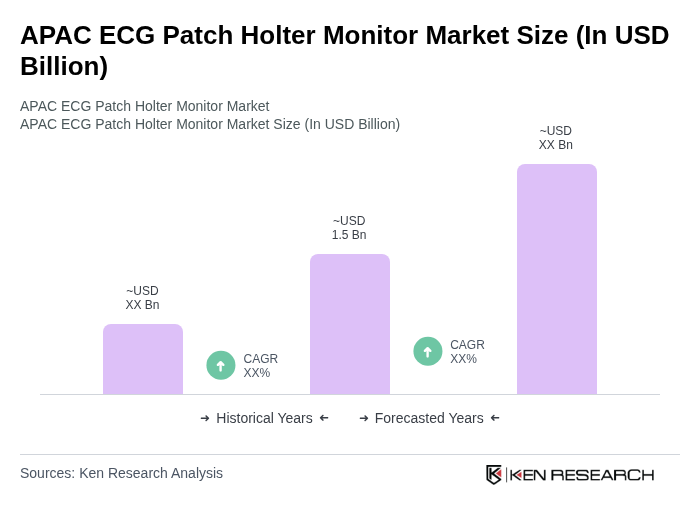
- The APAC ECG Patch Holter Monitor Market is valued at USD 1.5 billion, based on a five-year historical analysis. This growth is primarily driven by the increasing prevalence of cardiovascular diseases, rising geriatric population, and advancements in wearable technology that enhance patient monitoring capabilities. The demand for non-invasive and continuous cardiac monitoring solutions has surged, leading to a significant uptick in market value.
- Key players in this market include China, Japan, and India, which dominate due to their large populations, increasing healthcare expenditure, and rapid adoption of advanced medical technologies. These countries are investing heavily in healthcare infrastructure and digital health solutions, making them pivotal in the growth of the ECG patch Holter monitor market.
- Indian government initiatives in telemedicine, digital health, and cardiac care are encouraging adoption of remote cardiac monitoring (including ECG patches and Holter solutions), thereby driving the adoption of innovative cardiac monitoring solutions across the country.
APAC ECG Patch Holter Monitor Market Segmentation
By Type:The segmentation by type includes various ECG patch monitors that cater to different patient needs and monitoring durations. The subsegments are Single-lead ECG patches, Multi-lead ECG patches, Long-term continuous ECG patch monitors (7–14 days), and Short-term event/loop ECG patch monitors (24–72 hours). Each type serves specific clinical requirements, with varying levels of complexity and monitoring capabilities.
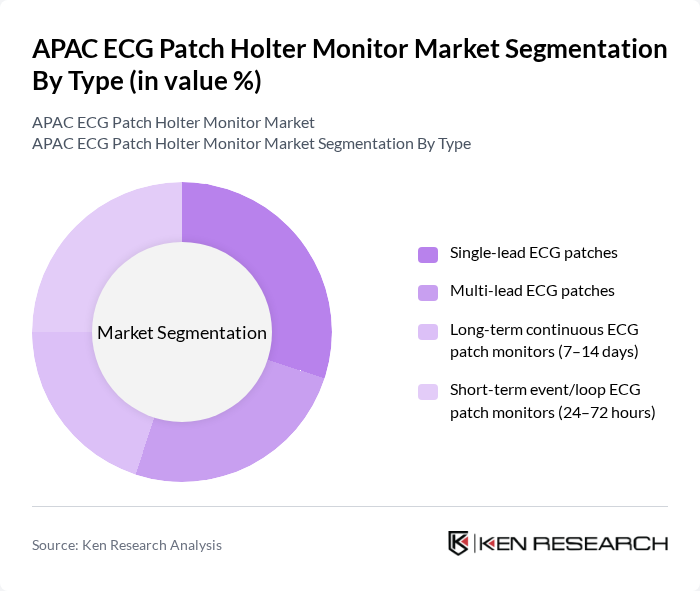
The Single-lead ECG patches segment is currently dominating the market due to their simplicity, cost-effectiveness, and ease of use. These patches are widely adopted in both clinical and home settings for basic cardiac monitoring, making them a preferred choice among healthcare providers and patients alike. The growing trend towards remote patient monitoring and the increasing incidence of arrhythmias further bolster the demand for single-lead ECG patches, solidifying their market leadership.
By End-User:The end-user segmentation includes Hospitals, Ambulatory surgical centers, Cardiology and diagnostic clinics, and Home healthcare & remote patient monitoring programs. Each end-user category reflects the diverse applications of ECG patch Holter monitors in various healthcare settings.
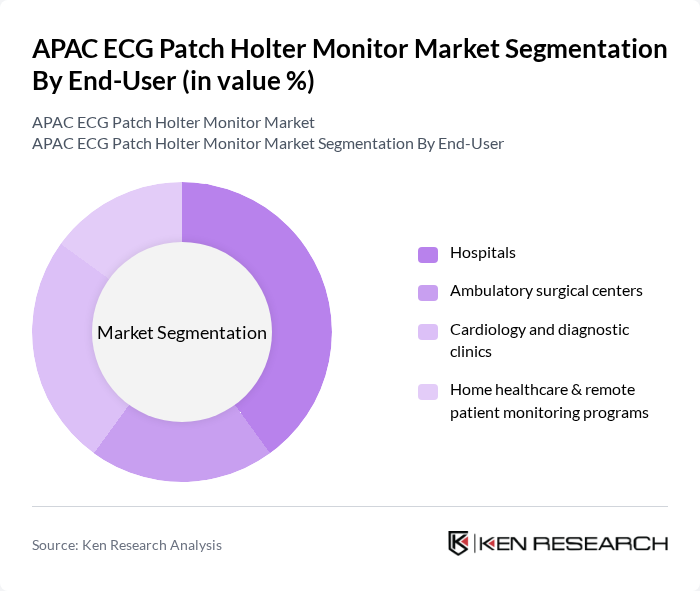
Hospitals are the leading end-user segment, primarily due to their extensive patient monitoring needs and the integration of advanced cardiac monitoring technologies in clinical practice. The increasing number of hospital admissions for cardiovascular conditions and the push for improved patient care standards are driving the demand for ECG patch Holter monitors in hospital settings. Additionally, hospitals are increasingly adopting remote monitoring solutions to enhance patient management and reduce readmission rates.
APAC ECG Patch Holter Monitor Market Competitive Landscape
The APAC ECG Patch Holter Monitor Market is characterized by a dynamic mix of regional and international players. Leading participants such as iRhythm Technologies, Inc., Koninklijke Philips N.V. (Philips Healthcare), Medtronic plc, GE HealthCare Technologies Inc., Nihon Kohden Corporation, Abbott Laboratories (including CAM patch portfolio), Boston Scientific Corporation, Biotelemetry, Inc. (a Philips company), AliveCor, Inc., Bittium Corporation, Fukuda Denshi Co., Ltd., SCHILLER AG, Hillrom / Welch Allyn (a Baxter company), Shenzhen Mindray Bio?Medical Electronics Co., Ltd., Medtronic Korea / regional APAC cardiac monitoring subsidiaries contribute to innovation, geographic expansion, and service delivery in this space.
APAC ECG Patch Holter Monitor Market Industry Analysis
Growth Drivers
- Increasing Prevalence of Cardiovascular Diseases:The World Health Organization reported that cardiovascular diseases (CVDs) account for approximately 17.9 million deaths annually, with a significant portion occurring in the APAC region. In future, it is estimated that CVDs will affect over 160 million individuals in APAC, driving the demand for ECG patch Holter monitors. This rising prevalence necessitates advanced monitoring solutions to manage and prevent complications associated with heart diseases, thereby propelling market growth.
- Technological Advancements in ECG Monitoring:The ECG monitoring technology has seen substantial advancements, with innovations such as wireless connectivity and improved battery life. In future, the global market for wearable health technology is projected to reach $70 billion, with ECG patches being a significant contributor. These advancements enhance the accuracy and convenience of monitoring, making ECG patch Holter monitors more appealing to both healthcare providers and patients, thus fostering market expansion.
- Rising Demand for Remote Patient Monitoring:The COVID-19 pandemic has accelerated the shift towards remote patient monitoring, with a reported 50% increase in telehealth services in APAC. In future, the remote patient monitoring market is expected to reach $30 billion in the region. This trend is driven by the need for continuous health monitoring without hospital visits, creating a favorable environment for ECG patch Holter monitors, which facilitate remote cardiac assessments.
Market Challenges
- High Cost of Advanced ECG Patch Monitors:The average cost of advanced ECG patch monitors can exceed $1,200, which poses a significant barrier to widespread adoption, especially in developing APAC countries. With healthcare budgets constrained, many hospitals and clinics may prioritize lower-cost alternatives, limiting the market penetration of these advanced devices. This challenge is exacerbated by the need for substantial upfront investment in technology and training.
- Limited Reimbursement Policies in Some Regions:In several APAC countries, reimbursement policies for ECG patch monitors are either non-existent or insufficient. For instance, only 35% of healthcare providers in the region report having adequate reimbursement for remote monitoring technologies. This lack of financial support discourages healthcare providers from adopting ECG patch Holter monitors, hindering market growth and limiting patient access to these innovative solutions.
APAC ECG Patch Holter Monitor Market Future Outlook
The APAC ECG patch Holter monitor market is poised for significant growth as technological innovations continue to enhance device functionality and patient engagement. The integration of artificial intelligence in ECG analysis is expected to improve diagnostic accuracy, while the expansion of telehealth services will facilitate broader access to remote monitoring solutions. As healthcare systems increasingly prioritize preventive care, the demand for ECG patch monitors will likely rise, creating a dynamic landscape for market participants in the coming years.
Market Opportunities
- Expansion of Telehealth Services:The ongoing expansion of telehealth services presents a significant opportunity for ECG patch Holter monitors. With an estimated 70% of healthcare providers in APAC planning to enhance telehealth capabilities in future, the demand for remote monitoring solutions will likely increase, driving market growth and improving patient outcomes.
- Development of AI-Driven ECG Analysis Tools:The development of AI-driven ECG analysis tools is set to revolutionize cardiac monitoring. In future, the AI healthcare market is projected to reach $45 billion, with ECG analysis being a key focus area. This innovation will enhance diagnostic capabilities, streamline workflows, and improve patient management, creating substantial opportunities for market players.
Scope of the Report
| Segment | Sub-Segments |
|---|---|
| By Type | Single-lead ECG patches Multi-lead ECG patches Long-term continuous ECG patch monitors (7–14 days) Short-term event/loop ECG patch monitors (24–72 hours) |
| By End-User | Hospitals Ambulatory surgical centers Cardiology and diagnostic clinics Home healthcare & remote patient monitoring programs |
| By Region | China Japan India South Korea Australia & New Zealand Southeast Asia (Indonesia, Malaysia, Thailand, Vietnam, others) Rest of APAC |
| By Application | Arrhythmia detection and diagnosis Post-operative and post-intervention cardiac monitoring Chronic disease and heart failure management Preventive health screening & wellness monitoring |
| By Distribution Channel | Direct sales to healthcare providers Distributor and dealer network E?commerce and OEM/telehealth platform partnerships Group purchasing organizations and tenders |
| By Technology | Bluetooth?enabled ECG patch monitors Cloud-connected ECG patch monitors with analytics platform access AI-enabled ECG patch monitors for automated rhythm analysis Others (integration with multi-parameter wearables, smartphone-based ECG patches) |
| By Policy Support | Reimbursement and coverage policies for ambulatory ECG monitoring Digital health and telemedicine guidelines Medical device registration and fast-track approval schemes Public–private partnership and innovation grants |
Key Target Audience
Investors and Venture Capitalist Firms
Government and Regulatory Bodies (e.g., Ministry of Health, Food and Drug Administration)
Manufacturers and Producers
Distributors and Retailers
Healthcare Providers and Hospitals
Medical Device Regulatory Authorities (e.g., Therapeutic Goods Administration)
Health Insurance Companies
Clinical Research Organizations
Players Mentioned in the Report:
iRhythm Technologies, Inc.
Koninklijke Philips N.V. (Philips Healthcare)
Medtronic plc
GE HealthCare Technologies Inc.
Nihon Kohden Corporation
Abbott Laboratories (including CAM patch portfolio)
Boston Scientific Corporation
Biotelemetry, Inc. (a Philips company)
AliveCor, Inc.
Bittium Corporation
Fukuda Denshi Co., Ltd.
SCHILLER AG
Hillrom / Welch Allyn (a Baxter company)
Shenzhen Mindray BioMedical Electronics Co., Ltd.
Medtronic Korea / regional APAC cardiac monitoring subsidiaries
Table of Contents
Market Assessment Phase
1. Executive Summary and Approach
2. APAC ECG Patch Holter Monitor Market Overview
2.1 Key Insights and Strategic Recommendations
2.2 APAC ECG Patch Holter Monitor Market Overview
2.3 Definition and Scope
2.4 Evolution of Market Ecosystem
2.5 Timeline of Key Regulatory Milestones
2.6 Value Chain & Stakeholder Mapping
2.7 Business Cycle Analysis
2.8 Policy & Incentive Landscape
3. APAC ECG Patch Holter Monitor Market Analysis
3.1 Growth Drivers
3.1.1 Increasing prevalence of cardiovascular diseases
3.1.2 Technological advancements in ECG monitoring
3.1.3 Rising demand for remote patient monitoring
3.1.4 Growing geriatric population in APAC
3.2 Market Challenges
3.2.1 High cost of advanced ECG patch monitors
3.2.2 Limited reimbursement policies in some regions
3.2.3 Data privacy concerns among patients
3.2.4 Competition from traditional Holter monitors
3.3 Market Opportunities
3.3.1 Expansion of telehealth services
3.3.2 Increasing partnerships with healthcare providers
3.3.3 Development of AI-driven ECG analysis tools
3.3.4 Growing awareness of preventive healthcare
3.4 Market Trends
3.4.1 Shift towards wearable health technology
3.4.2 Integration of ECG monitoring with mobile health apps
3.4.3 Focus on patient-centric healthcare solutions
3.4.4 Rise in demand for home healthcare solutions
3.5 Government Regulation
3.5.1 Stricter regulations on medical device approvals
3.5.2 Guidelines for data security in health monitoring
3.5.3 Incentives for manufacturers of innovative devices
3.5.4 Policies promoting telemedicine and remote monitoring
4. SWOT Analysis
5. Stakeholder Analysis
6. Porter's Five Forces Analysis
7. APAC ECG Patch Holter Monitor Market Size, 2019-2024
7.1 By Value
7.2 By Volume
7.3 By Average Selling Price
8. APAC ECG Patch Holter Monitor Market Segmentation
8.1 By Type
8.1.1 Single-lead ECG patches
8.1.2 Multi-lead ECG patches
8.1.3 Long-term continuous ECG patch monitors (7–14 days)
8.1.4 Short-term event/loop ECG patch monitors (24–72 hours)
8.2 By End-User
8.2.1 Hospitals
8.2.2 Ambulatory surgical centers
8.2.3 Cardiology and diagnostic clinics
8.2.4 Home healthcare & remote patient monitoring programs
8.3 By Region
8.3.1 China
8.3.2 Japan
8.3.3 India
8.3.4 South Korea
8.3.5 Australia & New Zealand
8.3.6 Southeast Asia (Indonesia, Malaysia, Thailand, Vietnam, others)
8.3.7 Rest of APAC
8.4 By Application
8.4.1 Arrhythmia detection and diagnosis
8.4.2 Post-operative and post-intervention cardiac monitoring
8.4.3 Chronic disease and heart failure management
8.4.4 Preventive health screening & wellness monitoring
8.5 By Distribution Channel
8.5.1 Direct sales to healthcare providers
8.5.2 Distributor and dealer network
8.5.3 E?commerce and OEM/telehealth platform partnerships
8.5.4 Group purchasing organizations and tenders
8.6 By Technology
8.6.1 Bluetooth?enabled ECG patch monitors
8.6.2 Cloud-connected ECG patch monitors with analytics platform access
8.6.3 AI-enabled ECG patch monitors for automated rhythm analysis
8.6.4 Others (integration with multi-parameter wearables, smartphone-based ECG patches)
8.7 By Policy Support
8.7.1 Reimbursement and coverage policies for ambulatory ECG monitoring
8.7.2 Digital health and telemedicine guidelines
8.7.3 Medical device registration and fast-track approval schemes
8.7.4 Public–private partnership and innovation grants
9. APAC ECG Patch Holter Monitor Market Competitive Analysis
9.1 Market Share of Key Players
9.2 Cross Comparison of Key Players
9.2.1 Company name and headquarters (APAC presence)
9.2.2 Group size (global revenue tier: large, mid, emerging)
9.2.3 APAC ECG patch Holter monitor revenue and 3–5 year CAGR
9.2.4 Share of ECG patch products in total cardiac monitoring portfolio
9.2.5 Installed base / number of monitored patients per year in APAC
9.2.6 Average selling price band and pricing strategy (premium/value)
9.2.7 R&D intensity (R&D spend as % of revenue) and product launch frequency
9.2.8 Regulatory and reimbursement coverage (number of APAC markets approved/reimbursed)
9.2.9 Channel strength (number of distributors / direct sales footprint in APAC)
9.2.10 Digital ecosystem capabilities (AI analytics, cloud platform, integration APIs)
9.2.11 Clinical evidence strength (number of clinical studies / key publications)
9.3 SWOT Analysis of Top Players
9.4 Pricing Analysis
9.5 Detailed Profile of Major Companies
9.5.1 iRhythm Technologies, Inc.
9.5.2 Koninklijke Philips N.V. (Philips Healthcare)
9.5.3 Medtronic plc
9.5.4 GE HealthCare Technologies Inc.
9.5.5 Nihon Kohden Corporation
9.5.6 Abbott Laboratories (including CAM patch portfolio)
9.5.7 Boston Scientific Corporation
9.5.8 Biotelemetry, Inc. (a Philips company)
9.5.9 AliveCor, Inc.
9.5.10 Bittium Corporation
9.5.11 Fukuda Denshi Co., Ltd.
9.5.12 SCHILLER AG
9.5.13 Hillrom / Welch Allyn (a Baxter company)
9.5.14 Shenzhen Mindray Bio?Medical Electronics Co., Ltd.
9.5.15 Medtronic Korea / regional APAC cardiac monitoring subsidiaries
10. APAC ECG Patch Holter Monitor Market End-User Analysis
10.1 Procurement Behavior of Key Ministries
10.1.1 Budget allocation for healthcare technology
10.1.2 Decision-making processes for procurement
10.1.3 Evaluation criteria for ECG devices
10.1.4 Others
10.2 Corporate Spend on Infrastructure & Energy
10.2.1 Investment in health technology infrastructure
10.2.2 Spending on training and support
10.2.3 Budget for maintenance and upgrades
10.2.4 Others
10.3 Pain Point Analysis by End-User Category
10.3.1 Challenges faced by hospitals
10.3.2 Issues in home care settings
10.3.3 Barriers for clinics
10.3.4 Others
10.4 User Readiness for Adoption
10.4.1 Awareness of ECG patch technology
10.4.2 Training needs for healthcare providers
10.4.3 Patient acceptance of remote monitoring
10.4.4 Others
10.5 Post-Deployment ROI and Use Case Expansion
10.5.1 Measurement of cost savings
10.5.2 Evaluation of patient outcomes
10.5.3 Opportunities for scaling usage
10.5.4 Others
11. APAC ECG Patch Holter Monitor Market Future Size, 2025-2030
11.1 By Value
11.2 By Volume
11.3 By Average Selling Price
Go-To-Market Strategy Phase
1. Whitespace Analysis + Business Model Canvas
1.1 Market gaps and opportunities
1.2 Business model components
2. Marketing and Positioning Recommendations
2.1 Branding strategies
2.2 Product USPs
3. Distribution Plan
3.1 Urban retail vs rural NGO tie-ups
4. Channel & Pricing Gaps
4.1 Underserved routes
4.2 Pricing bands
5. Unmet Demand & Latent Needs
5.1 Category gaps
5.2 Consumer segments
6. Customer Relationship
6.1 Loyalty programs
6.2 After-sales service
7. Value Proposition
7.1 Sustainability
7.2 Integrated supply chains
8. Key Activities
8.1 Regulatory compliance
8.2 Branding
8.3 Distribution setup
9. Entry Strategy Evaluation
9.1 Domestic Market Entry Strategy
9.1.1 Product mix
9.1.2 Pricing band
9.1.3 Packaging
9.2 Export Entry Strategy
9.2.1 Target countries
9.2.2 Compliance roadmap
10. Entry Mode Assessment
10.1 JV
10.2 Greenfield
10.3 M&A
10.4 Distributor Model
11. Capital and Timeline Estimation
11.1 Capital requirements
11.2 Timelines
12. Control vs Risk Trade-Off
12.1 Ownership vs Partnerships
13. Profitability Outlook
13.1 Breakeven analysis
13.2 Long-term sustainability
14. Potential Partner List
14.1 Distributors
14.2 JVs
14.3 Acquisition targets
15. Execution Roadmap
15.1 Phased Plan for Market Entry
15.1.1 Market Setup
15.1.2 Market Entry
15.1.3 Growth Acceleration
15.1.4 Scale & Stabilize
15.2 Key Activities and Milestones
15.2.1 Milestone tracking
15.2.2 Activity scheduling
Research Methodology
Phase 1: Approach1
Desk Research
- Analysis of market reports from healthcare organizations and industry associations
- Review of published articles in medical journals focusing on ECG technology and Holter monitoring
- Examination of regulatory frameworks and guidelines from health authorities across APAC countries
Primary Research
- Interviews with cardiologists and healthcare professionals using ECG patch Holter monitors
- Surveys with hospital procurement managers regarding purchasing trends and preferences
- Focus groups with patients to understand user experience and satisfaction levels
Validation & Triangulation
- Cross-validation of findings through multiple expert interviews and secondary data sources
- Triangulation of market data from healthcare providers, manufacturers, and regulatory bodies
- Sanity checks through expert panel reviews to ensure data accuracy and relevance
Phase 2: Market Size Estimation1
Top-down Assessment
- Estimation of total addressable market based on healthcare expenditure in APAC countries
- Segmentation by end-user categories such as hospitals, clinics, and home care settings
- Incorporation of growth rates from telehealth and remote patient monitoring trends
Bottom-up Modeling
- Collection of sales data from leading ECG patch manufacturers in the region
- Estimation of average selling prices and volume sold across different market segments
- Analysis of distribution channels and their impact on market penetration rates
Forecasting & Scenario Analysis
- Multi-factor regression analysis incorporating demographic trends and chronic disease prevalence
- Scenario modeling based on technological advancements and regulatory changes
- Development of baseline, optimistic, and pessimistic forecasts through 2030
Phase 3: CATI Sample Composition1
| Scope Item/Segment | Sample Size | Target Respondent Profiles |
|---|---|---|
| Cardiology Clinics | 60 | Cardiologists, Clinic Managers |
| Hospitals with Cardiology Departments | 100 | Procurement Officers, Department Heads |
| Home Healthcare Providers | 50 | Home Care Coordinators, Nurses |
| Patients Using ECG Patch Monitors | 120 | Patients, Caregivers |
| Telehealth Service Providers | 70 | Telehealth Coordinators, Technology Officers |
Frequently Asked Questions
What is the current value of the APAC ECG Patch Holter Monitor Market?
The APAC ECG Patch Holter Monitor Market is valued at approximately USD 1.5 billion, driven by the rising prevalence of cardiovascular diseases, an aging population, and advancements in wearable technology that enhance patient monitoring capabilities.
Which countries are leading in the APAC ECG Patch Holter Monitor Market?
What types of ECG patch monitors are available in the market?
What are the primary end-user segments for ECG patch Holter monitors?
Other Regional/Country Reports
Indonesia ECG Patch Holter Monitor Market
Malaysia ECG Patch Holter Monitor Market
KSA ECG Patch Holter Monitor Market
SEA ECG Patch Holter Monitor Market
Vietnam ECG Patch Holter Monitor Market
Other Adjacent Reports
Germany Wearable Cardiac Monitoring Market
UAE Remote Patient Monitoring Market Size, Share, Growth Drivers, Trends, Opportunities & Forecast 2025–2030Ksa Telehealth Services Market Report Size, Share, Growth Drivers, Trends, Opportunities & Forecast 2025–2030Brazil Cardiovascular Diagnostics Market
Mexico Medical Wearables Market
Indonesia AI ECG Analysis Market
Germany Ambulatory Monitoring Devices Market
Mexico Digital Health Solutions Market
Egypt Healthcare IoT MarketBahrain Cardiac Rehabilitation Equipment Market
Why Buy From Us?

What makes us stand out is that our consultants follow Robust, Refine and Result (RRR) methodology. Robust for clear definitions, approaches and sanity checking, Refine for differentiating respondents' facts and opinions, and Result for presenting data with story.

We have set a benchmark in the industry by offering our clients with syndicated and customized market research reports featuring coverage of entire market as well as meticulous research and analyst insights.

While we don't replace traditional research, we flip the method upside down. Our dual approach of Top Bottom & Bottom Top ensures quality deliverable by not just verifying company fundamentals but also looking at the sector and macroeconomic factors.

With one step in the future, our research team constantly tries to show you the bigger picture. We help with some of the tough questions you may encounter along the way: How is the industry positioned? Best marketing channel? KPI's of competitors? By aligning every element, we help maximize success.

Our report gives you instant access to the answers and sources that other companies might choose to hide. We elaborate each steps of research methodology we have used and showcase you the sample size to earn your trust.

If you need any support, we are here! We pride ourselves on universe strength, data quality, and quick, friendly, and professional service.