
APAC Fast Food Market Outlook to 2030
Region:Afganistan
Author(s):Meenakshi Bisht
Product Code:KROD4079
Region:Afganistan
Author(s):Meenakshi Bisht
Product Code:KROD4079
November 2024
82
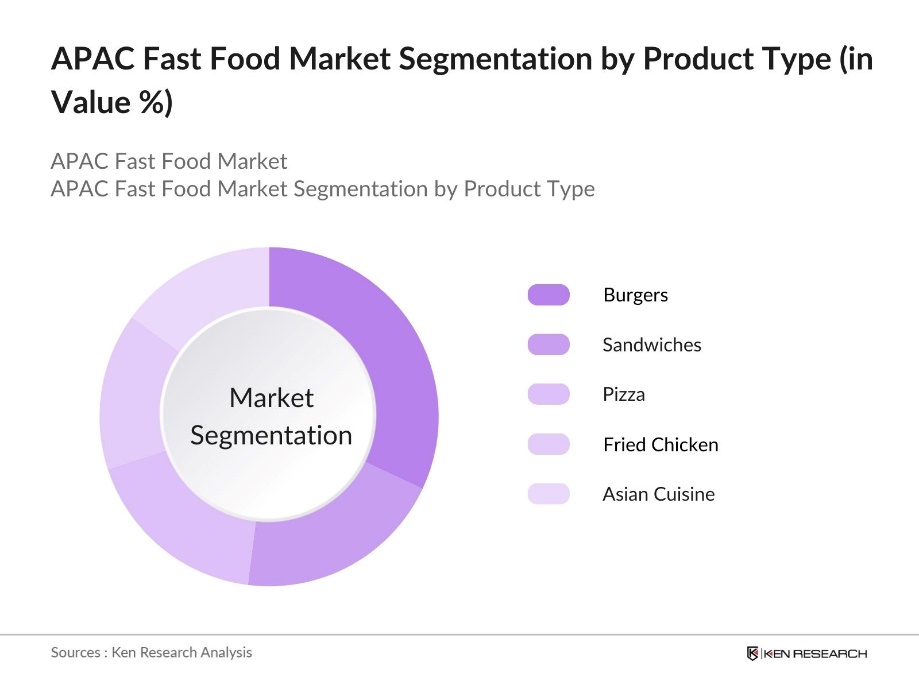
By Product Type: The APAC fast food market is segmented by product type into burgers, sandwiches, pizza, fried chicken, and Asian cuisine. Among these, burgers hold a dominant share of the market due to the widespread presence of established brands like McDonalds, Burger King, and Wendys. The appeal of burgers lies in their affordability, convenience, and adaptability to local tastes, making them a preferred option across a variety of age groups in both urban and suburban areas. Additionally, the increasing customization options and promotional deals offered by burger chains further contribute to their dominance.
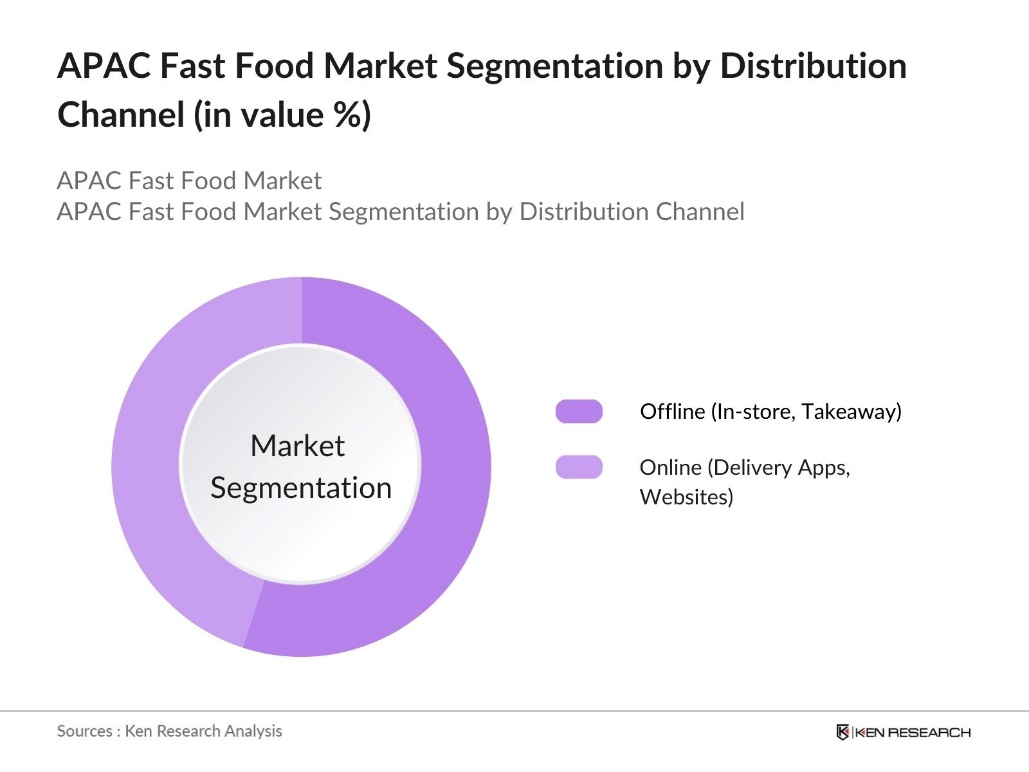
By Distribution Channel: In the APAC fast food market, distribution channels are divided into offline (in-store and takeaway) and online (delivery apps and websites). Online food delivery services have gained significant traction, accounting for a substantial portion of fast-food sales, driven by the increasing use of smartphones and the expansion of delivery platforms like GrabFood, Uber Eats, and Zomato. Particularly in highly urbanized areas such as Singapore, Tokyo, and Hong Kong, busy lifestyles and the desire for convenience have accelerated the growth of online channels, where discounts, promotions, and a wider variety of food options attract customers.
The market is highly competitive, with both global giants and regional players vying for market share. International brands leverage their global presence and marketing budgets, while local brands appeal to regional tastes and preferences. The competitive landscape of the market is dominated by international players such as McDonalds and Yum! Brands (KFC, Pizza Hut), but regional chains like Jollibee and MOS Burger are also growing rapidly.
|
Company |
Establishment Year |
Headquarters |
No. of Outlets (2023) |
Revenue (2023) |
Market Reach (No. of Countries) |
Investment in Technology |
Menu Localization Efforts |
Sustainability Initiatives |
Employee Count |
|
McDonald's Corporation |
1940 |
USA |
|||||||
|
Yum! Brands (KFC, Pizza Hut) |
1997 |
USA |
|||||||
|
Jollibee Foods Corporation |
1978 |
Philippines |
|||||||
|
Domino's Pizza Enterprises |
1960 |
USA |
|||||||
|
MOS Burger |
1972 |
Japan |
The APAC fast food market is set to continue its growth trajectory driven by several factors, including the increasing popularity of online food delivery, growing urbanization, and rising disposable incomes across the region. Over the next five years, we expect further market expansion as international chains invest in localization efforts, and new technology platforms such as AI-driven customer engagement and drone deliveries reshape the industry landscape.
|
By Product Type |
Burgers Sandwiches Pizza Chicken Asian Cuisine |
|
By Service Type |
Quick-Service Restaurants (QSR) Casual Dining Food Delivery Services |
|
By Distribution Channel |
Offline (In-Store, Takeaway) Online (Delivery Apps, Websites) |
|
By Ingredient Type |
Meat-Based Vegetarian Plant-Based Proteins Dairy-Free |
|
By Region |
China South Korea Japan India Australia Rest of APAC |
1.1. Definition and Scope
1.2. Market Taxonomy
1.3. Market Growth Rate
1.4. Market Segmentation Overview
2.1. Historical Market Size
2.2. Year-On-Year Growth Analysis
2.3. Key Market Developments and Milestones
3.1. Growth Drivers (Rising Disposable Income, Urbanization, Shifting Consumer Preferences)
3.1.1. Increased Spending on Quick-Service Restaurants (QSR)
3.1.2. Changing Lifestyle Patterns and Fast-Paced Urbanization
3.1.3. Growth in the Young Population Demographic
3.1.4. Expansion of Online Food Delivery Platforms
3.2. Market Challenges (Health Concerns, Rising Ingredient Prices, Regulations)
3.2.1. Growing Awareness of Health Issues Linked to Fast Food
3.2.2. Supply Chain Disruptions and Increasing Raw Material Costs
3.2.3. Stringent Government Regulations on Nutrition and Food Safety
3.3. Opportunities (Market Expansion, Sustainability Trends, Technological Advancements)
3.3.1. Increasing Penetration in Untapped Rural Markets
3.3.2. Rising Demand for Sustainable Packaging Solutions
3.3.3. Integration of Automation and AI in Operations
3.4. Trends (Vegan and Plant-Based Menus, Contactless Delivery, Loyalty Programs)
3.4.1. Increasing Popularity of Plant-Based and Alternative Protein Fast Foods
3.4.2. Surge in Demand for Contactless Delivery and Digital Payments
3.4.3. Expansion of Loyalty and Membership Programs for Customer Retention
3.5. Government Regulation (Food Safety Standards, Environmental Regulations)
3.5.1. APAC Region-Specific Food Labeling Laws
3.5.2. Government Initiatives to Curb Single-Use Plastic Waste
3.5.3. Nutritional Guidelines for Fast Food Operators
3.5.4. Taxation Policies Affecting Fast Food Consumption
3.6. SWOT Analysis
3.7. Stakeholder Ecosystem (Suppliers, Distributors, End-Users)
3.8. Porters Five Forces Analysis (Bargaining Power of Suppliers, Industry Rivalry)
3.9. Competition Ecosystem (Industry Landscape)
4.1. By Product Type (In Value %)
4.1.1. Burgers
4.1.2. Sandwiches
4.1.3. Pizza
4.1.4. Chicken
4.1.5. Asian Cuisine
4.2. By Service Type (In Value %)
4.2.1. Quick-Service Restaurants (QSR)
4.2.2. Casual Dining
4.2.3. Food Delivery Services
4.3. By Distribution Channel (In Value %)
4.3.1. Offline (In-Store, Takeaway)
4.3.2. Online (Delivery Apps, Websites)
4.4. By Ingredient Type (In Value %)
4.4.1. Meat-Based
4.4.2. Vegetarian
4.4.3. Plant-Based Proteins
4.4.4. Dairy-Free
4.5. By Region (In Value %)
4.5.1. China
4.5.2. South Korea
4.5.3. Japan
4.5.4. India
4.5.5. Australia
4.5.6. Rest of APAC
5.1 Detailed Profiles of Major Companies
5.1.1. McDonalds Corporation
5.1.2. Yum! Brands (KFC, Pizza Hut)
5.1.3. Restaurant Brands International (Burger King)
5.1.4. Dominos Pizza Enterprises
5.1.5. Jollibee Foods Corporation
5.1.6. Subway
5.1.7. Starbucks Corporation
5.1.8. Chick-fil-A
5.1.9. Dunkin Brands
5.1.10. Popeyes Louisiana Kitchen
5.1.11. Tim Hortons
5.1.12. Wendys
5.1.13. MOS Burger
5.1.14. Dicos
5.1.15. Lotteria
5.2 Cross Comparison Parameters (Number of Outlets, Revenue, Employee Count, Market Share, Geographical Presence, Delivery Infrastructure, Sustainability Initiatives, Technology Integration)
5.3 Market Share Analysis (Top Competitors)
5.4 Strategic Initiatives (Partnerships, Franchising, Marketing Campaigns)
5.5 Mergers And Acquisitions
5.6 Investment Analysis
5.7 Venture Capital Funding
5.8 Government Grants
5.9 Private Equity Investments
6.1 Food Safety and Hygiene Standards
6.2 Labor Laws and Employment Regulations
6.3 Taxation and Import Regulations
6.4 Environmental Compliance (Waste Management, Packaging)
7.1 Future Market Size Projections
7.2 Key Factors Driving Future Market Growth
8.1 By Product Type (In Value %)
8.2 By Service Type (In Value %)
8.3 By Distribution Channel (In Value %)
8.4 By Ingredient Type (In Value %)
8.5 By Region (In Value %)
9.1 TAM/SAM/SOM Analysis
9.2 Customer Segmentation Analysis
9.3 Marketing and Expansion Strategies
9.4 White Space Opportunity Analysis
In the initial phase, we identified the core variables influencing the APAC fast food market, including urbanization rates, per capita disposable income, and technological adoption. This step involved a review of secondary data sources such as industry reports, governmental data, and proprietary databases to ensure accuracy.
During this phase, we conducted a comprehensive analysis of market segmentation by product type and distribution channel. Historical data was gathered to evaluate trends in consumer behavior and market dynamics, focusing on revenue streams from both in-store and online sales channels.
To validate our hypotheses, we consulted industry experts through interviews, focusing on key companies in the APAC fast food market. Insights from these discussions helped refine market projections and understand operational and financial challenges faced by fast food operators.
The final step involved synthesizing data from multiple fast-food chains and food delivery platforms to provide a detailed market overview. The result is a comprehensive analysis of current market conditions, growth drivers, and competitive dynamics, ensuring a reliable and actionable report for stakeholders.
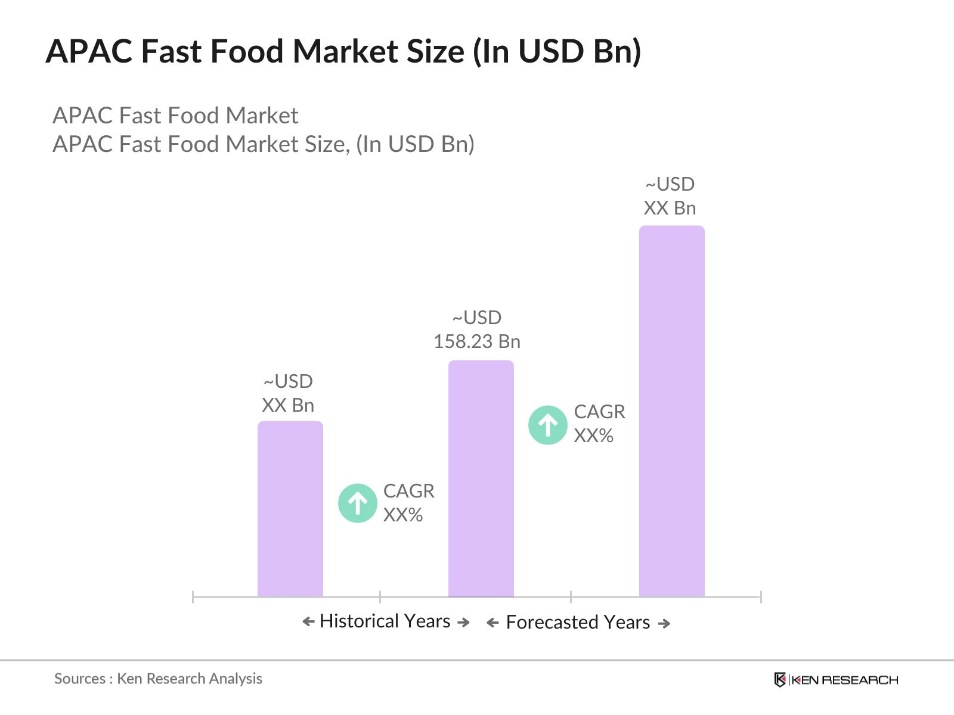
The APAC Fast Food Market is valued at USD 158.23 billion, driven by urbanization, increasing disposable income, and a growing preference for convenience food among consumers in major urban centers.
The APAC Fast Food Market is driven by urbanization, increasing disposable income, a growing youth population, and the rising popularity of online food delivery platforms. These factors contribute to the demand for quick-service restaurant options across the region.
China, Japan, and India dominate the fast-food market due to their large populations, growing middle class, and rapid urbanization. International chains have found success by localizing their menus and leveraging online food delivery services.
The major players in APAC Fast Food Market include McDonald's Corporation, Yum! Brands (KFC, Pizza Hut), Jollibee Foods Corporation, and Restaurant Brands International (Burger King), with local chains such as MOS Burger and Dicos also gaining traction.

What makes us stand out is that our consultants follows Robust, Refine and Result (RRR) methodology. i.e. Robust for clear definitions, approaches and sanity checking, Refine for differentiating respondents facts and opinions and Result for presenting data with story

We have set a benchmark in the industry by offering our clients with syndicated and customized market research reports featuring coverage of entire market as well as meticulous research and analyst insights.

While we don't replace traditional research, we flip the method upside down. Our dual approach of Top Bottom & Bottom Top ensures quality deliverable by not just verifying company fundamentals but also looking at the sector and macroeconomic factors.

With one step in the future, our research team constantly tries to show you the bigger picture. We help with some of the tough questions you may encounter along the way: How is the industry positioned? Best marketing channel? KPI's of competitors? By aligning every element, we help maximize success.

Our report gives you instant access to the answers and sources that other companies might choose to hide. We elaborate each steps of research methodology we have used and showcase you the sample size to earn your trust.

If you need any support, we are here! We pride ourselves on universe strength, data quality, and quick, friendly, and professional service.