About the Report
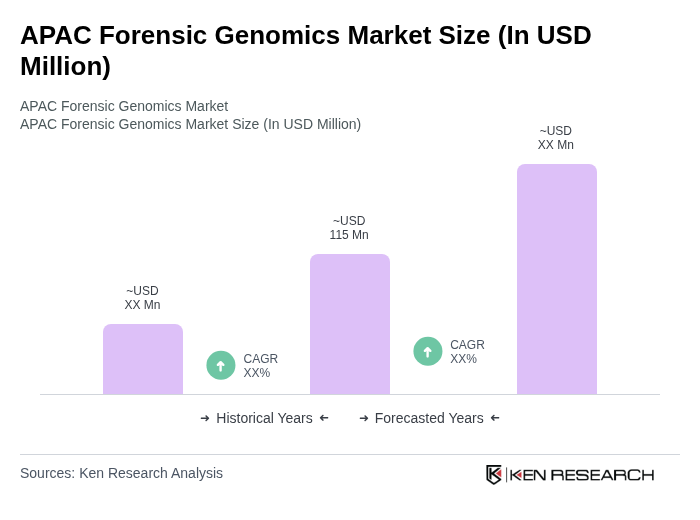
Base Year 2024APAC Forensic Genomics Market Overview
- The APAC Forensic Genomics Market is valued at USD 115 million, based on a five-year historical analysis. This growth is primarily driven by advancements in genomic technologies such as next-generation sequencing and STR profiling, increasing demand for forensic investigations, and rising awareness of genetic testing in criminal justice. The market is also supported by the growing need for accurate human identification and the expanding application of genomics in casework, paternity testing, and disaster victim identification across the region.
- Key players in this market include China, India, and Japan, which dominate due to their robust healthcare and research infrastructure, significant investments in life science and forensic R&D, and increasing government initiatives to enhance forensic capabilities. These countries are also witnessing rising volumes of criminal and civil cases where DNA evidence is used, along with expansion of national and regional DNA databases, which is propelling the adoption of advanced forensic genomics solutions.
- In 2023, the Indian government approved the National Forensic Infrastructure Enhancement Scheme under the Ministry of Home Affairs, which aims to significantly strengthen forensic science services across the country. This scheme includes funding for establishing new Central Forensic Science Laboratories and upgrading state laboratories, alongside initiatives to train personnel and promote the use of advanced forensic technologies, thereby supporting the growth of the forensic genomics market. In parallel, the Criminal Procedure (Identification) Act, 2022, issued by the Ministry of Home Affairs, Government of India, expands the legal framework for collection, storage, and processing of biometric and biological samples (including DNA) from certain categories of persons, enabling broader operational use of forensic genomics in investigations and human identification.
APAC Forensic Genomics Market Segmentation
By Product & Solution:The product and solution segment includes various offerings that cater to the needs of forensic genomics. The subsegments are Kits & Consumables, Analyzers & Sequencers, Software & Bioinformatics Tools, and Services. Each of these subsegments plays a crucial role in the overall market, with specific applications in forensic investigations and human identification.
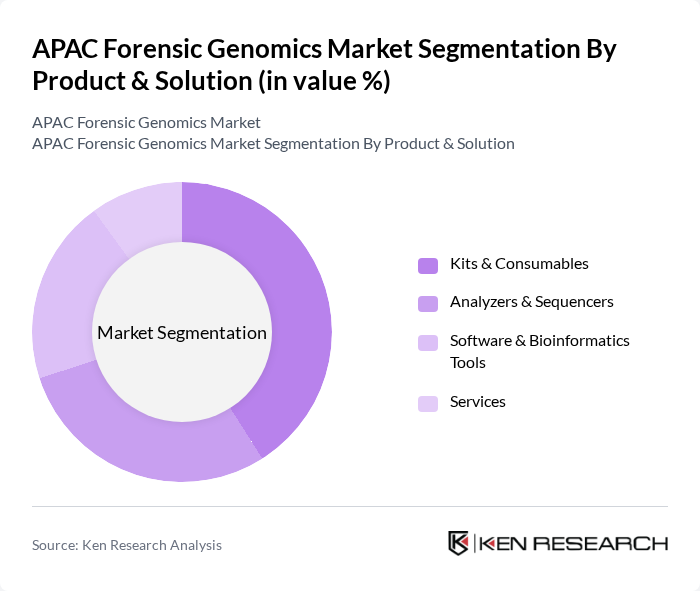
The Kits & Consumables subsegment is currently dominating the market due to the increasing demand for DNA profiling kits, PCR reagents, STR assay kits, and related consumables used in forensic laboratories. The rise in criminal investigations and the need for accurate human identification have led to a surge in the adoption of these products, particularly STR-based kits that are widely standardized for forensic use. Additionally, advancements in technology, including simplified workflows, higher-throughput formats, and improved sensitivity for degraded samples, have made these kits more accessible and user-friendly, further driving their popularity among law enforcement agencies and forensic professionals in APAC.
By Application:The application segment encompasses various uses of forensic genomics, including Criminal Investigation & Casework, Human Identification, Paternity & Kinship Testing, Missing Person & Unidentified Remains Identification, Disaster Victim Identification (DVI), and Others. Each application serves a unique purpose in the forensic field, contributing to the overall growth of the market.
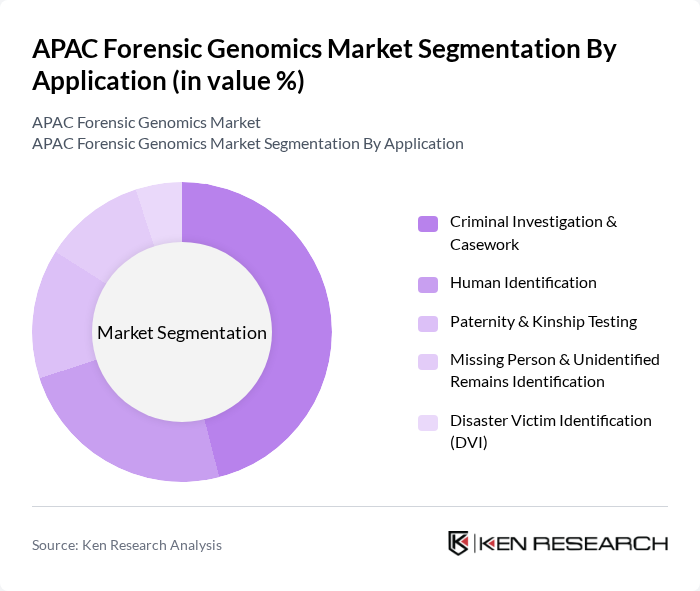
The Criminal Investigation & Casework application is the leading segment in the market, driven by the increasing number of criminal cases requiring forensic DNA analysis and the expansion of DNA databases across APAC. Law enforcement agencies are increasingly relying on genomic technologies, including STR profiling, next-generation sequencing, and rapid DNA systems, to solve crimes and accelerate case resolution, leading to a higher demand for forensic genomics solutions. The growing awareness of the importance of DNA evidence in legal proceedings, along with government-funded programs to modernize forensic infrastructure, further supports the dominance of this application in the market.
APAC Forensic Genomics Market Competitive Landscape
The APAC Forensic Genomics Market is characterized by a dynamic mix of regional and international players. Leading participants such as Thermo Fisher Scientific Inc., QIAGEN N.V., Illumina, Inc., Agilent Technologies, Inc., Bio-Rad Laboratories, Inc., LGC Limited, Eurofins Scientific SE, Promega Corporation, Merck KGaA, BGI Group, Genomatix Software GmbH, F. Hoffmann-La Roche Ltd, MGI Tech Co., Ltd., Zymo Research Corp., DNA Genotek Inc. contribute to innovation, geographic expansion, and service delivery in this space.
APAC Forensic Genomics Market Industry Analysis
Growth Drivers
- Increasing Crime Rates:The APAC region has witnessed a significant rise in crime rates, with reported incidents increasing by approximately 10% annually. In future, the total number of crimes reported reached over 25 million across major countries, prompting law enforcement agencies to seek advanced forensic solutions. This surge in criminal activities necessitates the adoption of forensic genomics, as it provides critical evidence for solving cases and enhancing public safety, thereby driving market growth.
- Advancements in DNA Sequencing Technologies:The rapid evolution of DNA sequencing technologies has led to a reduction in processing times and costs. For instance, the cost of whole-genome sequencing has dropped from $1,000 in the past to approximately $200 in future. This technological advancement enables forensic laboratories to analyze genetic material more efficiently, increasing the accuracy and reliability of forensic investigations, which is crucial for law enforcement agencies in the APAC region.
- Government Initiatives for Forensic Science Development:Governments across the APAC region are increasingly investing in forensic science development. In future, the total government expenditure on forensic science initiatives reached $600 million, with plans to increase this budget by 20% in future. These initiatives include funding for research, training programs, and the establishment of new forensic laboratories, which collectively enhance the capabilities of forensic genomics and support its market growth.
Market Challenges
- High Costs of Forensic Genomics Services:The high costs associated with forensic genomics services pose a significant challenge to market growth. For instance, the average cost of DNA analysis can range from $500 to $2,500 per case, depending on the complexity of the analysis. This financial barrier limits access for smaller law enforcement agencies and private entities, hindering the widespread adoption of forensic genomics solutions in the APAC region.
- Ethical and Privacy Concerns:Ethical and privacy concerns surrounding the use of genetic data are increasingly prominent in the APAC region. In future, over 70% of the population expressed apprehension regarding the potential misuse of their genetic information. This public sentiment has led to calls for stricter regulations and guidelines, which can slow down the implementation of forensic genomics technologies and create uncertainty in the market.
APAC Forensic Genomics Market Future Outlook
The future of the APAC forensic genomics market appears promising, driven by technological advancements and increasing collaboration between public and private sectors. As governments enhance funding for forensic science, the integration of artificial intelligence in forensic analysis is expected to streamline processes and improve accuracy. Additionally, the rising demand for genetic genealogy services will likely expand the market further, creating new avenues for growth and innovation in forensic genomics applications across the region.
Market Opportunities
- Expansion of Forensic Laboratories:The establishment of new forensic laboratories in urban areas presents a significant opportunity for market growth. With over 40 new labs projected to open in future, this expansion will enhance local law enforcement capabilities and improve response times in criminal investigations, ultimately increasing the demand for forensic genomics services.
- Integration of AI in Forensic Analysis:The integration of artificial intelligence in forensic analysis is set to revolutionize the industry. In future, AI-driven tools are expected to improve data processing speeds by up to 60%, allowing forensic experts to analyze complex genetic data more efficiently. This technological shift will enhance the accuracy of forensic investigations and drive the adoption of genomics solutions in the APAC market.
Scope of the Report
| Segment | Sub-Segments |
|---|---|
| By Product & Solution | Kits & Consumables Analyzers & Sequencers Software & Bioinformatics Tools Services |
| By Application | Criminal Investigation & Casework Human Identification Paternity & Kinship Testing Missing Person & Unidentified Remains Identification Disaster Victim Identification (DVI) Others |
| By Technology / Method | PCR Amplification Capillary Electrophoresis (CE) Next-Generation Sequencing (NGS) Microarray & Other Methods |
| By End-User | Forensic Laboratories Law Enforcement Agencies Government Agencies & Public Security Departments Research & Academic Institutes Contract Research Organizations (CROs) Others |
| By Sample Type | Blood Samples Hair & Fiber Samples Saliva & Buccal Swabs Bone, Teeth & Degraded Samples Others |
| By Country / Sub-Region | China India Japan South Korea Australia & New Zealand Southeast Asia Rest of APAC |
Key Target Audience
Investors and Venture Capitalist Firms
Government and Regulatory Bodies (e.g., National Institute of Health, Ministry of Health and Family Welfare)
Law Enforcement Agencies
Forensic Laboratories
Biotechnology and Genomics Companies
Healthcare Providers and Hospitals
Pharmaceutical Companies
Insurance Companies
Players Mentioned in the Report:
Thermo Fisher Scientific Inc.
QIAGEN N.V.
Illumina, Inc.
Agilent Technologies, Inc.
Bio-Rad Laboratories, Inc.
LGC Limited
Eurofins Scientific SE
Promega Corporation
Merck KGaA
BGI Group
Genomatix Software GmbH
F. Hoffmann-La Roche Ltd
MGI Tech Co., Ltd.
Zymo Research Corp.
DNA Genotek Inc.
Table of Contents
Market Assessment Phase
1. Executive Summary and Approach
2. APAC Forensic Genomics Market Overview
2.1 Key Insights and Strategic Recommendations
2.2 APAC Forensic Genomics Market Overview
2.3 Definition and Scope
2.4 Evolution of Market Ecosystem
2.5 Timeline of Key Regulatory Milestones
2.6 Value Chain & Stakeholder Mapping
2.7 Business Cycle Analysis
2.8 Policy & Incentive Landscape
3. APAC Forensic Genomics Market Analysis
3.1 Growth Drivers
3.1.1 Increasing Crime Rates
3.1.2 Advancements in DNA Sequencing Technologies
3.1.3 Rising Demand for Paternity Testing
3.1.4 Government Initiatives for Forensic Science Development
3.2 Market Challenges
3.2.1 High Costs of Forensic Genomics Services
3.2.2 Ethical and Privacy Concerns
3.2.3 Limited Awareness Among Law Enforcement Agencies
3.2.4 Regulatory Hurdles in Different Countries
3.3 Market Opportunities
3.3.1 Expansion of Forensic Laboratories
3.3.2 Integration of AI in Forensic Analysis
3.3.3 Collaborations with Academic Institutions
3.3.4 Growth in Private Sector Forensic Services
3.4 Market Trends
3.4.1 Increasing Use of Next-Generation Sequencing
3.4.2 Adoption of Mobile Forensic Solutions
3.4.3 Rising Popularity of Genetic Genealogy
3.4.4 Focus on Environmental Forensics
3.5 Government Regulation
3.5.1 Data Protection Laws
3.5.2 Forensic Evidence Standards
3.5.3 Regulations on DNA Databases
3.5.4 Guidelines for Ethical Use of Genetic Information
4. SWOT Analysis
5. Stakeholder Analysis
6. Porter's Five Forces Analysis
7. APAC Forensic Genomics Market Market Size, 2019-2024
7.1 By Value
7.2 By Volume
7.3 By Average Selling Price
8. APAC Forensic Genomics Market Segmentation
8.1 By Product & Solution
8.1.1 Kits & Consumables
8.1.2 Analyzers & Sequencers
8.1.3 Software & Bioinformatics Tools
8.1.4 Services
8.2 By Application
8.2.1 Criminal Investigation & Casework
8.2.2 Human Identification
8.2.3 Paternity & Kinship Testing
8.2.4 Missing Person & Unidentified Remains Identification
8.2.5 Disaster Victim Identification (DVI)
8.2.6 Others
8.3 By Technology / Method
8.3.1 PCR Amplification
8.3.2 Capillary Electrophoresis (CE)
8.3.3 Next-Generation Sequencing (NGS)
8.3.4 Microarray & Other Methods
8.4 By End-User
8.4.1 Forensic Laboratories
8.4.2 Law Enforcement Agencies
8.4.3 Government Agencies & Public Security Departments
8.4.4 Research & Academic Institutes
8.4.5 Contract Research Organizations (CROs)
8.4.6 Others
8.5 By Sample Type
8.5.1 Blood Samples
8.5.2 Hair & Fiber Samples
8.5.3 Saliva & Buccal Swabs
8.5.4 Bone, Teeth & Degraded Samples
8.5.5 Others
8.6 By Country / Sub-Region
8.6.1 China
8.6.2 India
8.6.3 Japan
8.6.4 South Korea
8.6.5 Australia & New Zealand
8.6.6 Southeast Asia
8.6.7 Rest of APAC
9. APAC Forensic Genomics Market Competitive Analysis
9.1 Market Share of Key Players
9.2 Cross Comparison of Key Players
9.2.1 Company Name
9.2.2 APAC Forensic Genomics Revenue (USD Million)
9.2.3 APAC Forensic Genomics Revenue CAGR, 2019-2024 (%)
9.2.4 APAC Market Share (%)
9.2.5 Product & Solution Mix (Kits, Instruments, Software, Services)
9.2.6 R&D Intensity (% of Revenue)
9.2.7 New Product Launches / Pipeline (Annual Count)
9.2.8 Geographic Footprint in APAC (Countries Covered, No. of Labs / Facilities)
9.2.9 Key Strategic Partnerships & Government Contracts (Count, Value)
9.2.10 Average Deal Size with Public Sector Clients (USD)
9.2.11 Gross Margin (%)
9.2.12 EBITDA Margin (%)
9.2.13 Installed Base of Forensic Genomics Systems in APAC (Units)
9.2.14 Average Selling Price Trend (2019-2024)
9.3 SWOT Analysis of Top Players
9.4 Pricing Analysis
9.5 Detailed Profile of Major Companies
9.5.1 Thermo Fisher Scientific Inc.
9.5.2 QIAGEN N.V.
9.5.3 Illumina, Inc.
9.5.4 Agilent Technologies, Inc.
9.5.5 Bio-Rad Laboratories, Inc.
9.5.6 LGC Limited
9.5.7 Eurofins Scientific SE
9.5.8 Promega Corporation
9.5.9 Merck KGaA
9.5.10 BGI Group
9.5.11 Genomatix Software GmbH
9.5.12 F. Hoffmann-La Roche Ltd
9.5.13 MGI Tech Co., Ltd.
9.5.14 Zymo Research Corp.
9.5.15 DNA Genotek Inc.
10. APAC Forensic Genomics Market End-User Analysis
10.1 Procurement Behavior of Key Ministries
10.1.1 Budget Allocation for Forensic Services
10.1.2 Decision-Making Processes
10.1.3 Preferred Suppliers
10.1.4 Compliance Requirements
10.2 Corporate Spend on Infrastructure & Energy
10.2.1 Investment in Forensic Technologies
10.2.2 Funding for Research and Development
10.2.3 Infrastructure Upgrades
10.2.4 Others
10.3 Pain Point Analysis by End-User Category
10.3.1 Challenges in Evidence Collection
10.3.2 Limitations of Current Technologies
10.3.3 Need for Training and Skill Development
10.3.4 Others
10.4 User Readiness for Adoption
10.4.1 Awareness of Forensic Genomics
10.4.2 Willingness to Invest in New Technologies
10.4.3 Training Needs
10.4.4 Others
10.5 Post-Deployment ROI and Use Case Expansion
10.5.1 Measurement of Success Metrics
10.5.2 Expansion into New Applications
10.5.3 Long-term Cost Savings
10.5.4 Others
11. APAC Forensic Genomics Market Future Size, 2025-2030
11.1 By Value
11.2 By Volume
11.3 By Average Selling Price
Go-To-Market Strategy Phase
1. Whitespace Analysis + Business Model Canvas
1.1 Market Gaps Identification
1.2 Business Model Development
2. Marketing and Positioning Recommendations
2.1 Branding Strategies
2.2 Product USPs
3. Distribution Plan
3.1 Urban Retail vs Rural NGO Tie-ups
4. Channel & Pricing Gaps
4.1 Underserved Routes
4.2 Pricing Bands
5. Unmet Demand & Latent Needs
5.1 Category Gaps
5.2 Consumer Segments
6. Customer Relationship
6.1 Loyalty Programs
6.2 After-sales Service
7. Value Proposition
7.1 Sustainability
7.2 Integrated Supply Chains
8. Key Activities
8.1 Regulatory Compliance
8.2 Branding
8.3 Distribution Setup
9. Entry Strategy Evaluation
9.1 Domestic Market Entry Strategy
9.1.1 Product Mix
9.1.2 Pricing Band
9.1.3 Packaging
9.2 Export Entry Strategy
9.2.1 Target Countries
9.2.2 Compliance Roadmap
10. Entry Mode Assessment
10.1 JV
10.2 Greenfield
10.3 M&A
10.4 Distributor Model
11. Capital and Timeline Estimation
11.1 Capital Requirements
11.2 Timelines
12. Control vs Risk Trade-Off
12.1 Ownership vs Partnerships
13. Profitability Outlook
13.1 Breakeven Analysis
13.2 Long-term Sustainability
14. Potential Partner List
14.1 Distributors
14.2 JVs
14.3 Acquisition Targets
15. Execution Roadmap
15.1 Phased Plan for Market Entry
15.1.1 Market Setup
15.1.2 Market Entry
15.1.3 Growth Acceleration
15.1.4 Scale & Stabilize
15.2 Key Activities and Milestones
15.2.1 Milestone Planning
15.2.2 Activity Tracking
Research Methodology
Phase 1: Approach1
Desk Research
- Analysis of market reports from industry associations and government publications related to forensic genomics
- Review of scientific literature and journals focusing on advancements in genomic technologies and their applications in forensics
- Examination of patent filings and intellectual property trends in the forensic genomics sector
Primary Research
- Interviews with forensic scientists and laboratory directors to understand current practices and technology adoption
- Surveys with law enforcement agencies to gauge the demand for forensic genomic services
- Focus groups with legal professionals to assess the impact of genomic evidence in court cases
Validation & Triangulation
- Cross-validation of findings through multiple data sources, including academic research and industry reports
- Triangulation of qualitative insights from interviews with quantitative data from market surveys
- Sanity checks conducted through expert panel reviews comprising industry veterans and academic researchers
Phase 2: Market Size Estimation1
Top-down Assessment
- Estimation of the overall forensic genomics market size based on national crime statistics and forensic case volumes
- Segmentation of the market by application areas such as criminal investigations, paternity testing, and disaster victim identification
- Incorporation of government funding and initiatives aimed at enhancing forensic capabilities in the APAC region
Bottom-up Modeling
- Collection of data on laboratory capacities and throughput from leading forensic genomics providers
- Operational cost analysis based on service pricing models and technology investments
- Volume x cost calculations for various service offerings, including DNA sequencing and analysis
Forecasting & Scenario Analysis
- Multi-factor regression analysis incorporating crime rate trends, technological advancements, and regulatory changes
- Scenario modeling based on potential shifts in public policy and funding for forensic science
- Development of baseline, optimistic, and pessimistic forecasts through 2030
Phase 3: CATI Sample Composition1
| Scope Item/Segment | Sample Size | Target Respondent Profiles |
|---|---|---|
| Criminal Investigation Agencies | 100 | Forensic Analysts, Crime Scene Investigators |
| Private Forensic Laboratories | 80 | Laboratory Managers, DNA Analysts |
| Legal Professionals | 60 | Criminal Defense Attorneys, Prosecutors |
| Government Regulatory Bodies | 50 | Policy Makers, Forensic Science Advisors |
| Academic Institutions | 70 | Research Scientists, Forensic Educators |
Frequently Asked Questions
What is the current value of the APAC Forensic Genomics Market?
The APAC Forensic Genomics Market is valued at approximately USD 115 million, driven by advancements in genomic technologies, increasing demand for forensic investigations, and rising awareness of genetic testing in criminal justice across the region.
Which countries dominate the APAC Forensic Genomics Market?
What are the key applications of forensic genomics in APAC?
What are the main growth drivers for the APAC Forensic Genomics Market?
Other Regional/Country Reports
Indonesia Forensic Genomics Market
Malaysia Forensic Genomics Market
SEA Forensic Genomics Market
Vietnam Forensic Genomics Market
Thailand Forensic Genomics Market
Other Adjacent Reports
Belgium Next-Generation Sequencing Market
UAE Bioinformatics MarketPhilippines Molecular Diagnostics Market Size Share Growth Drivers Trends Opportunities & Forecast 2025–2030South Africa Forensic Technology Market
Singapore Human Identification Market
Saudi Arabia biotechnology market Size, Share, Growth Drivers, Trends, Opportunities & Forecast 2025–2030Kuwait ASEAN Laboratory Equipment Market Report Size Share Growth Drivers Trends Opportunities & Forecast 2025–2030Singapore DNA Analysis Market
Qatar Life Sciences Market
Why Buy From Us?

What makes us stand out is that our consultants follow Robust, Refine and Result (RRR) methodology. Robust for clear definitions, approaches and sanity checking, Refine for differentiating respondents' facts and opinions, and Result for presenting data with story.

We have set a benchmark in the industry by offering our clients with syndicated and customized market research reports featuring coverage of entire market as well as meticulous research and analyst insights.

While we don't replace traditional research, we flip the method upside down. Our dual approach of Top Bottom & Bottom Top ensures quality deliverable by not just verifying company fundamentals but also looking at the sector and macroeconomic factors.

With one step in the future, our research team constantly tries to show you the bigger picture. We help with some of the tough questions you may encounter along the way: How is the industry positioned? Best marketing channel? KPI's of competitors? By aligning every element, we help maximize success.

Our report gives you instant access to the answers and sources that other companies might choose to hide. We elaborate each steps of research methodology we have used and showcase you the sample size to earn your trust.

If you need any support, we are here! We pride ourselves on universe strength, data quality, and quick, friendly, and professional service.