About the Report
Base Year 2024APAC Glamping Market Overview
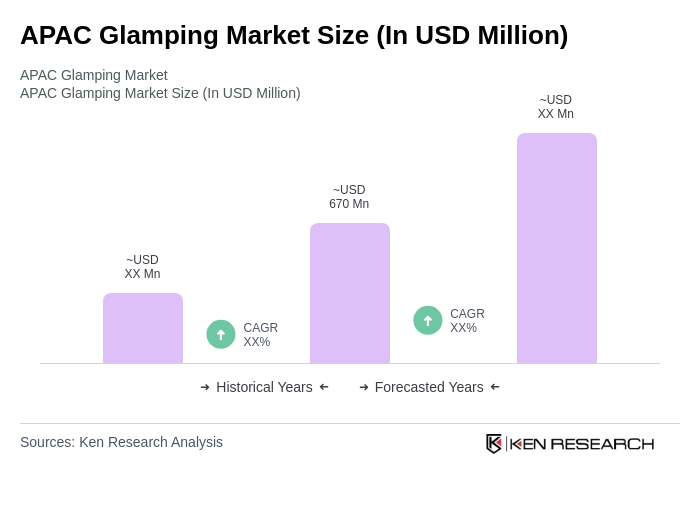
- The APAC Glamping Market is valued at USD 670 million, based on a five-year historical analysis . This growth is primarily driven by the increasing demand for unique outdoor experiences, expansion of domestic travel, rising disposable incomes, and a growing trend towards eco-tourism. The market is further supported by the popularity of experiential stays and the proliferation of glamping sites offering luxury accommodations such as tents, treehouses, and domes across the region .
- Countries such as Australia, Japan, and China dominate the APAC Glamping Market due to their diverse landscapes, robust tourism infrastructure, and a growing interest in outdoor recreational activities. Australia benefits from its extensive national parks and favorable climate, while Japan and China leverage their scenic locations and established travel sectors to attract glamping enthusiasts . India is also emerging as a high-growth market, with notable destinations such as Rishikesh, Jaisalmer, Munnar, Shimla, and Wayanad offering a variety of glamping experiences .
- In 2023, the Ministry of Tourism, Government of India, issued the “Guidelines for Approval of Caravan and Camping Parks” to promote sustainable tourism, including glamping sites. These guidelines require operators to implement eco-friendly practices such as effective waste management, use of renewable energy sources, and preservation of local ecology, thereby enhancing the appeal of glamping as a sustainable travel option .
APAC Glamping Market Segmentation
By Type:The glamping market can be segmented into various types, including luxury tents, yurts, treehouses, safari tents, airstreams, domes, cabins & pods, and others. Each type offers unique experiences and caters to different consumer preferences, contributing to the overall growth of the market .
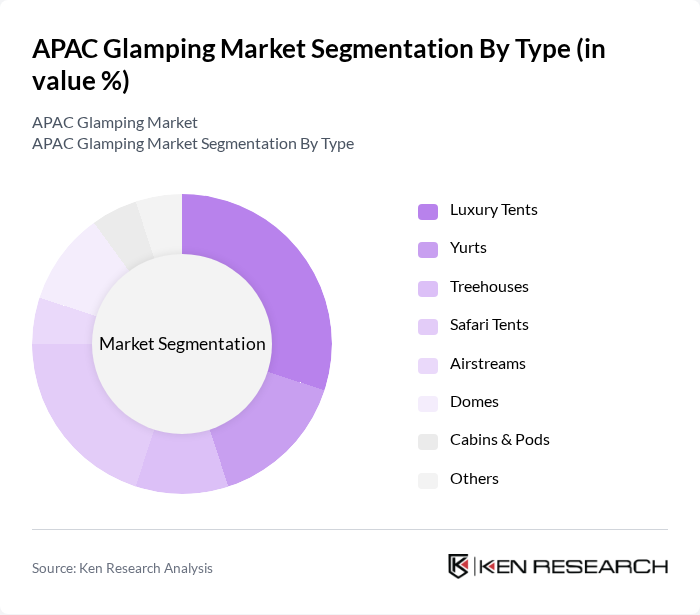
The Luxury Tents segment is currently dominating the market due to their appeal to affluent travelers seeking comfort and unique experiences in nature. This segment has seen a rise in demand as consumers prioritize high-quality amenities and personalized services while enjoying the outdoors. The trend towards experiential travel and eco-consciousness has further fueled the popularity of luxury tents and similar accommodations .
By End-User:The end-user segmentation includes families, couples, solo travelers, corporate groups, millennials (18-32 years), middle-aged (33-50 years), and seniors (51+ years). Each group has distinct preferences and motivations for choosing glamping as a travel option .
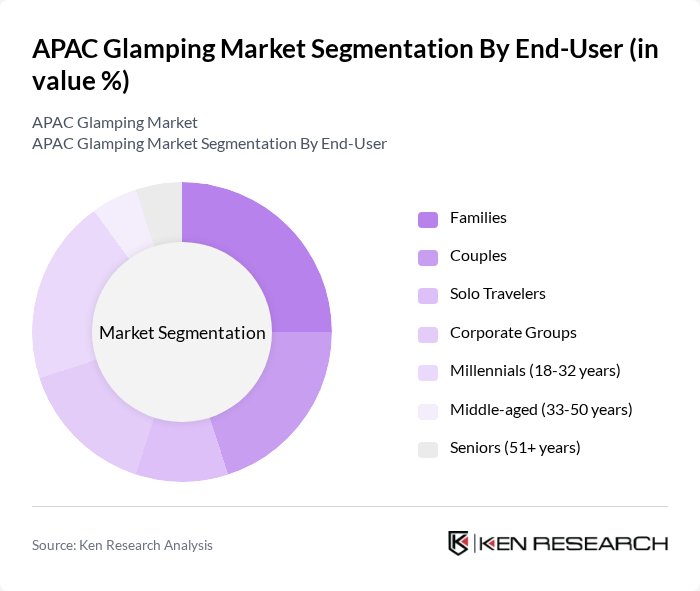
Families represent a significant portion of the end-user market, as glamping offers a unique way to bond and create lasting memories in nature. The appeal of family-friendly amenities and activities, along with the safety and comfort provided by glamping sites, makes this segment particularly attractive. Millennials are increasingly drawn to glamping for its blend of adventure, luxury, and sustainability, making them the largest revenue-generating age group in the APAC region .
APAC Glamping Market Competitive Landscape
The APAC Glamping Market is characterized by a dynamic mix of regional and international players. Leading participants such as Collective Retreats, Under Canvas, Tanja Lagoon Camp, Glamping Hub, Eco Retreats India, The Glamping Company Australia, Natra Bintan (Singapore/Indonesia), Klook Experiences, Treehouse Villas Thailand, Hoshinoya Fuji (Japan), Jaisalmer Desert Glamping (India), Glamping Dome Korea, Wayanad Wild (India), Glamping Society (Singapore), The Canopi (Indonesia) contribute to innovation, geographic expansion, and service delivery in this space .
APAC Glamping Market Industry Analysis
Growth Drivers
- Increasing Demand for Unique Travel Experiences:The APAC region has seen a surge in travelers seeking distinctive experiences, with 75% of tourists preferring unique accommodations over traditional hotels. This trend is driven by a desire for adventure and personalization, as evidenced by the 18 million glamping trips taken in future alone. The rise of social media platforms has further amplified this demand, as travelers share their unique experiences, encouraging others to explore glamping options.
- Rising Disposable Incomes in the APAC Region:The World Bank projects that the average disposable income in APAC countries will increase by 6% in future, reaching approximately $4,800 per capita. This economic growth enables more consumers to spend on leisure activities, including glamping. As more individuals can afford luxury travel experiences, the glamping sector is poised to benefit significantly, with an estimated 22% increase in bookings anticipated in future.
- Growing Awareness of Eco-Friendly Tourism:With 65% of travelers in APAC prioritizing sustainability, the glamping market is well-positioned to capitalize on this trend. Eco-conscious consumers are increasingly seeking accommodations that minimize environmental impact. In future, eco-friendly glamping sites reported a 35% increase in occupancy rates, reflecting the growing preference for sustainable travel options. This shift is supported by government initiatives promoting eco-tourism, further driving market growth.
Market Challenges
- High Initial Investment Costs:Establishing a glamping site requires significant capital, often exceeding $600,000 for land acquisition and infrastructure development. This financial barrier can deter potential investors, especially in regions where land prices are escalating. Additionally, ongoing operational costs, including maintenance and staffing, can further strain budgets, making it challenging for new entrants to sustain profitability in a competitive market.
- Regulatory Hurdles in Land Use:Navigating zoning laws and land use regulations poses a significant challenge for glamping operators. In many APAC countries, obtaining the necessary permits can take up to 14 months, delaying project launches. Furthermore, stringent environmental regulations may limit site locations, particularly in ecologically sensitive areas. These regulatory complexities can hinder market entry and expansion for new glamping businesses.
APAC Glamping Market Future Outlook
The APAC glamping market is expected to evolve significantly, driven by technological advancements and a heightened focus on sustainability. As operators increasingly integrate smart technologies into their offerings, such as mobile booking systems and eco-friendly amenities, customer engagement will improve. Additionally, the growing trend of wellness tourism will likely lead to the development of specialized glamping experiences that cater to health-conscious travelers, further diversifying the market landscape and enhancing its appeal.
Market Opportunities
- Development of New Glamping Sites:There is a substantial opportunity for the establishment of new glamping sites in underutilized natural areas. With over 1,200 potential locations identified across APAC, operators can tap into unexplored markets, catering to the increasing demand for unique outdoor experiences. This expansion can significantly enhance regional tourism and create local employment opportunities.
- Partnerships with Travel Agencies:Collaborating with travel agencies can enhance visibility and attract a broader customer base. By forming strategic partnerships, glamping operators can leverage existing networks to promote their offerings, potentially increasing bookings by 30%. This approach not only boosts sales but also enhances the overall travel experience by providing curated packages that combine glamping with local attractions.
Scope of the Report
| Segment | Sub-Segments |
|---|---|
| By Type | Luxury Tents Yurts Treehouses Safari Tents Airstreams Domes Cabins & Pods Others |
| By End-User | Families Couples Solo Travelers Corporate Groups Millennials (18-32 years) Middle-aged (33-50 years) Seniors (51+ years) |
| By Region | China Japan South Korea India Australia Southeast Asia Rest of APAC |
| By Seasonality | Peak Season Off-Peak Season |
| By Price Range | Budget Mid-Range Luxury |
| By Booking Channel | Online Travel Agencies Direct Bookings Travel Agents |
| By Experience Type | Adventure Glamping Wellness Glamping Family-Friendly Glamping Romantic Getaways Eco-Friendly Glamping |
Key Target Audience
Investors and Venture Capitalist Firms
Government and Regulatory Bodies (e.g., Ministry of Tourism, National Parks Authority)
Manufacturers and Producers of Glamping Equipment
Distributors and Retailers of Outdoor and Camping Gear
Hospitality and Resort Management Companies
Tourism Boards and Promotion Agencies
Real Estate Developers and Landowners
Environmental and Sustainability Organizations
Players Mentioned in the Report:
Collective Retreats
Under Canvas
Tanja Lagoon Camp
Glamping Hub
Eco Retreats India
The Glamping Company Australia
Natra Bintan (Singapore/Indonesia)
Klook Experiences
Treehouse Villas Thailand
Hoshinoya Fuji (Japan)
Jaisalmer Desert Glamping (India)
Glamping Dome Korea
Wayanad Wild (India)
Glamping Society (Singapore)
The Canopi (Indonesia)
Table of Contents
Market Assessment Phase
1. Executive Summary and Approach
2. APAC Glamping Market Overview
2.1 Key Insights and Strategic Recommendations
2.2 APAC Glamping Market Overview
2.3 Definition and Scope
2.4 Evolution of Market Ecosystem
2.5 Timeline of Key Regulatory Milestones
2.6 Value Chain & Stakeholder Mapping
2.7 Business Cycle Analysis
2.8 Policy & Incentive Landscape
3. APAC Glamping Market Analysis
3.1 Growth Drivers
3.1.1 Increasing demand for unique travel experiences
3.1.2 Rising disposable incomes in the APAC region
3.1.3 Growing awareness of eco-friendly tourism
3.1.4 Expansion of luxury camping facilities
3.2 Market Challenges
3.2.1 High initial investment costs
3.2.2 Regulatory hurdles in land use
3.2.3 Seasonal fluctuations in demand
3.2.4 Competition from traditional accommodations
3.3 Market Opportunities
3.3.1 Development of new glamping sites
3.3.2 Partnerships with travel agencies
3.3.3 Customization of glamping experiences
3.3.4 Expansion into emerging markets
3.4 Market Trends
3.4.1 Increasing integration of technology in glamping
3.4.2 Focus on sustainability and eco-friendliness
3.4.3 Rise of social media influence on travel choices
3.4.4 Growth of wellness-focused glamping options
3.5 Government Regulation
3.5.1 Zoning laws affecting glamping site locations
3.5.2 Environmental protection regulations
3.5.3 Health and safety standards for accommodations
3.5.4 Licensing requirements for operators
4. SWOT Analysis
5. Stakeholder Analysis
6. Porter's Five Forces Analysis
7. APAC Glamping Market Market Size, 2019-2024
7.1 By Value
7.2 By Volume
7.3 By Average Selling Price
8. APAC Glamping Market Segmentation
8.1 By Type
8.1.1 Luxury Tents
8.1.2 Yurts
8.1.3 Treehouses
8.1.4 Safari Tents
8.1.5 Airstreams
8.1.6 Domes
8.1.7 Cabins & Pods
8.1.8 Others
8.2 By End-User
8.2.1 Families
8.2.2 Couples
8.2.3 Solo Travelers
8.2.4 Corporate Groups
8.2.5 Millennials (18-32 years)
8.2.6 Middle-aged (33-50 years)
8.2.7 Seniors (51+ years)
8.3 By Region
8.3.1 China
8.3.2 Japan
8.3.3 South Korea
8.3.4 India
8.3.5 Australia
8.3.6 Southeast Asia
8.3.7 Rest of APAC
8.4 By Seasonality
8.4.1 Peak Season
8.4.2 Off-Peak Season
8.5 By Price Range
8.5.1 Budget
8.5.2 Mid-Range
8.5.3 Luxury
8.6 By Booking Channel
8.6.1 Online Travel Agencies
8.6.2 Direct Bookings
8.6.3 Travel Agents
8.7 By Experience Type
8.7.1 Adventure Glamping
8.7.2 Wellness Glamping
8.7.3 Family-Friendly Glamping
8.7.4 Romantic Getaways
8.7.5 Eco-Friendly Glamping
9. APAC Glamping Market Competitive Analysis
9.1 Market Share of Key Players
9.2 KPIs for Cross Comparison of Key Players
9.2.1 Company Name
9.2.2 Group Size (Large, Medium, or Small as per industry convention)
9.2.3 Revenue Growth Rate (YoY %)
9.2.4 Customer Acquisition Cost (USD per booking)
9.2.5 Average Length of Stay (nights)
9.2.6 Occupancy Rate (%)
9.2.7 Customer Satisfaction Score (Net Promoter Score or equivalent)
9.2.8 Pricing Strategy (Budget, Mid-range, Luxury)
9.2.9 Market Penetration Rate (% of target market reached)
9.2.10 Return on Investment (ROI %)
9.2.11 Sustainability Initiatives (e.g., % of sites with renewable energy, eco-certifications)
9.2.12 Digital Engagement (Website traffic, Social media followers)
9.2.13 Geographic Footprint (Number of APAC countries operated in)
9.3 SWOT Analysis of Top Players
9.4 Pricing Analysis
9.5 Detailed Profile of Major Companies
9.5.1 Collective Retreats
9.5.2 Under Canvas
9.5.3 Tanja Lagoon Camp
9.5.4 Glamping Hub
9.5.5 Eco Retreats India
9.5.6 The Glamping Company Australia
9.5.7 Natra Bintan (Singapore/Indonesia)
9.5.8 Klook Experiences
9.5.9 Treehouse Villas Thailand
9.5.10 Hoshinoya Fuji (Japan)
9.5.11 Jaisalmer Desert Glamping (India)
9.5.12 Glamping Dome Korea
9.5.13 Wayanad Wild (India)
9.5.14 Glamping Society (Singapore)
9.5.15 The Canopi (Indonesia)
10. APAC Glamping Market End-User Analysis
10.1 Procurement Behavior of Key Ministries
10.1.1 Budget Allocation for Tourism
10.1.2 Preference for Local Suppliers
10.1.3 Compliance with Environmental Standards
10.2 Corporate Spend on Infrastructure & Energy
10.2.1 Investment in Sustainable Practices
10.2.2 Funding for New Glamping Projects
10.2.3 Partnerships with Local Communities
10.3 Pain Point Analysis by End-User Category
10.3.1 Accessibility Issues
10.3.2 Quality of Amenities
10.3.3 Pricing Concerns
10.4 User Readiness for Adoption
10.4.1 Awareness of Glamping Options
10.4.2 Willingness to Pay a Premium
10.4.3 Interest in Eco-Friendly Options
10.5 Post-Deployment ROI and Use Case Expansion
10.5.1 Customer Retention Rates
10.5.2 Expansion into New Markets
10.5.3 Upselling Opportunities
11. APAC Glamping Market Future Size, 2025-2030
11.1 By Value
11.2 By Volume
11.3 By Average Selling Price
Go-To-Market Strategy Phase
1. Whitespace Analysis + Business Model Canvas
1.1 Market Gaps Identification
1.2 Business Model Development
2. Marketing and Positioning Recommendations
2.1 Branding Strategies
2.2 Product USPs
3. Distribution Plan
3.1 Urban Retail vs Rural NGO Tie-ups
4. Channel & Pricing Gaps
4.1 Underserved Routes
4.2 Pricing Bands
5. Unmet Demand & Latent Needs
5.1 Category Gaps
5.2 Consumer Segments
6. Customer Relationship
6.1 Loyalty Programs
6.2 After-sales Service
7. Value Proposition
7.1 Sustainability
7.2 Integrated Supply Chains
8. Key Activities
8.1 Regulatory Compliance
8.2 Branding
8.3 Distribution Setup
9. Entry Strategy Evaluation
9.1 Domestic Market Entry Strategy
9.1.1 Product Mix
9.1.2 Pricing Band
9.1.3 Packaging
9.2 Export Entry Strategy
9.2.1 Target Countries
9.2.2 Compliance Roadmap
10. Entry Mode Assessment
10.1 JV
10.2 Greenfield
10.3 M&A
10.4 Distributor Model
11. Capital and Timeline Estimation
11.1 Capital Requirements
11.2 Timelines
12. Control vs Risk Trade-Off
12.1 Ownership vs Partnerships
13. Profitability Outlook
13.1 Breakeven Analysis
13.2 Long-term Sustainability
14. Potential Partner List
14.1 Distributors
14.2 JVs
14.3 Acquisition Targets
15. Execution Roadmap
15.1 Phased Plan for Market Entry
15.1.1 Market Setup
15.1.2 Market Entry
15.1.3 Growth Acceleration
15.1.4 Scale & Stabilize
15.2 Key Activities and Milestones
15.2.1 Activity Planning
15.2.2 Milestone Tracking
Research Methodology
Phase 1: Approach1
Desk Research
- Market reports from industry associations and tourism boards across APAC countries
- Analysis of glamping trends through travel and hospitality publications
- Review of government tourism statistics and regulations impacting glamping
Primary Research
- Interviews with glamping site owners and operators in key APAC markets
- Surveys with travelers who have experienced glamping to gather insights on preferences
- Focus groups with tourism experts and travel agents specializing in unique accommodations
Validation & Triangulation
- Cross-validation of findings through multiple data sources, including travel agencies and online booking platforms
- Triangulation of consumer insights with industry growth forecasts and investment trends
- Sanity checks through expert panel reviews comprising industry veterans and market analysts
Phase 2: Market Size Estimation1
Top-down Assessment
- Estimation of total tourism revenue in APAC and allocation to glamping segment
- Analysis of demographic trends and disposable income levels influencing glamping demand
- Incorporation of regional tourism growth rates and glamping site proliferation
Bottom-up Modeling
- Data collection on average revenue per glamping site based on occupancy rates
- Estimation of operational costs and pricing strategies of existing glamping businesses
- Volume x revenue basis for different types of glamping accommodations (tents, cabins, etc.)
Forecasting & Scenario Analysis
- Multi-factor regression analysis incorporating travel trends, environmental sustainability, and consumer preferences
- Scenario modeling based on potential impacts of economic fluctuations and travel restrictions
- Baseline, optimistic, and pessimistic projections for market growth through 2030
Phase 3: CATI Sample Composition1
| Scope Item/Segment | Sample Size | Target Respondent Profiles |
|---|---|---|
| Glamping Site Operators | 60 | Owners, Managers, Marketing Directors |
| Travelers Who Have Experienced Glamping | 120 | Leisure Travelers, Adventure Seekers, Eco-tourists |
| Tourism Experts and Consultants | 40 | Industry Analysts, Travel Agency Executives |
| Local Government Tourism Officials | 40 | Policy Makers, Economic Development Officers |
| Environmental Sustainability Advocates | 40 | NGO Representatives, Sustainability Consultants |
Frequently Asked Questions
What is the current value of the APAC Glamping Market?
The APAC Glamping Market is valued at approximately USD 670 million, driven by increasing demand for unique outdoor experiences, rising disposable incomes, and a growing trend towards eco-tourism across the region.
Which countries dominate the APAC Glamping Market?
What types of accommodations are popular in the APAC Glamping Market?
What are the main growth drivers for the APAC Glamping Market?
Other Regional/Country Reports
Indonesia Glamping Market
Malaysia Glamping Market
KSA Glamping Market
SEA Glamping Market
Vietnam Glamping Market
Other Adjacent Reports
Bahrain Sustainable Hospitality Market
Global wellness tourism market Size, Share, Growth Drivers, Trends, Opportunities & Forecast 2025–2030Vietnam Outdoor Recreation Market
Indonesia Boutique Accommodation Market
Bahrain Travel Booking Market
Kuwait Recreational Vehicle Market Size, Share, Growth Drivers, Trends, Opportunities & Forecast 2025–2030Bahrain Nature Retreat Market
Why Buy From Us?

What makes us stand out is that our consultants follow Robust, Refine and Result (RRR) methodology. Robust for clear definitions, approaches and sanity checking, Refine for differentiating respondents' facts and opinions, and Result for presenting data with story.

We have set a benchmark in the industry by offering our clients with syndicated and customized market research reports featuring coverage of entire market as well as meticulous research and analyst insights.

While we don't replace traditional research, we flip the method upside down. Our dual approach of Top Bottom & Bottom Top ensures quality deliverable by not just verifying company fundamentals but also looking at the sector and macroeconomic factors.

With one step in the future, our research team constantly tries to show you the bigger picture. We help with some of the tough questions you may encounter along the way: How is the industry positioned? Best marketing channel? KPI's of competitors? By aligning every element, we help maximize success.

Our report gives you instant access to the answers and sources that other companies might choose to hide. We elaborate each steps of research methodology we have used and showcase you the sample size to earn your trust.

If you need any support, we are here! We pride ourselves on universe strength, data quality, and quick, friendly, and professional service.