Apac Intrauterine Devices Market Report Size, Share, Growth Drivers, Trends, Opportunities & Forecast 2025–2030

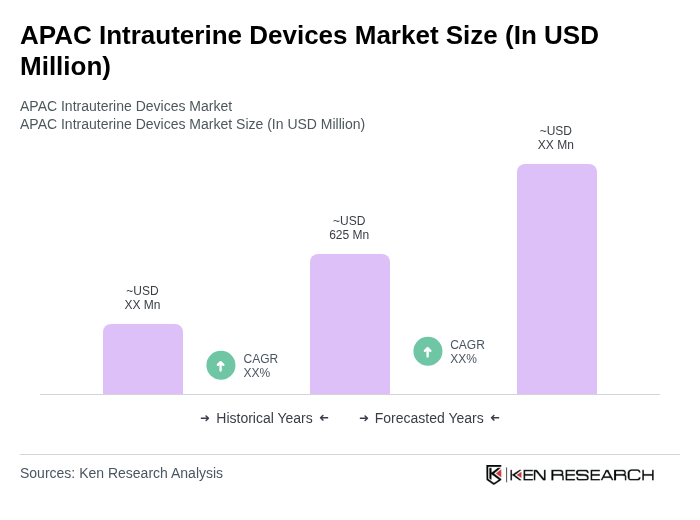
APAC Intrauterine Devices Market, valued at USD 625 million, grows due to rising reproductive health awareness, government initiatives, and demand in China (USD 290M) and India (USD 220M).

Region:Asia

Author(s):Dev

Product Code:KRAD3391

Pages:81

Published On:November 2025
About the Report

Base Year 2024

APAC Intrauterine Devices Market Overview

  • The APAC Intrauterine Devices Market is valued at USD 625 million, based on a five-year historical analysis. This growth is primarily driven by increasing awareness of family planning, rising healthcare expenditure, and the growing acceptance of long-term contraceptive methods among women. The market has seen a significant uptick in demand due to the emphasis on reproductive health and the availability of various IUD options, supported by technological advancements such as reusable and postpartum IUDs.
  • Countries such as China and India dominate the market due to their large populations and increasing healthcare investments. China accounts for approximately USD 290 million in market value, while India represents USD 220 million, collectively driving regional growth. Additionally, Japan and South Korea are significant players, driven by advanced healthcare infrastructure and a high level of awareness regarding reproductive health. The urbanization and changing societal norms in Southeast Asia also contribute to the market's growth in these regions.
  • Government initiatives and public health programs play a crucial role in market expansion. Multiple governments and non-profit organizations across the APAC region are actively promoting the use of IUDs in conjunction with educating populations about birth control measures and family planning. These coordinated efforts, combined with technological improvements that have resulted in effective contraception with minimal adverse effects, are expected to propel market growth throughout the forecast period.
APAC Intrauterine Devices Market Size

APAC Intrauterine Devices Market Segmentation

By Type:The market is segmented into various types of intrauterine devices, including Copper IUDs, Hormonal IUDs, Non-hormonal IUDs, and Others. Among these, Copper IUDs remain widely used due to their effectiveness and long duration of action. Hormonal IUDs are gaining popularity as they offer additional benefits such as reduced menstrual bleeding. Non-hormonal IUDs cater to a niche market, while the 'Others' category includes newer innovations in IUD technology.
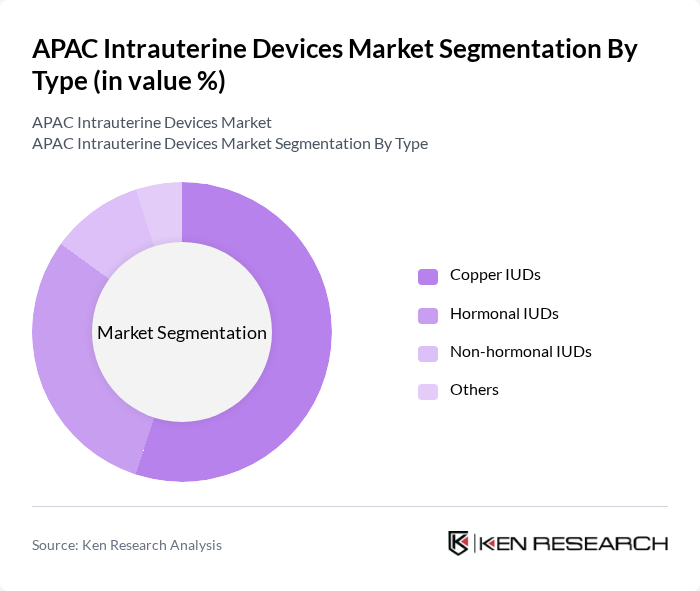
APAC Intrauterine Devices Market segmentation by Type.

By End-User:The end-user segmentation includes Hospitals, Clinics, Home care settings, and Others. Hospitals are the primary end-users due to their comprehensive healthcare services and facilities for IUD insertion. Clinics also play a significant role, especially in urban areas where women seek family planning services. Home care settings are emerging as a viable option for IUD management, while the 'Others' category includes community health organizations and NGOs.
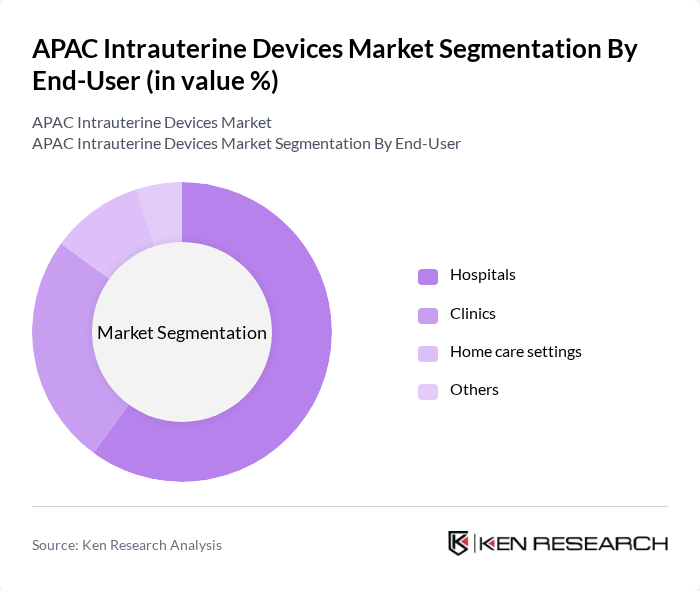
APAC Intrauterine Devices Market segmentation by End-User.

APAC Intrauterine Devices Market Competitive Landscape

The APAC Intrauterine Devices Market is characterized by a dynamic mix of regional and international players. Leading participants such as Bayer AG, CooperSurgical, Inc., Merck & Co., Inc., Teva Pharmaceutical Industries Ltd., HRA Pharma, Pregna International Limited, Ocon Medical Ltd., Tatum Medical, DKT International, Ferring Pharmaceuticals, Mylan N.V., Hologic, Inc., Semaine, Ameda, Inc., Becton, Dickinson and Company, Shanghai Dahua Medical Apparatus Co., Ltd., Hangzhou Kangnai Medical Instrument Co., Ltd., Jiangsu Yuyue Medical Equipment & Supply Co., Ltd., Medisafe International, Meditech International contribute to innovation, geographic expansion, and service delivery in this space.

Bayer AG

1863

Leverkusen, Germany

CooperSurgical, Inc.

1990

Trumbull, Connecticut, USA

Merck & Co., Inc.

1891

Kenilworth, New Jersey, USA

Teva Pharmaceutical Industries Ltd.

1901

Petah Tikva, Israel

HRA Pharma

2000

Paris, France

Company

Establishment Year

Headquarters

Market Presence (APAC Countries Served)

Revenue Share in APAC IUD Market

Product Portfolio Breadth (Copper, Hormonal, Non-hormonal IUDs)

Local Manufacturing & Supply Chain Strength

Regulatory Approvals in APAC Countries

Sales Growth Rate (APAC, 2020–2025)

APAC Intrauterine Devices Market Industry Analysis

Growth Drivers

  • Increasing Awareness of Reproductive Health:The APAC region has seen a significant rise in reproductive health awareness, with over 60% of women aged 15-49 now knowledgeable about various contraceptive methods, according to the World Health Organization. This awareness is bolstered by educational campaigns, which have increased access to information. In future, the region is expected to allocate approximately $1.5 billion towards reproductive health initiatives, further driving the adoption of intrauterine devices (IUDs) as a reliable contraceptive option.
  • Rising Demand for Long-term Contraceptive Solutions:The demand for long-term contraceptive solutions is surging, with IUD usage projected to increase by 20% in the APAC region in future. This trend is driven by a growing preference for methods that require minimal maintenance. In countries like India and Indonesia, where the population is expected to reach 1.6 billion and 290 million respectively, the need for effective family planning solutions is critical, making IUDs an attractive option for many women.
  • Government Initiatives Promoting Family Planning:Governments across the APAC region are increasingly investing in family planning initiatives, with funding expected to exceed $1 billion in future. Countries like Thailand and Vietnam have implemented policies to enhance access to contraceptives, including IUDs. These initiatives aim to reduce maternal mortality rates and improve overall reproductive health, thereby fostering a conducive environment for the growth of the IUD market in the region.

Market Challenges

  • Cultural Resistance to Contraceptive Methods:Cultural attitudes towards contraceptive methods pose significant challenges in the APAC region. In many countries, traditional beliefs and stigma surrounding contraceptive use hinder acceptance. For instance, in rural areas of Pakistan, only 30% of women use any form of contraception, with IUDs being particularly underutilized. This cultural resistance can limit market penetration and growth opportunities for IUD manufacturers.
  • Regulatory Hurdles in Product Approval:The regulatory landscape for contraceptives in the APAC region is complex, with varying standards across countries. For example, the approval process for new IUDs can take up to 24 months in India, compared to 12 months in Japan. These regulatory hurdles can delay product launches and increase costs for manufacturers, ultimately impacting market growth and innovation in the IUD sector.

APAC Intrauterine Devices Market Future Outlook

The future of the APAC intrauterine devices market appears promising, driven by increasing investments in women's health and a shift towards personalized contraceptive solutions. As governments and healthcare providers collaborate to enhance access to reproductive health services, the adoption of IUDs is expected to rise. Additionally, the growing trend of telehealth consultations will facilitate better education and access to IUDs, further supporting market growth in the coming years.

Market Opportunities

  • Expansion into Emerging Markets:Emerging markets in Southeast Asia present significant opportunities for IUD manufacturers. With a combined population of over 650 million, countries like Myanmar and Cambodia are experiencing increased demand for effective contraceptive solutions. Targeted marketing and distribution strategies can capitalize on this growing need, potentially increasing market share for IUDs in these regions.
  • Development of Innovative IUD Products:There is a growing opportunity for the development of innovative IUD products that cater to diverse consumer needs. For instance, the introduction of non-hormonal IUDs and those with extended duration of effectiveness can attract a broader user base. Research and development investments in this area could lead to significant advancements, enhancing the appeal of IUDs in the competitive contraceptive market.

Scope of the Report

SegmentSub-Segments
By Type

Copper IUDs

Hormonal IUDs

Non-hormonal IUDs

Others

By End-User

Hospitals

Clinics

Home care settings

Others

By Region

China

India

Japan

South Korea

Southeast Asia

Australia & New Zealand

By Application

Family planning

Menstrual regulation

Treatment of endometrial hyperplasia

Others

By Distribution Channel

Direct sales

Online sales

Retail pharmacies

Community health centers

Others

By Material

Plastic

Metal

Composite materials

Others

By Age Group

Adolescents

Adults

Older women

Others

Key Target Audience

Investors and Venture Capitalist Firms

Government and Regulatory Bodies (e.g., Ministry of Health, National Health Service)

Manufacturers and Producers

Distributors and Retailers

Healthcare Providers and Clinics

Pharmaceutical Companies

Industry Associations (e.g., Asia Pacific Society of Contraception)

Financial Institutions

Players Mentioned in the Report:

Bayer AG

CooperSurgical, Inc.

Merck & Co., Inc.

Teva Pharmaceutical Industries Ltd.

HRA Pharma

Pregna International Limited

Ocon Medical Ltd.

Tatum Medical

DKT International

Ferring Pharmaceuticals

Mylan N.V.

Hologic, Inc.

Semaine

Ameda, Inc.

Becton, Dickinson and Company

Shanghai Dahua Medical Apparatus Co., Ltd.

Hangzhou Kangnai Medical Instrument Co., Ltd.

Jiangsu Yuyue Medical Equipment & Supply Co., Ltd.

Medisafe International

Meditech International

Table of Contents

Market Assessment Phase

1. Executive Summary and Approach


2. APAC Intrauterine Devices Market Overview

2.1 Key Insights and Strategic Recommendations

2.2 APAC Intrauterine Devices Market Overview

2.3 Definition and Scope

2.4 Evolution of Market Ecosystem

2.5 Timeline of Key Regulatory Milestones

2.6 Value Chain & Stakeholder Mapping

2.7 Business Cycle Analysis

2.8 Policy & Incentive Landscape


3. APAC Intrauterine Devices Market Analysis

3.1 Growth Drivers

3.1.1 Increasing awareness of reproductive health
3.1.2 Rising demand for long-term contraceptive solutions
3.1.3 Government initiatives promoting family planning
3.1.4 Technological advancements in IUD design

3.2 Market Challenges

3.2.1 Cultural resistance to contraceptive methods
3.2.2 Regulatory hurdles in product approval
3.2.3 Competition from alternative contraceptive methods
3.2.4 Limited access in rural areas

3.3 Market Opportunities

3.3.1 Expansion into emerging markets
3.3.2 Development of innovative IUD products
3.3.3 Partnerships with healthcare providers
3.3.4 Increasing investment in women's health initiatives

3.4 Market Trends

3.4.1 Shift towards personalized contraceptive solutions
3.4.2 Growing popularity of non-hormonal IUDs
3.4.3 Rise in telehealth consultations for family planning
3.4.4 Increased focus on sustainability in product materials

3.5 Government Regulation

3.5.1 Stricter safety and efficacy standards
3.5.2 Mandatory reporting of adverse events
3.5.3 Guidelines for marketing and advertising contraceptives
3.5.4 Support for educational programs on contraceptive use

4. SWOT Analysis


5. Stakeholder Analysis


6. Porter's Five Forces Analysis


7. APAC Intrauterine Devices Market Market Size, 2019-2024

7.1 By Value

7.2 By Volume

7.3 By Average Selling Price


8. APAC Intrauterine Devices Market Segmentation

8.1 By Type

8.1.1 Copper IUDs
8.1.2 Hormonal IUDs
8.1.3 Non-hormonal IUDs
8.1.4 Others

8.2 By End-User

8.2.1 Hospitals
8.2.2 Clinics
8.2.3 Home care settings
8.2.4 Others

8.3 By Region

8.3.1 China
8.3.2 India
8.3.3 Japan
8.3.4 South Korea
8.3.5 Southeast Asia
8.3.6 Australia & New Zealand

8.4 By Application

8.4.1 Family planning
8.4.2 Menstrual regulation
8.4.3 Treatment of endometrial hyperplasia
8.4.4 Others

8.5 By Distribution Channel

8.5.1 Direct sales
8.5.2 Online sales
8.5.3 Retail pharmacies
8.5.4 Community health centers
8.5.5 Others

8.6 By Material

8.6.1 Plastic
8.6.2 Metal
8.6.3 Composite materials
8.6.4 Others

8.7 By Age Group

8.7.1 Adolescents
8.7.2 Adults
8.7.3 Older women
8.7.4 Others

9. APAC Intrauterine Devices Market Competitive Analysis

9.1 Market Share of Key Players

9.2 Cross Comparison of Key Players

9.2.1 Company Name
9.2.2 Market Presence (APAC Countries Served)
9.2.3 Revenue Share in APAC IUD Market
9.2.4 Product Portfolio Breadth (Copper, Hormonal, Non-hormonal IUDs)
9.2.5 Local Manufacturing & Supply Chain Strength
9.2.6 Regulatory Approvals in APAC Countries
9.2.7 Sales Growth Rate (APAC, 2020–2025)
9.2.8 R&D Investment (APAC Focus)
9.2.9 Brand Recognition (APAC)
9.2.10 Customer Satisfaction & Retention Rate

9.3 SWOT Analysis of Top Players

9.4 Pricing Analysis

9.5 Detailed Profile of Major Companies

9.5.1 Bayer AG
9.5.2 CooperSurgical, Inc.
9.5.3 Merck & Co., Inc.
9.5.4 Teva Pharmaceutical Industries Ltd.
9.5.5 HRA Pharma
9.5.6 Pregna International Limited
9.5.7 Ocon Medical Ltd.
9.5.8 Tatum Medical
9.5.9 DKT International
9.5.10 Ferring Pharmaceuticals
9.5.11 Mylan N.V.
9.5.12 Hologic, Inc.
9.5.13 Semaine
9.5.14 Ameda, Inc.
9.5.15 Becton, Dickinson and Company
9.5.16 Shanghai Dahua Medical Apparatus Co., Ltd.
9.5.17 Hangzhou Kangnai Medical Instrument Co., Ltd.
9.5.18 Jiangsu Yuyue Medical Equipment & Supply Co., Ltd.
9.5.19 Medisafe International
9.5.20 Meditech International

10. APAC Intrauterine Devices Market End-User Analysis

10.1 Procurement Behavior of Key Ministries

10.1.1 Government procurement policies
10.1.2 Budget allocation for reproductive health
10.1.3 Collaboration with NGOs
10.1.4 Others

10.2 Corporate Spend on Infrastructure & Energy

10.2.1 Investment in healthcare infrastructure
10.2.2 Funding for family planning programs
10.2.3 Corporate social responsibility initiatives
10.2.4 Others

10.3 Pain Point Analysis by End-User Category

10.3.1 Accessibility issues
10.3.2 Affordability concerns
10.3.3 Lack of awareness
10.3.4 Others

10.4 User Readiness for Adoption

10.4.1 Awareness campaigns
10.4.2 Training for healthcare providers
10.4.3 Community outreach programs
10.4.4 Others

10.5 Post-Deployment ROI and Use Case Expansion

10.5.1 Evaluation of effectiveness
10.5.2 User feedback collection
10.5.3 Expansion into new demographics
10.5.4 Others

11. APAC Intrauterine Devices Market Future Size, 2025-2030

11.1 By Value

11.2 By Volume

11.3 By Average Selling Price


Go-To-Market Strategy Phase

1. Whitespace Analysis + Business Model Canvas

1.1 Market gaps identification

1.2 Business model development


2. Marketing and Positioning Recommendations

2.1 Branding strategies

2.2 Product USPs


3. Distribution Plan

3.1 Urban retail vs rural NGO tie-ups


4. Channel & Pricing Gaps4.1 Underserved routes4.2 Pricing bands5. Unmet Demand & Latent Needs5.1 Category gaps5.2 Consumer segments6. Customer Relationship6.1 Loyalty programs6.2 After-sales service7. Value Proposition7.1 Sustainability7.2 Integrated supply chains8. Key Activities8.1 Regulatory compliance8.2 Branding8.3 Distribution setup9. Entry Strategy Evaluation9.1 Domestic Market Entry Strategy9.1.1 Product mix9.1.2 Pricing band9.1.3 Packaging9.2 Export Entry Strategy9.2.1 Target countries9.2.2 Compliance roadmap10. Entry Mode Assessment10.1 JV10.2 Greenfield10.3 M&A10.4 Distributor Model11. Capital and Timeline Estimation11.1 Capital requirements11.2 Timelines12. Control vs Risk Trade-Off12.1 Ownership vs Partnerships13. Profitability Outlook13.1 Breakeven analysis13.2 Long-term sustainability14. Potential Partner List14.1 Distributors14.2 JVs14.3 Acquisition targets15. Execution Roadmap15.1 Phased Plan for Market Entry15.1.1 Market Setup15.1.2 Market Entry15.1.3 Growth Acceleration15.1.4 Scale & Stabilize15.2 Key Activities and Milestones15.2.1 Milestone tracking15.2.2 Activity schedulingDisclaimerContact Us


Research Methodology

ApproachModellingSample

Phase 1: Approach1

Desk Research

  • Analysis of market reports from health organizations and industry associations in the APAC region
  • Review of published articles and journals focusing on gynecology and reproductive health
  • Examination of demographic and health statistics from government health departments and WHO databases

Primary Research

  • Interviews with gynecologists and healthcare professionals specializing in family planning
  • Surveys conducted with hospital administrators and clinic managers regarding IUD usage
  • Focus group discussions with women of reproductive age to understand preferences and perceptions

Validation & Triangulation

  • Cross-validation of findings through multiple data sources including sales data and health surveys
  • Triangulation of qualitative insights from interviews with quantitative data from surveys
  • Sanity checks through expert panel reviews comprising healthcare professionals and market analysts

Phase 2: Market Size Estimation1

Top-down Assessment

  • Estimation of total addressable market based on population demographics and reproductive health statistics
  • Segmentation of market size by country within the APAC region and by type of IUD
  • Incorporation of government health initiatives promoting family planning and contraceptive use

Bottom-up Modeling

  • Collection of sales data from leading IUD manufacturers and distributors in the region
  • Estimation of market penetration rates based on healthcare access and education levels
  • Volume x price analysis to determine revenue potential for different IUD types

Forecasting & Scenario Analysis

  • Multi-factor regression analysis incorporating factors such as economic growth, healthcare spending, and cultural attitudes
  • Scenario modeling based on potential changes in healthcare policies and contraceptive accessibility
  • Development of baseline, optimistic, and pessimistic forecasts through 2030

Phase 3: CATI Sample Composition1

Scope Item/SegmentSample SizeTarget Respondent Profiles
Healthcare Providers120Gynecologists, Family Planning Specialists
Hospital Administrators80Clinic Managers, Health Service Directors
Women of Reproductive Age150Patients, Community Health Workers
Pharmaceutical Distributors60Sales Representatives, Distribution Managers
Public Health Officials50Policy Makers, Health Program Coordinators

Frequently Asked Questions

What is the current value of the APAC Intrauterine Devices Market?

The APAC Intrauterine Devices Market is valued at approximately USD 625 million, driven by increasing awareness of family planning, rising healthcare expenditure, and the acceptance of long-term contraceptive methods among women in the region.

Which countries dominate the APAC Intrauterine Devices Market?

What types of intrauterine devices are available in the APAC market?

How do government initiatives impact the APAC Intrauterine Devices Market?

Other Regional/Country Reports

Indonesia Intrauterine Devices Market

Malaysia Intrauterine Devices Market

KSA Intrauterine Devices Market

SEA Intrauterine Devices Market

Vietnam Intrauterine Devices Market

Thailand Intrauterine Devices Market

Other Adjacent Reports

Indonesia Contraceptive Devices Market

Egypt Hormonal Contraceptives Market

Qatar Family Planning Services Market

UAE Womens Health Pharmaceuticals Market

Bahrain Gynecology Devices Market

Singapore Reproductive Health Services Market

Bahrain Fertility Treatment Market

Oman Menstrual Health Products Market

Thailand Obstetrics Equipment Market

UAE Sexual Wellness Products Market

Why Buy From Us?

Refine Robust Result (RRR) Framework

What makes us stand out is that our consultants follow Robust, Refine and Result (RRR) methodology. Robust for clear definitions, approaches and sanity checking, Refine for differentiating respondents' facts and opinions, and Result for presenting data with story.

Our Reach Is Unmatched

We have set a benchmark in the industry by offering our clients with syndicated and customized market research reports featuring coverage of entire market as well as meticulous research and analyst insights.

Shifting the Research Paradigm

While we don't replace traditional research, we flip the method upside down. Our dual approach of Top Bottom & Bottom Top ensures quality deliverable by not just verifying company fundamentals but also looking at the sector and macroeconomic factors.

More Insights-Better Decisions

With one step in the future, our research team constantly tries to show you the bigger picture. We help with some of the tough questions you may encounter along the way: How is the industry positioned? Best marketing channel? KPI's of competitors? By aligning every element, we help maximize success.

Transparency and Trust

Our report gives you instant access to the answers and sources that other companies might choose to hide. We elaborate each steps of research methodology we have used and showcase you the sample size to earn your trust.

Round the Clock Support

If you need any support, we are here! We pride ourselves on universe strength, data quality, and quick, friendly, and professional service.

Why Clients Choose Us?

400000+
Reports in repository
150+
Consulting projects a year
100+
Analysts
8000+
Client Queries in 2022








