
APAC Meal Kit Delivery Services Market Outlook to 2030
Region:Afganistan
Author(s):Meenakshi Bisht
Product Code:KROD5762
Region:Afganistan
Author(s):Meenakshi Bisht
Product Code:KROD5762
December 2024
83
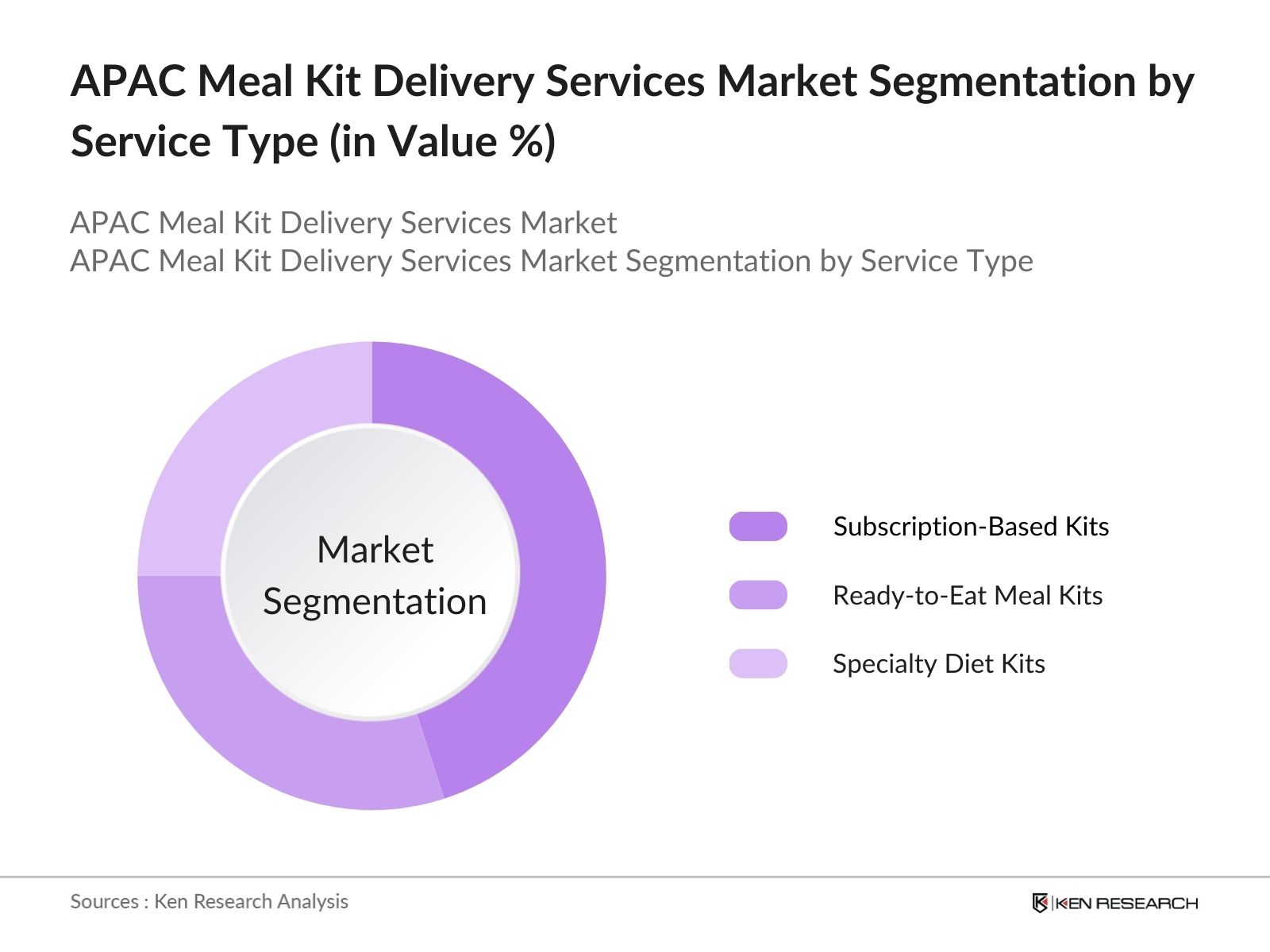
By Service Type: The APAC meal kit delivery services market is segmented by service type into subscription-based kits, ready-to-eat meal kits, and specialty diet kits. Recently, subscription-based meal kits have taken a dominant market share due to their convenience and the ability to cater to a wide range of consumer dietary preferences. Customers in cities like Tokyo and Sydney are gravitating toward these services for their time-saving benefits, nutritional value, and the flexibility of customizing orders. This has propelled subscription-based services to grow rapidly, especially among busy urban professionals and families.
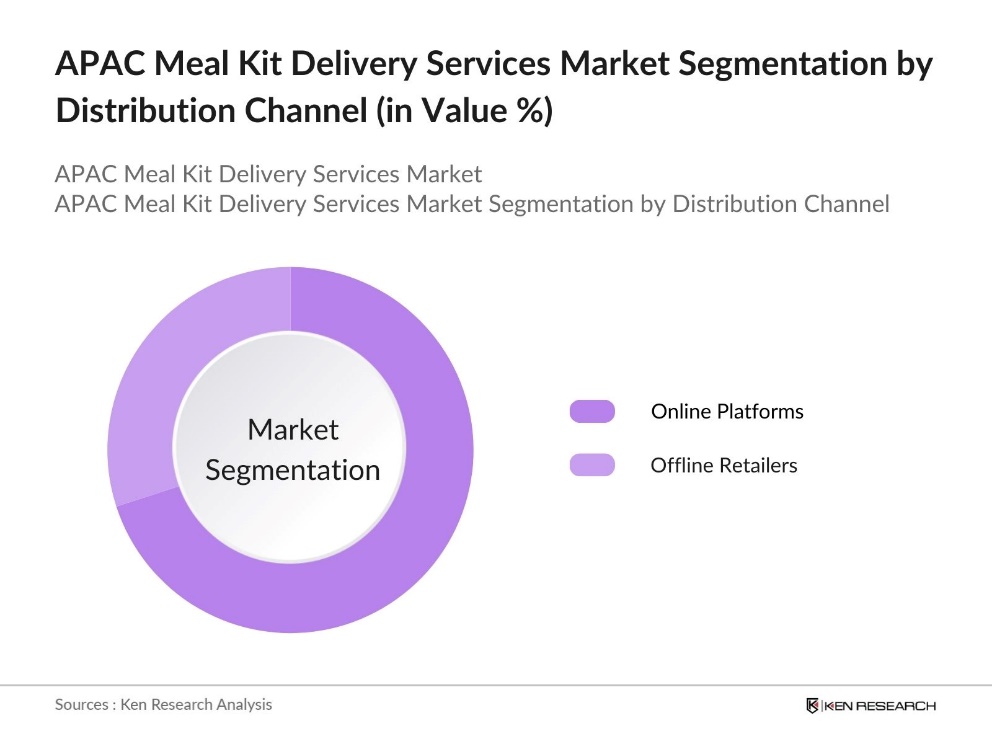
By Distribution Channel: The APAC meal kit delivery services market is segmented by distribution channel into online platforms and offline retailers. Online platforms hold a substantial portion of the market, driven by the rise of digital shopping trends and the growing consumer preference for doorstep delivery. Cities like Shanghai and Melbourne lead in this segment due to their high penetration of internet users and well-established delivery infrastructure. In contrast, offline retailers still play a key role in rural regions, though their market share has been shrinking as consumers move toward more convenient digital solutions.
The market is competitive, with both global and regional players vying for market share. Companies like HelloFresh and Blue Apron have established strong footholds in the region due to their brand recognition and vast supply chains. Additionally, local players like FreshMenu have leveraged their deep understanding of regional culinary preferences to maintain a competitive edge.
|
Company |
Year Established |
Headquarters |
Customer Base |
Subscription Model |
Meal Variety |
Logistics Network |
Sustainability Practices |
Local Partnerships |
Technology Integration |
|
HelloFresh |
2011 |
Berlin, Germany |
|||||||
|
Blue Apron |
2012 |
New York, USA |
|||||||
|
Marley Spoon |
2014 |
Berlin, Germany |
|||||||
|
FreshMenu |
2014 |
Bangalore, India |
|||||||
|
Gousto |
2012 |
London, UK |
Over the next five years, the APAC meal kit delivery market is expected to experience steady growth, driven by increasing consumer demand for convenience and health-conscious eating. As digital infrastructure improves across the region, especially in developing countries, online platforms will further dominate the distribution channel. Major players are expected to invest heavily in technology integration, improving customer experiences, and expanding their reach into new geographical markets.
|
By Type of Service |
Standard Meal Kits Ready-to-Eat Kits Specialty Diet Kits |
|
By Distribution Channel |
Online Platforms Offline Retailers |
|
By Dietary Preference |
Vegetarian Non-Vegetarian Vegan Gluten-Free |
|
By Geography |
China Japan India Southeast Asia Australia & New Zealand |
|
By End-User |
Residential Consumers Corporate Consumers |
1.1 Definition and Scope
1.2 Market Taxonomy
1.3 Market Dynamics (Drivers, Challenges, Opportunities)
1.4 Market Segmentation Overview
2.1 Historical Market Size (Market Share and Revenue Contributions by Major Regions)
2.2 Year-on-Year Growth Analysis
2.3 Key Market Developments and Strategic Milestones
3.1 Growth Drivers
3.1.1 Rising Consumer Demand for Convenient Meal Solutions
3.1.2 Urbanization and Changing Lifestyles (Urbanization rate, Income Levels, Spending Behavior)
3.1.3 Increasing Focus on Health and Wellness (Health-Conscious Consumers, Dietary Preferences)
3.1.4 Expansion of E-Commerce and Digital Platforms (Digital Penetration, Online Payment Systems)
3.2 Market Challenges
3.2.1 Logistics and Supply Chain Issues (Last-Mile Delivery, Cold Chain Challenges)
3.2.2 Competition from Supermarkets and Grocery Delivery Services
3.2.3 High Customer Retention Costs (Customer Acquisition and Retention Metrics)
3.3 Opportunities
3.3.1 Market Penetration into Tier 2 and 3 Cities (Untapped Markets)
3.3.2 Personalization and Customization of Meal Kits (Customer Preferences, Dietary Options)
3.3.3 Collaborations with Local Suppliers and Farmers (Farm-to-Table Integration)
3.4 Trends
3.4.1 Subscription-Based Meal Kits (Subscription Growth, Customer Engagement Rates)
3.4.2 Sustainable Packaging Solutions (Environmental Impact, Green Initiatives)
3.4.3 Introduction of Specialty Diet Meal Kits (Plant-Based, Keto, Vegan)
3.5 Government Regulation
3.5.1 Food Safety Standards (Regulatory Compliance for Meal Kit Ingredients)
3.5.2 Import/Export Regulations for Meal Components
3.5.3 Labor Laws and Regulations Impacting Delivery Services
3.5.4 E-Commerce and Data Privacy Laws
3.6 SWOT Analysis
3.7 Ecosystem Mapping (Key Industry Players, Suppliers, and Consumers)
3.8 Porters Five Forces Analysis
3.8.1 Threat of New Entrants
3.8.2 Bargaining Power of Suppliers
3.8.3 Bargaining Power of Consumers
3.8.4 Threat of Substitutes
3.8.5 Competitive Rivalry
3.9 Competitive Landscape
4.1 By Type of Service (In Value %)
4.1.1 Standard Meal Kits
4.1.2 Ready-to-Eat Kits
4.1.3 Specialty Diet Kits
4.2 By Distribution Channel (In Value %)
4.2.1 Online Platforms
4.2.2 Offline Retailers
4.3 By Dietary Preference (In Value %)
4.3.1 Vegetarian
4.3.2 Non-Vegetarian
4.3.3 Vegan
4.3.4 Gluten-Free
4.4 By Geography (In Value %)
4.4.1 China
4.4.2 Japan
4.4.3 India
4.4.4 Southeast Asia
4.4.5 Australia & New Zealand
4.5 By End-User (In Value %)
4.5.1 Residential Consumers
4.5.2 Corporate Consumers
5.1 Detailed Profiles of Major Companies
5.1.1 HelloFresh
5.1.2 Blue Apron
5.1.3 Marley Spoon
5.1.4 FreshMenu
5.1.5 Gousto
5.1.6 Home Chef
5.1.7 Chefs Plate
5.1.8 Dinnerly
5.1.9 Cook It
5.1.10 PlateJoy
5.1.11 Mindful Chef
5.1.12 Pepper Leaf
5.1.13 Green Chef
5.1.14 EveryPlate
5.1.15 Yumble
5.2 Cross Comparison Parameters
(No. of Employees, Headquarters, Inception Year, Revenue, Subscription Base, Product Range, Online vs Offline Presence, Customer Retention Rates)
5.3 Market Share Analysis (Market Share by Service Type and Region)
5.4 Strategic Initiatives (Partnerships, Collaborations, and Alliances)
5.5 Mergers and Acquisitions
5.6 Investment Analysis
5.7 Venture Capital Funding
5.8 Private Equity Investments
6.1 Food Safety Regulations (Quality Control Standards)
6.2 Import/Export Regulations for Meal Ingredients
6.3 E-Commerce Regulations (Consumer Data Privacy Laws)
6.4 Labor and Delivery Workforce Laws
7.1 Future Market Size Projections (Growth Potential in Key Regions)
7.2 Key Factors Driving Future Market Growth (Health Trends, Digital Adoption, and Sustainability Initiatives)
8.1 By Type of Service (In Value %)
8.2 By Distribution Channel (In Value %)
8.3 By Dietary Preference (In Value %)
8.4 By Geography (In Value %)
8.5 By End-User (In Value %
9.1 TAM/SAM/SOM Analysis
9.2 Customer Cohort Analysis (Customer Retention and Acquisition Strategies)
9.3 Strategic Marketing Initiatives (Digital Campaigns, Consumer Behavior Targeting)
9.4 White Space Opportunity Analysis (Untapped Markets, Niche Segments)
The research process begins with an in-depth analysis of key stakeholders in the APAC Meal Kit Delivery Services Market. Through secondary data sources such as industry reports and proprietary databases, critical variables such as consumer preferences, technological advancements, and regulatory frameworks are identified.
This step involves a detailed assessment of historical data, market dynamics, and industry trends. The analysis focuses on evaluating the market penetration of meal kit services across different regions and understanding the revenue patterns and service quality statistics from key market players.
To ensure accuracy, market hypotheses are validated by consulting industry experts through interviews and surveys. These consultations provide valuable insights into consumer behavior, market challenges, and the competitive landscape.
The final stage involves synthesizing the data collected to create a comprehensive market report. Data validation is performed using both top-down and bottom-up approaches, ensuring the final output accurately reflects the market conditions and growth trends.
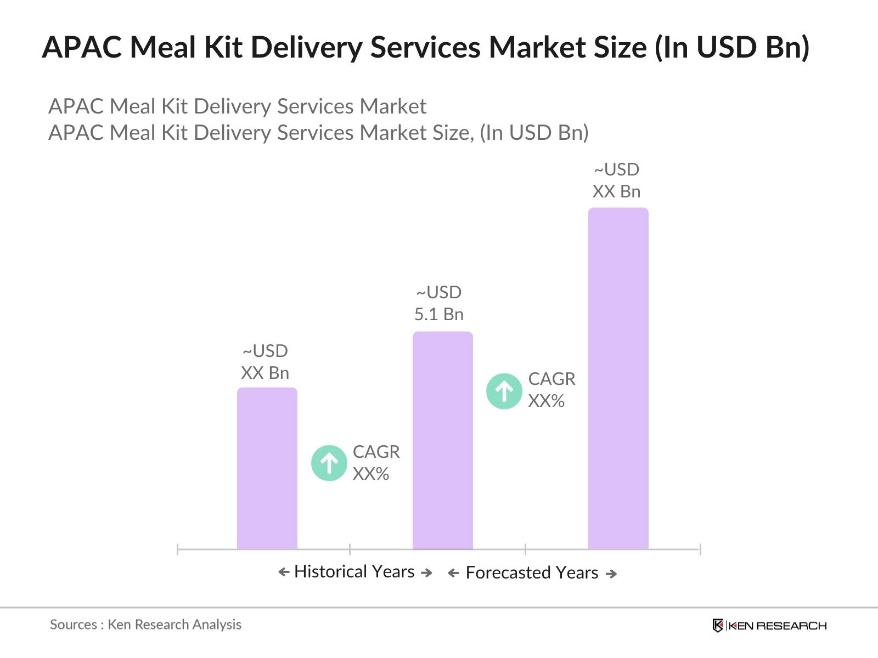
The APAC Meal Kit Delivery Services Market is valued at USD 5.1 billion, driven by growing urbanization, health-conscious eating habits, and the convenience of doorstep meal kit delivery solutions.
Challenges in APAC Meal Kit Delivery Services Market include high logistics and supply chain costs, competition from supermarket ready-meal offerings, and the need for constant customer acquisition to maintain subscription-based revenue models.
Major players in APAC Meal Kit Delivery Services Market include HelloFresh, Blue Apron, Marley Spoon, FreshMenu, and Gousto, each of which dominates different parts of the APAC region due to their tailored product offerings and robust delivery networks.
Key drivers in APAC Meal Kit Delivery Services Market include the increasing shift toward health and wellness, rising disposable incomes, the growing popularity of online shopping, and the adoption of sustainable and eco-friendly food practices.

What makes us stand out is that our consultants follows Robust, Refine and Result (RRR) methodology. i.e. Robust for clear definitions, approaches and sanity checking, Refine for differentiating respondents facts and opinions and Result for presenting data with story

We have set a benchmark in the industry by offering our clients with syndicated and customized market research reports featuring coverage of entire market as well as meticulous research and analyst insights.

While we don't replace traditional research, we flip the method upside down. Our dual approach of Top Bottom & Bottom Top ensures quality deliverable by not just verifying company fundamentals but also looking at the sector and macroeconomic factors.

With one step in the future, our research team constantly tries to show you the bigger picture. We help with some of the tough questions you may encounter along the way: How is the industry positioned? Best marketing channel? KPI's of competitors? By aligning every element, we help maximize success.

Our report gives you instant access to the answers and sources that other companies might choose to hide. We elaborate each steps of research methodology we have used and showcase you the sample size to earn your trust.

If you need any support, we are here! We pride ourselves on universe strength, data quality, and quick, friendly, and professional service.