
APAC Medium Density Fiberboard Market Outlook to 2030
Region:Afganistan
Author(s):Meenakshi Bisht
Product Code:KROD9004
Region:Afganistan
Author(s):Meenakshi Bisht
Product Code:KROD9004
December 2024
83
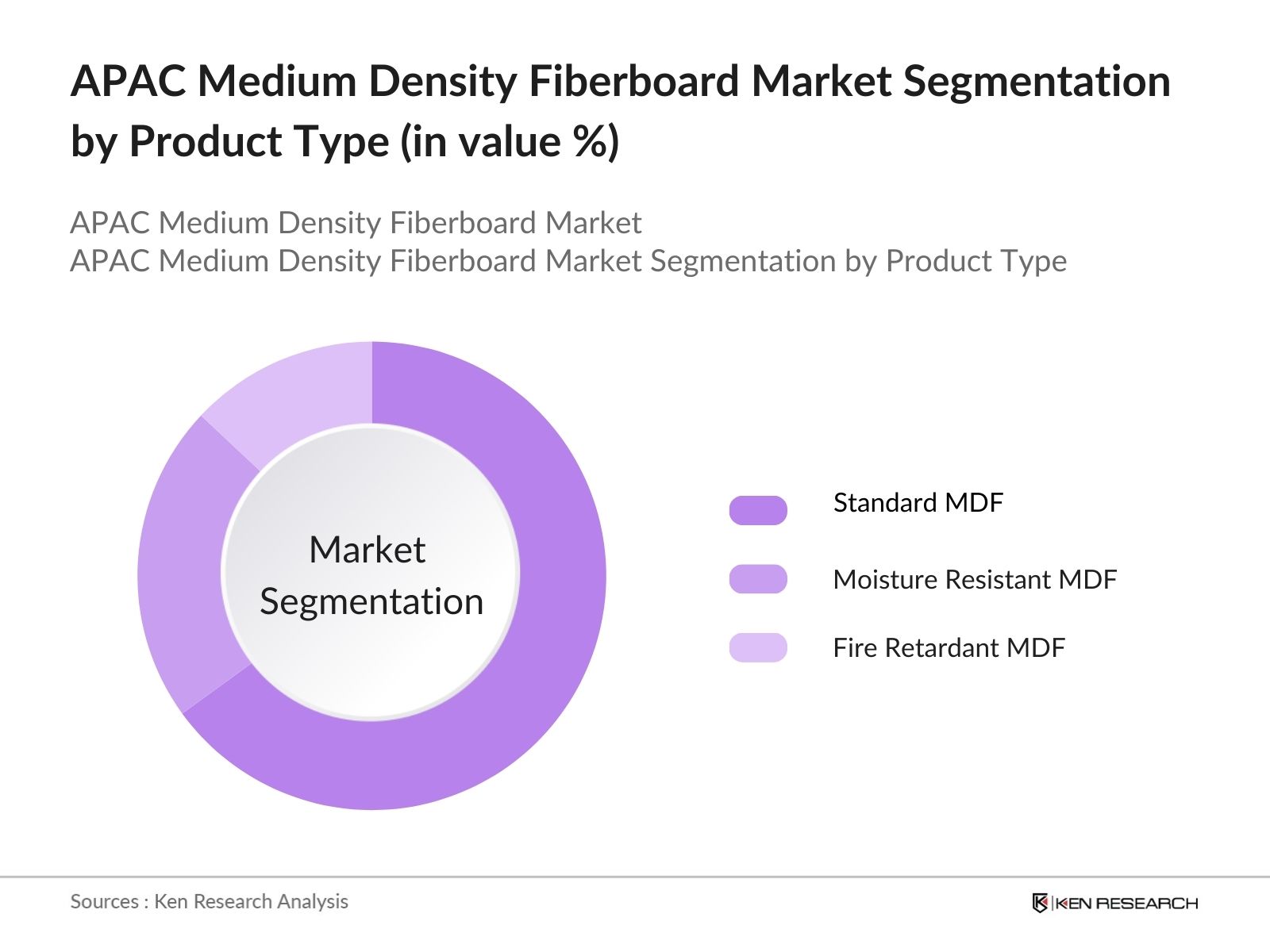
By Product Type: The APAC MDF market is segmented by product type into Standard MDF, Moisture Resistant MDF, and Fire Retardant MDF. Among these, Standard MDF holds the dominant market share due to its widespread application in furniture, doors, and cabinetry. Its versatility, cost-effectiveness, and ease of customization make it the preferred choice for both manufacturers and consumers. Furthermore, the rapid expansion of the furniture industry in countries like China and India, driven by increasing urbanization, has reinforced the dominance of standard MDF in the region.
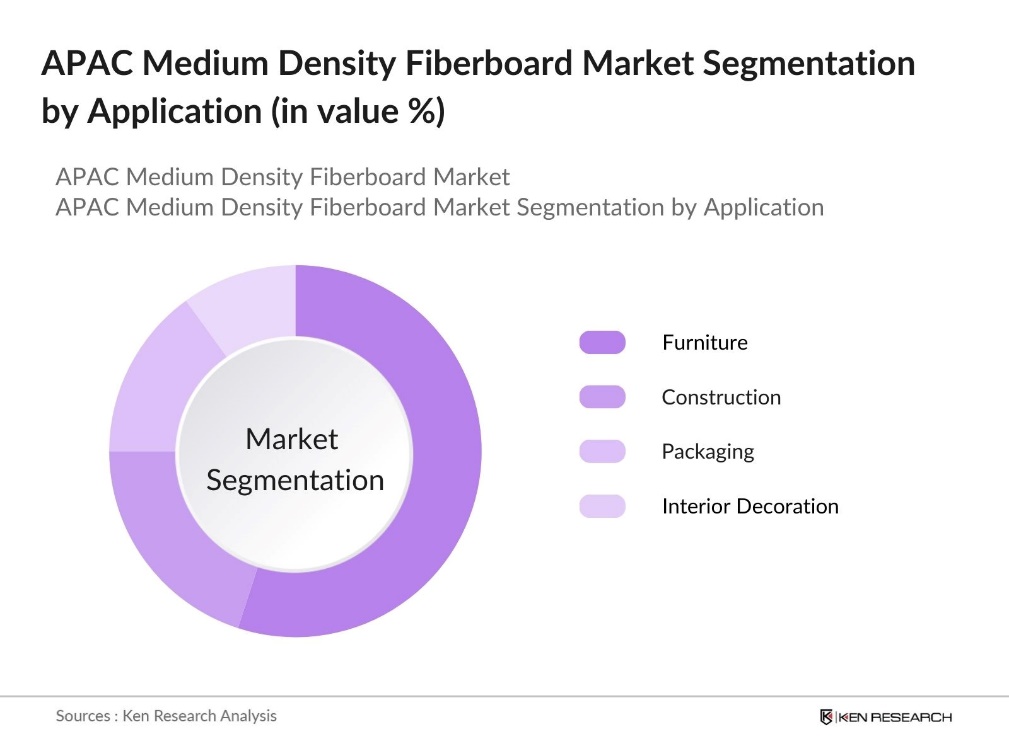
By Application: The APAC MDF market is segmented by application into Furniture, Construction, Packaging, and Interior Decoration. The Furniture segment holds the largest market share, driven by rising demand for affordable, durable, and aesthetically pleasing products. MDFs ability to be easily machined, painted, and veneered makes it a popular material in the furniture industry. The rapid urbanization and increasing disposable incomes in developing economies like India and China have resulted in high demand for cost-effective furniture solutions, contributing significantly to the dominance of this segment.
The APAC MDF market is competitive, with a few large players dominating the market. Key market participants are expanding their production capacities and focusing on product innovation to gain a competitive edge. The presence of both global manufacturers and domestic players creates a competitive environment, which has also led to improvements in product quality and sustainability practices.
|
Company |
Establishment Year |
Headquarters |
Production Capacity (Cubic Meters) |
Global Reach |
Sustainability Practices |
Product Innovation |
Revenue (USD Bn) |
Market Presence |
|
Kronospan |
1897 |
Austria |
||||||
|
Greenpanel Industries Ltd. |
2019 |
India |
||||||
|
Arauco |
1979 |
Chile |
||||||
|
Daiken Corporation |
1945 |
Japan |
||||||
|
Dongwha Group |
1948 |
South Korea |
Over the next five years, the APAC MDF market is expected to experience substantial growth, driven by increasing urbanization, the rise in disposable income, and the growth of the construction and furniture industries. Government support for sustainable and eco-friendly building materials, coupled with advancements in manufacturing technologies, will further boost market growth. The increasing demand for high-density MDF, particularly in furniture and interior decoration applications, is also expected to be a key growth driver.
|
By Thickness |
Thin MDF (2mm 6mm) |
|
By Application |
Furniture |
|
By Product Type |
Standard MDF |
|
By Density |
Low-Density MDF (550-650 Kg/M) |
|
By Region |
China |
1.1. Definition and Scope
1.2. Market Taxonomy
1.3. Market Growth Rate
1.4. Market Segmentation Overview
2.1. Historical Market Size
2.2. Year-On-Year Growth Analysis
2.3. Key Market Developments and Milestones
3.1. Growth Drivers (Rising Construction Industry, Increasing Use in Furniture Manufacturing, Regulatory Support for Sustainable Products)
3.1.1. Rising Urbanization in Developing Economies
3.1.2. Growth in Furniture Manufacturing (Increased Preference for Low-Cost Alternatives)
3.1.3. Government Policies Supporting Eco-Friendly Products
3.1.4. High Demand from the Construction Sector (Rapid Urban Infrastructure Development)
3.2. Market Challenges (Supply Chain Disruptions, Raw Material Price Fluctuations, Competition from Other Wood-based Panels)
3.2.1. Volatile Raw Material Prices (Wood Fibers, Resin)
3.2.2. Competition from Plywood and Particleboard
3.2.3. Limited Availability of Forest Resources
3.2.4. Environmental Concerns over Formaldehyde Emissions
3.3. Opportunities (Technological Advancements, Increasing Preference for Sustainable Materials, Expansion in Emerging Markets)
3.3.1. Innovations in Formaldehyde-Free MDF
3.3.2. Growth Potential in Emerging Markets (India, Vietnam, Philippines)
3.3.3. Expansion of Manufacturing Facilities in APAC
3.3.4. Adoption of MDF in Modular Furniture
3.4. Trends (Sustainable Production Methods, Lightweight MDF, High-Density MDF Usage)
3.4.1. Use of Recycled Wood Fiber in MDF Production
3.4.2. Growing Preference for Lightweight MDF in Furniture Industry
3.4.3. Shift Towards High-Density MDF in Specialized Applications
3.4.4. Customization and Design Flexibility in MDF for Furniture Manufacturers
3.5. Government Regulation (Environmental Regulations, Trade Policies, Standards for MDF Production)
3.5.1. Environmental Regulations on Formaldehyde Emissions
3.5.2. Import Tariffs on MDF and Wood-based Panels
3.5.3. Certification Standards for MDF Products (ISO, FSC)
3.5.4. Government Initiatives to Promote Green Building Materials
3.6. SWOT Analysis
3.7. Stakeholder Ecosystem (Raw Material Suppliers, MDF Manufacturers, Furniture Producers, Construction Companies)
3.8. Porters Five Forces Analysis
3.9. Competition Ecosystem
4.1. By Thickness (In Value %)
4.1.1. Thin MDF (2mm 6mm)
4.1.2. Standard MDF (6mm 20mm)
4.1.3. Thick MDF (20mm and Above)
4.2. By Application (In Value %)
4.2.1. Furniture
4.2.2. Construction
4.2.3. Packaging
4.2.4. Interior Decoration
4.3. By Product Type (In Value %)
4.3.1. Standard MDF
4.3.2. Moisture Resistant MDF
4.3.3. Fire Retardant MDF
4.4. By Density (In Value %)
4.4.1. Low-Density MDF (550-650 Kg/M)
4.4.2. Medium-Density MDF (650-800 Kg/M)
4.4.3. High-Density MDF (Above 800 Kg/M)
4.5. By Region (In Value %)
4.5.1. China
4.5.2. India
4.5.3. Japan
4.5.4. Australia
4.5.5. ASEAN Countries
5.1. Detailed Profiles of Major Companies
5.1.1. Kronospan
5.1.2. Greenpanel Industries Limited
5.1.3. Arauco
5.1.4. Duratex
5.1.5. Norbord Inc.
5.1.6. Egger Group
5.1.7. Fletcher Building
5.1.8. Daiken Corporation
5.1.9. Nelson Pine Industries Limited
5.1.10. Dongwha Group
5.1.11. Kastamonu Entegre
5.1.12. Swiss Krono Group
5.1.13. Yildiz Entegre
5.1.14. Masisa S.A.
5.1.15. Pfleiderer Group
5.2. Cross Comparison Parameters (Production Capacity, Market Presence, Product Portfolio, Sustainability Practices, Innovation Capabilities, Headquarters Location, Employee Count, Revenue)
5.3. Market Share Analysis
5.4. Strategic Initiatives
5.5. Mergers and Acquisitions
5.6. Investment Analysis
5.7. Venture Capital Funding
5.8. Government Grants
5.9. Private Equity Investments
6.1. Environmental Standards for MDF Manufacturing
6.2. Compliance Requirements for Formaldehyde Emissions
6.3. Certification Processes (ISO, FSC, CARB Compliance)
7.1. Future Market Size Projections
7.2. Key Factors Driving Future Market Growth
8.1. By Thickness (In Value %)
8.2. By Application (In Value %)
8.3. By Product Type (In Value %)
8.4. By Density (In Value %)
8.5. By Region (In Value %)
9.1. TAM/SAM/SOM Analysis
9.2. Market Expansion Strategies
9.3. Marketing Initiatives for APAC Region
9.4. Innovation and Sustainability Opportunities
Disclaimer Contact UsThis step involves identifying the critical variables influencing the APAC MDF market. Extensive desk research was conducted to map out the key stakeholders, including MDF manufacturers, suppliers, and end-users. Proprietary databases and secondary sources were leveraged to collect data on market size, growth drivers, and trends.
Historical data was analyzed to assess market penetration and the revenue generation capacity of MDF manufacturers. The data was gathered from trusted sources like government databases and industry reports to ensure accuracy. Additionally, the ratio of marketplaces to service providers was evaluated to forecast future trends.
Industry experts, including senior executives from MDF manufacturing companies, were consulted to validate the market data and refine projections. Expert insights helped ensure that the final estimates accurately reflect industry dynamics.
The final phase involved synthesizing all collected data to produce the reports output. Detailed interactions with manufacturers and suppliers were conducted to validate the analysis. This approach ensures that the final report presents a comprehensive and validated overview of the APAC MDF market.
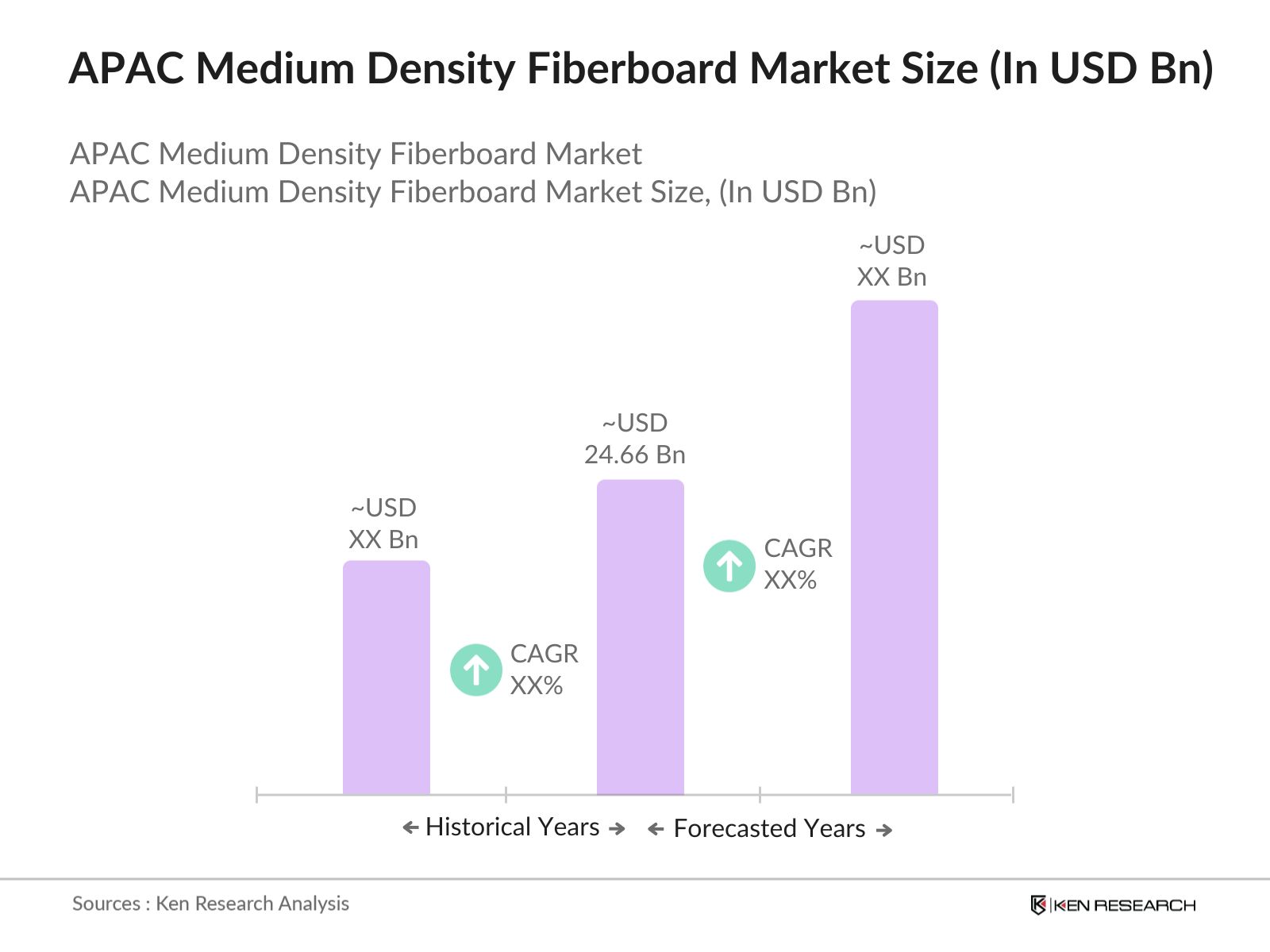
The APAC MDF Market was valued at USD 24.66 billion, driven by the growing demand in the construction and furniture industries, supported by rising urbanization and sustainability trends.
Key challenges in APAC MDF Market include raw material price fluctuations, supply chain disruptions, and competition from alternative wood-based panels like plywood. Environmental concerns regarding formaldehyde emissions also pose a challenge.
Prominent players in APAC MDF Market include Kronospan, Arauco, Daiken Corporation, Greenpanel Industries Ltd., and Dongwha Group. These companies dominate the market through their large production capacities and global reach.
The APAC MDF Market is primarily driven by rapid urbanization, increased demand for cost-effective furniture, and government policies supporting eco-friendly building materials.

What makes us stand out is that our consultants follows Robust, Refine and Result (RRR) methodology. i.e. Robust for clear definitions, approaches and sanity checking, Refine for differentiating respondents facts and opinions and Result for presenting data with story

We have set a benchmark in the industry by offering our clients with syndicated and customized market research reports featuring coverage of entire market as well as meticulous research and analyst insights.

While we don't replace traditional research, we flip the method upside down. Our dual approach of Top Bottom & Bottom Top ensures quality deliverable by not just verifying company fundamentals but also looking at the sector and macroeconomic factors.

With one step in the future, our research team constantly tries to show you the bigger picture. We help with some of the tough questions you may encounter along the way: How is the industry positioned? Best marketing channel? KPI's of competitors? By aligning every element, we help maximize success.

Our report gives you instant access to the answers and sources that other companies might choose to hide. We elaborate each steps of research methodology we have used and showcase you the sample size to earn your trust.

If you need any support, we are here! We pride ourselves on universe strength, data quality, and quick, friendly, and professional service.