Region:Asia
Author(s):Geetanshi
Product Code:KRAC9414
Pages:83
Published On:November 2025
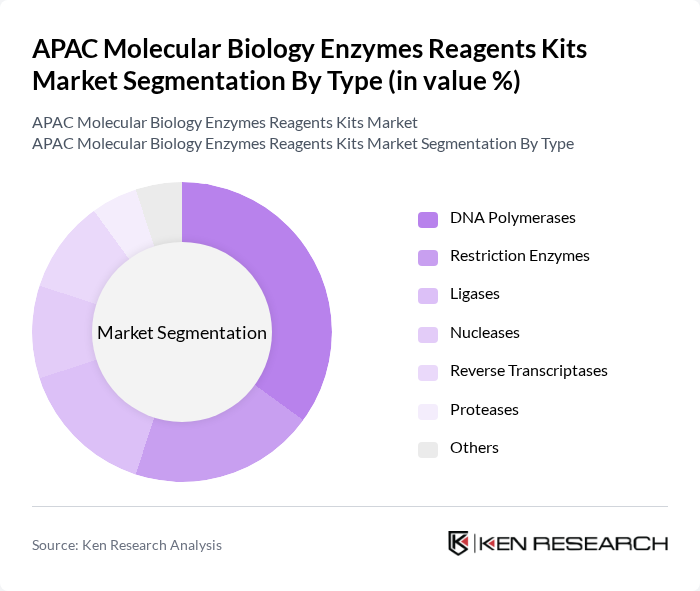
By Type:The market is segmented into various types of enzymes and reagents, including DNA Polymerases, Restriction Enzymes, Ligases, Nucleases, Reverse Transcriptases, Proteases, and Others. Among these,DNA Polymerasesare the most widely used due to their critical role in PCR and other amplification techniques, which are essential for genetic analysis and diagnostics. The increasing adoption of PCR-based methods in clinical diagnostics and research is driving the demand for DNA Polymerases significantly. The market also sees growing demand for enzymes tailored for next-generation sequencing, cloning, and gene editing applications.
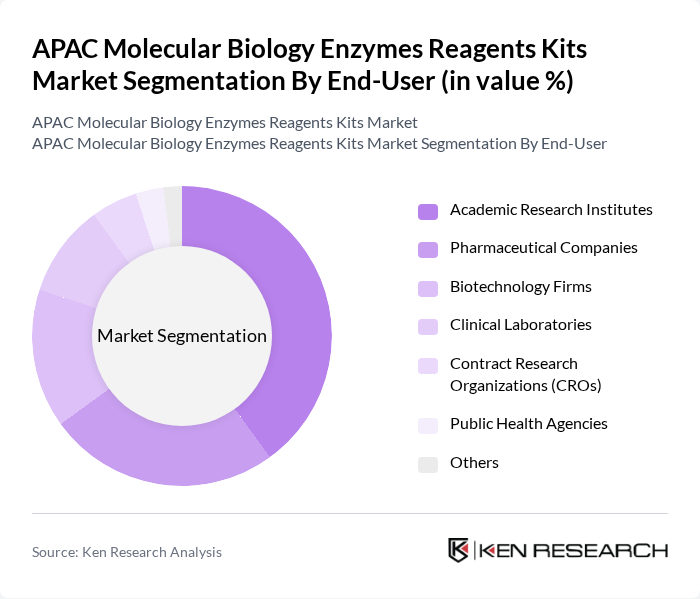
By End-User:The end-user segmentation includes Academic Research Institutes, Pharmaceutical Companies, Biotechnology Firms, Clinical Laboratories, Contract Research Organizations (CROs), Public Health Agencies, and Others.Academic Research Institutesare the leading end-users, driven by the increasing number of research projects and funding in molecular biology. The demand for innovative research tools and reagents in academic settings is propelling the growth of this segment. Pharmaceutical and biotechnology companies are also significant contributors, leveraging molecular biology enzymes for drug discovery, diagnostics, and biomanufacturing.
The APAC Molecular Biology Enzymes Reagents Kits Market is characterized by a dynamic mix of regional and international players. Leading participants such as Thermo Fisher Scientific, Roche Diagnostics, Agilent Technologies, New England Biolabs, QIAGEN, Bio-Rad Laboratories, Merck KGaA, Takara Bio, Promega Corporation, Sigma-Aldrich (Merck Group), Illumina, Bioneer Corporation, Enzo Life Sciences, Lucigen Corporation, GeneDireX, Toyobo Co., Ltd., Bio Basic Asia Pacific, Jena Bioscience, NIPPON Genetics Co., Ltd., Biotools Co., Ltd. contribute to innovation, geographic expansion, and service delivery in this space.
The future of the APAC molecular biology enzymes reagents kits market appears promising, driven by ongoing advancements in biotechnology and increasing collaboration between academic institutions and industry players. As personalized medicine gains traction, the demand for tailored genetic solutions will likely rise. Furthermore, the integration of artificial intelligence in research processes is expected to enhance efficiency and accuracy, paving the way for innovative applications in molecular biology and expanding market opportunities significantly.
| Segment | Sub-Segments |
|---|---|
| By Type | DNA Polymerases Restriction Enzymes Ligases Nucleases Reverse Transcriptases Proteases Others |
| By End-User | Academic Research Institutes Pharmaceutical Companies Biotechnology Firms Clinical Laboratories Contract Research Organizations (CROs) Public Health Agencies Others |
| By Application | Drug Discovery Diagnostics Sequencing PCR/qPCR/RT-PCR Agricultural Biotechnology Environmental Testing Forensic Testing Others |
| By Source | Natural Enzymes Recombinant Enzymes Synthetic Enzymes Others |
| By Distribution Channel | Direct Sales Distributors Online Sales Others |
| By Region | China Japan South Korea India Southeast Asia Oceania |
| By Research Type | Basic Research Applied Research Clinical Research Others |
| Scope Item/Segment | Sample Size | Target Respondent Profiles |
|---|---|---|
| Academic Research Institutions | 100 | Research Scientists, Lab Managers |
| Biotechnology Firms | 80 | Product Development Managers, Procurement Officers |
| Pharmaceutical Companies | 90 | Quality Control Managers, R&D Directors |
| Clinical Laboratories | 60 | Laboratory Technicians, Operations Managers |
| Government Research Agencies | 40 | Policy Makers, Research Coordinators |
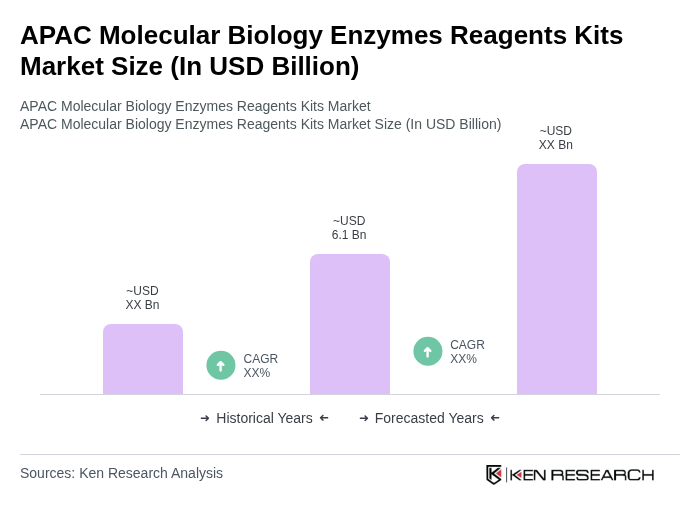
The APAC Molecular Biology Enzymes Reagents Kits Market is valued at approximately USD 6.1 billion, reflecting significant growth driven by advancements in molecular biology techniques and increasing demand for genetic research and diagnostics across the region.

What makes us stand out is that our consultants follow Robust, Refine and Result (RRR) methodology. Robust for clear definitions, approaches and sanity checking, Refine for differentiating respondents' facts and opinions, and Result for presenting data with story.

We have set a benchmark in the industry by offering our clients with syndicated and customized market research reports featuring coverage of entire market as well as meticulous research and analyst insights.

While we don't replace traditional research, we flip the method upside down. Our dual approach of Top Bottom & Bottom Top ensures quality deliverable by not just verifying company fundamentals but also looking at the sector and macroeconomic factors.

With one step in the future, our research team constantly tries to show you the bigger picture. We help with some of the tough questions you may encounter along the way: How is the industry positioned? Best marketing channel? KPI's of competitors? By aligning every element, we help maximize success.

Our report gives you instant access to the answers and sources that other companies might choose to hide. We elaborate each steps of research methodology we have used and showcase you the sample size to earn your trust.

If you need any support, we are here! We pride ourselves on universe strength, data quality, and quick, friendly, and professional service.













