About the Report
Base Year 2024APAC Outdoor Lighting Market Overview
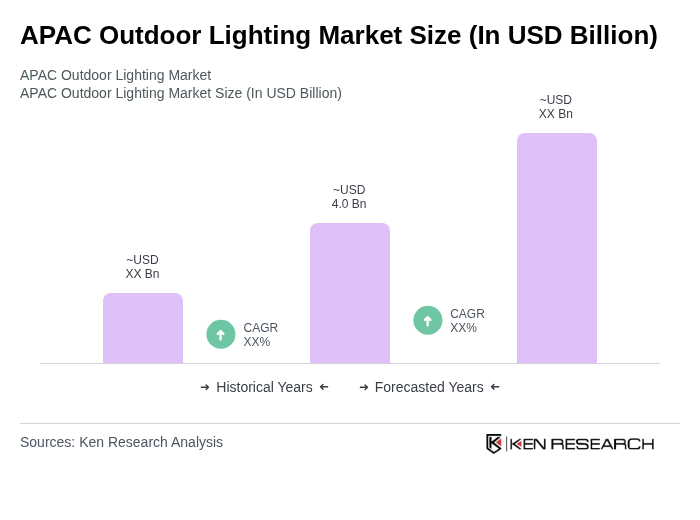
- The APAC Outdoor Lighting Market is valued at USD 4.0 billion, based on a five-year analysis of the most recent available data for the region’s outdoor lighting and LED lighting segments. Growth is primarily driven by rapid urbanization, government-funded smart city initiatives, and the rising demand for energy-efficient lighting solutions. The transition to LED and solar lighting technologies continues to accelerate market expansion, as these options offer superior sustainability, lower energy consumption, and reduced maintenance costs .
- Key players in this market include China, Japan, and India, which dominate due to their large urban populations, rapid infrastructure development, and significant investments in public lighting upgrades. China leads with its extensive manufacturing base and government support for green technologies, while Japan and India are advancing modernization and smart city programs to enhance outdoor lighting networks .
- In 2023, the Indian government continued the Street Lighting National Programme (SLNP), which targets the replacement of conventional street lights with energy-efficient LED fixtures in urban areas. This initiative is projected to deliver substantial energy savings and emissions reductions, reflecting the government’s commitment to sustainable urban development. The SLNP is administered by Energy Efficiency Services Limited (EESL) under the Ministry of Power, Government of India, and mandates the deployment of LED street lighting across municipalities .
APAC Outdoor Lighting Market Segmentation
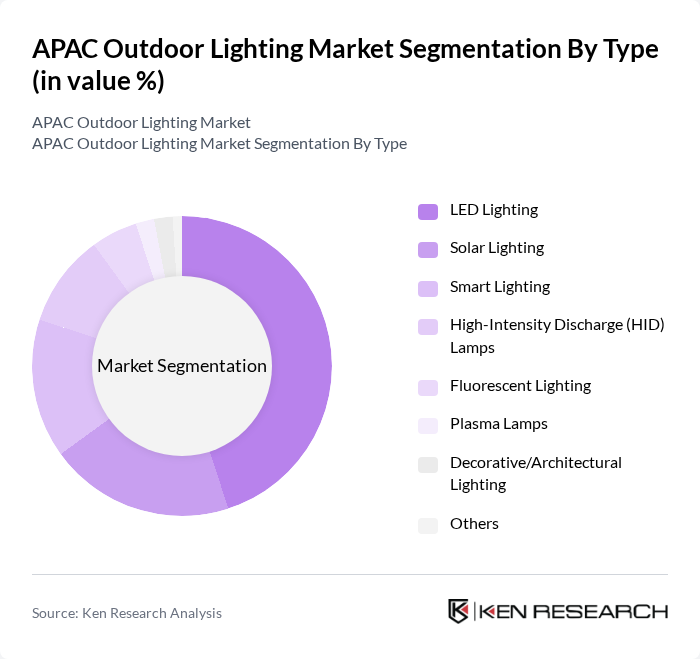
By Type:The outdoor lighting market in APAC is segmented into LED Lighting, Solar Lighting, Smart Lighting, High-Intensity Discharge (HID) Lamps, Fluorescent Lighting, Plasma Lamps, Decorative/Architectural Lighting, and Others. Among these,LED Lightingremains the dominant segment, driven by its high energy efficiency, long operational life, and declining costs, making it the preferred choice for both public infrastructure and private sector projects .
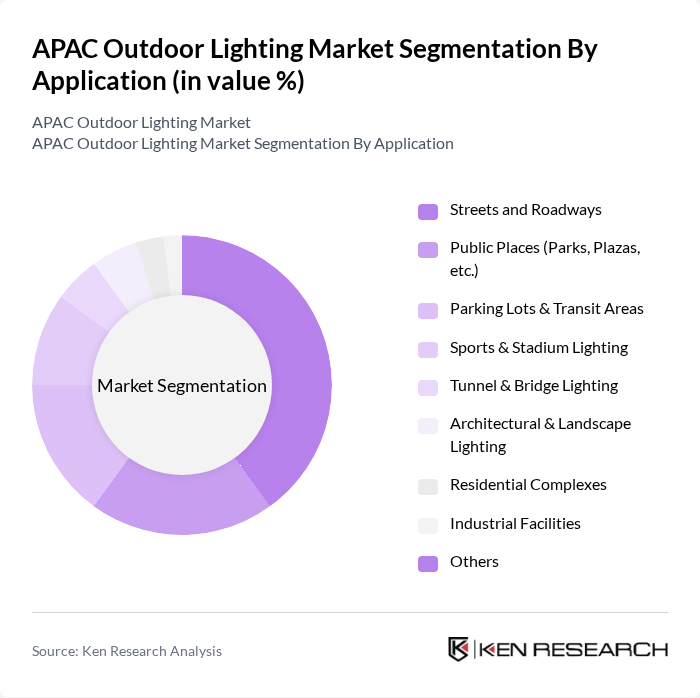
By Application:The market is also segmented by application, including Streets and Roadways, Public Places (Parks, Plazas, etc.), Parking Lots & Transit Areas, Sports & Stadium Lighting, Tunnel & Bridge Lighting, Architectural & Landscape Lighting, Residential Complexes, Industrial Facilities, and Others.Streets and Roadwayslighting is the leading application, supported by ongoing municipal upgrades and the need for improved safety and visibility in urban environments. Sports and stadium lighting is also experiencing notable growth due to increased investment in community and event infrastructure .
APAC Outdoor Lighting Market Competitive Landscape
The APAC Outdoor Lighting Market is characterized by a dynamic mix of regional and international players. Leading participants such as Signify N.V. (formerly Philips Lighting), Osram Licht AG, Cree LED (a Smart Global Holdings company), GE Lighting, a Savant company, Acuity Brands, Inc., Zumtobel Group AG, Eaton Corporation plc, Hubbell Lighting, Inc., Panasonic Corporation, Nichia Corporation, Samsung Electronics Co., Ltd., Toshiba Corporation, Opple Lighting Co., Ltd., FSL (Foshan Electrical and Lighting Co., Ltd.), Seoul Semiconductor Co., Ltd. contribute to innovation, geographic expansion, and service delivery in this space.
APAC Outdoor Lighting Market Industry Analysis
Growth Drivers
- Increasing Urbanization:The APAC region is experiencing rapid urbanization, with urban populations projected to reach 2.6 billion in future, according to the United Nations. This surge necessitates enhanced outdoor lighting solutions to ensure safety and accessibility in urban areas. Cities like Delhi and Shanghai are investing heavily in infrastructure, with budgets exceeding USD 120 billion for urban development, driving demand for advanced outdoor lighting systems that cater to growing urban populations.
- Government Initiatives for Smart Cities:Governments across APAC are prioritizing smart city initiatives, with over 600 smart city projects underway, as reported by the Asian Development Bank. These projects often include the integration of smart outdoor lighting systems, which can reduce energy consumption by up to 35%. For instance, Singapore's Smart Nation initiative allocates approximately USD 1.8 billion annually to enhance urban infrastructure, including intelligent lighting solutions that improve public safety and energy efficiency.
- Rising Demand for Energy-Efficient Solutions:The push for energy efficiency is evident, with the APAC region aiming to reduce energy consumption by 25% in future, as per the International Energy Agency. This demand is driving the adoption of LED lighting, which consumes 80% less energy than traditional lighting. In future, the market for energy-efficient outdoor lighting in APAC was valued at USD 9 billion, reflecting a significant shift towards sustainable lighting solutions that align with global energy conservation goals.
Market Challenges
- High Initial Investment Costs:The transition to advanced outdoor lighting systems often involves substantial upfront costs, which can deter municipalities and businesses. For instance, the installation of smart lighting systems can range from USD 120,000 to USD 1.2 million per project, depending on the scale. This financial barrier is particularly pronounced in developing countries within APAC, where budget constraints limit the adoption of innovative lighting technologies despite their long-term cost savings.
- Regulatory Compliance Issues:Navigating the complex regulatory landscape poses significant challenges for outdoor lighting manufacturers. Compliance with varying local and national regulations can incur additional costs and delays. For example, in India, the Bureau of Energy Efficiency mandates specific energy performance standards, which can complicate product development and market entry. This regulatory burden can hinder innovation and slow the adoption of new lighting technologies across the region.
APAC Outdoor Lighting Market Future Outlook
The APAC outdoor lighting market is poised for significant transformation, driven by technological advancements and increasing environmental awareness. As cities continue to embrace smart technologies, the integration of IoT in lighting systems will enhance operational efficiency and user experience. Furthermore, the growing emphasis on sustainability will likely accelerate the development of eco-friendly lighting solutions, aligning with global energy conservation efforts. This evolving landscape presents a unique opportunity for stakeholders to innovate and adapt to changing consumer preferences and regulatory frameworks.
Market Opportunities
- Integration of IoT in Lighting Solutions:The incorporation of IoT technology in outdoor lighting systems is a significant opportunity, with the potential to enhance energy management and operational efficiency. In future, it is estimated that smart lighting solutions could reduce energy costs by up to USD 2.5 billion annually across APAC, making them an attractive investment for municipalities and businesses alike.
- Development of Sustainable Lighting Products:The increasing focus on sustainability presents a lucrative opportunity for manufacturers to innovate eco-friendly lighting products. With the global market for sustainable lighting projected to reach USD 25 billion in future, APAC companies can capitalize on this trend by developing products that meet environmental standards and appeal to eco-conscious consumers, thereby enhancing their market competitiveness.
Scope of the Report
| Segment | Sub-Segments |
|---|---|
| By Type | LED Lighting Solar Lighting Smart Lighting High-Intensity Discharge (HID) Lamps Fluorescent Lighting Plasma Lamps Decorative/Architectural Lighting Others |
| By Application | Streets and Roadways Public Places (Parks, Plazas, etc.) Parking Lots & Transit Areas Sports & Stadium Lighting Tunnel & Bridge Lighting Architectural & Landscape Lighting Residential Complexes Industrial Facilities Others |
| By Region | China Japan India South Korea Australia Southeast Asia (Indonesia, Malaysia, Singapore, Thailand, Vietnam, Philippines) Rest of APAC |
| By Distribution Channel | Offline Online |
| By End-User | Government & Municipalities Commercial Industrial Residential Others |
Key Target Audience
Investors and Venture Capitalist Firms
Government and Regulatory Bodies (e.g., Ministry of Urban Development, Environmental Protection Agency)
Manufacturers and Producers
Distributors and Retailers
Utility Companies
Smart City Planners and Developers
Architectural and Engineering Firms
Financial Institutions
Players Mentioned in the Report:
Signify N.V. (formerly Philips Lighting)
Osram Licht AG
Cree LED (a Smart Global Holdings company)
GE Lighting, a Savant company
Acuity Brands, Inc.
Zumtobel Group AG
Eaton Corporation plc
Hubbell Lighting, Inc.
Panasonic Corporation
Nichia Corporation
Samsung Electronics Co., Ltd.
Toshiba Corporation
Opple Lighting Co., Ltd.
FSL (Foshan Electrical and Lighting Co., Ltd.)
Seoul Semiconductor Co., Ltd.
Table of Contents
Market Assessment Phase
1. Executive Summary and Approach
2. APAC Outdoor Lighting Market Overview
2.1 Key Insights and Strategic Recommendations
2.2 APAC Outdoor Lighting Market Overview
2.3 Definition and Scope
2.4 Evolution of Market Ecosystem
2.5 Timeline of Key Regulatory Milestones
2.6 Value Chain & Stakeholder Mapping
2.7 Business Cycle Analysis
2.8 Policy & Incentive Landscape
3. APAC Outdoor Lighting Market Analysis
3.1 Growth Drivers
3.1.1 Increasing Urbanization
3.1.2 Government Initiatives for Smart Cities
3.1.3 Rising Demand for Energy-Efficient Solutions
3.1.4 Technological Advancements in Lighting Solutions
3.2 Market Challenges
3.2.1 High Initial Investment Costs
3.2.2 Regulatory Compliance Issues
3.2.3 Competition from Alternative Lighting Solutions
3.2.4 Limited Awareness of Advanced Technologies
3.3 Market Opportunities
3.3.1 Expansion in Emerging Markets
3.3.2 Integration of IoT in Lighting Solutions
3.3.3 Development of Sustainable Lighting Products
3.3.4 Collaborations with Smart City Projects
3.4 Market Trends
3.4.1 Shift Towards LED Lighting
3.4.2 Adoption of Solar-Powered Solutions
3.4.3 Increasing Focus on Aesthetic Lighting Designs
3.4.4 Growth of Smart Lighting Systems
3.5 Government Regulation
3.5.1 Energy Efficiency Standards
3.5.2 Environmental Protection Regulations
3.5.3 Incentives for Renewable Energy Use
3.5.4 Urban Planning Guidelines
4. SWOT Analysis
5. Stakeholder Analysis
6. Porter's Five Forces Analysis
7. APAC Outdoor Lighting Market Market Size, 2019-2024
7.1 By Value
7.2 By Volume
7.3 By Average Selling Price
8. APAC Outdoor Lighting Market Segmentation
8.1 By Type
8.1.1 LED Lighting
8.1.2 Solar Lighting
8.1.3 Smart Lighting
8.1.4 High-Intensity Discharge (HID) Lamps
8.1.5 Fluorescent Lighting
8.1.6 Plasma Lamps
8.1.7 Decorative/Architectural Lighting
8.1.8 Others
8.2 By Application
8.2.1 Streets and Roadways
8.2.2 Public Places (Parks, Plazas, etc.)
8.2.3 Parking Lots & Transit Areas
8.2.4 Sports & Stadium Lighting
8.2.5 Tunnel & Bridge Lighting
8.2.6 Architectural & Landscape Lighting
8.2.7 Residential Complexes
8.2.8 Industrial Facilities
8.2.9 Others
8.3 By Region
8.3.1 China
8.3.2 Japan
8.3.3 India
8.3.4 South Korea
8.3.5 Australia
8.3.6 Southeast Asia (Indonesia, Malaysia, Singapore, Thailand, Vietnam, Philippines)
8.3.7 Rest of APAC
8.4 By Distribution Channel
8.4.1 Offline
8.4.2 Online
8.5 By End-User
8.5.1 Government & Municipalities
8.5.2 Commercial
8.5.3 Industrial
8.5.4 Residential
8.5.5 Others
9. APAC Outdoor Lighting Market Competitive Analysis
9.1 Market Share of Key Players
9.2 Cross Comparison of Key Players
9.2.1 Company Name
9.2.2 Group Size (Large, Medium, or Small as per industry convention)
9.2.3 Revenue (USD, APAC Outdoor Lighting Segment)
9.2.4 Revenue Growth Rate (3-5 Year CAGR)
9.2.5 Market Share in APAC Outdoor Lighting
9.2.6 Geographic Presence (Number of APAC Countries Served)
9.2.7 Product Portfolio Breadth (Outdoor Lighting SKUs)
9.2.8 R&D/Innovation Spend (% of Revenue)
9.2.9 Major Project Wins (Smart City/Infrastructure)
9.2.10 Distribution Channel Strength (Offline/Online/Direct)
9.2.11 Sustainability Initiatives (e.g., % LED, Solar, Green Certifications)
9.2.12 Customer Satisfaction Index
9.3 SWOT Analysis of Top Players
9.4 Pricing Analysis
9.5 Detailed Profile of Major Companies
9.5.1 Signify N.V. (formerly Philips Lighting)
9.5.2 Osram Licht AG
9.5.3 Cree LED (a Smart Global Holdings company)
9.5.4 GE Lighting, a Savant company
9.5.5 Acuity Brands, Inc.
9.5.6 Zumtobel Group AG
9.5.7 Eaton Corporation plc
9.5.8 Hubbell Lighting, Inc.
9.5.9 Panasonic Corporation
9.5.10 Nichia Corporation
9.5.11 Samsung Electronics Co., Ltd.
9.5.12 Toshiba Corporation
9.5.13 Opple Lighting Co., Ltd.
9.5.14 FSL (Foshan Electrical and Lighting Co., Ltd.)
9.5.15 Seoul Semiconductor Co., Ltd.
10. APAC Outdoor Lighting Market End-User Analysis
10.1 Procurement Behavior of Key Ministries
10.1.1 Government Procurement Policies
10.1.2 Budget Allocation Trends
10.1.3 Decision-Making Processes
10.1.4 Supplier Selection Criteria
10.2 Corporate Spend on Infrastructure & Energy
10.2.1 Investment Trends in Outdoor Lighting
10.2.2 Budgeting for Sustainability Initiatives
10.2.3 Cost-Benefit Analysis Practices
10.2.4 Long-term Financial Commitments
10.3 Pain Point Analysis by End-User Category
10.3.1 Residential User Concerns
10.3.2 Commercial User Challenges
10.3.3 Industrial User Requirements
10.3.4 Government User Expectations
10.4 User Readiness for Adoption
10.4.1 Awareness of New Technologies
10.4.2 Training and Support Needs
10.4.3 Financial Readiness
10.4.4 Infrastructure Compatibility
10.5 Post-Deployment ROI and Use Case Expansion
10.5.1 Measurement of ROI
10.5.2 Case Studies of Successful Implementations
10.5.3 User Feedback Mechanisms
10.5.4 Future Expansion Plans
11. APAC Outdoor Lighting Market Future Size, 2025-2030
11.1 By Value
11.2 By Volume
11.3 By Average Selling Price
Go-To-Market Strategy Phase
1. Whitespace Analysis + Business Model Canvas
1.1 Market Gaps Identification
1.2 Business Model Development
2. Marketing and Positioning Recommendations
2.1 Branding Strategies
2.2 Product USPs
3. Distribution Plan
3.1 Urban Retail vs Rural NGO Tie-ups
4. Channel & Pricing Gaps
4.1 Underserved Routes
4.2 Pricing Bands
5. Unmet Demand & Latent Needs
5.1 Category Gaps
5.2 Consumer Segments
6. Customer Relationship
6.1 Loyalty Programs
6.2 After-sales Service
7. Value Proposition
7.1 Sustainability
7.2 Integrated Supply Chains
8. Key Activities
8.1 Regulatory Compliance
8.2 Branding
8.3 Distribution Setup
9. Entry Strategy Evaluation
9.1 Domestic Market Entry Strategy
9.1.1 Product Mix
9.1.2 Pricing Band
9.1.3 Packaging
9.2 Export Entry Strategy
9.2.1 Target Countries
9.2.2 Compliance Roadmap
10. Entry Mode Assessment
10.1 Joint Ventures
10.2 Greenfield Investments
10.3 Mergers & Acquisitions
10.4 Distributor Model
11. Capital and Timeline Estimation
11.1 Capital Requirements
11.2 Timelines
12. Control vs Risk Trade-Off
12.1 Ownership vs Partnerships
13. Profitability Outlook
13.1 Breakeven Analysis
13.2 Long-term Sustainability
14. Potential Partner List
14.1 Distributors
14.2 Joint Ventures
14.3 Acquisition Targets
15. Execution Roadmap
15.1 Phased Plan for Market Entry
15.1.1 Market Setup
15.1.2 Market Entry
15.1.3 Growth Acceleration
15.1.4 Scale & Stabilize
15.2 Key Activities and Milestones
15.2.1 Milestone Planning
15.2.2 Activity Tracking
Research Methodology
Phase 1: Approach1
Desk Research
- Industry reports from government bodies and trade associations in the APAC region
- Market analysis publications focusing on outdoor lighting technologies and trends
- Statistical data from energy efficiency programs and environmental agencies
Primary Research
- Interviews with product managers at leading outdoor lighting manufacturers
- Surveys with urban planners and municipal lighting authorities
- Field interviews with installation contractors and electrical engineers
Validation & Triangulation
- Cross-validation of findings through multiple data sources including sales and installation data
- Triangulation of insights from primary interviews with secondary research findings
- Sanity checks conducted through expert panels comprising industry veterans
Phase 2: Market Size Estimation1
Top-down Assessment
- Analysis of national energy consumption data to estimate outdoor lighting market size
- Segmentation by application areas such as street lighting, parks, and commercial spaces
- Incorporation of government initiatives promoting smart and energy-efficient lighting
Bottom-up Modeling
- Volume estimates based on installation rates of outdoor lighting fixtures across urban areas
- Cost analysis derived from average pricing of various outdoor lighting technologies
- Calculation of market size based on projected growth rates in urbanization and infrastructure development
Forecasting & Scenario Analysis
- Multi-variable regression analysis incorporating factors like population growth and urban expansion
- Scenario modeling based on potential regulatory changes and technological advancements
- Development of baseline, optimistic, and pessimistic forecasts through 2030
Phase 3: CATI Sample Composition1
| Scope Item/Segment | Sample Size | Target Respondent Profiles |
|---|---|---|
| Municipal Street Lighting Projects | 100 | City Planners, Public Works Directors |
| Commercial Outdoor Lighting Solutions | 60 | Facility Managers, Retail Operations Heads |
| Smart Lighting Technology Adoption | 50 | IT Managers, Smart City Coordinators |
| Energy Efficiency Programs | 40 | Energy Auditors, Sustainability Consultants |
| Installation and Maintenance Services | 50 | Electrical Contractors, Service Managers |
Frequently Asked Questions
What is the current value of the APAC Outdoor Lighting Market?
The APAC Outdoor Lighting Market is valued at approximately USD 4.0 billion, driven by urbanization, government initiatives, and the demand for energy-efficient lighting solutions, particularly LED and solar technologies.
Which countries are the key players in the APAC Outdoor Lighting Market?
What are the main types of outdoor lighting in the APAC market?
What applications drive the demand for outdoor lighting in APAC?
Other Regional/Country Reports
Indonesia Outdoor Lighting Market
Malaysia Outdoor Lighting Market
KSA Outdoor Lighting Market
SEA Outdoor Lighting Market
Other Adjacent Reports
UAE LED Technology Market
Mexico Solar Energy Market Size, Share & Forecast, By Technology, Application & Project Scale, 2026-2031South Africa Urban Development Market
UAE Iot Devices MarketOman Energy Efficient Solutions Market
Qatar Lighting Controls Market
UAE Architectural Design Market
Belgium Renewable Energy Systems Market
Kuwait Street Furniture Market
Why Buy From Us?

What makes us stand out is that our consultants follow Robust, Refine and Result (RRR) methodology. Robust for clear definitions, approaches and sanity checking, Refine for differentiating respondents' facts and opinions, and Result for presenting data with story.

We have set a benchmark in the industry by offering our clients with syndicated and customized market research reports featuring coverage of entire market as well as meticulous research and analyst insights.

While we don't replace traditional research, we flip the method upside down. Our dual approach of Top Bottom & Bottom Top ensures quality deliverable by not just verifying company fundamentals but also looking at the sector and macroeconomic factors.

With one step in the future, our research team constantly tries to show you the bigger picture. We help with some of the tough questions you may encounter along the way: How is the industry positioned? Best marketing channel? KPI's of competitors? By aligning every element, we help maximize success.

Our report gives you instant access to the answers and sources that other companies might choose to hide. We elaborate each steps of research methodology we have used and showcase you the sample size to earn your trust.

If you need any support, we are here! We pride ourselves on universe strength, data quality, and quick, friendly, and professional service.