Ken Research Logo

APAC transdermal skin patches market report size, share, growth drivers, trends, opportunities & forecast 2025–2030

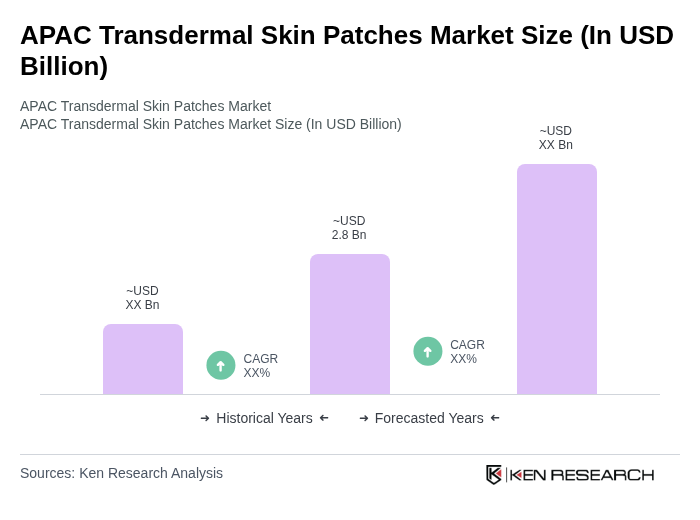
The APAC Transdermal Skin Patches Market, valued at USD 2.8 billion, grows due to rising chronic diseases, geriatric population, and innovations like smart patches.

Region:Asia

Author(s):Shubham

Product Code:KRAA8673

Pages:88

Published On:November 2025
About the Report

Base Year 2024

APAC Transdermal Skin Patches Market Overview

  • The APAC Transdermal Skin Patches Market is valued at USD 2.8 billion, based on a five-year historical analysis. This growth is primarily driven by the increasing prevalence of chronic diseases—including diabetes, cardiovascular disease, COPD, and cancer—the rising demand for non-invasive drug delivery systems, and advancements in patch technology such as smart patches and microneedle innovations. The market is also supported by the growing geriatric population, which is more susceptible to various health conditions requiring effective management and prefers easy-to-use, pain-free medication delivery methods.
  • Key players in this market include China, Japan, and India, which dominate due to their large populations, increasing healthcare expenditure, and robust pharmaceutical industries. China leads with its extensive manufacturing capabilities and investment in healthcare infrastructure, while Japan is recognized for advanced technology and innovation in drug delivery systems. India benefits from a growing market for affordable healthcare solutions and a strong presence of generic drug manufacturers. The region’s aging population and rising chronic disease incidence further drive demand for transdermal patches.
  • In 2023, the Indian government implemented the National Digital Health Mission, which aims to enhance healthcare delivery through digital technologies, including transdermal patches. This initiative focuses on improving access to healthcare services and promoting the use of innovative medical devices, thereby fostering growth in the transdermal skin patches market. The National Digital Health Mission, 2023, issued by the Ministry of Health & Family Welfare, mandates the integration of digital health records and supports the adoption of advanced medical devices, including transdermal drug delivery systems, to improve patient outcomes and healthcare accessibility.
APAC Transdermal Skin Patches Market Size

APAC Transdermal Skin Patches Market Segmentation

By Type:The transdermal skin patches market is segmented into various types, including Single-layer Drug-in-Adhesive Patches, Multi-layer Drug-in-Adhesive Patches, Matrix Patches, Reservoir Patches, and Others. Among these, Single-layer Drug-in-Adhesive Patches are gaining significant traction due to their simplicity in design and ease of use. They are particularly favored for delivering medications for pain relief and hormonal therapies, making them a popular choice among consumers and healthcare providers alike.
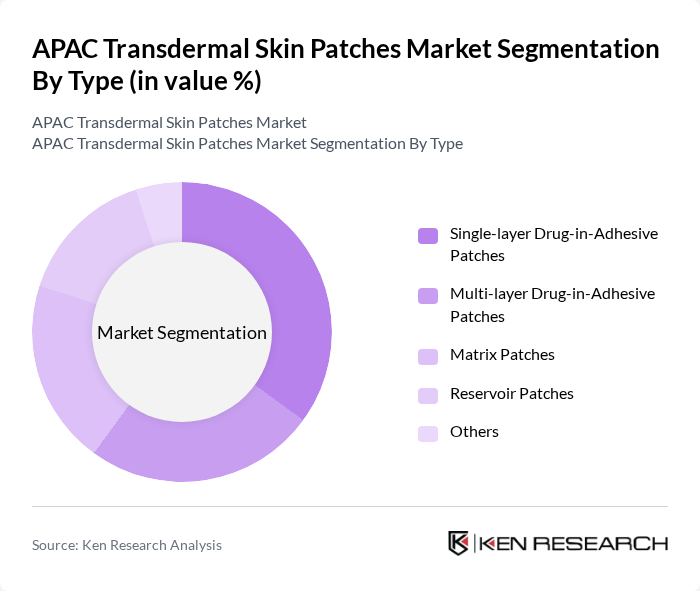
APAC Transdermal Skin Patches Market segmentation by Type.

By End-User:The market is also segmented by end-user, which includes Hospital Pharmacies, Retail Pharmacies, Online Pharmacies, Home Healthcare, and Others. Hospital Pharmacies are currently leading the market due to their critical role in patient care and medication management. The increasing number of hospitals and healthcare facilities, along with the growing trend of outpatient care, is driving the demand for transdermal patches in these settings. Additionally, the expansion of e-commerce platforms is supporting growth in online pharmacy sales, improving access for rural and remote populations.
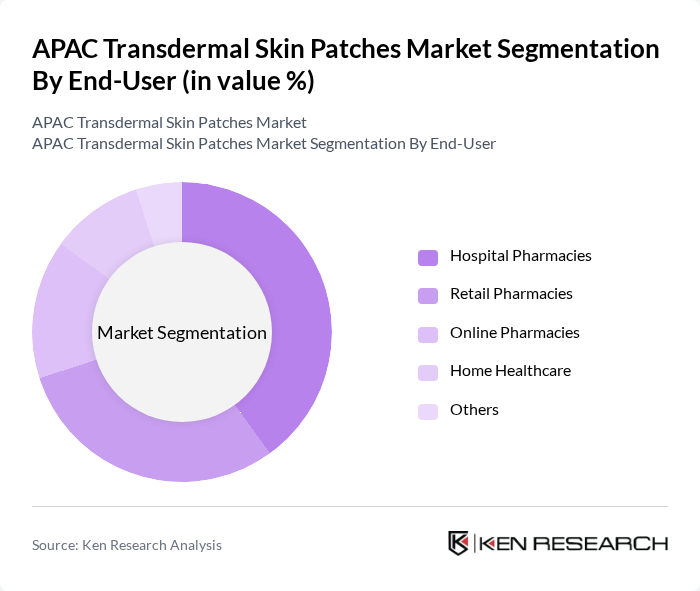
APAC Transdermal Skin Patches Market segmentation by End-User.

APAC Transdermal Skin Patches Market Competitive Landscape

The APAC Transdermal Skin Patches Market is characterized by a dynamic mix of regional and international players. Leading participants such as Johnson & Johnson, Novartis AG, Mylan N.V. (Viatris Inc.), Teva Pharmaceutical Industries Ltd., Hisamitsu Pharmaceutical Co., Inc., 3M Company, Luye Pharma Group Ltd., Nitto Denko Corporation, Sanofi S.A., GlaxoSmithKline plc, Abbott Laboratories, Zydus Lifesciences Ltd., Dr. Reddy’s Laboratories Ltd., Cipla Ltd., Medherant Ltd. contribute to innovation, geographic expansion, and service delivery in this space.

Johnson & Johnson

1886

New Brunswick, New Jersey, USA

Novartis AG

1996

Basel, Switzerland

Mylan N.V. (Viatris Inc.)

1961

Pittsburgh, Pennsylvania, USA

Teva Pharmaceutical Industries Ltd.

1901

Petah Tikva, Israel

Hisamitsu Pharmaceutical Co., Inc.

1847

Kobe, Japan

Company

Establishment Year

Headquarters

Market Share in APAC

Product Portfolio Breadth (Transdermal Patch Types)

R&D Investment Ratio

Regulatory Approval Success Rate

Distribution Network Coverage (APAC)

Manufacturing Capacity (Units/Year in APAC)

APAC Transdermal Skin Patches Market Industry Analysis

Growth Drivers

  • Increasing Prevalence of Chronic Diseases:The APAC region is witnessing a significant rise in chronic diseases, with an estimated 60% of adults suffering from at least one chronic condition in future. According to the World Health Organization, the number of diabetes cases in Asia is projected to reach 150 million, driving demand for effective drug delivery systems. This growing patient population necessitates innovative solutions like transdermal patches, which offer a convenient and effective method for medication administration.
  • Rising Demand for Non-Invasive Drug Delivery Systems:The global shift towards non-invasive drug delivery methods is evident, with the transdermal patch market expected to grow significantly. In future, the demand for non-invasive systems is projected to increase by 20%, driven by patient preference for less painful alternatives. This trend is supported by the increasing awareness of the benefits of transdermal patches, which provide consistent drug delivery and improved patient compliance, particularly in managing chronic conditions.
  • Technological Advancements in Patch Design:Innovations in transdermal patch technology are enhancing drug delivery efficiency. In future, the introduction of smart patches, which can monitor patient vitals and adjust drug release accordingly, is expected to revolutionize the market. The integration of micro-needles and enhanced adhesive technologies is projected to increase the effectiveness of drug absorption, making transdermal patches a more attractive option for both patients and healthcare providers in the APAC region.

Market Challenges

  • High Manufacturing Costs:The production of transdermal patches involves complex processes and high-quality materials, leading to elevated manufacturing costs. In future, the average cost of producing a single patch is estimated to be around $2.50, which can limit market accessibility, especially in price-sensitive regions. This financial barrier poses a significant challenge for manufacturers aiming to penetrate emerging markets where affordability is crucial for widespread adoption.
  • Regulatory Hurdles:The regulatory landscape for transdermal patches is stringent, with extensive requirements for clinical trials and product approvals. In future, the average time for regulatory approval in the APAC region is projected to be approximately 18 months, which can delay product launches. These regulatory challenges can hinder innovation and market entry for new players, impacting the overall growth of the transdermal skin patches market in the region.

APAC Transdermal Skin Patches Market Future Outlook

The APAC transdermal skin patches market is poised for significant growth, driven by technological advancements and increasing healthcare demands. As the region's population ages, the need for effective, non-invasive drug delivery systems will intensify. Furthermore, the integration of digital health technologies is expected to enhance patient engagement and adherence. Companies that focus on innovation and collaboration with healthcare providers will likely capture emerging opportunities, positioning themselves favorably in this evolving landscape.

Market Opportunities

  • Expansion into Emerging Markets:The growing middle class in countries like India and Indonesia presents a lucrative opportunity for transdermal patch manufacturers. With an increasing focus on healthcare accessibility, the demand for affordable and effective drug delivery systems is expected to rise, potentially increasing market penetration by 30% in these regions in future.
  • Development of Personalized Medicine:The trend towards personalized medicine is creating opportunities for tailored transdermal patches that cater to individual patient needs. In future, the market for personalized drug delivery systems is projected to grow by 25%, driven by advancements in genomics and patient data analytics, allowing for more effective treatment options.

Scope of the Report

SegmentSub-Segments
By Type

Single-layer Drug-in-Adhesive Patches

Multi-layer Drug-in-Adhesive Patches

Matrix Patches

Reservoir Patches

Others

By End-User

Hospital Pharmacies

Retail Pharmacies

Online Pharmacies

Home Healthcare

Others

By Region

China

Japan

India

South Korea

Australia

Southeast Asia

Rest of APAC

By Application

Pain Relief

Smoking Cessation

Hormonal Therapy

Cardiovascular Disorders

Neurological Disorders

Others

By Distribution Channel

Hospital Pharmacies

Retail Pharmacies

Online Pharmacies

Others

By Material

Polymeric Patches

Composite Patches

Others

By Technology

Microneedle Technology

Iontophoresis

Thermal Patches

Others

Key Target Audience

Investors and Venture Capitalist Firms

Government and Regulatory Bodies (e.g., Therapeutic Goods Administration, Health Sciences Authority)

Manufacturers and Producers

Distributors and Retailers

Pharmaceutical Companies

Medical Device Companies

Healthcare Providers and Institutions

Insurance Companies and Payers

Players Mentioned in the Report:

Johnson & Johnson

Novartis AG

Mylan N.V. (Viatris Inc.)

Teva Pharmaceutical Industries Ltd.

Hisamitsu Pharmaceutical Co., Inc.

3M Company

Luye Pharma Group Ltd.

Nitto Denko Corporation

Sanofi S.A.

GlaxoSmithKline plc

Abbott Laboratories

Zydus Lifesciences Ltd.

Dr. Reddys Laboratories Ltd.

Cipla Ltd.

Medherant Ltd.

Table of Contents

Market Assessment Phase

1. Executive Summary and Approach


2. APAC Transdermal Skin Patches Market Overview

2.1 Key Insights and Strategic Recommendations

2.2 APAC Transdermal Skin Patches Market Overview

2.3 Definition and Scope

2.4 Evolution of Market Ecosystem

2.5 Timeline of Key Regulatory Milestones

2.6 Value Chain & Stakeholder Mapping

2.7 Business Cycle Analysis

2.8 Policy & Incentive Landscape


3. APAC Transdermal Skin Patches Market Analysis

3.1 Growth Drivers

3.1.1 Increasing prevalence of chronic diseases
3.1.2 Rising demand for non-invasive drug delivery systems
3.1.3 Technological advancements in patch design
3.1.4 Growing geriatric population

3.2 Market Challenges

3.2.1 High manufacturing costs
3.2.2 Regulatory hurdles
3.2.3 Limited awareness among healthcare professionals
3.2.4 Competition from alternative drug delivery methods

3.3 Market Opportunities

3.3.1 Expansion into emerging markets
3.3.2 Development of personalized medicine
3.3.3 Collaborations with healthcare providers
3.3.4 Innovations in biodegradable patches

3.4 Market Trends

3.4.1 Increasing adoption of wearable technology
3.4.2 Focus on patient-centric healthcare solutions
3.4.3 Integration of digital health platforms
3.4.4 Rise in demand for over-the-counter patches

3.5 Government Regulation

3.5.1 Stricter quality control measures
3.5.2 Guidelines for clinical trials
3.5.3 Approval processes for new products
3.5.4 Regulations on advertising and marketing

4. SWOT Analysis


5. Stakeholder Analysis


6. Porter's Five Forces Analysis


7. APAC Transdermal Skin Patches Market Market Size, 2019-2024

7.1 By Value

7.2 By Volume

7.3 By Average Selling Price


8. APAC Transdermal Skin Patches Market Segmentation

8.1 By Type

8.1.1 Single-layer Drug-in-Adhesive Patches
8.1.2 Multi-layer Drug-in-Adhesive Patches
8.1.3 Matrix Patches
8.1.4 Reservoir Patches
8.1.5 Others

8.2 By End-User

8.2.1 Hospital Pharmacies
8.2.2 Retail Pharmacies
8.2.3 Online Pharmacies
8.2.4 Home Healthcare
8.2.5 Others

8.3 By Region

8.3.1 China
8.3.2 Japan
8.3.3 India
8.3.4 South Korea
8.3.5 Australia
8.3.6 Southeast Asia
8.3.7 Rest of APAC

8.4 By Application

8.4.1 Pain Relief
8.4.2 Smoking Cessation
8.4.3 Hormonal Therapy
8.4.4 Cardiovascular Disorders
8.4.5 Neurological Disorders
8.4.6 Others

8.5 By Distribution Channel

8.5.1 Hospital Pharmacies
8.5.2 Retail Pharmacies
8.5.3 Online Pharmacies
8.5.4 Others

8.6 By Material

8.6.1 Polymeric Patches
8.6.2 Composite Patches
8.6.3 Others

8.7 By Technology

8.7.1 Microneedle Technology
8.7.2 Iontophoresis
8.7.3 Thermal Patches
8.7.4 Others

9. APAC Transdermal Skin Patches Market Competitive Analysis

9.1 Market Share of Key Players

9.2 KPIs for Cross Comparison of Key Players

9.2.1 Revenue Growth Rate (APAC Segment)
9.2.2 Market Share in APAC
9.2.3 Product Portfolio Breadth (Transdermal Patch Types)
9.2.4 R&D Investment Ratio
9.2.5 Regulatory Approval Success Rate
9.2.6 Distribution Network Coverage (APAC)
9.2.7 Manufacturing Capacity (Units/Year in APAC)
9.2.8 Strategic Partnerships/Local Alliances
9.2.9 Brand Recognition (Healthcare Professional & Consumer Surveys)
9.2.10 Customer Satisfaction Score (APAC)

9.3 SWOT Analysis of Top Players

9.4 Pricing Analysis

9.5 Detailed Profile of Major Companies

9.5.1 Johnson & Johnson
9.5.2 Novartis AG
9.5.3 Mylan N.V. (Viatris Inc.)
9.5.4 Teva Pharmaceutical Industries Ltd.
9.5.5 Hisamitsu Pharmaceutical Co., Inc.
9.5.6 3M Company
9.5.7 Luye Pharma Group Ltd.
9.5.8 Nitto Denko Corporation
9.5.9 Sanofi S.A.
9.5.10 GlaxoSmithKline plc
9.5.11 Abbott Laboratories
9.5.12 Zydus Lifesciences Ltd.
9.5.13 Dr. Reddy’s Laboratories Ltd.
9.5.14 Cipla Ltd.
9.5.15 Medherant Ltd.

10. APAC Transdermal Skin Patches Market End-User Analysis

10.1 Procurement Behavior of Key Ministries

10.1.1 Budget Allocation Trends
10.1.2 Decision-Making Processes
10.1.3 Preferred Suppliers
10.1.4 Compliance Requirements

10.2 Corporate Spend on Infrastructure & Energy

10.2.1 Investment Trends
10.2.2 Budget Prioritization
10.2.3 Long-term Contracts
10.2.4 Cost Management Strategies

10.3 Pain Point Analysis by End-User Category

10.3.1 Healthcare Providers
10.3.2 Patients
10.3.3 Distributors
10.3.4 Others

10.4 User Readiness for Adoption

10.4.1 Training Needs
10.4.2 Technology Acceptance
10.4.3 Support Requirements
10.4.4 Feedback Mechanisms

10.5 Post-Deployment ROI and Use Case Expansion

10.5.1 Performance Metrics
10.5.2 Case Studies
10.5.3 User Feedback
10.5.4 Future Use Cases

11. APAC Transdermal Skin Patches Market Future Size, 2025-2030

11.1 By Value

11.2 By Volume

11.3 By Average Selling Price


Go-To-Market Strategy Phase

1. Whitespace Analysis + Business Model Canvas

1.1 Market Gaps Identification

1.2 Business Model Development


2. Marketing and Positioning Recommendations

2.1 Branding Strategies

2.2 Product USPs


3. Distribution Plan

3.1 Urban Retail Strategies

3.2 Rural NGO Tie-ups


4. Channel & Pricing Gaps

4.1 Underserved Routes

4.2 Pricing Bands


5. Unmet Demand & Latent Needs

5.1 Category Gaps

5.2 Consumer Segments


6. Customer Relationship

6.1 Loyalty Programs

6.2 After-sales Service


7. Value Proposition

7.1 Sustainability Initiatives

7.2 Integrated Supply Chains


8. Key Activities

8.1 Regulatory Compliance

8.2 Branding Efforts

8.3 Distribution Setup


9. Entry Strategy Evaluation

9.1 Domestic Market Entry Strategy

9.1.1 Product Mix
9.1.2 Pricing Band
9.1.3 Packaging Considerations

9.2 Export Entry Strategy

9.2.1 Target Countries
9.2.2 Compliance Roadmap

10. Entry Mode Assessment

10.1 Joint Ventures

10.2 Greenfield Investments

10.3 Mergers & Acquisitions

10.4 Distributor Model


11. Capital and Timeline Estimation

11.1 Capital Requirements

11.2 Timelines for Implementation


12. Control vs Risk Trade-Off

12.1 Ownership vs Partnerships


13. Profitability Outlook

13.1 Breakeven Analysis

13.2 Long-term Sustainability


14. Potential Partner List

14.1 Distributors

14.2 Joint Ventures

14.3 Acquisition Targets


15. Execution Roadmap

15.1 Phased Plan for Market Entry

15.1.1 Market Setup
15.1.2 Market Entry
15.1.3 Growth Acceleration
15.1.4 Scale & Stabilize

15.2 Key Activities and Milestones

15.2.1 Milestone Planning
15.2.2 Activity Tracking

Research Methodology

ApproachModellingSample

Phase 1: Approach1

Desk Research

  • Market reports from industry associations such as the Asia Pacific Pharmaceutical Association
  • Published articles and white papers on transdermal drug delivery systems
  • Regulatory guidelines and updates from health authorities across APAC countries

Primary Research

  • Interviews with product managers at leading pharmaceutical companies
  • Surveys with healthcare professionals specializing in pain management and chronic disease treatment
  • Field interviews with pharmacists and distributors of transdermal patches

Validation & Triangulation

  • Cross-validation of data from multiple sources including market reports and expert interviews
  • Triangulation of quantitative data with qualitative insights from industry experts
  • Sanity checks through feedback from a panel of healthcare professionals

Phase 2: Market Size Estimation1

Top-down Assessment

  • Analysis of overall pharmaceutical market growth trends in the APAC region
  • Segmentation of the transdermal patches market by therapeutic area and application
  • Incorporation of demographic data to assess potential market reach

Bottom-up Modeling

  • Estimation of production volumes based on manufacturing capacities of key players
  • Cost analysis of raw materials and production processes for transdermal patches
  • Volume x price calculations to derive revenue estimates for different segments

Forecasting & Scenario Analysis

  • Multi-variable forecasting using historical growth rates and market drivers
  • Scenario analysis based on potential regulatory changes and technological advancements
  • Development of baseline, optimistic, and pessimistic market projections through 2030

Phase 3: CATI Sample Composition1

Scope Item/SegmentSample SizeTarget Respondent Profiles
Chronic Pain Management45Pain Management Specialists, General Practitioners
Hormonal Therapy Applications38Endocrinologists, Gynecologists
Nicotine Replacement Therapy32Pharmacists, Smoking Cessation Counselors
Dermatological Treatments28Dermatologists, Cosmetic Surgeons
Market Distribution Channels42Distributors, Retail Pharmacy Managers

Frequently Asked Questions

What is the current value of the APAC Transdermal Skin Patches Market?

The APAC Transdermal Skin Patches Market is valued at approximately USD 2.8 billion, driven by the rising prevalence of chronic diseases and the demand for non-invasive drug delivery systems.

What factors are driving the growth of the APAC Transdermal Skin Patches Market?

Which countries are leading in the APAC Transdermal Skin Patches Market?

How does the aging population affect the transdermal patches market?

Other Regional/Country Reports

Indonesia Transdermal Skin Patches Market

Malaysia Transdermal Skin Patches Market

KSA Transdermal Skin Patches Market

SEA Transdermal Skin Patches Market

Vietnam Transdermal Skin Patches Market

Thailand Transdermal Skin Patches Market

Other Adjacent Reports

Singapore Transdermal Drug Delivery Market

Egypt Wearable Medical Devices Market

KSA Pain Management Pharmaceuticals Market

Oman Hormone Replacement Therapy Market

Vietnam Smoking Cessation Products Market

Thailand Dermatology Therapeutics Market

Oman Chronic Disease Management Market

Thailand Medical Adhesives and Sealants Market

Oman Microneedle Technology Market

Bahrain Over-the-Counter Medications Market

Why Buy From Us?

Refine Robust Result (RRR) Framework

What makes us stand out is that our consultants follow Robust, Refine and Result (RRR) methodology. Robust for clear definitions, approaches and sanity checking, Refine for differentiating respondents' facts and opinions, and Result for presenting data with story.

Our Reach Is Unmatched

We have set a benchmark in the industry by offering our clients with syndicated and customized market research reports featuring coverage of entire market as well as meticulous research and analyst insights.

Shifting the Research Paradigm

While we don't replace traditional research, we flip the method upside down. Our dual approach of Top Bottom & Bottom Top ensures quality deliverable by not just verifying company fundamentals but also looking at the sector and macroeconomic factors.

More Insights-Better Decisions

With one step in the future, our research team constantly tries to show you the bigger picture. We help with some of the tough questions you may encounter along the way: How is the industry positioned? Best marketing channel? KPI's of competitors? By aligning every element, we help maximize success.

Transparency and Trust

Our report gives you instant access to the answers and sources that other companies might choose to hide. We elaborate each steps of research methodology we have used and showcase you the sample size to earn your trust.

Round the Clock Support

If you need any support, we are here! We pride ourselves on universe strength, data quality, and quick, friendly, and professional service.

Why Clients Choose Us?

400000+
Reports in repository
150+
Consulting projects a year
100+
Analysts
8000+
Client Queries in 2022








