Hospital Management Software Adoption Survey: Why India's Hospitals Digitize the Money First and the Clinic Last
Ken Research
July 31, 2026 - 7 min read
July 31, 2026
by Ken ResearchIndia's Hospital Software Market Is Booming, but Adoption Runs Deep in Patches and Thin Everywhere Else
India's hospital software market is one of the fastest growing in healthcare technology. The India hospital information system market generated about USD 4.08 billion in revenue in 2024 and is projected to reach roughly USD 12.9 billion by 2030 at a 21.3% CAGR, with cloud-based deployment the largest and fastest-growing segment, as hospitals race to digitise operations under tighter budgets and new EMR standards.
Yet adoption is far from uniform across functions. To map how hospitals actually adopt management software, Ken Research conducted its Hospital Management Software Adoption Survey across India, surveying hospital administrators, IT heads, and clinical leads. The first chart frames which modules are live and which still lag, function by function.
Hospitals digitise the money modules first and the clinical ones last. Billing and revenue management is live in 81% of hospitals and patient registration in 78%, but EHR and clinical notes reach only 42%, radiology and PACS 38%, and analytics dashboards just 29%. The systems that protect cash flow are adopted fastest; the ones that improve care lag well behind.
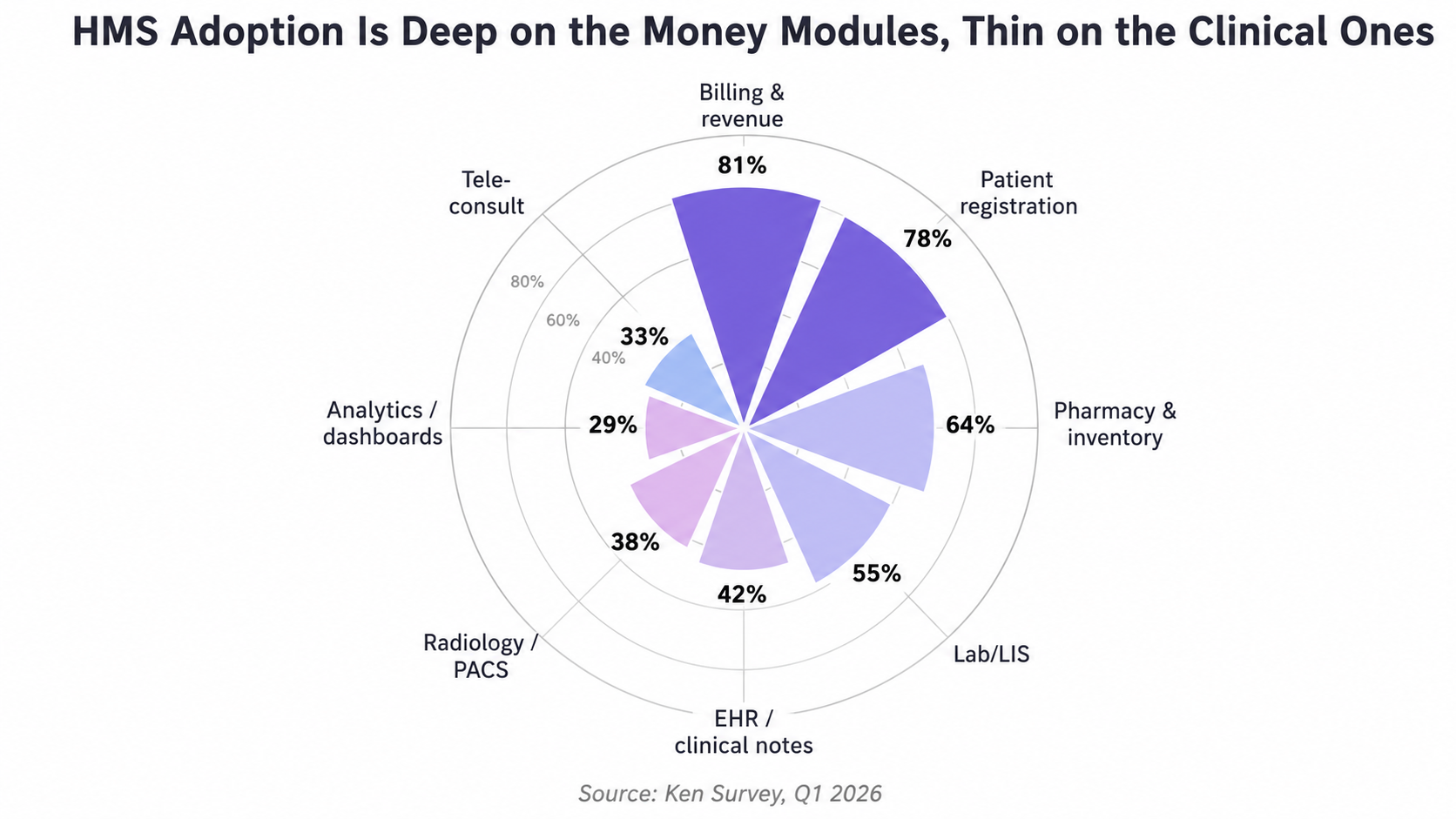
The implication is that most hospitals run on partial systems. A hospital can have fully digital billing yet still keep clinical notes on paper, leaving the data that drives quality and analytics trapped offline, which is exactly the adoption gap this survey set out to map.
Survey Profile: Who We Studied, Where, and Why It Matters
Sample and Geography
The survey was conducted in Q1 of 2026 across a stratified sample of 2,000 hospital software decision-makers spanning North, West, South, and East India, including Mumbai, Delhi-NCR, Bengaluru, Chennai, Hyderabad, Pune, Jaipur, Lucknow, and Kochi, across metro, tier-2, and tier-3 locations. The frame covered private chains, standalone hospitals, nursing homes, and large clinics. Fieldwork combined online panels, IT-head interviews, and assisted telephone surveys.
Respondent Profile
- Role mix: 33% hospital administrators and COOs, 29% IT and digital-health heads, 22% finance leaders, and 16% medical superintendents or clinical leads
- Location tier: 41% metro and tier-1, 38% tier-2 cities, 21% tier-3 and rural hospitals and clinics
- Adoption stage: a large share run partial or module-by-module systems rather than a single integrated suite, with full integration concentrated in chains
- Deployment: cloud is now the default choice for new rollouts, while legacy on-premises systems persist in older and smaller hospitals
How Long It Takes: Core Go-Live in Six Months, Full Adoption Beyond a Year
Adoption is a journey, not a switch, and its length shapes who attempts it. Tracking the typical rollout phase by phase shows where the time goes. The chart below maps each stage from kick-off to full optimization.
The core comes quickly; the clinical layer drags. Vendor selection and data migration take about four months; core billing and registration modules go live around the six-month mark, but clinical modules and analytics push full adoption past 14 to 18 months. The fast, visible wins arrive early; the harder, care-related modules are what stretch the timeline.
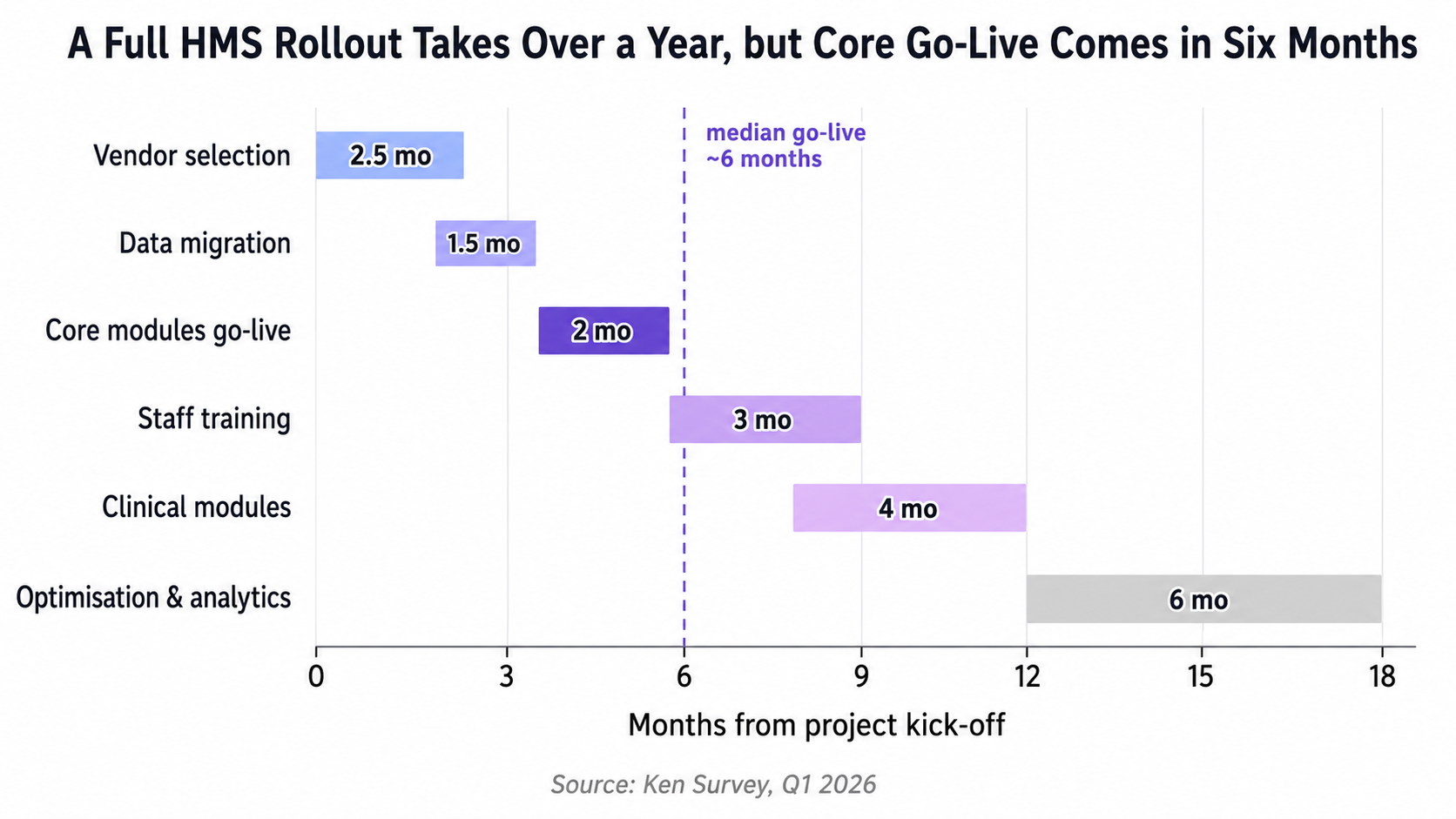
For vendors and hospitals, the lesson is to sequence for momentum. Delivering a fast core go-live builds the confidence and cash-flow proof needed to fund the slower clinical phases, which is why phased rollouts now dominate over big-bang ones.
Who Has Adopted: Metros Run on Cloud, Smaller Hospitals Lag the Target
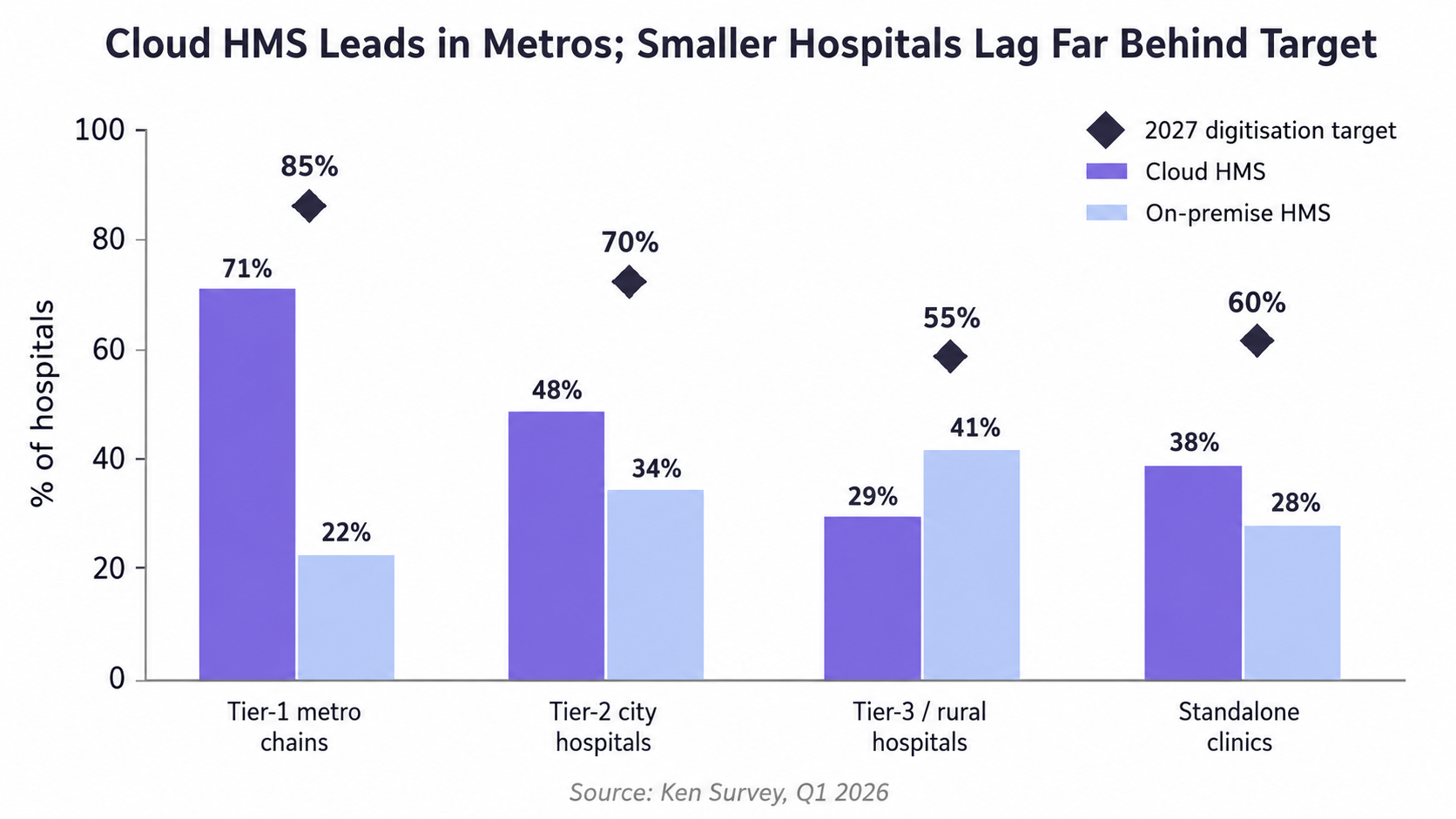
Adoption depends heavily on where a hospital sits. Comparing cloud and on-premise uptake against a digitisation target across hospital tiers exposes a sharp divide. The chart below plots each tier's adoption against the 2027 target.
The digital divide is geographic and stark. Tier-1 metro chains run 71% on cloud HMS against an 85% target, but tier-3 and rural hospitals sit at just 29% cloud adoption versus a 55% target, leaning instead on ageing on-premises systems. The hospitals that would benefit most from cloud are the furthest from reaching it.
What the Adoption Gap Reveals
- Cloud is the great equalizer, in theory: it removes the capital and IT-team barrier that blocks small hospitals, yet connectivity and trust still hold them back.
- The lag is a demand problem, not a supply one: over 90% of India's HMS vendors offer low-end solutions, so affordable products exist; adoption confidence does not.
- Tier-2 is the contested battleground: sitting between metro saturation and rural reluctance, tier-2 cities are where the next wave of adoption will be won or lost.
What Holds It Back: Cost Doubt and Staff Resistance Top the Barrier List
Knowing adoption lags is not enough; the decision turns on why hospitals hesitate. The survey asked respondents to name their top barriers to adopting management software. The chart below ranks each barrier by the share of hospitals citing it.
The blockers are about people and proof, not technology. Upfront cost and doubt over return on investment top the list at 68%, followed by staff resistance and training at 57% and poor internet or power at 49%, while pure data-security concerns rank lowest at 31%. Hospitals are reluctant to commit higher costs for good software when the payback feels uncertain.
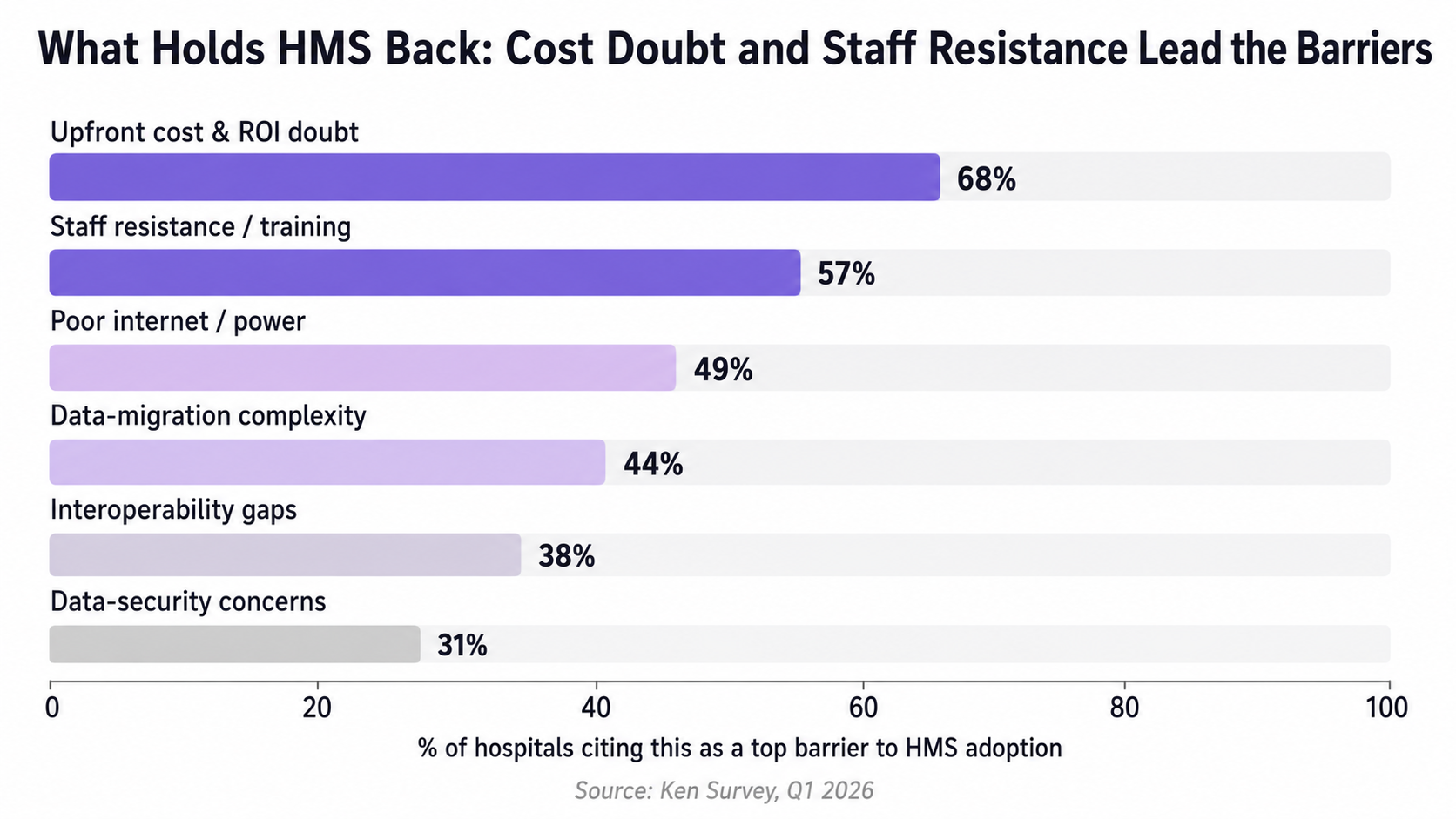
For vendors the takeaway is that the sale is about confidence, not features. Proving fast ROI and investing in staff training removes the two biggest barriers at once, far more effectively than adding another technical module.
What It Delivers: A Year After Go-Live, Every Operational Metric Improves
The ROI doubt that blocks adoption is answered by what happens after it. Tracking key operational metrics from go-live through one year shows the payoff. The chart below follows six metrics over twelve months.
The gains are broad and compounding. Within twelve months of go-live, the billing cycle shortens by about 66%, claim rejections fall 68%, inventory stock-outs drop 73%, and patient wait times and staff admin hours each roughly halve. Reports indicate hospitals can save up to 30% in operational costs once a comprehensive system is fully running.
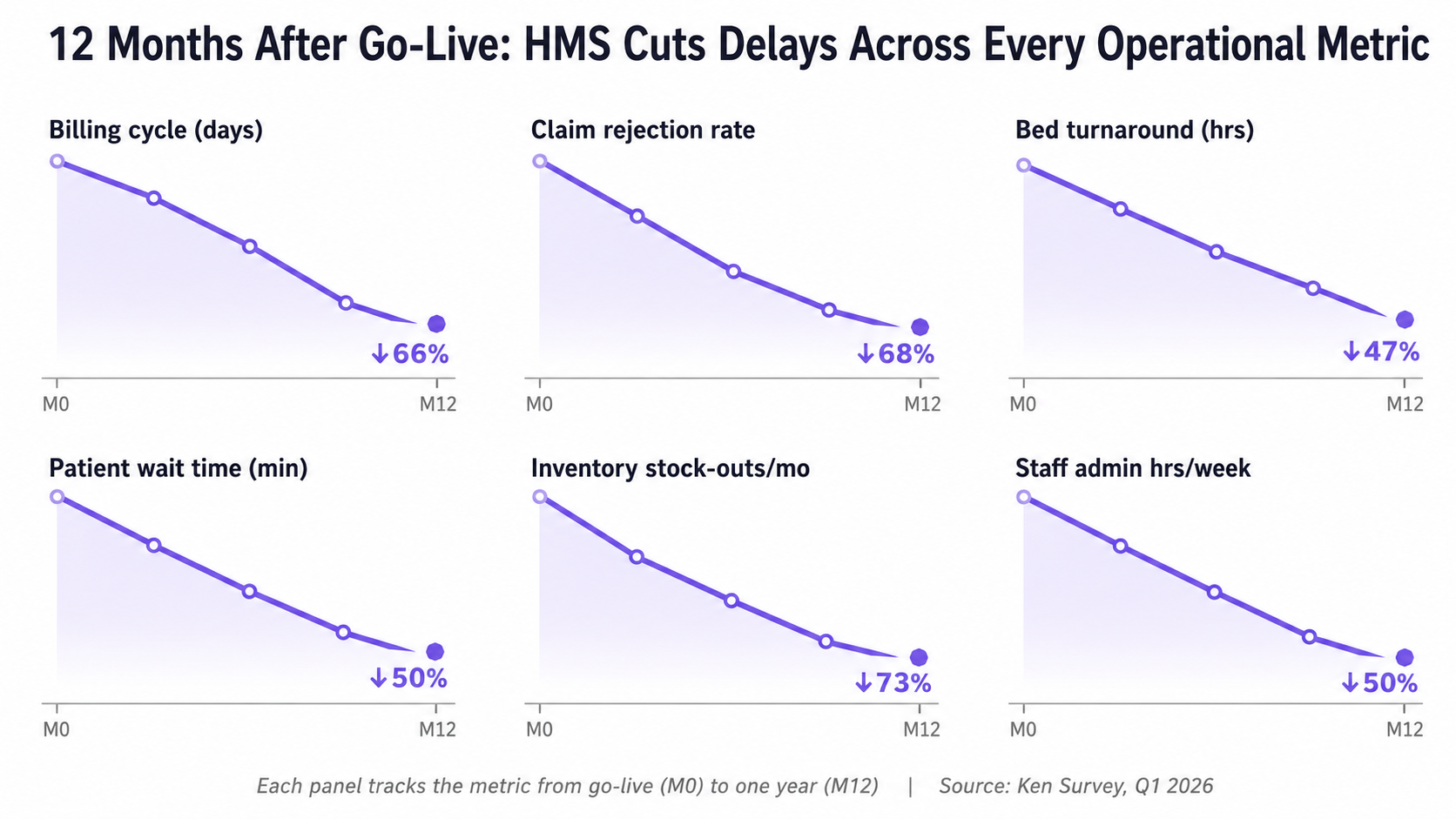
For hesitant hospitals the evidence reframes the decision. The cost of adopting HMS is paid once, but the operational and cash-flow gains recur every month, which is precisely the proof the cost-doubters need to see.
What Lies Ahead: The Strategic Reckoning for India's Hospitals and HMS Vendors
The gap between booming software supply and patchy real adoption has turned India's HMS market into a confidence contest as much as a technology one. Rapid market growth, cloud as the default, new EMR standards, and proven post-adoption gains all point the same way: the hospital that wins is the one that sequences adoption for momentum and digitises care, not just cash, and the vendor that wins is the one that proves ROI and trains staff, not the one with the longest feature list.
Hospital leaders and the vendors who serve them must now confront hard strategic questions:
Do hospitals keep digitising only the money modules, or extend adoption to the clinical layer where care quality actually improves?
Do smaller hospitals keep waiting on the sidelines, or use affordable cloud to leapfrog the metros they trail today?
Do vendors keep selling features, or remove the real barriers of cost doubt and staff resistance with proof and training?
Adopting software for billing alone, while clinical notes stay on paper and the data that drives quality stays offline, is no longer sufficient. India's HMS decisions are being judged on whole-hospital digitisation and proven returns, and the payoff is earned by finishing the journey, not by going live on the easy modules and stopping.
The data shows that the gains do not require the biggest budget, they require the confidence to sequence adoption and see it through. For India's hospitals and HMS vendors the message is direct: digitise care as well as cash, prove the return early, train the people who use it, and finish the rollout, or keep paying for paper long after the software arrived.
About the Author - Kunal Kumar:
Kunal Kumar is a Survey Research Analyst at Ken Research, specializing in market research and data-driven insights. He has experience in designing and analysing large-scale consumer surveys across industries and geographies, helping organisations turn primary research into strategic business decisions.
From the Author:
“At Ken Research, we have been mapping hospital software adoption at the level of the people who actually make the call, the administrators, IT heads, and clinical leads who decide what gets digitised, and the data tells a clear story. Hospitals are not short of software; they are short of the confidence to adopt it fully and the proof that it pays. The gap between digital billing and digital care is what decides whether a hospital truly modernises. India's HMS market is no longer a feature game, it is a confidence-and-completion game, and the winners will be those who prove the return and finish the journey better than their competitors do.”
About Ken Research:
Ken Research is a market intelligence and strategy consulting firm delivering actionable insights across the various sectors in dynamic markets. We support industry stakeholders with data-driven analysis on emerging trends, competitive benchmarking, pricing strategies, and shifting consumer preferences. Our expertise enables clients to refine market entry and penetration strategies, optimize product positioning, and respond effectively to evolving competitive landscapes.
Related tags
Hospitals and Clinics
Healthcare
Get started
We've helped companies around the world future-proof
their businesses - and we can do the same for you.