The €3,000 Battery Bet: How LFP Chemistry Is Redefining Europe’s EV Battleground
Ken Research
September 26, 2025 - 7 min read
September 26, 2025
by Manan GoenkaEurope's EV Revolution: Why LFP Batteries Are Rewriting the Rules
Europe's electric vehicle revolution is accelerating faster than many anticipated. Fuelled by tough new EU regulations and ambitious carbon-cutting targets, the EV market surged to 34% of the market during the first half of 2025 alone. Battery electric vehicles now claim a record 15.6% market share, with total electrified vehicles (including hybrids) reaching nearly 60%, marking a decisive shift in consumer and industry priorities. But for European automakers, this progress comes with unprecedented challenges, tighter CO₂ standards, and rising pressure to remain competitive as the combustion engine faces its 2035 phase-out.
Why are we focusing on this market now? What makes the adoption of lithium iron phosphate, LFP batteries so pivotal? And how can insight into this evolving landscape help industry leaders stay ahead? This article explores these questions, providing clarity on the strategic shifts reshaping the European EV sector.
Amid this disruption, LFP battery chemistry emerges as a strategic lever transforming how companies manage costs, manufacturing, and sustainability. Although European OEMs who have historically preferred nickel based chemistries are now rapidly embracing LFP’s promise, not just as a technical replacement but as a fundamental makeover of their competitive strategy. Markets like Germany, France, and the Netherlands are leading the charge, leveraging LFP to navigate regulatory demands while fighting back against cost-competitive Chinese rivals.
For automotive and battery leaders, understanding LFP's strategic impact is essential to maintain market position amid rising competition, where cost leadership and sustainable sourcing will define winners.
20% Cost Savings, 30% Less Power: The LFP Math That's Changing Everything
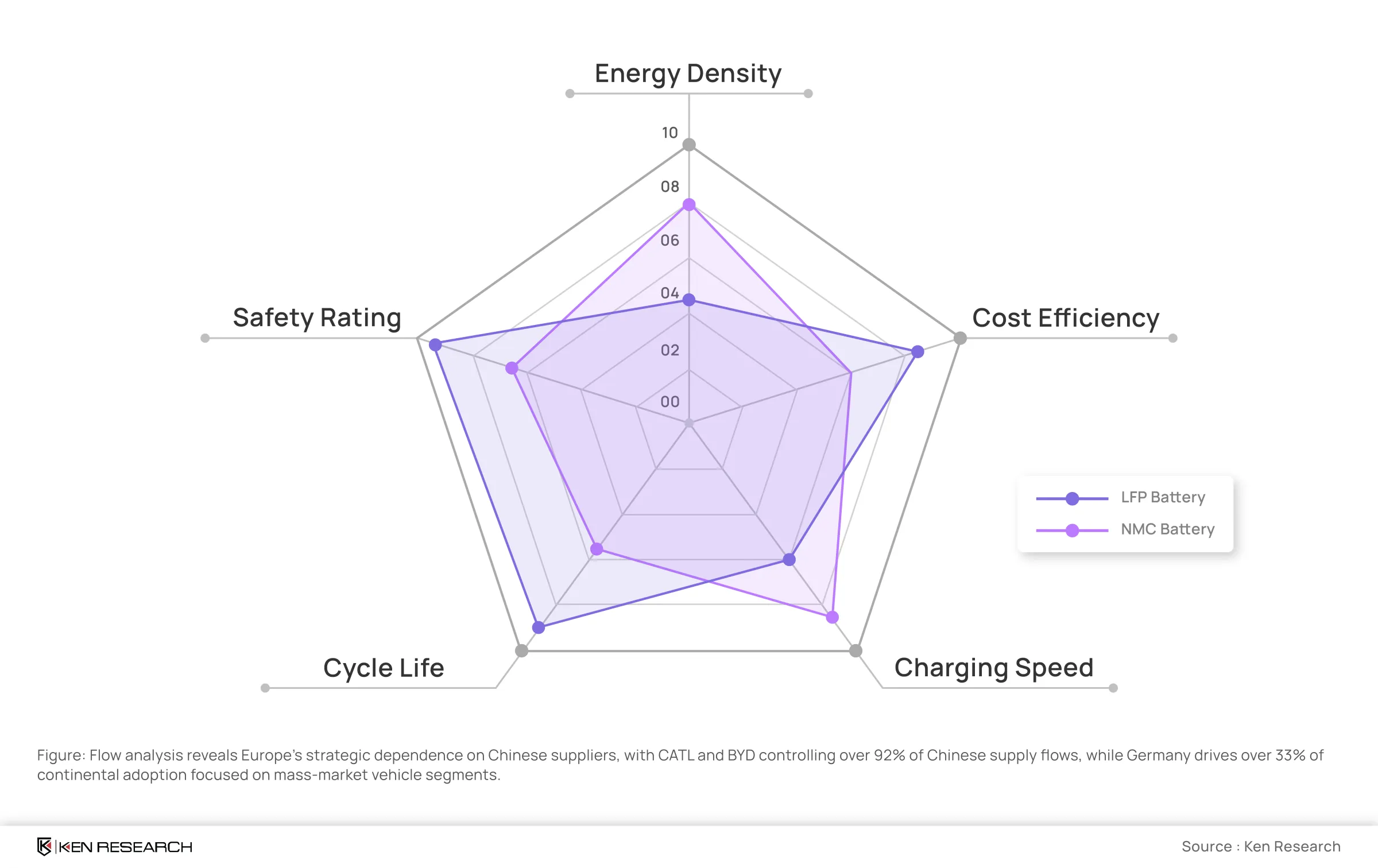
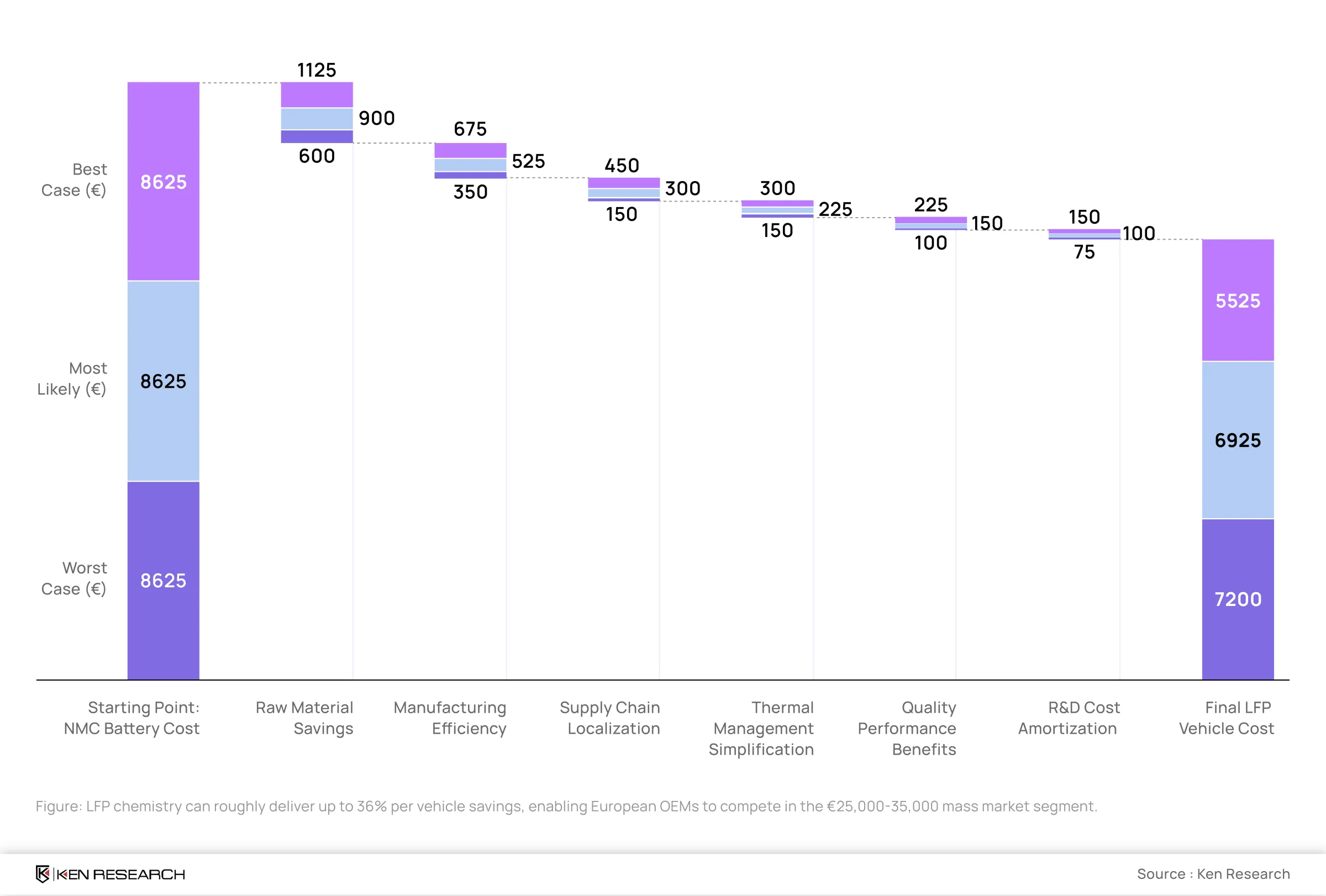
European OEM strategies are strongly influenced by the fundamental differences between LFP and traditional nickel-based batteries. LFP cells, typically costing $90–100 per kWh, offer a 15–25% cost advantage compared to NMC batteries, which generally price at $110–120 per kWh. This cost gap directly affects vehicle pricing, especially in the critical €25,000–35,000 segment, enabling savings of €2,000–3,000 per vehicle, an essential edge amidst growing competition from Chinese manufacturers.
Performance trade-offs demand careful consideration. NMC chemistry boasts higher energy density, ranging from 200 to 280 Wh/kg, while LFP achieves 150 to 180 Wh/kg, influencing vehicle packaging and range capabilities. OEMs confront design challenges since consumers increasingly expect driving ranges beyond 400 kilometres, and compromises on pack size or range risk market rejection.
Nevertheless, LFP batteries provide significant long-term value. Despite lower energy density, LFP delivers a superior total cost of ownership with over 2,000 charge cycles, compared to NMC’s 1,000 to 1,800 cycles. Enhanced thermal stability allows LFP to support stronger warranties and reduce fire risk. Additionally, unlike NMC batteries limited to an 80% state-of-charge, LFP batteries can be fully charged without degradation, improving durability and user satisfaction.
Germany's 30% LFP Lead: The New Geography of European Battery Power"
Europe’s LFP battery market is growing swiftly, valued at $2.36 billion in 2025 and set to expand at a 16.8% CAGR through 2029. This robust growth reflects a pivotal strategic turning point, as European OEMs and global entrants increasingly adopt cost-effective LFP chemistry to safeguard market share against aggressive Chinese competition.
Leading this surge is BYD, which dramatically outsold Tesla in Europe by 13,503 units in July 2025—a staggering 225% year-over-year growth—capturing a 1.2% market share in July compared to Tesla’s 0.8%. Affordable models like the sub-€30,000 Dolphin and Seagull hatchbacks, which leverage proprietary Blade LFP technology, have been central to BYD’s rapid expansion. Tesla’s own embrace of LFP in the Model 3 and Model Y standard versions, coupled with its Berlin Gigafactory producing 500,000 packs annually, signals mainstream acknowledgement of LFP's market relevance.
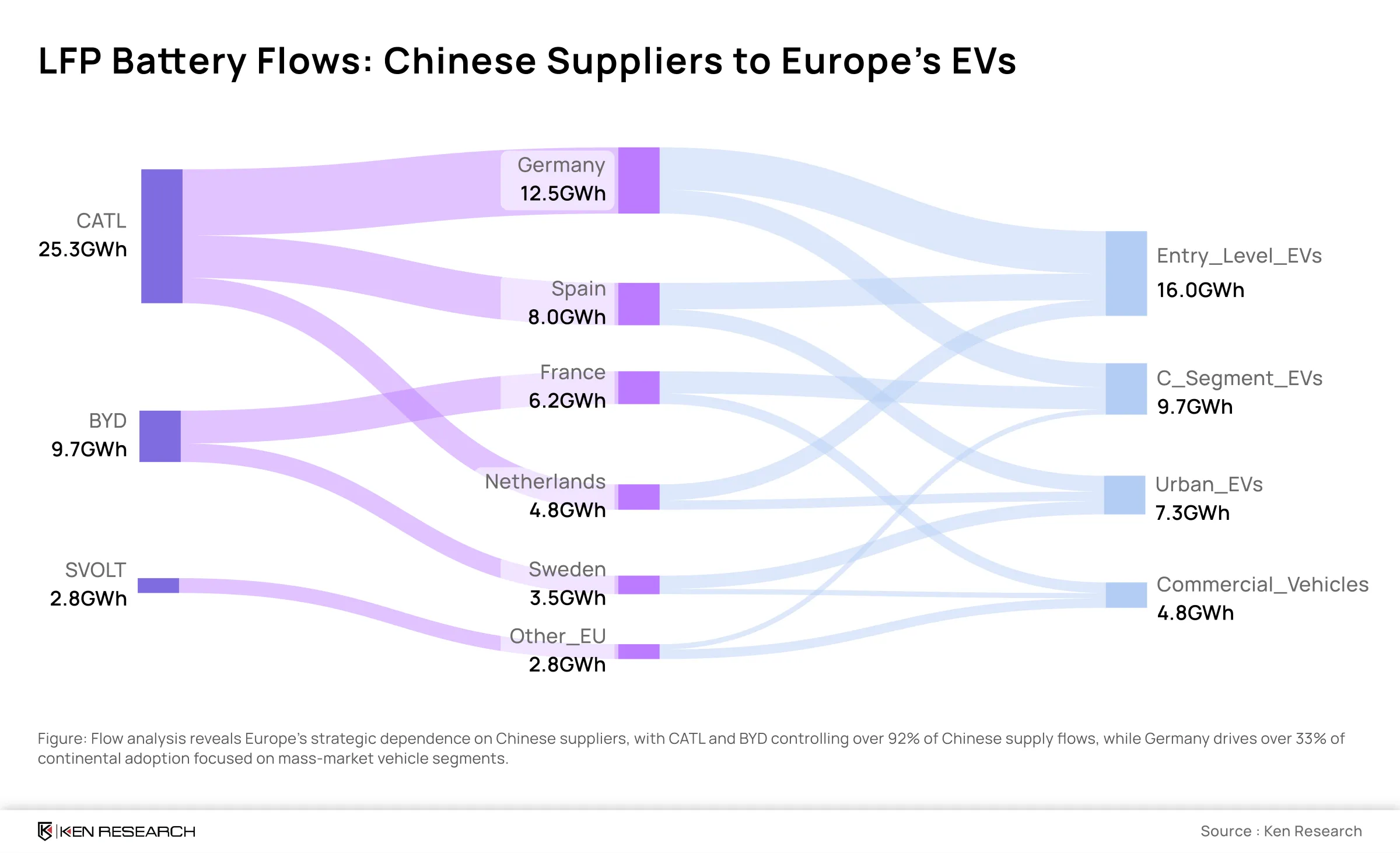
Germany accounts for about one-third of Europe's LFP battery demand, supported by strong automotive infrastructure and government incentives. Fuelled by urban mobility needs and subsidies aimed at reducing EV ownership costs, France and the Netherlands follow closely. Adoption in these markets is focused on the C-segment and entry-level cars, broadening financial access for consumers.
European supply chains continue to rely heavily on Chinese manufacturers such as CATL and BYD. This creates a complex dynamic that blends significant cost advantages with strategic vulnerabilities. Efforts to localise production are gaining momentum, with Stellantis partnering with CATL to develop domestic battery manufacturing and BYD’s €4 billion plant in Hungary aiming to produce 150,000 vehicles annually by 2026. This hybrid approach balances supply security against cost competitiveness by combining European manufacturing capabilities with Chinese expertise.
Beyond Cost Savings: How LFP Batteries Unlock ESG and Supply Chain Wins
LFP adoption offers European OEMs a competitive edge by enabling aggressive pricing without compromising value in the €25,000–35,000 segment, dominated by Chinese rivals. The €20–30 per kWh cost advantage translates to vehicle savings of €3,000–4,000. Since batteries comprise 30–35% of vehicle costs, this differential helps European brands preserve margins while keeping retail prices competitive.
Supply chain diversification further strengthens strategic resilience. LFP chemistry eliminates dependence on volatile cobalt and nickel, whose production costs in Europe run 50% higher than in China. This reduces geopolitical risks and ensures stable material access, even as prices fluctuate between $35,000 and $70,000 per tonne.
A third critical factor is ESG compliance. EU Battery Regulation requires recycling efficiency to rise from 65% for portable batteries in 2025 and stricter lithium recovery goals of 50% by 2027 and 80% by 2031, aligning well with LFP’s superior thermal stability and easier recyclability. Minimum recycled content rules—16% cobalt, 6% lithium, and 6% nickel—tighten by 2031. LFP's low reliance on critical metals supports regulatory compliance and circular economy goals, which are vital for investor confidence and adherence to EU taxonomy.
Together, these levers position LFP as a cornerstone technology helping European OEMs meet mounting competitive pressures while advancing sustainability mandates through cost-effectiveness, secure supply, and regulatory alignment.
The 400-Kilometer Problem: Engineering LFP for European Expectations
For European OEMs, integrating LFP batteries requires essential platform modifications to stay competitive. LFP’s lower energy density, ranging between 150 and 180 Wh/kg compared to NMC’s 200–280 Wh/kg, demands 15–20% larger battery packs to maintain driving range. This impacts weight distribution and packaging, posing a particular challenge for premium segments where consumers expect more than 400 kilometres of range.
Manufacturing advances mitigate these limitations. Removing traditional battery modules and cell-to-pack CTP technology streamlines assembly, reduces costs, and boosts space utilisation by 10–15%.
Battery management systems are complicated by LFP's flat voltage discharge curve, requiring advanced algorithms for SOC estimation due to LFP's flat voltage curve, even as thermal management demands remain lower than high nickel systems. For OEMs to fully benefit from LFP's cycle life, they must invest in advanced BMS.
Scaling manufacturing unlocks further potential. Automated CTP assembly enhances quality and reduces labour intensity, enabling European plants to better compete with China on cost. This is critical as LFP adoption expands primarily in entry-level and C-segment vehicles, where maintaining margins is essential for sustainable growth.
The LFP Perception Problem: Why Europeans Still Think It's 'Budget' Technology
While LFP batteries offer many advantages, European OEMs must navigate significant hurdles. The primary technical limitation remains energy density; LFP delivers about 25–30% lower energy density, typically 150–180 Wh/kg at the cell level, versus NMC’s 200–280 Wh/kg. This shortfall poses concerns, especially in premium segments where consumers expect driving ranges beyond 400 kilometers without compromise.
Charging performance adds complexity. Although LFP excels at high-state-of-charge charging, it is temperature-sensitive. Lithium-ion conductivity drops significantly below -20°C, slowing charging speeds and requiring longer preconditioning times than NMC—critical factors in Northern Europe’s cold climate.
Consumer perception presents another barrier. Despite LFP’s superior safety and longevity, market research suggests it is still viewed as a “lower spec” option tied to entry-level EVs. Since European buyers traditionally prioritize performance over total cost of ownership, overcoming this bias demands significant marketing efforts.
Adding to uncertainties, regulatory challenges loom. Pending energy density mandates may limit LFP deployment despite existing EU policies favouring cost-effective and sustainable chemistries. Manufacturers are increasingly cautious with LFP-focused platforms as policymakers consider minimum performance standards that may favour higher energy density solutions.
What Lies Ahead: Strategic Questions for European OEMs
The LFP battery revolution represents more than a chemistry change—it demands a fundamental rethink of how European automakers compete in an era defined by supply chain resilience and pricing transparency. Strategies focused on integrated cost management and faster platform decisions prioritizing accessibility over exclusivity are overtaking the traditional premium-focused, slow-adoption models.
European OEM leaders must now ask themselves:
- Should they embrace LFP across entry level portfolios to defend market share or maintain NMC exclusivity to protect premium brand positioning?
- How quickly can they localize LFP supply chains and manufacturing partnerships to reduce Chinese dependency while capturing cost advantages?
- What investment priorities, from cell-to-pack integration to thermal management systems, will enable competitive LFP deployment without compromising performance expectations?
The industry stands at a crossroads: either embrace cost-competitive battery strategies aggressively or cede the mass market to faster, more integrated competitors mastering LFP economics.
As market consolidation looms, now is the time to transform supply chain volatility, technological change, and regulatory pressures into lasting competitive strengths. Reach out to discuss how your company can navigate this evolving landscape with clarity and agility.
About the Author—Manan Goenka:
Manan Goenka is an Engagement Manager at Ken Research with 5+ years of experience advising CXOs on market assessment, product innovation, go-to-market strategy, and competitive intelligence. He has led strategic consulting mandates across global markets, particularly in the automotive, logistics, and TMT sectors.
From the Author:
“At Ken Research, our continuous monitoring of European EV market trends, battery technology shifts, and cost dynamics reveals a powerful insight: success will belong not to the largest manufacturers by volume, but to the most agile in adapting to technology and regulatory change. In a market where chemistry decisions directly impact pricing power and compliance frameworks dictate access, the timing and clarity of strategy separate leaders from laggards. Embracing innovations like LFP batteries with foresight and precision is no longer optional but a critical competitive imperative.”
About Ken Research:
Ken Research is a market intelligence and strategy consulting firm delivering actionable insights across the various sectors in dynamic markets such as Europe, the GCC, and Asia Pacific. We support OEMs and industry stakeholders with data-driven analysis on emerging trends, competitive benchmarking, pricing strategies, and shifting consumer preferences. Our expertise enables clients to refine market entry and penetration strategies, optimize product positioning, and respond effectively to evolving competitive landscapes.
Related tags
Consumer Products and Retail
Get started
We've helped companies around the world future-proof
their businesses - and we can do the same for you.