Get Ready for ₹30 to 50 Lakh Mini Coopers: The India & UK FTA Is Just the Beginning
Ken Research
August 18, 2025 - 9 min read

August 18, 2025
by Harsh SaxenaA Deal Beyond Diplomacy: How a Trade Pact Could Redefine Premium Consumption
After nearly two decades of diplomatic back-and-forth, India and the UK have finally sealed a landmark Free Trade Agreement (FTA)—a post-Brexit recalibration rooted in both economic alignment and soft power diplomacy. Positioned as a catalyst to double bilateral trade to $100 billion by 2030, the deal spans tariffs, services, and sectoral access. For India, it unlocks space in legal, consulting, and financial services. For the UK, it offers an on-ramp to India’s next-gen consumers - young, aspirational, and no longer confined to necessities.
Nowhere is this shift sharper than in the automotive sector. While the FTA covers textiles, alcohol, and tech, its most disruptive clause lies in a niche carveout: a proposed reduction in import duties on high-end UK-manufactured cars. More than tariff relief, it’s a strategic bet that India’s rising affluence warrants global luxury access.
For decades, importing a British luxury car into India meant paying a 100%+ import duty, effectively doubling the price before the engine turned over. A Land Rover priced at ₹70 lakh in the UK could land at over ₹1.5 crore in India—keeping ownership exclusive. That’s now changing. The FTA proposes phased tariff cuts down to 10%, contingent on local sourcing and production timelines flipping the luxury import equation.
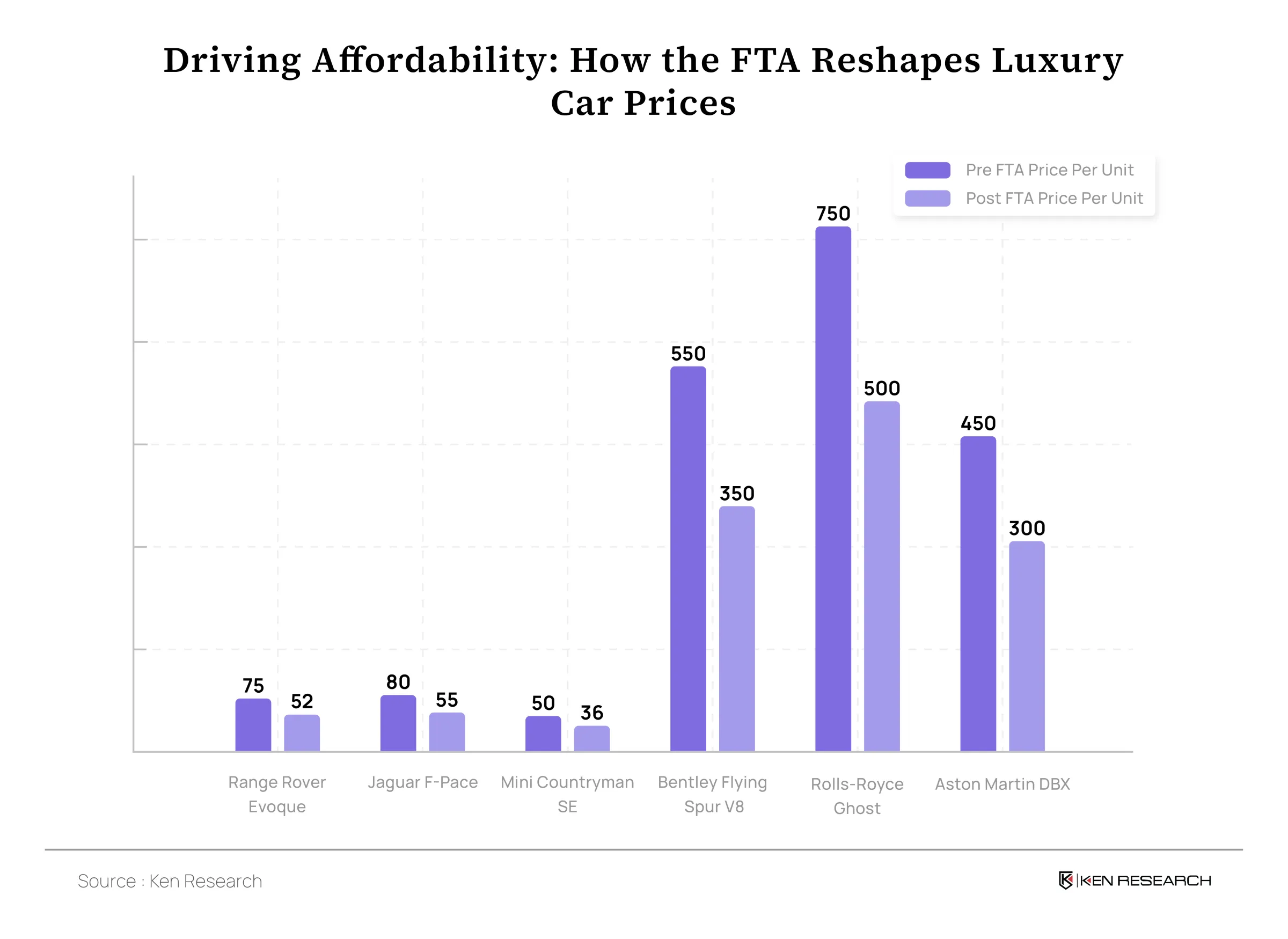
This isn’t just about cheaper cars it’s about unlocking demand from India’s expanding upper-middle class (₹35–50 lakh annual income), a segment just outside traditional luxury brackets but now within reach. With India’s HNI base set to grow 75% by 2030 and luxury car penetration still under 2%, the FTA becomes a market equalizer, turning aspiration into upgrade.
Take the Mini Countryman SE, currently priced at ₹50 lakh pre-FTA it could drop to nearly ₹36 lakh. Even ultra-luxury models like the Rolls-Royce Ghost or Bentley Flying Spur may see cuts of ₹2–3 crore, reshaping their India market appeal. What was once a heavily protected trade corridor is now a testbed for how bilateral pacts can drive premium consumption not just for the ultra-rich, but for a rising class with taste, means, and mobility ambition.
What’s Changing on Paper: Tariffs, Thresholds & the New Math of Imports
The India–UK FTA isn’t handing out blanket tax holidays. Instead, it offers strategic reliefs through well-calibrated thresholds balancing market access with local value addition. At its core is a redefinition of how imported vehicles are taxed, particularly the distinction between Completely Built Units (CBUs) and Completely Knocked Down (CKD) kits.
Until now, CBUs fully manufactured and assembled overseas faced steep import duties of 100–125%, making them viable only for the ultra-rich. CKDs, where parts are imported and assembled locally, attracted 30–50% duty, but required infrastructure, vendor networks, and after-sales readiness. The FTA proposes a phased reduction of duties on UK CBUs to as low as 30%, or even 10%, if local sourcing or assembly commitments are met.
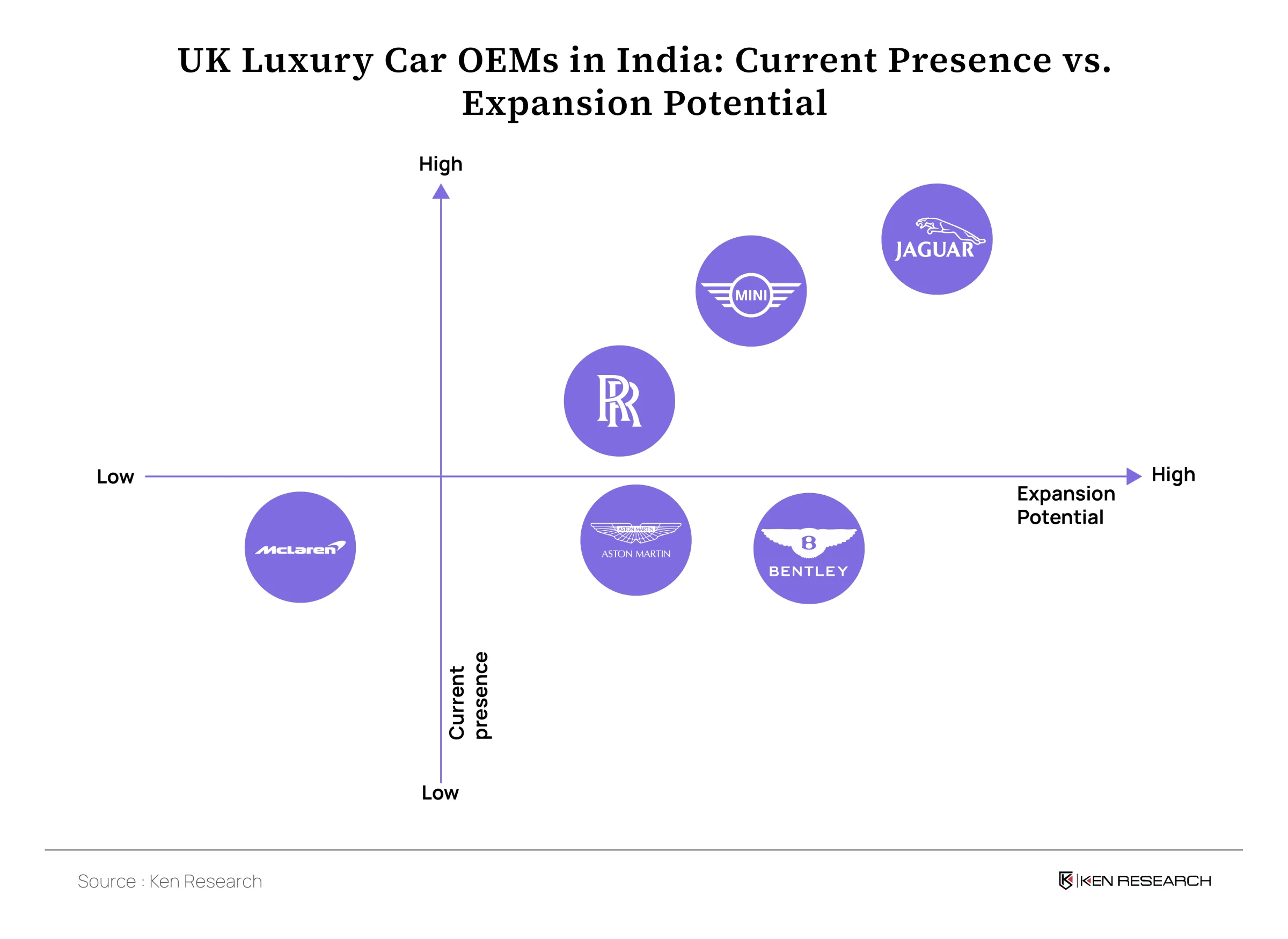
What’s new is the middle ground being formalized: a “semi-knocked-down” or localized CBU tier. Here, British OEMs can qualify for lower tariffs by sourcing a set percentage of parts from India or establishing assembly operations. This opens a path for UK brands like Jaguar Land Rover (Tata-owned), Bentley, and Aston Martin to recalibrate their India strategy investing just enough to gain duty benefits without going all-in on manufacturing.
This tiered system marks a shift from India’s traditionally protectionist stance. It creates a performance-linked incentive for OEMs: the more you commit to India, the cheaper your import ticket. For the Indian government, it’s a controlled liberalization importing luxury, but exporting jobs.
Before the Breakthrough: How India’s Luxury Car Market Operated in Silos
In the years leading up to the FTA, India’s luxury car market resembled a carefully managed workaround. OEMs weren’t scaling aggressively they were navigating constraints. For UK-based marques, volumes rarely justified deeper integration, and most operated on a lean presence, relying on urban dealerships, select SKUs, and premium pricing to hold ground.
The real friction lay beneath the showroom in homologation delays, long lead times, and an ecosystem not built for luxury throughput. Spare parts were often imported on demand, driving up maintenance costs and service timelines. The absence of local vendor partnerships meant even basic localization thresholds couldn’t be met, locking out brands from SKD/CKD cost advantages.
Logistics made it worse: few bonded warehouses, no luxury-grade ports, and each CBU required meticulous coordination. Dealer networks acted more as concierges than retailers fine for ₹3–4 crore cars, but a barrier for the growing sub-₹1 crore segment. Consumer access was also throttled test drives needed weeks, events were rare, and luxury expectations often met friction-filled experiences. The market wasn’t broken just under-optimized, and that mattered once demand started rising
Parallels and Precedents: What India’s Other Luxury Car Trade Relationships Reveal
The UK isn’t the first country India imports luxury cars from but it may be the first where policy tilts market fundamentals. Historically, Germany has led, with Mercedes-Benz, BMW, and Audi commanding over 55% of India’s luxury car market. Yet despite this dominance, there’s no formal trade agreement between India and the EU, meaning German automakers still pay the full 100–125% import duties on fully built units (CBUs). Their workaround? Years of investment in local assembly, CKD strategies, and deep vendor ties keeping them competitive while skirting tariff walls.
Japan and the US occupy niche segments. Lexus and Acura struggle with pricing and positioning challenges, while American brands like Cadillac and Lincoln are virtually absent. Italian marques like Ferrari, Lamborghini, and Maserati sell in ultra-low volumes, where price elasticity is irrelevant and exclusivity is the product.
So why does the UK stand out? Unlike Germany’s localization play or Italy’s ultra-premium detachment, the India–UK FTA formalizes a tariff edge, potentially making UK CBUs cheaper than German equivalents for the first time. It’s more than just car prices it’s about regulatory asymmetry in a historically level field. If the duty cut goes through, a Range Rover Sport from Solihull could undercut a locally assembled BMW X5 flipping the logic of value in a market that has long favored localization over origin.
The implication? A fresh wave of trade-led competition. German OEMs may push harder for an India–EU FTA. Japanese brands may revisit their India roadmap. And India may see calls to extend similar benefits or demand deeper UK localization. Either way, this deal may have triggered more than cheaper British SUVs. It may have redrawn the rules of premium mobility diplomacy.
The Used Car Wildcard: A Quiet Force in Premium Democratization
While most focus on the India–UK FTA is on new vehicle imports, its ripple effect on the used luxury segment could be even more transformative. India’s pre-owned luxury market is growing at 15–18% CAGR, with UK brands like Jaguar, Land Rover, Mini, and Bentley already active players. With duties on new imports falling, residual values of UK vehicles are set to improve boosting their secondary market appeal.
This uplift in residuals sets off a chain reaction. Dealers gain confidence in trade-ins and buybacks, enabling better pricing and stronger warranties. Lenders once wary of this volatile segment may now offer structured loans (EMIs under ₹50K, 4–6year terms, buyback guarantees), especially in Tier 1 and Tier 1.5 cities.
A dual-inventory strategy becomes viable mixing new and certified pre-owned UK models. This compresses the luxury ladder: a buyer priced out of a new Range Rover Evoque might opt for a 2-year-old certified version at 35–40% lower cost, with warranty and financing. This fuels upgrade cycles and brand stickiness.
The FTA also helps formalize India’s fragmented used luxury market, plagued by grey imports, patchy paperwork, and limited financing. As official UK imports grow, buyers will shift to certified resale channels, nudging the ecosystem toward refurb centers, after-sales networks, and digital platforms.
In effect, the FTA isn’t just rewriting import rules it’s reshaping the full lifecycle of UK luxury cars in India. For players ready to adapt, used isn’t spillover it’s a strategic unlock.
A Wide-Open Track: What the India–UK FTA Unlocks for the Ecosystem
Trade pacts don’t usually create new markets. But they do shake up old hierarchies and that’s exactly what the India–UK Free Trade Agreement is doing to the luxury auto ecosystem.
For British OEMs like JLR, Bentley, Rolls-Royce, and Mini, this is a once-in-a-decade opening. With lower duties and clearer compliance benchmarks, they can recalibrate their India portfolio away from niche ultra-HNIs toward emerging affluent buyers. Volume viability suddenly makes sense especially for models once priced out of reach. Think Range Rover Evoque, Jaguar F-Pace, or the Mini Countryman SE all primed for the under-₹75 lakh segment if tariff cuts flow through. Expect leaner trims, new financing models, and a deeper push into Tier 1.5 cities. It also sets the stage for stronger resale value pipelines creating a more structured and liquid used luxury market for UK-origin cars.
Indian dealers, especially those with premium retail networks, are watching closely. The FTA could create arbitrage for multi-brand luxury showrooms, who may now prefer UK-origin CBUs over CKD imports from non-FTA countries. With better margins and faster stock movement, dealer power dynamics could shift especially in Maharashtra, Delhi, and Tamil Nadu, which account for 60%+ of luxury car demand. This also strengthens their certified pre-owned (CPO) strategies, allowing dealers to confidently stock 2–3year old UK models with greater pricing power and warranty-backed assurance.
Financiers and NBFCs, often overlooked in premium segments, now have cause to re-enter. As UK luxury vehicles enter EMI-accessible zones, expect a spike in structured finance demand: 5–7year tenures, residual value-based leasing, even subscription models. And as resale values stabilize, banks and NBFCs may finally scale used luxury car loans enabling aspirational buyers to enter the segment with EMIs under ₹50K. This isn’t just about affordability it’s about smoothing aspiration with liquidity.
Aftermarket service providers and accessories firms especially those in infotainment, detailing, or smart diagnostics stand to gain from the rising UK vehicle base. British cars have higher tech-integration, meaning more play for ADAS recalibration, software-linked servicing, and advanced diagnostics. It’s a downstream goldmine. This applies to both new and used models opening up lifecycle service revenues beyond the first ownership window.
Even government stakeholders have a role. State-level EV policymakers, for instance, can leverage the FTA’s effect to nudge UK automakers to bring in luxury EVs like the Jaguar I-Pace or Rolls-Royce Spectre under relaxed homologation. A quiet opportunity to align trade access with clean mobility ambitions.
All of which makes one thing clear: this isn’t just a tariff change it’s an ecosystem nudge. From how cars are priced and sold to how they’re financed, serviced, resold, and localized, the India–UK FTA has kicked off a premium recalibration. The smart players aren’t waiting they’re already pivoting.
What Lies Ahead: The Imperative of Alignment
The India–UK FTA isn’t just a trade pact it’s a strategic fork in the road for every stakeholder in the luxury mobility value chain. What once worked premium positioning, low-volume exclusivity, and steep import markups won’t hold in a tariff-thinned, demand-driven future. The landscape is shifting, and so must the playbook.
Stakeholders must now confront bold, forward-looking questions:
- Should OEMs localize supply chains to tap origin benefits or risk getting undercut by FTA-aligned rivals?
- Should dealers double down on UK-origin stock or diversify across non-FTA markets?
- Should financiers step up with aspirational credit products tailored for first-time luxury buyers?
- Should policymakers treat this as a one-off, or use it as a template for future sector-linked FTAs?
Those treating the FTA as a one-time windfall may score short-term gains. But those who see it as a platform to reshape business models, deepen UK–India co-development, and reimagine GTM strategies will define the long-term winners. This is more than a regulatory tweak. It’s an inflection point for India’s luxury car market where access is expanding, margins are shifting, and policy is aligning with aspiration. For those who are willing to move early and smart, the upside goes far beyond tariff cuts.
About the Author – Harsh Saxena:
Harsh Saxena is the Principal, Consulting at Ken Research, with over 7 years of experience in consulting and business analytics, specializing in the automotive, logistics, and industrial sectors. He has supported clients in areas such as market entry strategy, competitive benchmarking, customer segmentation, channel optimization, and operational efficiency improvement, enabling organizations to achieve sustainable growth and stronger market positioning.
From the Author:
“At Ken Research, we’ve been closely tracking luxury vehicle trends across India and broader Asian markets including ASEAN economies, and the data points to more than a trade shift it signals a structural recalibration of the premium auto ecosystem. The India–UK FTA hasn’t just lowered tariffs; it’s reshaping demand signals, altering dealer incentives, and unlocking new customer segments. British OEMs aren’t simply entering with better price tags they’re reengineering market access. What was once a high-margin niche is transforming into a scale-driven play, backed by stronger resale economics and deeper retail penetration. This isn’t just trade policy in action it’s competitive repositioning in real time.”
About Ken Research:
Ken Research is a market intelligence and strategy consulting firm helping global OEMs, financiers, and channel partners decode disruptive shifts in mobility and trade. We equip clients with model-level sales insights, regulatory foresight, and go-to-market strategies shaped by high-impact developments — from the India–UK FTA to global trade treaties, import policy changes, and price realignments. From pricing dynamics and residual value modelling to channel restructuring and used luxury market evolution, our analysis enables stakeholders to anticipate change, capture arbitrage, and restructure portfolios for a premium-shifting India.
Related tags
Automotive and Automotive Components
Get started
We've helped companies around the world future-proof
their businesses - and we can do the same for you.