Strait of Hormuz Fertiliser Shock: Why Partial Recovery Has Not Removed the Global Food Security Risk
Ken Research
July 17, 2026 - 12 min read

July 17, 2026
by Ken ResearchThe initial phase of the West Asia conflict revealed how disruption in Gulf energy, fertilizer production, and maritime trade could reach farms and food markets. The ceasefire provided measurable relief, but recent developments are testing a supply chain that has not fully rebuilt its physical, commercial, or financial buffers.
When the West Asia conflict escalated on February 28, 2026, the immediate global concern was energy. Oil and gas flows came under pressure, vessel traffic through the Strait of Hormuz declined, and the security of one of the world’s most important maritime corridors moved to the centre of government and corporate decision-making.
The deeper vulnerability, however, lay in the connection between energy and agriculture.
The Gulf is not simply a transit corridor for hydrocarbons. It is a concentrated production and trading hub for natural gas, ammonia, urea, sulfur and phosphate-related inputs. Disruption in the region can therefore travel through several layers of the economy: from gas availability to ammonia production, from ammonia and sulfur to fertiliser supply, from fertiliser costs to farm application, and ultimately from crop yields to food availability and prices.
Fertiliser is particularly exposed because demand is difficult to defer, substitute capacity is limited, and the economic value of supply depends on whether nutrients reach farms before crop-specific application windows close. A cargo that arrives late may still have commercial value, but it can no longer protect the harvest for which it was intended.
Developments since the ceasefire have reinforced this structural risk.
The June peace agreement and the subsequent movement of selected vessels through Hormuz reduced acute pressure. Selected fertiliser benchmarks retreated from their conflict peaks, urgent cargoes began moving again, and import-dependent governments gained time to protect near-term agricultural requirements.
But the restoration of selected cargo movements did not translate into a complete recovery across production, inventories, shipping confidence, insurance capacity, trade finance and inland distribution.
July developments reinforced that the maritime system had not regained full stability. On July 8, the International Maritime Organisation highlighted continued threats to commercial shipping, persistent constraints on safe passage and the fact that nearly 6,000 seafarers remained unable to leave the Persian Gulf safely. On July 13, the IMO Council reiterated that transit through international straits must remain protected and unobstructed, underscoring that corridor reliability remained fragile despite the earlier easing in hostilities.
The market is therefore not facing two independent episodes. It is navigating one extended period of instability with three distinct stages. The first was an initial shock that exposed structural concentration. The second was a ceasefire that enabled partial normalisation. The third is renewed disruption that is testing how much resilience was rebuilt in the interval.
A maritime corridor can reopen long before the underlying supply system recovers. The critical question is whether renewed cargo movement is rebuilding resilience or merely postponing the next pressure point. Ken Research’s market-intelligence podcast, Decode by Ken Research, examines this gap through the Hormuz fertiliser disruption, connecting production, inventories, financing and crop-application windows with the wider outlook for agricultural output and food markets. What does genuine supply-chain recovery look like beyond falling prices and renewed cargo movement? Watch the full analysis.
The First Phase Exposed Concentration Across Products, Feedstocks and Corridors
The scale of the original shock cannot be understood through urea alone.
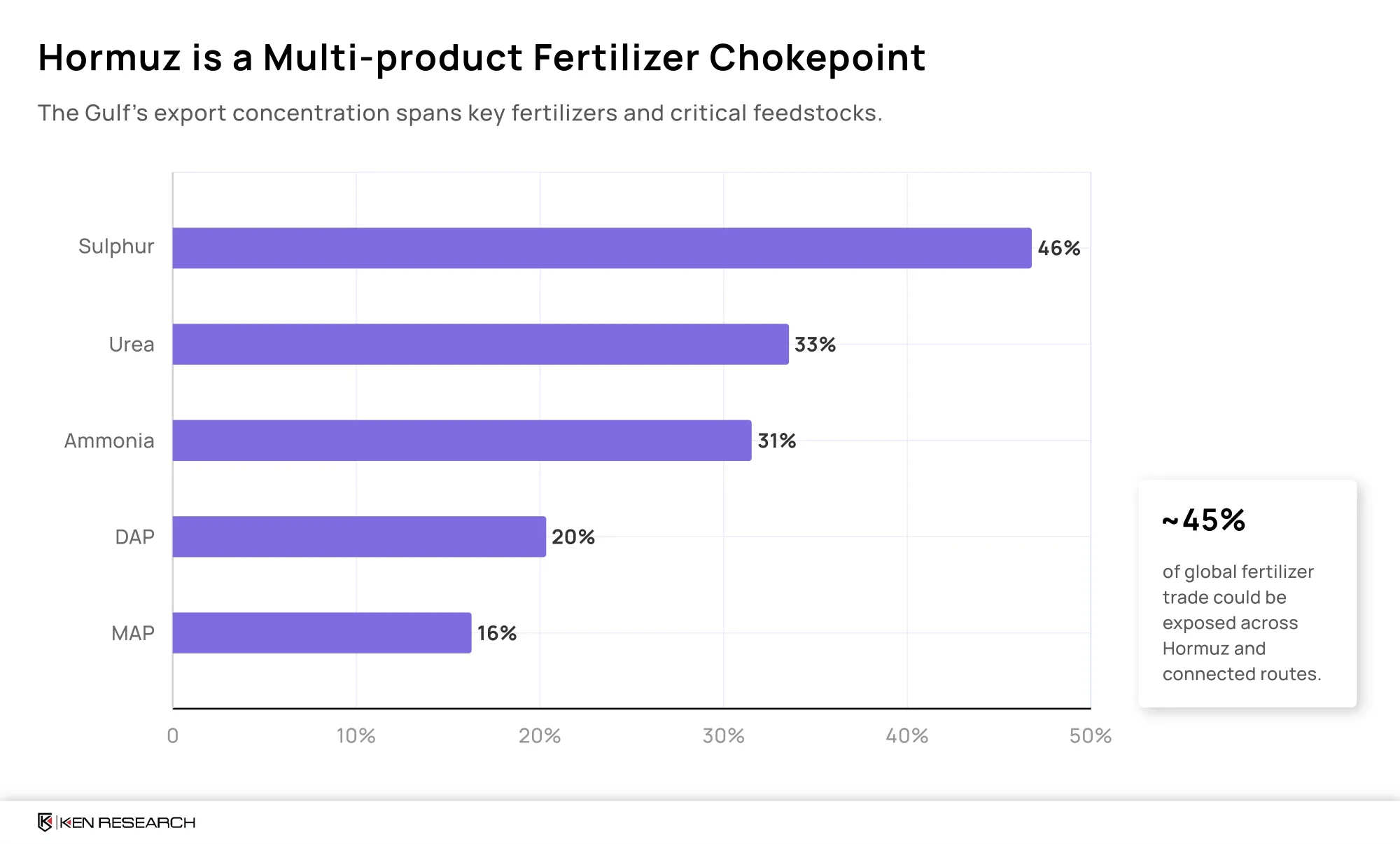
Ken Research estimates that, in 2025, the Gulf accounted for approximately 33% of global urea exports by value, 31% of global ammonia exports, 46% of global sulfur exports, 20% of global diammonium phosphate exports and 16% of global monoammonium phosphate exports.
At the corridor level, approximately 45% of global fertiliser trade was exposed to the combined Strait of Hormuz and Red Sea system.
This concentration matters because nitrogen and phosphate fertiliser chains are connected through common upstream inputs.
Natural gas is both a feedstock and an energy source for conventional ammonia production. Ammonia is then converted into nitrogen fertilisers such as urea and is also used in phosphate fertiliser production. Sulfur is required to produce sulfuric acid and phosphoric acid, both of which are essential to phosphate manufacturing.
An importer may therefore purchase nitrogen fertiliser from one country and phosphate fertiliser from another, yet remain exposed to the same Gulf-based gas, ammonia, sulfur, production infrastructure or maritime passage.
The supplier portfolio may appear diversified at the contractual level while remaining concentrated at the feedstock and corridor levels.
Outbound fertiliser flows through Hormuz were severely constrained after the conflict began. FAO estimated in April that approximately 1.3 million tonnes of fertiliser per month could no longer transit through the strait, with no viable land-based alternative available at comparable scale.
The disruption affected both nitrogen and phosphate markets, with particular consequences for import-dependent economies across Asia and Africa.
The exposure was intensified by conditions already present before the conflict. European nitrogen economics remained sensitive to gas prices, China had constrained parts of its phosphate export supply, and Russia could provide only a partial backstop because of logistics, compliance, payment and trade-policy complexity.
The system entered the conflict with limited immediately available replacement capacity and no alternative exporter capable of replacing the Gulf across all nutrients, feedstocks and trade routes assessed.
This is why conventional country diversification is insufficient.
Fertiliser resilience requires diversification across four dimensions. It requires a broader mix of finished-product suppliers, greater flexibility across upstream feedstocks, a wider network of production and export hubs, and more resilient maritime and inland logistics corridors.
The Initial Shock Moved Rapidly from Energy into Fertiliser Economics
The first phase demonstrated how disruption in the Gulf travels through the fertiliser value chain. The process begins with energy. Reduced availability or higher prices for natural gas raise the cost of ammonia production and can force fertiliser plants to lower utilisation. Ammonia constraints then affect both nitrogen and phosphate fertilisers, while reduced sulfur availability creates an additional bottleneck for phosphate producers.
The second transmission channel is logistics.
A route may remain technically open while becoming commercially unattractive because of security concerns, vessel scarcity, war-risk insurance and uncertainty over delivery schedules. Importers face fewer tender participants, suppliers become more cautious about forward commitments, and trade-finance costs and collateral requirements may increase as delivery and price risk rises.
Rerouting does not eliminate this risk. Ken Research estimates that diversion around the Cape of Good Hope can add 18 to 22 days to maritime transit, approximately USD50 per tonne in freight and insurance, and as much as six to nine weeks once port congestion and inland distribution delays are included.
The third transmission channel is financial.
When fertiliser prices and logistics costs rise together, importers need more working capital to secure the same physical volume. Governments face larger subsidy commitments, distributors become more reluctant to carry expensive inventory, and farmers in price-sensitive markets face either higher costs or lower availability.
This is where a fertiliser disruption becomes an agricultural shock.
Farmers confronted with expensive or delayed fertiliser typically reduce application rates, postpone purchases, concentrate nutrients on selected fields, cultivate less land or shift toward less nutrient-intensive crops.
Ken Research’s analysis suggests that fertiliser use could decline by 10% to 15%, while crop yields could fall by 5% to 8% in highly exposed markets.
More than 1 billion people across South and Southeast Asia depend on food systems exposed, directly or indirectly, to Gulf-linked fertiliser and feedstock flows. This makes the region particularly vulnerable to disruptions that move from energy and agricultural inputs into crop production and food availability.
FAO also cautioned in April that countries with limited financial buffers were especially vulnerable because fertiliser and energy disruptions were colliding with fixed crop calendars. It later warned that persistent constraints around Hormuz could reduce fertiliser application, weaken yields and tighten food availability during the second half of 2026 and into 2027.
The fertiliser risk is not immediate in the same way as an oil-price shock.
Fertiliser disruption first moves through procurement, inventories, farm economics and application decisions. Its effects then emerge in harvest volumes and food prices months later. That delay makes the risk easy to underestimate.
Duration Changes the Nature of the Risk
Fertiliser disruption becomes progressively harder to reverse as it extends across crop and procurement cycles.
Less than 30 Days: Severe but Manageable Where Buffers Exist
A short disruption can be managed where importers and distributors enter the period with sufficient inventory, cargoes are already at sea, and alternative routes remain commercially available.
Even in this scenario, vessels, terminals, production facilities and inland distribution may take three to four months to return to normal operation.
Between 30 and 60 Days: The Risk Moves Beyond Freight
Fertiliser inflation accelerates, tender competition intensifies, and major crop cycles become exposed.
Supply-chain recovery can require six to twelve months as delayed cargoes, inventory drawdowns and port backlogs accumulate.
Beyond 60 Days: The Risk Becomes Agronomic
Application windows begin to close, farmers reduce nutrient use and lost yield potential becomes difficult to recover.
Later imports may rebuild stocks, but they cannot recreate an application window that has already passed.
The maritime environment during the initial phase illustrated the severity of the disruption. By June 11, the IMO had confirmed 46 attacks on international shipping in and around Hormuz since February 28, with 14 seafarer fatalities.
Although a peace agreement was subsequently reached, restoring safe passage and evacuating stranded vessels required additional time. The evacuation operation was temporarily paused on June 25 following an attack in the Gulf of Oman on a vessel that had passed through the Strait.
The ceasefire therefore did not erase the disruption already absorbed by the system. Production had been lost, inventory had been consumed, tenders had been delayed, and financial commitments had increased.
The Ceasefire Reduced Immediate Pressure, but Recovery Remained Incomplete
The ceasefire delivered measurable operational relief.
It reduced the probability of a prolonged closure, allowed selected shipments to move and gave import-dependent governments and companies time to protect near-term agricultural needs.
As reported by India’s Department of Fertilisers on July 5, 15 vessels carrying fertiliser and fertiliser raw materials for India had safely crossed Hormuz, with supplies proceeding toward Indian ports as scheduled. Their cargoes included 332,000 tonnes of urea, 257,000 tonnes of DAP and 111,000 tonnes of sulfur.
Natural-gas supply to domestic fertiliser plants had also returned to 100% after earlier constraints, supporting the restoration of domestic production.
These movements materially improved India’s immediate supply position.
But the passage of selected vessels did not mean that the wider fertiliser system had normalised. A complete recovery requires production, shipping, insurance, supplier participation, trade finance, ports, inland distribution and destination-market inventories to improve together. During the ceasefire period, progress across these dimensions remained uneven.
Ships had to be repositioned. Delayed cargoes continued to occupy port and distribution capacity. Buyers competed to replenish stocks at the same time.
The scale of the continuing maritime disruption remained significant. Between June 23 and June 26, 136 vessels and an estimated 2,900 seafarers were evacuated through a coordinated plan. By early July, approximately 20,000 seafarers, port workers and offshore personnel were still affected across the region.
The ceasefire, hence, restored movement faster than it restored resilience.
Fertiliser Price Correction Ran Ahead of Physical Recovery
The divergence between prices and physical trade provides another indication of incomplete normalisation.
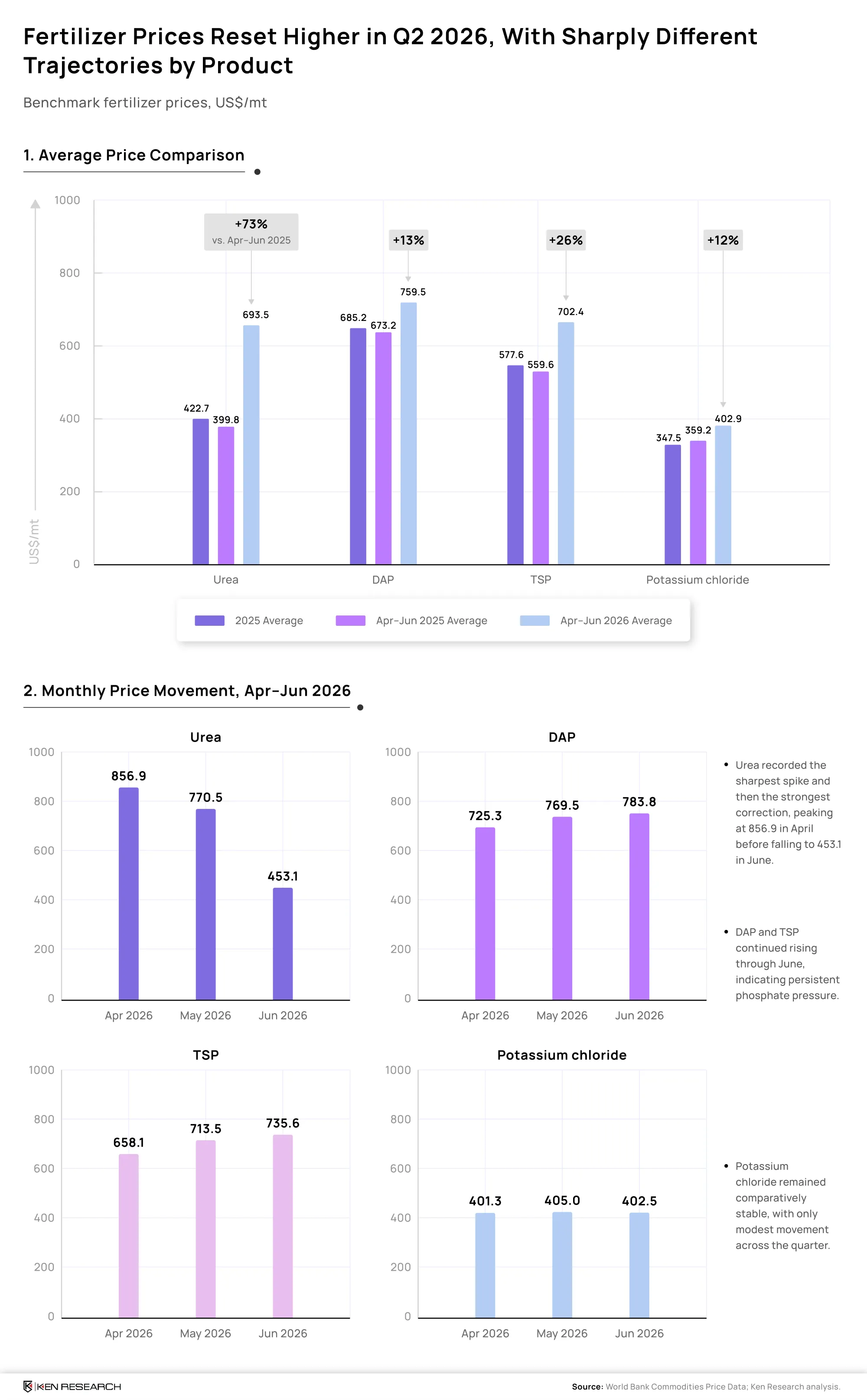
Ken Research’s benchmark analysis indicates that urea prices increased from approximately USD400 per tonne before the conflict to above USD850 per tonne in April, before easing to approximately USD453 per tonne by June.
Over the same period, the monitored DAP benchmark increased from around USD580 per tonne to approximately USD770 per tonne.
The decline in urea was significant, but it should not be interpreted as evidence that the full supply chain had recovered.
Commodity prices respond quickly to expectations. The prospect of reopening reduces panic purchasing, lowers the probability assigned to prolonged shortages and encourages some buyers to postpone procurement.
Physical systems recover more slowly.
Production losses cannot be reversed immediately. Delayed cargoes still have to move through constrained logistics networks. Inventories must be rebuilt after urgent demand has been served.
A market can correct on the screen before the physical supply chain recovers at sea, at the port or in the warehouse.
Renewed Disruption Is Affecting a System with Weaker Buffers
The latest maritime incidents do not represent a simple replay of the first phase.
They are occurring after importers, governments, suppliers and logistics providers have already used part of their operational and financial flexibility.
- Inventories were drawn down in markets relying on emergency supply.
- Importers absorbed higher freight and insurance costs.
- Governments increased subsidy exposure.
- Distributors financed more expensive stock.
- Simultaneous procurement by multiple importers reduced the amount of readily available replacement capacity.
Crop calendars also advanced during the ceasefire.
At the beginning of the conflict, the principal question was whether fertiliser could reach farmers for the immediate crop cycle. Following the partial reopening, some of this requirement was covered.
The risk now extends to whether governments and companies can replenish inventories for subsequent seasons, preserve farmer affordability, sustain subsidy and financing support into 2027, secure alternative supply before another disruption, and prevent temporary emergency measures from becoming permanent fiscal burdens.
In markets where inventories, financing capacity and crop timelines have already weakened, even a shorter second disruption could generate a disproportionate marginal impact.
The Crop Clock Remains the Decisive Constraint
Fertiliser supply chains must be managed against three connected timelines.
The Shipping Clock
The shipping clock determines whether vessels, ports, insurance and freight capacity are available. It can change within hours following an attack, maritime advisory or insurer decision.
The Fiscal Clock
The fiscal clock determines how long governments, importers, distributors and farmers can absorb elevated costs.
A country may be able to protect one planting season through subsidies or emergency financing. Repeated intervention can weaken public finances and reduce the capacity to respond later.
The Crop Clock
The crop clock determines whether fertiliser can still influence agricultural output. This is the least flexible timeline.
Fertiliser must be applied during defined stages of plant development. A shipment arriving after the application window may still be sold, stored or used in a later season, but it cannot fully recover the lost yield potential of the current crop.
FAO emphasised that delays of even a few weeks can force farmers to reduce fertiliser use or abandon application altogether, with the effects transmitted into subsequent harvests and food availability.
The economic value of fertiliser availability must therefore be measured by more than tonnes secured. It depends on the nutrient, the destination, the crop and the date of arrival.
The Economic Impact Will Differ Sharply Across Asian Markets
Ken Research analysis shows that the same Gulf fertiliser shock is producing sharply different outcomes across Asia, shaped by each market’s import dependence, domestic capacity, fiscal resilience and downstream industry exposure.
India: Import Dependence Creates Supply and Fiscal Pressure
Gulf suppliers accounted for approximately 64.8% of India’s urea imports, 30% of its DAP imports and 50% of its LNG supply. Domestic fertiliser production was operating at around 70% of capacity, limiting India’s ability to offset a prolonged external disruption.
Urea tender prices approached USD 1,000 per tonne, compared with approximately USD 510 per tonne before the conflict. This increased pressure on fertiliser availability, major importers and India’s subsidy system. Under a sustained-disruption scenario, grain-output losses could reach 5% to 8%.
Indonesia: Urea Surplus Does Not Remove Multi-Nutrient Exposure
Indonesia had an estimated 1.5 million tonnes of exportable urea surplus, positioning the country to support regional nitrogen supply and benefit from higher international prices.
However, Indonesia remains dependent on imported DAP, potash and sulfur-linked inputs. Sulfur shortages also create exposure beyond agriculture because the same input is critical to parts of the nickel-processing value chain. Under the severe disruption scenario, sulfur scarcity could add approximately USD 4,000 per tonne to selected nickel-processing costs.
Indonesia therefore combines a near-term opportunity in urea with continued vulnerability across phosphate fertilisers, sulfur and industrial processing.
Malaysia: Fertiliser Inflation Becomes a Palm-Oil Yield Risk
Fertiliser accounted for approximately 60% of palm-oil production costs, while raw-material costs increased by an estimated 100% to 150% within two weeks.
Delayed fertiliser application and suspended orders created estimated annualised economic losses exceeding RM3.5 billion. Reduced nutrient use could weaken fresh-fruit-bunch yields, constrain crude palm-oil production and increase pressure across vegetable-oil and food-manufacturing markets.
Because Malaysia and Indonesia together account for approximately 85% of global palm-oil supply, sustained fertiliser disruption in these markets could have global consequences.
The Gulf shock therefore becomes a supply and subsidy challenge in India, a nitrogen opportunity with wider nutrient and industrial exposure in Indonesia, and a plantation-productivity risk in Malaysia.
The First Phase Revealed the Fault Lines. The Renewed Phase Is Testing the Response.
The initial West Asia conflict established that fertiliser disruption is not a narrow commodity or logistics problem. It is a systemic risk that links energy, chemicals, maritime trade, agricultural production, public finances, and food markets.
The ceasefire demonstrated that coordinated intervention can protect immediate supply. Selected cargoes moved, prices eased, and governments gained time to address urgent agricultural needs.
It also revealed the limits of temporary relief.
Price correction ran ahead of physical recovery. Inventories were only partly replenished. Alternative suppliers remained nutrient-specific and capacity-constrained. Shipping confidence remained fragile. The time available before subsequent crop cycles continued to narrow.
Renewed disruption is therefore not replacing the risks identified during the first phase. It is increasing their cumulative significance.
The principal threat is no longer only a prolonged and uninterrupted closure of Hormuz. It is a repeating pattern of disruption, partial reopening and renewed instability that permits enough fertiliser to move to avert an immediate crisis, but not enough to restore the buffers required for the next crop cycle.
Those that manage fertiliser security as a continuous portfolio of feedstocks, suppliers, corridors, inventories, financing and nutrient-efficiency measures will be better positioned to protect agricultural output and absorb future volatility.
Get started
We've helped companies around the world future-proof
their businesses - and we can do the same for you.