Beyond the Brew: What India's Café Brand Preference Data Reveals About the Future of Consumer Loyalty
Ken Research
June 29, 2026 - 8 min read
June 29, 2026
by Ken ResearchIndia's café industry, once a niche urban novelty anchored by a handful of international chains, has become one of the most fiercely contested consumer battlegrounds in the country. The organised café and coffee shop market crossed INR 14,200 crore in revenue in 2024, expanding at a CAGR of approximately 11.4% since 2019, and is now home to over 18,000 branded café outlets across metropolitan and Tier-1 cities. Yet the headline growth obscures a structural tension that Ken Research's primary survey work has now quantified with uncomfortable clarity: more cafés are opening, more Indians are drinking coffee out-of-home, and brand loyalty is quietly fracturing.
To map where loyalty sits, where it is eroding, and what is driving the fracture, Ken Research conducted its inaugural Coffee Shop & Café Brand Preference Survey across six of India's most active café markets, a study tracking the brand perceptions, visit behaviours, and switching intent of over 4,100 active café-goers. What emerged is not simply a preference ranking. It is a strategic diagnostic, revealing to chains, investors, and F&B operators alike the profound gap between the experience cafés promises and the one that keeps customers returning.
India's top five organised café chains together command roughly 61% of branded outlet footfall, yet average Net Promoter Scores across the segment hover at just 47, a figure that signals satisfaction without advocacy. Footfall is not the same as loyalty, and loyalty is not the same as advocacy. The real story is not India's coffee boom. It is the brand credibility deficit growing quietly beneath it.
Survey Profile: Who We Studied, Where, and Why It Matters
Sample and Geography
The survey was conducted between Q3 and Q4 of 2024, covering a stratified, nationally representative sample of 4,107 active café-goers across six cities: Mumbai, Delhi-NCR, Bengaluru, Hyderabad, Chennai, and Pune. These cities collectively account for approximately 67% of India's branded café outlet footprint as of 2024. Data was collected through a combination of online panels, in-café intercept interviews, and assisted mobile surveys to ensure representation across digital literacy levels and café segment types.
Demographic Profile
- Age distribution: 35% Millennials (25–34), 32% Gen Z (18–24), 22% Gen X (35–44), 11% older adults (45–60)
- Visit frequency: 48% visited a café at least twice per week; 29% visited daily or near daily
- Spend profile: 39% spent between INR 200–400 per visit; 27% exceeded INR 400 per visit on average
- Brand breadth: 63% visited more than one café brand in the preceding 30 days, with an average of 2.4 brands per active café-goer
- Format mix: 44% primarily visited chain cafés; 31% preferred local independent cafés; 25% reported no strong format preference
The Preference Shift: Two Years That Rewrote India's Café Brand Hierarchy
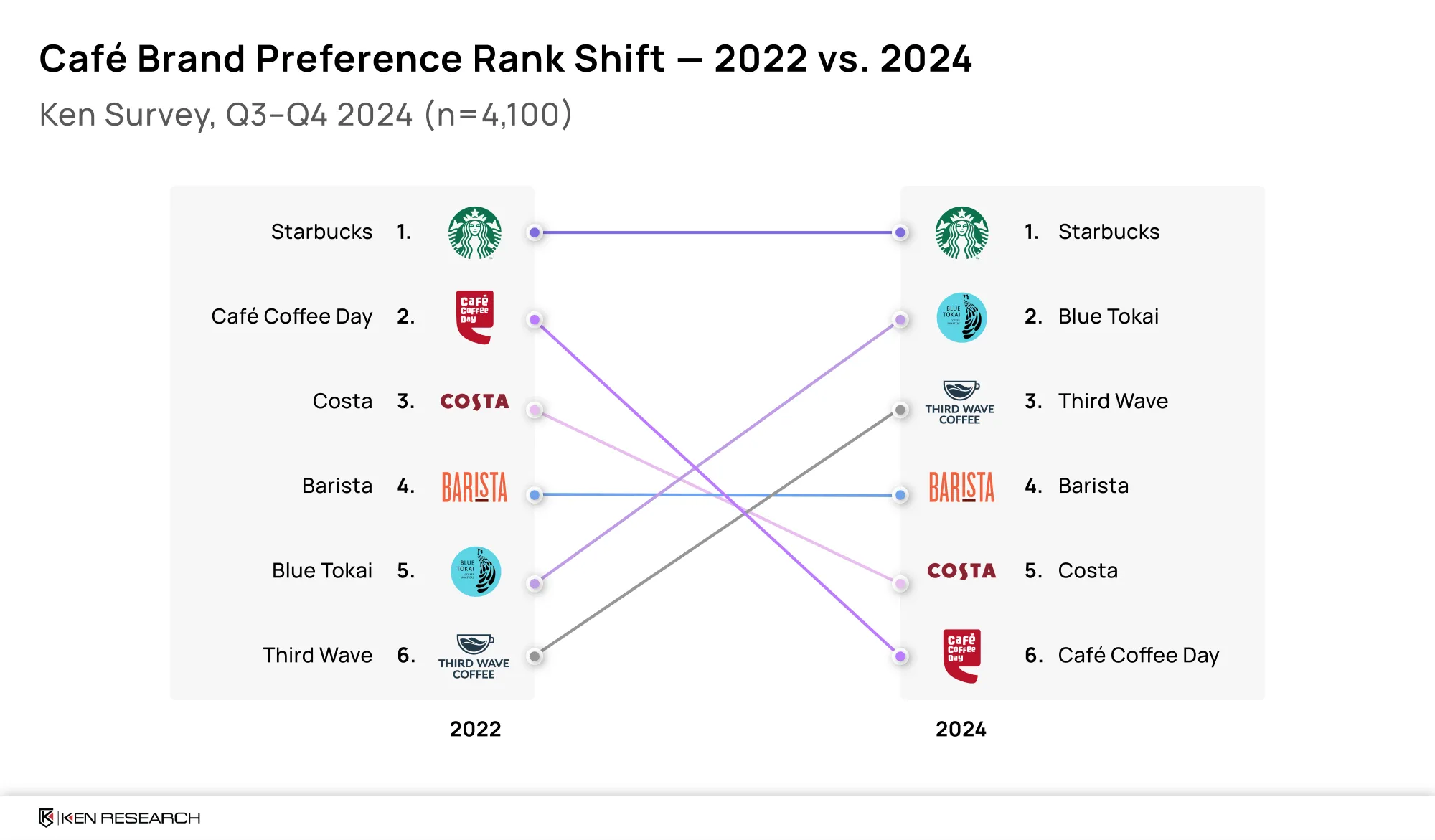
The slope chart captures a two-year realignment of brand preference that no outlet-count metric would reveal. Café Coffee Day, which held the second-highest preference rank as recently as 2022, has fallen to sixth position in 2024, displaced by two specialty chains that did not feature meaningfully in the national preference conversation just 24 months ago. This is not a gradual drift. It is a structural repositioning of consumer allegiance, driven by a cohort of younger, more brand-literate café-goers who have absorbed specialty coffee culture as a default aesthetic rather than a premium aspiration.
Blue Tokai's ascent from fifth to second, and Third Wave Coffee's rise from sixth to third, represent the clearest evidence that India's café preference hierarchy is now bifurcating along a fault line of authenticity. Chains that built their equity on ubiquity and affordability in the 2010s are discovering that the same attributes that drove their expansion are now liabilities in a consumer landscape that increasingly equates accessibility with commoditisation. Preference, in this market, is migrating toward scarcity, story, and sourcing credibility.
Costa Coffee's decline from third to fifth, despite maintaining its outlet network and product quality, reflects a different problem: invisible differentiation. In a market with intensifying competition at both the premium and value ends, a mid-positioned chain that offers no compelling reason to choose it over alternatives on either side of the spectrum is, in effect, a brand without a defensible territory. That is not a product failure. It is a positioning failure.
The Authenticity Premium
India's café preference shift is not price-driven and it is not product-driven. It is narrative driven. Consumers are not choosing Blue Tokai because its espresso is objectively superior to Costa's. They are choosing it because the brand story, farm-sourced, transparently priced, community-anchored, gives them a reason to feel something about their coffee choice. Chains that have not built a story cannot compete with chains that have, regardless of the objective quality of what is in the cup.
The Occasion Economy: Why the Same Cup of Coffee Means Something Different Across Income Brackets
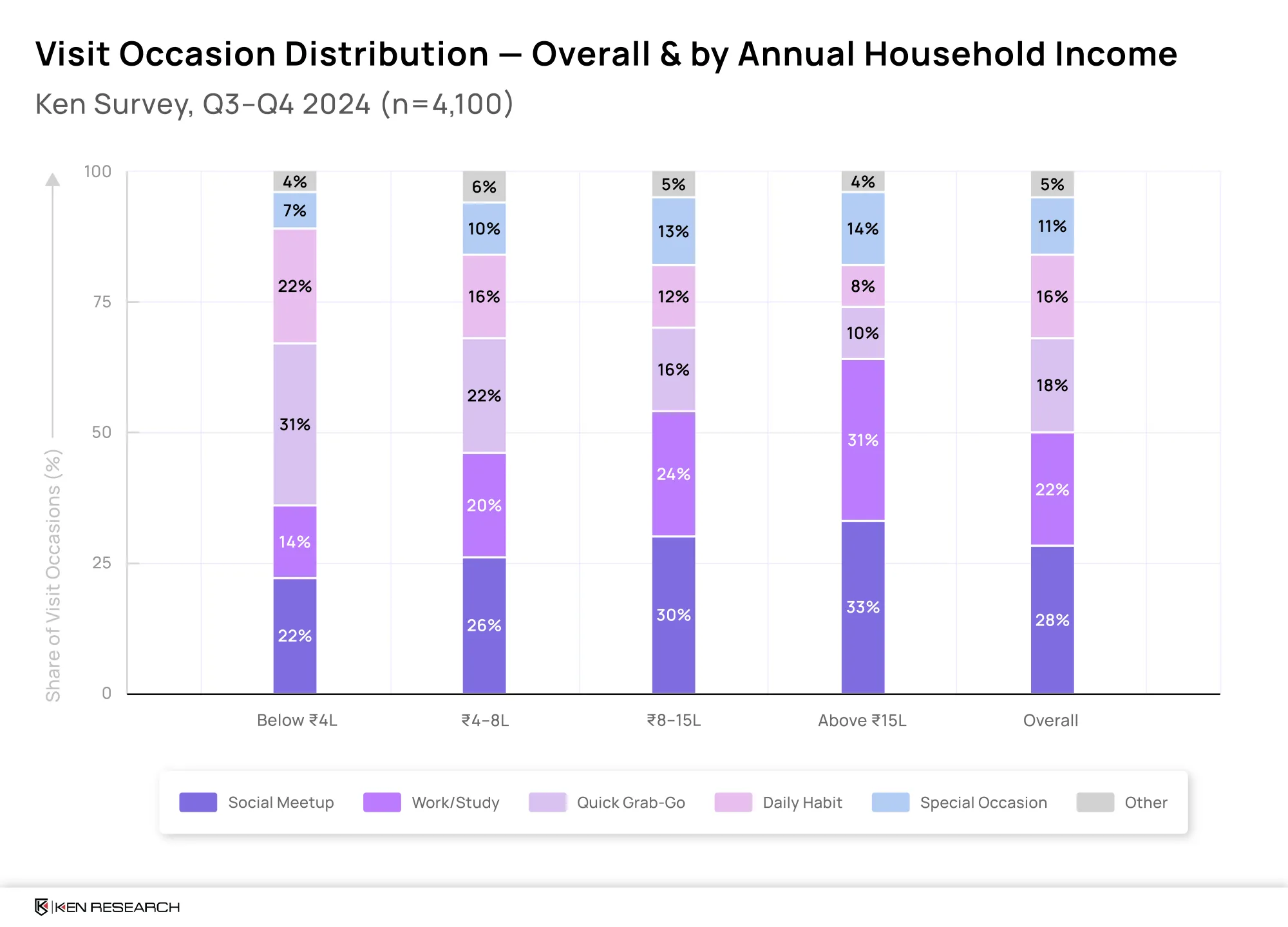
Across the full sample, social meetups account for the largest single slice of café visit occasions at 28%, followed by work and study sessions at 22%. But the income-stratified breakdown reveals that the national aggregate conceals radically different visit architectures across household income brackets, and chains that optimise their estate for one occasion type are systematically misaligned with large portions of their actual customer base.
Among households earning above INR 15 lakh annually, work and study sessions account for 31% of café visits and social meetups a further 33%, making this cohort the most experience-dependent segment in the dataset. For these customers, the café is a productivity environment and a social stage simultaneously. Wi-Fi reliability, seating ergonomics, ambient noise levels, and the quality of staff interaction are not peripheral concerns. They are the primary value proposition, and a beverage menu is merely the rental fee for access to the environment.
Households below INR 4 lakh annually tell an almost inverse story: quick grab-and-go accounts for 31% of visits and routine daily habit a further 22%, together comprising more than half of all café occasions for this income segment. For these customers, the café is a utility, not an experience. Speed, proximity, price predictability, and menu familiarity are the retention drivers. A loyalty programme that rewards the tenth visit with a free beverage upgrade is meaningfully relevant to this cohort in a way it will never be for the INR 15 lakh-plus segment, where the social signal of the café choice matters more than the economics of the reward.
The Loyalty Programme Gap: High Investment, Low Satisfaction Where It Counts
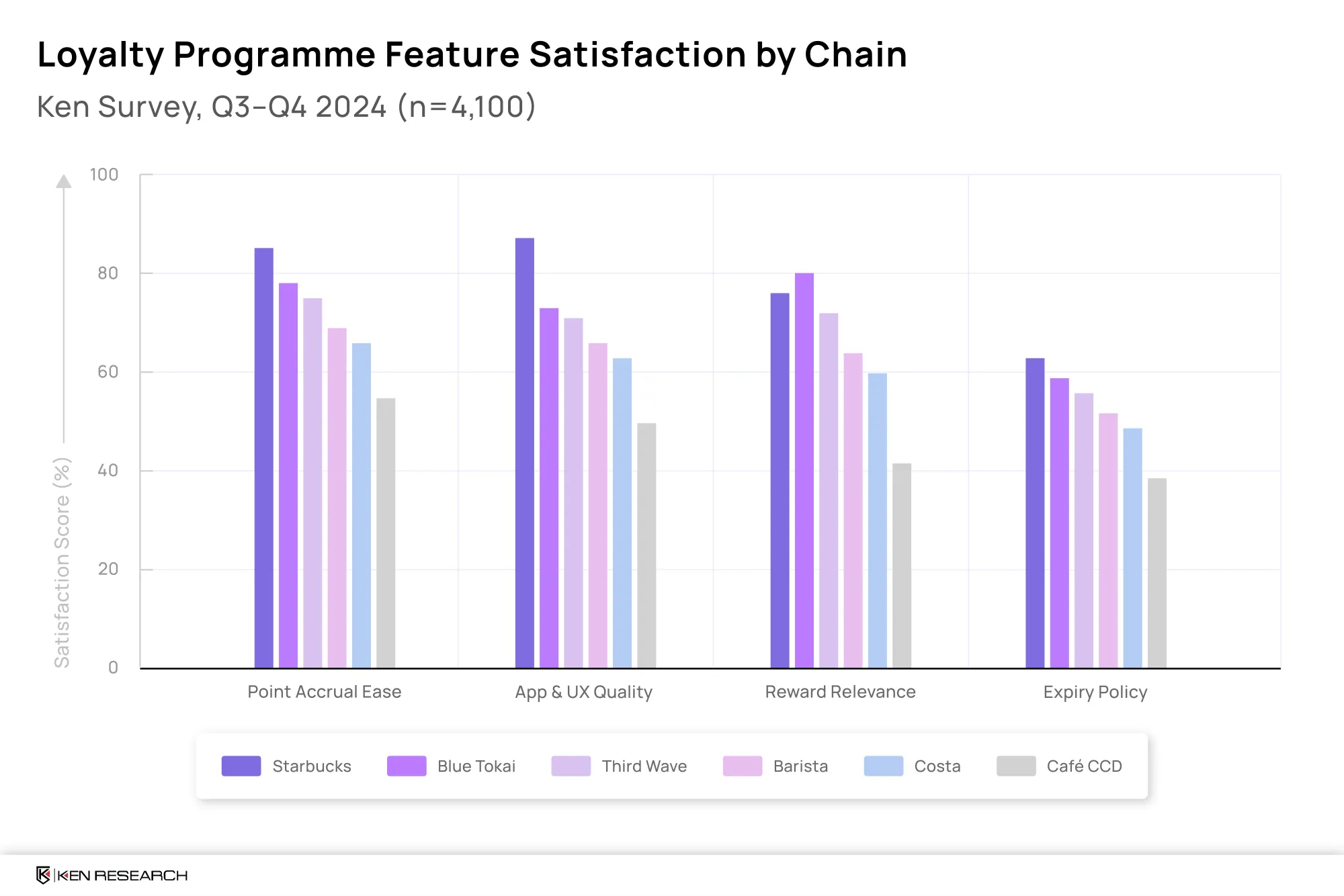
The loyalty programme feature satisfaction matrix reveals a landscape in which app and digital experience quality is the strongest differentiator between chains, and reward relevance is the dimension most consistently underperforming across the entire segment. Starbucks leads on app and UX quality at 86%, a reflection of its sustained technology investment and the integration of personalisation features that competing chains have not replicated. Blue Tokai scores highest on reward relevance at 79%, a finding that reflects its programme's alignment with the values and preferences of its core customer base rather than generic transaction rewards.
Café Coffee Day's loyalty programme satisfaction scores are the most commercially alarming in the dataset: 54% on point accrual ease, 49% on app and UX quality, and 41% on reward relevance. For a chain whose physical estate remains one of the largest in India, a loyalty programme that fails to convert transactional footfall into genuine brand attachment represents a structural waste of the most valuable asset a café chain possesses, the daily routine of a habitual customer.
Expiry policy emerges as the loyalty feature with the lowest satisfaction scores across every chain in the survey, averaging just 50% across the sample. This is a category-wide failure of loyalty programme design that reflects the industry's historical tendency to treat point expiry as a margin-protection mechanism rather than a customer relationship tool. Programmes that expire points within six to twelve months of accrual are, in effect, punishing the occasional visitor, precisely the customer segment most susceptible to switching and most in need of retention incentives.
What Lies Ahead: The Strategic Reckoning India's Café Chains Cannot Defer
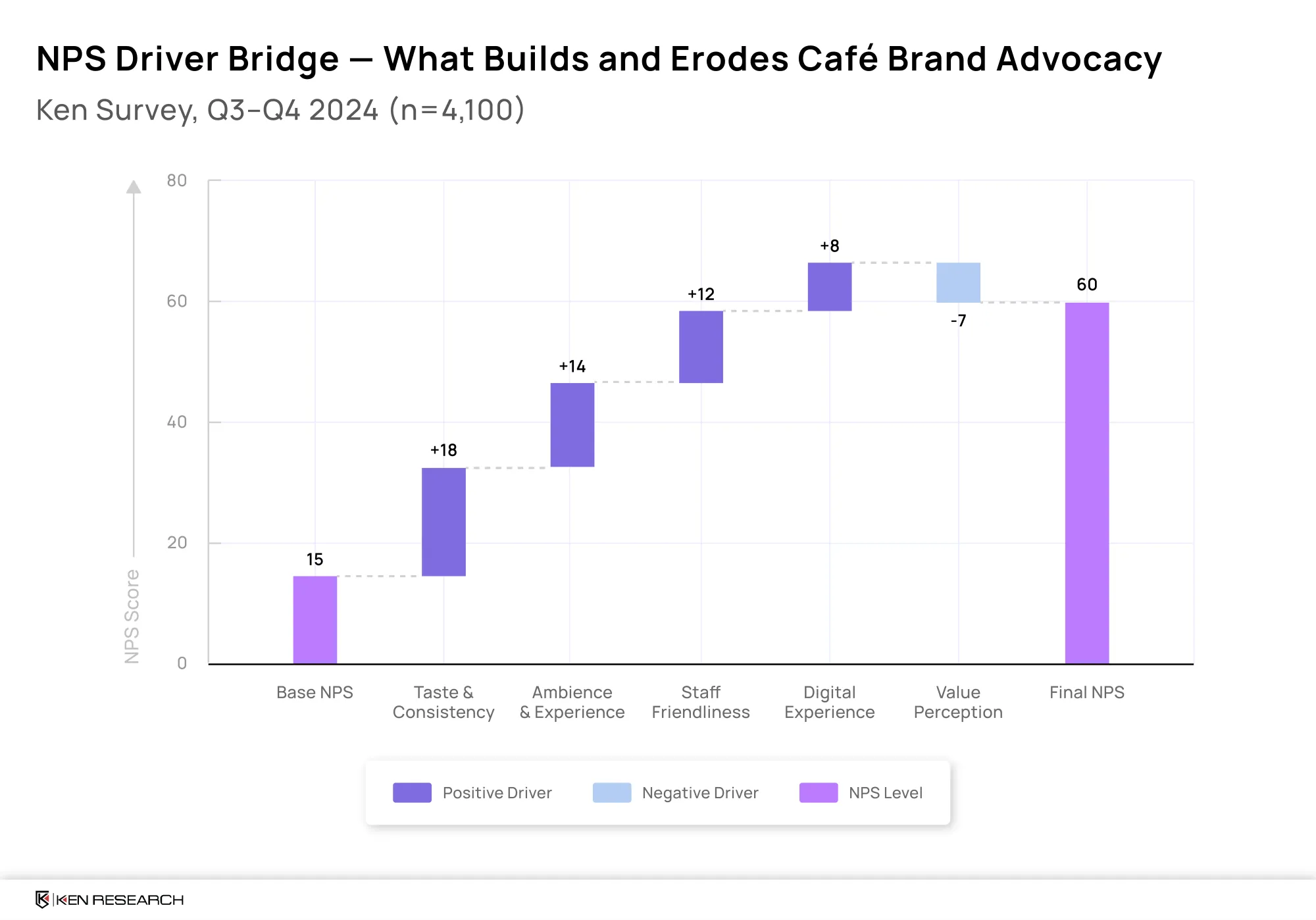
The NPS driver bridge quantifies what the preference and satisfaction data implies qualitatively: taste and consistency is the single largest positive contributor to advocacy, adding 18 points to the base NPS, followed by ambience and experience at 14 points and staff friendliness at 12. Value perception is the only driver that subtracts from NPS, reducing it by 7 points when customers feel the price-to-experience equation does not hold. The message for chains is structurally precise: invest in taste consistency and experiential quality first, staff training second, and digital experience third. Invest in value communication last, and only after the product and environment justify the price being charged.
The strategic questions India's café chains must now answer are not product questions. They are architectural ones. Do they invest in taste quality and staff training, the two highest-return advocacy drivers, or continue to allocate disproportionate budget to loyalty app features that the survey data confirms are not driving the advocacy scores that matter?
Do they design loyalty programmes around occasion-specific reward structures, recognising that the work-session customer in Bengaluru needs a fundamentally different retention mechanic than the quick-grab customer in Chennai, or continue to deploy national templates that optimise for average behaviour and satisfy no segment precisely?
Indian café market does not have a traffic problem. It has a conversion-to-advocacy problem, and the NPS bridge makes the cost of each misallocated investment rupee measurable. The chains that emerge with defensible loyalty in India's next growth cycle will be those that design for advocacy, not just footfall.
About the Author
Kunal Kumar is a Survey Research Analyst at Ken Research, specialising in market research and data-driven insights. He has experience in designing and analysing large-scale consumer surveys across industries and geographies, helping organizations turn primary research into strategic business decisions.
From the Author
"At Ken Research, we have been tracking café brand preference at the individual visit level across India's top cities, and the pattern is consistent across every market we have mapped: chains are growing their footprint faster than they are growing their loyalty depth. The gap between repeat visit frequency and genuine advocacy is widening, and the data makes clear that loyalty programme mechanics alone will not close it. India's café consumer is becoming more discerning, more brand-literate, and more willing to walk three additional minutes to a café that earns their preference rather than simply occupying the nearest corner. The chains that understand this are building for the next decade. The ones that do not are optimising for the next quarter, at significant long-run cost."
About Ken Research
Ken Research is a market intelligence and strategy consulting firm delivering actionable insights across the various sectors in dynamic markets. We support industry stakeholders with data-driven analysis on emerging trends, competitive benchmarking, pricing strategies, and shifting consumer preferences. Our expertise enables clients to refine market entry and penetration strategies, optimize product positioning, and respond effectively to evolving competitive landscapes.
Get started
We've helped companies around the world future-proof
their businesses - and we can do the same for you.