Which Industrial Products Should Indian Exporters Prioritise Next?
Ken Research
July 29, 2026 - 11 min read
July 29, 2026
by Ken ResearchIndia’s export ambition is often presented as a question of scale. It is increasingly a question of portfolio choice.
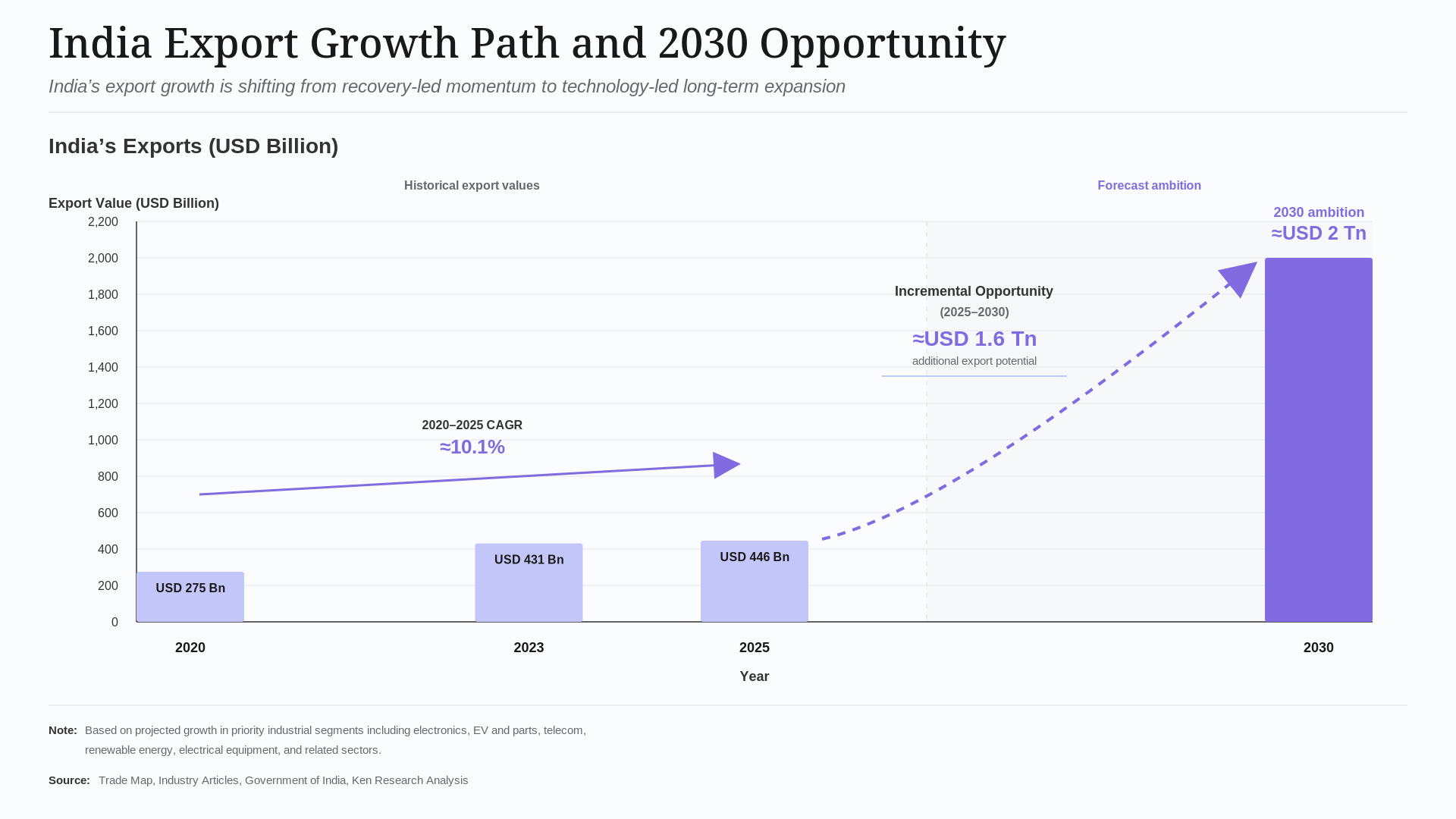
India's exports rose from approximately USD 275 billion in 2020 to approximately USD 446 billion in 2025. The stated ambition of reaching approximately USD 2 trillion by 2030 would create an incremental opportunity of nearly USD 1.6 trillion between 2025 and 2030. Yet that opportunity will not be captured by increasing volumes uniformly across the existing export basket. It requires a deliberate shift toward product categories capable of generating greater value, serving expanding end-use markets and competing within increasingly technology-intensive global supply chains.
The strategic question for exporters, investors and policymakers is therefore no longer simply how India can export more. It is what India should build, fund and take to global markets next.
Ken Research’s India Industrial Export Transformation Assessment identifies five product platforms based on export value, growth momentum and exporter intensity: semiconductor chips, network devices, PLC and SCADA panels and cabinets, electric motors and generators, and wind-turbine equipment and spare parts.
That does not mean India should abandon its established engineering strengths. It means future capital and capability decisions should distinguish between categories that preserve export scale and those that can create the next layer of value.
India’s Export Portfolio Is Already Beginning to Rotate
The shift toward technology-led industrial exports is visible in the performance of major categories between FY2021 and FY2025.
Exports of electrical equipment increased from USD 774.1 million to USD 2,418.9 million between 2021-25, representing a 33.0% CAGR. Telecom equipment rose from USD 677.1 million to USD 1,455.1 million, with a 21.1% CAGR, while renewable and energy equipment increased from USD 805.1 million to USD 1,416.1 million, recording a 15.2% CAGR over the same period.
The smaller next-generation engineering-goods category expanded from USD 20.1 million to USD 46.5 million, translating into a 23.3% CAGR. Electric vehicles and parts remained a large export category, growing from USD 2,444.1 million to USD 3,417.6 million, although its 8.8% CAGR remained below the growth recorded by electrical, telecom and next-generation categories.
By comparison, automotive and transport equipment grew from USD 869.3 million to USD 1,219.3 million, also at 8.8%, while fluid and process equipment increased from USD 295.1 million to USD 360.1 million, at 5.1%.
The implication is not that every fast-growing category should receive investment, or that every mature category has become unattractive. It is that India’s export mix is developing two distinct layers.
The first comprises established engineering categories that already offer meaningful scale, manufacturing depth and exporter participation. The second comprises faster-growing technology-linked products for which certification, technical compliance and export readiness are more decisive.
An effective portfolio cannot be built using growth alone. A small category can produce a high growth rate without yet supporting meaningful commercial scale. Conversely, a large category can remain strategically important even when its growth rate moderates. The most relevant opportunities are those where scale, growth, competitive structure and future demand reinforce one another.

Product Selection Must Move Beyond the Largest Export Categories
India already exports significant volumes of conventional industrial products. Valves account for approximately USD 2,760.8 million in exports, while pumps represent approximately USD 1,596.3 million. These categories remain important parts of the country’s industrial export base.
However, selecting the next export opportunity solely by current value would direct capital toward categories where participation is already high and growth may be more established. Selecting only by growth could produce the opposite error, prioritising products that are expanding rapidly from a low base but do not yet offer sufficient scale.
A stronger approach is to evaluate products through three connected tests.
The first is market potential. A product must offer enough export value or addressable demand to justify manufacturing investment, qualification expenditure and market-entry costs.
The second is growth momentum. The product should have a credible trajectory supported by expanding end-use industries, technology shifts or supply-chain demand.
The third is exporter intensity. Lower participation can indicate whitespace, but only when it is accompanied by a viable market and capabilities that Indian manufacturers can realistically develop. Low participation can also reflect technical barriers, limited demand or difficult economics.
In its India Industrial Export Transformation Analysis, Ken Research found that across almost 20 industrial products, the strongest opportunities emerge where meaningful export scale, sustained growth and lower exporter intensity converge. This distinction helps decision-makers separate categories that merely appear attractive from those where investment has a defensible commercial basis.
Five Product Platforms Define the Next Export Opportunity
Semiconductor Chips: The Highest-Growth Strategic Platform
Semiconductor chips combine meaningful export scale with the strongest growth momentum among the priority technology-led products identified by Ken Research.
The category recorded an export value of approximately USD 1,424 million in CY 2025 and a five-year value growth rate of 59.5%.
The opportunity extends across controlled diodes, electronic components, photoconductive cells, solar photovoltaic cells and other semiconductor products. These components serve multiple end-use industries, including automotive, industrial automation and telecom, and are incorporated into EV control units, advanced driver-assistance systems, smartphones, laptops, tablets, televisions and routers.
This breadth gives manufacturers several end-use industries against which product opportunities can be evaluated. It also raises the capability threshold. Production capacity alone will not convert the opportunity into export revenue; technical compliance and market readiness will determine whether manufacturers can qualify for and serve international demand.
The policy environment provides a significant enabling layer. The India Semiconductor Mission programme carries an outlay of INR 76,000 crore, while the Semiconductor Fabs Scheme provides fiscal support of up to 50% of project cost. The Design Linked Incentive Scheme supports both incentives and design infrastructure.
For investors and business owners, the central question is not whether semiconductors represent a large strategic opportunity. It is where, within the semiconductor value chain, India can establish a credible, commercially viable position. Capital should follow a defined product, customer and qualification thesis rather than the sector label alone. Identify which semiconductor product offers the strongest export opportunity with Ken Research’s Export Intelligence.
Network Devices: Scale, Growth and Expanding Digital Infrastructure Demand
Network devices recorded exports of approximately USD 1,455.1 million and value growth of 21.1%.
The platform includes routers, switches, modems, access points, gateways, firewalls, set-top boxes and enterprise Wi-Fi systems. Its principal end-use markets are telecom networks, information technology infrastructure and data centres. The category spans multiple product formats and end-use applications, requiring exporters to define which devices, buyers and markets they intend to prioritise.
India also has an emerging base of manufacturers and exporters across optical systems, telecom equipment and data networking, including Sterlite Technologies, Nokia India, Tejas Networks and HFCL. Their presence demonstrates that the category is not starting from zero, while the broader export-growth trajectory indicates room for further development.
The policy ecosystem includes the design-led PLI framework, which provides an additional 1% incentive for products designed and manufactured in India. The Electronics Components Manufacturing Scheme, notified in April 2025 with an outlay of INR 22,919 crore, supports the component and subassembly ecosystem, while EMC and EMC 2.0 provide infrastructure support for electronics-manufacturing clusters. Broader electronics-manufacturing support and RoDTEP therefore remain particularly relevant for network-device exporters.
The investment case is strongest for companies that can combine hardware manufacturing with product design, compliance, component sourcing and access to telecom or enterprise buyers.
PLC and SCADA Systems: An Industrial Automation Export Play
PLC and SCADA panels and cabinets occupy a critical position within energy, power generation, industrial automation, oil, gas and petrochemical infrastructure.
The product platform includes electrical substations and switchboxes, junction boxes, switchboards, industrial-control systems and related equipment. End-use products include PLC panels, SCADA cabinets, remote terminal unit panels and pump-control panels.
Manufacturers and automation companies active in India, including Larsen & Toubro, ABB India, Siemens India, Rockwell Automation and Schneider Electric, already participate across industrial automation, PLC systems, control panels and supervisory control technologies.
Electronics-manufacturing initiatives, capital incentives and RoDTEP support can improve cost competitiveness, but they cannot substitute for product-market readiness. Exporters must decide which applications they intend to serve, which specifications they can meet and whether they will compete as component suppliers, panel manufacturers, automation partners or integrated solution providers.
Electric Motors and Generators: A Cross-Sector Manufacturing Platform
Electric motors and generators support industrial manufacturing, power generation, automotive and EV applications. Their end-use products include pumps, compressors, fans, blowers, elevators, conveyors, machine tools and EV traction systems.
This is a broad platform rather than a single product market. It covers electric motors above 1 kW, single- and three-phase AC generators above 5 kW, servo motors and other products across multiple power ratings.
this category already includes established manufacturers such as CG Power and Industrial Solutions, Bharat Heavy Electricals Limited, Kirloskar Electric, Siemens India and ABB India. This provides manufacturing depth and existing export proof points across regions including Africa, the Middle East, ASEAN and Europe.
Policy support also connects the platform to the EV ecosystem. The PLI-Auto programme carries an outlay of INR 25,938 crore and is relevant to EV traction motors and advanced automotive components. PM E-DRIVE provides indirect support to the EV-motor manufacturing ecosystem and was extended in August 2025 to 31 March 2028. BEE efficiency initiatives provide another relevant layer.
A company supplying general industrial motors will require a different product, certification and channel strategy from one targeting EV traction systems, power-generation applications or high-efficiency industrial equipment, making application selection critical.
Wind-Turbine Equipment and Spare Parts: Building Around Renewable-Energy Demand
Wind-turbine equipment and spare parts provide exposure to renewable-energy investment.
Relevant products include rotor blades, gearboxes, generators, nacelle systems, electric-motor components and other spare parts and accessories. The broader renewable and energy equipment category increased from USD 805.1 million in FY2021 to USD 1,416.1 million in FY2025, representing a 15.2% CAGR.
Suzlon Energy provides an existing Indian manufacturing reference in wind turbines and parts. The opportunity should be assessed at component level against destination demand, tariff access, certification readiness and landed-cost competitiveness.
Established Engineering Categories Still Have a Strategic Role
A future-ready export strategy should not be interpreted as a binary choice between traditional and technology-led products.
Valves, pumps, heat exchangers, boilers, converters and automotive equipment continue to provide valuable manufacturing scale, customer relationships and export cash flows. Potential adjacencies may exist between established engineering products and technology-led platforms, but each transition requires a separate capability and market-feasibility assessment.
The strategic opportunity lies in assessing technology-led adjacencies against existing manufacturing capabilities, rather than attempting an unrelated technology pivot.
A portfolio view becomes imperative which should distinguish established categories that preserve export scale from priority products selected for focused export development.
Policy Support Should Strengthen the Export Case, Not Define It
India’s semiconductor, electronics, automotive and export-support programmes can materially improve investment economics.
The semiconductor programme, fabrication support, DLI, ECMS, PLI-Auto, PM E-DRIVE, RoDTEP, electronics-manufacturing clusters and export-finance support each address parts of the cost, infrastructure and ecosystem challenge. MSME exporters could also access credit-guarantee coverage of up to 85% for micro and small enterprises and 65% for medium enterprises for export-linked working capital, subject to a limit of INR 10 crore for FY2025–26. The Interest Subvention Scheme provides eligible MSME exporters with a 2.75% annual interest subvention on pre-shipment finance.
However, incentives should validate and accelerate a viable product strategy, not create one.
Policy support should be evaluated alongside product attractiveness, qualification requirements and target-market demand. A company with a strong product-market position may use policy support to reduce capital costs, strengthen pricing and improve the case presented to overseas OEMs.
The right sequence is to shortlist the product, test destination demand and tariff access, assess certification and exporter proof, and then convert relevant policy support into cost and qualification advantage.
Talk to Ken Research before finalising a policy-led investment. Our export intelligence approach connects product attractiveness with exporter density, policy eligibility, competitive positioning and the requirements needed to convert manufacturing capacity into export revenue.
Where Should India Export and Which Corridors Deserve Capital?
For manufacturers, exporters, CXOs, strategy leaders and investors, the central question is not only which industrial products show potential, but which destination markets offer the strongest product-market fit. Each corridor should be assessed through demand and tariff access, then tested for policy alignment, certification readiness, evidence of comparable exporters and landed-cost competitiveness. Corridors that remain attractive across these factors can move into commercial validation before significant resources are committed to product adaptation, compliance and market development.
Read Next: Where Should India Export Next? Explore how destination demand, tariff access and execution readiness determine which product-market corridors merit closer commercial attention.
How Should Exporters Turn Product Potential into Market Entry?
Identifying the products that should anchor the export portfolio is only the first strategic step.
A disciplined export strategy should move through four decisions.
First, the company must prioritise the product play by testing export value, growth, competitive intensity and capability fit.
Second, it must determine which product-market corridors offer sufficient demand and favourable access. The same product can have significantly different commercial potential across destination markets.
Third, it must translate PLI, ISM and RoDTEP support into cost advantage, qualification readiness and a stronger OEM proposition.
Fourth, it should run two or three focused go-to-market sprints to validate buyers, compliance gaps, channels and landed-cost competitiveness before scaling capacity.
Ken Research’s export intelligence framework supports this progression through product-market opportunity mapping, HS-code-level trade and tariff intelligence, exporter benchmarking, certification gap assessment and phased market-entry planning. It helps exporters narrow the field to the strongest product platforms and then test destination demand, tariff access and execution readiness before committing capital or go-to-market resources.
This approach prevents two common errors: investing in a growing product without a viable destination strategy, and entering an attractive market with a product that lacks differentiation or compliance readiness.
India’s Next Export Wave Will Be Won Through Selectivity
India’s industrial export opportunity is substantial, but it is not evenly distributed.
Electrical equipment, telecom products, renewable-energy equipment and next-generation engineering goods are already growing faster than several mature categories. At the product level, semiconductor chips, network devices, PLC and SCADA systems, electric motors and generators, and wind-turbine equipment and spare parts provide the clearest technology-led platforms for focused capability building and export-market development.
The strategic answer is not to chase every high-growth category. It is to identify where India’s manufacturing base, policy environment and global demand can be converted into a focused, compliance-ready and commercially viable offering.
Established engineering exports will continue to matter. They provide scale, capabilities and relationships that can support the transition. But the next phase of value creation will require exporters to move from broad category participation toward deliberate product platforms.
For exporters, the decision is what capability to build. For investors, it is where capital can produce defensible growth. For policymakers, it is which ecosystems require deeper support. For CEOs, it is which product bets can move from opportunity to revenue.
Get started
We've helped companies around the world future-proof
their businesses - and we can do the same for you.