USD 527 Billion Latin America Logistics Market: Where Should Nearshoring Capital Go
Ken Research
August 25, 2026 - 8 min read
August 25, 2026
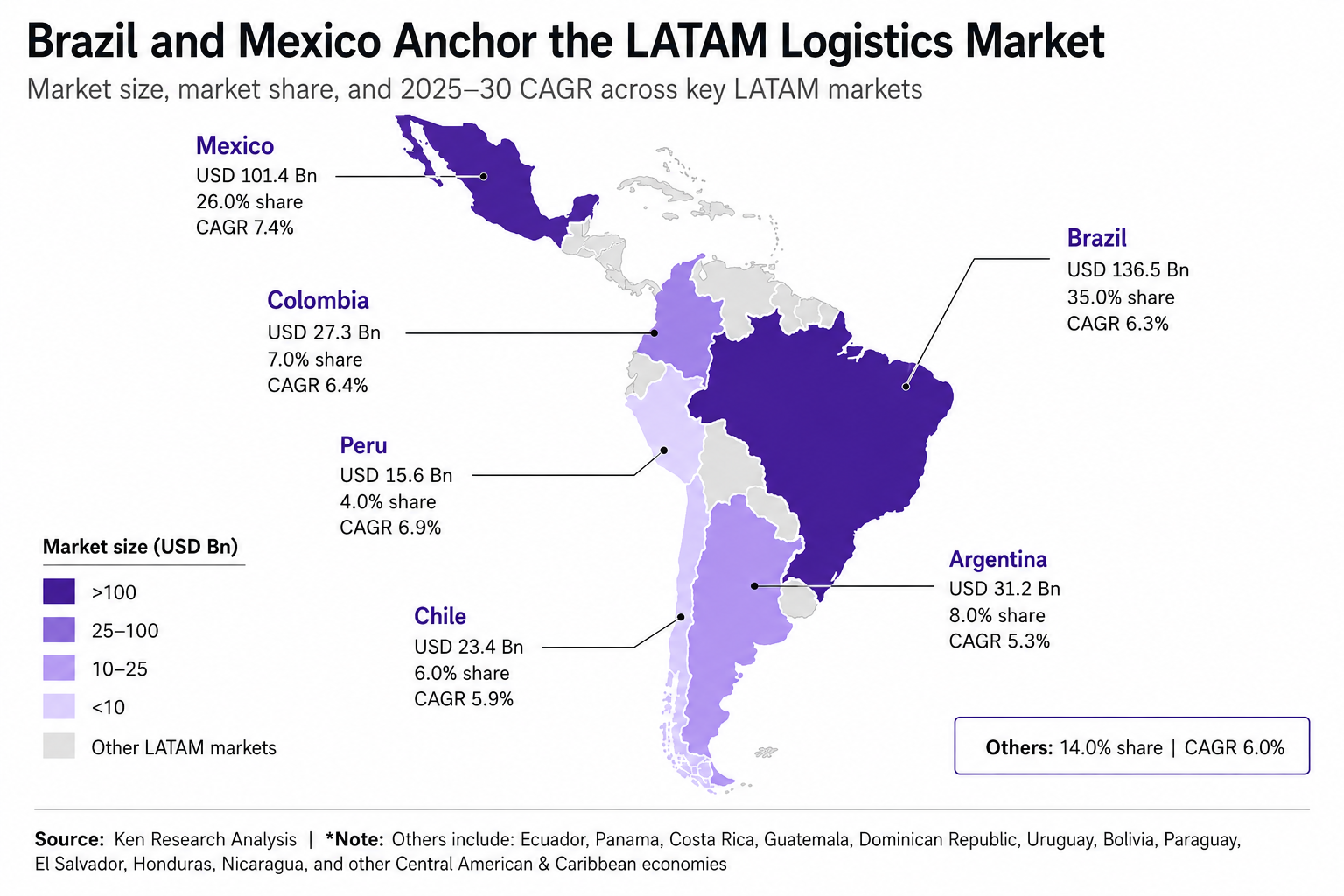
by Unnati MiglaniNearshoring is expanding into a USD 390 billion Latin American logistics market in 2025, projected to reach USD 527 billion by 2030 at a 6.6% CAGR. But the investment opportunity is far from uniform. Brazil accounts for roughly 35% of regional logistics value, or USD 136.5 billion, while Mexico represents 26%, or USD 101.4 billion, and is growing faster at 7.4% annually through 2030.
Capital flows reinforce that divergence. Latin America and the Caribbean attracted approximately USD 188.96 billion of FDI in 2024, up 7.1%. Brazil received USD 71.8 billion, equivalent to 38% of the regional total, while Mexico attracted USD 45.4 billion, or 24%, with inflows rising 47.9%. The United States accounted for 38% of the origin of regional FDI.
Ken Research's analysis points to two different investment cases behind those numbers: Brazil offers scale, domestic logistics depth and localisation potential; Mexico combines faster logistics growth with USMCA-linked manufacturing, supplier relocation and cross-border access to North America. Beyond the two largest markets, sector requirements further reshape the shortlist: Costa Rica and the Dominican Republic gain relevance in MedTech, Central America in apparel, and Colombia and Panama, where regional logistics and distribution are central to the operating model.
The location decision therefore starts with a more precise question than which market is largest or growing fastest: which country, sector and corridor combination best fits the role the investment needs to perform.
Mexico’s Advantage Is Closely Tied to North American Manufacturing
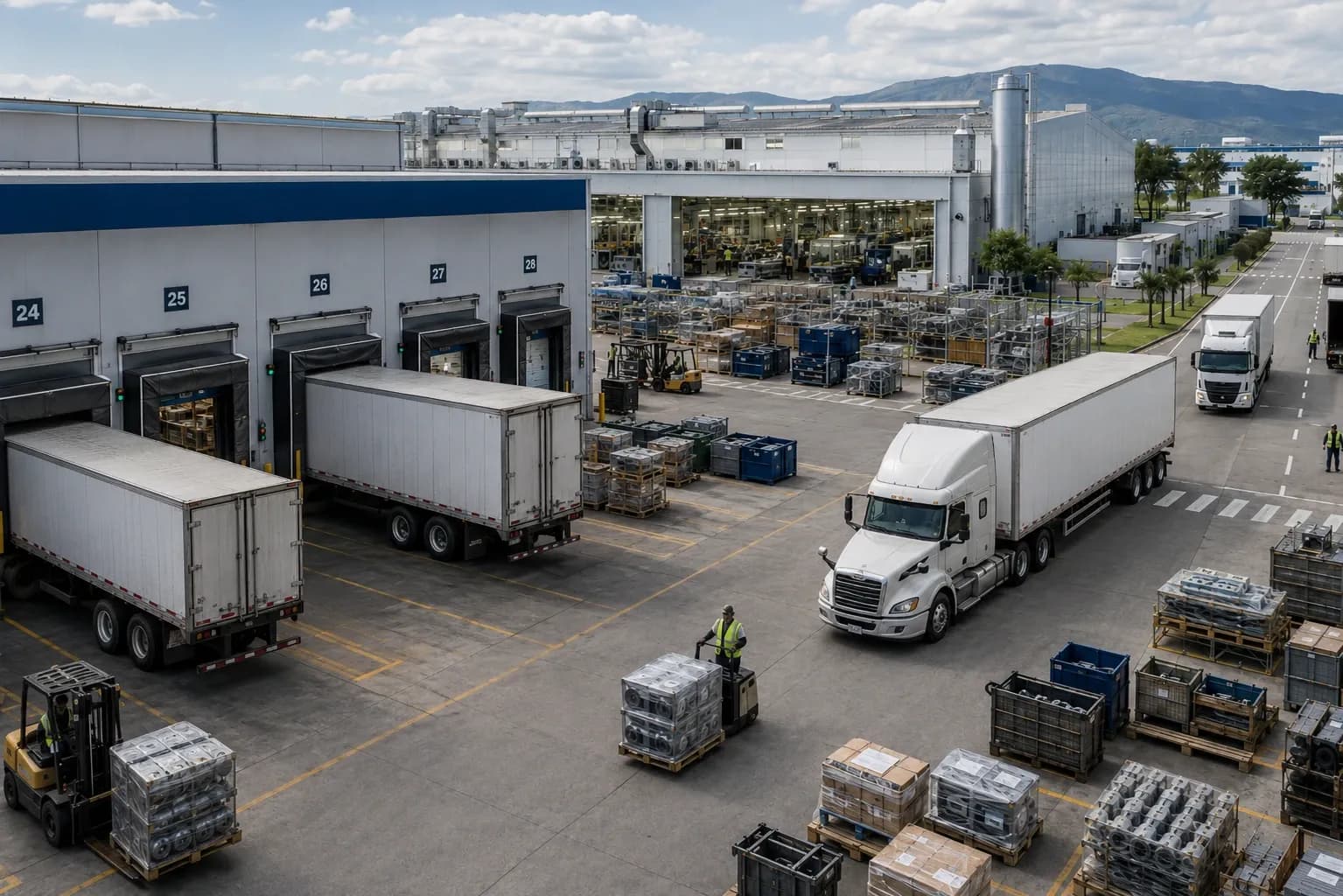
Mexico’s nearshoring proposition is built around a clear set of advantages: USMCA-linked automotive supply chains, proximity to the United States and ongoing supplier relocation.
Electronics manufacturing follows a similar pattern. Assembly operations and supplier networks are moving closer to North America, supported by Mexico’s border manufacturing base, industrial parks and access to US demand.
The logistics market reinforces that position. Mexico accounts for approximately USD 101.4 billion, or 26%, of Latin America’s logistics market in 2025 and is projected to grow at roughly 7.4% annually through 2030. Its role within the region is increasingly centred on nearshoring and USMCA-linked cross-border logistics.
That gives Mexico particular relevance where the investment depends on keeping production closely connected to US customers and North American supply chains.
Automotive and EV-component manufacturing is concentrated strongly in Mexico and Brazil, but Mexico carries the additional advantage of existing USMCA automotive linkages and US proximity. Electronics, EMS, and semiconductor-support activity also has meaningful potential across Mexico, Brazil, Costa Rica and the Dominican Republic, with Mexico benefiting from its established border-manufacturing ecosystem.
Mexico’s advantage comes from the way US-linked manufacturing, supplier relocation, industrial infrastructure and cross-border logistics reinforce one another, creating a stronger operating base for North American production networks.
Mexico is a strong North America-facing nearshoring case, but it is not the benchmark for every investment model. Download the complimentary LATAM nearshoring analysis to compare country, sector, corridor and logistics fit across the region before narrowing your location shortlist.
Brazil Offers Scale Rather Than a Replica of Mexico
Brazil competes on a different basis. Its logistics market is approximately USD 136.5 billion in 2025, representing 35% of Latin America’s total and making it the region’s largest domestic logistics and warehousing market. The sector is expected to expand at roughly 6.3% annually through 2030. Brazil also attracted the largest absolute volume of FDI in Latin America and the Caribbean in 2024.
The country has relevance across automotive, electronics, pharmaceuticals, e-commerce fulfilment and renewable-energy activity.
Its strategic value therefore lies less in reproducing Mexico’s US-border model and more in supporting scale-market localisation, domestic logistics and regional production.
This distinction matters when capital allocation begins. A manufacturing investment built primarily around US-bound production naturally places greater weight on Mexico’s trade position and cross-border infrastructure. An investment aimed at serving a large domestic market, localising production or building distribution around regional scale has a different economic logic.
Comparing Brazil and Mexico only through FDI or market-size rankings misses that difference. The more useful comparison is between the jobs each market can perform inside the company’s supply network.
Sector Fit Changes the Nearshoring Map
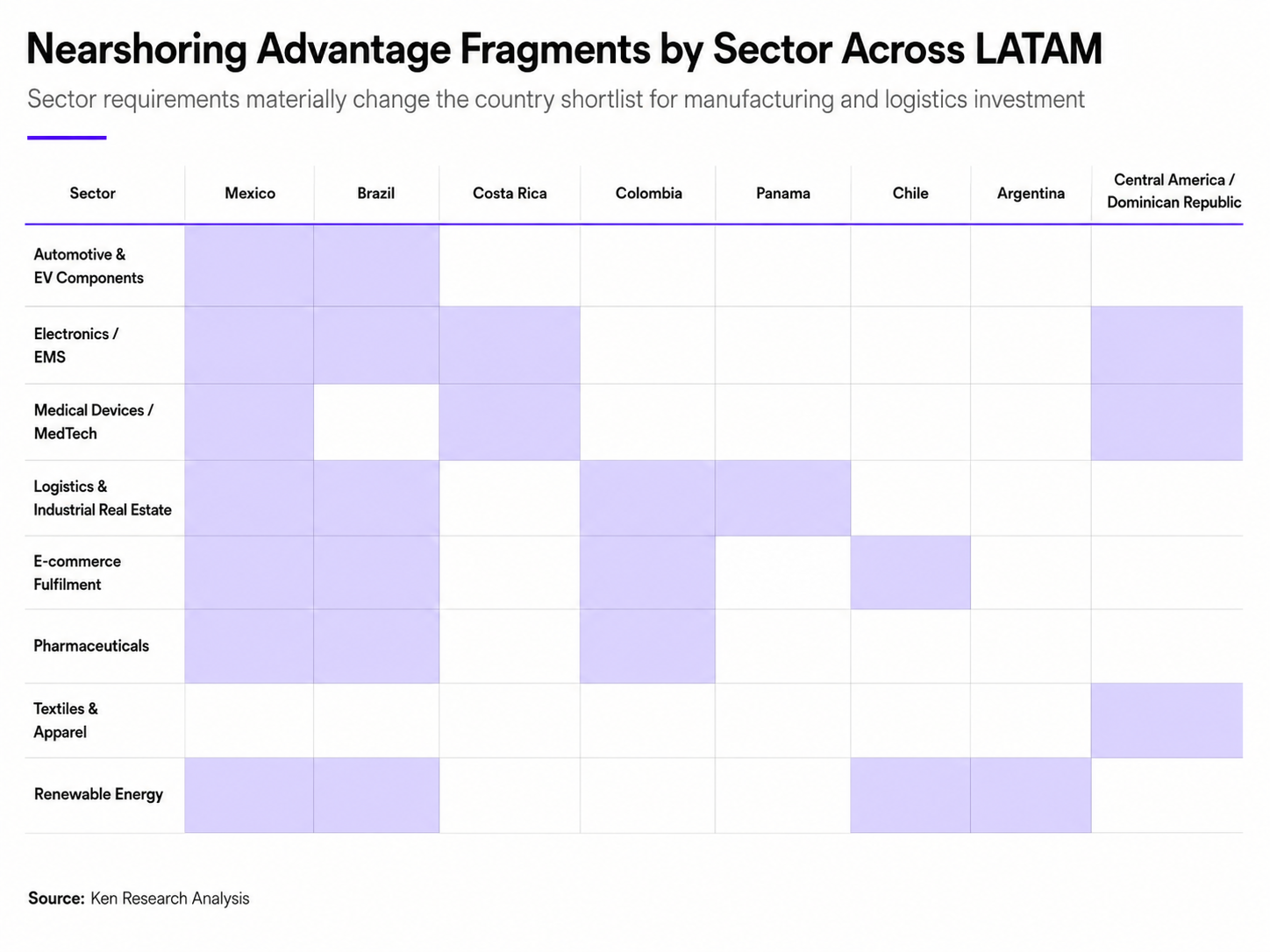
The sector-country pattern is clear: nearshoring attractiveness across Latin America changes materially once industry requirements are applied.
Automotive and EV components favour Mexico and Brazil, with Mexico benefiting from USMCA-linked supply chains, US proximity and supplier relocation. Electronics, EMS and semiconductor-support activity broadens the field to Mexico, Brazil, Costa Rica and the Dominican Republic, although Mexico retains an advantage where border manufacturing, industrial parks and US-linked demand are central to the model.
Medical devices and MedTech produce a different shortlist. Costa Rica and Mexico already have established medical-device export bases, while the Dominican Republic also carries relevance for regulated, high-value manufacturing. In this segment, existing export capability and sector specialisation can outweigh overall market scale.
The location logic shifts again in textiles and apparel. Honduras, Guatemala, El Salvador and the Dominican Republic benefit from shorter lead times to the United States compared with Asian sourcing, strengthening Central America’s position where fast replenishment is important.
Other sectors point to different combinations. Pharmaceuticals centre on Mexico, Brazil and Colombia, while e-commerce fulfilment and retail logistics span Mexico, Chile, Brazil and Colombia. Renewable energy brings Chile, Argentina, Brazil and Mexico into consideration, although the opportunity is more resource- and project-led than a conventional factory-relocation story.
Taken together, the evidence suggests that country scale is a poor substitute for sector fit. A market that ranks highly on FDI or logistics size can still be a weaker match for a particular operating model, while a smaller economy can become strategically stronger when it already offers the relevant export base, production ecosystem or trade linkage.
For investment teams, the more disciplined sequence is to define the sector requirement and target market first, then use those criteria to narrow the country shortlist.
Country Selection Is Only Half the Location Decision
Choosing the right market does not determine whether a nearshoring location will work operationally. The corridor connecting the site to suppliers, ports, borders and end markets can materially change the economics of the investment.
That is why country screening needs to be followed by a more granular test of trade access, infrastructure, warehousing clusters, border corridors, port connectivity, airport access and industrial-park availability. These factors determine whether a location is better suited to manufacturing support, regional distribution, fulfilment, cross-border trucking or a wider hub role.
Peru’s Chancay megaport shows how quickly that equation can shift. The Shanghai-Lima logistics journey has fallen from around 42 days to 23 days, with logistics costs estimated to be about 20% lower. More than USD 1.8 billion of cargo moved through the route between January and October 2025, while a further USD 1.3 billion expansion phase is planned for 2027.
For investment teams, the lesson is clear: country attractiveness establishes where to look; corridor economics determine whether a specific location can support the intended operating model. A manufacturing site, distribution hub and fulfilment operation may all sit in the same national market, but they do not require the same infrastructure or trade connectivity.
The location decision therefore needs to move one level below the country - towards the specific industrial cluster and trade corridor that can support how goods will enter, move through and leave the network.
Also Read: How Nearshoring Is Reshaping Latin America’s Logistics Service Mix
The Manufacturing Site Is Only as Strong as the Logistics Network Around It
Manufacturing relocation is expanding the infrastructure required around production. Across Mexico, Brazil, Colombia and Panama, nearshoring is increasing demand for warehouses, industrial parks, trucking, customs brokerage, ports and 3PL services. At the same time, companies are moving towards localised inventory buffers, bonded warehousing and regional stock positioning, while supplier diversification is increasing the need for supplier parks, cross-border trucking and regional distribution networks.
That makes logistics capacity part of the site economics, not a downstream execution issue. A production location must support the movement of inbound materials, storage of inventory and distribution of finished goods; cross-border models add customs and forwarding requirements, while regional fulfilment places greater weight on warehousing and distribution connectivity.
The operating environment also differs by market. Brazil offers the region’s largest domestic logistics and warehousing base; Mexico is strongest in US-linked cross-border logistics; Colombia is emerging as a regional distribution hub; Chile combines advanced port infrastructure with mining-export logistics; and Peru remains closely tied to export-oriented logistics.
It is hence important to assess production economics and logistics economics together. A location that works on land, labour or incentives can still be a weaker nearshoring choice if the surrounding logistics network does not support the way materials, inventory and finished goods need to move.
Entry Strategy Has to Match the Local Execution Base
An attractive market can still be difficult to execute if the local ecosystem is weak. The choice between direct investment, joint venture, acquisition, distributor, 3PL partnership or an asset-light model should therefore be tested against the depth of suppliers, contract manufacturers, logistics providers, customs brokers and industrial developers available around the target location.
The decision becomes sector-specific quickly. MedTech depends more on compliant manufacturing capability; automotive on supplier integration and cross-border execution; apparel on responsive sourcing; e-commerce on fulfilment and last-mile capacity. A market that looks attractive on demand or infrastructure can require a very different entry model once execution capability is assessed.
Ken Research’s investment decision framework brings market attractiveness, corridor economics, entry-model fit and partner capability into a single assessment, helping expansion teams judge whether a shortlisted location can support the required operating model at scale. For teams approaching site selection, the next step is to test the shortlist against these execution conditions before capital is committed.
Nearshoring Capital Should Follow Operating Fit, Not Market Size
Latin America is not converging on a single nearshoring model. Mexico is strongest where the investment depends on US-linked manufacturing and cross-border supply chains; Brazil offers scale, domestic logistics depth and localisation potential; Costa Rica and the Dominican Republic are more relevant for MedTech; Central America has a distinct apparel proposition; and Colombia and Panama become more important where regional logistics and distribution are central to the model.
That makes country ranking a weak endpoint for capital allocation. The investment case should be built in sequence: define the role of the site, establish sector and customer-market requirements, screen markets for trade access, infrastructure, labour and incentives, test the specific corridor and logistics network, and then assess whether the local supplier and partner base can support execution.
The result is a narrower but more useful management question:
Which location gives this investment the strongest operating fit across sector capability, market access, logistics connectivity and execution capacity?
That is the decision that should precede site commitment. Connect with Ken Research’s LATAM nearshoring experts to pressure-test priority markets, corridors and partner ecosystems against your manufacturing, distribution or regional-expansion strategy.
Related tags
Logistics
Logistics and Shipping
Automotive, Transportation and Warehousing
Get started
We've helped companies around the world future-proof
their businesses - and we can do the same for you.