Saudi Arabia Stationery Market to Add USD 513 Mn by 2030 Despite Classroom Digitalisation: Where Will the Value Shift?
Ken Research
September 29, 2026 - 8 min read
September 29, 2026
by Ken ResearchSaudi Arabia’s stationery market is entering a second reset. The first came during COVID-19, when school closures and disrupted office routines weakened traditional consumption. The next is more structural: digital classrooms, AI-enabled learning and paperless workflows are steadily eroding some conventional stationery use cases. Yet the market is not slowing with them.
Instead, the market is projected to expand from about USD 1.46 billion in 2025 to nearly USD 1.98 billion by 2030, with growth accelerating to a 6.2% CAGR, compared with 5.4% during 2019-25. That divergence is the real story. Saudi stationery is growing faster even as parts of its traditional demand base become easier to digitise.
The explanation lies in where value is moving. Education expansion, premiumisation, gifting, creative use cases and more formal institutional purchasing are offsetting pressure on digitally substitutable products. For manufacturers, the question is therefore no longer whether stationery demand will survive digitalisation, but which products will remain defensible, where buyers will trade up, and which parts of the portfolio deserve investment through 2030.
Back-to-School, Ramadan and Corporate Buying Keep Saudi Stationery Demand Recurring Throughout the Year
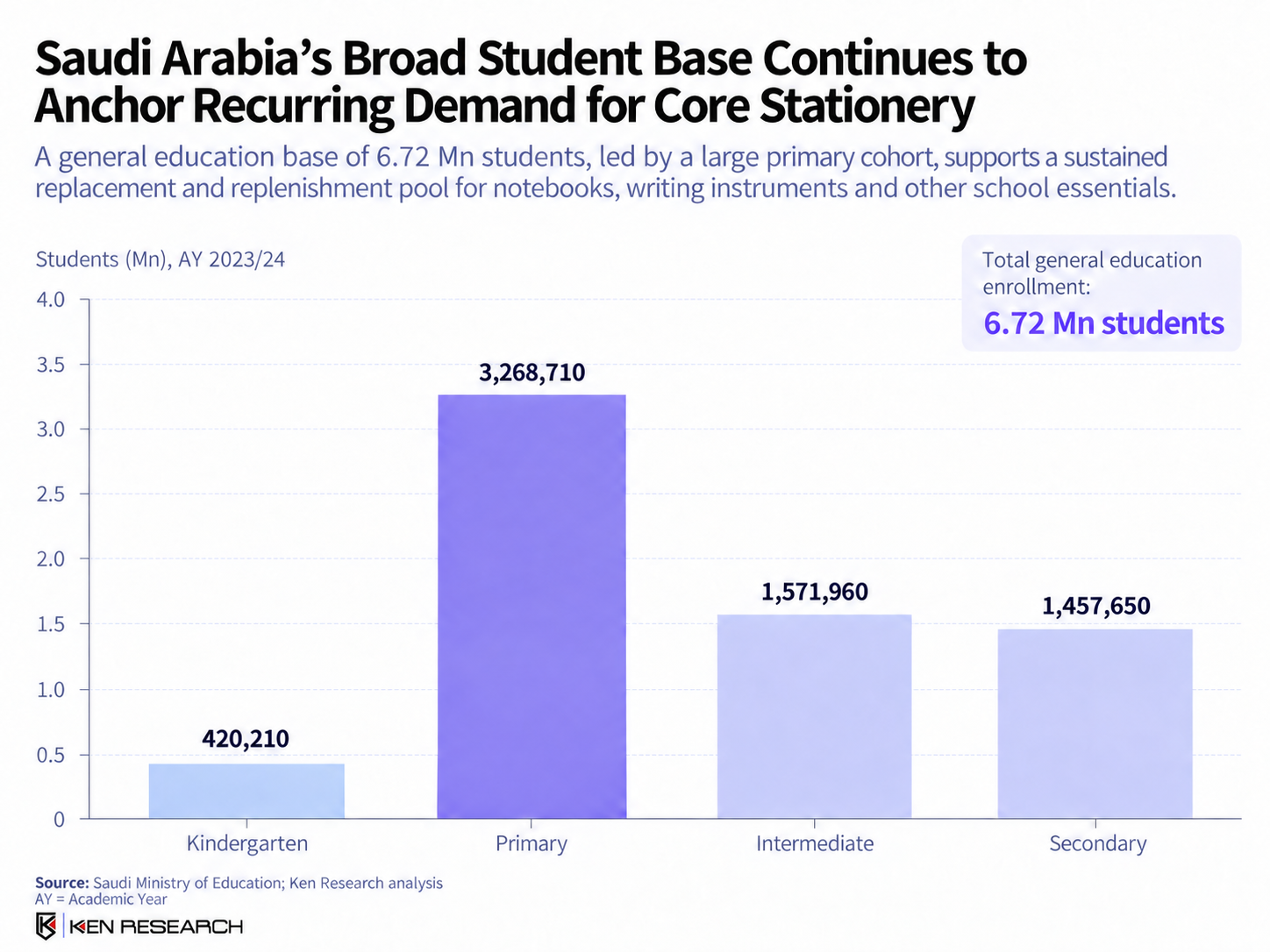
Saudi Arabia’s stationery demand is anchored by a large school-going population and a predictable academic cycle. More than 6.7 million students attended general education across over 31,000 schools at the start of the 2024-25 academic year, while completion reached 99.6% at primary level and 99.1% at intermediate level in 2025. This creates a sizeable recurring base for notebooks, writing instruments, school supplies and creative-learning materials.
Ken Research’s seasonal demand index identifies late July through September as the strongest stationery-purchasing window, with August at the peak. This is when households and educational institutions prepare for school reopening and replenish essential supplies, making assortment availability and timely replenishment particularly important for manufacturers, distributors and retailers.
The back-to-school period also operates within a closely monitored retail environment. The Ministry of Commerce has run dedicated inspection campaigns around school reopening for several consecutive years, covering stock availability, price transparency and retailer compliance.
In 2026 alone, it conducted 2,259 inspections of bookstores, stationery shops and school-supply outlets, underscoring the importance placed on orderly supply during a key trading period. Saudi Arabia’s School Bag Support programme also helps eligible Social Security households meet basic school-supply needs for public-education students aged 6-18 at the start of the academic term.
Demand does not end once schools reopen; it changes in character. Ramadan and Eid create another important purchase occasion, led more by gifting than by basic replenishment. Premium writing instruments, personalised notebooks, diaries, executive sets and customised stationery become more relevant in both personal and corporate gifting, where presentation, brand and perceived quality carry greater weight.
Corporate procurement provides another demand window beyond the academic calendar. Budget renewals between December and March support purchases of planners, calendars, filing products and office supplies, while Vision 2030 is expanding the addressable corporate base.
By 2024, 571 companies had established regional headquarters in Saudi Arabia, already above the programme’s 2030 target of 500. Broader business activity is also expanding, with non-oil activities growing 4.9% in 2025 and financial, insurance and business services recording 7.0% year-on-year growth in Q2 2025.
This creates a more diversified demand calendar: back-to-school drives essential volume, Ramadan and Eid support gifting-led purchases, and corporate procurement sustains workplace stationery demand into the first quarter.

6.7 Mn Students Still Need Physical Tools as Exams, Creative Learning and Hobbies Resist Digital Substitution
Saudi Arabia is embedding digital learning more deeply into both curriculum and classroom delivery. From the 2025–26 academic year, Artificial Intelligence was introduced across all levels of general education, while Madrasati, the Kingdom’s national digital learning platform, already connects more than 6.3 million students and 477,000 teachers through virtual classes, assignments and learning activities.
Digital assignments and online content clearly reduce some routine demand for printed worksheets, notebooks and filing products. But those are only part of the stationery basket.
Examination periods create their own recurring requirement for physical stationery. Saudi Arabia’s academic calendar includes examination windows around December-January and May-June, when writing instruments, notebooks, highlighters and study materials become more relevant. Written examinations, mathematical work, revision and annotation remain difficult to shift entirely onto digital devices.
Alongside this, Creative use is widening the physical-use case further. Art and craft supplies are projected to gain market share through 2030, supported by hobbyist, creative and do-it-yourself demand, while art and design are becoming more visible within the education environment. Drawing, colouring, model-making and other tactile activities depend on physical materials regardless of how much learning content moves online.
Saudi Arabia’s education reforms point to a hybrid learning model rather than a wholesale substitution of physical learning tools. Artificial Intelligence is being integrated into the curriculum alongside interactive, practical and creative learning, while subjects such as art and design retain a strong hands-on component. That keeps physical materials relevant in parts of the learning process where screens are less substitutable.
For stationery manufacturers, the implication is more specific than simple demand resilience. Routine paper use faces pressure, but examinations, handwriting, project work, sketching and creative learning preserve demand for products tied to active physical use. The market is therefore becoming more selective, with value increasingly dependent on whether a product serves a use case that remains relevant in a more digital classroom.
Saudi Stationery Is Shifting from Mass Towards Mid-Premium and Premium Products
Physical stationery retains multiple defensible use cases across education, examinations, creative activity and gifting. Separately, the market’s price mix is moving upwards. Premium and luxury stationery is projected to grow at 9.1% annually between 2025 and 2030, increasing its share from 20.5% to 23.5%, while mass-market products decline from 41.5% to 37.8%. Mid-premium grows at 6.6%, broadly maintaining its share while adding a substantial pool of new market value.
The shift is therefore not simply towards luxury. More spending is moving into the space above basic mass-market products, where better writing performance, stronger materials, design, personalisation and presentation provide clearer reasons to trade up. Ramadan, Eid and corporate gifting reinforce the relevance of these attributes, particularly for premium writing instruments, personalised notebooks, planners and gift-oriented stationery.
Sustainable and eco-friendly specifications are becoming part of the higher-value proposition as regulation and procurement standards place greater emphasis on compliant materials and packaging.
Refillable writing instruments, recyclable or responsibly sourced paper, durable products and lower-impact packaging allow brands to differentiate beyond aesthetics alone. SASO requirements for paper, cardboard and degradable plastic products reinforce this shift through conformity, labelling and environmental standards, while broader Vision 2030 sustainability priorities increase the relevance of certified, recyclable and lower-impact stationery products.
For manufacturers, the opportunity is to build a broader value ladder between commodity stationery and premium products. Mass-market ranges will continue to serve scale demand, but stronger growth is emerging in mid-premium and premium propositions where performance, design, gifting relevance, personalisation or sustainable specifications provide a credible basis for higher pricing.
Paper Will Still Anchor 48.5% of Saudi Stationery by 2030, but Two Faster-Gaining Categories Are Reshaping the Mix
Paper-based stationery will remain the largest value pool in Saudi Arabia, but it will account for a smaller share of the market over time. Its share is projected to decline from 50.0% in 2025 to 48.5% in 2030, even as the category itself expands from approximately USD 731 million to USD 958 million. The distinction matters: paper is losing relative share, not market relevance.
Growth is gradually becoming more distributed across the physical stationery basket. Writing instruments increase from 20.2% to 21.1% of market value, while art and craft supplies rise from 25.1% to 25.7%. Premiumisation and gifting support writing instruments, while creative, hobby and do-it-yourself activities provide additional demand for art and craft products.
This changing mix also fits the broader shift towards hybrid learning. Routine printing, filing and some basic paper consumption face greater exposure as educational content moves online, while handwriting, examinations, drawing and other tactile activities continue to require physical products. Digitisation therefore changes the relative attractiveness of stationery categories without removing the need for paper itself.

For manufacturers, the portfolio implication is not to move away from paper. Its scale still warrants distribution reach, cost discipline and dependable availability, particularly around back-to-school demand. The growth opportunity sits alongside that core: protect paper as the anchor while increasing exposure to writing and creative categories where differentiation, premium positioning and physical-use relevance provide greater room for value growth.
The 2030 Portfolio Playbook: Protect the Core, Reallocate Growth Capital and Build for Hybrid Learning
Saudi Arabia’s stationery market is not moving in one direction. Paper-based products will remain the largest demand pool, while writing instruments, art & craft supplies, premium formats and sustainable products gain strategic relevance. At the same time, smart-learning adoption is changing how physical stationery is used rather than removing its role. For manufacturers, the implication is clear: 2030 portfolio decisions should be made category by category, with product development, pricing, channel strategy and supply-chain investment aligned to the role each category will play.
- Protect high-frequency demand, but avoid over-investing in mature formats. Core notebooks, paper products and everyday writing instruments will continue to require scale, availability and strong back-to-school execution. Investment should therefore focus on supply reliability, channel coverage and seasonal inventory discipline rather than undifferentiated SKU expansion. Expanding domestic paper-manufacturing capacity can also strengthen supply continuity and reduce exposure to imported finished products.
- Direct innovation toward categories where differentiation can still support higher value. Premium writing instruments, personalised notebooks, planners, sustainable products and creative supplies offer greater scope for design, branding and product differentiation than commodity stationery. Growing preference for recyclable materials, responsibly sourced paper, refillable formats and lower-impact packaging also makes sustainability increasingly relevant to product specification, particularly as SASO conformity and environmental requirements become more important.
- Design physical products around hybrid-learning behaviour. Smart classrooms do not eliminate the need for stationery; they change the activities for which it remains useful. Specialised notebooks, planners, study organisers, stylus-compatible products and creative-learning tools can complement digital education through structured note-taking, annotation, project organisation and creative work. The priority should be to solve a specific learning task, not to add technology without a clear use case.
- Treat supply-chain intelligence as part of the growth strategy. AI-supported demand forecasting and digitally integrated inventory systems can help retailers, distributors and manufacturers anticipate back-to-school peaks, manage broader assortments and reduce stock-outs or excess seasonal inventory. For suppliers operating across institutional, retail and e-commerce channels, forecasting accuracy and replenishment discipline can become as important as launching another product range.
- Build compliance and procurement readiness into product development. SASO requirements covering paper, cardboard and degradable plastic products increase the importance of material selection, labelling, conformity and environmental performance. Designing products around these requirements from the outset can improve readiness for organised retail, educational institutions and other formal procurement channels.
The harder strategic decision is where to place the next unit of capital. A mass notebook supplier, premium writing brand, art-material manufacturer and hybrid-learning specialist should not be investing against the same demand assumptions. Each faces different category economics, price tolerance, channel structures and inventory risks. The companies best positioned for 2030 will be those that can identify which categories merit investment, where buyers will pay for differentiation, and which channels can support repeatable scale.
Ken Research helps stationery manufacturers, brands and distributors test these decisions before capital is committed, combining category demand sizing, institutional-buyer research, product and price benchmarking, channel assessment, competitive positioning, localisation analysis and market-entry strategy. If you are deciding where to expand your Saudi stationery portfolio, which categories justify product-development investment, or how to strengthen your route to market, talk to our experts to identify where the strongest commercial opportunity lies.
Get started
We've helped companies around the world future-proof
their businesses - and we can do the same for you.