About the Report
Base Year 2024Asean Mobile Virtual Network Operator Mvno Market Overview
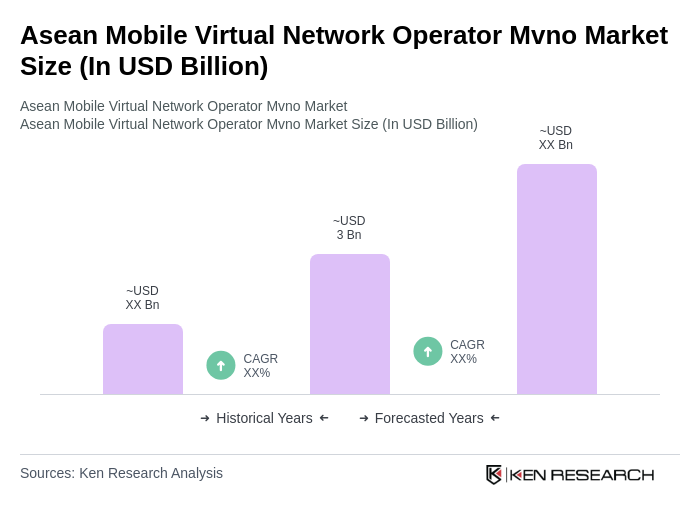
- The Asean Mobile Virtual Network Operator (MVNO) market is valued at approximately USD 3 billion, based on a five-year historical analysis drawing on recent ASEAN-focused estimates. This growth is primarily driven by the increasing demand for affordable mobile services, the rise of digital platforms, and the proliferation of smartphones across the region, which enable MVNOs to expand their subscriber base and service portfolios .
- Countries such as Malaysia, Singapore, and Indonesia are key MVNO markets within ASEAN due to advanced telecommunications infrastructure, high smartphone penetration, and supportive competition dynamics that have allowed multiple MVNO launches and 5G-based offerings (e.g., Singapore’s 5G MVNO launches via host networks). These markets maintain regulatory conditions and commercial wholesale access that encourage MVNO operations and competitive pricing .
- In 2023, the Malaysian Communications and Multimedia Commission (MCMC) followed through on merger-related undertakings around the Celcom–Digi transaction that affected the MVNO landscape, including measures to ensure fair MVNO access, divestment of Yoodo, and spectrum returns, which aimed to preserve competition and streamline MVNO arrangements in Malaysia .
Asean Mobile Virtual Network Operator Mvno Market Segmentation
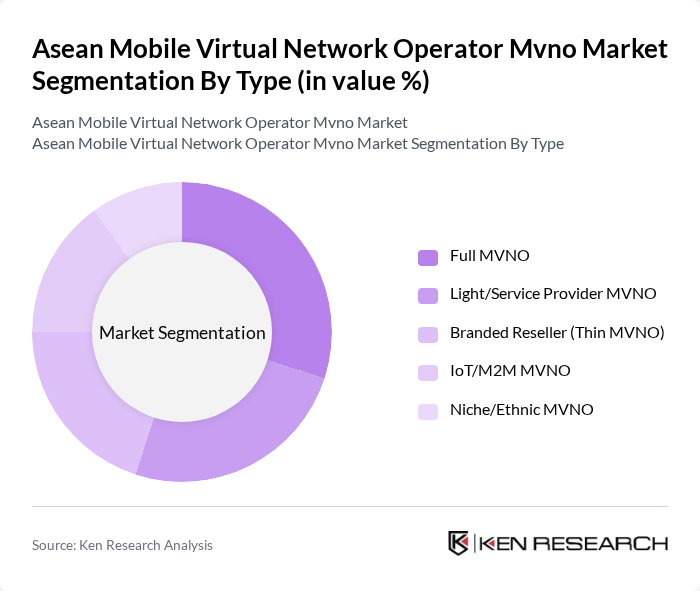
By Type:The MVNO market can be segmented into various types, including Full MVNO, Light/Service Provider MVNO, Branded Reseller (Thin MVNO), IoT/M2M MVNO, and Niche/Ethnic MVNO. Each type serves different market needs and consumer preferences, with Full MVNOs offering comprehensive services and infrastructure, while Light MVNOs focus on specific niches or partnerships. Recent ASEAN/global analyses also highlight the role of MVNE/MVNA enablement and enterprise/IoT-centric MVNOs supporting fintech, e-commerce, and connected device use cases .
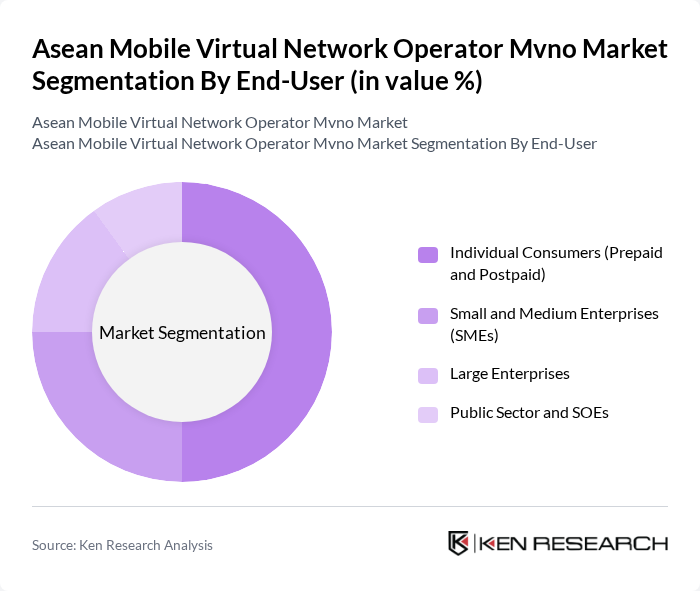
By End-User:The end-user segment of the MVNO market includes Individual Consumers (Prepaid and Postpaid), Small and Medium Enterprises (SMEs), Large Enterprises, and Public Sector and State-Owned Enterprises (SOEs). Individual consumers represent a significant portion of the market, driven by the demand for affordable mobile services, flexible plans, and digital-first onboarding, while enterprise and IoT demand is rising with fintech, logistics, and connected devices use cases across ASEAN .
Asean Mobile Virtual Network Operator Mvno Market Competitive Landscape
The Asean Mobile Virtual Network Operator Mvno Market is characterized by a dynamic mix of regional and international players. Leading participants such as Tune Talk Sdn Bhd (Malaysia), redONE Network Sdn Bhd (Malaysia), XOX Mobile Sdn Bhd (Malaysia), Yoodo (Malaysia), MyRepublic Mobile (Singapore), Circles Asia Pte. Ltd. (Circles.Life) (Singapore), Zero1 Pte Ltd (Singapore), Grid Communications Pte Ltd (Singapore), Mytel (Myanmar National Tele & Communications Co., Ltd.), Indosat Business (IoT/M2M MVNO Partnerships, Indonesia), Feels Telecom Corporation Co., Ltd. (Thailand), The Whitespace Co., Ltd. (Penguin SIM, Thailand), Loxley Public Company Limited (i-KOOL, Thailand), a2network (Thailand) Co., Ltd. (JP SIM/AIS partnerships), redONE Network (Thailand) Co., Ltd. contribute to innovation, geographic expansion, and service delivery in this space. Notably, Zero1’s commercial 5G MVNO access via Singtel and MCMC’s post-merger remedies supporting an open MVNO environment in Malaysia illustrate competitive and regulatory dynamics shaping the region .
Asean Mobile Virtual Network Operator Mvno Market Industry Analysis
Growth Drivers
- Increasing Smartphone Penetration:The ASEAN region has witnessed a significant rise in smartphone adoption, with over 400 million smartphone users reported in future. This figure is projected to reach approximately 450 million by the end of future, driven by affordable devices and improved internet access. The World Bank indicates that mobile broadband subscriptions in ASEAN countries have increased by 15% annually, creating a robust demand for mobile virtual network operators (MVNOs) to cater to this growing user base.
- Demand for Affordable Mobile Services:With a rising middle class, the demand for cost-effective mobile services is surging. In future, the average monthly mobile expenditure in ASEAN was around $10, with many consumers seeking budget-friendly options. According to the International Telecommunication Union, nearly 60% of users in the region prioritize affordability over brand loyalty, presenting a lucrative opportunity for MVNOs to capture price-sensitive customers through competitive pricing strategies and tailored service offerings.
- Expansion of 4G and 5G Networks:The rollout of 4G and 5G networks across ASEAN is accelerating, with over 70% of the population expected to have access to 4G by future. The GSMA reports that 5G connections in the region are projected to exceed 100 million by future. This infrastructure development not only enhances service quality but also enables MVNOs to offer innovative services, such as high-speed data plans and IoT solutions, thereby driving market growth.
Market Challenges
- Intense Competition Among MVNOs:The ASEAN MVNO market is characterized by fierce competition, with over 50 MVNOs operating in the region as of future. This saturation leads to aggressive pricing strategies, which can erode profit margins. According to industry reports, the average revenue per user (ARPU) for MVNOs has declined by 10% year-on-year, compelling operators to innovate and differentiate their offerings to maintain market share amidst this competitive landscape.
- Regulatory Hurdles and Compliance Issues:MVNOs in ASEAN face significant regulatory challenges, including complex licensing requirements and compliance with local telecommunications laws. For instance, the regulatory framework in Indonesia mandates MVNOs to partner with local mobile network operators (MNOs), which can limit operational flexibility. The World Bank highlights that navigating these regulations can incur additional costs, impacting the overall profitability and operational efficiency of MVNOs in the region.
Asean Mobile Virtual Network Operator Mvno Market Future Outlook
The future of the ASEAN MVNO market appears promising, driven by technological advancements and evolving consumer preferences. As smartphone penetration continues to rise, MVNOs are expected to leverage digital marketing strategies to enhance customer engagement. Additionally, the increasing adoption of eSIM technology will facilitate seamless connectivity, allowing MVNOs to offer more flexible plans. Furthermore, the integration of IoT services will create new revenue streams, positioning MVNOs to capitalize on emerging trends and meet the diverse needs of consumers in the region.
Market Opportunities
- Niche Market Targeting:MVNOs can explore niche markets, such as senior citizens and expatriates, which are often underserved. By tailoring services to meet the specific needs of these demographics, MVNOs can enhance customer loyalty and increase market penetration. For instance, specialized plans offering international calling at competitive rates can attract expatriates, providing a significant growth opportunity.
- Partnerships with Local Businesses:Collaborating with local businesses can create synergies that enhance service offerings. MVNOs can partner with e-commerce platforms or local retailers to provide bundled services, such as mobile data with shopping discounts. This strategy not only increases customer acquisition but also fosters community engagement, driving brand loyalty and expanding market reach.
Scope of the Report
| Segment | Sub-Segments |
|---|---|
| By Type | Full MVNO Light/Service Provider MVNO Branded Reseller (Thin MVNO) IoT/M2M MVNO Niche/Ethnic MVNO |
| By End-User | Individual Consumers (Prepaid and Postpaid) Small and Medium Enterprises (SMEs) Large Enterprises Public Sector and SOEs |
| By Distribution Channel | Digital-Only (App/Web, eKYC, eSIM) Retail/Convenience Stores and Kiosks Telco/Dealer Networks Partner/Affinity Channels (Banks, E-commerce, Superapps) |
| By Pricing Model | Pay-As-You-Go (Top-up) Subscription/Bundled Plans Usage-Based/Data-Only Enterprise Contract/Custom SLAs |
| By Service Offering | Mobile Voice and Messaging Mobile Broadband/Data Value-Added Digital Services (OTT bundles, roaming, content) IoT Connectivity (M2M, eSIM profiles, private APN) |
| By Customer Segment | Youth/Student and Budget-Conscious Migrant/Ethnic and Tourist Business/Enterprise and SOHO Senior/Low-Usage |
| By Market Positioning | Budget/Value MVNOs Digital-First/DIY MVNOs Enterprise/IoT Specialist MVNOs Premium/Content-Bundled MVNOs |
Key Target Audience
Investors and Venture Capitalist Firms
Government and Regulatory Bodies (e.g., ASEAN Telecommunications Regulators Council)
Mobile Network Operators
Telecommunications Equipment Manufacturers
Mobile Payment Service Providers
Telecom Infrastructure Providers
Industry Associations (e.g., GSMA)
Financial Institutions and Banks
Players Mentioned in the Report:
Tune Talk Sdn Bhd (Malaysia)
redONE Network Sdn Bhd (Malaysia)
XOX Mobile Sdn Bhd (Malaysia)
Yoodo (Malaysia)
MyRepublic Mobile (Singapore)
Circles Asia Pte. Ltd. (Circles.Life) (Singapore)
Zero1 Pte Ltd (Singapore)
Grid Communications Pte Ltd (Singapore)
Mytel (Myanmar National Tele & Communications Co., Ltd.)
Indosat Business (IoT/M2M MVNO Partnerships, Indonesia)
Feels Telecom Corporation Co., Ltd. (Thailand)
The Whitespace Co., Ltd. (Penguin SIM, Thailand)
Loxley Public Company Limited (i-KOOL, Thailand)
a2network (Thailand) Co., Ltd. (JP SIM/AIS partnerships)
redONE Network (Thailand) Co., Ltd.
Table of Contents
Market Assessment Phase
1. Executive Summary and Approach
2. Asean Mobile Virtual Network Operator Mvno Market Overview
2.1 Key Insights and Strategic Recommendations
2.2 Asean Mobile Virtual Network Operator Mvno Market Overview
2.3 Definition and Scope
2.4 Evolution of Market Ecosystem
2.5 Timeline of Key Regulatory Milestones
2.6 Value Chain & Stakeholder Mapping
2.7 Business Cycle Analysis
2.8 Policy & Incentive Landscape
3. Asean Mobile Virtual Network Operator Mvno Market Analysis
3.1 Growth Drivers
3.1.1 Increasing smartphone penetration
3.1.2 Demand for affordable mobile services
3.1.3 Rise of digital services and applications
3.1.4 Expansion of 4G and 5G networks
3.2 Market Challenges
3.2.1 Intense competition among MVNOs
3.2.2 Regulatory hurdles and compliance issues
3.2.3 Limited brand recognition
3.2.4 Dependence on MNOs for network access
3.3 Market Opportunities
3.3.1 Niche market targeting
3.3.2 Partnerships with local businesses
3.3.3 Expansion into underserved regions
3.3.4 Development of value-added services
3.4 Market Trends
3.4.1 Growth of eSIM technology
3.4.2 Increasing focus on customer experience
3.4.3 Shift towards digital marketing strategies
3.4.4 Emergence of IoT services
3.5 Government Regulation
3.5.1 Licensing requirements for MVNOs
3.5.2 Consumer protection regulations
3.5.3 Data privacy laws
3.5.4 Spectrum allocation policies
4. SWOT Analysis
5. Stakeholder Analysis
6. Porter's Five Forces Analysis
7. Asean Mobile Virtual Network Operator Mvno Market Market Size, 2019-2024
7.1 By Value
7.2 By Volume
7.3 By Average Selling Price
8. Asean Mobile Virtual Network Operator Mvno Market Segmentation
8.1 By Type
8.1.1 Full MVNO
8.1.2 Light/Service Provider MVNO
8.1.3 Branded Reseller (Thin MVNO)
8.1.4 IoT/M2M MVNO
8.1.5 Niche/Ethnic MVNO
8.2 By End-User
8.2.1 Individual Consumers (Prepaid and Postpaid)
8.2.2 Small and Medium Enterprises (SMEs)
8.2.3 Large Enterprises
8.2.4 Public Sector and SOEs
8.3 By Distribution Channel
8.3.1 Digital-Only (App/Web, eKYC, eSIM)
8.3.2 Retail/Convenience Stores and Kiosks
8.3.3 Telco/Dealer Networks
8.3.4 Partner/Affinity Channels (Banks, E-commerce, Superapps)
8.4 By Pricing Model
8.4.1 Pay-As-You-Go (Top-up)
8.4.2 Subscription/Bundled Plans
8.4.3 Usage-Based/Data-Only
8.4.4 Enterprise Contract/Custom SLAs
8.5 By Service Offering
8.5.1 Mobile Voice and Messaging
8.5.2 Mobile Broadband/Data
8.5.3 Value-Added Digital Services (OTT bundles, roaming, content)
8.5.4 IoT Connectivity (M2M, eSIM profiles, private APN)
8.6 By Customer Segment
8.6.1 Youth/Student and Budget-Conscious
8.6.2 Migrant/Ethnic and Tourist
8.6.3 Business/Enterprise and SOHO
8.6.4 Senior/Low-Usage
8.7 By Market Positioning
8.7.1 Budget/Value MVNOs
8.7.2 Digital-First/DIY MVNOs
8.7.3 Enterprise/IoT Specialist MVNOs
8.7.4 Premium/Content-Bundled MVNOs
9. Asean Mobile Virtual Network Operator Mvno Market Competitive Analysis
9.1 Market Share of Key Players
9.2 Cross Comparison of Key Players
9.2.1 Company Name
9.2.2 Operational Model (Full, Light/Service Provider, Reseller)
9.2.3 Host MNO(s) and Country Coverage
9.2.4 Subscriber Base (latest available)
9.2.5 Average Revenue Per User (ARPU)
9.2.6 Monthly Churn Rate
9.2.7 Customer Acquisition Cost (CAC)
9.2.8 4G/5G and eSIM Availability
9.2.9 Data Allowance per $ (GB per local currency unit)
9.2.10 Distribution Mix (Digital vs. Offline %)
9.2.11 Roaming and International Calling Footprint
9.2.12 Enterprise/IoT Connections and Contracts
9.2.13 Net Promoter Score (NPS)/Service Quality Index
9.2.14 Bundling/Partnerships (OTT, fintech, superapps)
9.2.15 EBITDA Margin/Unit Economics
9.3 SWOT Analysis of Top Players
9.4 Pricing Analysis
9.5 Detailed Profile of Major Companies
9.5.1 Tune Talk Sdn Bhd (Malaysia)
9.5.2 redONE Network Sdn Bhd (Malaysia)
9.5.3 XOX Mobile Sdn Bhd (Malaysia)
9.5.4 Yoodo (Malaysia)
9.5.5 MyRepublic Mobile (Singapore)
9.5.6 Circles Asia Pte. Ltd. (Circles.Life) (Singapore)
9.5.7 Zero1 Pte Ltd (Singapore)
9.5.8 Grid Communications Pte Ltd (Singapore)
9.5.9 Mytel (Myanmar National Tele & Communications Co., Ltd.)
9.5.10 Indosat Business (IoT/M2M MVNO Partnerships, Indonesia)
9.5.11 Feels Telecom Corporation Co., Ltd. (Thailand)
9.5.12 The Whitespace Co., Ltd. (Penguin SIM, Thailand)
9.5.13 Loxley Public Company Limited (i-KOOL, Thailand)
9.5.14 a2network (Thailand) Co., Ltd. (JP SIM/AIS partnerships)
9.5.15 redONE Network (Thailand) Co., Ltd.
10. Asean Mobile Virtual Network Operator Mvno Market End-User Analysis
10.1 Procurement Behavior of Key Ministries
10.1.1 Budget Allocation Trends
10.1.2 Decision-Making Processes
10.1.3 Preferred Service Providers
10.2 Corporate Spend on Infrastructure & Energy
10.2.1 Investment in Mobile Infrastructure
10.2.2 Spending on Digital Transformation
10.2.3 Budget for Telecommunications Services
10.3 Pain Point Analysis by End-User Category
10.3.1 Connectivity Issues
10.3.2 Service Reliability Concerns
10.3.3 Cost Sensitivity
10.4 User Readiness for Adoption
10.4.1 Awareness of MVNO Services
10.4.2 Willingness to Switch Providers
10.4.3 Technological Literacy
10.5 Post-Deployment ROI and Use Case Expansion
10.5.1 Measurement of Service Effectiveness
10.5.2 Expansion into New Use Cases
10.5.3 Customer Feedback Mechanisms
11. Asean Mobile Virtual Network Operator Mvno Market Future Size, 2025-2030
11.1 By Value
11.2 By Volume
11.3 By Average Selling Price
Go-To-Market Strategy Phase
1. Whitespace Analysis + Business Model Canvas
1.1 Market Gaps Identification
1.2 Business Model Options
2. Marketing and Positioning Recommendations
2.1 Branding Strategies
2.2 Product USPs
3. Distribution Plan
3.1 Urban Retail Strategies
3.2 Rural NGO Tie-Ups
4. Channel & Pricing Gaps
4.1 Underserved Routes
4.2 Pricing Bands
5. Unmet Demand & Latent Needs
5.1 Category Gaps
5.2 Consumer Segments
6. Customer Relationship
6.1 Loyalty Programs
6.2 After-Sales Service
7. Value Proposition
7.1 Sustainability Initiatives
7.2 Integrated Supply Chains
8. Key Activities
8.1 Regulatory Compliance
8.2 Branding Efforts
8.3 Distribution Setup
9. Entry Strategy Evaluation
9.1 Domestic Market Entry Strategy
9.1.1 Product Mix Considerations
9.1.2 Pricing Band Strategies
9.1.3 Packaging Options
9.2 Export Entry Strategy
9.2.1 Target Countries
9.2.2 Compliance Roadmap
10. Entry Mode Assessment
10.1 Joint Ventures
10.2 Greenfield Investments
10.3 Mergers & Acquisitions
10.4 Distributor Model
11. Capital and Timeline Estimation
11.1 Capital Requirements
11.2 Timelines for Implementation
12. Control vs Risk Trade-Off
12.1 Ownership vs Partnerships
13. Profitability Outlook
13.1 Breakeven Analysis
13.2 Long-Term Sustainability
14. Potential Partner List
14.1 Distributors
14.2 Joint Ventures
14.3 Acquisition Targets
15. Execution Roadmap
15.1 Phased Plan for Market Entry
15.1.1 Market Setup
15.1.2 Market Entry
15.1.3 Growth Acceleration
15.1.4 Scale & Stabilize
15.2 Key Activities and Milestones
15.2.1 Milestone Planning
15.2.2 Activity Tracking
Research Methodology
Phase 1: Approach1
Desk Research
- Analysis of industry reports from telecommunications regulatory authorities in ASEAN countries
- Review of market studies and white papers published by telecom associations and research firms
- Examination of financial reports and press releases from existing MVNOs operating in the region
Primary Research
- Interviews with executives from MVNOs to understand market dynamics and challenges
- Surveys targeting consumers to gauge preferences and usage patterns of mobile services
- Focus group discussions with industry experts and stakeholders to gather qualitative insights
Validation & Triangulation
- Cross-validation of findings through comparison with historical market data and trends
- Triangulation of insights from primary interviews with secondary research findings
- Sanity checks conducted through expert panel reviews to ensure data reliability
Phase 2: Market Size Estimation1
Top-down Assessment
- Estimation of total mobile service revenue across ASEAN countries as a baseline
- Segmentation of market size by country, service type, and consumer demographics
- Incorporation of growth rates based on historical data and future projections
Bottom-up Modeling
- Collection of subscriber data from existing MVNOs and mobile network operators
- Estimation of average revenue per user (ARPU) across different service tiers
- Calculation of market size based on subscriber counts and ARPU metrics
Forecasting & Scenario Analysis
- Development of forecasting models using historical growth rates and market trends
- Scenario analysis based on regulatory changes, technological advancements, and consumer behavior shifts
- Creation of multiple projections (baseline, optimistic, and pessimistic) through 2030
Phase 3: CATI Sample Composition1
| Scope Item/Segment | Sample Size | Target Respondent Profiles |
|---|---|---|
| Consumer Mobile Service Preferences | 150 | Mobile Users, Young Professionals, Students |
| MVNO Operational Insights | 60 | MVNO Executives, Product Managers |
| Regulatory Impact Assessment | 50 | Telecom Regulators, Policy Makers |
| Market Entry Strategies | 70 | Business Development Managers, Market Analysts |
| Consumer Satisfaction and Loyalty | 120 | Existing MVNO Customers, Telecom Subscribers |
Frequently Asked Questions
What is the current value of the ASEAN Mobile Virtual Network Operator (MVNO) market?
The ASEAN MVNO market is valued at approximately USD 3 billion, driven by the increasing demand for affordable mobile services, the rise of digital platforms, and the proliferation of smartphones across the region.
Which countries are key players in the ASEAN MVNO market?
What types of MVNOs exist in the ASEAN market?
What are the growth drivers for the ASEAN MVNO market?
Other Regional/Country Reports
Indonesia Mobile Virtual Network Operator Market
Malaysia Mobile Virtual Network Operator Market
Why Buy From Us?

What makes us stand out is that our consultants follow Robust, Refine and Result (RRR) methodology. Robust for clear definitions, approaches and sanity checking, Refine for differentiating respondents' facts and opinions, and Result for presenting data with story.

We have set a benchmark in the industry by offering our clients with syndicated and customized market research reports featuring coverage of entire market as well as meticulous research and analyst insights.

While we don't replace traditional research, we flip the method upside down. Our dual approach of Top Bottom & Bottom Top ensures quality deliverable by not just verifying company fundamentals but also looking at the sector and macroeconomic factors.

With one step in the future, our research team constantly tries to show you the bigger picture. We help with some of the tough questions you may encounter along the way: How is the industry positioned? Best marketing channel? KPI's of competitors? By aligning every element, we help maximize success.

Our report gives you instant access to the answers and sources that other companies might choose to hide. We elaborate each steps of research methodology we have used and showcase you the sample size to earn your trust.

If you need any support, we are here! We pride ourselves on universe strength, data quality, and quick, friendly, and professional service.