Asia Pacific Helicopters Market

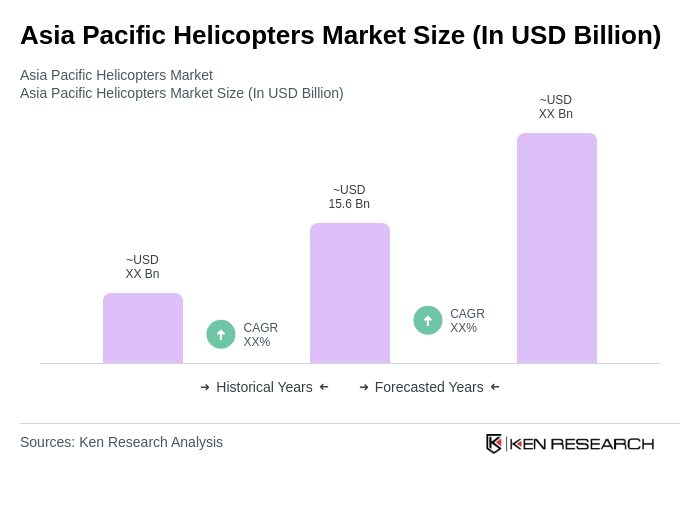
The Asia Pacific helicopters market, valued at USD 15.6 billion, is growing due to demand in defense, emergency services, and offshore energy, with opportunities in urban air mobility.

Region:Asia

Author(s):Dev

Product Code:KRAA1641

Pages:91

Published On:August 2025
About the Report

Base Year 2024

Asia Pacific Helicopters Market Overview

  • The Asia Pacific Helicopters Market is valued at USD 15.6 billion, based on a five-year historical analysis. This value reflects underlying demand from defense modernization, growing emergency medical services, offshore energy support, and fleet renewal across key economies. The market has seen steady acquisitions and upgrades across military and civil operators, supported by terrain and disaster-response needs in archipelagic and mountainous geographies.
  • Key players in this market include China, India, and Japan, driven by large defense budgets, civil demand, and infrastructure investments; each has prioritized helicopter capabilities for defense, EMS/SAR, and public safety missions. China continues military modernization and fleet expansion, while India and Japan emphasize disaster response and HEMS/SAR capacity building.
  • India has advanced several helicopter ecosystem initiatives for civil and defense use (e.g., PLI-like manufacturing incentives in aerospace, Make in India procurement, regional heli-hubs/heliports, and UDAN for regional connectivity), but there is no formal nationwide “Helicopter Policy” enacted in the stated year; current measures focus on enabling manufacturing, MRO, heliport infrastructure, and operational ease under broader aviation programs.
Asia Pacific Helicopters Market Size

Asia Pacific Helicopters Market Segmentation

By Type:The helicopter market can be segmented into various types, including Light Helicopters, Medium Helicopters, Heavy Helicopters, Multi-Mission/Utility Helicopters, Combat/Attack Helicopters, Search and Rescue (SAR)/HEMS Helicopters, and Training Helicopters. Light helicopters are widely adopted for training, patrol, EMS, and private/corporate roles due to lower operating costs and mission flexibility, while medium and heavy classes are prominent in defense lift, SAR, and offshore energy support.
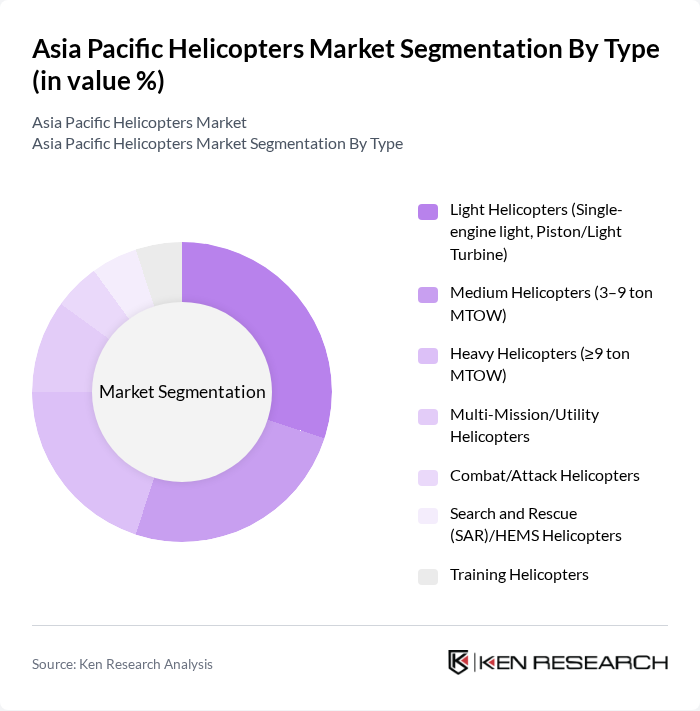
Asia Pacific Helicopters Market segmentation by Type.

By End-User:The end-user segmentation includes Military & Paramilitary, Civil & Commercial Operators, Public Safety & Emergency Services, Offshore Oil & Gas and Energy, Corporate/VIP & Tourism, and Utility & Aerial Work. Military & Paramilitary remains the largest on account of modernization, border security, and maritime surveillance, while civil/commercial use is supported by EMS/HEMS, tourism, corporate/VIP, and offshore logistics.
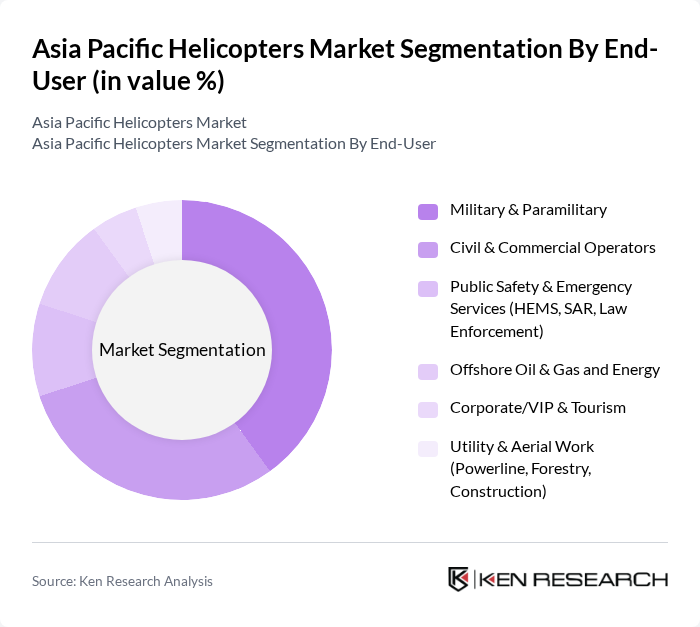
Asia Pacific Helicopters Market segmentation by End-User.

Asia Pacific Helicopters Market Competitive Landscape

The Asia Pacific Helicopters Market is characterized by a dynamic mix of regional and international players. Leading participants such as Airbus Helicopters, Bell Textron Inc., Boeing Defense, Space & Security, Leonardo S.p.A., Sikorsky Aircraft Corporation, MD Helicopters, LLC, Russian Helicopters JSC (Rostec), Kawasaki Heavy Industries Aerospace Systems Company, Korea Aerospace Industries (KAI), Hindustan Aeronautics Limited (HAL), Aviation Industry Corporation of China (AVIC) — AVICopter, Robinson Helicopter Company, Enstrom Helicopter Corporation, Kaman Corporation (Kaman Aerospace), Mitsubishi Heavy Industries — Helicopter & Engine Division contribute to innovation, geographic expansion, and service delivery in this space.

Airbus Helicopters

1992

Marignane, France

Bell Textron Inc.

1935

Fort Worth, Texas, USA

Boeing Defense, Space & Security

2002

Arlington, Virginia, USA

Leonardo S.p.A.

1948

Rome, Italy

Sikorsky Aircraft Corporation

1923

Stratford, Connecticut, USA

Company

Establishment Year

Headquarters

Fleet in Service in APAC (units)

New Deliveries to APAC (last 3 years, units)

APAC Revenue Exposure (% of total)

Order Backlog to APAC Customers (units)

Book-to-Bill Ratio (APAC)

Market Share by MTOW Class (Light/Medium/Heavy, %)

Asia Pacific Helicopters Market Industry Analysis

Growth Drivers

  • Increasing Demand for Emergency Medical Services:The Asia Pacific region is witnessing a surge in demand for emergency medical services (EMS), driven by rising healthcare needs. In future, the region is projected to allocate approximately $1.65 billion to EMS, reflecting a 10% increase from the previous year. This growth is fueled by an aging population and increased awareness of rapid medical response, necessitating the use of helicopters for timely patient transport, especially in remote areas where ground access is limited.
  • Expansion of Tourism and Aerial Services:The tourism sector in Asia Pacific is expected to generate over $1.1 trillion in revenue in future, with helicopter tours becoming increasingly popular. Countries like Australia and New Zealand are investing heavily in aerial services, with helicopter tourism projected to grow by 15% annually. This trend is supported by the region's diverse landscapes, attracting tourists seeking unique aerial experiences, thus driving demand for helicopter services in the tourism industry.
  • Government Investments in Defense and Security:In future, defense spending in the Asia Pacific region is anticipated to reach $550 billion, with a significant portion allocated to helicopter procurement and upgrades. Countries such as India and Japan are enhancing their military capabilities, focusing on advanced helicopter technologies. This investment is driven by regional security concerns, leading to increased demand for helicopters in defense operations, thereby bolstering the market's growth prospects.

Market Challenges

  • High Operational Costs:The operational costs associated with helicopter services in the Asia Pacific region are substantial, averaging around $1,250 per flight hour. Factors contributing to these costs include fuel prices, maintenance, and crew salaries. In future, rising fuel prices are expected to further strain operational budgets, making it challenging for operators to maintain profitability while meeting increasing service demands, thus hindering market growth.
  • Stringent Regulatory Compliance:Helicopter operators in the Asia Pacific face stringent regulatory frameworks that vary by country. Compliance with safety and environmental regulations can be costly and time-consuming. In future, the implementation of new safety protocols is expected to increase operational costs by approximately 20%. This regulatory burden can deter new entrants and limit the expansion of existing operators, posing a significant challenge to market growth.

Asia Pacific Helicopters Market Future Outlook

The Asia Pacific helicopters market is poised for significant transformation, driven by technological advancements and evolving consumer preferences. The rise of electric and hybrid helicopters is expected to reshape operational dynamics, enhancing efficiency and reducing environmental impact. Additionally, the shift towards on-demand helicopter services will cater to urban mobility needs, reflecting a broader trend towards convenience and accessibility in transportation. These developments will likely create a more competitive landscape, fostering innovation and collaboration among industry players.

Market Opportunities

  • Growth in Urban Air Mobility Solutions:The urban air mobility sector is projected to grow significantly, with investments expected to exceed $2.2 billion in future. This growth presents opportunities for helicopter manufacturers to develop innovative solutions tailored for urban environments, addressing congestion and enhancing transportation efficiency in metropolitan areas.
  • Development of Eco-Friendly Helicopter Models:As environmental concerns rise, the demand for eco-friendly helicopter models is increasing. In future, the market for sustainable aviation technologies is expected to reach $1.1 billion, encouraging manufacturers to invest in research and development of greener helicopter designs, thus aligning with global sustainability goals and attracting environmentally conscious consumers.

Scope of the Report

SegmentSub-Segments
By Type

Light Helicopters (Single-engine light, Piston/Light Turbine)

Medium Helicopters (3–9 ton MTOW)

Heavy Helicopters (?9 ton MTOW)

Multi-Mission/Utility Helicopters

Combat/Attack Helicopters

Search and Rescue (SAR)/HEMS Helicopters

Training Helicopters

By End-User

Military & Paramilitary

Civil & Commercial Operators

Public Safety & Emergency Services (HEMS, SAR, Law Enforcement)

Offshore Oil & Gas and Energy

Corporate/VIP & Tourism

Utility & Aerial Work (Powerline, Forestry, Construction)

By Application

Passenger Transport & VIP

Offshore Support & Cargo

HEMS/Medical Evacuation

Aerial Surveillance & Law Enforcement

Firefighting & Disaster Relief

Training & Pilot Instruction

By Point of Sale

OEM (New Deliveries)

Aftermarket (MRO, Upgrades, Spares)

Leasing

By MTOW (Maximum Take-Off Weight)

Light (<3,175 kg)

Medium (3,175–9,000 kg)

Heavy (>9,000 kg)

By Country

China

India

Japan

South Korea

Australia & New Zealand

Southeast Asia (Indonesia, Malaysia, Thailand, Vietnam, Philippines, Singapore)

Rest of Asia Pacific

Key Target Audience

Investors and Venture Capitalist Firms

Government and Regulatory Bodies (e.g., Civil Aviation Authority of Singapore, Directorate General of Civil Aviation - India)

Helicopter Manufacturers and Producers

Helicopter Service Operators

Aerospace and Defense Contractors

Helicopter Maintenance, Repair, and Overhaul (MRO) Providers

Industry Associations (e.g., Helicopter Association International)

Financial Institutions and Investment Banks

Players Mentioned in the Report:

Airbus Helicopters

Bell Textron Inc.

Boeing Defense, Space & Security

Leonardo S.p.A.

Sikorsky Aircraft Corporation

MD Helicopters, LLC

Russian Helicopters JSC (Rostec)

Kawasaki Heavy Industries Aerospace Systems Company

Korea Aerospace Industries (KAI)

Hindustan Aeronautics Limited (HAL)

Aviation Industry Corporation of China (AVIC) AVICopter

Robinson Helicopter Company

Enstrom Helicopter Corporation

Kaman Corporation (Kaman Aerospace)

Mitsubishi Heavy Industries Helicopter & Engine Division

Table of Contents

Market Assessment Phase

1. Executive Summary and Approach


2. Asia Pacific Helicopters Market Overview

2.1 Key Insights and Strategic Recommendations

2.2 Asia Pacific Helicopters Market Overview

2.3 Definition and Scope

2.4 Evolution of Market Ecosystem

2.5 Timeline of Key Regulatory Milestones

2.6 Value Chain & Stakeholder Mapping

2.7 Business Cycle Analysis

2.8 Policy & Incentive Landscape


3. Asia Pacific Helicopters Market Analysis

3.1 Growth Drivers

3.1.1 Increasing Demand for Emergency Medical Services
3.1.2 Expansion of Tourism and Aerial Services
3.1.3 Government Investments in Defense and Security
3.1.4 Technological Advancements in Helicopter Design

3.2 Market Challenges

3.2.1 High Operational Costs
3.2.2 Stringent Regulatory Compliance
3.2.3 Limited Infrastructure in Remote Areas
3.2.4 Competition from Alternative Transport Modes

3.3 Market Opportunities

3.3.1 Growth in Urban Air Mobility Solutions
3.3.2 Increasing Demand for Cargo Transport Services
3.3.3 Partnerships with Private Sector for Services
3.3.4 Development of Eco-Friendly Helicopter Models

3.4 Market Trends

3.4.1 Rise of Electric and Hybrid Helicopters
3.4.2 Integration of Advanced Avionics Systems
3.4.3 Shift Towards On-Demand Helicopter Services
3.4.4 Focus on Safety and Maintenance Innovations

3.5 Government Regulation

3.5.1 Air Traffic Management Regulations
3.5.2 Environmental Compliance Standards
3.5.3 Licensing and Certification Requirements
3.5.4 Safety Protocols for Helicopter Operations

4. SWOT Analysis


5. Stakeholder Analysis


6. Porter's Five Forces Analysis


7. Asia Pacific Helicopters Market Market Size, 2019-2024

7.1 By Value

7.2 By Volume

7.3 By Average Selling Price


8. Asia Pacific Helicopters Market Segmentation

8.1 By Type

8.1.1 Light Helicopters (Single-engine light, Piston/Light Turbine)
8.1.2 Medium Helicopters (3–9 ton MTOW)
8.1.3 Heavy Helicopters (?9 ton MTOW)
8.1.4 Multi-Mission/Utility Helicopters
8.1.5 Combat/Attack Helicopters
8.1.6 Search and Rescue (SAR)/HEMS Helicopters
8.1.7 Training Helicopters

8.2 By End-User

8.2.1 Military & Paramilitary
8.2.2 Civil & Commercial Operators
8.2.3 Public Safety & Emergency Services (HEMS, SAR, Law Enforcement)
8.2.4 Offshore Oil & Gas and Energy
8.2.5 Corporate/VIP & Tourism
8.2.6 Utility & Aerial Work (Powerline, Forestry, Construction)

8.3 By Application

8.3.1 Passenger Transport & VIP
8.3.2 Offshore Support & Cargo
8.3.3 HEMS/Medical Evacuation
8.3.4 Aerial Surveillance & Law Enforcement
8.3.5 Firefighting & Disaster Relief
8.3.6 Training & Pilot Instruction

8.4 By Point of Sale

8.4.1 OEM (New Deliveries)
8.4.2 Aftermarket (MRO, Upgrades, Spares)
8.4.3 Leasing

8.5 By MTOW (Maximum Take-Off Weight)

8.5.1 Light (<3,175 kg)
8.5.2 Medium (3,175–9,000 kg)
8.5.3 Heavy (>9,000 kg)

8.6 By Country

8.6.1 China
8.6.2 India
8.6.3 Japan
8.6.4 South Korea
8.6.5 Australia & New Zealand
8.6.6 Southeast Asia (Indonesia, Malaysia, Thailand, Vietnam, Philippines, Singapore)
8.6.7 Rest of Asia Pacific

9. Asia Pacific Helicopters Market Competitive Analysis

9.1 Market Share of Key Players

9.2 Cross Comparison of Key Players

9.2.1 Company Name
9.2.2 Fleet in Service in APAC (units)
9.2.3 New Deliveries to APAC (last 3 years, units)
9.2.4 APAC Revenue Exposure (% of total)
9.2.5 Order Backlog to APAC Customers (units)
9.2.6 Book-to-Bill Ratio (APAC)
9.2.7 Market Share by MTOW Class (Light/Medium/Heavy, %)
9.2.8 Average Installed Fleet Age (years, APAC)
9.2.9 Aftermarket/MRO Revenue Mix (% of APAC revenue)
9.2.10 HEMS/SAR Penetration (share of APAC fleet, %)
9.2.11 Offshore O&G Exposure (APAC fleet share, %)
9.2.12 Utilization Rate (flight hours per aircraft per month, APAC)
9.2.13 On-time Delivery Rate to APAC Programs (%)
9.2.14 R&D Intensity (% of revenue) and Key APAC Certifications

9.3 SWOT Analysis of Top Players

9.4 Pricing Analysis

9.5 Detailed Profile of Major Companies

9.5.1 Airbus Helicopters
9.5.2 Bell Textron Inc.
9.5.3 Boeing Defense, Space & Security
9.5.4 Leonardo S.p.A.
9.5.5 Sikorsky Aircraft Corporation
9.5.6 MD Helicopters, LLC
9.5.7 Russian Helicopters JSC (Rostec)
9.5.8 Kawasaki Heavy Industries Aerospace Systems Company
9.5.9 Korea Aerospace Industries (KAI)
9.5.10 Hindustan Aeronautics Limited (HAL)
9.5.11 Aviation Industry Corporation of China (AVIC) — AVICopter
9.5.12 Robinson Helicopter Company
9.5.13 Enstrom Helicopter Corporation
9.5.14 Kaman Corporation (Kaman Aerospace)
9.5.15 Mitsubishi Heavy Industries — Helicopter & Engine Division

10. Asia Pacific Helicopters Market End-User Analysis

10.1 Procurement Behavior of Key Ministries

10.1.1 Defense Procurement Trends
10.1.2 Emergency Services Budget Allocation
10.1.3 Infrastructure Development Spending
10.1.4 Environmental Compliance Investments

10.2 Corporate Spend on Infrastructure & Energy

10.2.1 Investment in Aviation Infrastructure
10.2.2 Corporate Fleet Expansion Plans
10.2.3 Partnerships with Aviation Service Providers

10.3 Pain Point Analysis by End-User Category

10.3.1 Cost Management Challenges
10.3.2 Regulatory Compliance Issues
10.3.3 Maintenance and Operational Efficiency

10.4 User Readiness for Adoption

10.4.1 Training and Skill Development Needs
10.4.2 Technology Adoption Barriers

10.5 Post-Deployment ROI and Use Case Expansion

10.5.1 Evaluation of Operational Efficiency Gains
10.5.2 Expansion into New Service Areas
10.5.3 Long-term Cost Savings Analysis

11. Asia Pacific Helicopters Market Future Size, 2025-2030

11.1 By Value

11.2 By Volume

11.3 By Average Selling Price


Go-To-Market Strategy Phase

1. Whitespace Analysis + Business Model Canvas

1.1 Market Gaps Identification

1.2 Business Model Framework


2. Marketing and Positioning Recommendations

2.1 Branding Strategies

2.2 Product USPs


3. Distribution Plan

3.1 Urban Retail Strategies

3.2 Rural NGO Tie-ups


4. Channel & Pricing Gaps

4.1 Underserved Routes

4.2 Pricing Bands Analysis


5. Unmet Demand & Latent Needs

5.1 Category Gaps

5.2 Consumer Segments


6. Customer Relationship

6.1 Loyalty Programs

6.2 After-sales Service


7. Value Proposition

7.1 Sustainability Initiatives

7.2 Integrated Supply Chains


8. Key Activities

8.1 Regulatory Compliance

8.2 Branding Efforts

8.3 Distribution Setup


9. Entry Strategy Evaluation

9.1 Domestic Market Entry Strategy

9.1.1 Product Mix Considerations
9.1.2 Pricing Band Strategy
9.1.3 Packaging Options

9.2 Export Entry Strategy

9.2.1 Target Countries
9.2.2 Compliance Roadmap

10. Entry Mode Assessment

10.1 Joint Ventures

10.2 Greenfield Investments

10.3 Mergers & Acquisitions

10.4 Distributor Model


11. Capital and Timeline Estimation

11.1 Capital Requirements

11.2 Timelines for Implementation


12. Control vs Risk Trade-Off

12.1 Ownership vs Partnerships


13. Profitability Outlook

13.1 Breakeven Analysis

13.2 Long-term Sustainability


14. Potential Partner List

14.1 Distributors

14.2 Joint Ventures

14.3 Acquisition Targets


15. Execution Roadmap

15.1 Phased Plan for Market Entry

15.1.1 Market Setup
15.1.2 Market Entry
15.1.3 Growth Acceleration
15.1.4 Scale & Stabilize

15.2 Key Activities and Milestones

15.2.1 Milestone Planning
15.2.2 Activity Tracking

Research Methodology

ApproachModellingSample

Phase 1: Approach1

Desk Research

  • Industry reports from aviation authorities and regional aviation bodies
  • Market analysis publications from aerospace and defense think tanks
  • Statistical data from government aviation departments and international organizations

Primary Research

  • Interviews with executives from helicopter manufacturing companies
  • Surveys with operators and service providers in the helicopter market
  • Field interviews with maintenance and repair organizations (MROs) in the region

Validation & Triangulation

  • Cross-validation of data through multiple industry sources and reports
  • Triangulation of insights from primary interviews and secondary data
  • Sanity checks conducted through expert panels comprising industry veterans

Phase 2: Market Size Estimation1

Top-down Assessment

  • Analysis of regional helicopter fleet size and growth trends
  • Breakdown of market segments by civil, military, and commercial use
  • Incorporation of government spending on aviation and defense initiatives

Bottom-up Modeling

  • Volume estimates based on helicopter deliveries and retirements
  • Revenue projections derived from service contracts and aftermarket sales
  • Cost analysis based on operational expenses and maintenance requirements

Forecasting & Scenario Analysis

  • Multi-variable regression analysis considering economic growth and tourism trends
  • Scenario modeling based on regulatory changes and technological advancements
  • Baseline, optimistic, and pessimistic forecasts through 2035

Phase 3: CATI Sample Composition1

Scope Item/SegmentSample SizeTarget Respondent Profiles
Civil Helicopter Operations120Flight Operations Managers, Safety Officers
Military Helicopter Procurement100Defense Procurement Officers, Military Strategists
Helicopter Maintenance Services80MRO Managers, Technical Directors
Helicopter Leasing Companies70Leasing Managers, Financial Analysts
Helicopter Training Organizations60Training Coordinators, Chief Instructors

Frequently Asked Questions

What is the current value of the Asia Pacific Helicopters Market?

The Asia Pacific Helicopters Market is valued at approximately USD 15.6 billion, reflecting strong demand driven by defense modernization, emergency medical services, offshore energy support, and fleet renewal across key economies in the region.

Which countries are the key players in the Asia Pacific Helicopters Market?

What are the main types of helicopters in the Asia Pacific market?

What are the primary end-users of helicopters in the Asia Pacific region?

Other Regional/Country Reports

Indonesia Asia Pacific Helicopters Market

Malaysia Asia Pacific Helicopters Market

KSA Asia Pacific Helicopters Market

APAC Asia Pacific Helicopters Market

SEA Asia Pacific Helicopters Market

Vietnam Asia Pacific Helicopters Market

Why Buy From Us?

Refine Robust Result (RRR) Framework

What makes us stand out is that our consultants follow Robust, Refine and Result (RRR) methodology. Robust for clear definitions, approaches and sanity checking, Refine for differentiating respondents' facts and opinions, and Result for presenting data with story.

Our Reach Is Unmatched

We have set a benchmark in the industry by offering our clients with syndicated and customized market research reports featuring coverage of entire market as well as meticulous research and analyst insights.

Shifting the Research Paradigm

While we don't replace traditional research, we flip the method upside down. Our dual approach of Top Bottom & Bottom Top ensures quality deliverable by not just verifying company fundamentals but also looking at the sector and macroeconomic factors.

More Insights-Better Decisions

With one step in the future, our research team constantly tries to show you the bigger picture. We help with some of the tough questions you may encounter along the way: How is the industry positioned? Best marketing channel? KPI's of competitors? By aligning every element, we help maximize success.

Transparency and Trust

Our report gives you instant access to the answers and sources that other companies might choose to hide. We elaborate each steps of research methodology we have used and showcase you the sample size to earn your trust.

Round the Clock Support

If you need any support, we are here! We pride ourselves on universe strength, data quality, and quick, friendly, and professional service.

Why Clients Choose Us?

400000+
Reports in repository
150+
Consulting projects a year
100+
Analysts
8000+
Client Queries in 2022








