About the Report
Base Year 2024Asia Pacific Private Equity Market Overview
- The Asia Pacific Private Equity Market is valued at USD 1.1 trillion, based on a five-year historical analysis of deal values and assets under management. This growth is primarily driven by increased investor interest in alternative assets, a dynamic startup ecosystem, and favorable macroeconomic conditions across the region. The market has experienced significant inflows from both domestic and international investors, reflecting continued strong appetite for private equity investments .
- Key players in this market include countries such asChina, India, and Australia, which dominate due to their large consumer bases, robust economic growth, and evolving regulatory environments. In recent years, India and Japan have attracted a greater share of investment dollars, while China’s share of deal value has declined. Technology, healthcare, and consumer goods remain the most vibrant sectors driving growth .
- In 2023, the Australian government introduced new regulations to enhance transparency in private equity transactions, including mandatory reporting requirements for fund managers. These measures are designed to protect investors and align with international standards, fostering greater trust and expected to attract more capital into the private equity sector .

Asia Pacific Private Equity Market Segmentation
By Fund Type:The Asia Pacific private equity market is segmented by fund type intoVenture Capital, Buyout Funds, Growth Equity, Mezzanine Financing, Distressed Assets, Fund of Funds, Secondaries,andHybrid Strategies (Equity + Private Credit). Each segment serves distinct investor profiles and risk appetites: Venture Capital targets early-stage innovation, Buyout Funds focus on established businesses, Growth Equity supports expansion-stage firms, Mezzanine Financing provides subordinated debt, Distressed Assets invest in turnaround opportunities, Fund of Funds offer diversification, Secondaries provide liquidity, and Hybrid Strategies blend equity with private credit .

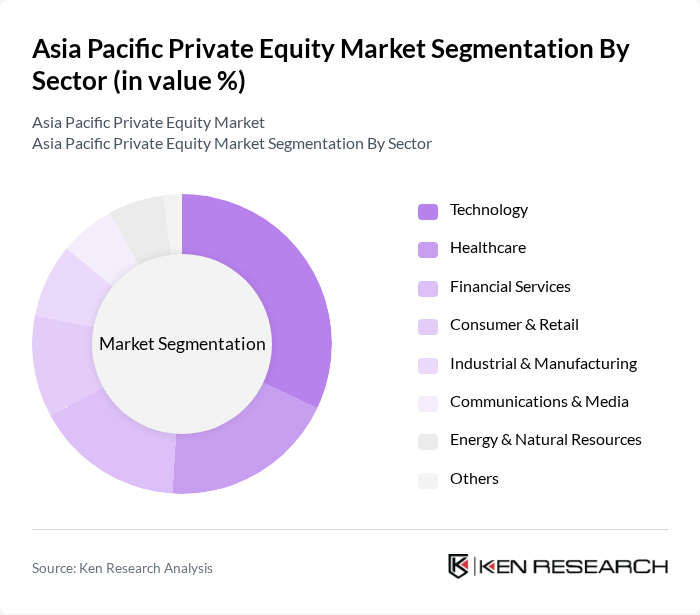
By Sector:The sector segmentation coversTechnology, Healthcare, Financial Services, Consumer & Retail, Industrial & Manufacturing, Communications & Media, Energy & Natural Resources,andOthers. Technology and healthcare remain the largest sectors, but recent years have seen increased allocations to financial services, consumer, and energy, reflecting shifting market trends and investor priorities. Sector allocations are influenced by macroeconomic shifts, regulatory changes, and evolving consumer demand .
Asia Pacific Private Equity Market Competitive Landscape
The Asia Pacific Private Equity Market is characterized by a dynamic mix of regional and international players. Leading participants such as Hillhouse Capital Group, Temasek Holdings, PAG (Pacific Alliance Group), Baring Private Equity Asia (now EQT Asia), Affinity Equity Partners, MBK Partners, GIC Private Limited, CDH Investments, KKR & Co. Inc., Carlyle Group, Bain Capital, TPG Capital, Warburg Pincus, CVC Capital Partners, General Atlantic, Sequoia Capital China (now HongShan), IDG Capital, Vertex Ventures, Navis Capital Partners, Quadrant Private Equity contribute to innovation, geographic expansion, and service delivery in this space.
Asia Pacific Private Equity Market Industry Analysis
Growth Drivers
- Increasing Institutional Investment:Institutional investors in the Asia Pacific region have significantly increased their allocations to private equity, with total commitments reaching approximately $160 billion in future. This trend is driven by the search for higher returns in a low-interest-rate environment. According to the Asian Venture Capital Journal, institutional investors now account for over 65% of total private equity capital raised, reflecting a robust confidence in the asset class's potential for growth and diversification.
- Rising Entrepreneurial Activity:The Asia Pacific region has seen a surge in entrepreneurial ventures, with over 1.7 million startups launched in future alone. This growth is fueled by a combination of technological advancements and a supportive ecosystem for innovation. The World Bank reported that the region's startup ecosystem attracted $35 billion in venture capital funding, indicating a strong appetite for investment in emerging businesses, which is a key driver for private equity growth.
- Expanding Middle-Class Population:The middle-class population in Asia Pacific is projected to reach 1.6 billion in future, driving increased consumer spending and demand for diverse products and services. This demographic shift is creating numerous investment opportunities for private equity firms, particularly in sectors such as consumer goods, healthcare, and technology. According to McKinsey, the middle-class spending in the region is expected to exceed $12 trillion, further enhancing the attractiveness of private equity investments.
Market Challenges
- Regulatory Uncertainty:The private equity landscape in Asia Pacific faces significant regulatory challenges, with varying compliance requirements across countries. For instance, the implementation of new tax regulations in countries like India and China has created uncertainty for investors. According to the Asian Development Bank, over 45% of private equity firms cite regulatory hurdles as a major barrier to investment, impacting their ability to operate efficiently and make long-term commitments.
- Competition from Other Investment Avenues:Private equity firms are increasingly competing with alternative investment options such as real estate and public equities. In future, the total capital raised for real estate investments in Asia Pacific reached $130 billion, drawing potential investors away from private equity. This competition is intensifying as investors seek liquidity and lower risk, making it challenging for private equity firms to attract and retain capital in a crowded market.
Asia Pacific Private Equity Market Future Outlook
The Asia Pacific private equity market is poised for continued growth, driven by increasing institutional investments and a vibrant startup ecosystem. As the region's middle class expands, consumer demand will create new opportunities for private equity firms. Additionally, the shift towards sustainable and responsible investing will likely influence investment strategies, with firms focusing on environmental, social, and governance (ESG) criteria. Overall, the market is expected to adapt to evolving economic conditions and investor preferences, fostering innovation and resilience.
Market Opportunities
- Growth in Technology Sector:The technology sector in Asia Pacific is projected to grow by $1.2 trillion in future, driven by advancements in AI, fintech, and e-commerce. This growth presents significant opportunities for private equity investments, particularly in tech startups that are innovating and scaling rapidly. The increasing digital transformation across industries further enhances the potential for lucrative returns in this sector.
- Increased Cross-Border Investments:Cross-border investments in Asia Pacific are expected to reach $60 billion in future, as firms seek to diversify their portfolios and tap into emerging markets. This trend is supported by favorable trade agreements and improved regulatory frameworks, facilitating smoother investment flows. Private equity firms can leverage these opportunities to access high-growth markets and enhance their competitive positioning.
Scope of the Report
| Segment | Sub-Segments |
|---|---|
| By Fund Type | Venture Capital Buyout Funds Growth Equity Mezzanine Financing Distressed Assets Fund of Funds Secondaries Hybrid Strategies (Equity + Private Credit) |
| By Sector | Technology Healthcare Financial Services Consumer & Retail Industrial & Manufacturing Communications & Media Energy & Natural Resources Others |
| By Investment Stage | Seed Stage Early Stage Growth/Expansion Stage Late Stage Pre-IPO |
| By Fund Size | Small Funds Medium Funds (USD 250M–1B) Large Funds (>USD 1B) |
| By Geographic Focus | Domestic Investments Pan-Asia/Regional Investments Global Investments |
| By Exit Strategy | IPO M&A (Trade Sale/Sponsor-to-Sponsor) Secondary Sale Recapitalization/Dividend Recap Buyback |
| By Policy Support | Tax Incentives Regulatory Frameworks Government Grants Others |
Key Target Audience
Investors and Venture Capitalist Firms
Government and Regulatory Bodies (e.g., Securities and Exchange Commission, Monetary Authority of Singapore)
Pension Funds and Sovereign Wealth Funds
Private Equity Firms
Investment Banks
Family Offices
Corporate Development Teams
Financial Advisors and Wealth Management Firms
Players Mentioned in the Report:
Hillhouse Capital Group
Temasek Holdings
PAG (Pacific Alliance Group)
Baring Private Equity Asia (now EQT Asia)
Affinity Equity Partners
MBK Partners
GIC Private Limited
CDH Investments
KKR & Co. Inc.
Carlyle Group
Bain Capital
TPG Capital
Warburg Pincus
CVC Capital Partners
General Atlantic
Sequoia Capital China (now HongShan)
IDG Capital
Vertex Ventures
Navis Capital Partners
Quadrant Private Equity
Table of Contents
Market Assessment Phase
1. Executive Summary and Approach
2. Asia Pacific Private Equity Market Overview
2.1 Key Insights and Strategic Recommendations
2.2 Asia Pacific Private Equity Market Overview
2.3 Definition and Scope
2.4 Evolution of Market Ecosystem
2.5 Timeline of Key Regulatory Milestones
2.6 Value Chain & Stakeholder Mapping
2.7 Business Cycle Analysis
2.8 Policy & Incentive Landscape
3. Asia Pacific Private Equity Market Analysis
3.1 Growth Drivers
3.1.1 Increasing Institutional Investment
3.1.2 Rising Entrepreneurial Activity
3.1.3 Expanding Middle-Class Population
3.1.4 Government Support for Startups
3.2 Market Challenges
3.2.1 Regulatory Uncertainty
3.2.2 Competition from Other Investment Avenues
3.2.3 Limited Exit Opportunities
3.2.4 Economic Volatility
3.3 Market Opportunities
3.3.1 Growth in Technology Sector
3.3.2 Increased Cross-Border Investments
3.3.3 Focus on Sustainable Investments
3.3.4 Expansion into Emerging Markets
3.4 Market Trends
3.4.1 Shift Towards ESG Investments
3.4.2 Rise of Digital Platforms for Fundraising
3.4.3 Increased Focus on Operational Improvements
3.4.4 Growth of Secondary Markets
3.5 Government Regulation
3.5.1 Enhanced Disclosure Requirements
3.5.2 Tax Incentives for Private Equity
3.5.3 Foreign Investment Regulations
3.5.4 Anti-Money Laundering Compliance
4. SWOT Analysis
5. Stakeholder Analysis
6. Porter's Five Forces Analysis
7. Asia Pacific Private Equity Market Market Size, 2019-2024
7.1 By Value
7.2 By Volume
7.3 By Average Selling Price
8. Asia Pacific Private Equity Market Segmentation
8.1 By Fund Type
8.1.1 Venture Capital
8.1.2 Buyout Funds
8.1.3 Growth Equity
8.1.4 Mezzanine Financing
8.1.5 Distressed Assets
8.1.6 Fund of Funds
8.1.7 Secondaries
8.1.8 Hybrid Strategies (Equity + Private Credit)
8.2 By Sector
8.2.1 Technology
8.2.2 Healthcare
8.2.3 Financial Services
8.2.4 Consumer & Retail
8.2.5 Industrial & Manufacturing
8.2.6 Communications & Media
8.2.7 Energy & Natural Resources
8.2.8 Others
8.3 By Investment Stage
8.3.1 Seed Stage
8.3.2 Early Stage
8.3.3 Growth/Expansion Stage
8.3.4 Late Stage
8.3.5 Pre-IPO
8.4 By Fund Size
8.4.1 Small Funds (<USD 250M)
8.4.2 Medium Funds (USD 250M–1B)
8.4.3 Large Funds (>USD 1B)
8.5 By Geographic Focus
8.5.1 Domestic Investments
8.5.2 Pan-Asia/Regional Investments
8.5.3 Global Investments
8.6 By Exit Strategy
8.6.1 IPO
8.6.2 M&A (Trade Sale/Sponsor-to-Sponsor)
8.6.3 Secondary Sale
8.6.4 Recapitalization/Dividend Recap
8.6.5 Buyback
8.7 By Policy Support
8.7.1 Tax Incentives
8.7.2 Regulatory Frameworks
8.7.3 Government Grants
8.7.4 Others
9. Asia Pacific Private Equity Market Competitive Analysis
9.1 Market Share of Key Players
9.2 Cross Comparison of Key Players
9.2.1 Company Name
9.2.2 Group Size (Large, Medium, or Small as per industry convention)
9.2.3 AUM (Assets Under Management, USD)
9.2.4 Fund Performance (Net IRR, TVPI, DPI)
9.2.5 Investment Return Rates (Annualized, Gross/Net)
9.2.6 Deal Flow Volume (Deals per Year, Average Deal Size)
9.2.7 Sector/Sectoral Focus
9.2.8 Exit Success Rate (by Exit Type)
9.2.9 Average Holding Period
9.2.10 Market Penetration (Number of Portfolio Companies, Regional Coverage)
9.2.11 ESG Integration Score
9.2.12 LP (Limited Partner) Satisfaction Index
9.3 SWOT Analysis of Top Players
9.4 Pricing Analysis
9.5 Detailed Profile of Major Companies
9.5.1 Hillhouse Capital Group
9.5.2 Temasek Holdings
9.5.3 PAG (Pacific Alliance Group)
9.5.4 Baring Private Equity Asia (now EQT Asia)
9.5.5 Affinity Equity Partners
9.5.6 MBK Partners
9.5.7 GIC Private Limited
9.5.8 CDH Investments
9.5.9 KKR & Co. Inc.
9.5.10 Carlyle Group
9.5.11 Bain Capital
9.5.12 TPG Capital
9.5.13 Warburg Pincus
9.5.14 CVC Capital Partners
9.5.15 General Atlantic
9.5.16 Sequoia Capital China (now HongShan)
9.5.17 IDG Capital
9.5.18 Vertex Ventures
9.5.19 Navis Capital Partners
9.5.20 Quadrant Private Equity
10. Asia Pacific Private Equity Market End-User Analysis
10.1 Procurement Behavior of Key Ministries
10.1.1 Investment Priorities
10.1.2 Budget Allocation Trends
10.1.3 Decision-Making Processes
10.1.4 Engagement with Private Equity Firms
10.2 Corporate Spend on Infrastructure & Energy
10.2.1 Investment Trends
10.2.2 Sector-Specific Spending
10.2.3 Long-Term Financial Commitments
10.3 Pain Point Analysis by End-User Category
10.3.1 Access to Capital
10.3.2 Regulatory Compliance Issues
10.3.3 Market Volatility Concerns
10.4 User Readiness for Adoption
10.4.1 Awareness of Private Equity Benefits
10.4.2 Willingness to Engage with PE Firms
10.4.3 Capacity for Investment
10.5 Post-Deployment ROI and Use Case Expansion
10.5.1 Measurement of ROI
10.5.2 Case Studies of Successful Deployments
10.5.3 Future Investment Plans
11. Asia Pacific Private Equity Market Future Size, 2025-2030
11.1 By Value
11.2 By Volume
11.3 By Average Selling Price
Go-To-Market Strategy Phase
1. Whitespace Analysis + Business Model Canvas
1.1 Market Gaps Identification
1.2 Value Proposition Development
1.3 Revenue Streams Analysis
1.4 Cost Structure Evaluation
1.5 Key Partnerships Exploration
1.6 Customer Segmentation
1.7 Channels of Distribution
2. Marketing and Positioning Recommendations
2.1 Branding Strategies
2.2 Product USPs
2.3 Target Audience Identification
2.4 Communication Strategies
2.5 Digital Marketing Approaches
3. Distribution Plan
3.1 Urban Retail Strategies
3.2 Rural NGO Tie-Ups
3.3 Online Distribution Channels
3.4 Direct Sales Approaches
4. Channel & Pricing Gaps
4.1 Underserved Routes
4.2 Pricing Bands Analysis
4.3 Competitor Pricing Strategies
5. Unmet Demand & Latent Needs
5.1 Category Gaps
5.2 Consumer Segments Analysis
5.3 Emerging Trends Identification
6. Customer Relationship
6.1 Loyalty Programs
6.2 After-Sales Service
6.3 Customer Feedback Mechanisms
7. Value Proposition
7.1 Sustainability Initiatives
7.2 Integrated Supply Chains
7.3 Competitive Advantages
8. Key Activities
8.1 Regulatory Compliance
8.2 Branding Efforts
8.3 Distribution Setup
9. Entry Strategy Evaluation
9.1 Domestic Market Entry Strategy
9.1.1 Product Mix Considerations
9.1.2 Pricing Band Strategies
9.1.3 Packaging Options
9.2 Export Entry Strategy
9.2.1 Target Countries
9.2.2 Compliance Roadmap
10. Entry Mode Assessment
10.1 Joint Ventures
10.2 Greenfield Investments
10.3 Mergers & Acquisitions
10.4 Distributor Model
11. Capital and Timeline Estimation
11.1 Capital Requirements
11.2 Timelines for Implementation
12. Control vs Risk Trade-Off
12.1 Ownership Considerations
12.2 Partnerships Evaluation
13. Profitability Outlook
13.1 Breakeven Analysis
13.2 Long-Term Sustainability
14. Potential Partner List
14.1 Distributors
14.2 Joint Ventures
14.3 Acquisition Targets
15. Execution Roadmap
15.1 Phased Plan for Market Entry
15.1.1 Market Setup
15.1.2 Market Entry
15.1.3 Growth Acceleration
15.1.4 Scale & Stabilize
15.2 Key Activities and Milestones
15.2.1 Milestone Planning
15.2.2 Activity Scheduling
Research Methodology
Phase 1: Approach1
Desk Research
- Analysis of market reports from regional private equity associations and financial institutions
- Review of investment trends and performance metrics from databases like Preqin and PitchBook
- Examination of regulatory frameworks and policy changes impacting private equity in the Asia Pacific region
Primary Research
- Interviews with senior executives at leading private equity firms operating in the Asia Pacific
- Surveys targeting investment analysts and fund managers to gather insights on market sentiment
- Field interviews with entrepreneurs and business owners who have received private equity funding
Validation & Triangulation
- Cross-validation of findings through multiple data sources, including financial reports and market surveys
- Triangulation of qualitative insights from interviews with quantitative data from market reports
- Sanity checks through expert panel discussions to ensure the reliability of the data collected
Phase 2: Market Size Estimation1
Top-down Assessment
- Estimation of total private equity investments based on GDP growth rates and historical investment data
- Segmentation of the market by industry verticals such as technology, healthcare, and consumer goods
- Incorporation of macroeconomic indicators and regional investment climate assessments
Bottom-up Modeling
- Analysis of fund sizes and capital raised by top private equity firms in the region
- Estimation of deal flow and average investment sizes across different sectors
- Calculation of exit values and returns on investment to project future market growth
Forecasting & Scenario Analysis
- Multi-factor regression analysis incorporating economic indicators, interest rates, and market volatility
- Scenario modeling based on potential changes in regulatory environments and investor sentiment
- Development of baseline, optimistic, and pessimistic forecasts through 2030
Phase 3: CATI Sample Composition1
| Scope Item/Segment | Sample Size | Target Respondent Profiles |
|---|---|---|
| Venture Capital Investments in Technology Startups | 100 | Investment Managers, Startup Founders |
| Private Equity in Healthcare Sector | 80 | Healthcare Executives, Fund Managers |
| Consumer Goods Investment Trends | 70 | Brand Managers, Private Equity Analysts |
| Impact of Regulatory Changes on Investments | 50 | Compliance Officers, Legal Advisors |
| Exit Strategies and Market Returns | 90 | Portfolio Managers, Financial Analysts |
Frequently Asked Questions
What is the current value of the Asia Pacific Private Equity Market?
The Asia Pacific Private Equity Market is valued at approximately USD 1.1 trillion, driven by increased investor interest in alternative assets, a dynamic startup ecosystem, and favorable macroeconomic conditions across the region.
Which countries dominate the Asia Pacific Private Equity Market?
What sectors are driving growth in the Asia Pacific Private Equity Market?
What regulatory changes have impacted the Asia Pacific Private Equity Market in 2023?
Other Regional/Country Reports
Why Buy From Us?

What makes us stand out is that our consultants follow Robust, Refine and Result (RRR) methodology. Robust for clear definitions, approaches and sanity checking, Refine for differentiating respondents' facts and opinions, and Result for presenting data with story.

We have set a benchmark in the industry by offering our clients with syndicated and customized market research reports featuring coverage of entire market as well as meticulous research and analyst insights.

While we don't replace traditional research, we flip the method upside down. Our dual approach of Top Bottom & Bottom Top ensures quality deliverable by not just verifying company fundamentals but also looking at the sector and macroeconomic factors.

With one step in the future, our research team constantly tries to show you the bigger picture. We help with some of the tough questions you may encounter along the way: How is the industry positioned? Best marketing channel? KPI's of competitors? By aligning every element, we help maximize success.

Our report gives you instant access to the answers and sources that other companies might choose to hide. We elaborate each steps of research methodology we have used and showcase you the sample size to earn your trust.

If you need any support, we are here! We pride ourselves on universe strength, data quality, and quick, friendly, and professional service.