About the Report
Base Year 2024Australia Baby Car Seat Market Overview
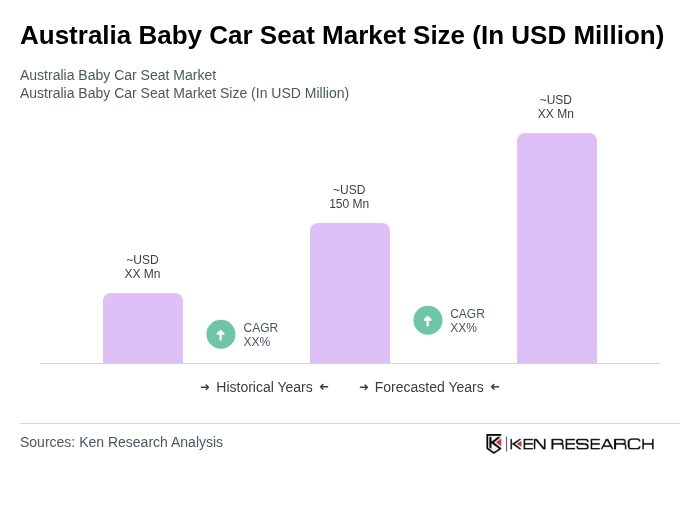
- The Australia Baby Car Seat Market is valued at USD 150 million, based on a five-year historical analysis. This growth is primarily driven by increasing awareness of child safety regulations, rising disposable incomes, growing population of young families, and demand for premium products featuring advanced safety technologies such as side-impact protection and extended rear-facing capabilities. The demand for high-quality and innovative baby car seats has surged as parents prioritize safety and comfort for their children during travel.
- Key cities such as Sydney, Melbourne, and Brisbane dominate the market due to their high population density and significant number of families with young children. These urban areas have a higher concentration of retail outlets and online platforms, making it easier for consumers to access a variety of baby car seat options. Additionally, the presence of major manufacturers and distributors in these cities contributes to their market dominance.
- In Australia, the Australian Road Rules 2014 issued by the National Transport Commission mandates that all children under 7 years must use an appropriate approved child restraint system matching their age and size, with children under 6 months required to be rear-facing, 6 months to 4 years forward or rear-facing, and 4 to 7 years in forward-facing or booster seats. This regulation requires compliance through AS/NZS 1754 certified seats, installation via ISOFIX or seatbelts, and applies nationwide with penalties for non-compliance, aiming to reduce injury risk in car accidents and driving increased parental adoption of compliant baby car seats.
Australia Baby Car Seat Market Segmentation
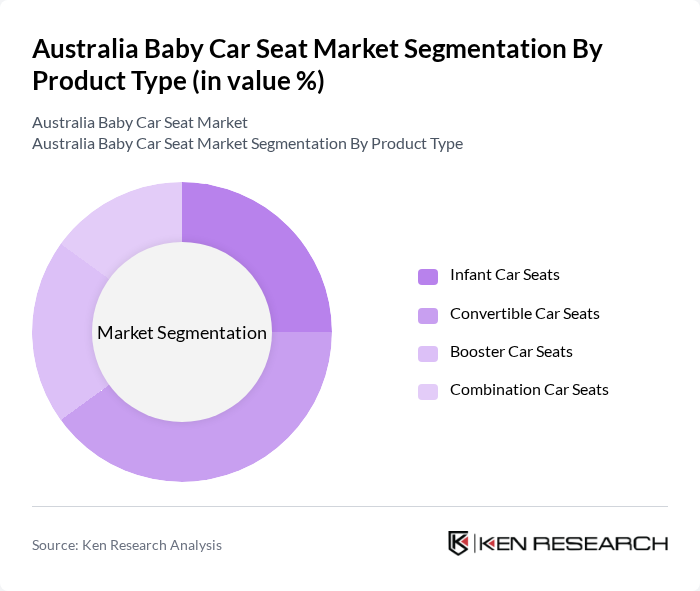
By Product Type:The product type segmentation includes various categories of baby car seats, each designed to cater to different age groups and safety requirements. The subsegments are Infant Car Seats, Convertible Car Seats, Booster Car Seats, and Combination Car Seats. Among these, Convertible Car Seats are currently dominating the market due to their versatility and extended use period, appealing to parents looking for long-term solutions. The trend towards multifunctional products is driving consumer preference towards these seats, as they can be used in both rear-facing and forward-facing positions.
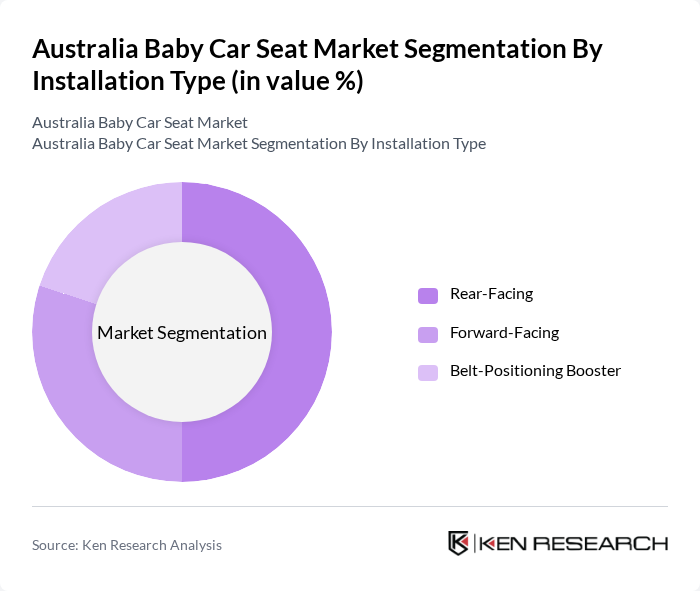
By Installation Type:The installation type segmentation includes Rear-Facing, Forward-Facing, and Belt-Positioning Booster seats. Rear-Facing seats are particularly popular among parents due to their safety benefits for infants and toddlers. The increasing awareness of child safety has led to a significant preference for Rear-Facing seats, as they are recommended for younger children to minimize injury risk during accidents. This trend is further supported by educational campaigns and guidelines from safety organizations.
Australia Baby Car Seat Market Competitive Landscape
The Australia Baby Car Seat Market is characterized by a dynamic mix of regional and international players. Leading participants such as Britax Australia, Maxi-Cosi, Safe-n-Sound, BabyLove, InfaSecure, Nuna, Joie, Peg Perego, Chicco, Graco, Clek, Evenflo, Safety 1st, Diono, Recaro contribute to innovation, geographic expansion, and service delivery in this space.
Australia Baby Car Seat Market Industry Analysis
Growth Drivers
- Increasing Awareness of Child Safety:The Australian government reported that in future, 90% of parents recognized the importance of child safety in vehicles. This heightened awareness has led to a surge in demand for baby car seats, with sales reaching approximately 1.3 million units in future. Furthermore, educational campaigns have increased knowledge about the risks associated with improper car seat usage, driving families to invest in safer options for their children.
- Government Regulations Mandating Car Seat Usage:In future, Australian regulations require all children under seven years to be secured in an appropriate car seat. This law has significantly influenced purchasing behavior, with a reported 20% increase in car seat sales since its implementation. Compliance with these regulations is crucial, as non-compliance can result in fines up to AUD 600, further incentivizing parents to invest in compliant car seats for their children.
- Rising Disposable Income Among Families:According to the Australian Bureau of Statistics, the average household disposable income rose to AUD 1,300 per week in future. This increase has empowered families to allocate more funds towards child safety products, including premium baby car seats. As families prioritize safety, the market has seen a notable shift towards higher-end models, with sales of premium car seats increasing by 25% in the last year.
Market Challenges
- High Cost of Premium Car Seats:The average price of premium baby car seats in Australia ranges from AUD 450 to AUD 850, which can be a significant financial burden for many families. This high cost limits access to advanced safety features, particularly for lower-income households. As a result, many parents opt for cheaper alternatives, which may not meet stringent safety standards, posing a risk to child safety.
- Limited Awareness of Proper Installation:A study by Kidsafe Australia found that approximately 75% of car seats are incorrectly installed. This lack of knowledge poses a significant challenge, as improper installation can compromise safety. Despite the availability of resources, many parents remain unaware of the correct installation procedures, leading to potential safety hazards and undermining the effectiveness of car seats in protecting children during travel.
Australia Baby Car Seat Market Future Outlook
The future of the Australia baby car seat market appears promising, driven by technological advancements and evolving consumer preferences. The trend towards smart car seats, equipped with sensors and connectivity features, is expected to gain traction in future, enhancing safety and convenience. Additionally, the increasing focus on eco-friendly materials will likely shape product development, as environmentally conscious consumers seek sustainable options. These trends indicate a dynamic market landscape, with opportunities for innovation and growth in the coming years.
Market Opportunities
- Expansion of E-commerce Platforms:The rise of e-commerce in Australia has created a significant opportunity for baby car seat manufacturers. Online sales accounted for 35% of total car seat sales in future, and this figure is expected to grow as more families prefer the convenience of online shopping. This shift allows brands to reach a broader audience and offer competitive pricing, enhancing market penetration.
- Development of Innovative Safety Features:There is a growing demand for car seats with advanced safety features, such as side-impact protection and integrated sensors. Manufacturers that invest in research and development to create innovative products can capture a larger market share. In future, it is projected that 30% of new car seat models will incorporate smart technology, appealing to tech-savvy parents focused on safety.
Scope of the Report
| Segment | Sub-Segments |
|---|---|
| By Product Type | Infant Car Seats Convertible Car Seats Booster Car Seats Combination Car Seats |
| By Installation Type | Rear-Facing Forward-Facing Belt-Positioning Booster |
| By Distribution Channel | Online Retail Offline Retail (Specialty Stores) Supermarkets/Hypermarkets Baby Boutiques |
Key Target Audience
Investors and Venture Capitalist Firms
Government and Regulatory Bodies (e.g., Australian Competition and Consumer Commission, National Transport Commission)
Manufacturers and Producers
Distributors and Retailers
Child Safety Advocacy Groups
Insurance Companies
Automotive Industry Stakeholders
Logistics and Supply Chain Companies
Players Mentioned in the Report:
Britax Australia
Maxi-Cosi
Safe-n-Sound
BabyLove
InfaSecure
Nuna
Joie
Peg Perego
Chicco
Graco
Clek
Evenflo
Safety 1st
Diono
Recaro
Table of Contents
Market Assessment Phase
1. Executive Summary and Approach
2. Australia Baby Car Seat Market Overview
2.1 Key Insights and Strategic Recommendations
2.2 Australia Baby Car Seat Market Overview
2.3 Definition and Scope
2.4 Evolution of Market Ecosystem
2.5 Timeline of Key Regulatory Milestones
2.6 Value Chain & Stakeholder Mapping
2.7 Business Cycle Analysis
2.8 Policy & Incentive Landscape
3. Australia Baby Car Seat Market Analysis
3.1 Growth Drivers
3.1.1 Increasing awareness of child safety
3.1.2 Government regulations mandating car seat usage
3.1.3 Rising disposable income among families
3.1.4 Growth in the number of new parents
3.2 Market Challenges
3.2.1 High cost of premium car seats
3.2.2 Limited awareness of proper installation
3.2.3 Competition from unregulated products
3.2.4 Variability in safety standards
3.3 Market Opportunities
3.3.1 Expansion of e-commerce platforms
3.3.2 Development of innovative safety features
3.3.3 Collaborations with hospitals and clinics
3.3.4 Increasing demand for eco-friendly materials
3.4 Market Trends
3.4.1 Shift towards smart car seats
3.4.2 Growth in rental car seat services
3.4.3 Rising popularity of convertible car seats
3.4.4 Increased focus on user-friendly designs
3.5 Government Regulation
3.5.1 Mandatory compliance with Australian safety standards
3.5.2 Regulations on marketing and advertising
3.5.3 Guidelines for product recalls
3.5.4 Incentives for manufacturers adopting safety innovations
4. SWOT Analysis
5. Stakeholder Analysis
6. Porter's Five Forces Analysis
7. Australia Baby Car Seat Market Market Size, 2019-2024
7.1 By Value
7.2 By Volume
7.3 By Average Selling Price
8. Australia Baby Car Seat Market Segmentation
8.1 By Product Type
8.1.1 Infant Car Seats
8.1.2 Convertible Car Seats
8.1.3 Booster Car Seats
8.1.4 Combination Car Seats
8.2 By Installation Type
8.2.1 Rear-Facing
8.2.2 Forward-Facing
8.2.3 Belt-Positioning Booster
8.3 By Distribution Channel
8.3.1 Online Retail
8.3.2 Offline Retail (Specialty Stores)
8.3.3 Supermarkets/Hypermarkets
8.3.4 Baby Boutiques
9. Australia Baby Car Seat Market Competitive Analysis
9.1 Market Share of Key Players
9.2 Cross Comparison of Key Players
9.2.1 Company Name
9.2.2 Market Share (%)
9.2.3 Revenue Growth Rate (YoY %)
9.2.4 EBITDA Margin (%)
9.2.5 Market Penetration (Geographic Coverage)
9.2.6 Customer Acquisition Cost (CAC)
9.2.7 Net Promoter Score (NPS)
9.2.8 Product Portfolio Breadth (# SKUs)
9.2.9 R&D Investment (% of Revenue)
9.2.10 Distribution Reach (# Retail Partners)
9.3 SWOT Analysis of Top Players
9.4 Pricing Analysis
9.5 Detailed Profile of Major Companies
9.5.1 Britax Australia
9.5.2 Maxi-Cosi
9.5.3 Safe-n-Sound
9.5.4 BabyLove
9.5.5 InfaSecure
9.5.6 Nuna
9.5.7 Joie
9.5.8 Peg Perego
9.5.9 Chicco
9.5.10 Graco
9.5.11 Clek
9.5.12 Evenflo
9.5.13 Safety 1st
9.5.14 Diono
9.5.15 Recaro
10. Australia Baby Car Seat Market End-User Analysis
10.1 Procurement Behavior of Key Ministries
10.1.1 Government procurement policies
10.1.2 Budget allocation for child safety
10.1.3 Collaboration with manufacturers
10.1.4 Evaluation criteria for suppliers
10.2 Corporate Spend on Infrastructure & Energy
10.2.1 Investment in child safety initiatives
10.2.2 Funding for awareness campaigns
10.2.3 Partnerships with NGOs
10.2.4 Corporate social responsibility programs
10.3 Pain Point Analysis by End-User Category
10.3.1 Safety concerns
10.3.2 Cost of high-quality car seats
10.3.3 Installation difficulties
10.3.4 Limited product availability
10.4 User Readiness for Adoption
10.4.1 Awareness of safety regulations
10.4.2 Willingness to invest in safety
10.4.3 Accessibility of information
10.4.4 Support from healthcare providers
10.5 Post-Deployment ROI and Use Case Expansion
10.5.1 Evaluation of safety outcomes
10.5.2 Feedback from users
10.5.3 Opportunities for product upgrades
10.5.4 Expansion into new markets
11. Australia Baby Car Seat Market Future Size, 2025-2030
11.1 By Value
11.2 By Volume
11.3 By Average Selling Price
Go-To-Market Strategy Phase
1. Whitespace Analysis + Business Model Canvas
1.1 Market gaps identification
1.2 Value proposition development
1.3 Revenue model exploration
1.4 Customer segment analysis
1.5 Key partnerships
1.6 Cost structure assessment
1.7 Competitive advantage
2. Marketing and Positioning Recommendations
2.1 Branding strategies
2.2 Product USPs
2.3 Target audience identification
2.4 Communication channels
2.5 Promotional tactics
2.6 Customer engagement strategies
2.7 Market positioning
3. Distribution Plan
3.1 Urban retail vs rural NGO tie-ups
3.2 Online distribution strategies
3.3 Partnerships with retailers
3.4 Logistics and supply chain management
3.5 Inventory management
3.6 Distribution channel optimization
3.7 Customer service integration
4. Channel & Pricing Gaps
4.1 Underserved routes
4.2 Pricing bands
4.3 Competitor pricing analysis
4.4 Value-based pricing strategies
4.5 Discounts and promotions
4.6 Price elasticity assessment
4.7 Customer willingness to pay
5. Unmet Demand & Latent Needs
5.1 Category gaps
5.2 Consumer segments
5.3 Emerging trends
5.4 Product feature requests
5.5 Market entry barriers
5.6 Customer feedback analysis
5.7 Future demand forecasting
6. Customer Relationship
6.1 Loyalty programs
6.2 After-sales service
6.3 Customer feedback mechanisms
6.4 Community engagement
6.5 Customer education initiatives
6.6 Relationship management tools
6.7 Retention strategies
7. Value Proposition
7.1 Sustainability
7.2 Integrated supply chains
7.3 Unique selling points
7.4 Customer-centric approach
7.5 Competitive differentiation
7.6 Value delivery mechanisms
7.7 Brand loyalty enhancement
8. Key Activities
8.1 Regulatory compliance
8.2 Branding
8.3 Distribution setup
8.4 Marketing execution
8.5 Product development
8.6 Customer support
8.7 Performance monitoring
9. Entry Strategy Evaluation
9.1 Domestic Market Entry Strategy
9.1.1 Product mix
9.1.2 Pricing band
9.1.3 Packaging
9.2 Export Entry Strategy
9.2.1 Target countries
9.2.2 Compliance roadmap
10. Entry Mode Assessment
10.1 JV
10.2 Greenfield
10.3 M&A
10.4 Distributor Model
11. Capital and Timeline Estimation
11.1 Capital requirements
11.2 Timelines
12. Control vs Risk Trade-Off
12.1 Ownership vs Partnerships
13. Profitability Outlook
13.1 Breakeven analysis
13.2 Long-term sustainability
14. Potential Partner List
14.1 Distributors
14.2 JVs
14.3 Acquisition targets
15. Execution Roadmap
15.1 Phased Plan for Market Entry
15.1.1 Market Setup
15.1.2 Market Entry
15.1.3 Growth Acceleration
15.1.4 Scale & Stabilize
15.2 Key Activities and Milestones
15.2.1 Milestone tracking
15.2.2 Activity scheduling
15.2.3 Resource allocation
Research Methodology
Phase 1: Approach1
Desk Research
- Analysis of industry reports from Australian transport and safety authorities
- Review of market trends and consumer behavior studies published by child safety organizations
- Examination of sales data from major retailers and e-commerce platforms specializing in baby products
Primary Research
- Interviews with pediatricians and child safety experts to understand safety standards and consumer preferences
- Surveys conducted with parents regarding their purchasing decisions and brand loyalty in baby car seats
- Focus groups with new parents to gather qualitative insights on product features and usability
Validation & Triangulation
- Cross-validation of findings through multiple data sources, including sales figures and expert opinions
- Triangulation of consumer insights with industry expert feedback to ensure accuracy
- Sanity checks through peer reviews and consultations with market analysts
Phase 2: Market Size Estimation1
Top-down Assessment
- Estimation of total market size based on national statistics on births and car ownership rates
- Segmentation of the market by car seat types, including infant, convertible, and booster seats
- Incorporation of government regulations and safety standards impacting market demand
Bottom-up Modeling
- Collection of sales data from leading manufacturers and retailers in the baby car seat market
- Estimation of average selling prices across different car seat categories
- Calculation of market volume based on unit sales and average price points
Forecasting & Scenario Analysis
- Utilization of historical growth rates to project future market trends through 2030
- Scenario analysis based on potential changes in consumer behavior and regulatory impacts
- Development of best-case, worst-case, and most-likely market scenarios
Phase 3: CATI Sample Composition1
| Scope Item/Segment | Sample Size | Target Respondent Profiles |
|---|---|---|
| Parent Purchasers of Baby Car Seats | 120 | Parents with children aged 0-5 years |
| Retailers of Baby Products | 80 | Store Managers, Product Buyers |
| Child Safety Experts | 40 | Pediatricians, Child Safety Advocates |
| Manufacturers of Baby Car Seats | 60 | Product Development Managers, Marketing Directors |
| Consumer Advocacy Groups | 30 | Consumer Rights Advocates, Safety Inspectors |
Frequently Asked Questions
What is the current value of the Australia Baby Car Seat Market?
The Australia Baby Car Seat Market is valued at approximately USD 150 million, reflecting a significant growth driven by increased awareness of child safety regulations, rising disposable incomes, and a growing population of young families prioritizing safety and comfort in travel.
What are the key regulations regarding child car seat usage in Australia?
Which cities dominate the Australia Baby Car Seat Market?
What types of baby car seats are available in the Australian market?
Other Regional/Country Reports
Other Adjacent Reports
South Korea Infant Carrier Market
UAE Child Safety Products Market
Thailand Automotive Accessories Market
Qatar Baby Monitor Market
South Africa Infant Travel Gear Market
Japan Child Bicycle Seat Market
Germany Maternity Products Market
Thailand Pediatric Safety Equipment Market
Mexico Baby High Chair Market
Why Buy From Us?

What makes us stand out is that our consultants follow Robust, Refine and Result (RRR) methodology. Robust for clear definitions, approaches and sanity checking, Refine for differentiating respondents' facts and opinions, and Result for presenting data with story.

We have set a benchmark in the industry by offering our clients with syndicated and customized market research reports featuring coverage of entire market as well as meticulous research and analyst insights.

While we don't replace traditional research, we flip the method upside down. Our dual approach of Top Bottom & Bottom Top ensures quality deliverable by not just verifying company fundamentals but also looking at the sector and macroeconomic factors.

With one step in the future, our research team constantly tries to show you the bigger picture. We help with some of the tough questions you may encounter along the way: How is the industry positioned? Best marketing channel? KPI's of competitors? By aligning every element, we help maximize success.

Our report gives you instant access to the answers and sources that other companies might choose to hide. We elaborate each steps of research methodology we have used and showcase you the sample size to earn your trust.

If you need any support, we are here! We pride ourselves on universe strength, data quality, and quick, friendly, and professional service.