About the Report
Base Year 2024Philippines Baby Car Seat Market Overview
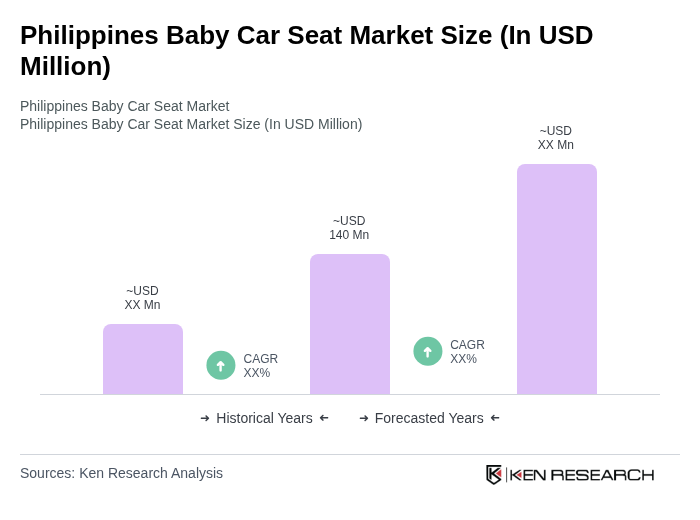
- The Philippines Baby Car Seat Market is valued at USD 140 million, based on a five-year historical analysis. This growth is primarily driven by increasing awareness of child safety regulations, rising disposable incomes, a growing number of vehicle owners, expanding automobile industry, and rising safety awareness among parents.
- Metro Manila, Cebu, and Davao are the dominant cities in the Philippines Baby Car Seat Market. Metro Manila leads due to its high population density and urbanization, while Cebu and Davao benefit from increasing economic activities and a growing middle class. These regions have seen a rise in consumer spending on child safety products, contributing to market growth.
- The Republic Act No. 11229, also known as the Child Safety in Motor Vehicles Act, issued by the Philippine Congress in 2019, mandates the use of child restraint systems for children under 12 years old or shorter than 150 cm in height. This regulation requires proper child safety seats based on age and size during travel in motor vehicles, with penalties for non-compliance including fines up to PHP 5,000 for first offenses, significantly impacting the demand for baby car seats. The law aims to enhance child safety in vehicles and reduce road traffic injuries among young passengers.
Philippines Baby Car Seat Market Segmentation
By Type:The market is segmented into various types of baby car seats, including Infant Car Seats, Convertible Car Seats, Booster Seats, All-in-One Car Seats, and Others. Each type serves different age groups and safety needs, catering to the diverse preferences of consumers.
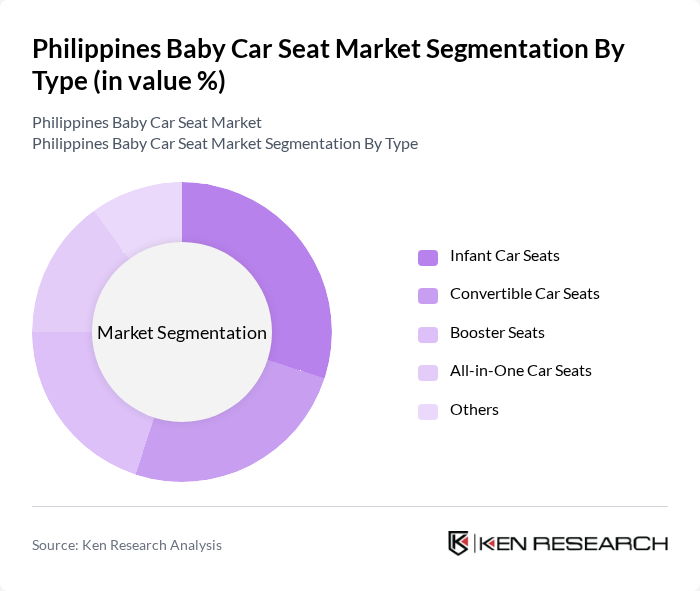
The Infant Car Seats segment dominates the market due to their essential role in ensuring the safety of newborns and infants during travel. Parents are increasingly opting for these seats as they provide the necessary support and protection for young children. The growing awareness of child safety regulations and the emphasis on using appropriate car seats for infants have further fueled the demand for this segment. Additionally, the convenience of portability and ease of installation make Infant Car Seats a preferred choice among parents.
By End-User:The market is segmented based on end-users, including Individual Consumers, Retailers, E-commerce Platforms, Government Institutions, and Others. This segmentation reflects the various channels through which baby car seats are purchased and utilized.
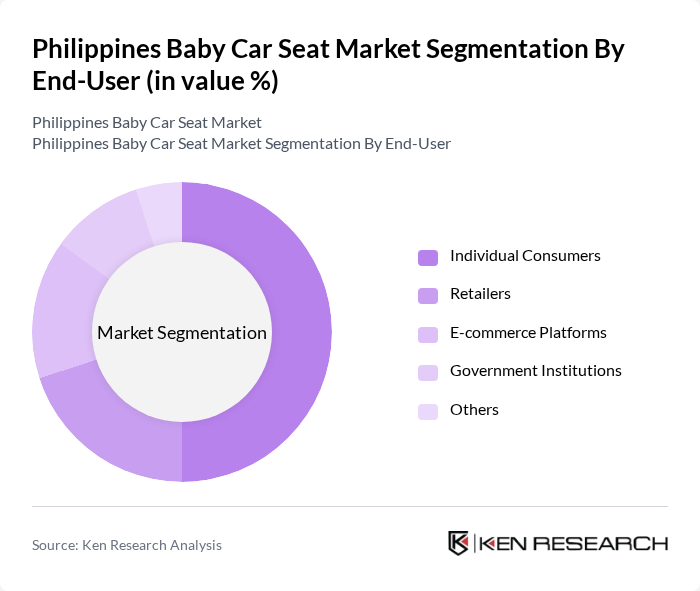
The Individual Consumers segment holds the largest market share, driven by the increasing number of families and the growing awareness of child safety. Parents are more inclined to invest in high-quality baby car seats to ensure their children's safety during travel. The rise of e-commerce platforms has also facilitated access to a wider range of products, further boosting consumer purchases. Retailers play a significant role in providing these products, but the direct purchasing power of individual consumers remains the dominant force in the market.
Philippines Baby Car Seat Market Competitive Landscape
The Philippines Baby Car Seat Market is characterized by a dynamic mix of regional and international players. Leading participants such as Graco, Chicco, Britax, Evenflo, Maxi-Cosi, Clek, Safety 1st, Baby Trend, Peg Perego, Joie, Nuna, Recaro, Diono, Kiddy, Combi contribute to innovation, geographic expansion, and service delivery in this space.
Philippines Baby Car Seat Market Industry Analysis
Growth Drivers
- Increasing Awareness of Child Safety:The Philippines has seen a significant rise in awareness regarding child safety in vehicles, with a reported 70% increase in parental concern over child safety in recent years. This shift is driven by various campaigns and educational programs, leading to a growing demand for baby car seats. The Department of Transportation reported that 80% of parents now prioritize safety features when purchasing vehicles, further boosting the baby car seat market.
- Government Regulations Mandating Car Seat Usage:In future, the Philippine government implemented stricter regulations requiring the use of child safety seats for children under 12 years old. This law is expected to impact approximately 12 million families, significantly increasing the demand for compliant car seats. The government has allocated PHP 600 million for public awareness campaigns, ensuring that parents understand the importance of these regulations, thus driving market growth.
- Rising Disposable Income Among Families:The Philippines' GDP per capita is projected to reach PHP 120,000 in future, reflecting a 6% increase from previous years. This rise in disposable income allows families to invest more in child safety products, including baby car seats. As more families can afford quality products, the market is expected to expand, with a notable increase in sales of premium car seat brands, which are perceived as safer and more reliable.
Market Challenges
- High Cost of Quality Car Seats:The average price of certified baby car seats in the Philippines ranges from PHP 6,000 to PHP 16,000, which can be prohibitive for many families. With approximately 28% of the population living below the poverty line, affordability remains a significant barrier. This challenge is compounded by the perception that higher-priced seats offer better safety, limiting access to essential products for lower-income families.
- Limited Availability of Certified Products:The market currently faces a shortage of certified baby car seats, with only 25% of available products meeting safety standards set by the Department of Transportation. This scarcity leads to consumer frustration and a lack of trust in the market. Additionally, many retailers do not stock certified options, making it difficult for parents to find safe products, which hinders overall market growth.
Philippines Baby Car Seat Market Future Outlook
The Philippines baby car seat market is poised for significant growth, driven by increasing safety awareness and government regulations. As urbanization continues, more families are purchasing vehicles, leading to a higher demand for child safety products. Innovations in product design, such as multifunctional car seats, are expected to attract tech-savvy parents. Furthermore, the rise of e-commerce platforms will facilitate easier access to a wider range of products, enhancing market penetration and consumer choice.
Market Opportunities
- Expansion of E-commerce Platforms:The growth of e-commerce in the Philippines, with online sales projected to reach PHP 250 billion in future, presents a significant opportunity for baby car seat manufacturers. By leveraging online platforms, brands can reach a broader audience, particularly in rural areas where access to physical stores is limited, thus increasing overall sales and brand visibility.
- Collaboration with Hospitals and Pediatricians:Partnering with healthcare providers can enhance consumer trust and awareness regarding the importance of using certified baby car seats. Hospitals can provide educational materials and recommendations, potentially reaching over 1.2 million new parents annually. This collaboration can drive demand for safe products and improve overall child safety in vehicles across the country.
Scope of the Report
| Segment | Sub-Segments |
|---|---|
| By Type | Infant Car Seats Convertible Car Seats Booster Seats All-in-One Car Seats Others |
| By End-User | Individual Consumers Retailers E-commerce Platforms Government Institutions Others |
| By Age Group | Newborns (0-12 months) Toddlers (1-4 years) Preschoolers (4-7 years) Others |
| By Safety Features | Side Impact Protection Five-Point Harness System Adjustable Headrest Others |
| By Material | Plastic Metal Fabric Others |
| By Distribution Channel | Online Retail Offline Retail Direct Sales Others |
| By Price Range | Budget Mid-Range Premium Others |
Key Target Audience
Investors and Venture Capitalist Firms
Government and Regulatory Bodies (e.g., Department of Transportation, Department of Trade and Industry)
Manufacturers and Producers
Distributors and Retailers
Child Safety Advocacy Groups
Automobile Manufacturers
Insurance Companies
Logistics and Supply Chain Companies
Players Mentioned in the Report:
Graco
Chicco
Britax
Evenflo
Maxi-Cosi
Clek
Safety 1st
Baby Trend
Peg Perego
Joie
Nuna
Recaro
Diono
Kiddy
Combi
Table of Contents
Market Assessment Phase
1. Executive Summary and Approach
2. Philippines Baby Car Seat Market Overview
2.1 Key Insights and Strategic Recommendations
2.2 Philippines Baby Car Seat Market Overview
2.3 Definition and Scope
2.4 Evolution of Market Ecosystem
2.5 Timeline of Key Regulatory Milestones
2.6 Value Chain & Stakeholder Mapping
2.7 Business Cycle Analysis
2.8 Policy & Incentive Landscape
3. Philippines Baby Car Seat Market Analysis
3.1 Growth Drivers
3.1.1 Increasing awareness of child safety
3.1.2 Government regulations mandating car seat usage
3.1.3 Rising disposable income among families
3.1.4 Growth in the automotive market
3.2 Market Challenges
3.2.1 High cost of quality car seats
3.2.2 Limited availability of certified products
3.2.3 Lack of consumer education on proper usage
3.2.4 Competition from unregulated products
3.3 Market Opportunities
3.3.1 Expansion of e-commerce platforms
3.3.2 Collaboration with hospitals and pediatricians
3.3.3 Development of innovative and affordable products
3.3.4 Increasing urbanization and car ownership
3.4 Market Trends
3.4.1 Shift towards multifunctional car seats
3.4.2 Growing demand for eco-friendly materials
3.4.3 Rise in online shopping for baby products
3.4.4 Increased focus on product safety certifications
3.5 Government Regulation
3.5.1 Implementation of mandatory car seat laws
3.5.2 Safety standards set by the Department of Transportation
3.5.3 Incentives for manufacturers meeting safety regulations
3.5.4 Public awareness campaigns on child safety
4. SWOT Analysis
5. Stakeholder Analysis
6. Porter's Five Forces Analysis
7. Philippines Baby Car Seat Market Market Size, 2019-2024
7.1 By Value
7.2 By Volume
7.3 By Average Selling Price
8. Philippines Baby Car Seat Market Segmentation
8.1 By Type
8.1.1 Infant Car Seats
8.1.2 Convertible Car Seats
8.1.3 Booster Seats
8.1.4 All-in-One Car Seats
8.1.5 Others
8.2 By End-User
8.2.1 Individual Consumers
8.2.2 Retailers
8.2.3 E-commerce Platforms
8.2.4 Government Institutions
8.2.5 Others
8.3 By Age Group
8.3.1 Newborns (0-12 months)
8.3.2 Toddlers (1-4 years)
8.3.3 Preschoolers (4-7 years)
8.3.4 Others
8.4 By Safety Features
8.4.1 Side Impact Protection
8.4.2 Five-Point Harness System
8.4.3 Adjustable Headrest
8.4.4 Others
8.5 By Material
8.5.1 Plastic
8.5.2 Metal
8.5.3 Fabric
8.5.4 Others
8.6 By Distribution Channel
8.6.1 Online Retail
8.6.2 Offline Retail
8.6.3 Direct Sales
8.6.4 Others
8.7 By Price Range
8.7.1 Budget
8.7.2 Mid-Range
8.7.3 Premium
8.7.4 Others
9. Philippines Baby Car Seat Market Competitive Analysis
9.1 Market Share of Key Players
9.2 Cross Comparison of Key Players
9.2.1 Company Name
9.2.2 Group Size (Large, Medium, or Small as per industry convention)
9.2.3 Sales Revenue
9.2.4 Market Penetration Rate
9.2.5 Customer Satisfaction Score
9.2.6 Product Return Rate
9.2.7 Pricing Strategy
9.2.8 Distribution Efficiency
9.2.9 Brand Recognition
9.2.10 Innovation Rate
9.3 SWOT Analysis of Top Players
9.4 Pricing Analysis
9.5 Detailed Profile of Major Companies
9.5.1 Graco
9.5.2 Chicco
9.5.3 Britax
9.5.4 Evenflo
9.5.5 Maxi-Cosi
9.5.6 Clek
9.5.7 Safety 1st
9.5.8 Baby Trend
9.5.9 Peg Perego
9.5.10 Joie
9.5.11 Nuna
9.5.12 Recaro
9.5.13 Diono
9.5.14 Kiddy
9.5.15 Combi
10. Philippines Baby Car Seat Market End-User Analysis
10.1 Procurement Behavior of Key Ministries
10.1.1 Government procurement policies
10.1.2 Budget allocation for child safety
10.1.3 Collaboration with NGOs
10.1.4 Awareness programs for parents
10.2 Corporate Spend on Infrastructure & Energy
10.2.1 Investment in child safety initiatives
10.2.2 Partnerships with manufacturers
10.2.3 Funding for awareness campaigns
10.3 Pain Point Analysis by End-User Category
10.3.1 Cost concerns
10.3.2 Product availability
10.3.3 Safety concerns
10.3.4 Lack of information
10.4 User Readiness for Adoption
10.4.1 Awareness of safety regulations
10.4.2 Willingness to invest in safety
10.4.3 Accessibility of products
10.4.4 Support from community programs
10.5 Post-Deployment ROI and Use Case Expansion
10.5.1 Evaluation of safety improvements
10.5.2 Feedback from users
10.5.3 Potential for product upgrades
10.5.4 Expansion into new markets
11. Philippines Baby Car Seat Market Future Size, 2025-2030
11.1 By Value
11.2 By Volume
11.3 By Average Selling Price
Go-To-Market Strategy Phase
1. Whitespace Analysis + Business Model Canvas
1.1 Market gaps identification
1.2 Value proposition development
1.3 Revenue model exploration
1.4 Customer segmentation analysis
1.5 Competitive landscape overview
1.6 Key partnerships identification
1.7 Risk assessment
2. Marketing and Positioning Recommendations
2.1 Branding strategies
2.2 Product USPs
2.3 Target audience identification
2.4 Communication strategy
2.5 Digital marketing approach
2.6 Offline marketing tactics
2.7 Performance metrics
3. Distribution Plan
3.1 Urban retail vs rural NGO tie-ups
3.2 Online distribution channels
3.3 Partnerships with local retailers
3.4 Logistics and supply chain management
3.5 Inventory management strategies
3.6 Customer service considerations
3.7 Distribution efficiency metrics
4. Channel & Pricing Gaps
4.1 Underserved routes
4.2 Pricing bands
4.3 Competitor pricing analysis
4.4 Consumer price sensitivity
4.5 Value-based pricing strategies
4.6 Discount and promotion strategies
4.7 Pricing optimization techniques
5. Unmet Demand & Latent Needs
5.1 Category gaps
5.2 Consumer segments
5.3 Product feature demands
5.4 Service expectations
5.5 Market entry barriers
5.6 Future trends analysis
5.7 Recommendations for product development
6. Customer Relationship
6.1 Loyalty programs
6.2 After-sales service
6.3 Customer feedback mechanisms
6.4 Community engagement strategies
6.5 Customer education initiatives
6.6 Relationship management tools
6.7 Performance tracking
7. Value Proposition
7.1 Sustainability
7.2 Integrated supply chains
7.3 Unique selling points
7.4 Customer-centric approach
7.5 Competitive advantages
7.6 Long-term value creation
7.7 Market differentiation strategies
8. Key Activities
8.1 Regulatory compliance
8.2 Branding
8.3 Distribution setup
8.4 Marketing execution
8.5 Customer engagement
8.6 Performance monitoring
8.7 Continuous improvement
9. Entry Strategy Evaluation
9.1 Domestic Market Entry Strategy
9.1.1 Product mix
9.1.2 Pricing band
9.1.3 Packaging
9.2 Export Entry Strategy
9.2.1 Target countries
9.2.2 Compliance roadmap
10. Entry Mode Assessment
10.1 JV
10.2 Greenfield
10.3 M&A
10.4 Distributor Model
11. Capital and Timeline Estimation
11.1 Capital requirements
11.2 Timelines
12. Control vs Risk Trade-Off
12.1 Ownership vs Partnerships
13. Profitability Outlook
13.1 Breakeven analysis
13.2 Long-term sustainability
14. Potential Partner List
14.1 Distributors
14.2 JVs
14.3 Acquisition targets
15. Execution Roadmap
15.1 Phased Plan for Market Entry
15.1.1 Market Setup
15.1.2 Market Entry
15.1.3 Growth Acceleration
15.1.4 Scale & Stabilize
15.2 Key Activities and Milestones
15.2.1 Milestone tracking
15.2.2 Activity scheduling
15.2.3 Resource allocation
Research Methodology
Phase 1: Approach1
Desk Research
- Analysis of government reports on child safety regulations and car seat standards in the Philippines
- Review of market reports from industry associations and child safety organizations
- Examination of demographic data and trends related to family size and vehicle ownership
Primary Research
- Interviews with pediatricians and child safety experts to understand consumer attitudes towards baby car seats
- Surveys with parents to gauge awareness and purchasing behavior regarding baby car seats
- Focus groups with expectant parents to discuss preferences and concerns about car seat features
Validation & Triangulation
- Cross-validation of findings with sales data from major retailers and e-commerce platforms
- Triangulation of insights from expert interviews with consumer survey results
- Sanity check through feedback from industry stakeholders and regulatory bodies
Phase 2: Market Size Estimation1
Top-down Assessment
- Estimation of total addressable market based on national vehicle registration statistics
- Segmentation of the market by car seat type (infant, convertible, booster) and distribution channel (online vs. offline)
- Incorporation of government initiatives promoting child safety in vehicles
Bottom-up Modeling
- Collection of sales data from leading baby car seat manufacturers and retailers
- Estimation of average selling prices and volume sold across different regions
- Analysis of consumer spending patterns on baby products to derive market potential
Forecasting & Scenario Analysis
- Multi-factor regression analysis incorporating economic indicators and birth rates
- Scenario modeling based on potential changes in regulations and consumer safety awareness
- Development of baseline, optimistic, and pessimistic market growth projections through 2030
Phase 3: CATI Sample Composition1
| Scope Item/Segment | Sample Size | Target Respondent Profiles |
|---|---|---|
| Urban Parents with Infants | 120 | Parents aged 25-40, with children aged 0-2 years |
| Expectant Parents | 100 | Couples expecting their first child |
| Child Safety Advocates | 50 | Members of child safety organizations and NGOs |
| Retailers of Baby Products | 80 | Store managers and owners of baby product retail outlets |
| Pediatricians and Child Health Experts | 60 | Healthcare professionals specializing in child health and safety |
Frequently Asked Questions
What is the current value of the Philippines Baby Car Seat Market?
The Philippines Baby Car Seat Market is valued at approximately USD 140 million, reflecting a significant growth driven by increased awareness of child safety regulations, rising disposable incomes, and a growing number of vehicle owners.
Which cities are the largest markets for baby car seats in the Philippines?
What is Republic Act No. 11229 in the Philippines?
How has government regulation impacted the demand for baby car seats?
Other Regional/Country Reports
Other Adjacent Reports
Egypt Child Safety Products Market
Japan Automotive Accessories Market
Singapore Infant Care Products Market
Germany Vehicle Safety Equipment Market
Global Baby Carrier Market Size, Share & Forecast, By Product Type, Price Tier & Distribution Channel, 2025-2032Egypt Parenting Products Market
Qatar Road Safety Devices Market
Japan Baby Furniture Market
UAE E-commerce Retail Market
Why Buy From Us?

What makes us stand out is that our consultants follow Robust, Refine and Result (RRR) methodology. Robust for clear definitions, approaches and sanity checking, Refine for differentiating respondents' facts and opinions, and Result for presenting data with story.

We have set a benchmark in the industry by offering our clients with syndicated and customized market research reports featuring coverage of entire market as well as meticulous research and analyst insights.

While we don't replace traditional research, we flip the method upside down. Our dual approach of Top Bottom & Bottom Top ensures quality deliverable by not just verifying company fundamentals but also looking at the sector and macroeconomic factors.

With one step in the future, our research team constantly tries to show you the bigger picture. We help with some of the tough questions you may encounter along the way: How is the industry positioned? Best marketing channel? KPI's of competitors? By aligning every element, we help maximize success.

Our report gives you instant access to the answers and sources that other companies might choose to hide. We elaborate each steps of research methodology we have used and showcase you the sample size to earn your trust.

If you need any support, we are here! We pride ourselves on universe strength, data quality, and quick, friendly, and professional service.