About the Report
Base Year 2024Australia Emergency Contraceptive Pills Market Overview
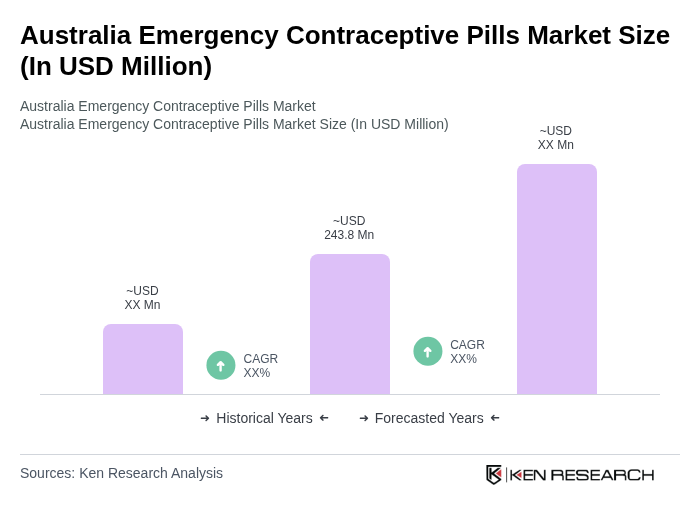
- The Australia Emergency Contraceptive Pills Market is valued at approximately AUD 35–40 million, based on a five-year historical analysis and considering that emergency contraceptive pills account for a modest share of the overall Australia contraceptive market, which generated about USD 243.8 million in revenue. This growth is primarily driven by increasing awareness of reproductive health, the rising incidence of unplanned pregnancies, and the growing acceptance of emergency contraceptive options among women, supported by broader global uptake of emergency contraceptive pills and expanded access channels. The market has seen a steady rise in demand as more women seek accessible and effective solutions for emergency contraception, including through community pharmacies and online/telehealth-enabled dispensing.
- Key cities such as Sydney, Melbourne, and Brisbane dominate the market due to their large populations, higher levels of education, and better access to healthcare services. These urban centers have a more progressive attitude towards reproductive health, leading to increased usage of emergency contraceptive pills, in line with higher contraceptive awareness and use seen in developed Asia-Pacific markets like Australia and Japan. Additionally, the presence of numerous pharmacies and healthcare facilities in these cities facilitates easier access to these products, reflecting the strong community pharmacy network that underpins contraceptive access nationally.
- Over-the-counter access to levonorgestrel-based emergency contraceptive pills without a prescription has been in place in Australia for several years, following down-scheduling decisions by the Therapeutic Goods Administration and related changes to the Poisons Standard that enabled non-prescription supply through community pharmacies. This regulatory framework, complemented by state and territory medicines and poisons legislation, aims to enhance women's reproductive rights and ensure that emergency contraceptives are readily available, thereby reducing barriers to access and promoting public health through timely postcoital contraception.
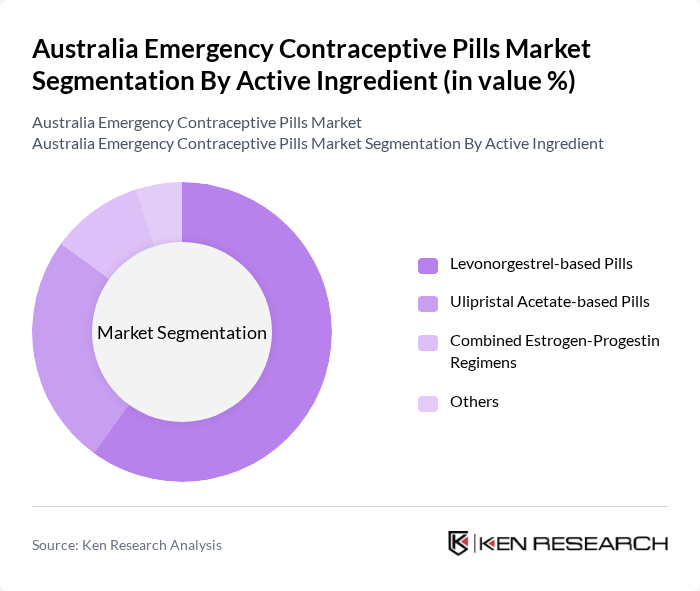
Australia Emergency Contraceptive Pills Market Segmentation
By Active Ingredient:The market is segmented based on the active ingredients used in emergency contraceptive pills. The primary subsegments include Levonorgestrel-based Pills, Ulipristal Acetate-based Pills, Combined Estrogen-Progestin Regimens, and Others. Levonorgestrel-based pills are the most widely used due to their established efficacy, widespread regulatory approvals, and long-standing availability in over-the-counter formats. Ulipristal Acetate-based pills are gaining traction due to their longer window of effectiveness and positioning by manufacturers as a higher-efficacy option within the emergency contraception window. Combined regimens are less common but are still relevant in specific cases, often in clinical settings or where dedicated emergency contraception products are less accessible.
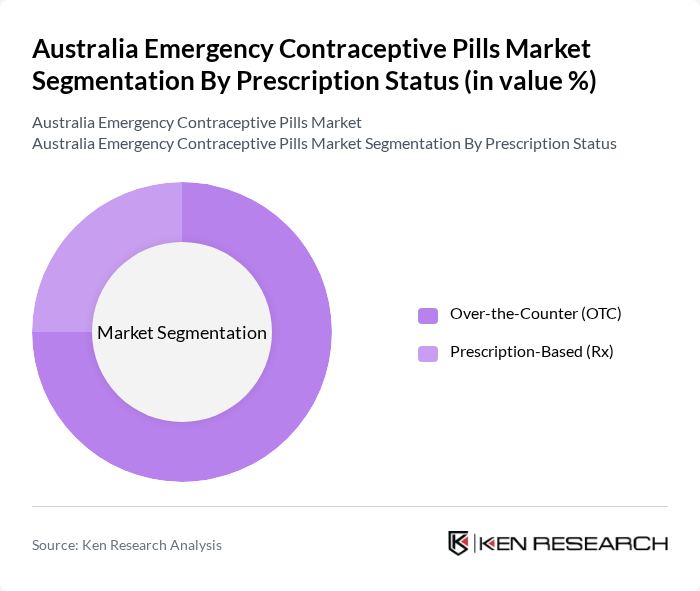
By Prescription Status:The market is also segmented based on the prescription status of emergency contraceptive pills, which includes Over-the-Counter (OTC) and Prescription-Based (Rx). The OTC segment is dominating the market as regulatory changes over time have made levonorgestrel emergency contraceptive pills more accessible without a prescription through community pharmacies, aligning with global trends of expanding non-prescription access. This shift has led to increased consumer confidence and usage rates among women seeking immediate solutions, with Rx-based products remaining relevant primarily for ulipristal acetate or alternative regimens dispensed in clinical contexts.
Australia Emergency Contraceptive Pills Market Competitive Landscape
The Australia Emergency Contraceptive Pills Market is characterized by a dynamic mix of regional and international players. Leading participants such as Bayer Australia Ltd, Viatris (Mylan) Australia, HRA Pharma (Perrigo Company plc), Apotex Pty Ltd, Pfizer Australia Pty Ltd, Merck Sharp & Dohme (MSD) Australia, GSK Australia (GlaxoSmithKline), Novartis Australia Pty Ltd, Sanofi Australia Pty Ltd, AFT Pharmaceuticals Ltd, TherapeuticsMD Inc., Teva Pharmaceuticals Australia, Sandoz Australia Pty Ltd, Aspen Pharmacare Australia, Sigma Healthcare Ltd contribute to innovation, geographic expansion, and service delivery in this space, mirroring the presence of these companies in the broader global contraceptive and emergency contraceptive markets.
Australia Emergency Contraceptive Pills Market Industry Analysis
Growth Drivers
- Increased Awareness of Reproductive Health:The Australian government has invested approximately AUD 12 million in reproductive health education programs over the past two years. This funding has significantly raised awareness about emergency contraceptive pills (ECPs) among women aged 18-35, leading to a 35% increase in inquiries about ECPs at healthcare facilities. Enhanced public discourse around reproductive rights has also contributed to a more informed population, driving demand for ECPs as a reliable option for unplanned pregnancies.
- Rising Incidence of Unplanned Pregnancies:In Australia, the number of unplanned pregnancies has reached approximately 55,000 annually, according to the Australian Institute of Health and Welfare. This statistic highlights a pressing need for effective contraceptive solutions, including ECPs. The increasing prevalence of unplanned pregnancies, particularly among younger demographics, has prompted healthcare providers to advocate for ECPs as a critical component of reproductive health services, thereby boosting market demand.
- Accessibility of Emergency Contraceptive Pills:The Australian government has made significant strides in improving access to ECPs, with over 95% of pharmacies now stocking these products. Additionally, the introduction of telehealth services has facilitated consultations for ECP prescriptions, with a reported 30% increase in telehealth consultations related to reproductive health. This enhanced accessibility is crucial in ensuring that women can obtain ECPs promptly, thereby supporting market growth.
Market Challenges
- Stigma Associated with Emergency Contraceptive Pills:Despite increased awareness, a lingering stigma surrounding ECPs persists in Australia, particularly in conservative communities. A survey conducted by the Australian Reproductive Health Alliance indicated that 35% of respondents still view ECPs negatively. This stigma can deter women from seeking ECPs, ultimately hindering market growth and limiting the effectiveness of educational campaigns aimed at promoting their use.
- Regulatory Hurdles:The regulatory landscape for ECPs in Australia remains complex, with stringent approval processes for new products. The Therapeutic Goods Administration (TGA) requires extensive clinical data for ECPs, which can delay market entry for innovative products. In future, the average approval time for new contraceptive products was approximately 16 months, creating barriers for manufacturers and limiting the variety of options available to consumers in the market.
Australia Emergency Contraceptive Pills Market Future Outlook
The future of the Australia Emergency Contraceptive Pills market appears promising, driven by ongoing advancements in telehealth and a shift towards over-the-counter availability. As telehealth services continue to expand, more women will have access to consultations and prescriptions for ECPs, enhancing convenience. Additionally, the trend towards making ECPs available without prescriptions is likely to further increase their accessibility, thereby encouraging usage and reducing the incidence of unplanned pregnancies in the coming years.
Market Opportunities
- Expansion of Online Pharmacies:The rise of online pharmacies presents a significant opportunity for the ECP market. With an estimated 35% of Australians now purchasing medications online, this channel can enhance accessibility and privacy for women seeking ECPs. Online platforms can also facilitate educational resources, further empowering women to make informed choices regarding their reproductive health.
- Collaborations with Healthcare Providers:Strategic partnerships between ECP manufacturers and healthcare providers can enhance product visibility and credibility. By collaborating on educational initiatives and outreach programs, these partnerships can effectively address stigma and promote the benefits of ECPs. Such collaborations could lead to increased prescriptions and sales, ultimately benefiting both parties and improving women's health outcomes.
Scope of the Report
| Segment | Sub-Segments |
|---|---|
| By Active Ingredient | Levonorgestrel-based Pills Ulipristal Acetate-based Pills Combined Estrogen-Progestin Regimens Others |
| By Prescription Status | Over-the-Counter (OTC) Prescription-Based (Rx) |
| By Distribution Channel | Community/Retail Pharmacies Hospital Pharmacies Online Pharmacies & Telehealth Platforms Public & NGO Clinics |
| By Age Group | 15–19 Years 20–24 Years 25–34 Years 35 Years and Above |
| By Region | New South Wales Victoria Queensland Western Australia South Australia Tasmania Australian Capital Territory & Northern Territory |
| By Brand Type | Branded Generic/Private Label |
| By Price Tier | Economy Mid-range Premium |
Key Target Audience
Investors and Venture Capitalist Firms
Government and Regulatory Bodies (e.g., Therapeutic Goods Administration, Department of Health)
Manufacturers and Producers
Distributors and Retailers
Pharmaceutical Wholesalers
Healthcare Providers and Clinics
Pharmacy Chains and Independent Pharmacies
Health Insurance Companies
Players Mentioned in the Report:
Bayer Australia Ltd
Viatris (Mylan) Australia
HRA Pharma (Perrigo Company plc)
Apotex Pty Ltd
Pfizer Australia Pty Ltd
Merck Sharp & Dohme (MSD) Australia
GSK Australia (GlaxoSmithKline)
Novartis Australia Pty Ltd
Sanofi Australia Pty Ltd
AFT Pharmaceuticals Ltd
TherapeuticsMD Inc.
Teva Pharmaceuticals Australia
Sandoz Australia Pty Ltd
Aspen Pharmacare Australia
Sigma Healthcare Ltd
Table of Contents
Market Assessment Phase
1. Executive Summary and Approach
2. Australia Emergency Contraceptive Pills Market Overview
2.1 Key Insights and Strategic Recommendations
2.2 Australia Emergency Contraceptive Pills Market Overview
2.3 Definition and Scope
2.4 Evolution of Market Ecosystem
2.5 Timeline of Key Regulatory Milestones
2.6 Value Chain & Stakeholder Mapping
2.7 Business Cycle Analysis
2.8 Policy & Incentive Landscape
3. Australia Emergency Contraceptive Pills Market Analysis
3.1 Growth Drivers
3.1.1 Increased Awareness of Reproductive Health
3.1.2 Rising Incidence of Unplanned Pregnancies
3.1.3 Accessibility of Emergency Contraceptive Pills
3.1.4 Supportive Government Policies
3.2 Market Challenges
3.2.1 Stigma Associated with Emergency Contraceptive Pills
3.2.2 Regulatory Hurdles
3.2.3 Limited Availability in Rural Areas
3.2.4 Competition from Alternative Contraceptive Methods
3.3 Market Opportunities
3.3.1 Expansion of Online Pharmacies
3.3.2 Increasing Demand for Women's Health Products
3.3.3 Collaborations with Healthcare Providers
3.3.4 Educational Campaigns to Promote Usage
3.4 Market Trends
3.4.1 Growth of Telehealth Services
3.4.2 Shift Towards Over-the-Counter Availability
3.4.3 Rising Popularity of Generic Brands
3.4.4 Focus on Sustainable Packaging
3.5 Government Regulation
3.5.1 Approval Processes for New Products
3.5.2 Guidelines for Advertising and Promotion
3.5.3 Regulations on Prescription Requirements
3.5.4 Policies Supporting Women's Health Initiatives
4. SWOT Analysis
5. Stakeholder Analysis
6. Porter's Five Forces Analysis
7. Australia Emergency Contraceptive Pills Market Market Size, 2019-2024
7.1 By Value
7.2 By Volume
7.3 By Average Selling Price
8. Australia Emergency Contraceptive Pills Market Segmentation
8.1 By Active Ingredient
8.1.1 Levonorgestrel-based Pills
8.1.2 Ulipristal Acetate-based Pills
8.1.3 Combined Estrogen-Progestin Regimens
8.1.4 Others
8.2 By Prescription Status
8.2.1 Over-the-Counter (OTC)
8.2.2 Prescription-Based (Rx)
8.3 By Distribution Channel
8.3.1 Community/Retail Pharmacies
8.3.2 Hospital Pharmacies
8.3.3 Online Pharmacies & Telehealth Platforms
8.3.4 Public & NGO Clinics
8.4 By Age Group
8.4.1 15–19 Years
8.4.2 20–24 Years
8.4.3 25–34 Years
8.4.4 35 Years and Above
8.5 By Region
8.5.1 New South Wales
8.5.2 Victoria
8.5.3 Queensland
8.5.4 Western Australia
8.5.5 South Australia
8.5.6 Tasmania
8.5.7 Australian Capital Territory & Northern Territory
8.6 By Brand Type
8.6.1 Branded
8.6.2 Generic/Private Label
8.7 By Price Tier
8.7.1 Economy
8.7.2 Mid-range
8.7.3 Premium
9. Australia Emergency Contraceptive Pills Market Competitive Analysis
9.1 Market Share of Key Players
9.2 Cross Comparison of Key Players
9.2.1 Company Name
9.2.2 Group Size (Large, Medium, or Small as per industry convention)
9.2.3 Australia Emergency Contraceptive Pill Revenue (AUD, Latest FY)
9.2.4 Australia Emergency Contraceptive Pill Revenue CAGR (3–5 Years)
9.2.5 Australia Market Share (%) in Emergency Contraceptive Pills
9.2.6 Volume Sales (Units, Annual)
9.2.7 Average Realized Price per Pack (AUD)
9.2.8 Gross Margin (%) – EC Pill Portfolio
9.2.9 Pharmacy Coverage (% of Pharmacies Stocking Brand)
9.2.10 Share of Online Channel in Total EC Sales (%)
9.2.11 New Product/Line Extension Launches (Last 3 Years)
9.2.12 Marketing & Promotion Spend on EC (AUD, Latest FY)
9.3 SWOT Analysis of Top Players
9.4 Pricing Analysis
9.5 Detailed Profile of Major Companies
9.5.1 Bayer Australia Ltd
9.5.2 Viatris (Mylan) Australia
9.5.3 HRA Pharma (Perrigo Company plc)
9.5.4 Apotex Pty Ltd
9.5.5 Pfizer Australia Pty Ltd
9.5.6 Merck Sharp & Dohme (MSD) Australia
9.5.7 GSK Australia (GlaxoSmithKline)
9.5.8 Novartis Australia Pty Ltd
9.5.9 Sanofi Australia Pty Ltd
9.5.10 AFT Pharmaceuticals Ltd
9.5.11 TherapeuticsMD Inc.
9.5.12 Teva Pharmaceuticals Australia
9.5.13 Sandoz Australia Pty Ltd
9.5.14 Aspen Pharmacare Australia
9.5.15 Sigma Healthcare Ltd
10. Australia Emergency Contraceptive Pills Market End-User Analysis
10.1 Procurement Behavior of Key Ministries
10.1.1 Government Procurement Policies
10.1.2 Budget Allocations for Women's Health
10.1.3 Collaboration with NGOs
10.1.4 Evaluation Criteria for Suppliers
10.2 Corporate Spend on Infrastructure & Energy
10.2.1 Investment in Health Infrastructure
10.2.2 Funding for Health Initiatives
10.2.3 Partnerships with Private Sector
10.2.4 Resource Allocation for Emergency Services
10.3 Pain Point Analysis by End-User Category
10.3.1 Accessibility Issues
10.3.2 Affordability Concerns
10.3.3 Awareness Gaps
10.3.4 Cultural Barriers
10.4 User Readiness for Adoption
10.4.1 Awareness Levels
10.4.2 Attitudes Towards Emergency Contraceptive Pills
10.4.3 Availability of Information
10.4.4 Support from Healthcare Providers
10.5 Post-Deployment ROI and Use Case Expansion
10.5.1 Evaluation of Effectiveness
10.5.2 User Feedback Mechanisms
10.5.3 Opportunities for Product Improvement
10.5.4 Expansion into New Markets
11. Australia Emergency Contraceptive Pills Market Future Size, 2025-2030
11.1 By Value
11.2 By Volume
11.3 By Average Selling Price
Go-To-Market Strategy Phase
1. Whitespace Analysis + Business Model Canvas
1.1 Market Gaps Identification
1.2 Business Model Framework
2. Marketing and Positioning Recommendations
2.1 Branding Strategies
2.2 Product USPs
3. Distribution Plan
3.1 Urban Retail vs Rural NGO Tie-ups
4. Channel & Pricing Gaps
4.1 Underserved Routes
4.2 Pricing Bands
5. Unmet Demand & Latent Needs
5.1 Category Gaps
5.2 Consumer Segments
6. Customer Relationship
6.1 Loyalty Programs
6.2 After-sales Service
7. Value Proposition
7.1 Sustainability
7.2 Integrated Supply Chains
8. Key Activities
8.1 Regulatory Compliance
8.2 Branding
8.3 Distribution Setup
9. Entry Strategy Evaluation
9.1 Domestic Market Entry Strategy
9.1.1 Product Mix
9.1.2 Pricing Band
9.1.3 Packaging
9.2 Export Entry Strategy
9.2.1 Target Countries
9.2.2 Compliance Roadmap
10. Entry Mode Assessment
10.1 JV
10.2 Greenfield
10.3 M&A
10.4 Distributor Model
11. Capital and Timeline Estimation
11.1 Capital Requirements
11.2 Timelines
12. Control vs Risk Trade-Off
12.1 Ownership vs Partnerships
13. Profitability Outlook
13.1 Breakeven Analysis
13.2 Long-term Sustainability
14. Potential Partner List
14.1 Distributors
14.2 JVs
14.3 Acquisition Targets
15. Execution Roadmap
15.1 Phased Plan for Market Entry
15.1.1 Market Setup
15.1.2 Market Entry
15.1.3 Growth Acceleration
15.1.4 Scale & Stabilize
15.2 Key Activities and Milestones
15.2.1 Activity Timeline
15.2.2 Milestone Tracking
Research Methodology
Phase 1: Approach1
Desk Research
- Analysis of government health statistics and reports on contraceptive usage in Australia
- Review of academic journals and publications on emergency contraceptive pills and their market dynamics
- Examination of market reports from health organizations and pharmaceutical industry associations
Primary Research
- Interviews with healthcare professionals, including gynecologists and pharmacists, to gather insights on prescribing trends
- Surveys conducted with women of reproductive age to understand awareness and usage patterns of emergency contraceptive pills
- Focus group discussions with stakeholders in reproductive health to explore perceptions and barriers to access
Validation & Triangulation
- Cross-validation of findings through comparison with international market trends and data
- Triangulation of qualitative insights from interviews with quantitative data from surveys
- Sanity checks through expert panel reviews comprising industry veterans and academic researchers
Phase 2: Market Size Estimation1
Top-down Assessment
- Estimation of total market size based on national health expenditure and contraceptive spending
- Segmentation of the market by demographics, including age, income, and geographic distribution
- Incorporation of trends in sexual health education and access to contraceptive methods
Bottom-up Modeling
- Collection of sales data from pharmacies and online retailers specializing in emergency contraceptive pills
- Estimation of average retail prices and volume sold across different distribution channels
- Analysis of prescription versus over-the-counter sales to determine market share dynamics
Forecasting & Scenario Analysis
- Multi-factor regression analysis incorporating factors such as population growth, changes in sexual health policies, and public awareness campaigns
- Scenario modeling based on potential regulatory changes and shifts in consumer behavior towards contraceptive use
- Development of baseline, optimistic, and pessimistic forecasts through 2030
Phase 3: CATI Sample Composition1
| Scope Item/Segment | Sample Size | Target Respondent Profiles |
|---|---|---|
| Healthcare Professionals | 120 | Gynecologists, Family Physicians, Pharmacists |
| Women Aged 18-35 | 150 | University Students, Young Professionals, Working Women |
| Pharmacy Retailers | 90 | Pharmacy Owners, Store Managers, Sales Representatives |
| Public Health Officials | 60 | Health Policy Makers, Program Coordinators, Community Health Workers |
| Reproductive Health Advocates | 50 | NGO Representatives, Educators, Activists |
Frequently Asked Questions
What is the current value of the Australia Emergency Contraceptive Pills Market?
The Australia Emergency Contraceptive Pills Market is valued at approximately AUD 3540 million. This figure is based on a five-year historical analysis and reflects the modest share of emergency contraceptive pills within the overall AUD 243.8 million contraceptive market in Australia.
What factors are driving the growth of the Emergency Contraceptive Pills Market in Australia?
Which cities in Australia have the highest demand for emergency contraceptive pills?
Are emergency contraceptive pills available over-the-counter in Australia?
Other Regional/Country Reports
Other Adjacent Reports
Philippines Oral Contraceptives Market
Brazil Hormonal Contraceptives Market
Singapore Contraceptive Devices Market
Qatar Sexual Health Products Market
Indonesia Womens Health Pharmaceuticals Market
Vietnam Reproductive Health Services Market
Malaysia Telehealth Services Market
UAE Online Pharmacy Market
South Korea Pregnancy Testing Market
Kuwait Family Planning Products Market
Why Buy From Us?

What makes us stand out is that our consultants follow Robust, Refine and Result (RRR) methodology. Robust for clear definitions, approaches and sanity checking, Refine for differentiating respondents' facts and opinions, and Result for presenting data with story.

We have set a benchmark in the industry by offering our clients with syndicated and customized market research reports featuring coverage of entire market as well as meticulous research and analyst insights.

While we don't replace traditional research, we flip the method upside down. Our dual approach of Top Bottom & Bottom Top ensures quality deliverable by not just verifying company fundamentals but also looking at the sector and macroeconomic factors.

With one step in the future, our research team constantly tries to show you the bigger picture. We help with some of the tough questions you may encounter along the way: How is the industry positioned? Best marketing channel? KPI's of competitors? By aligning every element, we help maximize success.

Our report gives you instant access to the answers and sources that other companies might choose to hide. We elaborate each steps of research methodology we have used and showcase you the sample size to earn your trust.

If you need any support, we are here! We pride ourselves on universe strength, data quality, and quick, friendly, and professional service.